Surviving the Attack of the Clones
Pith reviewed 2026-06-30 04:22 UTC · model grok-4.3
The pith
Autocatalytic cloning of diffusing particles substantially accelerates the search for a hidden reactive target.
A machine-rendered reading of the paper's core claim, the machinery that carries it, and where it could break.
Core claim
In this population-dynamics model each particle that reaches the catalytic surface produces two independent clones whose subsequent motion and reaction statistics match those of the parent; the resulting exponential growth in searcher number reduces the first-reaction time to the hidden target, with the survival probability obeying a nonlinear integral equation whose solution yields explicit bounds on the mean first-reaction time.
What carries the argument
The nonlinear integral equation for the survival probability of the branching population, which encodes the combined effects of diffusion, cloning at the catalytic surface, and eventual reaction at the target.
If this is right
- The mean first-reaction time decreases monotonically with increasing catalytic rate.
- Explicit lower and upper bounds on the mean first-reaction time are expressed directly in terms of target reactivity, catalytic rate, and diffusivity.
- Numerical evaluation in simple geometries shows both the acceleration gained from cloning and the saturation that occurs at high cloning rates.
Where Pith is reading between the lines
- The same branching mechanism could be tested in microfluidic devices where a catalytic wall is placed near a reactive sensor to measure the speedup in arrival times.
- If clones interact sterically or chemically at high densities, the predicted acceleration would be reduced; an extension could incorporate a density-dependent reaction term.
- The framework suggests that similar population-growth strategies might appear in biological search processes such as viral replication near host cells.
Load-bearing premise
Every hit on the catalytic surface produces two fully independent, non-interacting clones whose motion and reaction statistics are identical to those of the original particle.
What would settle it
Compare the measured mean first-reaction time in a controlled diffusive system with and without an active catalytic surface; the model predicts a clear reduction whose magnitude scales with the catalytic rate, and this reduction should disappear when the surface is made non-catalytic.
Figures
read the original abstract
We consider a population dynamics model in which each diffusing particle that hits a catalytic surface can split into two independent copies (clones). The particles of such a growing-in-size population search in parallel for a hidden partially reactive target to trigger a reaction event (e.g., a viral attack). We investigate the statistics of the fastest first-reaction time (FRT) among all the particles. We establish a nonlinear integral equation for the survival probability and then analyze the associated probability density of the FRT and its moments. Lower and upper bounds on the mean FRT are then deduced in terms of the system parameters (target reactivity, catalytic rate, diffusivity, etc.). Because autocatalytic replication can rapidly increase the number of searchers, it can substantially accelerate the diffusive search. We solve the nonlinear equations numerically in a basic geometric setting and reveal advantages and limitations on the autocatalytic search.
Editorial analysis
A structured set of objections, weighed in public.
Referee Report
Summary. The paper models diffusing particles that autocatalytically split into independent clones upon hitting a catalytic surface, thereby increasing the searcher population for a hidden partially reactive target. It establishes a nonlinear integral equation for the survival probability of the fastest first-reaction time (FRT), analyzes the associated PDF and moments, derives lower and upper bounds on the mean FRT in terms of parameters such as target reactivity, catalytic rate, and diffusivity, and numerically solves the equations in a basic geometric setting to illustrate search acceleration.
Significance. If the independence assumption for post-split clones holds and the nonlinear equation is correctly derived, the work supplies a concrete framework for quantifying how population growth via replication can accelerate diffusive search, including explicit bounds that depend on controllable parameters. The numerical exploration of advantages and limitations adds practical value for applications in reaction-diffusion systems.
major comments (2)
- [Nonlinear integral equation derivation] The central nonlinear integral equation for the survival probability is constructed by treating every catalytic hit as producing two fully independent, non-interacting clones whose subsequent motion and reaction statistics are identical to the parent. The abstract states this construction but supplies no derivation steps or explicit check that the branching process remains Markovian and factorizable after the first split (see skeptic note on spatial correlations or overlapping domains). This assumption is load-bearing for the acceleration claim and the subsequent bounds on mean FRT.
- [Bounds on mean FRT] Lower and upper bounds on the mean FRT are deduced from the nonlinear equation in terms of target reactivity, catalytic rate, and diffusivity. Without visible intermediate steps showing how the independence assumption enters the bounds, it is unclear whether the reported acceleration remains valid when even weak spatial correlations arise after the first clone split.
minor comments (2)
- The abstract refers to numerical solution 'in a basic geometric setting' but does not specify the geometry, discretization method, or convergence checks for the nonlinear equation solver.
- Clarify how the partial reactivity of the target is encoded in the integral equation (e.g., via a Robin boundary condition or absorption probability) and whether this enters the clone-splitting rule.
Simulated Author's Rebuttal
We thank the referee for the careful reading and constructive comments. We address each major comment below and will revise the manuscript accordingly to improve clarity on the derivation and assumptions.
read point-by-point responses
-
Referee: [Nonlinear integral equation derivation] The central nonlinear integral equation for the survival probability is constructed by treating every catalytic hit as producing two fully independent, non-interacting clones whose subsequent motion and reaction statistics are identical to the parent. The abstract states this construction but supplies no derivation steps or explicit check that the branching process remains Markovian and factorizable after the first split (see skeptic note on spatial correlations or overlapping domains). This assumption is load-bearing for the acceleration claim and the subsequent bounds on mean FRT.
Authors: We agree that the original manuscript did not provide sufficient intermediate steps for the derivation of the nonlinear integral equation. In the revised version we will insert a dedicated subsection deriving the equation from the single-particle survival probability, showing explicitly how the branching at each catalytic hit leads to the nonlinear term via the independence of clones. The Markov property holds by construction because each clone is assigned the same diffusion and reaction rules with no memory or interaction terms introduced at the split; the process remains a Markov branching process. We will also add a paragraph discussing the independence assumption, noting that it is exact within the model definition (clones are defined as non-interacting) and is appropriate when the catalytic surface is extended or the particle density remains low enough that spatial overlap is negligible. Potential limitations in regimes with strong correlations will be acknowledged. revision: yes
-
Referee: [Bounds on mean FRT] Lower and upper bounds on the mean FRT are deduced from the nonlinear equation in terms of target reactivity, catalytic rate, and diffusivity. Without visible intermediate steps showing how the independence assumption enters the bounds, it is unclear whether the reported acceleration remains valid when even weak spatial correlations arise after the first clone split.
Authors: The bounds follow from applying standard integral inequalities to the nonlinear survival equation after the independence assumption has been used to factorize the multi-clone survival probability. In the revision we will display the intermediate algebraic steps, highlighting the factorization step. Within the model the acceleration is a direct consequence of this factorization; we will state explicitly that the bounds are model-specific and that weak spatial correlations (not included in the present formulation) could modify the quantitative acceleration, while the qualitative conclusion that replication increases searcher number remains robust. revision: yes
Circularity Check
No circularity: derivation is self-contained from model assumptions
full rationale
The paper constructs a nonlinear integral equation for survival probability directly from the stated model rules (diffusing particles split into independent clones on catalytic hits, then search in parallel for a target). Bounds on mean FRT and numerical solutions follow from this equation with external parameters (reactivity, catalytic rate, diffusivity) treated as inputs. No step reduces a prediction to a fitted quantity defined by the same data, no self-citations are load-bearing, and no ansatz or uniqueness claim is imported from prior author work. The derivation chain remains independent of its target results.
Axiom & Free-Parameter Ledger
free parameters (3)
- target reactivity
- catalytic rate
- diffusivity
axioms (2)
- domain assumption Particles perform independent Brownian motion between surface or target encounters.
- domain assumption Clones produced at the catalytic surface are statistically identical and non-interacting.
Reference graph
Works this paper leans on
-
[1]
Importantly, the factor S2(t − t′|x) in Eq
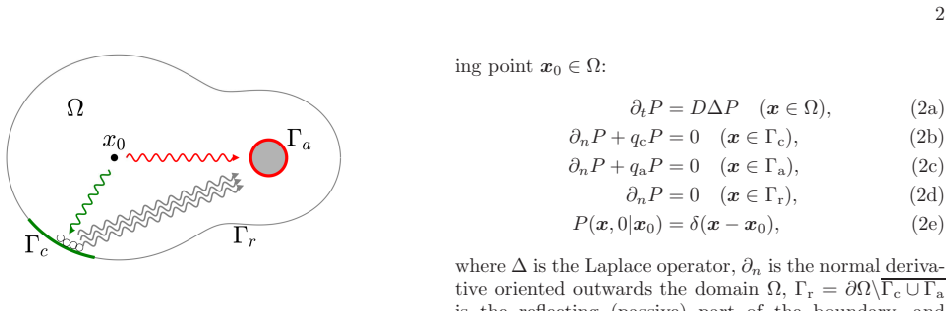
averages over all possible splitting times t′ ∈ (0, t ) and all possible splitting loca- tions x ∈ Γ c. Importantly, the factor S2(t − t′|x) in Eq. (6) is not a mean-field closure; it follows exactly from the branching property. The integral equation ( 6) is the first main result of this paper. In analogy to derivations presented in [ 27], one can easily ch...
-
[2]
provides a simple variational interpretation of the search acceler- ation: increasing either the target reactivity or the cat- alytic rate raises the principal eigenvalue, thereby short- ening the characteristic decay time of the survival prob- ability. B. Dual representation As discussed in [ 28] in the context of the population size dynamics, an impleme...
-
[3]
allows one to derive alternative but equivalent integral representations. For this purpose, let us consider the single-particle prop- agator P0(x, t |x0) with Neumann boundary condition on Γ c: ∂tP0 = D∆ P0 (x ∈ Ω) , (22a) ∂nP0 = 0 ( x ∈ Γ c), (22b) ∂nP0 + qaP0 = 0 ( x ∈ Γ a), (22c) ∂nP0 = 0 ( x ∈ Γ r), (22d) P0(x, 0|x0) = δ(x − x0). (22e) In other words,...
-
[4]
(28) The same bound holds for the MFRT (and higher-order moments): Ta(x0) ≤ T (x0) ≤ T0(x0)
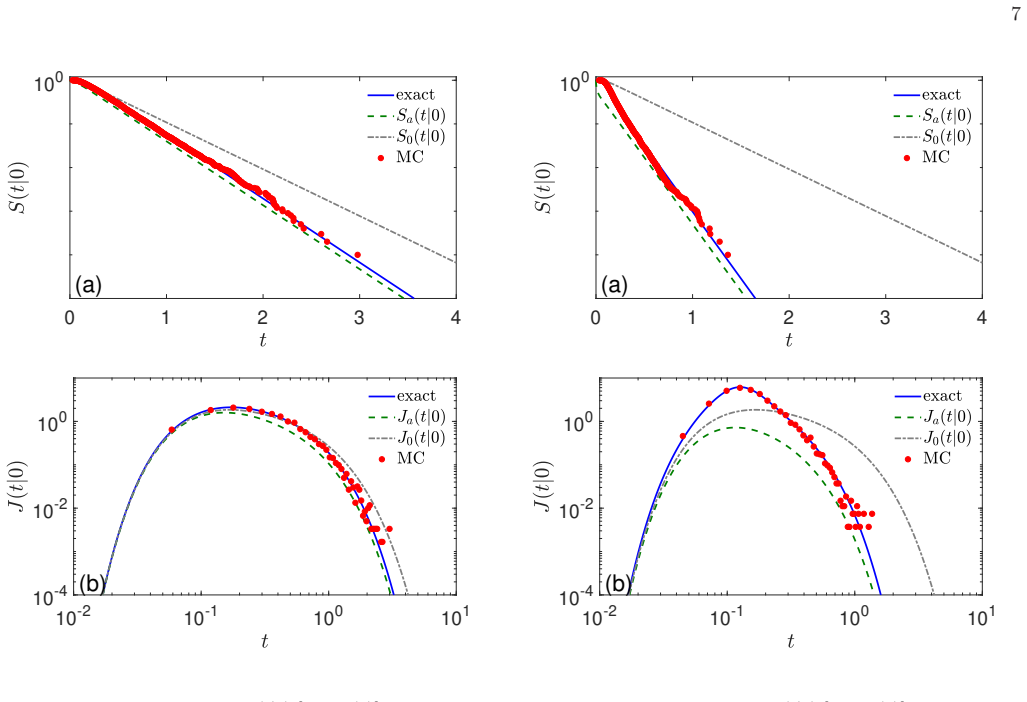
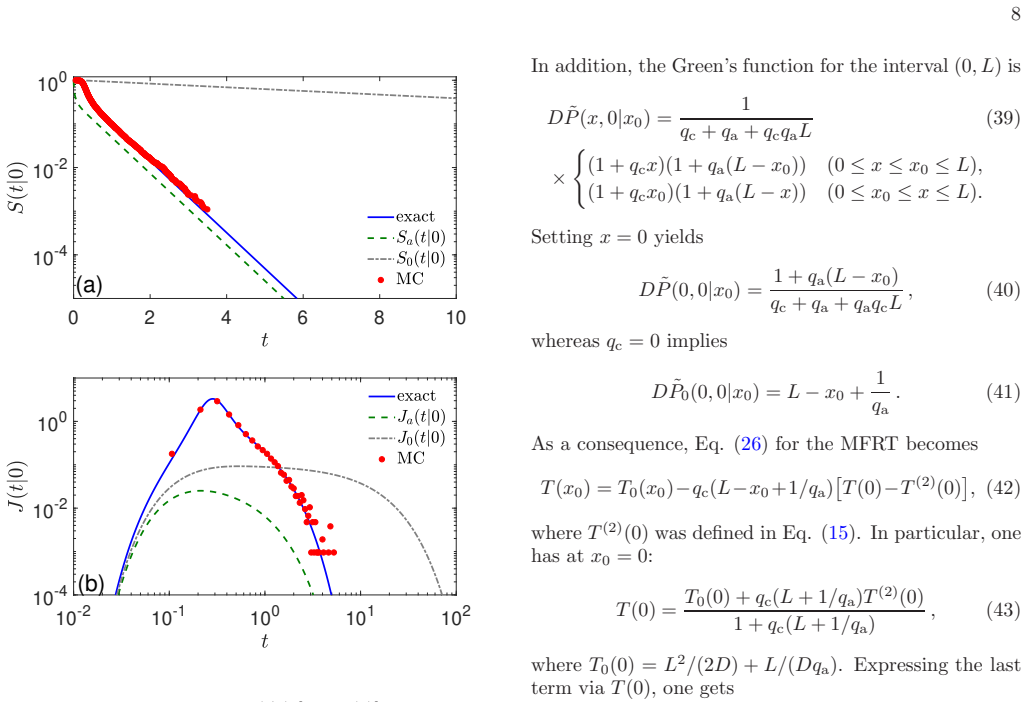
is the two-sided bound on the survival probability: Sa(t|x0) ≤ S(t|x0) ≤ S0(t|x0). (28) The same bound holds for the MFRT (and higher-order moments): Ta(x0) ≤ T (x0) ≤ T0(x0). (29) The upper bound has a simple physical interpreta- tion: autocatalytic replication can only create additional searchers and therefore cannot make the search less effi- cient. In f...
-
[5]
Moreover, one can apply a perturbation approach to get higher-order corrections in terms of S0(t|x0) and P0(x, t |x0)
implies immediately that S0(t|x0) is the leading-order approx- imation for S(t|x0) as qc → 0. Moreover, one can apply a perturbation approach to get higher-order corrections in terms of S0(t|x0) and P0(x, t |x0). Similarly, Eq. ( 26) implies a two-term approximation for the MFRT: T (x0) = T0(x0) − qcD ∫ Γ c dx P0(x, t |x0) × ∞∫ 0 dt ( S0(t|x) − S2 0(t|x) ...
-
[6]
In other words, the properties of the FRT do not almost change when qc crosses the critical value qcrit c
with the rate λ 0, which smoothly depends on the catalytic rate qc (as it fol- lows from the variational principle ( 21)). In other words, the properties of the FRT do not almost change when qc crosses the critical value qcrit c . This apparent paradox has two complementary explanations. (i) In mathematical terms, the long-time behavior of the mean popula...
-
[7]
yields T0(x0) = L2 − x2 0 2D + L Dqa . (38) In addition, the Green’s function for the interval (0 , L ) is D ˜P (x, 0|x0) = 1 qc + qa + qcqaL (39) × { (1 + qcx)(1 + qa(L − x0)) (0 ≤ x ≤ x0 ≤ L), (1 + qcx0)(1 + qa(L − x)) (0 ≤ x0 ≤ x ≤ L). Setting x = 0 yields D ˜P (0, 0|x0) = 1 + qa(L − x0) qc + qa + qaqcL , (40) whereas qc = 0 implies D ˜P0(0, 0|x0) = L ...
-
[8]
When the catalytic rate qc is small, one can use the perturbative approach described in Sec
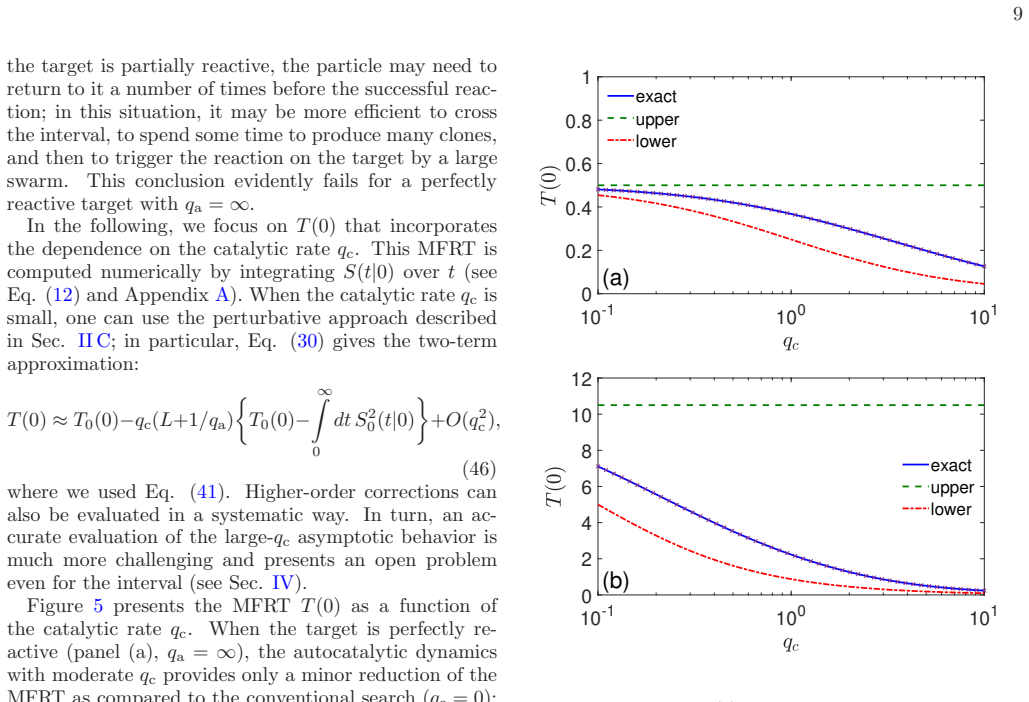
and Appendix A). When the catalytic rate qc is small, one can use the perturbative approach described in Sec. II C; in particular, Eq. ( 30) gives the two-term approximation: T (0) ≈ T0(0)− qc(L+1/q a) { T0(0)− ∞∫ 0 dt S2 0 (t|0) } +O(q2 c ), (46) where we used Eq. ( 41). Higher-order corrections can also be evaluated in a systematic way. In turn, an ac- ...
-
[9]
8 times larger than qaTa(0)
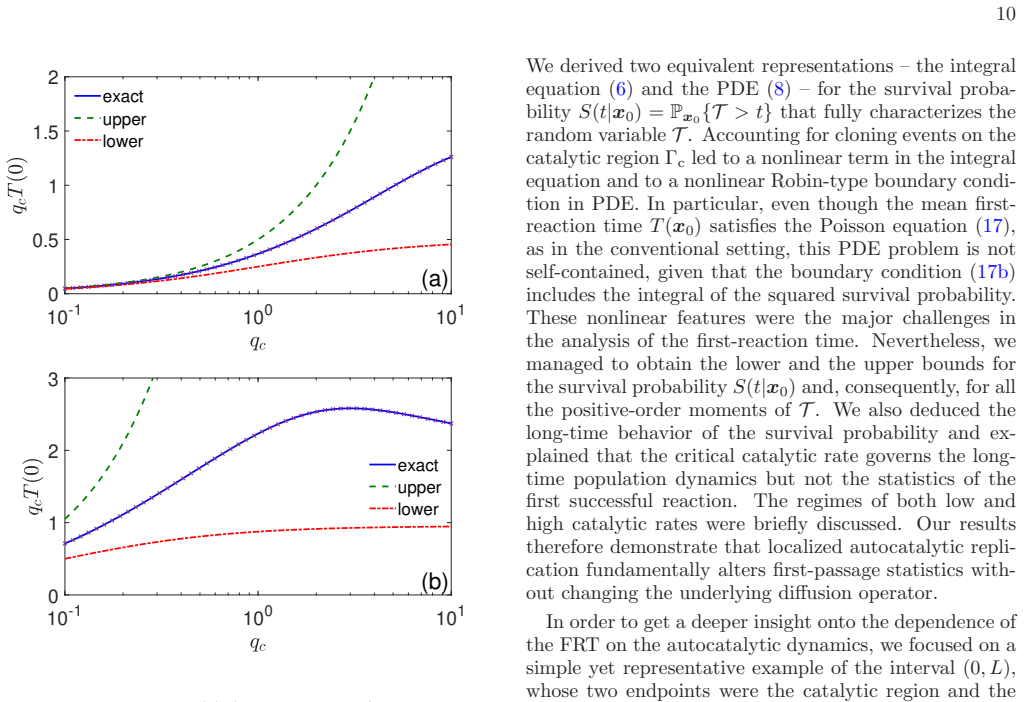
5 − 2. 8 times larger than qaTa(0). This numerical evi- dence suggests that T (0) scales as 1 /q c at large qc, even though finding the precise form of this asymptotic behav- ior remains an interesting open analytical problem (see Sec. IV). IV. DISCUSSION AND CONCLUSION The present work extends classical first-passage theory by incorporating autocatalytic b...
-
[10]
ingredients
and the PDE ( 8) – for the survival proba- bility S(t|x0) = Px0{T > t } that fully characterizes the random variable T . Accounting for cloning events on the catalytic region Γ c led to a nonlinear term in the integral equation and to a nonlinear Robin-type boundary condi- tion in PDE. In particular, even though the mean first- reaction time T (x0) satisfie...
-
[11]
(i) From the population dynamics perspective, the mean number of particles grows exponentially fast, approxi- mately as eq2 c Dt, that prohibits Monte Carlo simulations
are explicitly known, this problem turned out to be surprisingly difficult. (i) From the population dynamics perspective, the mean number of particles grows exponentially fast, approxi- mately as eq2 c Dt, that prohibits Monte Carlo simulations. In this regime, it may be instructive to compare the autocatalytic search to the large- N asymptotic behav- ior o...
-
[12]
(iii) At short times, one has P0(0, t |0) ≈ 1/ √ πDt , so that the integral term is close to the fractional inte- gral operator of order 1 / 2
with large qc via standard quadratures is computationally demand- ing due to the need of using extremely small timesteps, whereas the numerical results are sensitive to round-off errors. (iii) At short times, one has P0(0, t |0) ≈ 1/ √ πDt , so that the integral term is close to the fractional inte- gral operator of order 1 / 2. Its formal inversion allows...
-
[13]
Further analysis of the asymptotic behavior at large qc is an interesting open problem
depends on the entire history, i.e., it is effectively an infinite-dimensional dynamical system, which may exhibit rich dynamical behavior, especially for large q. Further analysis of the asymptotic behavior at large qc is an interesting open problem. Finally, we stress that the considered model of the au- tocatalytic dynamics can naturally be generalized i...
-
[14]
is re- placed by Sm(t|x); moreover, one can randomly pick the branching order ˆm from a given distribution, in which case one deals with the expectation E{S ˆm(t|x)}. (ii) In many applications, the particles have a finite life- time (e.g., radioactive decay), or diffuse in a reactive medium that can spontaneously destroy the particle [ 68– 70]; such “mortal...
2024
-
[15]
Spectral representations The Laplacian eigenvalues and eigenfunctions are λ k = α 2 k/L 2, (A1a) uk(x) = √ 2 L βk ( cos(α kx/L ) + h1 α k sin(α kx/L ) ) , (A1b) where h1 = qcL, h2 = qaL, βk = ( α 2 k α 2 k + h1 + h2 1 + h2(α 2 k + h2 1)/ (α 2 k + h2 2) ) 1/ 2 (A2) 12 are the normalization constants, and α k are the positive solutions of the equation: tan(...
-
[16]
Following [ 28], we introduce p(t) = qcDP0(0, t |0) √ t (A17) to remove the weak square-root singularity of the propa- gator P0(0, t |0) at short times
Quadrature solver We need to solve numerically the nonlinear equation (35) with x0 = 0. Following [ 28], we introduce p(t) = qcDP0(0, t |0) √ t (A17) to remove the weak square-root singularity of the propa- gator P0(0, t |0) at short times. In fact, according to Eq. ( A7), we have p(0) = qc √ D/ √ π . Discretizing the time interval (0, t ) into k subinter...
-
[17]
However, we keep using the above direct scheme even for this equation
is linear with respect to J(t|x0) and can thus be solved by standard deconvolu- tion techniques (e.g., via a discrete FFT transformation). However, we keep using the above direct scheme even for this equation. Here, we simply write J(kδ|0) ≈ J0(kδ|0) + k∑ j=0 wj [ 2S((k − j)δ|0) − 1 ] J((k − j)δ|0)), from which J(kδ|0) ≈ 1 1 + w0(1 − 2S(kδ|0)) [ J0(kδ|0) ...
-
[18]
For this purpose, we discretize the interval with a step a and introduce the associated timestep δ = a2/ (2D) (we set a = 0
Monte Carlo simulations For validation purposes, we also perform independent Monte Carlo simulations of a random walk on the interval (0, L ). For this purpose, we discretize the interval with a step a and introduce the associated timestep δ = a2/ (2D) (we set a = 0. 005). When the particle is on the catalytic site ( x = 0), it can either jump to the neig...
-
[19]
short times
Spectral ODE solver To verify that the numerical solution of the nonlin- ear integral equation is independent of the discretiza- tion strategy, we also implemented an alternative solver based on spectral decomposition. Since both functions Sa(t|0) and P (0, t |0) admit spectral representations, one can reduce the nonlinear integral equation to a system of...
-
[20]
Alberts, D
B. Alberts, D. Bray, J. Lewis, M. Raff, K. Roberts, and J. D. Watson, Molecular Biology of the Cell , 5th Ed. (Gar- land Science, Taylor & Francis Group, New York, 2008). 15
2008
-
[21]
Redner, A Guide to First Passage Processes (Cam- bridge, Cambridge University press, 2001)
S. Redner, A Guide to First Passage Processes (Cam- bridge, Cambridge University press, 2001)
2001
-
[22]
Schuss, Brownian Dynamics at Boundaries and Inter- faces in Physics, Chemistry and Biology (Springer: New York, USA, 2013)
Z. Schuss, Brownian Dynamics at Boundaries and Inter- faces in Physics, Chemistry and Biology (Springer: New York, USA, 2013)
2013
-
[23]
Metzler, G
R. Metzler, G. Oshanin, and S. Redner (Eds), First- Passage Phenomena and Their Applications (Singapore, World Scientific, 2014)
2014
-
[24]
Masoliver, Random Processes: First-passage and Es- cape (World Scientific, 2018)
J. Masoliver, Random Processes: First-passage and Es- cape (World Scientific, 2018)
2018
-
[25]
Lindenberg, R
K. Lindenberg, R. Metzler, and G. Oshanin (Eds), Chem- ical Kinetics: Beyond the Textbook (World Scientific, New Jersey, 2019)
2019
-
[26]
D. S. Grebenkov, R. Metzler, and G. Oshanin (Eds), Target Search Problems (Springer: Cham, Switzerland, 2024)
2024
-
[27]
P. C. Bressloff and J. Newby, Stochastic models of intra- cellular transport, Rev. Mod. Phys. 85, 135-196 (2013)
2013
-
[28]
A. J. Bray, S. N. Majumdar, and G. Schehr, Persis- tence and First-Passage Properties in Non-equilibrium Systems, Adv. Phys. 62, 225-361 (2013)
2013
-
[29]
B´ enichou and R
O. B´ enichou and R. Voituriez, From first-passage times of random walks in confinement to geometry-controlled kinetics, Phys. Rep. 539, 225-284 (2014)
2014
-
[30]
Reynaud, Z
K. Reynaud, Z. Schuss, N. Rouach, and D. Holcman, Why so many sperm cells? Commun. Integr. Biol. 8, e1017156 (2015)
2015
-
[31]
J. Yang, I. Kupka, Z. Schuss, and D. Holcman, Search for a small egg by spermatozoa in restricted geometries, J. Math. Biol. 73, 423-446 (2016)
2016
-
[32]
M. J. Berridge, M. D. Bootman, and H. L Roderick, Cal- cium: calcium signalling: dynamics, homeostasis and re- modelling, Nat. Rev. Mol. Cell Biol. 4, 517 (2003)
2003
-
[33]
M. Reva, D. DiGregorio, and D. S. Grebenkov, A first- passage approach to diffusion-influenced reversible bind- ing and its insights into nanoscale signaling at the presy- napse, Scient. Rep. 11, 5377 (2021)
2021
-
[34]
G. H. Weiss, K. E. Shuler, and K. Lindenberg, Order Statistics for First Passage Times in Diffusion Processes, J. Stat. Phys. 31, 255-278 (1983)
1983
-
[35]
Schuss, K
Z. Schuss, K. Basnayake, and D. Holcman, Redundancy principle and the role of extreme statistics in molecular and cellular biology, Phys. Life Rev. 28, 52-79 (2019)
2019
-
[36]
S. D. Lawley, Distribution of extreme first passage time s of diffusion, J. Math. Biol. 80, 2301-2325 (2020)
2020
-
[37]
S. D. Lawley and J. B. Madrid, A Probabilistic Approach to Extreme Statistics of Brownian Escape Times in Di- mensions 1, 2, and 3, J. Nonlinear. Sci. 30, 1207 (2020)
2020
-
[38]
S. D. Lawley, Universal formula for extreme first passag e statistics of diffusion, Phys. Rev. E 101, 012413 (2020)
2020
-
[39]
S. D. Lawley, Extreme statistics of anomalous subdiffu- sion following a fractional Fokker-Planck equation: subd- iffusion is faster than normal diffusion, J. Phys. A: Math. Theor. 53, 385005 (2020)
2020
-
[40]
S. D. Lawley, Extreme first passage times of piecewise deterministic Markov processes, Nonlinearity 34, 2750 (2021)
2021
-
[41]
D. S. Grebenkov, R. Metzler, and G. Oshanin, Fastest first-passage time for multiple searchers with finite speed (submitted; preprint 2602.15627v1)
-
[42]
D. S. Grebenkov, R. Metzler, and G. Oshanin, From single-particle stochastic kinetics to macroscopic react ion rates: fastest first-passage time of N random walkers, New J. Phys. 22, 103004 (2020)
2020
-
[43]
J. B. Madrid and S. D. Lawley, Competition between slow and fast regimes for extreme first passage times of diffusion, J. Phys. A: Math. Theor. 53, 335002 (2020)
2020
-
[44]
D. S. Grebenkov, R. Metzler, and G. Oshanin, Fastest first-passage time statistics for time-dependent particle injection, Phys. Rev. Res. 7, 023239 (2025)
2025
-
[45]
D. S. Grebenkov and Y. Ye, The geometric control of boundary-catalytic branching processes, J. Chem. Phys. 164, 104106 (2026)
2026
-
[46]
D. S. Grebenkov, Birth, Death, and Repli- cation at Surfaces: Universal Laws of Auto- catalytic Dynamics (submitted; available at https://arxiv.org/abs/2604.21586)
-
[47]
D. S. Grebenkov and Y. Ye, Population dynamics of surface-mediated autocatalytic processes (submitted; available at https://arxiv.org/abs/2606.13498)
-
[48]
D. S. Grebenkov, Paradigm Shift in Diffusion-Mediated Surface Phenomena, Phys. Rev. Lett. 125, 078102 (2020)
2020
-
[49]
C. W. Gardiner, Handbook of stochastic methods for physics, chemistry and the natural sciences (Berlin, Springer, 1985)
1985
-
[50]
Risken, The Fokker-Planck equation: methods of so- lution and applications , 3rd Ed
H. Risken, The Fokker-Planck equation: methods of so- lution and applications , 3rd Ed. (Berlin: Springer, 1996)
1996
-
[51]
Levitin, D
M. Levitin, D. Mangoubi, and I. Polterovich, Topics in Spectral Geometry (Graduate Studies in Mathematics, vol. 237; American Mathematical Society, 2023)
2023
-
[52]
T. E. Harris, The theory of branching processes, GL series 119 (Springer, Berlin 1963)
1963
-
[53]
K. B. Athreya and P. E. Ney, Branching Processes (Springer-Verlag, Berlin, 1972)
1972
-
[54]
M. M. R. Williams, Random Processes in Nuclear Reac- tors (Elsevier, Amsterdam, 2013)
2013
-
[55]
Kimmel and D
M. Kimmel and D. E. Axelrod, Branching Processes in Biology (Springer, New York, 2002)
2002
-
[56]
J. D. Murrey, Mathematical Biology. II. Spatial Models and Biomedical Applications , 3rd Ed. (Springer: Berlin, 2003)
2003
-
[57]
A. N. Kolmogorov and N. A. Dmitriev, Branching stochastic processes, Dokl. Akad. Nauk USSR 56, 7-10 (1947)
1947
-
[58]
B. A. Sevastyanov, Branching stochastic processes for particles diffusing in a restricted domain with absorbing boundaries, Theor. Probab. Appl. 3, 111-126 (1958)
1958
-
[59]
A. V. Skorohod, Branching diffusion processes, Theor. Probab. Appl. 9, 445-449 (1964)
1964
-
[60]
R. A. Fisher, The Wave of Advance of Advantageous Genes, Ann. Eugenics 7, 353-369 (1937)
1937
-
[61]
Kolmogorov, I
A. Kolmogorov, I. Petrovskii, and N. Piskunov, A study of the diffusion equation with increase in the amount of substance, and its application to a biological problem, In V. M. Tikhomirov, editor, Selected Works of A. N. Kolmogorov I, pages 248-270 (Kluwer 1991); Translated by V. M. Volosov from Bull. Moscow Univ., Math. Mech. 1, 1-25 (1937)
1991
-
[62]
Grindrod, The theory and applications of reaction- diffusion equations: Patterns and waves , 2nd Ed
P. Grindrod, The theory and applications of reaction- diffusion equations: Patterns and waves , 2nd Ed. (Ox- ford Applied Mathematics and Computing Science Se- ries; The Clarendon Press, Oxford University Press, New York, 1996)
1996
-
[63]
Le Gall, Spatial branching processes, random snakes, and partial differential equations , Lectures in Mathematics (ETH Zrich, 1999)
J.-F. Le Gall, Spatial branching processes, random snakes, and partial differential equations , Lectures in Mathematics (ETH Zrich, 1999)
1999
-
[64]
E. B. Dynkin, Diffusions, superdiffusions and partial dif- 16 ferential equations (AMS, Providence 2002)
2002
-
[65]
Del Grosso and M
G. Del Grosso and M. Campanino, A Construction of the Stochastic Process Associated to Heat Diffusion in a Polygonal Region, Bollettino U. M. I. 13B, 876-895 (1976)
1976
-
[66]
D. A. Dawson and K. Fleischmann, Catalytic and mutu- ally catalytic branching, WIAS preprint 510 (1999)
1999
-
[67]
Stochastic Models
A. Klenke, A Review on Spatial Catalytic Branching, in L. Gorostiza, G. Ivanoff (Eds.), “Stochastic Models”, A Conference in Honor of Don Dawson, in: Conference Pro- ceedings, vol. 26, Canadian Mathematical Society, Prov- idence, 2000, pp. 245-264
2000
-
[68]
Engl¨ ander and A
J. Engl¨ ander and A. E. Kyprianou, Local extinction ver - sus exponential growth for spatial branching processes, Ann. Probab. 32, 78-99 (2004)
2004
-
[69]
Delmas and P
J.-F. Delmas and P. Vogt, Non-linear Neumann’s con- dition for the heat equation: a probabilistic representa- tion using catalytic super-Brownian motion, Ann. I. H. Poincar´ e PR41, 817-849 (2005)
2005
-
[70]
M¨ orters and P
P. M¨ orters and P. Vogt, A construction of catalytic super- Brownian motion via collision local time, Stoch. Proc. Appl. 115, 77-90 (2005)
2005
-
[71]
Engl¨ ander, Branching diffusions, superdiffusions a nd random media, Probab
J. Engl¨ ander, Branching diffusions, superdiffusions a nd random media, Probab. Surveys 4, 303-364 (2007)
2007
-
[72]
Bocharov and S
S. Bocharov and S. C. Harris, Branching Brownian Mo- tion with Catalytic Branching at the Origin, Acta Appl. Math. 34, 201-228 (2014)
2014
-
[73]
Redner and K
S. Redner and K. Kang, Unimolecular reaction kinetics, Phys. Rev. A 30, 3362(R) (1984)
1984
-
[74]
Albeverio, L
S. Albeverio, L. V. Bogachev, and E. B. Yarovaya, Asymptotics of branching symmetric random walk on the lattice with a single source, C. R. Acad. Sci. Paris Ser. I Math. 326, 975-980 (1998)
1998
-
[75]
L. V. Bogachev and E. B. Yarovaya, A limit theorem for a supercritical branching random walk on Zd with a single source, Russian Math. Surveys 53, 1086-1088 (1998)
1998
-
[76]
Kesten and V
H. Kesten and V. Sidoravicius, Branching Random Walk with Catalysts, Electron. J. Probab. 8, 1-51 (2003)
2003
-
[77]
V. A. Vatutin, V. A. Topchii, and E. B. Yarovaya, Cat- alytic branching random walk and queueing systems with random number of independent servers, Theory Prob. Math. Stat. 69, 1-15 (2004)
2004
-
[78]
Vatutin and J
V. Vatutin and J. Xiong, Some Limit Theorems for a Particle System of Single Point Catalytic Branching Ran- dom Walks, Acta Math. Sinica, Engl. Series 23, 997-1012 (2007)
2007
-
[79]
Y. Hu, V. Vatutin, and V. Topchii, Branching random walk in Z4 with branching at the origin only, Theory Probab. Appl. 56, 193-212 (2012)
2012
-
[80]
V. A. Topchi and V. A. Vatutin, Catalytic Branching Random Walks in Zd with Branching at the Origin, Siberian Adv. Math. 23, 123-153 (2013)
2013
discussion (0)
Sign in with ORCID, Apple, or X to comment. Anyone can read and Pith papers without signing in.