REVIEW 2 major objections 1 minor 76 references
Weakly Supervised Camouflaged Object Detection Based on the SAM Model and Mask Guidance
T0 review · 2 major / 1 minor · reviewed 2026-06-29 · grok-4.3
Pith's one-line read Mask-guided network trained on SAM pseudo-labels from boxes matches state-of-the-art in camouflaged detection
desk verdict This paper describes a SAM-prompted pseudo-label pipeline plus custom modules for weakly supervised camouflaged detection, but the abstract supplies no metrics to support the competitive-performance claim. read the letter →
The pith
A machine-rendered reading of the paper's core claim, the machinery that carries it, and where it could break.
The reading
What carries the argument
MGNet, which uses initial masks from the Cascaded Mask Decoder to guide segmentation and enhance edge predictions, combined with BoxSAM for pseudo-label generation.
What would settle it
An experiment retraining the network with the generated pseudo-labels and measuring its performance on standard camouflaged object detection test sets, finding it significantly below fully supervised baselines, would falsify the central claim.
Extended reading notes
Core claim
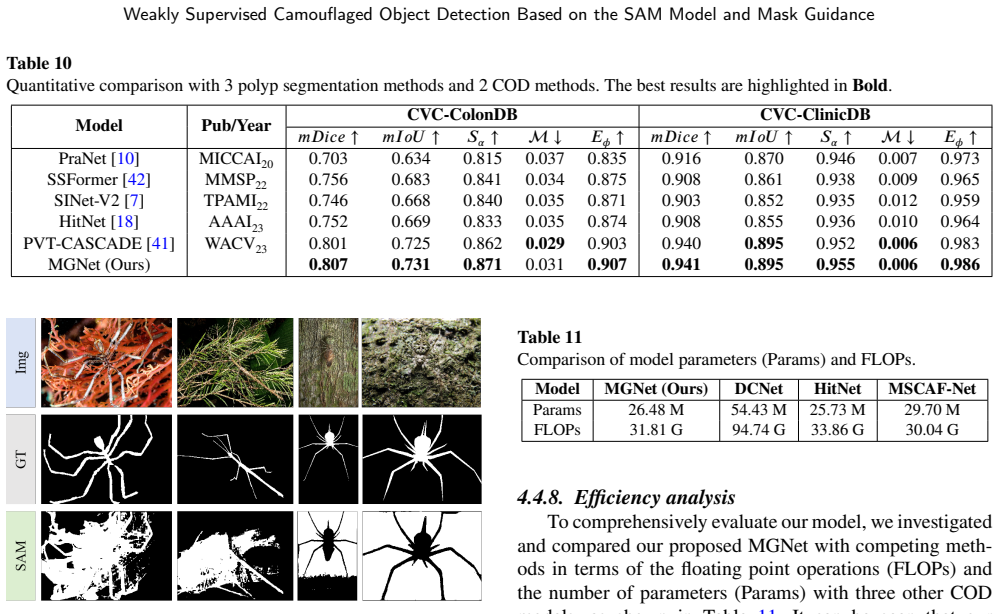
The central claim is that BoxSAM generates high quality pixel-level pseudo-labels by leveraging the Segment Anything Model with bounding-box prompts and redundant processing, allowing MGNet to be trained effectively. MGNet tackles edge ambiguity and missed detections by utilizing initial masks from the Cascaded Mask Decoder to guide the segmentation process, incorporates a Context Enhancement Module to reduce missing detections, and a Mask-guided Feature Aggregation Module for effective feature aggregation, delivering competitive performance against current state-of-the-art methods.
Load-bearing premise
The pseudo-labels generated by BoxSAM using bounding-box prompts and redundant processing are of sufficient quality to train MGNet without the performance degradation typically seen in weakly supervised methods.
Editorial extensions
If this is right
- The method delivers competitive performance against current state-of-the-art methods.
- It provides high quality pixel-level pseudo-labels for training without typical weak supervision degradation.
- The Context Enhancement Module reduces missed detections.
- The Mask-guided Feature Aggregation Module enables effective feature aggregation.
Reading between the lines
- The success with bounding box prompts suggests SAM's versatility in generating labels for other detection domains.
- Redundant processing could be a general technique to boost pseudo-label quality in prompt-based systems.
Editorial analysis
A structured set of objections, weighed in public.
Referee Report
Summary. The paper proposes a weakly supervised camouflaged object detection method called MGNet. It generates pixel-level pseudo-labels via BoxSAM (SAM prompted by bounding boxes with a redundant processing strategy) and trains MGNet using initial masks from a Cascaded Mask Decoder (CMD) to guide segmentation, a Context Enhancement Module (CEM) to mitigate missed detections, and a Mask-guided Feature Aggregation Module (MFAM) for feature aggregation. The central claim is that this pipeline overcomes limitations of coarse annotations in weakly supervised COD and achieves competitive performance versus state-of-the-art methods.
Significance. If the empirical results hold, the work could demonstrate a practical route to high-quality pseudo-labels for COD by combining SAM with redundant box prompting, potentially lowering annotation costs while addressing edge ambiguity and missed detections. The modular design (CMD/CEM/MFAM) offers reusable components for mask-guided segmentation.
major comments (2)
- [Abstract] Abstract: the claim that the method 'delivers competitive performance against current state-of-the-art methods' and supplies 'high quality pixel-level pseudo-labels' is unsupported by any quantitative metrics, tables, baselines, or ablation results. Without these data it is impossible to assess whether the central empirical claim holds.
- [Abstract / Method description] The weakest assumption—that pseudo-labels from BoxSAM and the CMD initial masks are of sufficient quality to avoid the performance degradation typical of weakly supervised methods—requires explicit validation. No comparison to fully supervised upper bounds or to other box-supervised baselines is referenced in the provided text.
minor comments (1)
- [Abstract] Abstract: 'Context Enhancement Module(CEM)' is missing a space before the parenthesis.
Simulated Author's Rebuttal
We thank the referee for the constructive feedback on our manuscript. We address each major comment point by point below, indicating where revisions will be made to strengthen the presentation of results and validation.
read point-by-point responses
-
Referee: [Abstract] Abstract: the claim that the method 'delivers competitive performance against current state-of-the-art methods' and supplies 'high quality pixel-level pseudo-labels' is unsupported by any quantitative metrics, tables, baselines, or ablation results. Without these data it is impossible to assess whether the central empirical claim holds.
Authors: The abstract summarizes findings from the experimental section (Section 4), which contains quantitative tables, baseline comparisons, and ablation studies supporting the performance claims and pseudo-label quality. To improve self-containment and address the concern directly, we will revise the abstract to include key quantitative metrics (e.g., specific mIoU or F-measure values) and explicit references to the relevant tables and figures. revision: yes
-
Referee: [Abstract / Method description] The weakest assumption—that pseudo-labels from BoxSAM and the CMD initial masks are of sufficient quality to avoid the performance degradation typical of weakly supervised methods—requires explicit validation. No comparison to fully supervised upper bounds or to other box-supervised baselines is referenced in the provided text.
Authors: We agree that explicit validation of pseudo-label quality through comparisons would strengthen the manuscript. The current work emphasizes comparisons against state-of-the-art weakly supervised COD methods, but we will add comparisons to fully supervised upper bounds and additional box-supervised baselines in the revised experiments section, along with an analysis quantifying any performance gap attributable to the pseudo-labels. revision: yes
Circularity Check
No significant circularity detected
full rationale
The paper describes an empirical pipeline (BoxSAM pseudo-label generation via SAM with bounding-box prompts and redundant processing, followed by MGNet training with CMD, CEM, and MFAM modules) and asserts competitive results on experiments. No equations, fitted parameters, derivations, uniqueness theorems, or self-citation chains appear in the provided text. All load-bearing claims reduce to standard architectural choices and external empirical validation rather than any self-referential reduction by construction.
Assumptions & free parameters
Cite this review
Pith. "Pith review of Weakly Supervised Camouflaged Object Detection Based on the SAM Model and Mask Guidance." pith.science (2026). https://pith.science/paper/MS2BSM7W
@misc{pith2026260525385,
  author       = {Pith},
  title        = {Pith review of: Weakly Supervised Camouflaged Object Detection Based on the SAM Model and Mask Guidance},
  year         = {2026},
  howpublished = {\url{https://pith.science/paper/MS2BSM7W}},
  note         = {Machine review of arXiv:2605.25385}
}
read the original abstract
Camouflaged object detection (COD) from a single image is a challenging task due to the high similarity between objects and their surroundings. Existing fully supervised methods require labor-intensive pixel-level annotations, making weakly supervised methods a viable compromise that balances accuracy and annotation efficiency. However, weakly supervised methods often experience performance degradation due to the use of coarse annotations. In this paper, we introduce a new weakly supervised approach for camouflaged object detection to overcome these limitations. Specifically, we propose a novel network, MGNet, which tackles edge ambiguity and missed detections by utilizing initial masks generated by our custom-designed Cascaded Mask Decoder (CMD) to guide the segmentation process and enhance edge predictions. We introduce a Context Enhancement Module(CEM) to reduce the missing detection, and a Mask-guided Feature Aggregation Module (MFAM) for effective feature aggregation. For the weak supervision challenge, we propose BoxSAM, which leverages the Segment Anything Model (SAM) with bounding-box prompts to generate pseudo-labels. By employing a redundant processing strategy, high quality pixel-level pseudo-labels are provided for training MGNet. Extensive experiments demonstrate that our method delivers competitive performance against current state-of-the-art methods.
Figures


Figures from the paper (11 more)




Reference graph
Works this paper leans on
-
[1]
What’s the point: Semantic segmentation with point supervision, in: Euro- pean conference on computer vision, Springer
Bearman, A., Russakovsky, O., Ferrari, V., Fei-Fei, L., 2016. What’s the point: Semantic segmentation with point supervision, in: Euro- pean conference on computer vision, Springer. pp. 549–565
2016
-
[2]
Wm-dova maps for accurate polyp highlightingincolonoscopy:Validationvs.saliencymapsfromphysi- cians
Bernal, J., Sánchez, F.J., Fernández-Esparrach, G., Gil, D., Ro- dríguez, C., Vilariño, F., 2015. Wm-dova maps for accurate polyp highlightingincolonoscopy:Validationvs.saliencymapsfromphysi- cians. Computerized medical imaging and graphics 43, 99–111
2015
-
[3]
Ma-sam: Modality-agnostic sam adaptation for 3d medical image segmentation
Chen, C., Miao, J., Wu, D., Zhong, A., Yan, Z., Kim, S., Hu, J., Liu, Z., Sun, L., Li, X., et al., 2024a. Ma-sam: Modality-agnostic sam adaptation for 3d medical image segmentation. Medical Image Analysis , 103310
-
[4]
Sam-cod: Sam-guided unified framework for weakly-supervised camouflaged object detec- tion
Chen, H., Wei, P., Guo, G., Gao, S., 2024b. Sam-cod: Sam-guided unified framework for weakly-supervised camouflaged object detec- tion. European Conference on Computer Vision
-
[5]
Chen, L.C., Papandreou, G., Kokkinos, I., Murphy, K., Yuille, A.L.,
-
[6]
IEEE transactions on pattern analysis and machine intelligence 40, 834– 848
Deeplab: Semantic image segmentation with deep convo- lutional nets, atrous convolution, and fully connected crfs. IEEE transactions on pattern analysis and machine intelligence 40, 834– 848
-
[7]
Diffusion model for camouflaged object detection, in: ECAI 2023
Chen, Z., Gao, R., Xiang, T.Z., Lin, F., 2023. Diffusion model for camouflaged object detection, in: ECAI 2023. IOS Press, pp. 445– 452
2023
-
[8]
Concealed object detection
Fan, D.P., Ji, G.P., Cheng, M.M., Shao, L., 2021. Concealed object detection. IEEE transactions on pattern analysis and machine intelli- gence 44, 6024–6042
2021
Show all 76 references
-
[9]
Camouflaged object detection, in: Proceedings of the IEEE/CVF conference on computer vision and pattern recognition, pp
Fan, D.P., Ji, G.P., Sun, G., Cheng, M.M., Shen, J., Shao, L., 2020a. Camouflaged object detection, in: Proceedings of the IEEE/CVF conference on computer vision and pattern recognition, pp. 2777– 2787
-
[10]
Advances in deep concealed scene understanding
Fan, D.P., Ji, G.P., Xu, P., Cheng, M.M., Sakaridis, C., Van Gool, L., 2023. Advances in deep concealed scene understanding. Visual Intelligence 1, 16
2023
-
[11]
Pranet: Parallel reverse attention network for polyp segmen- tation, in: International conference on medical image computing and computer-assisted intervention, Springer
Fan, D.P., Ji, G.P., Zhou, T., Chen, G., Fu, H., Shen, J., Shao, L., 2020b. Pranet: Parallel reverse attention network for polyp segmen- tation, in: International conference on medical image computing and computer-assisted intervention, Springer. pp. 263–273
-
[12]
A robust deep- learning-based detector for real-time tomato plant diseases and pests recognition
Fuentes, A., Yoon, S., Kim, S.C., Park, D.S., 2017. A robust deep- learning-based detector for real-time tomato plant diseases and pests recognition. Sensors 17, 2022
2017
-
[13]
Weakly supervised video salient object detection via point supervi- sion, in: Proceedings of the 30th ACM International Conference on Multimedia, pp
Gao, S., Xing, H., Zhang, W., Wang, Y., Guo, Q., Zhang, W., 2022. Weakly supervised video salient object detection via point supervi- sion, in: Proceedings of the 30th ACM International Conference on Multimedia, pp. 3656–3665
2022
-
[14]
Res2net: A new multi-scale backbone architecture
Gao, S.H., Cheng, M.M., Zhao, K., Zhang, X.Y., Yang, M.H., Torr, P., 2019. Res2net: A new multi-scale backbone architecture. IEEE transactions on pattern analysis and machine intelligence 43, 652– 662
2019
-
[15]
Weakly-supervised concealed object segmentation with sam- basedpseudolabelingandmulti-scalefeaturegrouping
He,C.,Li,K.,Zhang,Y.,Xu,G.,Tang,L.,Zhang,Y.,Guo,Z.,Li,X., 2023a. Weakly-supervised concealed object segmentation with sam- basedpseudolabelingandmulti-scalefeaturegrouping. Advancesin Neural Information Processing Systems 36
-
[16]
Strategic preys make acute predators: Enhancing camouflaged object detectors by generating camouflaged objects, in: International Conference on Learning Representations
He, C., Li, K., Zhang, Y., Zhang, Y., Guo, Z., Li, X., Danelljan, M., Yu, F., 2024. Strategic preys make acute predators: Enhancing camouflaged object detectors by generating camouflaged objects, in: International Conference on Learning Representations
2024
-
[17]
Weakly-supervisedcam- ouflaged object detection with scribble annotations, in: Proceedings of the AAAI Conference on Artificial Intelligence, pp
He,R.,Dong,Q.,Lin,J.,Lau,R.W.,2023b. Weakly-supervisedcam- ouflaged object detection with scribble annotations, in: Proceedings of the AAAI Conference on Artificial Intelligence, pp. 781–789
-
[18]
Detection of the mobile object with camouflage color under dynamic background based on optical flow
Hou, J.Y.Y.H.W., Li, J., 2011. Detection of the mobile object with camouflage color under dynamic background based on optical flow. Procedia Engineering 15, 2201–2205
2011
-
[19]
High-resolutioniterativefeedbacknetworkforcamouflaged object detection, in: Proceedings of the AAAI Conference on Artifi- cial Intelligence, pp
Hu, X., Wang, S., Qin, X., Dai, H., Ren, W., Luo, D., Tai, Y., Shao, L.,2023. High-resolutioniterativefeedbacknetworkforcamouflaged object detection, in: Proceedings of the AAAI Conference on Artifi- cial Intelligence, pp. 881–889
2023
-
[20]
5557–5566
Huang,Z.,Dai,H.,Xiang,T.Z.,Wang,S.,Chen,H.X.,Qin,J.,Xiong, H.,2023.Featureshrinkagepyramidforcamouflagedobjectdetection with transformers, in: Proceedings of the IEEE/CVF conference on computer vision and pattern recognition, pp. 5557–5566
2023
-
[21]
Kvasir-seg: A segmented polyp dataset, in: MultiMedia modeling: 26th international conference, MMM2020,Daejeon,SouthKorea,January5–8,2020,proceedings, part II 26, Springer
Jha, D., Smedsrud, P.H., Riegler, M.A., Halvorsen, P., De Lange, T., Johansen, D., Johansen, H.D., 2020. Kvasir-seg: A segmented polyp dataset, in: MultiMedia modeling: 26th international conference, MMM2020,Daejeon,SouthKorea,January5–8,2020,proceedings, part II 26, Springer....
2020
-
[22]
Deep gradient learning for efficient camouflaged object detection
Ji, G.P., Fan, D.P., Chou, Y.C., Dai, D., Liniger, A., Van Gool, L., 2023a. Deep gradient learning for efficient camouflaged object detection. Machine Intelligence Research 20, 92–108
-
[23]
segmentanything
Ji, G.P., Fan, D.P., Xu, P., Zhou, B., Cheng, M.M., Van Gool, L., 2023b. Sam struggles in concealed scenes—empirical study on “segmentanything”.ScienceChinaInformationSciences66,226101
-
[24]
Ji,W.,Li,J.,Bi,Q.,Liu,T.,Li,W.,Cheng,L.,2024.Segmentanything is not always perfect: An investigation of sam on different real-world applications
2024
-
[25]
Khan,A.,Khan,M.,Gueaieb,W.,ElSaddik,A.,DeMasi,G.,Karray, F., 2024. Camofocus: Enhancing camouflage object detection with split-featurefocalmodulationandcontextrefinement,in:Proceedings of the IEEE/CVF Winter Conference on Applications of Computer Vision, pp. 1434–1443
2024
-
[26]
Segment anything,in: Proceedingsof theIEEE/CVFInternational Conference on Computer Vision, pp
Kirillov,A.,Mintun,E.,Ravi,N.,Mao,H.,Rolland,C.,Gustafson,L., Xiao, T., Whitehead, S., Berg, A.C., Lo, W.Y., et al., 2023. Segment anything,in: Proceedingsof theIEEE/CVFInternational Conference on Computer Vision, pp. 4015–4026
2023
-
[27]
Anabranch network for camouflaged object segmentation
Le, T.N., Nguyen, T.V., Nie, Z., Tran, M.T., Sugimoto, A., 2019. Anabranch network for camouflaged object segmentation. Computer vision and image understanding 184, 45–56
2019
-
[28]
Visual saliency detection based on multiscale deep cnn features
Li, G., Yu, Y., 2016. Visual saliency detection based on multiscale deep cnn features. IEEE transactions on image processing 25, 5012– 5024
2016
-
[29]
Csrnet: Dilated convolutional neural networks for understanding the highly congested scenes, in: Proceedings of the IEEE conference on computer vision and pattern recognition, pp
Li, Y., Zhang, X., Chen, D., 2018. Csrnet: Dilated convolutional neural networks for understanding the highly congested scenes, in: Proceedings of the IEEE conference on computer vision and pattern recognition, pp. 1091–1100
2018
-
[30]
Tree energy loss: Towards sparsely annotated semantic segmentation, in: Proceedings of the IEEE/CVF conference on computer vision and pattern recognition, pp
Liang, Z., Wang, T., Zhang, X., Sun, J., Shen, J., 2022. Tree energy loss: Towards sparsely annotated semantic segmentation, in: Proceedings of the IEEE/CVF conference on computer vision and pattern recognition, pp. 16907–16916
2022
-
[31]
Searchandrecoverynetworkforcamouflaged object detection
Liu,G.,Wu,W.,2024. Searchandrecoverynetworkforcamouflaged object detection. Image and Vision Computing 151, 105247
2024
-
[32]
Adaptive early-learning correction for segmentation from noisy an- notations,in:ProceedingsoftheIEEE/CVFConferenceonComputer Vision and Pattern Recognition, pp
Liu, S., Liu, K., Zhu, W., Shen, Y., Fernandez-Granda, C., 2022a. Adaptive early-learning correction for segmentation from noisy an- notations,in:ProceedingsoftheIEEE/CVFConferenceonComputer Vision and Pattern Recognition, pp. 2606–2616
-
[33]
Weaklysupervisedsalientobjectdetection via bounding-box annotation and sam model
Liu,X.,Huang,X.,2024. Weaklysupervisedsalientobjectdetection via bounding-box annotation and sam model. Electronic Research Archive 32, 1624–1645. Xia Li et al.:Preprint submitted to ElsevierPage 16 of 18 Weakly Supervised Camouflaged Object Detection Based on the SAM Model an...
2024
-
[34]
Mscaf-net: A general framework for camouflaged object detection via learning multi-scale context-aware features
Liu, Y., Li, H., Cheng, J., Chen, X., 2023. Mscaf-net: A general framework for camouflaged object detection via learning multi-scale context-aware features. IEEE Transactions on Circuits and Systems for Video Technology 33, 4934–4947
2023
-
[35]
Weakly- supervised salient object detection with saliency bounding boxes
Liu, Y., Wang, P., Cao, Y., Liang, Z., Lau, R.W., 2021. Weakly- supervised salient object detection with saliency bounding boxes. IEEE Transactions on Image Processing 30, 4423–4435
2021
-
[36]
Ssfam: Scribble supervised salient object detection family
Liu, Z., Deng, S., Wang, X., Wang, L., Fang, X., Tang, B., 2025. Ssfam: Scribble supervised salient object detection family. IEEE Transactions on Multimedia
2025
-
[37]
Boosting camouflaged object detection with dual-task interactive transformer, in: 2022 26th International Conference on Pattern Recognition (ICPR), IEEE
Liu, Z., Zhang, Z., Tan, Y., Wu, W., 2022b. Boosting camouflaged object detection with dual-task interactive transformer, in: 2022 26th International Conference on Pattern Recognition (ICPR), IEEE. pp. 140–146
2022
-
[38]
Simultaneously localize, segment and rank the camouflaged objects, in:ProceedingsoftheIEEE/CVFconferenceoncomputervisionand pattern recognition, pp
Lv,Y.,Zhang,J.,Dai,Y.,Li,A.,Liu,B.,Barnes,N.,Fan,D.P.,2021. Simultaneously localize, segment and rank the camouflaged objects, in:ProceedingsoftheIEEE/CVFconferenceoncomputervisionand pattern recognition, pp. 11591–11601
2021
-
[39]
Distraction-aware camouflaged object segmentation
Mei, H., Yang, X., Zhou, Y., Ji, G.P., Wei, X., Fan, D., 2023. Distraction-aware camouflaged object segmentation. SCIENTIA SINICA Informationis (SSI) 3, 7
2023
-
[40]
Studyonthe camouflagedtargetdetectionmethodbasedon3dconvexity
Pan,Y.,Chen,Y.,Fu,Q.,Zhang,P.,Xu,X.,etal.,2011. Studyonthe camouflagedtargetdetectionmethodbasedon3dconvexity. Modern Applied Science 5, 152
2011
-
[41]
IEEE transactions on pattern analysis and machine intelligence
Pang,Y.,Zhao,X.,Xiang,T.Z.,Zhang,L.,Lu,H.,2024.Zoomnext:A unified collaborative pyramid network for camouflaged object detec- tion. IEEE transactions on pattern analysis and machine intelligence
2024
-
[42]
Medical image segmentation via cascaded attention decoding, in: Proceedings of the IEEE/CVF Winter Conference on Applications of Computer Vision, pp
Rahman, M.M., Marculescu, R., 2023. Medical image segmentation via cascaded attention decoding, in: Proceedings of the IEEE/CVF Winter Conference on Applications of Computer Vision, pp. 6222– 6231
2023
-
[43]
Ssformer:Alightweighttransformerfor semantic segmentation, in: 2022 IEEE 24th International Workshop on Multimedia Signal Processing (MMSP), IEEE
Shi,W.,Xu,J.,Gao,P.,2022. Ssformer:Alightweighttransformerfor semantic segmentation, in: 2022 IEEE 24th International Workshop on Multimedia Signal Processing (MMSP), IEEE. pp. 1–5
2022
-
[44]
A new camouflage texture evaluation method based on wssim and nature image features, in: 2010 Inter- national conference on multimedia technology, IEEE
Song, L., Geng, W., 2010. A new camouflage texture evaluation method based on wssim and nature image features, in: 2010 Inter- national conference on multimedia technology, IEEE. pp. 1–4
2010
-
[45]
Automated polyp detectionincolonoscopyvideosusingshapeandcontextinformation
Tajbakhsh, N., Gurudu, S.R., Liang, J., 2015. Automated polyp detectionincolonoscopyvideosusingshapeandcontextinformation. IEEE transactions on medical imaging 35, 630–644
2015
-
[46]
Can sam segment anything? when sam meets camouflaged object detection
Tang, L., Xiao, H., Li, B., 2023. Can sam segment anything? when sam meets camouflaged object detection. arXiv preprint arXiv:2304.04709
2023
-
[47]
Wang, L., Lu, H., Wang, Y., Feng, M., Wang, D., Yin, B., Ruan, X.,
-
[48]
Learningtodetectsalientobjectswithimage-levelsupervision, in: Proceedings of the IEEE conference on computer vision and pattern recognition, pp. 136–145
-
[49]
Weakly supervised salient object detection algorithm based on bounding box annotation
WANG, Q., HUANG, X., TONG, Q., LIU, X., 2023. Weakly supervised salient object detection algorithm based on bounding box annotation. Journal of Computer Applications 43, 1910
2023
-
[50]
Salient object detection in the deep learning era: An in-depth survey
Wang,W.,Lai,Q.,Fu,H.,Shen,J.,Ling,H.,Yang,R.,2021a. Salient object detection in the deep learning era: An in-depth survey. IEEE TransactionsonPatternAnalysisandMachineIntelligence44,3239– 3259
-
[51]
Pyramid vision transformer: A versatile backbone for dense prediction without convolutions, in: Proceedings of the IEEE/CVF international conference on computer vision, pp
Wang, W., Xie, E., Li, X., Fan, D.P., Song, K., Liang, D., Lu, T., Luo, P., Shao, L., 2021b. Pyramid vision transformer: A versatile backbone for dense prediction without convolutions, in: Proceedings of the IEEE/CVF international conference on computer vision, pp. 568–578
-
[52]
Pvt v2: Improved baselines with pyramid vision transformer
Wang,W.,Xie,E.,Li,X.,Fan,D.P.,Song,K.,Liang,D.,Lu,T.,Luo, P., Shao, L., 2022. Pvt v2: Improved baselines with pyramid vision transformer. Computational Visual Media 8, 415–424
2022
-
[53]
Ipnet: Polarization-based camouflaged object detection via dual-flow net- work
Wang, X., Ding, J., Zhang, Z., Xu, J., Gao, J., 2024. Ipnet: Polarization-based camouflaged object detection via dual-flow net- work. Engineering Applications of Artificial Intelligence 127, 107303
2024
-
[54]
F 3net:fusion,feedbackandfocus for salient object detection, in: Proceedings of the AAAI conference on artificial intelligence, pp
Wei,J.,Wang,S.,Huang,Q.,2020. F 3net:fusion,feedbackandfocus for salient object detection, in: Proceedings of the AAAI conference on artificial intelligence, pp. 12321–12328
2020
-
[55]
Cbam: Convolutional block attention module, in: Proceedings of the European conference on computer vision (ECCV), pp
Woo, S., Park, J., Lee, J.Y., Kweon, I.S., 2018. Cbam: Convolutional block attention module, in: Proceedings of the European conference on computer vision (ECCV), pp. 3–19
2018
-
[56]
Guided multi-scale refinement network for camouflaged object detection
Xu, X., Chen, S., Lv, X., Wang, J., Hu, X., 2023. Guided multi-scale refinement network for camouflaged object detection. Multimedia Tools and Applications 82, 5785–5801
2023
-
[57]
Boundary guidancenetworkforcamouflageobjectdetection
Xu, X., Zhu, M., Yu, J., Chen, S., Hu, X., Yang, Y., 2021. Boundary guidancenetworkforcamouflageobjectdetection. ImageandVision Computing 114, 104283
2021
-
[58]
Hierarchical saliency detection, in: Proceedings of the IEEE conference on computer vision and pattern recognition, pp
Yan, Q., Xu, L., Shi, J., Jia, J., 2013. Hierarchical saliency detection, in: Proceedings of the IEEE conference on computer vision and pattern recognition, pp. 1155–1162
2013
-
[59]
Camouflaged object segmentation based on matching–recognition–refinement network
Yan, X., Sun, M., Han, Y., Wang, Z., 2023. Camouflaged object segmentation based on matching–recognition–refinement network. IEEE Transactions on Neural Networks and Learning Systems
2023
-
[60]
Saliency detection via graph-based manifold ranking, in: Proceedings of the IEEE conference on computer vision and pattern recognition, pp
Yang, C., Zhang, L., Lu, H., Ruan, X., Yang, M.H., 2013. Saliency detection via graph-based manifold ranking, in: Proceedings of the IEEE conference on computer vision and pattern recognition, pp. 3166–3173
2013
-
[61]
Yang, F., Zhai, Q., Li, X., Huang, R., Luo, A., Cheng, H., Fan, D.P.,
-
[62]
4146–4155
Uncertainty-guided transformer reasoning for camouflaged objectdetection,in:ProceedingsoftheIEEE/CVFinternationalcon- ference on computer vision, pp. 4146–4155
-
[63]
Spatial coherence loss for salient and camouflaged object detection and beyond
Yang, Z., Choy, K., Farsiu, S., 2024. Spatial coherence loss for salient and camouflaged object detection and beyond. arXiv preprint arXiv:2402.18698
2024
-
[64]
Reverse cross-refinement network for camouflaged object detection
Ye, Q., Zhou, Y., Huo, G., Liu, Y., Zhou, Y., Li, Q., 2024. Reverse cross-refinement network for camouflaged object detection. Image and Vision Computing 150, 105218
2024
-
[65]
Camoformer: Masked separable attention for camouflagedobjectdetection
Yin, B., Zhang, X., Fan, D.P., Jiao, S., Cheng, M.M., Van Gool, L., Hou, Q., 2024. Camoformer: Masked separable attention for camouflagedobjectdetection. IEEETransactionsonPatternAnalysis and Machine Intelligence
2024
-
[66]
Structure-consistent weakly supervised salient object detection with local saliency coher- ence, in: Proceedings of the AAAI conference on artificial intelli- gence, pp
Yu, S., Zhang, B., Xiao, J., Lim, E.G., 2021. Structure-consistent weakly supervised salient object detection with local saliency coher- ence, in: Proceedings of the AAAI conference on artificial intelli- gence, pp. 3234–3242
2021
-
[67]
Exploring deeper! segment anything model with depth perception for camou- flaged object detection, in: Proceedings of the 32nd ACM Interna- tional Conference on Multimedia, pp
Yu, Z., Zhang, X., Zhao, L., Bin, Y., Xiao, G., 2024. Exploring deeper! segment anything model with depth perception for camou- flaged object detection, in: Proceedings of the 32nd ACM Interna- tional Conference on Multimedia, pp. 4322–4330
2024
-
[68]
Dual-constraint coarse-to-fine network for camouflaged object detection
Yue, G., Xiao, H., Xie, H., Zhou, T., Zhou, W., Yan, W., Zhao, B., Wang, T., Jiang, Q., 2023. Dual-constraint coarse-to-fine network for camouflaged object detection. IEEE Transactions on Circuits and Systems for Video Technology
2023
-
[69]
Weakly- supervised salient object detection via scribble annotations, in: Pro- ceedingsoftheIEEE/CVFconferenceoncomputervisionandpattern recognition, pp
Zhang, J., Yu, X., Li, A., Song, P., Liu, B., Dai, Y., 2020. Weakly- supervised salient object detection via scribble annotations, in: Pro- ceedingsoftheIEEE/CVFconferenceoncomputervisionandpattern recognition, pp. 12546–12555
2020
-
[70]
Learning camouflaged object detection from noisy pseudo label, in: European Conference on Computer Vision, Springer
Zhang, J., Zhang, R., Shi, Y., Cao, Z., Liu, N., Khan, F.S., 2025. Learning camouflaged object detection from noisy pseudo label, in: European Conference on Computer Vision, Springer. pp. 158–174
2025
-
[71]
Image super-resolutionusingverydeepresidualchannelattentionnetworks, in: Proceedings of the European conference on computer vision (ECCV), pp
Zhang, Y., Li, K., Li, K., Wang, L., Zhong, B., Fu, Y., 2018. Image super-resolutionusingverydeepresidualchannelattentionnetworks, in: Proceedings of the European conference on computer vision (ECCV), pp. 286–301
2018
-
[72]
Zhang,Y.,Zhou,T.,Wang,S.,Liang,P.,Zhang,Y.,Chen,D.Z.,2023. Input augmentation with sam: Boosting medical image segmentation with segmentation foundation model, in: International Conference on Medical Image Computing and Computer-Assisted Intervention, Springer. pp. 129–139
2023
-
[73]
IEEEtransactions on image processing 30, 1949–1961
Zhang,Z.,Lin,Z.,Xu,J.,Jin,W.D.,Lu,S.P.,Fan,D.P.,2021.Bilateral attentionnetworkforrgb-dsalientobjectdetection. IEEEtransactions on image processing 30, 1949–1961. Xia Li et al.:Preprint submitted to ElsevierPage 17 of 18 Weakly Supervised Camouflaged Object Detection Based on ...
2021
-
[74]
Focusdiffuser: Perceiving local disparities for camouflaged object detection, in: European Conference on Computer Vision, Springer
Zhao,J.,Li,X.,Yang,F.,Zhai,Q.,Luo,A.,Jiao,Z.,Cheng,H.,2024. Focusdiffuser: Perceiving local disparities for camouflaged object detection, in: European Conference on Computer Vision, Springer. pp. 181–198
2024
-
[75]
Bilateral reference for high-resolution dichotomous image segmentation
Zheng, P., Gao, D., Fan, D.P., Liu, L., Laaksonen, J., Ouyang, W., Sebe, N., 2024. Bilateral reference for high-resolution dichotomous image segmentation. CAAI Artificial Intelligence Research 3
2024
-
[76]
I can find you! boundary-guided separated attention network for camouflaged object detection, in: Proceedings of the AAAI conference on artificial intelligence, pp
Zhu, H., Li, P., Xie, H., Yan, X., Liang, D., Chen, D., Wei, M., Qin, J., 2022. I can find you! boundary-guided separated attention network for camouflaged object detection, in: Proceedings of the AAAI conference on artificial intelligence, pp. 3608–3616. Xia Li et al.:Preprin...
2022
Reviewed June 29, 2026 · model on record in the stance chip above.
Discussion (0). Sign in to comment.