REVIEW 3 major objections 5 minor 88 references
Many-body correlations from integral geometry
T0 review · 3 major / 5 minor · reviewed 2026-08-14 · deepseek-v4-flash
Pith's one-line read The paper derives a new morphometric theory that computes hard-sphere pair and triplet correlation functions from the geometry of the solute cluster, and shows it matches simulation.
desk verdict Clean new virial/CS morphometric coefficients with an honest limitation statement; the pair agreement is partly built in and the triplet test is too narrow to settle additivity, but it deserves referee time. read the letter →
The pith
A machine-rendered reading of the paper's core claim, the machinery that carries it, and where it could break.
The reading
What carries the argument
The load-bearing mathematical object is the morphometric ansatz (Eq. 7), justified by Hadwiger's theorem: any functional of a body that is translation/rotation invariant, additive, and continuous is a linear combination of the intrinsic volumes, so the insertion cost $\Delta\Omega$ has exactly the four terms $V,A,C,X$. The new theory's coefficients (Eqs. 18a-c) are obtained by solving the scaled particle relations together with the virial theorem for the contact value. The machinery also includes the canonical parallel-surface relations (Eq. 10), which convert between molecular and solvent-accessible surfaces, and the generalised potential of mean force (Eq. 4), which turns correlation functions into insertion free energies.
What would settle it
Measure the insertion free energy of a hard-sphere trimer by Widom insertion in a simulation at high density and compare it with the value predicted from the four intrinsic volumes using the virial/CS coefficients. If two trimers with the same $(V,A,C,X)$ but different shapes give measurably different insertion costs, or if the cost departs from the linear form at deep supercooling where the point-to-set length exceeds the trimer size, the central ansatz is falsified.
Extended reading notes
Core claim
The central discovery is that the many-body correlations of a hard-sphere liquid can be obtained from integral geometry: the reversible work $\Delta\Omega[K]$ of inserting a solute $K$ is written exactly as $pV[K]+a_2A[K]+a_1C[K]+a_0X[K]$, where $V,A,C,X$ are the four intrinsic volumes. The paper derives the coefficients for a theory it calls virial/CS by demanding that the contact value of $g^{(2)}(\sigma)$ computed from this potential of mean force satisfies the virial theorem exactly, using the Carnahan-Starling pressure as input. Because only the contact value is fixed by construction, the theory's accurate predictions away from contact and at the three-body level are genuine predictions rather than fits. The theory is presented as a generalisation of scaled particle theory, and the paper shows that the classical SPT/PY coefficients and the White Bear II morphometric coefficients emerge as special cases of the same argument. The practical upshot is a route to $g^{(n)}$ for arbitrary local clusters, limited to geometries whose boundary does not self-intersect.
Load-bearing premise
The load-bearing premise is that the insertion free energy is exactly additive: the cost of inserting a many-particle cluster is a single linear combination of the four intrinsic volumes, independent of the cluster's shape details. The paper itself states that additivity is a strong assumption and that it must break down near a critical point and when the liquid's static length scale exceeds the solute size.
Editorial extensions
If this is right
- Pair correlations from virial/CS are accurate for $r<\sqrt{3}\sigma$ in the stable liquid, so the theory provides a predictive alternative to integral-equation closures for hard-sphere fluids at high density.
- Because the same procedure works for any $n$-particle cluster, the theory gives a direct estimate of the concentrations of local structural motifs (e.g., triangles, tetrahedra) in the liquid, which the authors use to study changes approaching dynamical arrest.
- The derivation recovers the classical SPT/PY and SPT/CS (White Bear II) coefficients as special cases, showing that those known theories are particular choices within the same scaled particle framework.
- The theory's validity ends when the solute surface self-intersects, for a pair at $r=\sqrt{3}\sigma$, so correlations at larger separations are outside its scope and require a different treatment.
- The virial/CS theory sacrifices low-density asymptotic accuracy and planar surface tension accuracy relative to SPT/CS, suggesting the latter remains preferable for large solutes with nearly planar surfaces.
Reading between the lines
- A natural test of the additivity assumption is to compute the insertion free energy of compact versus elongated trimers of the same $(V,A,C,X)$ by simulation; if the values differ, the theory's four-term linearity fails even at moderate density.
- The paper's stated breakdown near a critical point and when the static length scale exceeds the solute size implies that the theory will degrade at deep supercooling, where clusters approach the point-to-set length; this could be probed by comparing virial/CS predictions with polydisperse simulations above the freezing density.
- The same geometric route could be extended to Lennard-Jones-type potentials by treating attractions as a perturbation around the hard core, though the closed-form coefficients would likely become numerical integrals.
- The poor planar-limit accuracy of virial/CS hints that a hybrid theory using SPT/CS coefficients for large solutes and virial/CS for small clusters could improve both surface tension and many-body correlations simultaneously.
Signed reviews
Editorial analysis
A structured set of objections, weighed in public.
Referee Report
Summary. The paper develops a morphometric/scaled-particle-theory framework for computing many-body correlation functions in hard-sphere fluids. The authors derive the generalised potential of mean force for n particles in terms of the insertion cost ΔΩ, approximate ΔΩ by a linear combination of the four intrinsic volumes V, A, C, X (the morphometric ansatz), and then construct a new set of thermodynamic coefficients (``virial/CS'') by imposing the exact single-particle conditions, the identity ΔΩ(σ/2)=μ_ex, and the virial-theorem contact value of g(2)(r). They compare the resulting pair and triplet correlation functions with molecular dynamics simulations at η=0.45 and with polydisperse MD above freezing. The central claim is that the new theory accurately predicts two- and three-body correlations in the hard-sphere liquid, and the paper also shows that the classical SPT/PY and SPT/CS (White Bear II) coefficients can be recovered within the same formalism.
Significance. If the claimed predictive accuracy holds, the paper provides a useful and conceptually clean route from scaled particle theory to many-body correlations: the derivation avoids fundamental measure theory, the coefficients are given explicitly, and the geometric decomposition is transparent. The authors are honest about the scope of the approximation, explicitly noting in Section V and Appendix A that the additivity of ΔΩ is a strong assumption and that the ansatz must break down near criticality and when the static length scale exceeds the solute size. The new virial/CS coefficients are a concrete, reproducible result, and the comparison of pair correlations away from contact is a genuine prediction, since only the contact value is fixed by construction. However, the many-body evidence, which is the title-level claim of the paper, rests on a single-density, error-bar-free triplet comparison in which the Kirkwood closure also performs surprisingly well, so the strength of the evidence is currently disproportionate to the strength of the claim.
major comments (3)
- [§IV, Fig. 5] The triplet correlation functions g(3)(r,s,t) are the only unconstrained many-body predictions of the theory, and they are presented at a single density (η=0.45) without error bars on the MD data. The authors themselves state that the Kirkwood closure (Eq. 21), which contains no three-body insertion physics, performs ``surprisingly well'' in both tests. As presented, the data do not show that the morphometric additivity assumption is distinguishable from a much weaker approximation. The central claim of the paper would be substantially strengthened by a quantitative comparison at several densities (including the supercooled regime) with statistical uncertainties, or by an explicit statement that the triplet comparison is illustrative rather than decisive.
- [§IV, Fig. 6] The comparison of the monodisperse virial/CS theory with the 8% polydisperse MD data above freezing is not a controlled test of the theory's suitability for the supercooled regime. Differences between theory and simulation could be attributed to polydispersity, which is known to shift the equation of state and the local structure. If the claim that the theory is ``particularly suited'' to supercooled conditions is retained, the authors should either provide monodisperse supercooled MD data or extend the theory to polydisperse mixtures; otherwise the supercooled-regime claim should be tempered.
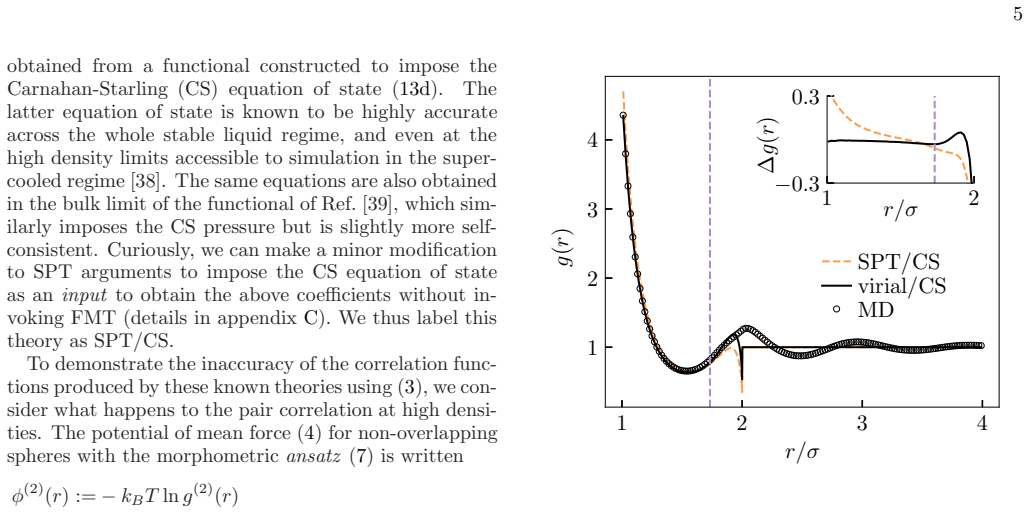
- [§III.C, Eqs. (14)–(17) and Fig. 2] The agreement of the virial/CS contact value with the virial theorem in Fig. 2 is a tautology: Eq. (17) is used to determine the coefficients a0, a1, a2 in Eqs. (18a–c), so the contact point is fixed by construction. This is acknowledged in the text, but the figure and surrounding discussion could give the impression of an independent test. The genuinely unconstrained pair-level prediction is the distance dependence for σ<r<√3σ in Fig. 3, which is currently shown at only one density; additional densities and a quantitative error metric (e.g., mean absolute deviation of g(2)(r) versus MD) would make the claim that the theory ``outperforms SPT/CS even away from contact'' more robust.
minor comments (5)
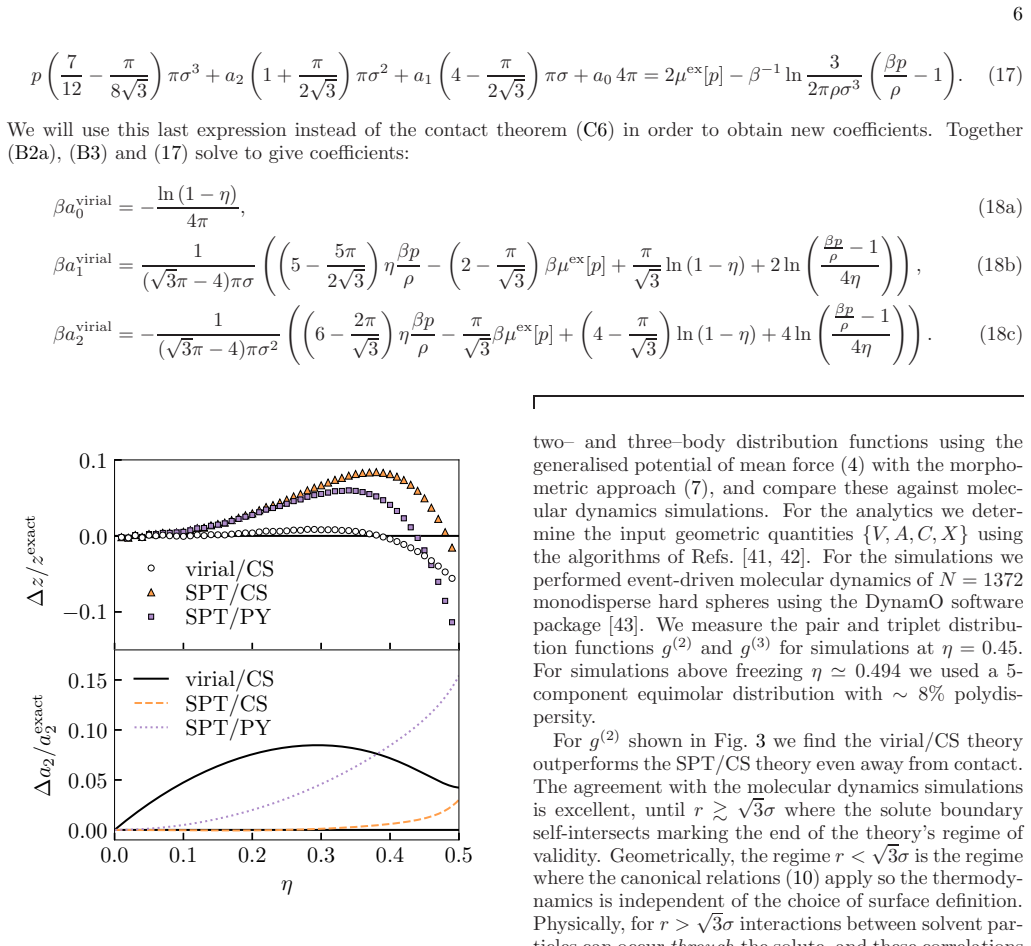
- [§IV, Fig. 4 top panel] Please specify what the ``exact'' values in the top panel refer to (simulation data or a reference equation of state) and define the error metric precisely; currently the text says ``within 10% accuracy'' without stating the norm or averaging procedure.
- [§IV, Fig. 3 inset] The inset legend is not visible in the description; please ensure that the curves in the inset are labelled clearly, and state the density at which the inset is evaluated.
- [§II.A around Eq. (2)] The line ``Changing the summation limits N → N+n'' is slightly opaque; it would help to explicitly write N−n = N' and then rename the dummy index, to make the combinatorial step transparent.
- [§III.D, Eq. (18)] The final coefficients are written in terms of βp/ρ and βμ_ex[p]; it would aid reproducibility to state explicitly that these quantities are evaluated with the Carnahan-Starling equation of state and Eq. (C7), respectively, before the expressions are used in Section IV.
- [§V] The discussion of the breakdown of additivity in the context of the point-to-set length is welcome, but it would be clearer to connect this limitation to the actual solute sizes used in the triplet calculations (triangles with side lengths near σ), so the reader can judge whether the theory is being used inside or outside its stated regime of validity.
Circularity Check
The only by-construction element is the g(2) contact value, which is fixed through Eq. (17); the away-from-contact pair structure and the triplet correlations are genuine, unfitted predictions, so the central many-body claim is not circular.
-
self definitional
[Section III.D, Eq. (17) and Fig. 2]
"We will use this last expression instead of the contact theorem (C6) in order to obtain new coefficients. Together (B2a), (B3) and (17) solve to give coefficients: ... The pair correlation produced by these coefficients (black line in Fig. 2) is self-consistent with CS at contact by construction."
The new virial/CS coefficients (18a-c) are defined as the solution of (B2a), (B3), and (17). Equation (17) is obtained by inserting the two-particle contact geometry into Eq. (14) and equating it to the virial theorem, Eq. (15). Therefore the contact value g(2)(sigma) is an input to the theory rather than an independent prediction; the contact agreement shown in Fig. 2, and the contact point in Fig. 3, are identities by construction. The paper states this explicitly, and the away-from-contact part of g(2)(r) and the triplet g(3) comparisons are not used to set the coefficients, so the circularity is confined to the contact point and does not undermine the central many-body claim.
full rationale
The derivation is largely self-contained. The new coefficients are fixed by three exact hard-sphere conditions: the point-solute limit (B2a), the solute-equals-solvent identity (B3), and the contact virial theorem imposed through Eq. (17). The only element that is circular by construction is the contact value g(2)(sigma), and the paper acknowledges this openly. The genuinely predictive outputs are the full r-dependence of g(2)(r) for r > sigma (Fig. 3), the integrated coordination z(delta), and especially the triplet correlation g(3) (Figs. 5 and 6), none of which were used to fit the coefficients; these are honest out-of-sample tests against external molecular dynamics data. The morphometric ansatz (7) is an explicit assumption, justified via Hadwiger's theorem, an external mathematical result, rather than through a self-citation chain; the citations to prior morphometric work [7, 10-15] serve as accuracy precedents and are not load-bearing for the new derivation. The SPT/CS coefficients are correctly identified as identical to the earlier White Bear II coefficients, so this is a transparent re-derivation, not a disguised tautology. The paper's stated limitations, such as the strong additivity assumption and expected breakdown near criticality, are assumptions about domain of validity rather than circular steps. Overall score 3 reflects the one acknowledged by-construction contact condition; the central many-body prediction stands on independent evidence.
Assumptions & free parameters
assumptions (6)
- domain assumption The insertion cost ΔΩ[K] is a linear combination of intrinsic volumes V, A, C, X (Eq. 7).
- domain assumption The Carnahan-Starling equation of state (Eq. 13d) is accurate up to the highest densities considered, including the supercooled regime.
- standard math The parallel surface relations (Eqs. 10) correctly transform between molecular and excluded-volume geometries for the solutes considered.
- standard math The virial theorem for hard spheres at contact, g(σ) = (3/(2πσ³ρ))(βp/ρ - 1) (Eq. 15), holds.
- standard math The generalized potential distribution theorem (Eq. 2) relating n-particle densities to insertion free energies is valid.
- domain assumption The solute geometry for the triplet (a triangle of hard spheres) is computed correctly by the external algorithms of Refs. [41,42].
Cite this review
Pith. "Pith review of Many-body correlations from integral geometry." pith.science (2026). https://pith.science/paper/MS3ROSGQ
@misc{pith2026190803508,
  author       = {Pith},
  title        = {Pith review of: Many-body correlations from integral geometry},
  year         = {2026},
  howpublished = {\url{https://pith.science/paper/MS3ROSGQ}},
  note         = {Machine review of arXiv:1908.03508}
}
read the original abstract
In a recent letter we presented a framework for predicting the concentrations of many-particle local structures inside the bulk liquid as a route to assessing changes in the liquid approaching dynamical arrest. Central to this framework was the morphometric approach, a synthesis of integral geometry and liquid state theory, which has traditionally been derived from fundamental measure theory. We present the morphometric approach in a new context as a generalisation of scaled particle theory, and derive several morphometric theories for hard spheres of fundamental and practical interest. Our central result is a new theory which is particularly suited to the treatment of many-body correlation functions in the hard sphere liquid, which we demonstrate by numerical tests against simulation.
Figures


Figures from the paper (3 more)


Reference graph
Works this paper leans on
- [44]
-
[1]
(22) Comparison with molecular dynamics simulations in Fig
we find this as [47] C∆ (δ) = 8 π 2 ∫ σ +δ σ ∫ σ +δ σ ∫ σ +δ σ ρ(3)(r, s, t ) rst drdsdt. (22) Comparison with molecular dynamics simulations in Fig. 6 shows similar levels of accuracy for small δ, though the 0 100 g(3)(r, r, r ) virial/CS SPT/CS 0 100 g(3)(σ, r, r ) Kirkwood MD
-
[2]
where Ω is the grand potential of the solvent in the presence of the n-particle inhomogeneity
becomes ρ(n)(rn) = zne−β (Un+Ω −Ω hom). where Ω is the grand potential of the solvent in the presence of the n-particle inhomogeneity. Splitting the chemical potential into its ideal and excess parts so that βµ = ln Λ dρ + βµ ex gives ρ(n)(rn) = ρne−β (Un+Ω −Ω hom−nµ ex). FIG. 1. The system considered for many-body correlations showing (a) the local parti...
-
[3]
is then ∆Ω[ L] = pVL + γ[∂L]A∂ L. (5) The problem of determining the n-particle distributions has been reduced to a solvation problem: we must find the surface tension between a solute (the specific local arrangement) and a solvent (the rest of the liquid). We will use the solute–solvent terminology, but one could also think of local–bulk nomenclature. III....
-
[4]
interspecies
while kinetic theories posit the existence of dynami- cal defects [5]. In a recent letter [6] we proposed a frame- work for treating many-body correlations, and developed an operational scheme for predicting the populations and dynamics of local structural motifs within a uniform liq- uid. Central to this is the use of the morphometric ap- proach. The mor...
-
[5]
We introduce our central ap- proximation in section III A and our choice of surface in III B
to evaluate ∆Ω in ( 4). We introduce our central ap- proximation in section III A and our choice of surface in III B. Then, we show that previous theories fail to pro- duce accurate correlation functions at high densities in III C and derive a new theory to rectify this in III D. A. Our central approximation: the morphometric/scaled particle ansatz Our ke...
-
[6]
before we can proceed. B. Choice of dividing surface All coefficients we give are for the molecular geometry bounded by the molecular surface (∂L1 in Fig. 1b), the surface where interactions occur between the solute and a test particle representing the remaining liquid. However, it is usually more convenient to do calculations with the 4
-
[7]
The key advantage of a geometric expansion of the free energy is that the role of thermodynamics and ge- ometry are kept separate
using integral geometric arguments in appendix A. The key advantage of a geometric expansion of the free energy is that the role of thermodynamics and ge- ometry are kept separate. Thermodynamics only enters through the coefficients {p, a 2, a 1, a 0}, so they can be de- termined in simple geometries to obtain a general theory. As a linear theory, only four...
Show all 88 references
-
[8]
0 0 . 2 0 . 4 0 . 6 η 0 5 10 15 20 g(2)(σ ) − 1 freezing melting virial/CS (this work) SPT/CS SPT/PY 1 2 5 10 20 40 βp/ρ FIG. 2. Contact values of the radial distribution func- tion against volume fraction η and reduced pressure for the hard sphere liquid with (3) and (7) for ...
-
[9]
In appendix B we summarise the classical scaled particle arguments of Refs
or ( 7), a specific theory comprises the set of coefficients {p, a 2, a 1, a 0}. In appendix B we summarise the classical scaled particle arguments of Refs. [16, 24] using modern notation, which produce coefficients βa SPT/ PY 0 = − ln (1 − η) 4π , (12a) βa SPT/ PY 1 = 3η 2πσ (1 − ...
-
[10]
dumbbell
for non-overlapping spheres with the morphometric ansatz (7) is written φ (2)(r) := − kBT ln g(2)(r) =pV (r) + a2A(r) + a1C(r) + a0X(r) − 2µ ex[p]. (14) As a self-consistency test, we will compare this explicit result at contact against the exact value of g(2)(σ ) pre- dicted ...
-
[11]
(16c) Fig
gives the solute parameters as C(σ ) = ( 4 − π 2 √ 3 ) πσ, (16a) A(σ ) = ( 1 + π 2 √ 3 ) πσ 2, (16b) V (σ ) = ( 7 12 − π 8 √ 3 ) πσ 3. (16c) Fig. 2 shows the contact value g(2)(σ ) from inserting the geometric parameters above into ( 14), and the quasi- exact result of ( 15) a...
-
[12]
3 ∆ g(r) FIG. 3. Comparing radial distribution functions of the mor- phometric theories which impose the Carnahan-Starling equ a- tion of state (13d), against results of molecular dynamics (MD) simulations at volume fraction η = 0 . 45. The inset shows the difference between th...
-
[13]
1 ∆ z/z exact virial/CS SPT/CS SPT/PY
-
[14]
0 0 . 1 0 . 2 0 . 3 0 . 4 0 . 5 η
-
[15]
by construction. D. Obtaining the new theory by self-consistency of the contact value of g(2)(r) with the virial theorem Our goal is to develop a morphometric theory which produces accurate correlation functions g(n). As de- scribed at the end of the last section, the correlat...
-
[16]
15 ∆ a2/a exact 2 virial/CS SPT/CS SPT/PY FIG. 4. Errors in different morphometric theories for hard spheres. Top panel: error in the coordination defined in (19) , giving the average number of neighbours in the shell r < 1. 4σ around a particle. Bottom panel: planar surface ten...
-
[17]
is self-consistent with CS at contact by con- struction. IV. NUMERICAL RESULTS We apply the thermodynamic coefficients determined in previous sections for a system of hard spheres to obtain two– and three–body distribution functions using the generalised potential of mean force (
-
[18]
For the analytics we deter- mine the input geometric quantities {V, A, C, X } using the algorithms of Refs
with the morpho- metric approach ( 7), and compare these against molec- ular dynamics simulations. For the analytics we deter- mine the input geometric quantities {V, A, C, X } using the algorithms of Refs. [41, 42]. For the simulations we performed event-driven molecular dyna...
-
[19]
For comparison we also include the tabulated values of Ref
The virial/CS closure most closely matches the simulations at high densities, suggesting the theory is suitable for modeling complex many-particle local structures [6]. For comparison we also include the tabulated values of Ref. [44] where g(3) is used to treat polyatomic mole...
-
[20]
0 1 . 1 1 . 2 1 . 3 1 . 4 r/σ 0 100 g(3)(r, σ, σ ) M&G (1993) r r r σ r r r σ σ FIG. 5. Comparison of predicted correlations for the mor- phometric approaches in triangular geometries, i.e. the fir st correlations beyond the pair level, against molecular dyna m- ics simulations...
1993
-
[21]
performs sur- prisingly well at the three-body level in both of these tests. V. DISCUSSION AND SUMMAR Y We have presented the morphometric approach as a generalisation of SPT, thus placing the scaled particle ansatz on more precise and physically motivated assump- tions i.e. t...
-
[22]
0 0 . 2 0 . 4 0 . 6 η 0 5 10 C∆ (δ = 0. 4σ ) virial/CS SPT/CS Kirkwood MD (mono) MD (poly)
-
[23]
6η 103 g(3)(σ, σ, σ ) FIG
4 0 . 6η 103 g(3)(σ, σ, σ ) FIG. 6. Concentration of triangles in the hard sphere liquid with side lengths r, s, t ∈ [σ, σ + δ] versus volume fraction. Direct measurements by molecular dynamics using a single- component system and an 8% polydisperse system, while the lines sho...
-
[24]
Are invariant with respect to translations and ro- tations
-
[25]
they transform under com- bination of subsystems via the inclusion/exclusion relation e.g
Increase additively, i.e. they transform under com- bination of subsystems via the inclusion/exclusion relation e.g. V [A ∪ B] = V [A] + V [B] − V [A ∩ B], and similar expressions for A, C, and X
-
[26]
Loosely speaking, this means that the size measures converge as the object is ap- proximated by increasingly finely meshed polyhe- dra excluding e.g
Are continuous (specifically with respect to the Hausdorff metric). Loosely speaking, this means that the size measures converge as the object is ap- proximated by increasingly finely meshed polyhe- dra excluding e.g. fractal geometries. As a simple intuitive example, the measure...
-
[27]
In addition to providing a more general ansatz than SPT, this approach lays out its underlying assumptions explic- itly eschewing the ad-hoc way in which the original SPT ansatz (
then follows. In addition to providing a more general ansatz than SPT, this approach lays out its underlying assumptions explic- itly eschewing the ad-hoc way in which the original SPT ansatz (
-
[28]
was obtained. Moreover, classical SPT as- sumes hard spheres from the outset while our generalisa- tion based on integral geometry is more flexible, allowing for generalisations to mixtures, more realistic pair poten- tials and non-spherical particles without compromising its a...
-
[29]
(cf. Ref. [57]), so we have β ( ∂∆Ω ∂R ) µ,V,T ⏐ ⏐ ⏐ ⏐ ⏐ R= σ 2 = β ( ∂Ω ∂R ) µ,V,T ⏐ ⏐ ⏐ ⏐ ⏐ R= σ 2 = 4πσ 2ρ g(2)(σ ). So inserting the SPT ansatz (6) gives πσ 2 p + 4πσ a 2 + 4π a 1 = 4πσ 2ρ β g(2)(σ ). (C5) Inserting the virial theorem ( 15) into the right-hand side of ( C5...
-
[30]
Nonetheless, this self-consistency is a testament to the effectiveness of SPT and related approaches
is in- exact. Nonetheless, this self-consistency is a testament to the effectiveness of SPT and related approaches. Since the pressure is now a known input, the excess chemical potential can be determined by integrating ( C2) i.e. βµ ex[p] = ( βp ρ − 1 ) + ∫ η 0 ( βp ρ − 1 ) dη...
-
[31]
J. G. Kirkwood, J. Chem. Phys. 3, 300 (1935)
1935
-
[32]
R. P. Sear, J. Phys. Condens. Matter 19, 033101 (2007)
2007
-
[33]
Lubchenko and P
V. Lubchenko and P. G. Wolynes, Annu. Rev. Phys. Chem. 58, 235 (2007)
2007
-
[34]
Brito and M
C. Brito and M. Wyart, J. Chem. Phys. 131, 024504 (2009)
2009
-
[35]
Chandler and J
D. Chandler and J. P. Garrahan, Annu. Rev. Phys. Chem. 61, 191 (2010)
2010
-
[36]
J. F. Robinson, F. Turci, R. Roth, and C. P. Royall, Phys. Rev. Lett. 122, 8004 (2019)
2019
-
[37]
K¨ onig, R
P.-M. K¨ onig, R. Roth, and K. R. Mecke, Phys. Rev. Lett. 93, 160601 (2004)
2004
-
[38]
R. Roth, Y. Harano, and M. Kinoshita, Phys. Rev. Lett. 97, 078101 (2006)
2006
-
[39]
Hansen-Goos, R
H. Hansen-Goos, R. Roth, K. R. Mecke, and S. Dietrich, Phys. Rev. Lett. 99, 128101 (2007)
2007
-
[40]
Oettel, H
M. Oettel, H. Hansen-Goos, P. Bryk, and R. Roth, Europhys. Lett. 85, 36003 (2009)
2009
-
[41]
D. J. Ashton, N. B. Wilding, R. Roth, and R. Evans, Phys. Rev. E 84, 061136 (2011)
2011
-
[42]
B. B. Laird, A. Hunter, and R. L. Davidchack, Phys. Rev. E 86, 060602 (2012)
2012
-
[43]
E. M. Blokhuis, Phys. Rev. E 87, 022401 (2013)
2013
-
[45]
Hansen-Goos, J
H. Hansen-Goos, J. Chem. Phys. 141, 171101 (2014)
2014
-
[46]
Reiss, H
H. Reiss, H. L. Frisch, and J. L. Lebowitz, J. Chem. Phys. 31, 369 (1959)
1959
-
[47]
M. S. Wertheim, Phys. Rev. Lett. 10, 321 (1963)
1963
-
[48]
Rosenfeld, Phys
Y. Rosenfeld, Phys. Rev. Lett. 63, 980 (1989)
1989
-
[49]
Reiss, H
H. Reiss, H. L. Frisch, E. Helfand, and J. L. Lebowitz, J. Chem. Phys. 32, 119 (1960)
1960
-
[50]
Helfand, H
E. Helfand, H. Reiss, H. L. Frisch, and J. L. Lebowitz, J. Chem. Phys. 33, 1379 (1960)
1960
-
[51]
Reiss and S
H. Reiss and S. W. Mayer, J. Chem. Phys. 34, 2001 (1961)
1961
-
[52]
Gibbons, Mol
R. Gibbons, Mol. Phys. 17, 81 (1969)
1969
-
[53]
Gibbons, Mol
R. Gibbons, Mol. Phys. 18, 809 (1970)
1970
-
[54]
J. L. Lebowitz, E. Helfand, and E. Praestgaard, J. Chem. Phys. 43, 774 (1965)
1965
-
[55]
F. H. Stillinger, P. G. Debenedetti, and S. Chatterjee, J. Chem. Phys. 125, 204504 (2006)
2006
-
[56]
Chatterjee, P
S. Chatterjee, P. G. Debenedetti, and F. H. Stillinger, J. Chem. Phys. 125, 204505 (2006)
2006
-
[57]
Helfand, H
E. Helfand, H. L. Frisch, and J. L. Lebowitz, J. Chem. Phys. 34, 1037 (1961)
1961
-
[58]
S. C. Martin, B. B. Laird, R. Roth, and H. Hansen-Goos, J. Chem. Phys. 149, 084701 (2018)
2018
-
[59]
Hansen-Goos, J
H. Hansen-Goos, J. Chem. Phys. 150, 011101 (2019)
2019
-
[60]
Hansen-Goos and R
H. Hansen-Goos and R. Roth, J. Phys. Condens. Matter 18, 8413 (2006) . 12
2006
-
[61]
Widom, J
B. Widom, J. Chem. Phys. 39, 2808 (1963)
1963
-
[62]
Widom, J
B. Widom, J. Phys. Chem. 86, 869 (1982)
1982
-
[63]
J. S. Rowlinson and B. Widom, Molecular Theory of Cap- illarity (Dover Publications, 2002)
2002
-
[64]
Hansen and I
J.-P. Hansen and I. R. McDonald, Theory of Simple Liq- uids, 4th ed. (Elsevier, 2013)
2013
-
[65]
Evans, Adv
R. Evans, Adv. Phys. 28, 143 (1979)
1979
-
[66]
L. A. Santal´ o,Integral Geometry and Geometric Proba- bility, 2nd ed., Cambridge Mathematical Library (Cam- bridge University Press, Cambridge, UK ; New York, 2004)
2004
-
[67]
D. A. Klain and G.-C. Rota, Introduction to Geometric Probability, Lezioni Lincee (Cambridge University Press, Cambridge, UK ; New York, 1997)
1997
-
[68]
Berthier, D
L. Berthier, D. Coslovich, A. Ninarello, and M. Ozawa, Phys. Rev. Lett. 116, 238002 (2016)
2016
-
[69]
Santos, Phys
A. Santos, Phys. Rev. E 86, 040102 (2012)
2012
-
[70]
R. L. Davidchack, B. B. Laird, and R. Roth, Mol. Phys. 113, 1091 (2015)
2015
-
[71]
K. R. Mecke, T. Buchert, and H. Wagner, Astron. As- trophys. 288, 697 (1994)
1994
-
[72]
K. V. Klenin, F. Tristram, T. Strunk, and W. Wenzel, J. Comput. Chem. 32, 2647 (2011)
2011
-
[73]
M. N. Bannerman, L. Lue, and L. V. Woodcock, J. Chem. Phys. 132, 084507 (2010)
2010
-
[74]
E. A. M¨ uller and K. E. Gubbins, Mol. Phys. 80, 957 (1993)
1993
-
[75]
Attard and G
P. Attard and G. Stell, Chem. Phys. Lett. 189, 128 (1992)
1992
-
[76]
(A1) of Ref
We believe there is a misprint in Eq. (A1) of Ref. [44], which should read (1 − η)3 in the denominator. We refit- ted their source data [45] with this corrected form to be sure
-
[77]
J. A. Krumhansl and S. S. Wang, J. Chem. Phys. 56, 2034 (1972)
1972
-
[78]
Evans, R
R. Evans, R. Roth, and P. Bryk, Europhys. Lett. EPL 62, 815 (2003)
2003
-
[79]
Evans, J
R. Evans, J. R. Henderson, and R. Roth, J. Chem. Phys. 121, 12074 (2004)
2004
-
[80]
Montanari and G
A. Montanari and G. Semerjian, J. Stat. Phys. 125, 23 (2006)
2006
-
[81]
Yaida, L
S. Yaida, L. Berthier, P. Charbonneau, and G. Tarjus, Phys. Rev. E 94, 032605 (2016)
2016
-
[82]
Hadwiger, Vorlesungen ¨Uber Inhalt, Oberfl¨ ache Und Isoperimetrie (Springer Berlin Heidelberg, Berlin, Hei- delberg, 1957)
H. Hadwiger, Vorlesungen ¨Uber Inhalt, Oberfl¨ ache Und Isoperimetrie (Springer Berlin Heidelberg, Berlin, Hei- delberg, 1957)
1957
-
[83]
R. Roth, R. Evans, A. Lang, and G. Kahl, J. Phys. Condens. Matter 14, 12063 (2002)
2002
-
[84]
N. F. Carnahan and K. E. Starling, J. Chem. Phys. 51, 635 (1969)
1969
-
[85]
Sollich, P
P. Sollich, P. B. Warren, and M. E. Cates, in Advances in Chemical Physics , edited by I. Prigogine and S. A. Rice (John Wiley & Sons, Inc., Hoboken, NJ, USA, 2001) pp. 265–336
2001
-
[86]
P. Bryk, R. Roth, K. R. Mecke, and S. Dietrich, Phys. Rev. E 68, 031602 (2003)
2003
-
[87]
J. K. Percus, Phys. Rev. Lett. 8, 462 (1962)
1962
-
[88]
Hansen-Goos and R
H. Hansen-Goos and R. Roth, J. Chem. Phys. 124, 154506 (2006)
2006
Reviewed August 14, 2026 · model on record in the stance chip above.
Discussion (0). Continue with ORCID to comment.