REVIEW 4 major objections 4 minor 53 references
G2PDiffusion: Cross-Species Genotype-to-Phenotype Prediction via Evolutionary Diffusion
T0 review · 4 major / 4 minor · reviewed 2026-08-08 · deepseek-v4-flash
Pith's one-line read The paper claims that a diffusion model can reconstruct an insect's appearance from its DNA barcode and geographic location, using evolutionary alignments and environment context, and can generalize to species without names.
desk verdict Novel diffusion-based G2P pipeline, but MSA retrieval from the training/eval database likely leaks species identity, so the cross-species generalization claim needs tighter controls. read the letter →
The pith
A machine-rendered reading of the paper's core claim, the machinery that carries it, and where it could break.
The reading
What carries the argument
The load-bearing object is the environment-aware MSA conditioner. It works by searching a reference database with MMseqs2, taking the top-m homologous barcodes, tokenizing them as k-mers, and computing a conservation vector that marks columns where all sequences agree. Row attention gates intra-sequence attention by that conservation signal, while column attention gates cross-sequence attention by spherical-coordinate embeddings of latitude and longitude; the sum is normalized and pooled into a genotype-environment representation C. That representation conditions a denoising diffusion model, and a dynamic aligner gφ(Xt,t) adds gradient guidance at each sampling step to keep noisy images close to the DNA embedding. This mechanism is what lets the model translate genotype plus environment into an image.
What would settle it
Re-run the evaluation after deleting the query sequence and all same-species barcodes from the MSA retrieval database, then compare success rates; if the scores fall to the level of the baselines, the evolutionary-signal input was not the active ingredient.
Extended reading notes
Core claim
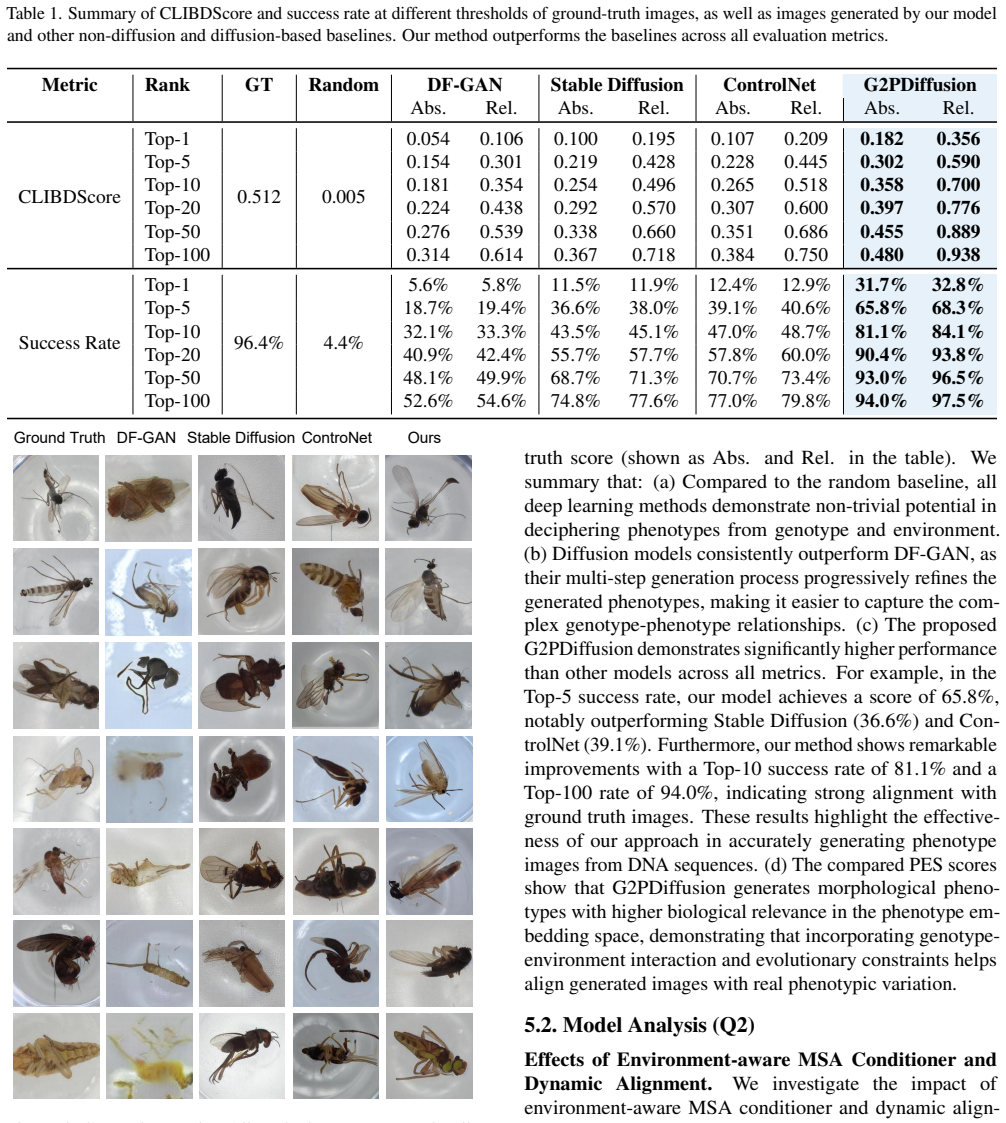
The paper claims that a conditional diffusion model can learn a cross-species genotype-to-phenotype map, taking a DNA barcode and environmental coordinates as input and outputting an image of the organism's morphology. The evolutionary signals are central: retrieved multiple sequence alignments mark conserved and variable positions, and those positions, combined with environment embeddings, condition the diffusion process. The reported result is that G2PDiffusion achieves a top-5 success rate of 65.8% against 36.6% for Stable Diffusion and 39.1% for ControlNet, with higher phenotype embedding similarity at every rank, and that it still outperforms baselines on an unseen set of species without scientific names. The claim is that conserved and co-evolving positions in the MSA, together with environmental context, carry enough information to reconstruct phenotype across species.
Load-bearing premise
The load-bearing premise is that the reference database used for MSA retrieval does not already contain the query barcode or close relatives, because if it does, the model can get the answer by recognizing the species instead of by learning a general genotype-to-phenotype mapping.
Editorial extensions
If this is right
- A single model could generate candidate phenotypes for many species at once, removing the need for per-species labeled training sets.
- Unnamed or under-studied species could receive plausible morphological predictions, supporting biodiversity surveys and conservation triage.
- Because environment is an explicit input, the model can in principle visualize how the same genotype's phenotype changes with geographic location.
- The dynamic alignment module shows that gradient guidance during diffusion can keep generated images consistent with a DNA condition, not just a text condition.
- At top-100 sampling, the reported success rate near 94% on seen species suggests that most candidates preserve the right species-level morphology, making the approach usable for candidate screening.
Reading between the lines
- Extension: before crediting the MSA signal, the retrieval database must be held out by excluding the query and its close relatives; without this control, the high scores could come from nearest-neighbor species lookup.
- Extension: because the main metric reuses a DNA-image embedder trained on the same insect distribution, an independent evaluation with human experts or a separate morphological trait annotation would strengthen the claim.
- Extension: if the method transfers to plants or vertebrates, image-conditioned phenotype prediction could become a screening tool in breeding programs, a direct but untested extrapolation of the cross-species claim.
- Extension: a clean test of the genotype-environment mechanism would be to fix the DNA input and vary only latitude and longitude, or vice versa, and check whether generated morphology shifts in the expected direction.
Editorial analysis
A structured set of objections, weighed in public.
Referee Report
Summary. The paper proposes G2PDiffusion, a conditional diffusion model for cross-species genotype-to-phenotype prediction. The input is a DNA barcode sequence plus geographic coordinates (latitude/longitude); the output is a synthetic morphological image of the corresponding insect specimen. Three components are introduced: an MSA retrieval engine that uses MMseqs2 to fetch homologous sequences from a reference database (Section 3.3); an environment-aware MSA conditioner that produces a GxE representation via row/column attention (Section 3.4); and a dynamic alignment module that guides the reverse diffusion process with a contrastive loss between noisy image embeddings and the GxE representation (Section 3.5). Experiments on BIOSCAN-5M report CLIBDScore, Success Rate, and PES for seen and unseen species, claiming consistent improvements over DF-GAN, Stable Diffusion, and ControlNet. The paper's central claim is that the model learns a generalizable genotype-to-phenotype mapping, not mere retrieval or memorization.
Significance. If the quantitative claims survive scrutiny, the paper introduces a promising reformulation of genotype-to-phenotype prediction as conditional image generation, with a novel use of MSA as evolutionary context and a practical way to exploit large-scale DNA-image datasets. The paper ships a concrete architecture, a clear evaluation protocol, and an interesting biological framing. However, the significance is conditional on three unresolved threats: (1) the MSA retrieval engine may leak species identity through the reference database, (2) the top-n evaluation protocol selects samples using the same metric that is later reported, and (3) the unseen-species evaluation is not demonstrably open-world. These issues bear directly on the claim of cross-species generalization, so the significance is not yet established at the level claimed in Section 5.1 and Section 5.3.
major comments (4)
- [Section 4, 'Implementation details' and Tables 1, 3] The retrieval database used in Eq. (2) is never specified. The only dataset described in Section 4 is BIOSCAN-5M, which is also used for training and evaluation. If the retrieval database contains the query's own barcode or barcodes from the same species, then the MSA condition C in Eq. (6) can encode species or even specimen identity, reducing the method to nearest-neighbor retrieval rather than a learned genotype-to-phenotype mapping. The paper does not state that query sequences or same-species sequences are excluded. This concern is sharpened by Table 5, where m=1 (the nearest-neighbor setting) is best and m=0 is much worse, and by the absence of a k-NN retrieval baseline. Please clarify the composition of the retrieval database, add ablation experiments that exclude the query and all same-species sequences, and report a baseline that simply retrieves the image of the nearest sequence. This control is load-bearing for the central generalization claim of Section 5.3.
- [Section 4, 'Implementation details' and Tables 1, 3] The reported 'top-n' metrics are computed by generating n images per DNA sequence and selecting the one with the highest CLIBDScore, as stated in Section 4: 'we generate n images, compute CLIBDScore, Success Rate, and PES metrics, and record the highest score as the top-n values.' This is test-time optimization with the same metric used for evaluation. As a result, the Top-100 success rate of 94.0% in Table 1 is the probability that at least one of 100 generated samples exceeds the threshold x0, not the success rate of a single prediction. The paper's claim of 'high accuracy and consistency' (Section 5.1) is therefore inflated by sample size. Please report the full score distribution and the success rate for fixed n=1 with no metric-based selection, and separate the selection criterion from the evaluation metric. This is necessary to interpret the comparison against baselines fairly.
- [Section 5.3] The unseen-species evaluation is described as an 'open-world scenario' where species lack scientific names, but these samples are part of BIOSCAN-5M. If the retrieval database is the full BIOSCAN-5M, then queries from the unseen set can retrieve sequences from the same unnamed species or from known species, so the evaluation is not open-world in the sense required to test generalization. The paper does not control for retrieval-set membership or report whether any retrieved sequence shares a species label with the query. Moreover, no experiment isolates the contribution of environmental context: the paper claims that GxE interactions are modeled (Section 3.4), but the environment is only latitude/longitude and there is no ablation showing that varying the environment changes the generated phenotype in a biologically sensible way.
- [Section 3.5, Eq. (13) and Tables 1-3] The dynamic alignment module in Eq. (13) trains a contrastive aligner that pushes noisy image embeddings toward the learned GxE representation C, and this same type of DNA-image alignment is measured by the primary evaluation metric CLIBDScore. While CLIBD is a separately pretrained model and the two are not identical, the sampling-time guidance and the CLIBDScore-based selection both optimize the same semantic alignment objective. The reported improvements over baselines may therefore partially reflect overfitting to an alignment-style objective rather than a generalizable genotype-to-phenotype mapping. Please provide results where the selection among n samples is performed with a different criterion (e.g., PES or random choice) and report the corresponding CLIBDScore and PES. Also, no confidence intervals or significance tests are provided; the tables report single numbers, which is insufficient to judge the stability of the improvements.
minor comments (4)
- [Section 3.4, Eq. (6)] The definition of C in Eq. (6) contains an undefined index j: C = (1/m) * sum_{i=1}^m H^{MSA}_{i,j}. It should be either averaged over the row dimension or written with explicit indexing, e.g., mean over i of H^{MSA}_{i,:}.
- [Section 5.2, Tables 4 and 5] There are typographical errors in Table 4 and Table 5: 'Methood' should be 'Method' and 'relativeness' appears in the text before Table 4. More substantively, the baseline in Table 4 uses DNABERT as the encoder; the paper should state whether this baseline also receives environmental context, because the claim that the conditioner contributes to GxE modeling depends on this.
- [Section 4, Baselines] The adaptation of Stable Diffusion and ControlNet to DNA input is not described. It is unclear how a DNA sequence and geographic coordinates are injected into these models; without this detail, the baseline comparisons are not reproducible.
- [Section 4, Figure 4] The threshold x0 = 0.255 is derived from the training-set score distributions of true and shuffled pairs. Since this threshold is dataset-specific, the Success Rate values are not directly comparable across datasets; please state this limitation explicitly when discussing the absolute success rates.
Circularity Check
No significant circularity; the derivation is self-contained and the reported predictions are not equivalent to the model's inputs by construction.
full rationale
The paper's claimed derivation chain is self-contained. The model is a conditional diffusion generator trained with a standard denoising objective (Eq. 12) plus an auxiliary contrastive alignment loss (Eq. 13) against the learned GxE representation. The evaluation uses CLIBDScore (a pretrained, externally developed model) and PES (a separately trained classifier); neither metric is a parameter fitted by the generation model and renamed as a prediction. The success-rate threshold is calibrated on training-set score distributions, but this is a measurement calibration, not an input to the generator. There are no load-bearing self-citations or imported uniqueness theorems. The MSA retrieval engine (Eq. 2) is a potential source of data leakage if the reference database overlaps the training/evaluation set and queries are not excluded, but that is a benchmarking/validation concern rather than a circularity: the genotype remains the intended input, and the retrieved sequences are not the same object as the predicted image. No step in the derivation makes the prediction equal to the input by definition.
Assumptions & free parameters
free parameters (4)
- Success Rate threshold x0 =
0.255
- Guidance strength w and update rate eta =
not reported
- Number of retrieved MSA sequences m =
1 or 2
- Top-n selection count n =
1, 5, 10, 20, 50, 100
assumptions (4)
- domain assumption The COI mitochondrial barcode (~658bp) contains sufficient information to determine the morphological phenotype of an individual.
- domain assumption Latitude and longitude are a sufficient environmental context for genotype-environment interaction.
- domain assumption The CLIBD model, trained on the same BIOSCAN-5M dataset, provides a valid and unbiased measure of DNA-image semantic similarity.
- domain assumption MMseqs2 retrieval from the reference database (likely BIOSCAN-5M itself) provides evolutionarily informative signal without information leakage from the query or its close relatives.
Cite this review
Pith. "Pith review of G2PDiffusion: Cross-Species Genotype-to-Phenotype Prediction via Evolutionary Diffusion." pith.science (2026). https://pith.science/paper/MS7G22RV
@misc{pith2026250204684,
  author       = {Pith},
  title        = {Pith review of: G2PDiffusion: Cross-Species Genotype-to-Phenotype Prediction via Evolutionary Diffusion},
  year         = {2026},
  howpublished = {\url{https://pith.science/paper/MS7G22RV}},
  note         = {Machine review of arXiv:2502.04684}
}
read the original abstract
Understanding how genes influence phenotype across species is a fundamental challenge in genetic engineering, which will facilitate advances in various fields such as crop breeding, conservation biology, and personalized medicine. However, current phenotype prediction models are limited to individual species and expensive phenotype labeling process, making the genotype-to-phenotype prediction a highly domain-dependent and data-scarce problem. To this end, we suggest taking images as morphological proxies, facilitating cross-species generalization through large-scale multimodal pretraining. We propose the first genotype-to-phenotype diffusion model (G2PDiffusion) that generates morphological images from DNA considering two critical evolutionary signals, i.e., multiple sequence alignments (MSA) and environmental contexts. The model contains three novel components: 1) a MSA retrieval engine that identifies conserved and co-evolutionary patterns; 2) an environment-aware MSA conditional encoder that effectively models complex genotype-environment interactions; and 3) an adaptive phenomic alignment module to improve genotype-phenotype consistency. Extensive experiments show that integrating evolutionary signals with environmental context enriches the model's understanding of phenotype variability across species, thereby offering a valuable and promising exploration into advanced AI-assisted genomic analysis.
Figures


Figures from the paper (3 more)


Reference graph
Works this paper leans on
-
[1]
Jose L Mellina Andreu, Luis Bernal, Antonio F Skarmeta, Mina Ryten, Sara ´Alvarez, Alejandro Cisterna Garc´ıa, and Juan A Bot´ıa. Phenolinker: Phenotype-gene link prediction and explanation using heterogeneous graph neural networks. arXiv preprint arXiv:2402.01809, 2024. 1
work page Pith review arXiv 2024
-
[2]
Machine learning models for phenotype prediction from genotype
Richard Annan, Letu Qingge, and Pei Yang. Machine learning models for phenotype prediction from genotype. In 2023 IEEE 23rd International Conference on Bioinformatics and Bioengineering (BIBE), pages 81–86. IEEE, 2023. 2
work page 2023
-
[3]
Field high-throughput phenotyping: the new crop breeding frontier
Jos´e Luis Araus and Jill E Cairns. Field high-throughput phenotyping: the new crop breeding frontier. Trends in plant science, 19(1):52–61, 2014. 1
work page 2014
-
[4]
Improving image generation with better captions
James Betker, Gabriel Goh, Li Jing, Tim Brooks, Jianfeng Wang, Linjie Li, Long Ouyang, Juntang Zhuang, Joyce Lee, Yufei Guo, et al. Improving image generation with better captions. Computer Science. https://cdn. openai. com/papers/dall-e-3. pdf, 2(3):8, 2023. 3, 5
work page 2023
-
[5]
New technologies to assess genotype– phenotype relationships
Barry R Bochner. New technologies to assess genotype– phenotype relationships. Nature Reviews Genetics, 4(4):309– 314, 2003. 2
work page 2003
-
[6]
Genomic dna k-mer spectra: models and modalities
Benny Chor, David Horn, Nick Goldman, Yaron Levy, and Tim Massingham. Genomic dna k-mer spectra: models and modalities. Genome biology, 10:1–10, 2009. 4
work page 2009
-
[7]
Plant genotype to phenotype prediction using machine learning
Monica F Danilevicz, Mitchell Gill, Robyn Anderson, Jacque- line Batley, Mohammed Bennamoun, Philipp E Bayer, and David Edwards. Plant genotype to phenotype prediction using machine learning. Frontiers in Genetics, 13:822173, 2022. 1, 2
work page 2022
-
[8]
Alexander JM Dingemans, Max Hinne, Kim MG Truijen, Lia Goltstein, Jeroen Van Reeuwijk, Nicole De Leeuw, Jan- neke Schuurs-Hoeijmakers, Rolph Pfundt, Illja J Diets, Joery Den Hoed, et al. Phenoscore quantifies phenotypic variation for rare genetic diseases by combining facial analysis with other clinical features using a machine-learning framework. Nature ...
work page 2023
Show all 53 references
-
[9]
Genotype to phenotype: a complex problem
Robin D Dowell, Owen Ryan, An Jansen, Doris Cheung, Sudeep Agarwala, Timothy Danford, Douglas A Bernstein, P Alexander Rolfe, Lawrence E Heisler, Brian Chin, et al. Genotype to phenotype: a complex problem. Science, 328 (5977):469–469, 2010. 2
2010
-
[10]
The post- gwas era: from association to function
Michael D Gallagher and Alice S Chen-Plotkin. The post- gwas era: from association to function. The American Journal of Human Genetics, 102(5):717–730, 2018. 1
2018
-
[11]
Lowe, ZeMing Gong, Pablo Millan Arias, Nicholas Pellegrino, Austin T
Zahra Gharaee, Scott C. Lowe, ZeMing Gong, Pablo Millan Arias, Nicholas Pellegrino, Austin T. Wang, Joakim Brus- lund Haurum, Iuliia Zarubiieva, Lila Kari, Dirk Steinke, Gra- ham W. Taylor, Paul Fieguth, and Angel X. Chang. Bioscan- 5m: A multimodal dataset for insect biodiver...
2024 arXiv
-
[12]
Wang, Xiaoliang Huo, Joakim Brus- lund Haurum, Scott C
ZeMing Gong, Austin T. Wang, Xiaoliang Huo, Joakim Brus- lund Haurum, Scott C. Lowe, Graham W. Taylor, and Angel X. Chang. Clibd: Bridging vision and genomics for biodiversity monitoring at scale. arXiv preprint arXiv: 2405.17537, 2024. 6
2024
-
[13]
Learned representation-guided diffusion models for large-image generation
Alexandros Graikos, Srikar Yellapragada, Minh-Quan Le, Saarthak Kapse, Prateek Prasanna, Joel Saltz, and Dimitris Samaras. Learned representation-guided diffusion models for large-image generation. In Proceedings of the IEEE/CVF Conference on Computer Vision and Pattern Recogn...
2024
-
[14]
Genome-wide association testing beyond snps
Laura Harris, Ellen M McDonagh, Xiaolei Zhang, Katherine Fawcett, Amy Foreman, Petr Daneck, Panagiotis I Sergounio- tis, Helen Parkinson, Francesco Mazzarotto, Michael Inouye, et al. Genome-wide association testing beyond snps. Nature Reviews Genetics, pages 1–15, 2024. 1
2024
-
[15]
Clipscore: A reference-free evaluation metric for image captioning
Jack Hessel, Ari Holtzman, Maxwell Forbes, Ronan Le Bras, and Yejin Choi. Clipscore: A reference-free evaluation metric for image captioning. Conference on Empirical Methods in Natural Language Processing, 2021. 6
2021
-
[16]
Classifier-free diffusion guidance
Jonathan Ho and Tim Salimans. Classifier-free diffusion guidance. arXiv preprint arXiv:2207.12598, 2022. 5
2022 arXiv
-
[17]
Denoising diffu- sion probabilistic models
Jonathan Ho, Ajay Jain, and Pieter Abbeel. Denoising diffu- sion probabilistic models. Advances in neural information processing systems, 33:6840–6851, 2020. 5
2020
-
[18]
Dnabert: pre-trained bidirectional encoder representations from transformers model for dna-language in genome
Yanrong Ji, Zhihan Zhou, Han Liu, and Ramana V Davuluri. Dnabert: pre-trained bidirectional encoder representations from transformers model for dna-language in genome. Bioin- formatics, 37(15):2112–2120, 2021. 7
2021
-
[19]
Qtl analysis in plants; where are we now? Heredity, 80(2):137–142, 1998
Mike J Kearsey and AGL Farquhar. Qtl analysis in plants; where are we now? Heredity, 80(2):137–142, 1998. 1
1998
-
[20]
A review of statis- tical methods for expression quantitative trait loci mapping
Christina Kendziorski and Ping Wang. A review of statis- tical methods for expression quantitative trait loci mapping. Mammalian genome, 17(6):509–517, 2006. 2
2006
-
[21]
Quantitative trait loci mapping in dairy cattle: review and meta-analysis
Mehar S Khatkar, Peter C Thomson, Imke Tammen, and Herman W Raadsma. Quantitative trait loci mapping in dairy cattle: review and meta-analysis. Genetics selection evolution, 36(2):163–190, 2004. 2
2004
-
[22]
Dif- fusionclip: Text-guided diffusion models for robust image manipulation
Gwanghyun Kim, Taesung Kwon, and Jong Chul Ye. Dif- fusionclip: Text-guided diffusion models for robust image manipulation. In Proceedings of the IEEE/CVF conference on computer vision and pattern recognition, pages 2426–2435,
-
[23]
Adam: A method for stochastic optimization
Diederik P Kingma and Jimmy Ba. Adam: A method for stochastic optimization. arXiv preprint arXiv:1412.6980 ,
-
[24]
Genotypes and phenotypes
Joachim Klose. Genotypes and phenotypes. ELEC- TROPHORESIS: An International Journal, 20(4-5):643–652,
-
[25]
From qtl to gene: the harvest begins
Ron Korstanje and Beverly Paigen. From qtl to gene: the harvest begins. Nature genetics, 31(3):235–236, 2002. 1
2002
-
[26]
Genotype to phenotype: lessons from model organisms for human genetics
Ben Lehner. Genotype to phenotype: lessons from model organisms for human genetics. Nature Reviews Genetics, 14 (3):168–178, 2013. 1
2013
-
[27]
Srdiff: Single image super-resolution with diffusion probabilistic models
Haoying Li, Yifan Yang, Meng Chang, Shiqi Chen, Huajun Feng, Zhihai Xu, Qi Li, and Yueting Chen. Srdiff: Single image super-resolution with diffusion probabilistic models. Neurocomputing, 479:47–59, 2022. 3
2022
-
[28]
Zero- shot medical image translation via frequency-guided diffusion models
Yunxiang Li, Hua-Chieh Shao, Xiao Liang, Liyuan Chen, Ruiqi Li, Steve Jiang, Jing Wang, and You Zhang. Zero- shot medical image translation via frequency-guided diffusion models. IEEE transactions on medical imaging, 2023. 3
2023
-
[29]
Text to image generation with semantic-spatial aware gan
Wentong Liao, Kai Hu, Michael Ying Yang, and Bodo Rosen- hahn. Text to image generation with semantic-spatial aware gan. In Proceedings of the IEEE/CVF conference on com- puter vision and pattern recognition , pages 18187–18196,
-
[30]
Deep neural network prediction of genome-wide transcrip- tome signatures–beyond the black-box
Rasmus Magnusson, Jesper N Tegn´er, and Mika Gustafsson. Deep neural network prediction of genome-wide transcrip- tome signatures–beyond the black-box. NPJ systems biology and applications, 8(1):9, 2022. 2
2022
-
[31]
Qtl mapping in rice
Susan R McCough and Rebecca W Doerge. Qtl mapping in rice. Trends in Genetics, 11(12):482–487, 1995. 1
1995
-
[32]
Personalized medicine: temper expectations
Daniel W Nebert and Ge Zhang. Personalized medicine: temper expectations. Science, 337(6097):910–910, 2012. 1
2012
-
[33]
Glide: Towards photorealistic image generation and editing with text-guided diffusion models
Alex Nichol, Prafulla Dhariwal, Aditya Ramesh, Pranav Shyam, Pamela Mishkin, Bob McGrew, Ilya Sutskever, and Mark Chen. Glide: Towards photorealistic image generation and editing with text-guided diffusion models. arXiv preprint arXiv:2112.10741, 2021. 3, 5
2021 arXiv
-
[34]
Ramesh, Gabriel Goh, Sandhini Agarwal, Girish Sastry, Amanda Askell, Pamela Mishkin, Jack Clark, Gretchen Krueger, and I
Alec Radford, Jong Wook Kim, Chris Hallacy, A. Ramesh, Gabriel Goh, Sandhini Agarwal, Girish Sastry, Amanda Askell, Pamela Mishkin, Jack Clark, Gretchen Krueger, and I. Sutskever. Learning transferable visual models from natural language supervision. International Conference o...
2021
-
[35]
High-resolution image synthesis with latent diffusion models
Robin Rombach, Andreas Blattmann, Dominik Lorenz, Patrick Esser, and Bj ¨orn Ommer. High-resolution image synthesis with latent diffusion models. In Proceedings of the IEEE/CVF conference on computer vision and pattern recognition, pages 10684–10695, 2022. 3, 6
2022
-
[36]
Palette: Image-to-image diffusion models
Chitwan Saharia, William Chan, Huiwen Chang, Chris Lee, Jonathan Ho, Tim Salimans, David Fleet, and Mohammad Norouzi. Palette: Image-to-image diffusion models. In ACM SIGGRAPH 2022 conference proceedings, pages 1–10, 2022. 3
2022
-
[37]
Pho- torealistic text-to-image diffusion models with deep language understanding
Chitwan Saharia, William Chan, Saurabh Saxena, Lala Li, Jay Whang, Emily L Denton, Kamyar Ghasemipour, Raphael Gontijo Lopes, Burcu Karagol Ayan, Tim Salimans, et al. Pho- torealistic text-to-image diffusion models with deep language understanding. Advances in Neural Informati...
2022
-
[38]
Mmseqs2 enables sensitive protein sequence searching for the analysis of mas- sive data sets.Nature biotechnology, 35(11):1026–1028, 2017
Martin Steinegger and Johannes S¨oding. Mmseqs2 enables sensitive protein sequence searching for the analysis of mas- sive data sets.Nature biotechnology, 35(11):1026–1028, 2017. 4
2017
-
[39]
Benefits and limitations of genome-wide association studies
Vivian Tam, Nikunj Patel, Michelle Turcotte, Yohan Boss´e, Guillaume Par´e, and David Meyre. Benefits and limitations of genome-wide association studies. Nature Reviews Genetics, 20(8):467–484, 2019. 1, 2
2019
-
[40]
Plug-and-play diffusion features for text-driven image-to- image translation
Narek Tumanyan, Michal Geyer, Shai Bagon, and Tali Dekel. Plug-and-play diffusion features for text-driven image-to- image translation. In Proceedings of the IEEE/CVF Con- ference on Computer Vision and Pattern Recognition, pages 1921–1930, 2023. 3
1921
-
[41]
Genome- wide association studies
Emil Uffelmann, Qin Qin Huang, Nchangwi Syntia Munung, Jantina De Vries, Yukinori Okada, Alicia R Martin, Hilary C Martin, Tuuli Lappalainen, and Danielle Posthuma. Genome- wide association studies. Nature Reviews Methods Primers, 1 (1):59, 2021. 1, 2
2021
-
[42]
Genotype-environment interac- tion and the evolution of phenotypic plasticity
Sara Via and Russell Lande. Genotype-environment interac- tion and the evolution of phenotypic plasticity. Evolution, 39 (3):505–522, 1985. 2
1985
-
[43]
Five years of gwas discovery
Peter M Visscher, Matthew A Brown, Mark I McCarthy, and Jian Yang. Five years of gwas discovery. The American Journal of Human Genetics, 90(1):7–24, 2012. 1
2012
-
[44]
Lstm autoencoder-based deep neural networks for barley genotype-to-phenotype prediction
Guanjin Wang, Junyu Xuan, Penghao Wang, Chengdao Li, and Jie Lu. Lstm autoencoder-based deep neural networks for barley genotype-to-phenotype prediction. arXiv preprint arXiv:2407.16709, 2024. 1, 2
2024 arXiv
-
[45]
Prediction of plant complex traits via integration of multi-omics data
Peipei Wang, Melissa D Lehti-Shiu, Serena Lotreck, Kenia Segura Ab´a, Patrick J Krysan, and Shin-Han Shiu. Prediction of plant complex traits via integration of multi-omics data. Nature Communications, 15(1):6856, 2024. 2
2024
-
[46]
Imagen editor and editbench: Advancing and evaluating text-guided image inpainting
Su Wang, Chitwan Saharia, Ceslee Montgomery, Jordi Pont- Tuset, Shai Noy, Stefano Pellegrini, Yasumasa Onoe, Sarah Laszlo, David J Fleet, Radu Soricut, et al. Imagen editor and editbench: Advancing and evaluating text-guided image inpainting. In Proceedings of the IEEE/CVF con...
-
[47]
Phenotype—genotype relationships in mono- genic disease: lessons from the thalassaemias
DJ Weatherall. Phenotype—genotype relationships in mono- genic disease: lessons from the thalassaemias. Nature reviews genetics, 2(4):245–255, 2001. 1
2001
-
[48]
Diffusion-based scene graph to image gener- ation with masked contrastive pre-training
Ling Yang, Zhilin Huang, Yang Song, Shenda Hong, Guohao Li, Wentao Zhang, Bin Cui, Bernard Ghanem, and Ming- Hsuan Yang. Diffusion-based scene graph to image gener- ation with masked contrastive pre-training. arXiv preprint arXiv:2211.11138, 2022. 3
2022 arXiv
-
[49]
In- terpreting artificial neural networks to detect genome-wide association signals for complex traits
Burak Yelmen, Maris Alver, Merve Nur G ¨uler, Estonian Biobank Research Team, Flora Jay, and Lili Milani. In- terpreting artificial neural networks to detect genome-wide association signals for complex traits. arXiv preprint arXiv:2407.18811, 2024. 1
2024 arXiv
-
[50]
The historical evolution and significance of multiple sequence alignment in molecular structure and function prediction
Chenyue Zhang, Qinxin Wang, Yiyang Li, Anqi Teng, Gang Hu, Qiqige Wuyun, and Wei Zheng. The historical evolution and significance of multiple sequence alignment in molecular structure and function prediction. Biomolecules, 14(12):1531,
-
[51]
Adding conditional control to text-to-image diffusion models
Lvmin Zhang, Anyi Rao, and Maneesh Agrawala. Adding conditional control to text-to-image diffusion models. In Proceedings of the IEEE/CVF International Conference on Computer Vision, pages 3836–3847, 2023. 5, 6
2023
-
[52]
Inversion-based style transfer with diffusion models
Yuxin Zhang, Nisha Huang, Fan Tang, Haibin Huang, Chongyang Ma, Weiming Dong, and Changsheng Xu. Inversion-based style transfer with diffusion models. In Pro- ceedings of the IEEE/CVF conference on computer vision and pattern recognition, pages 10146–10156, 2023. 3
2023
-
[53]
Halign: Fast multiple similar dna/rna sequence alignment based on the centre star strategy
Quan Zou, Qinghua Hu, Maozu Guo, and Guohua Wang. Halign: Fast multiple similar dna/rna sequence alignment based on the centre star strategy. Bioinformatics, 31(15): 2475–2481, 2015. 4
2015
Reviewed August 8, 2026 · model on record in the stance chip above.
Discussion (0). Continue with ORCID to comment.