REVIEW 4 major objections 7 minor 16 references
A Hybrid Framework for Healing Semigroups with Machine Learning
T0 review · 4 major / 7 minor · reviewed 2026-08-05 · deepseek-v4-flash
Pith's one-line read A hybrid pipeline of trust maps, random-forest masking, and local closure repair restores associativity in over 95% of corrupted semigroups up to size 6 at 15% corruption, and 60% at size 10, versus 2% for deterministic repair.
desk verdict Promising heuristic, but the headline healing rate conflates associativity with fidelity and the ML-only baseline is missing. read the letter →
The pith
A machine-rendered reading of the paper's core claim, the machinery that carries it, and where it could break.
The reading
What carries the argument
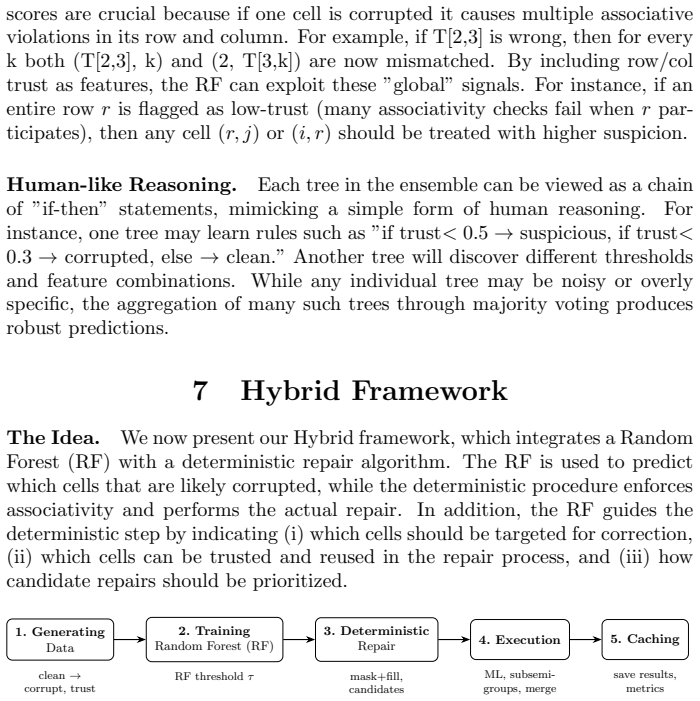
The trust map: each cell (i,j) gets trust(i,j) = (1/n) × #{k : T(T(i,j),k) = T(i,T(j,k))}, measuring how often that entry survives associativity checks; the paper shows low-trust cells align with truly corrupted cells. A random forest is trained on trust scores, row/column indices, and candidate values to output a corruption probability, and a threshold masks low-trust cells for repair. Closure sets G(i,j,k) are the minimal element sets needed for one associativity check; each surviving set with size between 2 and 5 is reindexed, locally repaired by replacing the lower-trust side of any violation, and mapped back to global labels. Overlapping closures propose candidates for the same global e
What would settle it
Run the method on a fresh set of, say, 1,000 order-10 semigroups at 15% corruption and count fully associative outputs; if the rate does not clearly exceed deterministic repair, the central performance claim fails. For the local-associativity guarantee, test all n³ triples on any output at n = 10: a single violating triple refutes the Section 4.3 assertion that the merge always yields global associativity.
Extended reading notes
Core claim
The paper's central claim is that a corrupted finite semigroup's Cayley table can be reliably healed by combining three signals: a per-cell trust score that counts how often an entry survives associativity checks; a random-forest classifier that uses these scores, positional features, and candidate statistics to mask likely-corrupted cells; and a two-pass repair in which masked entries are first repaired deterministically by majority vote over associativity-derived candidates, then overlapping closure sets G(i,j,k) = {i, j, k, i·j, j·k, (i·j)·k, i·(j·k)} are repaired locally and merged with weights (ML probability) × (trust) / |G|². On model-builder-generated tables at 15% corruption, the au
Load-bearing premise
The load-bearing premise is that repairing each closure set G(i,j,k) separately and merging the weighted results guarantees a globally associative table; the paper asserts this in its Section 4.3 justification, but the reported 60% full-associativity rate at n = 10 shows it is only a statistical tendency, not a proven guarantee.
Editorial extensions
If this is right
- At 15% corruption, more than 95% of tables up to size 6 become fully associative after the two-pass hybrid repair, and 60% do so at size 10.
- The subsemigroup pass is decisive: healing pass 1 alone repairs about 20% of size-10 tables, while adding pass 2 raises that to 60%.
- Even when full associativity fails, the healed tables stay close to the original: mean per-cell accuracy remains high and the mean associative fraction is 92% at n = 20.
- The collapse of deterministic repair is not a random fluctuation: under the uniformity assumption, the probability of the wrong value outvoting the true one at n = 10, p = 0.15 is about 9.1e-9, so the real cause is semigroup tables' skewed value frequencies.
Reading between the lines
- The Section 4.3 'Justification' overclaims: local closure repair plus weighted merging does not guarantee global associativity, since the paper's own numbers show 40% failure at n = 10; a real theorem would need conditions on closure overlaps and merge weights.
- The trust-map-and-mask idea is generic: it should transfer to healing other finite algebras whose defining axioms are identities, such as loops, quasigroups, or monoids, whenever violations can be scored per cell.
- The merge weight 1/|G|² is a hand-picked heuristic; tuning or learning it is a direct, testable route to extending recovery beyond n = 10.
- The skewed-value-frequency analysis suggests a stronger alternative to a black-box classifier: a Bayesian prior over semigroup tables that respects non-uniform element frequencies could make the merge step more principled.
Editorial analysis
A structured set of objections, weighed in public.
Referee Report
Summary. The paper proposes a hybrid framework for repairing corrupted finite semigroup Cayley tables: a Random Forest classifier predicts corrupted cells, a deterministic associativity-based repair fills masked entries, and a second pass heals small closure sets G(i,j,k) with weighted merging. Experiments on Mace4-generated semigroups report that at p=15% corruption the hybrid method yields fully associative tables for >95% of instances up to n=6 and 60% at n=10, compared with 2% for deterministic repair. The paper also discusses trust maps, a subsemigroup decomposition, and a statistical analysis intended to explain the failure of deterministic repair.
Significance. If substantiated, the paper would contribute a practically useful repair strategy for corrupted algebraic structures, combining a learned corruption detector with deterministic consistency enforcement and a subsemigroup-local merging pass. The trust-map idea and the use of closure sets are reasonable and potentially transferable. However, the current evidence does not support the central claims: no ML-only baseline is reported; the claimed global associativity guarantee is contradicted by the paper's own numbers; the primary success metric does not enforce the paper's own fidelity requirement; and the statistical analysis is not a valid model of the repair mechanism. Reproducibility is also limited by missing dataset details and hyperparameters. With corrections and additional experiments, the core idea could become a solid applied contribution, but in its present form the empirical conclusions are not established.
major comments (4)
- [Abstract and §8 (Results)] The abstract and §8 claim that the hybrid framework achieves higher healing rates than 'deterministic-only and ML-only baselines,' but no ML-only baseline results appear anywhere in the paper. Figure 7 compares Hybrid with Deterministic only; 'Healing Pass 1' already includes RF masking plus deterministic repair, so it is not an ML-only method. Without an actual Random-Forest-only (or other ML-only) baseline evaluated on the same metrics and corruption levels, the claimed superiority over ML-only is unsupported. Please add this baseline or remove/qualify the claim.
- [§4.3 (Justification)] The 'Justification' paragraph asserts that repairing each closure set G(i,j,k) and merging the results 'the result is a globally associative table.' This is not established: weighted merging across overlapping subsemigroups can assign a value to a cell that was not part of a local repair for some other triple, and the new value can create new associativity failures. The paper's own results contradict the claimed guarantee: §8 reports 60% fully associative at n=10, and Figure 8 shows lower rates for larger n. The method should be described as a heuristic with empirical success rates, not a guaranteed repair. If a guarantee is intended, a proof must be supplied; otherwise the 'Justification' passage should be rewritten or removed.
- [§3 (Definition of Healing) and §8 (Evaluation)] Section 3 defines a healed table as one satisfying both global associativity and local fidelity, measured by per-cell accuracy. Section 8, however, uses '% Fully Associative Tables' as the primary success measure and reports mean per-cell accuracy only as a global average over all outputs, not conditioned on the fully associative subset. A fully associative table can have very low fidelity (e.g., collapse all entries to a single value), and the paper itself notes this failure mode for the backtracking baseline in §5.1 ('collapsed into trivial semigroups'). To substantiate the '95% healed at n≤6' and '60% at n=10' claims, the authors must report the proportion of fully associative outputs that also meet an explicit fidelity threshold, or provide per-cell accuracy restricted to the fully associative outputs.
- [§9.1 (Statistical Analysis)] The binomial 'Exceeds C' calculation does not model the deterministic repair mechanism. Deterministic repair counts votes from decompositions i = i1·i2; the relevant quantity is the distribution of the true value's vote count against the maximum vote count among the other n−1 possible values, not Pr[X ≥ C] for a single Bin(n, 1/n) variable. Moreover, C = (1−p)n is introduced as the 'expected number of correct votes' without derivation, and the non-uniform frequency observation is not incorporated into the formula. The section therefore does not establish the claimed contradiction between random fluctuations and the collapse of deterministic repair. It should be corrected or removed from the discussion.
minor comments (7)
- [§4.1] Report the number of Mace4-generated semigroups per cardinality, the number of corruption draws per table, and the train/test split for the Random Forest. Without these, the results cannot be reproduced or assessed statistically.
- [§4.2 / §7] The trust-map threshold τ and all Random Forest hyperparameters (number of trees, depth, feature set, Gini/entropy) are not reported. These are needed for reproducibility and for assessing the risk of training and evaluating on the same corruption distribution.
- [§5] The text describes deterministic repair as having 'some efficiency at small cardinalities (47% at n=3)' but no error bars or confidence intervals are provided. Please report variance over multiple corruption realizations.
- [§4.3 / §7] There are internal reference errors: §4.3 refers to the trust map as 'Section 3.2', §7 Execution refers to subsemigroups as 'Section 3.3', and §6 refers to trust scores with an apparent cross-reference. These should be updated to the actual section numbers.
- [§8 (Figure 8)] The labels 'Baseline', 'Healing Pass 1', and 'Healing Pass 2' in Figure 8 are not explicitly defined in the pipeline description of Section 7. Add definitions or refer to the pipeline steps by name.
- [§9.2] The sentence 'we must understand the ways in which machine learning provides a decisive advantage?' has a grammatical error / missing question mark. Also, the related-work section mentions an autoencoder baseline by Balzin and Shminke, but no comparison to that method is made in the experiments; it should be either included as a baseline or explicitly deferred.
- [References] Reference [14] points to a W3Schools tutorial. For a journal submission, replace this with a peer-reviewed or otherwise authoritative source on Random Forests, e.g., Breiman [4].
Circularity Check
No fitting-as-prediction or self-citation circularity; the main issue is that the headline 'healed' rate uses only the associativity half of the paper's own two-part definition of healing.
-
self definitional
[Section 3 'Definition of Healing'; Section 8 'Evaluation' and 'Metrics for Success']
"For this paper, a healed table must satisfy two requirements: 1. Global associativity ... 2. Local fidelity ... measured by per-cell accuracy. ... For n ≤ 6, more than 95% of corrupted tables were fully repaired. ... the hybrid approach achieved 60% fully associative tables ... Although the percentage of tables that are fully associative is the primary measure of success..."
The paper defines 'healed' as a conjunction of global associativity and local fidelity, but the headline 'healing rate' is the fraction of fully associative tables, and 'fully repaired' is used synonymously with 'fully associative' in Section 8. Thus the reported 95%/60% counts only one of the two defining conditions. Per-cell fidelity is reported only as a global mean over all outputs, not conditioned on the fully associative subset, so a fully associative but degenerate table (the paper itself notes that backtracking 'collapsed into trivial semigroups') would be counted as healed. The success metric is therefore equivalent to one component of the paper's own definition, with the other defining component dropped.
full rationale
Aside from the definitional/metric issue above, I found no significant circularity. The Random Forest is trained on a train/test split of the Mace4-generated corrupted tables, which is ordinary supervised evaluation rather than fitting the test set; there are no load-bearing self-citations; and the trust map is an empirical statistic, not a pre-fitted target. The unsupported 'Justification' in Section 4.3 is an invalid mathematical claim (local consistency plus weighted merging does not guarantee global associativity, as the paper's own 60%-at-n=10 result shows), but it is a correctness flaw, not a circular reduction. The unreported threshold τ and hyperparameters are reproducibility/generalization concerns, not circularity. The central empirical claim is thus an experimental measurement, but it is reported under a weakened reading of 'healed', which prevents a zero score.
Assumptions & free parameters
free parameters (5)
- corruption percentage p =
0.15
- RF mask threshold tau
- Random Forest hyperparameters
- subsemigroup size cutoff =
2 to 5
- merging weight coefficients
assumptions (5)
- standard math Associativity is defined by the standard triple condition (a*b)*c = a*(b*c) for all triples.
- domain assumption Corruption is modeled by uniformly flipping p% of entries to other values while preserving closure.
- domain assumption Trust scores computed on a corrupted table reliably indicate which cells are corrupted.
- ad hoc to paper Repairing every closure set G(i,j,k) and merging by weighted voting yields a globally associative table.
- ad hoc to paper The binomial 'Exceeds C' calculation models the vote distribution in deterministic repair.
Cite this review
Pith. "Pith review of A Hybrid Framework for Healing Semigroups with Machine Learning." pith.science (2026). https://pith.science/paper/MSFO5M5C
@misc{pith2026250901763,
  author       = {Pith},
  title        = {Pith review of: A Hybrid Framework for Healing Semigroups with Machine Learning},
  year         = {2026},
  howpublished = {\url{https://pith.science/paper/MSFO5M5C}},
  note         = {Machine review of arXiv:2509.01763}
}
read the original abstract
In this paper, we propose a hybrid framework that heals corrupted finite semigroups, combining deterministic repair strategies with Machine Learning using a Random Forest Classifier. Corruption in these tables breaks associativity and invalidates the algebraic structure. Deterministic methods work for small cardinality n and low corruption but degrade rapidly. Our experiments, carried out on Mace4-generated data sets, demonstrate that our hybrid framework achieves higher healing rates than deterministic-only and ML-only baselines. At a corruption percentage of p=15%, our framework healed 95% of semigroups up to cardinality n=6 and 60% at n=10.
Figures


Figures from the paper (4 more)



Reference graph
Works this paper leans on
- [1]
-
[2]
Exploring roughness in left almost semigroups and its connections to fuzzy lie algebras
Abdullah Assiry and Amir Baklouti. Exploring roughness in left almost semigroups and its connections to fuzzy lie algebras. Symmetry, 15(9):1717, 2023
work page 2023
-
[3]
A Neural Network for Semigroups
Edouard Balzin and Boris Shminke. A neural network for semigroups. arXiv preprint arXiv:2103.07388 , 2021
work page Pith review arXiv 2021
- [4]
-
[5]
DUE: A Deep Learning Framework and Library for Modeling Unknown Equations
Junfeng Chen, Kailiang Wu, and Dongbin Xiu. Due: A deep learning framework and library for modeling unknown equations. arXiv preprint arXiv:2504.10373, 2025
work page Pith review arXiv 2025
-
[6]
Marco Cuturi, Kenji Fukumizu, and Jean-Philippe Vert. Semigroup kernels on measures. Journal of Machine Learning Research , 6:1169–1198, 2005
work page 2005
-
[7]
Andreas Distler, Christopher Jefferson, Tom Kelsey, and Lars Kotthoff. The semigroups of order 10. In Michela Milano, editor, Principles and Practice of Constraint Programming (CP) , volume 7514 of Lecture Notes in Computer Science , pages 883–899. Springer Berlin Heidelberg, 2012
work page 2012
-
[8]
Yuanyuan Feng, Lei Li, and Jian-Guo Liu. Semi-groups of stochastic gra- dient descent and online principal component analysis: properties and dif- fusion approximations. arXiv preprint arXiv:1712.06509 , 2017
work page Pith review arXiv 2017
Show all 16 references
-
[9]
Prediction error certification for pinns: Theory, computation, and application to stokes flow
Birgit Hillebrecht and Benjamin Unger. Prediction error certification for pinns: Theory, computation, and application to stokes flow. arXiv preprint arXiv:2508.07994, 2025
2025 arXiv
-
[10]
Efficiently learn- ing and sampling multimodal distributions with data-based initialization
Frederic Koehler, Holden Lee, and Thuy-Duong Vuong. Efficiently learn- ing and sampling multimodal distributions with data-based initialization. arXiv preprint arXiv:2411.09117 , 2024
2024 arXiv
-
[11]
Kostic, Karim Lounici, H´ el` ene Halconruy, Timoth´ ee Devergne, Pietro Novelli, and Massimiliano Pontil
Vladimir R. Kostic, Karim Lounici, H´ el` ene Halconruy, Timoth´ ee Devergne, Pietro Novelli, and Massimiliano Pontil. Laplace transform based low- complexity learning of continuous markov semigroups. In Proceedings of the 42nd International Conference on Machine Learning , 2024
2024
-
[12]
A semigroup method for high dimensional committor functions based on neural net- work
Haoya Li, Yuehaw Khoo, Yinuo Ren, and Lexing Ying. A semigroup method for high dimensional committor functions based on neural net- work. In Proceedings of the 2nd Mathematical and Scientific Machine Learning Conference, volume 145 of Proceedings of Machine Learning Re- search...
2022
-
[13]
Mace4 reference manual
William McCune. Mace4 reference manual. https://www.cs.unm.edu/ ~mccune/mace4/. Accessed: 2025-08-30. 15
2025
-
[14]
Random forest tutorial
W3Schools. Random forest tutorial. https://www.w3schools.com/ python/python_ml_random_forest.asp. Accessed: 2025-08-30
2025
-
[15]
Is deep learning a useful tool for the pure mathemati- cian? arXiv preprint arXiv:2304.12602 , 2023
Geordie Williamson. Is deep learning a useful tool for the pure mathemati- cian? arXiv preprint arXiv:2304.12602 , 2023
2023 arXiv
-
[16]
Understanding oversmoothing in diffusion-based gnns from the perspective of operator semigroup theory
Weichen Zhao, Chenguang Wang, Xinyan Wang, Congying Han, Tiande Guo, and Tianshu Yu. Understanding oversmoothing in diffusion-based gnns from the perspective of operator semigroup theory. In Proceedings of the 31st ACM SIGKDD Conference on Knowledge Discovery and Data Mining, 2024. 16
2024
Reviewed August 5, 2026 · model on record in the stance chip above.
Discussion (0). Continue with ORCID to comment.