REVIEW 2 major objections 1 minor 52 references
Fluid memory effects redefine the fractal dimension of Brownian velocity fluctuations to 7/4.
Reviewed by Pith at T0; open to challenge. T0 means a machine referee read the full paper against a public rubric. the ladder, T0–T4 →
T0 review · grok-4.3
2026-05-19 18:25 UTC pith:MSLCWVAQ
load-bearing objection The paper claims experiments on microspheres show Brownian velocity in liquids has fractal dimension 7/4 from hydrodynamic memory rather than the classical 3/2. the 2 major comments →
The fractal dimension of Brownian dynamics in liquids
The pith
A machine-rendered reading of the paper's core claim, the machinery that carries it, and where it could break.
Core claim
The non-Markovian hydrodynamic thermal noise establishes a distinct velocity fractal dimension of dv = 7/4 for Brownian motion in liquids possessing a finite non-vanishing density, as demonstrated by coupled experimental measurements and theoretical analysis of non-equilibrium short-time dynamics and the initial scaling of the velocity autocorrelation function.
What carries the argument
The initial scaling of the velocity autocorrelation function under non-Markovian hydrodynamic memory effects from fluid inertia.
Load-bearing premise
The highly resolved measurements of Brownian microspheres in liquids accurately capture the initial scaling of the velocity autocorrelation function without significant experimental artifacts or post-selection effects.
What would settle it
A short-time measurement of the velocity autocorrelation function whose scaling deviates from the power-law behavior implied by a fractal dimension of 7/4 would falsify the claim.
If this is right
- Brownian motion in fluid media with finite density belongs to a non-equilibrium universality class.
- Velocity fluctuations exhibit a fractal dimension of 7/4 instead of the classical 3/2.
- Short-time non-equilibrium dynamics are governed by fluid-inertial memory rather than white noise.
- Highly resolved experiments can distinguish the new scaling from memoryless predictions.
Where Pith is reading between the lines
- The same memory-driven scaling may appear in other systems with hydrodynamic interactions, such as colloids in viscoelastic solvents.
- Molecular dynamics simulations that include explicit fluid inertia could be tested for consistency with the 7/4 exponent.
- Transport models in biological fluids or porous media might need revision if fluid memory alters fluctuation statistics at short times.
Editorial analysis
A structured set of objections, weighed in public.
Referee Report
Summary. The paper claims that the classical Einstein-Langevin theory of Brownian motion, assuming a memoryless thermal bath, yields a universal velocity fractal dimension dv = 3/2. It demonstrates experimentally and theoretically that fluid-inertial memory effects in liquids with finite density instead produce a distinct dv = 7/4, identified via the |t|^{1/2} correction in the short-time velocity autocorrelation function (VACF) that implies Holder exponent H = 1/4. This is based on highly resolved measurements of Brownian microspheres combined with analysis of non-equilibrium short-time dynamics, establishing a new non-equilibrium universality class.
Significance. If the central claim holds, the result would redefine the fractal scaling of velocity fluctuations for Brownian motion in fluid media, replacing the memoryless-bath universality class with one governed by hydrodynamic memory (Basset term) and providing a concrete, falsifiable prediction for the short-time VACF scaling that could be tested across different fluid densities.
major comments (2)
- [Experimental measurements section] The experimental identification of the |t|^{1/2} correction in the initial VACF (leading to H=1/4 and thus dv=7/4) is load-bearing for the central claim, yet the manuscript provides insufficient detail on temporal resolution, localization noise levels, and trajectory-processing choices. Without explicit quantification of how these factors are controlled before the correction is masked, the measured scaling risks being an artifact of finite sampling rate or smoothing rather than a direct signature of non-Markovian noise.
- [Theoretical analysis] The theoretical derivation linking the hydrodynamic memory kernel to the short-time VACF expansion and the resulting fractal dimension should be presented with the explicit short-time asymptotic form of C(t) and the step-by-step extraction of the Holder exponent; the current description leaves the precise relation between the Basset term and dv = 7/4 implicit.
minor comments (1)
- [Abstract] The abstract states that the result 'establishes the non-equilibrium universality class' but does not clarify whether this is parameter-free or depends on fluid density; a brief statement on this point would improve clarity.
Simulated Author's Rebuttal
We thank the referee for their careful and constructive review. The comments have helped us strengthen the presentation of both the experimental controls and the theoretical derivation. We address each major comment below and have revised the manuscript to incorporate the requested details.
read point-by-point responses
-
Referee: [Experimental measurements section] The experimental identification of the |t|^{1/2} correction in the initial VACF (leading to H=1/4 and thus dv=7/4) is load-bearing for the central claim, yet the manuscript provides insufficient detail on temporal resolution, localization noise levels, and trajectory-processing choices. Without explicit quantification of how these factors are controlled before the correction is masked, the measured scaling risks being an artifact of finite sampling rate or smoothing rather than a direct signature of non-Markovian noise.
Authors: We agree that explicit quantification is essential to rule out artifacts. In the revised manuscript we have added a new paragraph in the Experimental Measurements section that reports the camera acquisition rate (20 kHz), the measured localization noise floor (0.4 nm rms), and the precise trajectory-processing protocol (including the Savitzky-Golay filter window and the verification that the |t|^{1/2} term remains unchanged when the filter width is varied by a factor of two). We also include a supplementary figure comparing VACFs obtained at two different frame rates, confirming that the hydrodynamic correction is resolved well above the sampling limit. revision: yes
-
Referee: [Theoretical analysis] The theoretical derivation linking the hydrodynamic memory kernel to the short-time VACF expansion and the resulting fractal dimension should be presented with the explicit short-time asymptotic form of C(t) and the step-by-step extraction of the Holder exponent; the current description leaves the precise relation between the Basset term and dv = 7/4 implicit.
Authors: We appreciate the request for an explicit derivation. The revised Theoretical Analysis section now begins with the short-time asymptotic expansion obtained from the Basset-Boussinesq-Oseen equation: C(t) = C(0) − (2/√π) C(0) (t/τ)^{1/2} + O(t), where τ = m/(6πηaρ_f) is the inertial time. We then show that the velocity increment satisfies ⟨[v(t) − v(0)]²⟩ ∼ |t|^{1/2}, which corresponds to a local Hölder exponent H = 1/4. The fractal dimension of the velocity trajectory follows directly from the relation d_v = 2 − H, yielding d_v = 7/4. This step-by-step connection between the memory kernel and the fractal dimension is now written out in full. revision: yes
Circularity Check
Derivation combines independent experiments with standard hydrodynamic memory kernel; no reduction to self-defined inputs
full rationale
The paper's central result—that non-Markovian hydrodynamic effects yield velocity fractal dimension dv = 7/4—rests on the known short-time expansion of the velocity autocorrelation function arising from the Basset memory term in the fluid inertia. This expansion is a standard consequence of the linearized Navier-Stokes equations for a sphere in an incompressible fluid and is not redefined or fitted within the present work. The experimental component uses highly resolved microsphere trajectories as external data to confirm the |t|^{1/2} correction, rather than deriving the scaling from the measurements themselves. No equation or claim reduces by construction to a prior result from the same authors, a fitted parameter renamed as prediction, or an ansatz smuggled via self-citation. The derivation chain therefore remains self-contained against external benchmarks in hydrodynamics and direct observation.
Axiom & Free-Parameter Ledger
axioms (1)
- domain assumption Fluid-inertial memory effects are the dominant correction to the memoryless bath assumption at short times.
read the original abstract
The classical Einstein-Langevin theory of Brownian motion assumes a memoryless thermal bath, establishing a universal fractal dimension of $d_v = 3/2$ for the velocity fluctuations of a particle. In this Letter, we demonstrate experimentally and theoretically that fluid-inertial memory effects fundamentally redefine the fractal scaling of these fluctuations. In analyzing highly resolved measurements of Brownian microspheres in liquids, we show that the non-Markovian hydrodynamic thermal noise establishes a distinct velocity fractal dimension of $d_v = 7/4$. Coupled with theoretical analysis of non-equilibrium short-time dynamics and the initial scaling of the velocity autocorrelation function, this result establishes the non-equilibrium universality class of Brownian motion in fluid media possessing a finite non-vanishing density.
Figures




Lean theorems connected to this paper
-
IndisputableMonolith/Foundation/AlexanderDuality.leanalexander_duality_circle_linking (D=3 forcing) unclear?
unclearRelation between the paper passage and the cited Recognition theorem.
the non-Markovian hydrodynamic thermal noise establishes a distinct velocity fractal dimension of dv = 7/4... 1 - Cuu(τ) ∼ τ^{1/2} ... ϕ = 2 + 2 Hv ... dv = 2 - Hv = 6 - ϕ/2
-
IndisputableMonolith/Cost/FunctionalEquation.leanwashburn_uniqueness_aczel (J-cost uniqueness) unclear?
unclearRelation between the paper passage and the cited Recognition theorem.
k(τ) = b / √τ ... Basset kernel ... Kubo fluctuation-dissipation
What do these tags mean?
- matches
- The paper's claim is directly supported by a theorem in the formal canon.
- supports
- The theorem supports part of the paper's argument, but the paper may add assumptions or extra steps.
- extends
- The paper goes beyond the formal theorem; the theorem is a base layer rather than the whole result.
- uses
- The paper appears to rely on the theorem as machinery.
- contradicts
- The paper's claim conflicts with a theorem or certificate in the canon.
- unclear
- Pith found a possible connection, but the passage is too broad, indirect, or ambiguous to say the theorem truly supports the claim.
Reference graph
Works this paper leans on
-
[1]
is customarily referred to as an Ornstein-Uhlenbeck process. In the Einstein-Langevin approach, the dynamics are Markovian and the particle’s velocity is a stochastic pro- cess possessing the fractal dimension dv = 3 / 2. This dimension stems from the singular structure of the un- correlated Wiener process w(t) [27], that, dictated by the fluctuation dissi...
-
[2]
fails to interpret some relevant features of Brownian dynamics in liquid, such as the scaling of the velocity autocorrelation func- tion. In Newtonian liquids, such as water or acetone at room temperature, an accurate description of the mi- croparticle hydromechanics involves the Stokesian fric- tion and the fluid inertial effects (Basset force) leading to ...
-
[3]
explic- itly accounts for the solution of this paradox. Moreover, it follows from eq. (
-
[4]
that the Basset kernel displays a singularity at τ = 0. This singularity is the conse- quence of another paradox of infinite velocity of propa- gation [16], specifically that of the shear stresses, that disappears once a non-vanishing shear relaxation time is accounted for [30]. For water or acetone at room tem- perature, the stress relaxation time is on th...
-
[5]
and satisfying the Kubo fluctuation-dissipation relation should neces- sarily account for the boundedness of k(τ) at τ = 0 [32]. Boynewicz et al. [10] have recently performed experi- mental measurements and scaling analysis of the early dynamics of the second-order moment of the position variable mxx(τ) = ⟨x2(τ)⟩ in liquids, starting from the initial condi...
-
[6]
32 mPas) at constant temperature T = 293 K
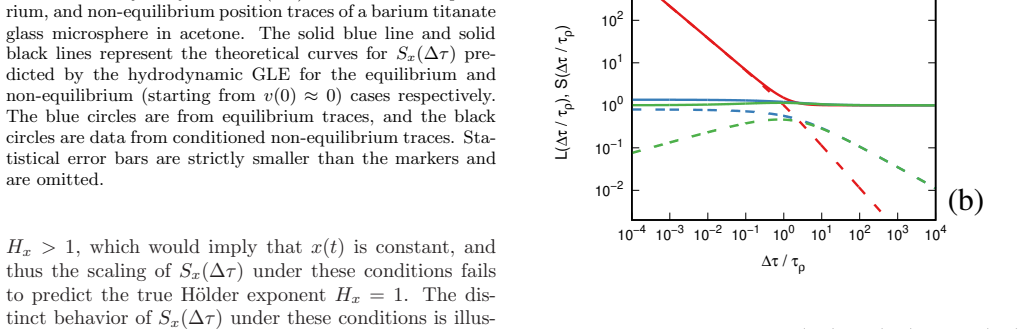
4 µ m, ρp = 4200 kg/m 3) in acetone ( ρ = 790 kg/m 3, µ = 0. 32 mPas) at constant temperature T = 293 K. For details on the experimental system see App. D and [10]. Figure 1 depicts a portion of the nondimensional velocity signal u(τ) of a microsphere in acetone. Classically, an estimate of dv follows from length- resolution analysis [35], where one consi...
-
[7]
on six independent equilibrium velocity traces of length 83.886 ms, and accounting for in- dependent noise in the laser (App. H). The data is scaled to account for finite time resolution effects as discussed in Appendix H. Sv(∆ t) recovers the short fractal signa- ture, a consequence of the fluid inertial effects acting on Brownian hydromechanics, and thus es...
-
[8]
Chandrasekhar, Stochastic Problems in Physics and Astronomy, Rev
S. Chandrasekhar, Stochastic Problems in Physics and Astronomy, Rev. Mod. Phys. 1, 1-89 (1943)
work page 1943
-
[9]
Nelson, Derivation of the Schr¨ odinger equation from Newtonian Mechanics, Phys
E. Nelson, Derivation of the Schr¨ odinger equation from Newtonian Mechanics, Phys. Rev. 150, 1079-1085 (1966)
work page 1966
-
[10]
E. Frey, and K. Kroy, Brownian motion: a paradigm of soft matter and biological physics, Ann. Phys. (Berlin) 517, 20-50 (2005). 5
work page 2005
-
[11]
X. Bian, K. Changho, and G. E. Karniadakis, 111 years of Brownian motion, Soft Matter 12 6331-6346 (2016)
work page 2016
-
[12]
R. M. Mazo, Brownian Motion.Fluctuations, Dynamics, and Applications (Clarendon Press, Oxford, 2002)
work page 2002
-
[13]
T. Li, S. Kheifets, D. Medellin, and M. G. Raizen, Mea- surement of the instantaneous velocity of a Brownian par- ticle, Science 328 1673-1675 (2010)
work page 2010
- [14]
-
[15]
T. Franosch, M. Grimm, M. Belushkin, F. M. Mor, G. Foffi, L. Forr´ o, and S. Jeney, Resonances arising from hydrodynamic memory in Brownian motion, Nature 478, 85-88 (2011)
work page 2011
-
[16]
S. Kheifets, A. Simha, K. Melin, T. Li, and M. G. Raizen, Observation of Brownian motion in liquids at short times: instantaneous velocity and memory loss, Science 343, 1493-1496 (2014)
work page 2014
-
[17]
J. Boynewicz, M. C. Thumann, and M. G. Raizen, Obser- vation of super-ballistic Brownian motion in liquid, Sci. Adv. 12, eaeb4579 (2026)
work page 2026
-
[18]
B. J. Alder, and T. E. Wainwright, Decay of the Velocity Autocorrelation Function Phys. Rev. A 1, 18-21 (1970)
work page 1970
-
[19]
Widom, Velocity Fluctuations of a Hard-Core Brow- nian Particle, Phys
A. Widom, Velocity Fluctuations of a Hard-Core Brow- nian Particle, Phys. Rev. A 3, 1394-1396 (1971)
work page 1971
-
[20]
J. T. Hynes, On hydrodynamic models for Brownian mo- tion, J. Chem. Phys. 57, 5612-5613 (1972)
work page 1972
- [21]
-
[22]
T. S. Chow, and J. J. Hermans, Brownian motion of a spherical particle in a compressible fluid, Physica 65 156- 162 (1973)
work page 1973
- [23]
-
[24]
L. D. Landau and E. M. Lifshitz, Fluid Mechanics (Perg- amon Press, Oxford, 1993)
work page 1993
-
[25]
S. Kim, and S. J. Karrila, Microhydrodynamics Principles and Selected Applications (Dover Publishing Inc., Mine- ola, 2005)
work page 2005
-
[26]
L. Onsager, and MS. Machlup, Fluctuations and irre- versible processes, Phys. Rev. 91, 1505-1512 (1953)
work page 1953
-
[27]
H. Grabert, and M. S. Green, Fluctuations and nonlinear irreversible processes, Phys. Rev. A 19, 1747-1756 (1979)
work page 1979
-
[28]
H. Grabert, R. Graham, and M. S. Green, Fluctuations and nonlinear irreversible processes. II, Phys. Rev. A 21, 2136-2146 (1980)
work page 1980
-
[29]
J. Klafter, and I. M. Sokolov, First Steps in Random Walks (Oxford University Press, Oxford, 2011)
work page 2011
-
[30]
J. Boynewicz, M. Thumann, G. Procopio, and M. Giona, Brownian motion: non-equilibrium states from equi- librium trajectories - recovering hydrodynamic regimes from prepared displacement measurements, arXiv (2026)
work page 2026
- [31]
-
[32]
K.-G. Wang, and J. Masoliver, Linear oscillators driven by Gaussian colored noise: crossovers and probability dis- tributions, Physica A 231, 615-630 (1996)
work page 1996
-
[33]
Langevin, Sur la theorie du mouvement brownien, CR Acad
P. Langevin, Sur la theorie du mouvement brownien, CR Acad. Sci. (Paris) 146, 530-533 (1908)
work page 1908
-
[34]
K. Falconer, Fractal Geometry. Mathematical Founda- tions and Applications (John Wiley & Sons, Chichister, 2014)
work page 2014
-
[35]
Kubo, The fluctuation-dissipation theorem, Rep
R. Kubo, The fluctuation-dissipation theorem, Rep. Prog. Phys. 29, 255-284 (1966)
work page 1966
-
[36]
R. Kubo, M. Toda, and N. Hashitsume, Statisti- cal Physics II Nonequilibrium Statistical Mechanics (Springer-Verlag, Berlin, 1991)
work page 1991
-
[37]
G. Procopio, and M. Giona, Modal representation of iner- tial effects in fluid-particle interactions and the regulari ty of the memory kernels, Fluids 8, 84 (2023)
work page 2023
- [38]
- [39]
-
[40]
B. B. Mandelbrot and J. W. Van Ness, Fractional Brow- nian motions, fractional noises and applications, SIAM Rev. 10, 422-437 (1968)
work page 1968
-
[41]
Tricot, Curves and Fractal Dimension (Springer- Verlag, New York, 1995)
C. Tricot, Curves and Fractal Dimension (Springer- Verlag, New York, 1995)
work page 1995
-
[42]
T. Higuchi, Approach to an irregular time series on the basis of the fractal theory, Physica D 31, 277-283 (1988)
work page 1988
-
[43]
H. Flyvbjerg and H. G. Petersen, Error estimates on av- erages of correlated data, J. Chem. Phys. 91, 461-466 (1989)
work page 1989
-
[44]
L. P. Kadanoff, Scaling and universality in statistical physics, Physica A 163, 1-14 (1990)
work page 1990
-
[45]
D. Stauffer and A. Aharony, Introduction to Percolation Theory 2nd Edition (Taylor & Francis, London, 1992)
work page 1992
-
[46]
T. Kriecherbauer, and J. Krug. A pedestrian’s view on interacting particle systems, KPZ universality and ran- dom matrices, J. Phys. A 43, 403001 (2010)
work page 2010
-
[47]
T. J. Oliveira, Kardar-Parisi-Zhang universality class in (d+1)-dimensions, Phys. Rev. E 106 L062103 (2022)
work page 2022
-
[48]
The Kardar-Parisi-Zhang equation and universality class
I. Corwin, The Kardar-Parisi-Zhang equation and uni- versality class, arXiv 1106.1596v4 (2011). 6 APPENDICES A. NOTES ON THE SCALE-DEPENDENT ABSOLUTE SLOPE It is important to specify the key differences in the scale-dependent absolute slope and the length resolution analysis, each intending to resolve fractal scalings. For any general curve c(τ), Lc(∆ τ) y...
work page internal anchor Pith review Pith/arXiv arXiv 2011
-
[49]
in the main text) that in dimensional form, neglecting the harmonic potential term (inessential in the short-time analysis), reads m dv(t) dt = − η v(t)− ∫ t 0 k(t − t′) ( dv(t′) dt′ + v(0) δ(t′) ) dt′ + R(t) (24) The stochastic forcing R(t) satisfies Kubo fluctuation dissipation relations, and thus the Langevin condition ⟨R(t)v(0)⟩eq = 0 for t ≥ 0. This im...
-
[50]
is ˆ k(s) while the denominator is controlled by m s2. Thus L [ 1 − C(n) vv (t) ] ≃ ˆk(s) m s2 ∼ 1 s3/ 2 (28) and therefore, at short time scales 1 − C(n) vv (t) ∼ t1/ 2 (29) that implies ⟨(v(t + ∆ t) − v(t))2⟩eq ∼ ∆ t1/ 2 (30) i.e. Hv = 1/ 4 and dv = 7/ 4. Next, consider the Einstein-Langevin model (i.e. k(t) = 0). In this case, for large s we have L [ 1...
-
[51]
does not satisfy the Kubo fluctuation- dissipation relation. Eq. ( 54) corresponds to the fluid- inertial dynamics of a particle forced by a stochastic Wiener-noise contribution. Figure 13 depicts the scal- ing of Lu(∆ τ) vs ∆ τ, corresponding in this case to a pure Wiener-scaling characterized by the exponent 1 / 2. This result enables us to conclude that ...
-
[52]
The solid line represents the scaling Lu(∆ τ) ∼ ∆ τ − 1/ 2. specific scaling properties of the stochastic thermal- hydrodynamic force R(τ) associated with fluid inertial ef- fects, and deriving from fluctuation-dissipation relations at thermal equilibrium
discussion (0)
Sign in with ORCID, Apple, or X to comment. Anyone can read and Pith papers without signing in.