REVIEW 4 major objections 4 minor 1 cited by
New Loop Quantum Cosmology Modifications from Gauge-covariant Fluxes
T0 review · 4 major / 4 minor · reviewed 2026-08-14 · deepseek-v4-flash
Pith's one-line read Replacing standard fluxes with gauge-covariant fluxes changes the loop quantum cosmology bounce from symmetric to asymmetric.
desk verdict A parameter-free derivation of gauge-covariant flux corrections in LQC that deserves refereeing; the asymmetric bounce and G rescaling are conditional on an unproven effective-dynamics identification. read the letter →
The pith
A machine-rendered reading of the paper's core claim, the machinery that carries it, and where it could break.
The reading
What carries the argument
The central object is the gauge-covariant flux $P_I(e)$ attached to each edge $e$ of a cubic lattice, which transforms covariantly under SU(2) gauge transformations even at finite lattice spacing. In isotropic cosmology this flux evaluates to the standard flux times $\mathrm{sinc}^2(c\epsilon/2)$, so every appearance of the triad in the regularized Hamiltonian is replaced by $p\,\mathrm{sinc}^2(c\epsilon/2)$. This single substitution generates the new regularized constraint $C_\epsilon$ (Eq. (26)) and all of the paper's subsequent modifications to the bounce, the Friedmann equations, the matter coupling, and the quantum difference equation.
What would settle it
Compute the full quantum evolution generated by $\Theta^{\mathrm{TF}}$ (or the scalar-constraint expectation values in gauge-covariant coherent states) and check whether the resulting bounce is asymmetric with the pre-bounce rescaling $\bar G = G(2/\pi)^4$; a symmetric bounce or a different rescaling would show that the regularized dynamics is not the true effective dynamics. A simpler check is to test whether higher-order terms in the coherent-state expansion change Eq. (26) at leading order; if they do, the central prediction fails.
Extended reading notes
Core claim
The paper's central claim is that finite-lattice gauge invariance forces one to replace the triad $p$ by $p\,\mathrm{sinc}^2(c\epsilon/2)$ in the symmetry-reduced Hamiltonian, and that the resulting regularized constraint $C_\epsilon$ produces an effective dynamics in which the big bang is replaced by a bounce whose two asymptotic branches are not equivalent. Near the post-bounce branch the usual classical Friedmann and Raychaudhuri equations are recovered, while near the pre-bounce branch they are recovered with a rescaled gravitational constant $\bar G = G(2/\pi)^4$; since no choice of $G$ eliminates this mismatch, the asymmetry is generic. The same $C_\epsilon$ also changes the matter sector into an effective non-minimal coupling and, upon quantization, produces a bounded higher-order quantum difference operator instead of the nearest-neighbour operator of standard LQC.
Load-bearing premise
The whole analysis leans on the conjecture that the expectation value of the loop quantum gravity scalar constraint in suitable coherent states is, at leading order, the regularized constraint $C_\epsilon$ from Eq. (26); the paper states explicitly that this is not yet proven, so if that effective-dynamics step fails, the asymmetric bounce and the $G$ rescaling may not describe the actual quantum theory.
Editorial extensions
If this is right
- The big bang singularity is replaced by a quantum bounce, as in standard LQC, but the evolution is generically asymmetric between the pre-bounce and post-bounce branches.
- In the asymptotic pre-bounce regime the Friedmann and Raychaudhuri equations take classical form with a rescaled Newton constant $\bar G = G(2/\pi)^4$, so a classical universe on one side of the bounce is matched to a classical universe with different gravitational coupling on the other side.
- In the $\bar\mu$-scheme the bounce occurs at a universal energy density $\rho_{\max}\approx 0.515\,\rho_{\mathrm{Pl}}$ in the paper's conventions, larger than the standard LQC value, while in the $\mu_0$-scheme the bounce density still depends on the scalar-field momentum.
- Matter behaves as if non-minimally coupled because the gauge-covariant flux corrections enter the matter Hamiltonian, enriching the effective dynamics beyond the usual minimally coupled scalar field.
- The quantum scalar constraint becomes a higher-order difference equation whose shift contributions decay rapidly with lattice distance, unlike the nearest-neighbour constraint of standard LQC.
- The same qualitative results—asymmetric bounce and $G$ rescaling—hold for both the $\mu_0$ and $\bar\mu$ regularizations, indicating that the asymmetry is a feature of gauge-covariant fluxes rather than of a particular regulator choice.
Reading between the lines
- If the Newton-constant rescaling survives in the full quantum theory, the two asymptotic branches of the bounce have gravitational couplings differing by a fixed factor $(2/\pi)^4 \approx 0.164$, so any future observation or simulation that could compare both branches would directly test quantum-geometry discreteness rather than a free choice.
- Because the matter Hamiltonian acquires an effective non-minimal coupling through the sinc factors, inflationary perturbation spectra derived from standard LQC should be re-derived in this regularization; the paper does not compute those spectra.
- The proposed quantum evolution operator $\Theta^{\mathrm{TF}}$ is an infinite sum of shifts, and the paper does not solve it; a natural next step would be to evolve coherent states with $\Theta^{\mathrm{TF}}$ and check whether the asymmetric bounce and the $\bar G$ rescaling survive at the full quantum level or are artifacts of the effective truncation.
- The paper works in a fixed cubic lattice and combines Euclidean and Lorentzian terms before discretization; treating the two terms independently, as the companion work does, may either sharpen or soften the asymmetry, so the robustness of the result across regularization choices is still open.
Signed reviews
Editorial analysis
A structured set of objections, weighed in public.
Referee Report
Summary. The paper introduces gauge-covariant fluxes, following Thiemann's construction, into loop quantum cosmology. It derives the correction p -> p sinc^2(c epsilon/2) for a cubic-lattice discretization of isotropic, spatially flat FLRW spacetime, and uses it to write a regularized Hamiltonian constraint C_epsilon in Eq. (26) for a massless scalar field. The authors analyze the classical Hamiltonian flow of C_epsilon in both the mu0 and mu-bar schemes, find that the big bang is replaced by an asymmetric bounce, and derive that the pre-bounce asymptotic branch obeys the classical Friedmann and Raychaudhuri equations with a rescaled Newton constant G_bar = G (2/pi)^4. They also propose a quantization of the mu-bar constraint by replacing sinc with a truncated Fourier series, obtaining a higher-order difference operator Theta_TF that is nonlocal on the LQC lattice. The paper concludes that gauge-covariant fluxes lead to an asymmetric bounce, a change in effective constants across the bounce, and an effective non-minimal coupling of matter.
Significance. If the regularized dynamics is indeed the effective dynamics of the corresponding quantum cosmology, the paper is a significant step toward connecting LQC with LQG. The derivation of Eq. (24) is clean, parameter-free, and gives a concrete, falsifiable prediction: a generically asymmetric bounce with a fixed rescaling G -> G(2/pi)^4 in the pre-bounce branch. The numerical evidence is extensive, with more than 500 test cases for both regulators. The paper is also transparent: Sec. V explicitly states that the regularized dynamics is not yet proven to be the effective dynamics of a quantum cosmological theory. That transparency is a strength, but it also delimits what the paper actually establishes. The main advertised physical predictions are conditional on an unproven identification of C_epsilon with the leading-order coherent-state expectation value of the full quantum scalar constraint.
major comments (4)
- [Secs. III, IV, V (in particular Eq. (26), Eq. (62), and the final paragraph of Sec. V)] The central claim that the big bang is replaced by an asymmetric quantum bounce, and the associated rescaling of Newton's constant, is not established for the quantum theory. Section III introduces the 'regularized dynamics' as an assumed effective Hamiltonian, and Sec. IV constructs the operator Theta_TF but explicitly defers to a later publication the comparison of its evolution with the regularized dynamics. Section V states: 'regularized dynamics studied in this manuscript is at the moment not proven to be the effective dynamics of a corresponding quantum cosmology theory.' In standard LQC this step is justified by explicit numerical coherent-state evolutions (refs. [55,56]) and by expectation-value computations of the quantum Hamiltonian constraint (ref. [57]); no analogous check is provided here. The abstract and conclusion present the asymmetric bounce and the G rescaling as physical results, not as properties of a candidate classical discretization. The authors should either supply the missing semiclassical/coherent-state verification or substantially weaken the advertised claims.
- [Sec. II.B, Eqs. (22)-(24)] The central correction factor sinc^2(c epsilon/2), and hence the pre-bounce rescaling G -> G(2/pi)^4, is obtained from a specific choice of paths in the gauge-covariant flux: in Eq. (22) the path is split as rho_x = rho_{x,a} composed with rho'_{x,b}, with straight segments along the coordinate axes. Thiemann's construction allows other admissible path choices for rho_x, and these can change the resulting flux function and therefore the correction factor. The paper does not discuss or bound this path dependence. Because the asymmetric bounce and the constant rescaling are generated entirely by the sinc^2 factor, the robustness of these predictions under alternative path choices should be addressed.
- [Sec. IV, Eqs. (56) and (61)] The quantization section contains two technical problems. First, in Eq. (56) the Fourier coefficient is defined as a_n = (1/(2 pi)) integral_{-2 pi}^{2 pi} dx sin^2(x) cos(nx)/x^2, but the Fourier series is written in the basis cos(nb/2) on the interval (-2 pi, 2 pi); consistency requires cos(nx/2) in the coefficient integral. As written, the series does not approximate sinc^2(b) on the claimed interval. Second, Eq. (61) asserts the equality ||TF_infty psi|| = (a_0/2)||psi|| + (1/2) sum_n a_n(||psi(.+n)||+||psi(.-n)||); this is an equality of norms of a sum with a sum of norms, which holds only in very special cases. The boundedness of TF_infty can be obtained from the triangle inequality and the absolute convergence of the coefficients, but the stated unit-norm property is not proven and may be false. These issues affect the reliability of the proposed quantum evolution operator.
- [Sec. III.A, Eq. (28)] The energy-density formula for the mu0 scheme appears to have a typo: from Eq. (26) and the definition rho = H_M/v_{g.c.} with v_{g.c.} = p^{3/2} sinc^3(c epsilon/2), solving the constraint gives rho proportional to p^{-1} sin^2(c mu0) sinc^{-2}(c mu0/2), not p^{1/2} sin^2(c mu0) sinc^{-2}(c mu0/2). The analogous mu-bar expression in Eq. (46) is consistent with the p^{-1} form after substituting mu-bar = sqrt(Delta/p). The authors should correct Eq. (28) and re-check any statements that rely on it.
minor comments (4)
- [Sec. III.A, Eqs. (34) and (39)] The solutions for c and c* appear to have sqrt(p) in the denominator; solving Eq. (33) and Eq. (38) gives a denominator of p. The final Friedmann equations (36)-(37) and (40)-(41) are consistent with the p-denominator version, so this is likely a typographical error that should be corrected.
- [Sec. II.A, sentence after Eq. (9)] The phrase 'a non-commuting Poisson brackets' should be 'non-commuting Poisson brackets'; there are several similar small grammatical slips throughout the introduction and Sec. II.
- [Abstract] The abstract says 'functions build out of the standard discretized variables'; this should be 'functions built out of the standard discretized variables'.
- [Sec. IV, paragraph following Eq. (65)] The sentence 'We will come back to this task in a later publication' is clear, but given that the quantum operator is advertised in the abstract, the authors should perhaps note more prominently in the abstract or introduction that the quantum evolution is not yet analyzed.
Circularity Check
No constructional circularity found: the gauge-covariant flux replacement is derived in Eq. (24), the modified constraint follows by substitution, and the G rescaling is read off from the resulting Hamilton equations; the paper's admitted unproven step is a conjecture that regularized dynamics equals effective dynamics, not a circular reduction.
full rationale
The derivation chain is self-contained and not circular. The gauge-covariant flux P_I(e_k) is computed explicitly in Eq. (24) as P_I = E_I sinc^2(cε/2); this is a derived relation, not an input. Substituting this relation into a standard LQC-style regularization yields the constraint C_epsilon in Eq. (26). The asymptotic Friedmann and Raychaudhuri equations (40)-(41) and the rescaling bar{G}=G(2/pi)^4 in Eq. (43) are obtained by expanding the Hamilton equations generated by C_epsilon, with no free parameters fitted to the bounce or to the pre-bounce branch. The paper's own caveat, stated in Sec. V, that 'regularized dynamics studied in this manuscript is at the moment not proven to be the effective dynamics of a corresponding quantum cosmology theory' is a genuine limitation about the connection to quantum theory, but it is not a circular step: the classical regularized dynamics is not defined in terms of the quantum effective dynamics, nor is the bounce result assumed as an input. The companion citations [38,47] summarize related work, but the core substitution and asymptotic computation in this paper do not load-bear on them. Thus no prediction reduces by construction to the inputs, and the circularity score is 0.
Assumptions & free parameters
assumptions (5)
- standard math Thiemann's gauge-covariant flux P_I(e) and the symplectic bracket algebra (10)-(12) define the discrete phase space.
- domain assumption The scalar constraint is regularized by combining Euclidean and Lorentzian parts using the classical FLRW symmetry before discretization, as in standard LQC.
- domain assumption The expectation value of the full LQG scalar constraint in suitable coherent states equals the discretized constraint C_epsilon in leading order, so C_epsilon can be used as an effective Hamiltonian.
- ad hoc to paper The gauge-covariant flux path choice rho_x = rho_{x,a} composed with rho'_{x,b} in Eq. (22) yields the specific sinc^2 factor; other path choices could modify the correction.
- domain assumption The Fourier series replacement TF_N of sinc on the interval (-2pi,2pi) is a valid quantization input because physical trajectories stay in the principal branch c epsilon in (-pi,pi).
Cite this review
Pith. "Pith review of New Loop Quantum Cosmology Modifications from Gauge-covariant Fluxes." pith.science (2026). https://pith.science/paper/MTERRPJ7
@misc{pith2026190807001,
  author       = {Pith},
  title        = {Pith review of: New Loop Quantum Cosmology Modifications from Gauge-covariant Fluxes},
  year         = {2026},
  howpublished = {\url{https://pith.science/paper/MTERRPJ7}},
  note         = {Machine review of arXiv:1908.07001}
}
read the original abstract
Loop quantum cosmology is a symmetry reduced quantization of cosmological spacetimes based on loop quantum gravity. While it has been successful in resolution of various cosmological singularities and connecting Planck scale physics to phenomenology, its connection with loop quantum gravity has remained elusive. It is therefore important to integrate more and more features of the full theory into this framework and understand the reliability of physical predictions. In particular, if one wishes to connect the effective Hamiltonian in loop quantum cosmology to an expectation value of the scalar constraint operator in suitable coherent states for the full theory, one has to go beyond the standard setting of loop quantum cosmology. One possibility is to introduce gauge-covariant fluxes, which become necessary because the presence of a finite regularization parameter causes functions build out of the standard discretized variables to be in general not gauge invariant. Following the construction of gauge-covariant fluxes pioneered by Thiemann in [1], we show that the physics of loop quantum cosmology is affected in a non-trivial way. The bounce turns out to be generically asymmetric with a rescaling of the Newton's constant in the pre-bounce branch. Gauge-covariant fluxes result in a higher order quantum difference equation in comparison to loop quantum cosmology. Even the behavior of matter, which behaves innocuously in loop quantum cosmology, is enriched, resulting in an effective non-minimal coupling. These effects are shown to be common to different choices of regularization parameters.
Figures

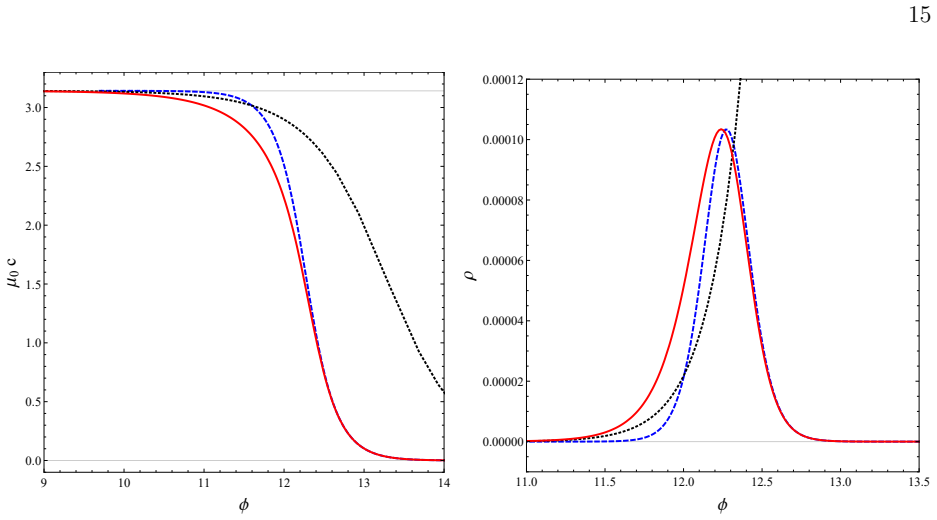

Figures from the paper (4 more)


Forward citations
Cited by 1 Pith paper
-
Some physical implications of regularization ambiguities in SU(2) gauge-invariant loop quantum cosmology
In Thiemann-regularized loop quantum cosmology, the mu0 scheme produces pre-bounce emergent matter with equation of state w = -1/3 (string gas), while the bar-mu scheme produces an emergent cosmological constant, and ...
Reference graph
Works this paper leans on
-
[57]
Taveras, Corrections to the Friedmann Equations from LQG for a Universe with a Free Scalar Field
V. Taveras, Corrections to the Friedmann Equations from LQG for a Universe with a Free Scalar Field. 28 Phys. Rev. D 78, 064072 (2008)
work page 2008
-
[1]
More on correlators and contact terms in {\cal N}=4 SYM at order g^4
T. Thiemann, Quantum Spin Dynamics (QSD): VII. Symplectic Structures and Continuum Lattice Formulations of Gauge Field Theories, Class. Quant. Grav. 18, 3293-3338 [arXiv:hep-th/00052232] (2001)
work page Pith review arXiv 2001
-
[2]
Rovelli, Quantum Gravity, Cambridge University Press (2004)
C. Rovelli, Quantum Gravity, Cambridge University Press (2004)
2004
-
[3]
A. Ashtekar, J. Lewandowski, Background independent quantum gravity: A Status report, Class. Quant. Grav. 21, R53-R152 (2004)
work page 2004
-
[4]
Thiemann, Modern Canonical Quantum General Relativity, Cambridge University Press (2007)
T. Thiemann, Modern Canonical Quantum General Relativity, Cambridge University Press (2007)
work page 2007
-
[5]
R. Arnowitt, S. Deser, C. Misner, The Dynamics of General Relativity, In: Gravitation: An introduc- tion to current research by L Witten (ed) New York 227-265 (1962)
work page 1962
-
[6]
Ashtekar, New variables for classical and Quantum Gravity, Phys
A. Ashtekar, New variables for classical and Quantum Gravity, Phys. Rev. Lett. 57, 2244-2247 (1986)
work page 1986
-
[7]
Ashtekar, New Hamiltonian formulation of General Relativity, Phys
A. Ashtekar, New Hamiltonian formulation of General Relativity, Phys. Rev. D 36, 1587-1602 (1987) 26
work page 1987
Show all 79 references
-
[8]
Barbero, A real polynomial formulation of General Relativity in terms of connection, Phys
J.F. Barbero, A real polynomial formulation of General Relativity in terms of connection, Phys. Rev. D 49, 6935-6938 (1994)
1994
-
[9]
Bojowald, Loop Quantum Cosmology, Living Rev
M. Bojowald, Loop Quantum Cosmology, Living Rev. Relativity 8, 11 (2005)
2005
-
[10]
Ashtekar, P
A. Ashtekar, P. Singh, Loop Quantum Cosmology: A Status Report, Class. Quant. Grav. 28, 213001 (2011)
2011
-
[11]
Ashtekar, T
A. Ashtekar, T. Pawlowski, P Singh, Quantum Nature of the Big Bang, Phys. Rev. Let. 96, 141301 (2006)
2006
-
[12]
Ashtekar, T
A. Ashtekar, T. Pawlowski, P. Singh, Quantum Nature of the Big Bang: An Analytical and Numerical Investigation, Phys. Rev. D 73, 124038 (2006)
2006
-
[13]
Ashtekar, A
A. Ashtekar, A. Corichi and P. Singh, Robustness of key features of loop quantum cosmology, Phys. Rev. D 77, 024046 (2008)
2008
-
[14]
Agullo, P
For a recent review of these developments see, I. Agullo, P. Singh, Loop Quantum Cosmology, in Loop Quantum Gravity: The First 30 Years, Eds: A. Ashtekar, J. Pullin, World Scientific (2017)
2017
-
[15]
Gambini, J
R. Gambini, J. Omedo and J. Pullin, Quantum black holes in loop quantum gravity, Class. Quant. Grav. 31, 095009 (2014)
2014
-
[16]
Ashtekar, J
A. Ashtekar, J. Olmedo and P. Singh, Quantum extension of the Kruskal spacetime, Phys. Rev. D 98, 126003 (2018)
2018
-
[17]
Brunnemann
J. Brunnemann. C Fleischhack, On the Configuration Spaces of Homogeneous Loop Quantum Cosmol- ogy and Loop Quantum Gravity, [arXiv:0709.1621] (2007)
2007 arXiv
-
[18]
Fleischhack, Kinematical Foundations of Loop Quantum Cosmology, [arXiv:1505.04400] (2015)
C. Fleischhack, Kinematical Foundations of Loop Quantum Cosmology, [arXiv:1505.04400] (2015)
2015 arXiv
-
[19]
Beetle, J
C. Beetle, J. Engle, M. Hogan, P. Mendonca, Diffeomorphism invariant cosmological symmetry in full quantum gravity, Int. J. Mod. Physics D 25, 1642012 (2016)
2016
-
[20]
Beetle, J
C. Beetle, J. Engle, M. Hogan, P. Mendonca, Diffeomorphism invariant cosmological sector in loop quantum gravity, [arXiv:1706.02424] (2017)
2017 arXiv
-
[21]
Engle, I
J. Engle, I. Vilensky, Deriving loop quantum cosmology dynamics from diffeomorphism invariance, [arXiv:1802.01543] (2018)
2018 arXiv
-
[22]
Alesci, F
E. Alesci, F. Cianfrani, A new perspective on cosmology in Loop Quantum Gravity, [arXiv:1210.4504] (2012)
2012 arXiv
-
[23]
Alesci, F
E. Alesci, F. Cianfrani, Quantum Reduced Loop Gravity: Semiclassical limit, [arXiv:1402.3155] (2014)
2014 arXiv
-
[24]
Alesci, G
E. Alesci, G. Botta, G. Luzi, G Stagno, Bianchi I effective dynamics in Quantum Reduced Loop Gravity, [arXiv:1901.07140] (2019)
2019 arXiv
-
[25]
Dapor, K
A. Dapor, K. Liegener, Cosmological Effective Hamiltonian from full Loop Quantum Gravity, Phys. Lett. B 785, 506-510 (2018)
2018
-
[26]
Dapor, K
A. Dapor, K. Liegener, Cosmological Coherent State Expectation Values in LQG I. Isotropic Kinemat- ics, Class. Quant. Grav. 35, 135011 [arXiv:1710.04015] (2018)
2018 arXiv
-
[27]
Liegener, R
K. Liegener, R. Lukasz, Cosmological Coherent State Expectation Values in LQG II. Thiemann- regularized Hamiltonian, (to appear)
-
[28]
Ashtekar, A
A. Ashtekar, A. Corichi, J. Zapata, Quantum theory of geometry: III. Non-commutativity of Rieman- nian structures, Class. Quant. Grav. 15, 2955-2972 (1998)
1998
-
[29]
Freidel, D
L. Freidel, D. Louapre, Ponzano-Regge model revisited I: Gauge fixing, observables and interacting spinning particles, Class. Quant. Grav. 21, 5685-5726 (2004)
2004
-
[30]
Baratin, B
A. Baratin, B. Dittrich, D. Oriti, J. Tambornino, Non-commutative flux representation for loop quan- tum gravity, Class. Quant. Grav. 28, 175011 (2010)
2010
-
[31]
Freidel, M
L. Freidel, M. Geiller, J. Ziprick, Continuous formulation of the Loop Quantum Gravity phase space, Class. Quant. Grav. 30, 085013 (2011) 27
2011
-
[32]
Bonzom, B
V. Bonzom, B. Dittrich, Dirac’s discrete hypersurface deformation algebras, [arXiv:1304.5983] (2013)
2013 arXiv
-
[33]
Dittrich, M
B. Dittrich, M. Geiller, A new vacuum for Loop Quantum Gravity, [arXiv:1401.6441] (2015)
2015 arXiv
-
[34]
A. S. Cattaneo, A. Perez, A note on the Poisson bracket of 2d smeared fluxes in loop quantum gravity, [arXiv:1611.08394] (2016)
2016 arXiv
-
[35]
Dupuis, L
M. Dupuis, L. Freidel, F. Girelli, Discretization of 3d gravity in different polarizations, Phys. Rev. D 96, 086017 (2017)
2017
-
[36]
Freidel, F
L. Freidel, F. Girelli, B Shoshany, 2+1D Loop Quantum Gravity on the Edge, [arXiv:1811.04360] (2018)
2018 arXiv
-
[37]
Magliaro, A
E. Magliaro, A. Marciano, C. Perini, Coherent states for FLRW space-times in loop quantum gravity, Phys.Rev. D 83, 044029 (2011)
2011
-
[38]
Liegener, P
K. Liegener, P. Singh, Gauge-invariant bounce from quantum geometry, arXiv:1906.02759
1906 arXiv
-
[39]
Thiemann, Gauge Field Theory Coherent States (GCS): I
T. Thiemann, Gauge Field Theory Coherent States (GCS): I. General Properties, Class. Quant. Grav. 18, 2025-2064 (2001)
2001
-
[40]
Thiemann, O
T. Thiemann, O. Winkler, Gauge Field Theory Coherent States (GCS): II. Peakedness Properties, Class. Quant. Grav. , 2561-2636 18 (2001)
2001
-
[41]
Thiemann, O
T. Thiemann, O. Winkler, Gauge Field Theory Coherent States (GCS): III. Ehrenfest Theorems, Class. Quant. Grav., 4629-4682 18 (2001)
2001
-
[42]
Thiemann, Complexifier coherent states for quantum general relativity, Class
T. Thiemann, Complexifier coherent states for quantum general relativity, Class. Quant. Grav. 23, 2063-2118 (2006)
2006
-
[43]
Sahlmann, T
H. Sahlmann, T. Thiemann, O. Winkler, Coherent states for canonical quantum General Relativity and the infinite tensor product extension, Nucl. Phys. B 606, 401-440 (2001)
2001
-
[44]
Giesel, T
K. Giesel, T. Thiemann, Algebraic Quantum Gravity (AQG) II. Semiclassical Analysis, Class. Quant.Grav. 24 2499-2564 (2007)
2007
-
[45]
Ashtekar, M
A. Ashtekar, M. Bojowald and J. Lewandowski, Mathematical structure of loop quantum cosmology, Adv. Theor. Math. Phys. 7, 233 (2003)
2003
-
[46]
Ashtekar, T
A. Ashtekar, T. Pawlowski, P. Singh, Quantum Nature of the Big Bang: Improved dynamics, Phys. Rev. D 74, 084003 (2006)
2006
-
[47]
Liegener, P
K. Liegener, P. Singh, Some physical implications of regularization ambiguities in SU(2) gauge-invariant loop quantum cosmology [arXiv:1908.07543] (2019)
2019 arXiv
-
[48]
Rovelli, L
C. Rovelli, L. Smolin, Discreteness of area and volume in quantum gravity, Nucl. Phys. B 442, 593-622 (1995)
1995
-
[49]
Ashtekar, J
A. Ashtekar, J. Lewandowski, Quantum Theory of Gravity I: Area Operators, Class. Quant. Grav. 14, A55-A82 (1996)
1996
-
[50]
Ashtekar, J
A. Ashtekar, J. Lewandowski, Quantum Theory of Geometry II: Volume Operators, Adv. Theor. Math. Phys 1, 388-429 (1998)
1998
-
[51]
Thiemann, Quantum Spin Dynamics (QSD) I, Class
T. Thiemann, Quantum Spin Dynamics (QSD) I, Class. Quant. Grav. 15, 839-873 (1998)
1998
-
[52]
Thiemann, Quantum Spin Dynamics (QSD) II, Class
T. Thiemann, Quantum Spin Dynamics (QSD) II, Class. Quant. Grav. 15, 875-905 (1998)
1998
-
[53]
Kogut, L Susskind, Hamiltonian Formulation of Wilsons Lattice Gauge Theories, Phys
J. Kogut, L Susskind, Hamiltonian Formulation of Wilsons Lattice Gauge Theories, Phys. Rev. D 11 (1975)
1975
-
[54]
Corichi, P
A. Corichi, P. Singh, Is loop quantization in cosmology unique?, Phys. Rev. D 78, 024034 (2008)
2008
-
[55]
Diener, B
P. Diener, B. Gupt, P. Singh, Numerical simulations of a loop quantum cosmos: robustness of the quantum bounce and the validity of effective dynamics, Class. Quant. Grav. 31, 105015 (2014)
2014
-
[56]
Diener, A
P. Diener, A. Joe, M. Megevand, P. Singh, Numerical simulations of loop quantum Bianchi-I spacetimes, Class. Quant. Grav. 34, 094004 (2017)
2017
-
[58]
B. Li, P. Singh, A. Wang, Towards Cosmological Dynamics from Loop Quantum Gravity, Phys Rev. D 97, 084029 (2018)
2018
-
[59]
Ashtekar, E
A. Ashtekar, E. Wilson-Ewing, Loop quantum cosmology of Bianchi type II models, Phys. Rev. D 80, 123532 (2009)
2009
-
[60]
Wilson-Ewing, Loop quantum cosmology of Bianchi type IX models, Phys
E. Wilson-Ewing, Loop quantum cosmology of Bianchi type IX models, Phys. Rev. D 82, 043508 (2010)
2010
-
[61]
Corichi, A
A. Corichi, A. Karami, Loop quantum cosmology of k=1 FRW: A tale of two bounces, Phys. Rev. D 84, 044003 (2011)
2011
-
[62]
Corichi, A
A. Corichi, A. Karami, Loop quantum cosmology of k=1 FLRW: Effects of inverse volume corrections, Class. Quant. Grav. 31, 035008 (2014)
2014
-
[63]
Saini, P
S. Saini, P. Singh, Generic absence of strong singularities in loop quantum Bianchi-IX spacetimes, Class. Quant. Grav. 36, 105014 (2019)
2019
-
[64]
Saini and P
S. Saini and P. Singh, Von Neumann stability of modified loop quantum cosmologies, Class. Quant. Grav. 36, 105010 (2019)
2019
-
[65]
Singh, E Wilson-Ewing, Quantisation ambiguities and bounds on geometric scalars in anisotropic loop quantum cosmology, Class
P. Singh, E Wilson-Ewing, Quantisation ambiguities and bounds on geometric scalars in anisotropic loop quantum cosmology, Class. Quant. Grav. 31, 035010 (2014)
2014
-
[66]
A Kolmogoroff, Zur Groessenordnung des Restgliedes Fourierscher Reihen Differenzierbarer Funktio- nen, Ann. of Math. 36, 521-526 (1935)
1935
-
[67]
Barrera-Figueroa, A
C. Barrera-Figueroa, A. Lucas-Bravo, J. Lopez-Bonilla, The remainder term in Fourier series and its relationship with the Basel problem, Ann. Math. et Info. 34, 17-28 (2007)
2007
-
[68]
Bojowald, Loop Quantum Cosmology I: Kinematics, Class
M. Bojowald, Loop Quantum Cosmology I: Kinematics, Class. Quant. Grav. 17, 1489-1508 (1999)
1999
-
[69]
Bojowald, Loop Quantum Cosmology II: Volume Operators, Class
M. Bojowald, Loop Quantum Cosmology II: Volume Operators, Class. Quant. Grav. 17, 1509-1526 (1999)
1999
-
[70]
Velhino, The Quantum Configuration Space of Loop Quantum Cosmology, Class Quant Grav
J. Velhino, The Quantum Configuration Space of Loop Quantum Cosmology, Class Quant Grav. 24, 3745-3758 (2007)
2007
-
[71]
Assanioussi, A
M. Assanioussi, A. Dapor, K. Liegener, T. Pawlowski, Emergent de Sitter epoch of the quantum Cosmos: a detailed analysis. [arXiv:1906.05315] (2019)
2019 arXiv
-
[72]
Smolin, Did the Universe evolve? Class
L. Smolin, Did the Universe evolve? Class. Quant. Grav. 9, 173 (1992)
1992
-
[73]
A difference from earlier studies of [72, 73] is that the change of constants is not random but completely fixed by the dynamics
as well as for Thiemann regularization of LQC using triads [58, 71]. A difference from earlier studies of [72, 73] is that the change of constants is not random but completely fixed by the dynamics. Let us note that regularized dynamics studied in this manuscript is at the momen...
-
[74]
Gambini, J
R. Gambini, J. Pullin, Discrete quantum gravity: A Mechanism for selecting the value of fundamental constants, Int. J. Mod. Phys. D 12, 1775 (2003)
2003
-
[75]
Hasenfratz, Prospects for perfect actions, Nucl
P. Hasenfratz, Prospects for perfect actions, Nucl. Phys. Proc. Suppl. 63, 53-58 (1998)
1998
-
[76]
Hasenfratz, The theorectical background and properties of perfect actions, [arXiv:hep-lat/9803027] (2008)
P. Hasenfratz, The theorectical background and properties of perfect actions, [arXiv:hep-lat/9803027] (2008)
2008 arXiv
-
[77]
T. Lang, K. Liegener, T. Thiemann, Hamiltonian Renormalisation III: Renormalisation Flow of 1+1 dimensional scalar fields: Properties, Class. Quant. Grav. 35, 245013 (2018)
2018
-
[78]
Assanioussi, Polymer quantization of connection theories: Graph coherent states, Phys
M. Assanioussi, Polymer quantization of connection theories: Graph coherent states, Phys. Rev. D 98, 045016 (2018)
2018
-
[79]
Thiemann, A
T. Thiemann, A. Zipfel, Stable Coherent States, Phys. Rev. D 93, 084030 (2016)
2016
Reviewed August 14, 2026 · model on record in the stance chip above.
Discussion (0). Continue with ORCID to comment.