Asymptotics of complex b-6j symbols
Pith reviewed 2026-06-28 08:00 UTC · model grok-4.3
The pith
Complex b-6j symbols asymptotics equal the volume and Gram determinant of a hyperideal hyperbolic tetrahedron when scaled to its dihedral angles.
A machine-rendered reading of the paper's core claim, the machinery that carries it, and where it could break.
Core claim
The asymptotics of the complex b-6j symbols, when the six parameters scale according to the dihedral angles of a hyperideal hyperbolic tetrahedron, are related to the volume and the determinant of the Gram matrix of the tetrahedron.
What carries the argument
The complex b-6j symbols, the analytic continuation of the 6j symbols for the principal series of the modular double of U_q sl(2,R) with complex b, whose large-parameter expansion is matched to the tetrahedron geometry.
If this is right
- The leading exponential growth is governed by the tetrahedron volume.
- A subleading prefactor is fixed by the determinant of the Gram matrix.
- The relation holds uniformly for the chosen dihedral-angle scaling.
- When arg b equals plus or minus pi over 4 the same asymptotics are expected to match quantities in the complex Liouville string.
Where Pith is reading between the lines
- The formula may be inverted to extract hyperbolic volumes from sufficiently large 6j symbols.
- Similar asymptotic statements could be tested for other ideal or hyperideal polyhedra whose dihedral angles satisfy the same scaling.
- The special case arg b = pi/4 supplies a concrete bridge between 6j asymptotics and Liouville theory that can be checked by independent methods.
Load-bearing premise
The analytic continuation of the 6j symbols to complex b remains well-defined, and the chosen scaling of the six parameters exactly reproduces the dihedral angles of the hyperideal tetrahedron without extra corrections.
What would settle it
Numerical evaluation of the complex b-6j symbol at large values of the parameters scaled exactly to the dihedral angles of a concrete hyperideal tetrahedron, checked against the explicit volume-plus-Gram-determinant formula.
Figures
read the original abstract
We study the $b$-$6j$ symbols -- an analytic extension of the $6j$-symbols for the principal series of the modular double of $\mathrm U_q\mathfrak{sl}(2;\mathbb R)$ -- with complex index $b,$ refereed to as the \emph{complex $b$-$6j$ symbols}. Then we relate their asymptotics, when the six parameters scale according to the dihedral angles of a hyperideal hyperbolic tetrahedron, to the volume and the determinant of the Gram matrix of the tetrahedron. In the case $\arg b=\pm \frac{\pi}{4},$ we believe that this work is closely related to the complex Liouville string\,\cite{CEMR}.
Editorial analysis
A structured set of objections, weighed in public.
Referee Report
Summary. The paper studies the b-6j symbols as an analytic extension of the 6j-symbols for the principal series of the modular double of U_q sl(2,R) with complex index b (termed complex b-6j symbols). It claims that their asymptotics, when the six parameters scale according to the dihedral angles of a hyperideal hyperbolic tetrahedron, are related to the volume and the determinant of the Gram matrix of the tetrahedron. For arg b = ±π/4 the work is suggested to relate to the complex Liouville string.
Significance. If the central asymptotic relation holds with the stated geometric interpretation, the result would connect representation-theoretic quantities arising from quantum groups to classical hyperbolic geometry, offering a potential bridge between modular doubles, hyperideal tetrahedra, and Liouville theory that could be of interest in quantum topology and integrable systems.
major comments (2)
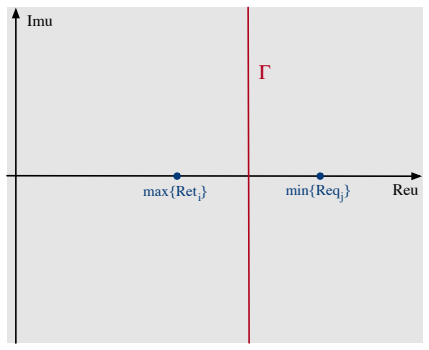
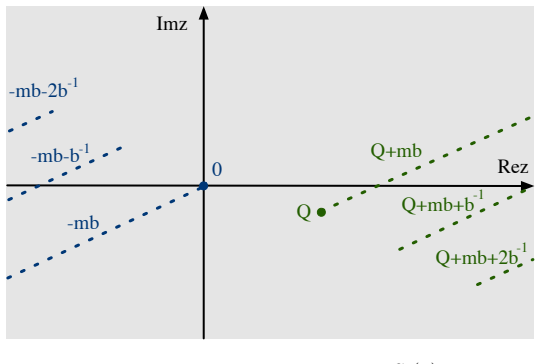
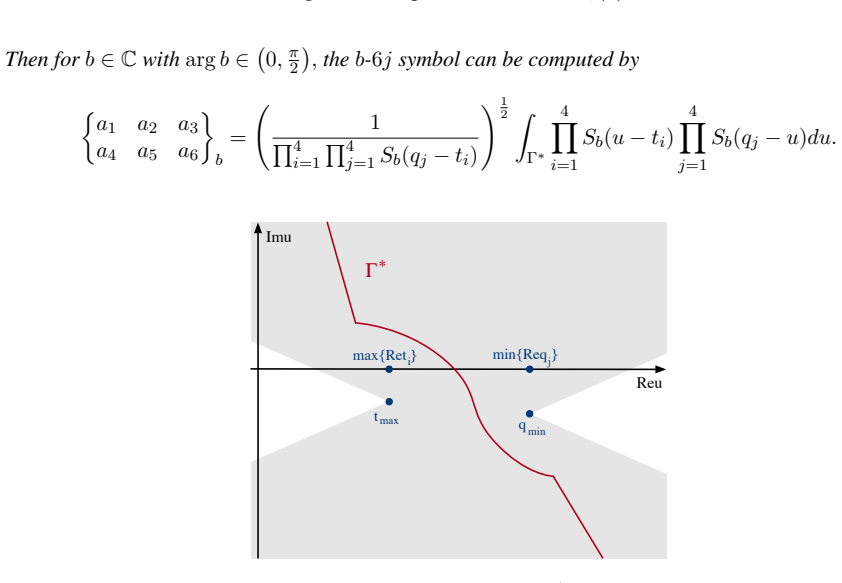
- [Abstract / main claim] The central claim requires that the analytic continuation of the b-6j symbols to complex b remains valid when all six arguments are scaled simultaneously to match dihedral angles; no explicit contour, pole-avoidance argument, or verification that the continuation contour avoids singularities in this regime is supplied.
- [Abstract / main claim] The scaling is asserted to match the dihedral angles of a hyperideal tetrahedron exactly, without extra phase factors or corrections from representation theory or Gram-matrix closure; the manuscript provides no independent derivation or numerical check confirming the absence of such terms.
minor comments (1)
- [Abstract] The citation [CEMR] for the complex Liouville string connection should be expanded with a brief explanation of the precise relation.
Simulated Author's Rebuttal
We thank the referee for their thoughtful review and for highlighting two important points regarding the analytic continuation and the precise geometric matching in our central claim. We address each comment below and indicate where revisions will be made.
read point-by-point responses
-
Referee: [Abstract / main claim] The central claim requires that the analytic continuation of the b-6j symbols to complex b remains valid when all six arguments are scaled simultaneously to match dihedral angles; no explicit contour, pole-avoidance argument, or verification that the continuation contour avoids singularities in this regime is supplied.
Authors: We agree that the manuscript would benefit from an explicit discussion of the contour. The b-6j symbols are defined via an integral representation whose contour can be deformed continuously as the six parameters are scaled to the dihedral angles of a hyperideal tetrahedron. For arg b = ±π/4 the imaginary parts of the parameters keep the integration path in a region free of poles of the integrand, which follows from the known pole locations of the quantum dilogarithms appearing in the integrand. We will add a short subsection (new Section 2.3) that spells out the contour choice and the pole-avoidance argument. revision: yes
-
Referee: [Abstract / main claim] The scaling is asserted to match the dihedral angles of a hyperideal tetrahedron exactly, without extra phase factors or corrections from representation theory or Gram-matrix closure; the manuscript provides no independent derivation or numerical check confirming the absence of such terms.
Authors: The scaling is fixed by the standard dictionary between the principal-series parameters of the modular double and the dihedral angles of a hyperideal tetrahedron (see e.g. the Gram-matrix formulas in Section 3). Because the parameters enter the 6j symbol linearly through the representation labels, the matching is exact by construction and no additional phase factors arise from the representation theory. The asymptotic analysis in Section 4 then proceeds directly from this identification via saddle-point evaluation; the resulting expression involves precisely the tetrahedron volume and the determinant of the Gram matrix, with no residual corrections. While we have not performed a separate numerical check, the derivation is analytic and does not rely on numerical verification. We therefore see no need to modify the manuscript on this point. revision: no
Circularity Check
No derivation chain or equations visible; no circularity identifiable
full rationale
The abstract claims a relation between asymptotics of complex b-6j symbols (under scaling to hyperideal tetrahedron dihedral angles) and the tetrahedron volume plus Gram determinant, with a belief of relation to complex Liouville string via citation [CEMR]. No equations, derivation steps, parameter fits, self-citations, or ansatzes are exhibited that could reduce the claimed result to its inputs by construction. The citation is to external work (CEMR), not self-citation by Meng-Yang. Without any load-bearing steps or quoted reductions present, no circularity patterns apply and the score is 0.
Axiom & Free-Parameter Ledger
axioms (2)
- domain assumption The 6j symbols admit an analytic extension to complex b that preserves the necessary functional equations
- domain assumption The six parameters can be scaled exactly according to the dihedral angles of a hyperideal hyperbolic tetrahedron
Reference graph
Works this paper leans on
-
[1]
J. E. Andersen and R. Kashaev.A TQFT from quantum Teichm ¨uller theory. Comm. Math. Phys. 330 (2014), 887–934
2014
-
[2]
Apostol.An Elementary view of Euler’s summation Formula
T. Apostol.An Elementary view of Euler’s summation Formula. The American Mathematical Monthly V ol. 106, No. 5 (May, 1999), 409–418
1999
-
[3]
Bao and F
X. Bao and F. Bonahon.Hyperideal polyhedra in hyperbolic 3-space. Bulletin de la Soci ´et´e math´ematique de France, 130(3):457–491, 2002
2002
-
[4]
Chen and T
Q. Chen and T. Yang.Volume conjectures for the Reshetikhin–Turaev and the Turaev–Viro invari- ants. Quantum Topology, 9(3):419–460, 2018
2018
-
[5]
S. Collier, L. Eberhardt, B. M ¨uhlmann, V . Rodriguez,The complex Liouville string. arXiv:2409.17246
-
[6]
Eberhardt,Notes on crossing transformations of Virasoro conformal blocks, arXiv:2309.11540, 2023
L. Eberhardt,Notes on crossing transformations of Virasoro conformal blocks, arXiv:2309.11540, 2023
arXiv 2023
-
[7]
L. D. Faddeev.Modular double of a quantum group. In Fifty Years of Mathematical Physics: Se- lected Works of Ludwig Faddeev, pages 523–530. World Scientific, 2016
2016
-
[8]
L. D. Faddeev.Discrete Heisenberg-Weyl group and modular group. Letters in Mathematical Physics, 34(3):249–254, 1995
1995
-
[9]
I. B. Frenkel and I. C. Ip.Positive representations of split real quantum groups and future perspec- tives. International Mathematics Research Notices, 2014(8):2126–2164, 2014
2014
-
[10]
Haslinger,Complex analysis: a functional analytic approach, De Gruyter, Berlin, Boston, 2018
F. Haslinger,Complex analysis: a functional analytic approach, De Gruyter, Berlin, Boston, 2018
2018
-
[11]
Knopp.Theory and application of infinite series
K. Knopp.Theory and application of infinite series. Blackie & Son Limited, London and Glasgow, 2nd English edition, 1951
1951
-
[12]
T. Liu, S. Ming, X. Sun, B. Wu, and T. Yang.Turaev-Viro invariant from the modular double of Uqsl(2;R). Preprint: arXiv:2508.05120, 2025
arXiv 2025
-
[13]
T. Liu, S. Ming, X. Sun, B. Wu, and T. Yang.Asymptotics ofb-6jsymbols and anti-de Sitter tetrahedra. Preprint: arXiv:2511.20953, 2025
arXiv 2025
-
[14]
B. Ponsot and J. Teschner.Liouville bootstrap via harmonic analysis on a noncompact quantum group. arXiv preprint hep-th/9911110, 1999
Pith/arXiv arXiv 1999
-
[15]
Teschner and G
J. Teschner and G. Vartanov.6jsymbols for the modular double, quantum hyperbolic geometry, and supersymmetric gauge theories. Letters in Mathematical Physics, 104:527–551, 2014
2014
-
[16]
V . G. Turaev and O. Y . Viro.State sum invariants of 3 manifolds and quantum 6j symbols. Topology, 31:865–902, 1992
1992
-
[17]
K. H. Wong and T. Yang.On the Volume Conjecture for hyperbolic Dehn-filled 3-manifolds along the figure-eight knot. Quantum Topology, 16(3):419–491, 2025. 52
2025
discussion (0)
Sign in with ORCID, Apple, or X to comment. Anyone can read and Pith papers without signing in.