REVIEW 3 major objections 5 minor 133 references
Approximate Quantum Error Correction at Chiral Topological Edges
T0 review · 3 major / 5 minor · reviewed 2026-08-07 · deepseek-v4-flash
Pith's one-line read Chiral topological edge states form a new family of approximate quantum error-correcting codes that beat their 1D counterparts under local erasure.
desk verdict A genuinely new AQEC construction with a clean relative-entropy reduction, but the headline 2D-vs-1D robustness comparison rests on an unproven dimensional-reduction assumption and on unpublished replica formulas. read the letter →
The pith
A machine-rendered reading of the paper's core claim, the machinery that carries it, and where it could break.
The reading
What carries the argument
The central objects are cylinder primary states |a, φ^I_a(L), φ^J_{\bar a}(R)⟩ of a chiral topological order, representing one state per anyon sector. The key mechanism is a dimensional-reduction assumption that identifies UV-finite entanglement quantities (relative entropies and mutual information of full-column regions) computed on the cylinder with those of a 1D rational CFT. This assumption, combined with the orthogonality of anyon sectors detected by a noncontractible bulk annulus, converts the coherent-information loss into a CFT-computable relative entropy. The machinery also includes the universal twirled Petz map and the full-boundary entanglement bootstrap, which provide the power-law-range recovery map.
What would settle it
Compute the coherent-information loss or the average relative entropy Δ(Y; V) for a physical lattice model of a chiral topological order (e.g., the ν=1/2 bosonic Laughlin state on a cylinder) at several system sizes. If the fitted exponent γ does not satisfy γ ≥ α, or if the relative-entropy formula of Thm. 7 fails to reproduce Δ(A; V) when the complement contains a noncontractible bulk annulus, the central claim is falsified. A direct check: evaluate S(ρ^a_B ∥ ρ̄_B) - log D for an annulus region B that is not fully symmetric; if it is not exponentially small, the orthogonality assumption underlying the theorem breaks.
Extended reading notes
Core claim
For a chiral edge code, when the complement of the erased region contains a noncontractible bulk annulus, the coherent-information loss equals the average relative entropy between codeword states on the erased region: Δ(A; V) = (1/D) Σ_a S(ρ^a_A ∥ ρ̄_A). This reduces the recoverability problem to universal edge CFT data. Consequently, the loss scales as a power law in the angular size x of the erased region, with distinct exponents α, β, γ. The main robustness result is the hierarchy γ ≥ α ≥ min{α,β}, where γ governs truly 2D edge-local erasures and min{α,β} governs the dimensionally reduced 1D CFT code, implying the 2D edge code is never worse and often better. For Abelian code subspaces, the paper constructs a power-law-range recovery map supported on the erased region plus a subextensive buffer, with recovery infidelity decaying as O(1) $L_x^{{-γ*μ*/(γ*+μ*)}}$ scale.
Load-bearing premise
The whole quantitative comparison between 2D chiral edge codes and their 1D CFT counterparts rests on Assumption 5: that every UV-finite entanglement quantity computed on the cylinder using primary states and full-column regions equals the same quantity computed in the dimensionally reduced 1D RCFT with the corresponding intervals.
Editorial extensions
If this is right
- If the claim is correct, chiral edge codes are the first explicit AQEC codes that combine a gapped, stable bulk with gapless edge degrees of freedom protected by topology, rather than fine-tuning, giving power-law robustness with computable exponents.
- The hierarchy γ ≥ α ≥ min{α,β} implies that for local erasures, the 2D edge code has a larger effective code distance d*(δ) ~ (δ/c)^{1/γ} compared to the dimensional-reduced 1D code, so information leakage is smaller for a given erasure size.
- The theorem establishing Δ = average relative entropy provides a direct, computable diagnostic for local recoverability: the coherent-information loss can be evaluated by CFT data alone, and bounds all local noise channel deficits.
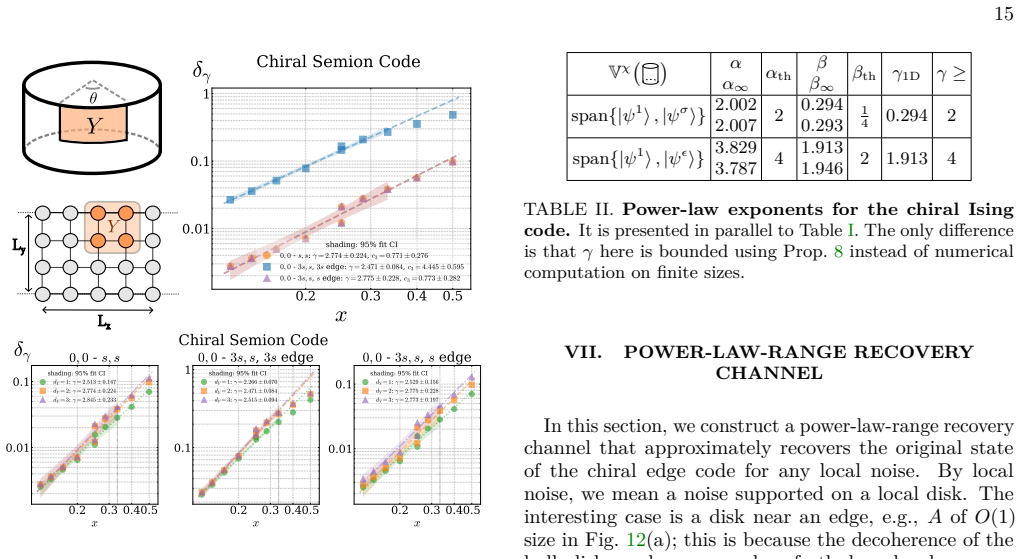
- The explicit power-law-range recovery map for Abelian sectors, independent of the encoded state, implies approximate error correction is possible with recovery supported within a subextensive buffer. For the chiral semion example the infidelity decays as L_x^{-0.697}, and for the chiral Ising example as L_x^{-0.276}.
- If the edge exponents are universal, the same power-law scaling should be observed in all microscopic lattice realizations in the same chiral topological phase, making this a robust fingerprint of the edge CFT.
Reading between the lines
- The dimensional-reduction assumption is stated as exact for UV-finite quantities; the paper's own discussion (Sec. VIII) openly lists deriving this correspondence with controlled errors as an open problem. A natural inference is that the exponents α, β, γ will receive finite-size and finite-correlation-length corrections, but the hierarchy γ ≥ α may still hold approximately in microscopic models.
- The power-law-range recovery construction depends on the Markov property for Abelian sectors; extending this to non-Abelian sectors likely requires a formulation that tracks the fusion-space structure, and may yield weaker locality guarantees.
- If the edge CFT codes are as robust as claimed, they provide a candidate platform for storing quantum information in fractional quantum Hall edge states, where the gapped bulk suppresses bulk errors and the edge handles the logical degrees of freedom.
- A testable extension: the chiral edge code robustness under extensive IID noise, beyond the finite-size signs of favorable exponents seen in Appendix E, needs to determine whether a threshold exists controlled by γ or another edge datum.
Editorial analysis
A structured set of objections, weighed in public.
Referee Report
Summary. The manuscript introduces a family of approximate quantum error-correcting codes, called chiral edge codes, whose code subspaces are spanned by cylinder primary states associated with distinct anyon sectors of a two-dimensional chiral topological order. The main technical results are: (i) an exact expression (Theorem 7) equating the coherent-information loss under erasure of a region A to an average of relative entropies on A whenever the complement contains a noncontractible bulk annulus; (ii) a power-law hierarchy (Proposition 8) relating the 2D local-erasure exponent γ to the 1D dimensional-reduction exponents α and β, namely γ ≥ α ≥ min{α, β}; and (iii) a power-law-range recovery theorem (Theorem 9) for Abelian code subspaces, with recovery supported on the erased region plus a subextensive buffer. The analytic predictions for α and β are tested numerically on lattice models realizing the chiral semion and Ising edge codes, and γ is estimated for the semion code using bosonic Laughlin wavefunctions. The paper is clearly written and the main logical steps are presented in detail, but the quantitative comparison between 2D and 1D codes rests on an unproven dimensional-reduction assumption and on replica-formula results deferred to a 'to appear' reference.
Significance. If the missing pieces are supplied, this is a valuable contribution that connects topological order, CFT-based approximate quantum error correction, and local-erasure diagnostics. The derivation of Theorem 7 is clean and follows from sector orthogonality plus the relative-entropy identity of Lemma 6; the monotonicity argument yielding γ ≥ α in Proposition 8 is sound. The numerical work is extensive and well documented (Appendices B, C, F), and the explicit construction of a code-subspace-dependent recovery map for Abelian sectors is a useful step beyond abstract recovery theorems. The main weakness is that the headline claim—that the 2D chiral edge code is at least as robust as its dimensionally reduced 1D counterpart—is conditional on Assumption 5 (Sec. IV D), which asserts an equivalence of all UV-finite entanglement quantities between cylinder primary states and 1D RCFT states. The paper itself lists the controlled derivation of this correspondence as an open problem.
major comments (3)
- [Sec. IV D, Assumption 5; used in Prop. 8, Eq. (53), and Thm. 9 (App. D)]
- [Appendix A 2, Eqs. (A20)-(A23)]
- [Sec. VII and Appendix D 3, Prop. 10 and proof of Thm. 9]
minor comments (5)
- [Sec. IV B, Definition 4]
- [Sec. V A, Eqs. (40)-(42)]
- [Sec. VI C, paragraph after Table I]
- [Appendix A 3]
- [Appendix B 1, Eq. (B1)]
Circularity Check
The robustness hierarchy is a proved inequality among defined exponents, but the 2D exponent is a definitional label of the same relative-entropy quantity and the analytic α,β values are deferred to an overlapping-authors 'to appear' paper; lattice numerics keep the central claim independently supported.
-
self definitional
[Sec. V C, Eq. (42) and Prop. 8 proof]
"xγ ∼ 1/D ∑_{a∈A_code} S(ρ^a_Y||ρ̄_Y), ... The first claim, ∆(Y ; Vχ)∼x γ, follows immediately from Thm. 7 and the definition of γ in Eq. (42)."
The exponent γ is defined by Eq. (42) as the leading small-x power of the average relative entropy on the region Y. Theorem 7 proves that the coherent-information loss ∆(Y;Vχ) is exactly equal to that same average relative entropy. Therefore the statement ∆(Y;Vχ)∼x^γ is not an independent prediction of the 2D robustness exponent; it is a relabeling of the assumed power-law scaling of the relative-entropy average, combined with Theorem 7. The genuinely nontrivial content is in Theorem 7 itself and in the monotonicity inequality γ≥α, not in the claim that the 2D loss is governed by the exponent γ, which holds by construction.
-
self citation load bearing
[Appendix A.2 (Relative entropy in RCFT); used in Sec. VI, Tables I and II]
"the universal formulas are available for both the interval A and its complement ¯A, the details of which will be presented in future work [74]; here we summarize the formulas needed for the present work."
The analytical values αth=(2,2) and βth=(1,5),(1/4,2) reported in Tables I and II come from Eqs. (A20)-(A23), whose derivation is deferred to Ref. [74], a paper with overlapping authorship (B. Shi, Y. Song, and Z. Wang are coauthors of the present manuscript). Thus the first-principles component of the exponent prediction is not self-contained: it appeals to an unpublished self-citation for the central formulas. However, the lattice numerics in Sec. VI independently estimate α and β for the same code subspaces, so the robustness comparison and the strict-enhancement examples do not depend on Ref. [74] alone. This limits the circularity to the analytic-theory layer rather than the main numerical claim.
full rationale
Theorem 7 is a genuine exact reduction: it proves that the coherent-information loss equals an average relative entropy, using the anyon-annulus orthogonality of the entanglement bootstrap (Ref. [47]), a published external result. The hierarchy γ≥α≥min{α,β} follows from the definitions of the exponents together with the monotonicity of relative entropy (Eq. (54)); it is a proved inequality among defined quantities, not a fitted prediction. The definitional component is that γ is introduced in Eq. (42) as the exponent of the very average relative entropy that Theorem 7 identifies with ∆(Y;Vχ), so asserting ∆∼x^γ is a labeling of an assumed scaling, while the nontrivial physical statement is the monotonicity inequality. The analytic values of α and β are deferred to Ref. [74], an overlapping-authors 'to appear' paper, so the analytic derivation is not self-contained; nevertheless the finite-size lattice computations of α, β, and γ in Sec. VI provide independent numerical support for the central comparison. The dimensional-reduction Assumption 5 is an explicit assumption whose controlled derivation the paper lists as an open problem in Sec. VIII; this is a limitation on the 2D/1D identification, not a hidden circular step. Overall, the main robustness comparison has independent numerical content, so the paper is only partially circular rather than fundamentally so.
Assumptions & free parameters
free parameters (5)
- Power-law exponent α =
2.075 (semion {|0,0>,|s,s>}), 2.000 (semion {|0,0>,|3s,s>}), 2.007 (Ising I-σ), 3.787 (Ising I-ε)
- Power-law exponent β =
0.927, 4.737, 0.293, 1.946 for the same code subspaces
- Power-law exponent γ =
2.774 and 2.471 (semion, for the two code subspaces)
- Disjoint-interval mutual information exponent µ* =
≈0.297 (Ising I-ε), ≈1.071 (semion)
- IID noise collapse exponents ζ_P =
ζ_Z≈-0.653, ζ_X≈-0.760 (2D); ζ_Z≈-0.200, ζ_X≈0.000 (1D)
assumptions (6)
- domain assumption Noncontractible bulk annuli perfectly resolve anyon sectors with orthogonal reduced density matrices (Eqs. (19)-(20))
- ad hoc to paper Assumption 5: dimensional reduction preserves UV-finite relative entropies and disjoint-interval mutual information between cylinder primary states and 1D RCFT states (Sec. IV D)
- domain assumption Full boundary entanglement bootstrap axioms A0 and A1 hold for cylinder primary states, with A1 only for Abelian sectors (Appendix D 1 b)
- ad hoc to paper Replica formulas for relative entropy with probabilistic mixtures, Eqs. (A20) and (A23), are correct
- domain assumption Lattice bosonic Laughlin wavefunctions at ν=1/2 realize the chiral semion edge primary states (Appendix B)
- domain assumption puMPS tangent-space states approximate Ising CFT primaries (Appendix C)
Cite this review
Pith. "Pith review of Approximate Quantum Error Correction at Chiral Topological Edges." pith.science (2026). https://pith.science/paper/MUZF3NFI
@misc{pith2026260806258,
  author       = {Pith},
  title        = {Pith review of: Approximate Quantum Error Correction at Chiral Topological Edges},
  year         = {2026},
  howpublished = {\url{https://pith.science/paper/MUZF3NFI}},
  note         = {Machine review of arXiv:2608.06258}
}
read the original abstract
Topologically ordered phases naturally realize quantum error correction through nonlocal encoding of quantum information. More recently, conformal field theories have been shown to realize approximate quantum error-correcting codes, but such constructions generally require fine tuning to criticality. Here we introduce a family of approximate quantum error-correcting codes realized by the chiral edges of two-dimensional topologically ordered phases. The proposed encoding combines the robustness of a gapped topological bulk with the flexibility of gapless edge conformal field theories. To characterize its robustness, we study coherent-information loss under local erasure. We derive an exact expression relating coherent-information loss to relative entropy, reducing the recoverability problem to universal properties of the edge theory. This leads to power-law scaling of coherent-information loss with the size of the erased region. We further show that, for geometrically local erasures near one edge, the two-dimensional chiral edge code is at least as robust as the dimensionally reduced CFT code, and is strictly more robust in several representative examples. For Abelian code subspaces, we further construct a power-law-range recovery map supported on the erased region together with a power-law-range buffer; this recovery map depends only on the code subspace, not on the unknown encoded state. We provide numerical calculations for lattice realizations of compact free boson and Ising CFT examples that support the theoretical predictions of the power-law exponents.
Figures


Figures from the paper (17 more)




Reference graph
Works this paper leans on
-
[74]
Characterizing topological order by the information convex,
B. Shi and Y.-M. Lu, “Characterizing topological order by the information convex,”Physical Review B99 (2019) 035112,1801.01519
arXiv 2019
-
[1]
Beyond these examples, exact all-x results are rare
Relative entropy between different primaries For relative entropy between two different primaries, there exist analytic formulas for any 0 < x <1 in free boson CFT [ 69, 70, 100] and Ising CFT [ 94], as we will discuss in the examples later. Beyond these examples, exact all-x results are rare. However, the leading small- interval (x≪ 1) behavior of the re...
-
[2]
Relative entropy with a probabilistic mixture Next, we present the relative entropy formulas between a primary and a mixture of primaries, which can be used to determine the exponentsαandβ. a. Analytic results ofα Before introducing the explicit results, for the small interval case, one may use joint convexity of relative entropy [103, 104] S( ∑ i λiρi|| ...
-
[3]
We then discuss the simplification 21 FIG
Review of the replica method Here we give a brief review of the replica method used to compute the relative entropy in (1+1)D CFT, as first discussed in [69, 70]. We then discuss the simplification 21 FIG. 13. The Euclidean path integral for computing tr [ ρa A(ρb A)n−1] . Given region A, the replica manifold Mn is obtained by gluing n copies of Euclidean...
-
[4]
This conformal transformation makes the calculation more tractable
Therefore, the above correlators can be equivalently computed on the complex plane. This conformal transformation makes the calculation more tractable. However, even after the conformal trans- formation, the relative entropy can only be computed explicitly in very special cases, for example, between two primaries in free boson CFT [ 69, 70, 100], or betwe...
-
[5]
charge number
Analytical wave functions The chiral semion topological order can be realized by the bosonic fractional quantum Hall (FQH) with ν = 1/2. Ref. [45, 76] provides a wider class of FQH states, with ν = 1/q in which q is an even integer. (Similar models have been generalized to non-Abelian topological orders, see e.g. [105, 106].) Here, we discuss the wave fun...
-
[6]
11, we choose the lattice of N = LxLy sites as follows
Cylinder with a square lattice For the cylinder used in Fig. 11, we choose the lattice of N = LxLy sites as follows. For integers Lx and Ly, sites are labeled by a row index j2 = 0,...,L y− 1 and a periodic coordinate j1 = 0,...,L x− 1, with j1∼j 1 +Lx. The corresponding row-major site label isj = 1+j2Lx+j1. The complex plane coordinates {zj} are generate...
-
[7]
To do so, we choose q = 2
Spin chains We can use this analytical wave function to simulate the 1D compact free boson RCFT with compactification radius R = √ 2 and central charge c = 1. To do so, we choose q = 2. For the primary state |φ 1 2, 1 2 s ⟩ which corresponds to the vertex operator V(z,¯z) =: exp ( i√ 2ϕ(z) + i√ 2 ¯ϕ(¯z) ) :,(B6) we set w1 = 0 and w2 = 108. The qubits are ...
Show all 133 references
-
[8]
A puMPS with phys- ical dimension d = 2 and bond dimension D is specified by one tensorA s∈C D×D, repeated at every site: |Ψ(A)⟩= d∑ s1,...,sN=1 Tr [ As1As2···A sN ] |s1s2···s N⟩
Hamiltonian and periodic uniform MPS ansatz The critical transverse-field Ising chain used in the simulation is HN =− N∑ j=1 XjXj+1− N∑ j=1 Zj,(C1) The ground-state variational ansatz is the periodic uni- form matrix product state (puMPS). A puMPS with phys- ical dimension d =...
-
[9]
For momentump= 2πk/N, define |Φp(B;A)⟩ = N∑ n=1 eipn∑ s Tr [As1···A sn−1BsnAsn+1···A sN ]|s⟩
Construction of excited states|σ⟩and|ϵ⟩ Low-energy excited states are represented by Bloch- state tangent vectors built on the optimized ground-state tensorA. For momentump= 2πk/N, define |Φp(B;A)⟩ = N∑ n=1 eipn∑ s Tr [As1···A sn−1BsnAsn+1···A sN ]|s⟩. (C11) The sign of p is a...
-
[10]
Reduced density matrices from puMPS contractions The reduced density matrix of subsystem M can be obtained directly from puMPS transfer matrices, avoiding the dense vector of sizedN. For two local tensorsXs,Y s∈ CD×D, define the single-site double-layer transfer matrices Es,t ...
-
[11]
Tools for the proof We present a set of tools and necessary background knowledge for the proof of theorem 9. a. A universal recovery theorem There is a universal recovery theorem following from Eq. (15) in Ref. [ 50]. For a pair of states ρ,σ such that 25 supp(ρ)⊆supp (σ), the...
-
[12]
Furthermore, the recovery map R has an explicit form as worked out in Ref. [50]. We shall need the special context of tripartite states ρABC andσABC living on a tensor product of three finite- dimensional Hilbert spacesHA⊗HB⊗HC with a channel NA acting on A. Furthermore, we re...
-
[13]
Define C :=Q\ (AB); see Fig
Proof of the theorem 9 Let A be the erased local disk near the edge and let B be a buffer region surrounding A. Define C :=Q\ (AB); see Fig. 15(a). We denote the channel on A asNA. Our first trick is to apply the variant of the universal recovery theorem from (D3), choosing σA...
-
[14]
Recall that,γ ab is defined according to S(ρa A||ρb A)∼x γab (D30) for regionAin Fig
A trick for computingγ ab We present a useful proposition that allows us to com- pute γab exactly using the dimensional reduction picture. Recall that,γ ab is defined according to S(ρa A||ρb A)∼x γab (D30) for regionAin Fig. 16. We now defineα ab according to S(ρa ABC||ρb ABC)...
-
[15]
Computation of relevant exponentµ a In this appendix, we compute the exponent µa that is relevant to the power-law-range recovery channel in Sec. VII. Recall that µa is defined according to an empir- ical formula of mutual information of a certain 1D CFT state|φa⟩ obtained fro...
-
[16]
[31], we assume that in the weak-noise regime Ic(p) =f ( pNζP ) , p→0, N→∞.(E5) Here ζP is the IID scaling-collapse exponent for Pauli type P
Weak-noise scaling ansatz Following the coherent-information scaling hypothesis of Ref. [31], we assume that in the weak-noise regime Ic(p) =f ( pNζP ) , p→0, N→∞.(E5) Here ζP is the IID scaling-collapse exponent for Pauli type P . (The exponent ζP corresponds to the exponent ...
-
[17]
We use the analytical wave function described in Appendix B 1, and we scale up the size of the cylinder N
Finite size scaling with Golden-cylinder coordinate We now describe the finite-size scaling method for ν = 1/2 fractional quantum Hall states. We use the analytical wave function described in Appendix B 1, and we scale up the size of the cylinder N. We map the cylinder coordin...
-
[18]
In both cases the coherent information is computed using the purification algorithm described in Appendix F
Numerical comparison:1D chain versus2D golden cylinder We compare IID Pauli dephasing for the dimensionally reduced 1D CFT code VCFT = Γ(Vχ( ) ) and the 2D chiral edge code Vχ( ) . In both cases the coherent information is computed using the purification algorithm described in...
2000
-
[19]
Scheme for reducing decoherence in quantum computer memory,
P. W. Shor, “Scheme for reducing decoherence in quantum computer memory,”Phys. Rev. A52(Oct,
-
[20]
Simple approach to approximate quantum error correction based on the transpose channel,
H. K. Ng and P. Mandayam, “Simple approach to approximate quantum error correction based on the transpose channel,”Phys. Rev. A81(June, 2010) 062342,0909.0931
2010 arXiv
-
[21]
Theory of quantum error-correcting codes,
E. Knill and R. Laflamme, “Theory of quantum error-correcting codes,”Phys. Rev. A55(Feb., 1997) 900–911
1997
-
[22]
Topological Orders in Rigid States,
X. G. Wen, “Topological Orders in Rigid States,” International Journal of Modern Physics B4(Jan.,
-
[23]
Ground-state degeneracy of the fractional quantum Hall states in the presence of a random potential and on high-genus Riemann surfaces,
X. G. Wen and Q. Niu, “Ground-state degeneracy of the fractional quantum Hall states in the presence of a random potential and on high-genus Riemann surfaces,” Phys. Rev. B41(May, 1990) 9377–9396, https://link.aps.org/doi/10.1103/PhysRevB.41.9377
1990 doi
-
[24]
Fault-tolerant quantum computation by anyons,
A. Y. Kitaev, “Fault-tolerant quantum computation by anyons,”Annals of Physics303(Jan., 2003) 2–30, quant-ph/9707021
2003 arXiv
-
[25]
Topological quantum memory,
E. Dennis, A. Kitaev, A. Landahl, and J. Preskill, “Topological quantum memory,”Journal of Mathematical Physics43(Sept., 2002) 4452–4505, quant-ph/0110143
2002 arXiv
-
[26]
Quantum error correction for quantum memories,
B. M. Terhal, “Quantum error correction for quantum memories,”Rev. Mod. Phys.87(2015), no. 2 307, 1302.3428
2015 arXiv
-
[27]
Quasiadiabatic continuation of quantum states: The stability of topological ground-state degeneracy and emergent gauge invariance,
M. B. Hastings and X.-G. Wen, “Quasiadiabatic continuation of quantum states: The stability of topological ground-state degeneracy and emergent gauge invariance,”Phys. Rev. B72(July, 2005) 045141, cond-mat/0503554. 33
2005 arXiv
-
[28]
Local unitary transformation, long-range quantum entanglement, wave function renormalization, and topological order,
X. Chen, Z.-C. Gu, and X.-G. Wen, “Local unitary transformation, long-range quantum entanglement, wave function renormalization, and topological order,” Phys. Rev. B82(Oct., 2010) 155138,1004.3835
2010 arXiv
-
[29]
Topological quantum order: Stability under local perturbations,
S. Bravyi, M. B. Hastings, and S. Michalakis, “Topological quantum order: Stability under local perturbations,”Journal of Mathematical Physics51 (Sept., 2010) 093512–093512,1001.0344
2010 arXiv
-
[30]
Strong Resilience of Topological Codes to Depolarization,
H. Bombin, R. S. Andrist, M. Ohzeki, H. G. Katzgraber, and M. A. Martin-Delgado, “Strong Resilience of Topological Codes to Depolarization,” Physical Review X2(Apr., 2012) 021004,1202.1852
2012 arXiv
-
[31]
On the stability of topological order in tensor network states,
D. J. Williamson, C. Delcamp, F. Verstraete, and N. Schuch, “On the stability of topological order in tensor network states,”Phys. Rev. B104(Dec., 2021) 235151,2012.15346
2021 arXiv
-
[32]
Topological Quantum Spin Glass Order and its realization in qLDPC codes,
B. Placke, T. Rakovszky, N. P. Breuckmann, and V. Khemani, “Topological Quantum Spin Glass Order and its realization in qLDPC codes,”arXiv e-prints (Dec., 2024) arXiv:2412.13248,2412.13248
2024 arXiv
-
[33]
On stability of k-local quantum phases of matter,
A. Lavasani, M. J. Gullans, V. V. Albert, and M. Barkeshli, “On stability of k-local quantum phases of matter,”arXiv e-prints(May, 2024) arXiv:2405.19412,2405.19412
2024 arXiv
-
[34]
Low-Density Parity-Check Stabilizer Codes as Gapped Quantum Phases: Stability under Graph-Local Perturbations,
W. De Roeck, V. Khemani, Y. Li, N. O’Dea, and T. Rakovszky, “Low-Density Parity-Check Stabilizer Codes as Gapped Quantum Phases: Stability under Graph-Local Perturbations,”PRX Quantum6(Aug.,
-
[35]
Approximate quantum error correction can lead to better codes,
D. W. Leung, M. A. Nielsen, I. L. Chuang, and Y. Yamamoto, “Approximate quantum error correction can lead to better codes,”Phys. Rev. A56(Oct., 1997) 2567–2573,quant-ph/9704002
1997 arXiv
-
[36]
Approximate Quantum Error Correction,
B. Schumacher and M. D. Westmoreland, “Approximate Quantum Error Correction,”Quantum Information Processing1(Apr., 2002) 5–12,quant-ph/0112106
2002 arXiv
-
[37]
Reversing quantum dynamics with near-optimal quantum and classical fidelity,
H. Barnum and E. Knill, “Reversing quantum dynamics with near-optimal quantum and classical fidelity,” Journal of Mathematical Physics43(May, 2002) 2097–2106,quant-ph/0004088
2002
-
[38]
The Information-Disturbance Tradeoff and the Continuity of Stinespring’s Representation,
D. Kretschmann, D. Schlingemann, and R. F. Werner, “The Information-Disturbance Tradeoff and the Continuity of Stinespring’s Representation,”arXiv e-prints(Apr., 2006) quant–ph/0605009, quant-ph/0605009
2006
-
[39]
Bootstrapping noninvertible symmetries,
Y.-H. Lin and S.-H. Shao, “Bootstrapping noninvertible symmetries,”Phys. Rev. D107(June, 2023) 125025, 2302.13900
2023 arXiv
-
[40]
General Conditions for Approximate Quantum Error Correction and Near-Optimal Recovery Channels,
C. B´ eny and O. Oreshkov, “General Conditions for Approximate Quantum Error Correction and Near-Optimal Recovery Channels,”Phys. Rev. Lett. 104(Mar., 2010) 120501,0907.5391
2010 arXiv
-
[41]
Limits on the storage of quantum information in a volume of space,
S. T. Flammia, J. Haah, M. J. Kastoryano, and I. H. Kim, “Limits on the storage of quantum information in a volume of space,”Quantum1(Apr., 2017) 4, 1610.06169
2017 arXiv
-
[42]
Complexity and order in approximate quantum error-correcting codes,
J. Yi, W. Ye, D. Gottesman, and Z.-W. Liu, “Complexity and order in approximate quantum error-correcting codes,”Nature Physics20(Nov., 2024) 1798–1803,2310.04710
2024 arXiv
-
[43]
Approximate Quantum Codes From Long Wormholes,
G. Bentsen, P. Nguyen, and B. Swingle, “Approximate Quantum Codes From Long Wormholes,”Quantum8 (Aug., 2024) 1439,2310.07770
2024 arXiv
-
[44]
Lov´ asz Meets Lieb-Schultz-Mattis: Complexity in Approximate Quantum Error Correction,
J. Yi, R. Liu, and Z. Li, “Lov´ asz Meets Lieb-Schultz-Mattis: Complexity in Approximate Quantum Error Correction,”arXiv e-prints(Oct., 2025) arXiv:2510.04453,2510.04453
2025
-
[45]
Continuous Symmetries and Approximate Quantum Error Correction,
P. Faist, S. Nezami, V. V. Albert, G. Salton, F. Pastawski, P. Hayden, and J. Preskill, “Continuous Symmetries and Approximate Quantum Error Correction,”Physical Review X10(Oct., 2020) 041018, 1902.07714
2020 arXiv
-
[46]
New perspectives on covariant quantum error correction,
S. Zhou, Z.-W. Liu, and L. Jiang, “New perspectives on covariant quantum error correction,”Quantum5(Aug.,
-
[47]
Bulk locality and quantum error correction in AdS/CFT,
A. Almheiri, X. Dong, and D. Harlow, “Bulk locality and quantum error correction in AdS/CFT,”Journal of High Energy Physics2015(Apr., 2015) 163, 1411.7041
2015 arXiv
-
[48]
Holographic quantum error-correcting codes: toy models for the bulk/boundary correspondence,
F. Pastawski, B. Yoshida, D. Harlow, and J. Preskill, “Holographic quantum error-correcting codes: toy models for the bulk/boundary correspondence,”Journal of High Energy Physics2015(June, 2015) 149, 1503.06237
2015 arXiv
-
[49]
Towards Holography via Quantum Source-Channel Codes,
F. Pastawski, J. Eisert, and H. Wilming, “Towards Holography via Quantum Source-Channel Codes,”Phys. Rev. Lett.119(July, 2017) 020501,1611.07528
2017 arXiv
-
[50]
Approximate Quantum Error Correcting Codes from Conformal Field Theory,
S. Sang, T. H. Hsieh, and Y. Zou, “Approximate Quantum Error Correcting Codes from Conformal Field Theory,”Phys. Rev. Lett.133(Nov., 2024) 210601, 2406.09555
2024 arXiv
-
[51]
Eigenstate thermalization hypothesis and approximate quantum error correction,
N. Bao and N. Cheng, “Eigenstate thermalization hypothesis and approximate quantum error correction,” Journal of High Energy Physics2019(Aug., 2019) 152, 1906.03669
2019 arXiv
-
[52]
Quantum Error Correcting Codes in Eigenstates of Translation-Invariant Spin Chains,
F. G. S. L. Brand˜ ao, E. Crosson, M. B. S ¸ahinoˇ glu, and J. Bowen, “Quantum Error Correcting Codes in Eigenstates of Translation-Invariant Spin Chains,”Phys. Rev. Lett.123(Sept., 2019) 110502,1710.04631
2019 arXiv
-
[53]
Error Threshold of SYK Codes from Strong-to-Weak Parity Symmetry Breaking,
J. Kim, E. Altman, and J. Y. Lee, “Error Threshold of SYK Codes from Strong-to-Weak Parity Symmetry Breaking,”arXiv e-prints(Oct., 2024) arXiv:2410.24225,2410.24225
2024 arXiv
-
[54]
Conformal Fields and Operator Product Expansion in Critical Quantum Spin Chains,
Y. Zou, A. Milsted, and G. Vidal, “Conformal Fields and Operator Product Expansion in Critical Quantum Spin Chains,”Phys. Rev. Lett.124(Jan., 2020) 040604, 1901.06439
2020 arXiv
-
[55]
Critical theory of quantum spin chains,
I. Affleck and F. D. M. Haldane, “Critical theory of quantum spin chains,”Phys. Rev. B36(Oct., 1987) 5291–5300
1987
-
[56]
Symmetry Protection of Critical Phases and a Global Anomaly in 1 +1 Dimensions,
S. C. Furuya and M. Oshikawa, “Symmetry Protection of Critical Phases and a Global Anomaly in 1 +1 Dimensions,”Phys. Rev. Lett.118(Jan., 2017) 021601
2017
-
[57]
Anomaly Matching and Symmetry-Protected Critical Phases in S U (N ) Spin Systems in 1 +1 Dimensions,
Y. Yao, C.-T. Hsieh, and M. Oshikawa, “Anomaly Matching and Symmetry-Protected Critical Phases in S U (N ) Spin Systems in 1 +1 Dimensions,”Phys. Rev. Lett.123(Nov., 2019) 180201,1805.06885
2019 arXiv
-
[58]
A mathematical theory of gapless edges of 2d topological orders. Part I,
L. Kong and H. Zheng, “A mathematical theory of gapless edges of 2d topological orders. Part I,”Journal of High Energy Physics2020(Feb., 2020) 150, 1905.04924
2020 arXiv
-
[59]
Topological orders and edge excitations in fractional quantum Hall states,
X.-G. Wen, “Topological orders and edge excitations in fractional quantum Hall states,”Advances in Physics 44(Sept., 1995) 405–473,cond-mat/9506066
1995 arXiv
-
[60]
Anyons in an exactly solved model and beyond,
A. Kitaev, “Anyons in an exactly solved model and beyond,”Annals of Physics321(Jan., 2006) 2–111, cond-mat/0506438
2006 arXiv
-
[61]
Anomalous Quantum Hall Effect: An Incompressible Quantum Fluid with Fractionally 34 Charged Excitations,
R. B. Laughlin, “Anomalous Quantum Hall Effect: An Incompressible Quantum Fluid with Fractionally 34 Charged Excitations,”Phys. Rev. Lett.50(May, 1983) 1395–1398
1983
-
[62]
Equivalence of the resonating-valence-bond and fractional quantum Hall states,
V. Kalmeyer and R. B. Laughlin, “Equivalence of the resonating-valence-bond and fractional quantum Hall states,”Phys. Rev. Lett.59(Nov, 1987) 2095–2098, https://link.aps.org/doi/10.1103/PhysRevLett.59.2095
1987 doi
-
[63]
Nonabelions in the fractional quantum hall effect,
G. Moore and N. Read, “Nonabelions in the fractional quantum hall effect,”Nuclear Physics B360(Aug.,
-
[64]
Laughlin Spin-Liquid States on Lattices Obtained from Conformal Field Theory,
A. E. B. Nielsen, J. I. Cirac, and G. Sierra, “Laughlin Spin-Liquid States on Lattices Obtained from Conformal Field Theory,”Phys. Rev. Lett.108(June,
-
[65]
Generalizations of Kitaev’s honeycomb model from braided fusion categories,
L. Eck and P. Fendley, “Generalizations of Kitaev’s honeycomb model from braided fusion categories,” SciPost Physics18(June, 2025) 170,2408.04006
2025 arXiv
-
[66]
Fusion rules from entanglement,
B. Shi, K. Kato, and I. H. Kim, “Fusion rules from entanglement,”Annals of Physics418(July, 2020) 168164,1906.09376
2020 arXiv
-
[67]
Chiral Virasoro algebra from a single wavefunction,
I. H. Kim, X. Li, T.-C. Lin, J. McGreevy, and B. Shi, “Chiral Virasoro algebra from a single wavefunction,” Annals of Physics471(Dec., 2024) 169849, 2403.18410
2024 arXiv
-
[68]
Quantum Conditional Mutual Information and Approximate Markov Chains,
O. Fawzi and R. Renner, “Quantum Conditional Mutual Information and Approximate Markov Chains,” Communications in Mathematical Physics340(Dec.,
-
[69]
Universal recovery maps and approximate sufficiency of quantum relative entropy,
M. Junge, R. Renner, D. Sutter, M. M. Wilde, and A. Winter, “Universal recovery maps and approximate sufficiency of quantum relative entropy,”Annales Henri Poincar´ e19(2018), no. 10 2955–2978,1509.07127
2018 arXiv
-
[70]
Quantum data processing and error correction,
B. Schumacher and M. A. Nielsen, “Quantum data processing and error correction,”Phys. Rev. A54(Oct.,
-
[71]
Relative entropy of excited states in two dimensional conformal field theories,
G. S´ arosi and T. Ugajin, “Relative entropy of excited states in two dimensional conformal field theories,” Journal of High Energy Physics2016(July, 2016) 114, 1603.03057
2016 arXiv
-
[72]
ρ′ QR =λ A⊗ρBR, whereλ A is an arbitrary density matrix andρ BR = TrA|ψQR⟩⟨ψQR|
One realization of the strongest channel is such that it replaces the local density by a product, e.g. ρ′ QR =λ A⊗ρBR, whereλ A is an arbitrary density matrix andρ BR = TrA|ψQR⟩⟨ψQR|
-
[73]
Gottesman,Stabilizer codes and quantum error correction
D. Gottesman,Stabilizer codes and quantum error correction. PhD thesis, California Institute of Technology, Jan., 1997
1997
-
[75]
Seeing topological entanglement through the information convex,
B. Shi, “Seeing topological entanglement through the information convex,”Physical Review Research1(Oct.,
-
[76]
Quantized thermal transport in the fractional quantum Hall effect,
C. L. Kane and M. P. A. Fisher, “Quantized thermal transport in the fractional quantum Hall effect,”Phys. Rev. B55(June, 1997) 15832–15837, cond-mat/9603118
1997 arXiv
-
[77]
Gapless edges of 2d topological orders and enriched monoidal categories,
L. Kong and H. Zheng, “Gapless edges of 2d topological orders and enriched monoidal categories,”Nuclear Physics B927(Feb., 2018) 140–165,1705.01087
2018 arXiv
-
[78]
Conformal Data and Renormalization Group Flow in Critical Quantum Spin Chains Using Periodic Uniform Matrix Product States,
Y. Zou, A. Milsted, and G. Vidal, “Conformal Data and Renormalization Group Flow in Critical Quantum Spin Chains Using Periodic Uniform Matrix Product States,” Phys. Rev. Lett.121(Dec., 2018) 230402,1710.05397
2018 arXiv
-
[79]
A mathematical theory of gapless edges of 2d topological orders. Part II,
L. Kong and H. Zheng, “A mathematical theory of gapless edges of 2d topological orders. Part II,”arXiv e-prints(Dec., 2019) arXiv:1912.01760,1912.01760
2019 arXiv
-
[80]
Conformal geometry from entanglement,
I. H. Kim, X. Li, T.-C. Lin, J. McGreevy, and B. Shi, “Conformal geometry from entanglement,”arXiv e-prints(Apr., 2024) arXiv:2404.03725,2404.03725
2024 arXiv
-
[81]
Protected Edge Modes without Symmetry,
M. Levin, “Protected Edge Modes without Symmetry,” Physical Review X3(Apr., 2013) 021009,1301.7355
2013 arXiv
-
[82]
Higher central charges and Witt groups,
S.-H. Ng, E. C. Rowell, Y. Wang, and Q. Zhang, “Higher central charges and Witt groups,”arXiv e-prints (Feb., 2020) arXiv:2002.03570,2002.03570
2020 arXiv
-
[83]
Higher central charges and topological boundaries in 2+1-dimensional TQFTs,
J. Kaidi, Z. Komargodski, K. Ohmori, S. Seifnashri, and S.-H. Shao, “Higher central charges and topological boundaries in 2+1-dimensional TQFTs,”SciPost Physics13(Sept., 2022) 067,2107.13091
2022 arXiv
-
[84]
Vertex operator algebras and operads,
Y.-Z. Huang and J. Lepowsky, “Vertex operator algebras and operads,”arXiv e-prints(Jan., 1993) hep–th/9301009,hep-th/9301009
1993
-
[85]
Vertex operator algebras, the Verlinde conjecture, and modular tensor categories,
Y.-Z. Huang, “Vertex operator algebras, the Verlinde conjecture, and modular tensor categories,”Proceedings of the National Academy of Science102(Apr., 2005) 5352–5356,math/0412261
2005 arXiv
-
[86]
Chiral topologically ordered states on a lattice from vertex operator algebra,
N. Sopenko, “Chiral topologically ordered states on a lattice from vertex operator algebra,”Advances in Theoretical and Mathematical Physics28(Jan., 2024) 1–35,2301.08697
2024 arXiv
-
[87]
On classification of modular tensor categories,
E. Rowell, R. Stong, and Z. Wang, “On classification of modular tensor categories,”arXiv e-prints(Dec., 2007) arXiv:0712.1377,0712.1377
2007 arXiv
-
[88]
General Relationship between the Entanglement Spectrum and the Edge State Spectrum of Topological Quantum States,
X.-L. Qi, H. Katsura, and A. W. W. Ludwig, “General Relationship between the Entanglement Spectrum and the Edge State Spectrum of Topological Quantum States,”Phys. Rev. Lett.108(May, 2012) 196402, 1103.5437
2012 arXiv
-
[89]
Relative Entropies in Conformal Field Theory,
N. Lashkari, “Relative Entropies in Conformal Field Theory,”Phys. Rev. Lett.113(Aug., 2014) 051602, 1404.3216
2014 arXiv
-
[90]
Modular Hamiltonian for Excited States in Conformal Field Theory,
N. Lashkari, “Modular Hamiltonian for Excited States in Conformal Field Theory,”Phys. Rev. Lett.117(July,
-
[91]
Tessellation codes: encoded quantum gates by geometric rotation,
Y. Wang, Y. Xu, and Z.-W. Liu, “Tessellation codes: encoded quantum gates by geometric rotation,”arXiv e-prints(Oct., 2024) arXiv:2410.18713,2410.18713
2024
-
[92]
Relative entropy of excited states in conformal field theories of arbitrary dimensions,
G. S´ arosi and T. Ugajin, “Relative entropy of excited states in conformal field theories of arbitrary dimensions,”Journal of High Energy Physics2017 (Feb., 2017) 60,1611.02959
2017 arXiv
-
[93]
Entanglement in descendants,
B. G. Chowdhury and J. R. David, “Entanglement in descendants,”Journal of High Energy Physics2022 (Feb., 2022) 3,2108.00898
2022 arXiv
-
[94]
Lashkari, J
N. Lashkari, J. Mohanty, B. Shi, Y. Song, and Z. Wang to appear(2026)
2026
-
[95]
Codes for the Quantum Erasure Channel,
M. Grassl, T. Beth, and T. Pellizzari, “Codes for the Quantum Erasure Channel,”Phys. Rev. A56(July,
-
[96]
Chiral Central Charge from a Single Bulk Wave Function,
I. H. Kim, B. Shi, K. Kato, and V. V. Albert, “Chiral Central Charge from a Single Bulk Wave Function,” Phys. Rev. Lett.128(Apr., 2022) 176402,2110.06932
2022 arXiv
-
[97]
Anyon braiding in semianalytical fractional quantum Hall lattice models,
A. E. B. Nielsen, “Anyon braiding in semianalytical fractional quantum Hall lattice models,”Phys. Rev. B 91(Jan., 2015) 041106,1409.3073
2015 arXiv
-
[98]
These standard errors quantify the uncertainty of the power-law fits but are not used as weights in the subsequent 1/Nregression
In panels (c) and (d), the error bars on the filled finite-Nsymbols represent one standard error of the exponent obtained from the corresponding fixed-N log-log regression. These standard errors quantify the uncertainty of the power-law fits but are not used as weights in the ...
-
[99]
Many-body chirality of topological stabilizer states,
T. D. Ellison, D. Lee, Z. Li, A. Moharramipour, Y. Panahi, and B. Yoshida, “Many-body chirality of topological stabilizer states,”arXiv e-prints(June,
-
[100]
Entanglement entropy of two disjoint intervals in conformal field theory,
P. Calabrese, J. Cardy, and E. Tonni, “Entanglement entropy of two disjoint intervals in conformal field theory,”Journal of Statistical Mechanics: Theory and Experiment2009(Nov., 2009) 11001,0905.2069
2009 arXiv
-
[101]
Entanglement entropy of two disjoint intervals in conformal field theory: II,
P. Calabrese, J. Cardy, and E. Tonni, “Entanglement entropy of two disjoint intervals in conformal field theory: II,”Journal of Statistical Mechanics: Theory and Experiment2011(Jan., 2011) 01021,1011.5482
2011 arXiv
-
[102]
Diagnostics of Mixed-State Topological Order and Breakdown of Quantum Memory,
R. Fan, Y. Bao, E. Altman, and A. Vishwanath, “Diagnostics of Mixed-State Topological Order and Breakdown of Quantum Memory,”PRX Quantum5 (May, 2024) 020343,2301.05689
2024 arXiv
-
[103]
Exact Calculations of Coherent Information for Toric Codes under Decoherence: Identifying the Fundamental Error Threshold,
J. Y. Lee, “Exact Calculations of Coherent Information for Toric Codes under Decoherence: Identifying the Fundamental Error Threshold,”Phys. Rev. Lett.134 (Jun, 2025) 250601, https://link.aps.org/doi/10.1103/hlfh-86yz
2025 doi
-
[104]
Coherent information for Calderbank-Shor-Steane codes under decoherence,
R. Niwa and J. Y. Lee, “Coherent information for Calderbank-Shor-Steane codes under decoherence,” Phys. Rev. A111(Mar, 2025) 032402, https://link.aps.org/doi/10.1103/PhysRevA.111.032402
2025 doi
-
[105]
Information Critical Phases under Decoherence,
A. Vijay and J. Y. Lee, “Information Critical Phases under Decoherence,”arXiv e-prints(Dec., 2025) arXiv:2512.22121,2512.22121
2025
-
[106]
Stability of Mixed-State Quantum Phases via Finite Markov Length,
S. Sang and T. H. Hsieh, “Stability of Mixed-State Quantum Phases via Finite Markov Length,”Phys. Rev. Lett.134(Feb., 2025) 070403,2404.07251
2025
-
[107]
Topological Mixed States: Phases of Matter from Axiomatic Approaches,
T.-H. Yang, B. Shi, and J. Y. Lee, “Topological Mixed States: Phases of Matter from Axiomatic Approaches,” arXiv e-prints(June, 2025) arXiv:2506.04221, 2506.04221
2025
-
[108]
Critical non-equilibrium phases from noisy topological memories,
A.-R. Negari, S. Sahu, J. Behrends, B. B´ eri, and T. H. Hsieh, “Critical non-equilibrium phases from noisy topological memories,”arXiv e-prints(Jan., 2026) arXiv:2601.10792,2601.10792
2026
-
[109]
Probing mixed-state phases on a quantum computer via Renyi correlators and variational decoding,
Y. Zhang, T. H. Hsieh, Y. B. Kim, and Y. Zou, “Probing mixed-state phases on a quantum computer via Renyi correlators and variational decoding,”arXiv e-prints(May, 2025) arXiv:2505.02900,2505.02900
2025 arXiv
-
[110]
Measuring Modular Matrices by Shearing Lattices,
Y.-Z. You and M. Cheng, “Measuring Modular Matrices by Shearing Lattices,”arXiv e-prints(Feb., 2015) arXiv:1502.03192,1502.03192
2015 arXiv
-
[111]
Instantaneous braids and Dehn twists in topologically ordered states,
G. Zhu, A. Lavasani, and M. Barkeshli, “Instantaneous braids and Dehn twists in topologically ordered states,” arXiv e-prints(June, 2018) arXiv:1806.06078, 1806.06078
2018 arXiv
-
[113]
Universal Quantum Computation with Gapped Boundaries,
I. Cong, M. Cheng, and Z. Wang, “Universal Quantum Computation with Gapped Boundaries,”Phys. Rev. Lett.119(Oct., 2017) 170504,1707.05490
2017 arXiv
-
[114]
Fractional quantum Hall states under density decoherence,
Z. Wang, R. Fan, T. Wang, S. J. Garratt, and E. Altman, “Fractional quantum Hall states under density decoherence,”arXiv e-prints(Oct., 2025) arXiv:2510.08490,2510.08490
2025
-
[115]
Numerical calculations on the relative entanglement entropy in critical spin chains,
Y. O. Nakagawa and T. Ugajin, “Numerical calculations on the relative entanglement entropy in critical spin chains,”Journal of Statistical Mechanics: Theory and Experiment9(Sept., 2017) 093104,1705.07899
2017 arXiv
-
[116]
Analytically Continuing the Randomized Measurement Toolbox,
A. Vijay, A. Raj, J. Kudler-Flam, B. Vermersch, A. Elben, and L. Nie, “Analytically Continuing the Randomized Measurement Toolbox,”arXiv e-prints (Nov., 2025) arXiv:2511.02912,2511.02912
2025 arXiv
-
[118]
Modular Commutators in Conformal Field Theory,
Y. Zou, B. Shi, J. Sorce, I. T. Lim, and I. H. Kim, “Modular Commutators in Conformal Field Theory,” Phys. Rev. Lett.129(Dec., 2022) 260402,2206.00027
2022 arXiv
-
[119]
Chirality, magic, and quantum correlations in multipartite quantum states,
S. Vardhan, B. Shi, I. H. Kim, and Y. Zou, “Chirality, magic, and quantum correlations in multipartite quantum states,”SciPost Physics20(Mar., 2026) 066, 2503.10764
2026 arXiv
-
[122]
Relative entanglement entropies in 1 + 1-dimensional conformal field theories,
P. Ruggiero and P. Calabrese, “Relative entanglement entropies in 1 + 1-dimensional conformal field theories,” Journal of High Energy Physics2017(Feb., 2017) 39, 1612.00659
2017 arXiv
-
[123]
Di Francesco, P
P. Di Francesco, P. Mathieu, and D. Senechal, Conformal Field Theory. Graduate Texts in Contemporary Physics. Springer-Verlag, New York, 1997
1997
-
[124]
Fusion Category Symmetry II: Categoriosities at c = 1 and Beyond,
R. Thorngren and Y. Wang, “Fusion Category Symmetry II: Categoriosities at c = 1 and Beyond,” arXiv e-prints(June, 2021) arXiv:2106.12577, 2106.12577
2021 arXiv
-
[125]
Expectations and entropy inequalities for finite quantum systems,
G. Lindblad, “Expectations and entropy inequalities for finite quantum systems,”Communications in Mathematical Physics39(June, 1974) 111–119
1974
-
[126]
Trace inequalities and quantum entropy: an introductory course,
E. Carlen, “Trace inequalities and quantum entropy: an introductory course,”Entropy and the quantum529 (2010), no. 73-140 146
2010
-
[127]
Non-Abelian quasiholes in lattice Moore-Read states and parent Hamiltonians,
S. Manna, J. Wildeboer, G. Sierra, and A. E. B. Nielsen, “Non-Abelian quasiholes in lattice Moore-Read states and parent Hamiltonians,”Phys. Rev. B98 (Oct., 2018) 165147,1807.11222
2018 arXiv
-
[128]
Bridging conformal field theory and parton approaches to SU(n)k chiral spin liquids,
T. Liu, Y.-H. Wu, H.-H. Tu, and T. Xiang, “Bridging conformal field theory and parton approaches to SU(n)k chiral spin liquids,”Phys. Rev. B111(May, 2025) 205137,2501.09567
2025
-
[129]
Variational optimization algorithms for uniform matrix product states,
V. Zauner-Stauber, L. Vanderstraeten, M. T. Fishman, F. Verstraete, and J. Haegeman, “Variational optimization algorithms for uniform matrix product states,”Phys. Rev. B97(Jan., 2018) 045145, 1701.07035
2018 arXiv
-
[130]
Strict Area Law Entanglement versus Chirality,
X. Li, T.-C. Lin, J. McGreevy, and B. Shi, “Strict Area Law Entanglement versus Chirality,”Phys. Rev. Lett. 134(May, 2025) 180402,2408.10306
2025
-
[131]
Strict area law implies commuting parent Hamiltonian,
I. H. Kim, T.-C. Lin, D. Ranard, and B. Shi, “Strict area law implies commuting parent Hamiltonian,”arXiv e-prints(Apr., 2024) arXiv:2404.05867,2404.05867
2024 arXiv
-
[132]
Modular commutator in gapped quantum many-body systems,
I. H. Kim, B. Shi, K. Kato, and V. V. Albert, “Modular commutator in gapped quantum many-body systems,” Phys. Rev. B106(Aug., 2022) 075147,2110.10400
2022 arXiv
-
[133]
Testing the robustness of topological quantities evaluated from the modular Hamiltonian for a given wavefunction,
S. Sharma and A. C. Balram, “Testing the robustness of topological quantities evaluated from the modular Hamiltonian for a given wavefunction,”arXiv e-prints (Apr., 2026) arXiv:2604.24058,2604.24058
2026 arXiv
-
[1995]
R2493–R2496, https://link.aps.org/doi/10.1103/PhysRevA.52.R2493
-
[1996]
2629–2635,quant-ph/9604022
-
[1997]
33–38,quant-ph/9610042
-
[2026]
arXiv:2606.20472,2606.20472
Reviewed August 7, 2026 · model on record in the stance chip above.
Discussion (0). Sign in to comment.