REVIEW 3 major objections 4 minor 47 references
Replacing fixed top-k routing in MoE-LoRA with a confidence-adaptive nucleus rule improves accuracy at matched compute and yields a free uncertainty signal.
Reviewed by Pith at T0; open to challenge. T0 means a machine referee read the full paper against a public rubric. the ladder, T0–T4 →
T0 review · deepseek-v4-flash
2026-08-04 03:15 UTC pith:MVVSYM2A
load-bearing objection Solid, modest contribution: adaptive expert-count routing via router-mass thresholding is genuinely new to MoE-LoRA and broadly evaluated, but the optimality proofs rely on unproven monotonicity and the empirics need error bars and a real artifact. the 3 major comments →
Spend Experts Where You Are Unsure: Confidence-Adaptive Routing for Mixture-of-Experts LoRA
The pith
A machine-rendered reading of the paper's core claim, the machinery that carries it, and where it could break.
Core claim
The central claim is that the router distribution in a trained MoE-LoRA is already a per-token uncertainty signal, and that using it to adapt the number of active experts—admitting experts in decreasing router weight until cumulative mass reaches a threshold, plus a small extension when admitted experts disagree—strictly improves the accuracy–compute frontier over fixed top-k routing. CARE is a drop-in, parameter-free, single-forward-pass rule that replaces only the gate. At matched average compute it improves accuracy (e.g., +0.5 on LLaMA commonsense), and at matched accuracy it needs 3.5 experts on average versus 4.0 for fixed-k. The same concentration and disagreement signals, blended as
What carries the argument
The carrying mechanism is the nucleus admission rule: sort router weights, accumulate them, and stop at the first k whose cumulative mass C_k reaches threshold τ; optionally extend by up to γ experts scaled by disagreement D(h;S) beyond δ. The budget thermostat (Eq. 5) calibrates τ by bisection on a held-out set to match an average budget B, so the average number of active experts is controlled. Disagreement D is the weighted per-coordinate variance of admitted expert outputs normalized by mean squared magnitude. Proposition 3 connects the thermostat to an optimal budget allocation under concavity and monotonicity of marginal gains.
Load-bearing premise
The central premise is that a token's chance of being answered correctly increases as the router's top-1 mass increases, and that each additional expert helps in proportion to the router mass it covers; if either monotonicity fails, CARE's optimality guarantees and potentially its accuracy gains weaken.
What would settle it
Measure the empirical correctness rate of tokens as a function of top-1 router mass p(1) on a given MoE-LoRA checkpoint. If the curve is non-monotonic (e.g., tokens with p(1) near 0.9 are less accurate than those near 0.6), then the confidence ranking guarantee (Prop. 2) fails and CARE's allocation may not be optimal. Similarly, plot marginal accuracy gain from the (k+1)-th expert against cumulative mass C_k; if the gain is not non-decreasing in C_k, the budget thermostat may not implement the claimed optimal allocation.
If this is right
- Any trained MoE-LoRA checkpoint can be wrapped with CARE at inference time by replacing the gate; no retraining, no extra parameters, no extra forward passes.
- The accuracy–compute frontier shifts upward: at any average budget CARE is more accurate than fixed top-k, and it reaches the fixed-k=4 accuracy with 12% fewer active experts.
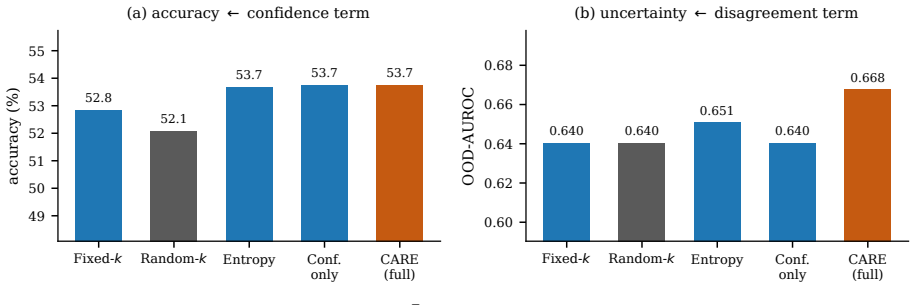
- CARE's confidence and disagreement signals yield a single-pass OOD detection score (AUROC 0.668) that outperforms max-softmax, entropy, and multi-pass proxies like MC-dropout and deep ensembles.
- Under distribution shift, CARE retains accuracy better than fixed top-k at the same average compute (53.1% vs 50.3%), because shifted inputs flatten the router and trigger more expert admissions.
- The thermostat provides a single knob τ that trades compute for accuracy along the frontier, letting deployments select an operating point.
Where Pith is reading between the lines
- The optimality guarantees (Props 2 and 3) rely on monotonicity of correctness probability in top-1 mass and monotonicity of marginal gain in cumulative mass; these are only partially validated. If they fail on a target distribution, CARE's allocation may not be budget-optimal, though the empirical gains could persist.
- CARE's benefit should scale with per-token difficulty heterogeneity; on homogeneous tasks it converges to fixed-k. A practitioner can pre-screen by measuring the variance of routing entropy across a small sample.
- The disagreement signal is defined over classification-style outputs; extending it to free-form generation (e.g., via semantic equivalence) is a natural next step that the paper leaves open.
- Per-layer thermostats, mentioned as an extension, could improve allocation further; a testable hypothesis is that layerwise calibration with per-layer budgets yields additional accuracy gains at the same total compute.
Editorial analysis
A structured set of objections, weighed in public.
Referee Report
Summary. The paper proposes CARE, a test-time routing rule for MoE-LoRA that replaces fixed top-k expert selection with per-token nucleus admission: experts are added in decreasing router weight until cumulative mass exceeds a threshold tau, with a disagreement-based extension, and tau is calibrated so that the average number of active experts matches a target budget. The same router signals (concentration and expert disagreement) are used as an uncertainty score for OOD detection and abstention. The paper claims that CARE improves accuracy over fixed top-k at matched compute (e.g., +0.5 on LLaMA commonsense and +0.9 on math/code/knowledge), matches fixed-k=4 accuracy with 12% fewer experts, and improves OOD-AUROC from 0.640 to 0.668 in a single forward pass. Theoretical support is provided via four propositions: nucleus fidelity, confidence ranking, budget optimality, and epistemic disagreement.
Significance. The contribution is potentially significant: if the empirical claims hold, CARE is a zero-retraining, single-pass improvement applicable to any MoE-LoRA model, and it yields a useful uncertainty signal as a by-product. The router-as-uncertainty idea is simple and well motivated, and the experimental suite spans two backbones and four task families. The reported gains are small but consistent in direction. However, the strength of the claims is undercut by an incomplete budget-optimality proof and by a lack of statistical detail in the empirical comparisons; these are fixable, so the paper merits revision rather than rejection.
major comments (3)
- [A.3 / Prop. 3] The proof of budget optimality does not establish that the nucleus threshold rule of Eq. (3) implements the optimal allocation. The greedy marginal-gain argument for a separable concave objective is standard, but the final step asserts that a threshold on marginal gain corresponds to a single threshold on cumulative mass C_k. This requires a cross-token homogeneity condition: the marginal gain of the last admitted expert must be a function of C_k that is comparable across tokens. The manuscript states this only as a modeling assumption and provides no direct evidence; Fig. 4(c) plots marginal gain against expert disagreement, not against C_k. Without a precise sufficient condition or a direct empirical test, the advertised 'budget optimality' is not supported. Please either prove a concrete condition under which the equivalence holds, add a test of monotonicity in C_k, or weaken the clai
- [Tables 1-4 / App. B] All headline numbers are three-seed means with no confidence intervals, error bars, or per-seed results. The key differences are small (+0.5 on LLaMA commonsense, +0.9 on math/code/knowledge) and the text describes the top fixed-k baselines as a 'tight band.' Without variance estimates it is impossible to judge whether the improvements are statistically distinguishable from noise. Since the central empirical claim is that CARE improves accuracy at matched compute, this is load-bearing. Please report per-seed values or error bars, and state whether the differences are significant.
- [§6.5 / Table 3] The OOD split is described only as 'a harder-and-flatter distribution shift of the same domain,' which is too vague to reproduce or to rule out selection bias. Moreover, the 'MC-dropout (proxy)' and 'Deep ensemble (proxy)' rows report AUROC 0.636/0.638, below the simple MSP baseline of 0.640. This is anomalous and suggests the proxy implementations are not faithful to the methods they approximate, undermining the claim that CARE beats multi-pass uncertainty methods. Specify exactly how the OOD split is constructed and how the proxies are computed, or remove the comparison to multi-pass methods.
minor comments (4)
- [Abstract / §4] CARE is described as 'no extra parameters' and 'parameter-free,' but Algorithm 1 depends on hyperparameters gamma, delta, w, kmin, kmax, and the calibrated tau*. These are not learned parameters, but the phrasing is overstated and could mislead readers about tuning burden.
- [Figure 4(b)] The x-axis label 'token difficulty' is not defined. It should be made explicit how difficulty is measured (e.g., empirical error rate, router entropy, or something else).
- [Table 2] The column header 'SV AMP' should be 'SVAMP'.
- [Eq. (6)] The notation for the sequence-level uncertainty score is ambiguous: H(p) and D are introduced as per-token quantities, but the equation appears to define a sequence-level average. Clarify the averaging.
Circularity Check
Empirical claims are externally benchmarked and non-circular, but the theoretical budget-optimality proof partly reduces to its own monotonicity assumption.
specific steps
-
other
[§5 Prop. 3 and App. A.3 (proof)]
"If the marginal gain ∆gj(k) is monotone in the covered routing mass Ck(pj) (the modeling assumption that extra experts help in proportion to the mass they add), then the threshold on marginal gain corresponds to a single threshold τ(λ) on cumulative mass, which is exactly the nucleus rule of Eq. (3) with the thermostat τ⋆ of Eq. (5)."
Proposition 3 is presented as proving that CARE's single-threshold nucleus rule is budget-optimal. The proof's final step does not derive this from concavity; it assumes that a threshold on cumulative mass C_k is equivalent to a threshold on marginal gain. That equivalence is precisely the property needed to make Eq. (3)/Eq. (5) optimal. A single global τ equalizes marginal gains only if marginal gain is the same monotone function of C_k across tokens, and the paper provides no direct evidence for this—Figure 4(c) plots marginal gain against disagreement, not C_k. The advertised 'budget optimality' is therefore encoded in the 'monotone in covered mass' assumption rather than established from the stated concavity premise.
full rationale
The central empirical claim—CARE improves accuracy at matched average compute and matches fixed-k=4 with 12% fewer experts—is evaluated against external fixed top-k and other MoE-LoRA baselines (Tables 1–3, Figure 3), so it is not circular. The budget thermostat is calibrated to a target average expert count by construction, but the accuracy-compute frontier is then measured, not defined. The self-citation to FRAME (Saliencro et al., 2026) is merely a related-work mention and is not load-bearing. Proposition 1 (nucleus fidelity) and Proposition 4 (disagreement as ensemble variance) are straightforward derivations from definitions. Proposition 2 is explicitly conditional ('If the correctness likelihood ratio is monotone...'), and while its conclusion is a restatement of the assumption, it is presented as a conditional theorem rather than a hidden premise. The one genuine circularity is in Proposition 3: the proof's final step assumes the very monotone relationship between marginal gain and cumulative mass that would make a single cumulative-mass threshold implement the optimal greedy allocation; without that unstated cross-token equivalence, the theorem does not follow. This partially undermines the theoretical support for budget optimality but leaves the externally benchmarked accuracy and OOD results intact.
Axiom & Free-Parameter Ledger
free parameters (5)
- tau* (budget thermostat threshold) =
~0.8 for B=4 (Table 5: tau=0.8 gives 3.96 avg experts)
- gamma (disagreement extension budget) =
2
- delta (disagreement threshold) =
0.55
- w (uncertainty blend weight) =
0.5
- kmax (max active experts cap) =
8
axioms (4)
- domain assumption Correctness probability eta(h) is non-decreasing in top-1 router mass p(1) (Prop. 2's monotone-likelihood assumption).
- ad hoc to paper Per-token accuracy gain g_j(k) is non-decreasing and concave in k, and marginal gain is monotone in cumulative routing mass C_k (Prop. 3).
- domain assumption Disagreement D(h;S) is an estimator of epistemic (reducible) uncertainty.
- domain assumption The held-out set used to calibrate tau* has router statistics representative of the test and shifted splits.
Cite this review
Pith. "Pith review of Spend Experts Where You Are Unsure: Confidence-Adaptive Routing for Mixture-of-Experts LoRA." pith.science (2026). https://pith.science/paper/MVVSYM2A
@misc{pith2026260726052,
  author       = {Pith},
  title        = {Pith review of: Spend Experts Where You Are Unsure: Confidence-Adaptive Routing for Mixture-of-Experts LoRA},
  year         = {2026},
  howpublished = {\url{https://pith.science/paper/MVVSYM2A}},
  note         = {Machine review of arXiv:2607.26052}
}
read the original abstract
Mixture-of-Experts (MoE) variants of Low-Rank Adaptation (LoRA) route every token to a fixed number of experts $k$. Tokens differ in how uncertain the model is about them, so a single k over-spends on easy tokens and under-serves hard ones. We observe that the router's output distribution is already a per-token uncertainty signal: peaked mass indicates confidence, while a flat distribution indicates ambiguity. We introduce CARE (Confidence-Adaptive Routing of Experts), which admits experts in a nucleus fashion. Experts are activated in decreasing router weight until their cumulative mass reaches a threshold, with a small extension when the admitted experts disagree. A budget thermostat calibrates the threshold so that the average number of active experts matches any target. CARE is a drop-in, single-forward-pass rule with no extra parameters. Across eight commonsense benchmarks on LLaMA-3.1-8B and Qwen2.5-7B, as well as math, code, and knowledge tasks, CARE improves over fixed top-k MoE-LoRA at matched compute and matches the fixed-k=4 baseline while activating fewer experts. The same confidence and disagreement signals also improve out-of-distribution detection over MSP, entropy, and multi-pass proxies. We support the design with nucleus fidelity, budget optimality, and an epistemic reading of disagreement, and we release code.
Figures


Reference graph
Works this paper leans on
-
[1]
and Shen, Yelong and Wallis, Phillip and Allen-Zhu, Zeyuan and Li, Yuanzhi and Wang, Shean and Wang, Lu and Chen, Weizhu , booktitle=
Hu, Edward J. and Shen, Yelong and Wallis, Phillip and Allen-Zhu, Zeyuan and Li, Yuanzhi and Wang, Shean and Wang, Lu and Chen, Weizhu , booktitle=. 2022 , eprint=
2022
-
[2]
Utility-Diversity Aware Online Batch Selection for
Zou, Heming and Mao, Yixiu and Qu, Yun and Wang, Qi and Ji, Xiangyang , journal=. Utility-Diversity Aware Online Batch Selection for. 2025 , url=
2025
-
[3]
2023 , eprint=
Zhang, Qingru and Chen, Minshuo and Bukharin, Alexander and Karampatziakis, Nikos and He, Pengcheng and Cheng, Yu and Chen, Weizhu and Zhao, Tuo , booktitle=. 2023 , eprint=
2023
-
[4]
International Conference on Learning Representations (ICLR) , year=
Outrageously Large Neural Networks: The Sparsely-Gated Mixture-of-Experts Layer , author=. International Conference on Learning Representations (ICLR) , year=. 1701.06538 , archivePrefix=
-
[5]
Journal of Machine Learning Research , volume=
Switch Transformers: Scaling to Trillion Parameter Models with Simple and Efficient Sparsity , author=. Journal of Machine Learning Research , volume=. 2022 , eprint=
2022
-
[6]
Gao, Chongyang and Chen, Kezhen and Rao, Jinmeng and Sun, Baochen and Liu, Ruibo and Peng, Daiyi and Zhang, Yawen and Guo, Xiaoyuan and Yang, Jie and Subrahmanian, V. S. , journal=. Higher Layers Need More. 2024 , url=
2024
-
[7]
2024 , eprint=
Dou, Shihan and Zhou, Enyu and Liu, Yan and Gao, Songyang and Zhao, Jun and Shen, Wei and Zhou, Yuhao and Xi, Zhiheng and Wang, Xiao and Fan, Xiaoran and Pu, Shiliang and Zhu, Jiang and Zheng, Rui and Gui, Tao and Zhang, Qi and Huang, Xuanjing , booktitle=. 2024 , eprint=
2024
-
[8]
2024 , url=
Li, Dengchun and Ma, Yingzi and Wang, Naizheng and Ye, Zhengmao and Cheng, Zhiyuan and Tang, Yinghao and Zhang, Yan and Duan, Lei and Zuo, Jie and Yang, Cal and Tang, Mingjie , journal=. 2024 , url=
2024
-
[9]
International Conference on Learning Representations (ICLR) , year=
Energy-based Automated Model Evaluation , author=. International Conference on Learning Representations (ICLR) , year=. 2401.12689 , archivePrefix=
-
[10]
2025 , url=
Li, Dengchun and Wang, Naizheng and Zhang, Zihao and Yin, Haoyang and Duan, Lei and Xiao, Meng and Tang, Mingjie , journal=. 2025 , url=
2025
-
[11]
2026 , eprint=
Saliencro, Tom and Lindqvist, Maya and Desai, Rohan and Nair, Priya and Whitmore, Daniel , journal=. 2026 , eprint=
2026
-
[12]
Functional-level Uncertainty Quantification for Calibrated Fine-tuning on
Niu, Ruijia and Wu, Dongxia and Yu, Rose and Ma, Yi-An , journal=. Functional-level Uncertainty Quantification for Calibrated Fine-tuning on. 2024 , url=
2024
-
[13]
2023 , url=
Wang, Xi and Aitchison, Laurence and Rudolph, Maja , journal=. 2023 , url=
2023
-
[14]
Transactions on Machine Learning Research , year=
M. Transactions on Machine Learning Research , year=. 2405.14438 , archivePrefix=
-
[15]
International Conference on Learning Representations (ICLR) , year=
Bayesian Low-rank Adaptation for Large Language Models , author=. International Conference on Learning Representations (ICLR) , year=. 2308.13111 , archivePrefix=
-
[16]
arXiv preprint arXiv:2511.08968 , year=
Bayesian Mixture of Experts for Large Language Models , author=. arXiv preprint arXiv:2511.08968 , year=
-
[17]
Advances in Neural Information Processing Systems (NeurIPS) , year=
Energy-based Out-of-distribution Detection , author=. Advances in Neural Information Processing Systems (NeurIPS) , year=. 2010.03759 , archivePrefix=
Pith/arXiv arXiv 2010
-
[18]
Proceedings of the 34th International Conference on Machine Learning (ICML) , year=
On Calibration of Modern Neural Networks , author=. Proceedings of the 34th International Conference on Machine Learning (ICML) , year=. 1706.04599 , archivePrefix=
-
[19]
Advances in Neural Information Processing Systems (NeurIPS) , year=
Simple and Scalable Predictive Uncertainty Estimation using Deep Ensembles , author=. Advances in Neural Information Processing Systems (NeurIPS) , year=. 1612.01474 , archivePrefix=
-
[20]
Proceedings of the 33rd International Conference on Machine Learning (ICML) , year=
Dropout as a Bayesian Approximation: Representing Model Uncertainty in Deep Learning , author=. Proceedings of the 33rd International Conference on Machine Learning (ICML) , year=. 1506.02142 , archivePrefix=
-
[21]
International Conference on Learning Representations (ICLR) , year=
Semantic Uncertainty: Linguistic Invariances for Uncertainty Estimation in Natural Language Generation , author=. International Conference on Learning Representations (ICLR) , year=. 2302.09664 , archivePrefix=
-
[22]
Advances in Neural Information Processing Systems (NeurIPS) , year=
Selective Classification for Deep Neural Networks , author=. Advances in Neural Information Processing Systems (NeurIPS) , year=. 1705.08500 , archivePrefix=
-
[23]
International Conference on Learning Representations (ICLR) , year=
The Curious Case of Neural Text Degeneration , author=. International Conference on Learning Representations (ICLR) , year=. 1904.09751 , archivePrefix=
Pith/arXiv arXiv 1904
-
[24]
International Conference on Learning Representations (ICLR) , year=
Measuring Massive Multitask Language Understanding , author=. International Conference on Learning Representations (ICLR) , year=. 2009.03300 , archivePrefix=
Pith/arXiv arXiv 2009
-
[25]
arXiv preprint arXiv:2110.14168 , year=
Training Verifiers to Solve Math Word Problems , author=. arXiv preprint arXiv:2110.14168 , year=
-
[26]
arXiv preprint arXiv:2107.03374 , year=
Evaluating Large Language Models Trained on Code , author=. arXiv preprint arXiv:2107.03374 , year=
-
[27]
Think you have Solved Question Answering? Try
Clark, Peter and Cowhey, Isaac and Etzioni, Oren and Khot, Tushar and Sabharwal, Ashish and Schoenick, Carissa and Tafjord, Oyvind , journal=. Think you have Solved Question Answering? Try. 2018 , url=
2018
-
[28]
2022 , eprint=
Lin, Stephanie and Hilton, Jacob and Evans, Owain , booktitle=. 2022 , eprint=
2022
-
[29]
Grattafiori, Aaron and Dubey, Abhimanyu and Jauhri, Abhinav and Pandey, Abhinav and Kadian, Abhishek and Al-Dahle, Ahmad and Letman, Aiesha and Mathur, Akhil and Schelten, Alan and Vaughan, Alex and others , journal=. The
-
[30]
Yang, An and Yang, Baosong and Zhang, Beichen and Hui, Binyuan and Zheng, Bo and Yu, Bowen and Li, Chengyuan and Liu, Dayiheng and Huang, Fei and Wei, Haoran and others , journal=
-
[31]
2024 , eprint=
Liu, Shih-Yang and Wang, Chien-Yi and Yin, Hongxu and Molchanov, Pavlo and Wang, Yu-Chiang Frank and Cheng, Kwang-Ting and Chen, Min-Hung , booktitle=. 2024 , eprint=
2024
-
[32]
2024 , eprint=
Tian, Chunlin and Shi, Zhan and Guo, Zhijiang and Li, Li and Xu, Cheng-Zhong , booktitle=. 2024 , eprint=
2024
-
[33]
Clark, Christopher and Lee, Kenton and Chang, Ming-Wei and Kwiatkowski, Tom and Collins, Michael and Toutanova, Kristina , booktitle=
-
[34]
Bisk, Yonatan and Zellers, Rowan and Gao, Jianfeng and Choi, Yejin , booktitle=
-
[35]
Zellers, Rowan and Holtzman, Ari and Bisk, Yonatan and Farhadi, Ali and Choi, Yejin , booktitle=
-
[36]
Sakaguchi, Keisuke and Le Bras, Ronan and Bhagavatula, Chandra and Choi, Yejin , booktitle=
-
[37]
Proceedings of the 2018 Conference on Empirical Methods in Natural Language Processing , pages=
Can a suit of armor conduct electricity? A new dataset for open book question answering , author=. Proceedings of the 2018 Conference on Empirical Methods in Natural Language Processing , pages=
2018
-
[38]
Measuring mathematical problem solving with the
Hendrycks, Dan and Burns, Collin and Kadavath, Saurav and Arora, Akul and Basart, Steven and Tang, Eric and Song, Dawn and Steinhardt, Jacob , journal=. Measuring mathematical problem solving with the
-
[39]
arXiv preprint arXiv:2108.07732 , year=
Program synthesis with large language models , author=. arXiv preprint arXiv:2108.07732 , year=
-
[40]
Advances in Neural Information Processing Systems (NeurIPS) , year=
Learn to Explain: Multimodal Reasoning via Thought Chains for Science Question Answering , author=. Advances in Neural Information Processing Systems (NeurIPS) , year=. 2209.09513 , archivePrefix=
-
[41]
Sap, Maarten and Rashkin, Hannah and Chen, Derek and Le Bras, Ronan and Choi, Yejin , booktitle=. Social
-
[42]
Patel, Arkil and Bhattamishra, Satwik and Goyal, Navin , journal=. Are
-
[43]
2025 , eprint=
Zou, Heming and Zang, Yunliang and Xu, Wutong and Zhu, Yao and Ji, Xiangyang , booktitle=. 2025 , eprint=
2025
-
[44]
Koncel-Kedziorski, Rik and Roy, Subhro and Amini, Aida and Kushman, Nate and Hajishirzi, Hannaneh , booktitle=
-
[45]
Proceedings of the 55th Annual Meeting of the Association for Computational Linguistics (Volume 1: Long Papers) , year=
Program induction by rationale generation: Learning to solve and explain algebraic word problems , author=. Proceedings of the 55th Annual Meeting of the Association for Computational Linguistics (Volume 1: Long Papers) , year=
-
[46]
2025 , url=
Liao, Mengqi and Chen, Wei and Shen, Junfeng and Guo, Shengnan and Wan, Huaiyu , booktitle=. 2025 , url=
2025
-
[47]
Parameter-Efficient Fine-Tuning with Discrete
Gao, Ziqi and Wang, Qichao and Chen, Aochuan and Liu, Zijing and Wu, Bingzhe and Chen, Liang and Li, Jia , booktitle=. Parameter-Efficient Fine-Tuning with Discrete. 2024 , eprint=
2024
discussion (0)
Sign in with ORCID, Apple, or X to comment. Anyone can read and Pith papers without signing in.