REVIEW 4 major objections 6 minor 113 references
"Conservatives Overfit, Liberals Underfit": The Social-Psychological Control of Affect and Uncertainty
T0 review · 4 major / 6 minor · reviewed 2026-08-14 · deepseek-v4-flash
Pith's one-line read The paper claims that a single somatic transform—the mathematical link between felt sentiment and symbolic interpretation—is sufficient to account for the classic fairness, dissonance, and conformity biases.
desk verdict A clean formal addition to BayesAct with honest limits, but the dissonance demonstration leans on a favorable prior choice and the simulations are illustrations, not evidence. read the letter →
The pith
A machine-rendered reading of the paper's core claim, the machinery that carries it, and where it could break.
The reading
What carries the argument
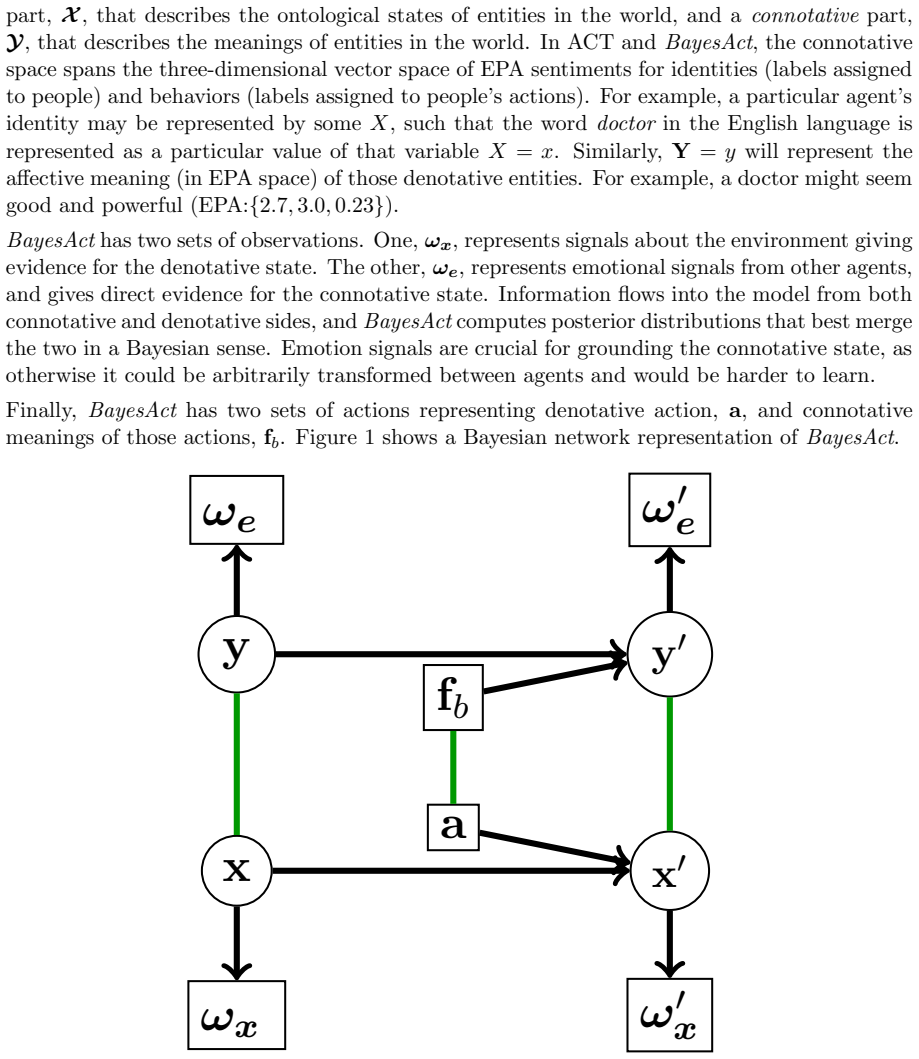
The central object is the somatic transform, a probabilistic map between the denotative state (what an agent believes is happening) and the connotative state (how that situation feels in a low-dimensional affective space defined by evaluation, potency, and activity). It is defined through the somatic potential $G(x,y) = c\,e^{-(y-M(x))^2/\gamma^2}$, where $M(x)$ gives the culturally shared sentiment for denotative entity $x$ and $\gamma$ controls the predictability of the environment. The transform computes posteriors over $x$ and $y$ by multiplying the priors with this potential, and it naturally shifts weight toward the connotative system as the denotative prior becomes more uncertain. This single object carries the argument: the same pair of posterior-update equations is used to generate the fairness, dissonance, and conformity results.
What would settle it
Re-run the three simulations using EPA sentiment norms collected from the exact populations and time periods of the original experiments rather than the 2015 US survey; if the predicted shifts (for instance, the dissonance posterior P'(bad) falling from 0.8 to 0.34) disappear or invert while the original behavioral effects are replicated, the somatic transform's sufficiency claim is refuted.
Extended reading notes
Core claim
The paper's central discovery is that the revised BayesAct model's somatic transform is sufficient to account for cognitive biases about fairness, dissonance, and conformity. In the dissonance simulation, updating a prior that the obtained prize is bad with a connotative prior tied to the self drives the posterior probability P'(bad) from 0.8 to 0.34, reversing the item's apparent value. In the conformity simulation, sequential observations of peers choosing an obviously wrong answer push P'(wrong) to 0.67 after five peers and to 0.995 after ten. The fairness result is reproduced as a shift from denotative, decision-theoretic reasoning toward connotative, socially normative reasoning when uncertainty is made salient. The paper presents these simulations as evidence that a single affect-cognition coupling, not separate fairness, dissonance, and conformity modules, can express all three effects.
Load-bearing premise
The load-bearing premise is that the survey-based sentiment meanings measured in one population can stand in for the meanings held by the people in the original experiments, even though the paper itself concedes this is clearly not true for the dissonance study.
Editorial extensions
If this is right
- Fairness, dissonance, and conformity are not separate psychological mechanisms but expressions of the same uncertainty-driven tradeoff between affective and deliberative processing.
- When denotative uncertainty rises, agents lean more heavily on connotative, socially normative reasoning; when uncertainty falls, denotative, decision-theoretic reasoning dominates.
- Artificial agents built on BayesAct can use the somatic transform to become interpretable members of social systems, with applications to online collaboration and assistive technologies.
- Random and value-based exploration in reinforcement learning are unified as reflections of the same uncertainty-management process, with socially normative policies emerging under higher uncertainty.
- Individual differences in the model's parameters correspond to stable biases in the bias-variance tradeoff, a suggestion the paper connects to the political spectrum via its 'conservatives overfit, liberals underfit' framing.
Reading between the lines
- The simulations use sentiment norms from a 2015 US survey, so the exact quantitative effect sizes are not yet calibrated to the original experimental populations; a natural next step would be fitting $\gamma$ and the priors directly to those datasets.
- If sentiment norms are era- and culture-specific, the model predicts measurable group differences in the strength of these biases, a claim that could be tested by re-running the simulations with dictionaries collected from different populations.
- The same transform suggests a design principle for artificial agents: increasing an agent's connotative weight should make it cooperate more in ambiguous social dilemmas, while lowering it should push it toward more individual, deliberative exploration.
Signed reviews
Editorial analysis
A structured set of objections, weighed in public.
Referee Report
Summary. The paper proposes a revised version of the Bayesian Affect Control Theory (BayesAct) in which a "somatic transform" couples a denotative (symbolic/cognitive) representation with a connotative (affective/EPA) representation through a Boltzmann potential. The authors claim that this single mechanism is sufficient to account for three classic social-psychological effects: the effect of uncertainty on fairness judgments (van den Bos, 2001), cognitive dissonance (Festinger), and conformity (Asch). The paper derives the somatic transform from a graphical model, gives closed-form posterior updates for Gaussian priors, and presents three exploratory simulations. It then discusses connections to dual-process theories, active inference, reinforcement learning exploration, and applications to online collaboration and dementia care.
Significance. If the central claim were established, the paper would offer a parsimonious, formally explicit account of several classic biases using a single affect-cognition coupling mechanism, with potential value for affective computing and multi-agent system design. The mathematical framework in Equations 1-4 is clear and the model is concretely testable, which is a genuine strength. However, the demonstrations are qualitative, rely on hand-set parameters, and in at least one case select a favorable prior rather than the population-appropriate one. The sufficiency claim is therefore not yet supported by the evidence presented; the paper is better read as a theoretical proposal with illustrative simulations than as a validated account of the three biases.
major comments (4)
- [Section 4.2, Figure 7] The dissonance simulation sets the connotative prior P(y) to the Georgia 2015 EPA profile for "child" (E=2.0, sigma=1.23), while the text itself notes that the actual participants in Festinger's study were teenage girls, whose E rating in the same dataset is 0.2 with sigma=1.3. The text explicitly states that "child" was selected "because it was more positive and less dispersed than teenager," which is a favorable, not neutral, choice. Since the posterior shift in P'(X=bad) from 0.8 to 0.34 is driven by the distance and dispersion of this prior, the demonstration does not establish the effect for the population on which the original experiment was run. The authors should report the result using the teenager prior and, ideally, integrate over plausible identity priors; Equation 7 only averages over sigma_y types and does not address the prior mean.
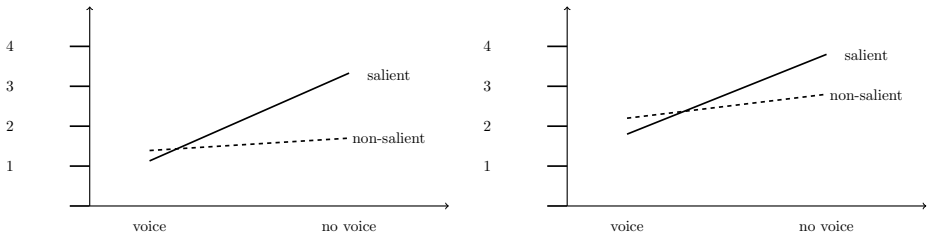
- [Section 4.1, Figure 6] The fairness demonstration is not actually a test of the somatic transform. The text states "Using ACT only" and employs the Indiana 2005 dataset and standard ACT deflection calculations, rather than applying Equations 3-4, which are the paper's claimed key component. The comparison to van den Bos's data is only qualitative ("these curves correspond in form"), with no quantitative fit or error measure. If the fairness result is meant to support the abstract's claim that the somatic transform is sufficient for fairness, the simulation must use that mechanism; otherwise the section should be explicitly framed as an ACT illustration and not as evidence for the new model.
- [Section 4.3, Equations 3-4] In the conformity simulation, the rise in P'(X=wrong) to 0.995 after 10 peers is driven primarily by repeated multiplication with the hand-set observation likelihood P(Omega_x|X)=0.85. Standard Bayesian updating of the denotative posterior would produce qualitatively similar conformity-like convergence even without any connotative coupling, so this demonstration does not isolate the contribution of the somatic potential. The authors should compare the model against a baseline with the somatic transform removed, and report sensitivity of the result to gamma, sigma_y, the prior P(X=wrong), and the observation likelihood.
- [Section 3.3-4, overall methodology] All three demonstrations select values for gamma, sigma_y, P(X), and the observation likelihood ad hoc, with no parameter estimation, error bars, or systematic sensitivity analysis. Because the central claim is that the model is "sufficient to account" for these biases, the authors should show that the qualitative effects persist over a range of parameter values rather than at a single hand-picked operating point. At a minimum, a sensitivity analysis for the dissonance and conformity simulations is needed to establish that the reported outcomes are not artifacts of the chosen parameters.
minor comments (6)
- [Abstract and Section 4] The abstract uses "demonstrate," while Section 4 is titled "Exploratory Examples" and the text repeatedly says the simulations are simplified; the phrasing should be aligned so the strength of the claim matches the evidence presented.
- [Section 4.3] There is a typo in the sentence about repeating the process "five five times," which should read "five times."
- [Section 4.2, Equation 7] In Equation 7 the left-hand side is written P(X=bad), but the text is computing an integrated posterior; the notation should be P'(X=bad) or otherwise clearly distinguish the posterior from the prior P(X=bad) used earlier.
- [Section 4.1, Figure 6] The scaling of the ACT distances to the 1-7 range in Figure 6(a) is not described; please provide the exact scaling formula so the reader can compare the simulation and experimental axes.
- [Section 4.2] The Festinger dissonance study is invoked without a specific reference; please cite the original study (or the specific variant with teenage girls) so the population claims can be checked.
- [Throughout] There are several typos, including "thefore lessvalid" in Section 2.1, "splotlight" in Section 2.3, and "interacti" in Section 5.3; a careful proofread is needed.
Circularity Check
Partial circularity: the dissonance demonstration is forced by selecting the favorable 'child' EPA prior, which the paper admits is unrepresentative of Festinger's participants.
-
fitted input called prediction
[Section 4.2 (Cognitive Dissonance), Figure 7, footnote 11; Eqs. 3-4]
"We selected child for this demonstrative example because it was more positive and less dispersed than teenager (EPA:{0.2, 0.7, 2.0}) with standard deviations of (EPA:{1.3, 1.5, 1.3})"
Equation 4 gives P'(x) as the prior P(x) weighted by an expectation of the somatic potential under P(y), so the reported shift from P(X=bad)=0.8 to P'(X=bad)=0.34 is a mathematical consequence of the chosen prior mean and variance of Y. The paper chooses the 'child' identity (E=2.0, sigma=1.23) explicitly because it is more positive and less dispersed than the age-appropriate 'teenager' prior (E=0.2), and concedes that the Georgia norms are 'clearly not' representative of the Festinger population. The demonstration therefore reduces by construction to the strength of a favorable identity prior; using the unrepresentative-but-favorable prior is what produces the advertised dissonance effect, so the 'prediction' is not an independent test of the model.
full rationale
The fairness simulation (Section 4.1) is a qualitative ACT calculation using external EPA norms and is not circular: it simply shows that a connotative 'anxious student' identity yields a larger fairness gap, matching van den Bos's pattern. The conformity simulation (Section 4.3) is ordinary sequential Bayesian updating with an observation likelihood of 0.85; the posterior rise to 0.995 is forced by the likelihood, but that is a transparent model mechanism rather than a fitted parameter. The self-citations to BayesAct (Hoey et al., 2016; Schroder et al., 2016) are not load-bearing for the three demonstrations, because the somatic transform and Equations 3-4 are introduced in this paper and the simulations are computed directly from them. The one genuine circularity is in the dissonance example: the paper's own footnote selects the 'child' EPA prior because it is favorable, and the manuscript's own text admits that the Georgia dataset is not representative of the dissonance experiment's population. Since the posterior shift is just the prior's pull through Equation 4, this particular 'account' of cognitive dissonance is an input choice presented as a prediction, giving partial circularity rather than a fully independent demonstration.
Assumptions & free parameters
free parameters (4)
- gamma =
0.3 (most examples; varied in Fig. 4)
- sigma_y =
2.0, 1.23, 0.5, 3.5 (per example)
- P(X) denotative prior =
nurse=0.7; bad=0.8; wrong=0.1
- Observation likelihood P(Omega_x|X) =
0.85
assumptions (6)
- standard math Bayes' rule and normalization of probability distributions
- domain assumption EPA space is a valid cross-cultural representation of affective meaning
- ad hoc to paper Somatic potential is a Boltzmann distribution G(x,y)=c exp(-(y-M(x))^2/gamma^2)
- domain assumption Prior independence P(X,Y)=P(X)P(Y)
- ad hoc to paper ACT dictionary norms from Georgia 2015 transfer to the experimental populations
- ad hoc to paper Gamma is a free parameter set by the agent
invented entities (1)
-
Somatic potential / somatic transform
Cite this review
Pith. "Pith review of "Conservatives Overfit, Liberals Underfit": The Social-Psychological Control of Affect and Uncertainty." pith.science (2026). https://pith.science/paper/MW5O6WNW
@misc{pith2026190803106,
  author       = {Pith},
  title        = {Pith review of: "Conservatives Overfit, Liberals Underfit": The Social-Psychological Control of Affect and Uncertainty},
  year         = {2026},
  howpublished = {\url{https://pith.science/paper/MW5O6WNW}},
  note         = {Machine review of arXiv:1908.03106}
}
read the original abstract
The presence of artificial agents in human social networks is growing. From chatbots to robots, human experience in the developed world is moving towards a socio-technical system in which agents can be technological or biological, with increasingly blurred distinctions between. Given that emotion is a key element of human interaction, enabling artificial agents with the ability to reason about affect is a key stepping stone towards a future in which technological agents and humans can work together. This paper presents work on building intelligent computational agents that integrate both emotion and cognition. These agents are grounded in the well-established social-psychological Bayesian Affect Control Theory (BayesAct). The core idea of BayesAct is that humans are motivated in their social interactions by affective alignment: they strive for their social experiences to be coherent at a deep, emotional level with their sense of identity and general world views as constructed through culturally shared symbols. This affective alignment creates cohesive bonds between group members, and is instrumental for collaborations to solidify as relational group commitments. BayesAct agents are motivated in their social interactions by a combination of affective alignment and decision theoretic reasoning, trading the two off as a function of the uncertainty or unpredictability of the situation. This paper provides a high-level view of dual process theories and advances BayesAct as a plausible, computationally tractable model based in social-psychological theory. We introduce a revised BayesAct model that more deeply integrates social-psychological theorising, and we demonstrate a component of the model as being sufficient to account for cognitive biases about fairness, dissonance and conformity. We show how the model can unify different exploration strategies in reinforcement learning.
Figures


Figures from the paper (5 more)




Reference graph
Works this paper leans on
-
[1]
Unpacking the habitus: Meaning making across lifestyles
Jens Ambrasat, Christian von Scheve, Gesche Schauenburg, Markus Conrad, and Tobias Schröder. Unpacking the habitus: Meaning making across lifestyles. Sociological Forum, 31 0 (4): 0 994--1017, 2016. doi:10.1111/socf.12293. URL https://onlinelibrary.wiley.com/doi/abs/10.1111/socf.12293
-
[2]
Effects of group pressure upon the modification and distortion of judgments
Solomon E Asch and Harold Guetzkow. Effects of group pressure upon the modification and distortion of judgments. Documents of gestalt psychology, pages 222--236, 1951
1951
-
[3]
The moral machine experiment
Edmond Awad, Sohan Dsouza, Richard Kim, Jonathan Schulz, Joseph Henrich, Azim Shariff, Jean-François Bonnefon, and Iyad Rahwan. The moral machine experiment. Nature, 563: 0 59--64, october 2018
2018
-
[4]
Social Interaction Systems: Theory and Measurement
Robert Freed Bales. Social Interaction Systems: Theory and Measurement. Transaction Publishers, New Brunswick, NJ, 1999
1999
-
[5]
The theory of constructed emotion: An active inference account of interoception and categorization
Lisa Feldman Barrett. The theory of constructed emotion: An active inference account of interoception and categorization. Social Cognitive and Affective Neuroscience, 12 0 (1): 0 1--23, 2017
2017
-
[6]
Large-scale brain networks in affective and social neuroscience: Towards an integrative functional architecture of the brain
Lisa Feldman Barrett and Ajay Satpute. Large-scale brain networks in affective and social neuroscience: Towards an integrative functional architecture of the brain. Current Opinion in Neurobiology, 23: 0 361--372, 2013
2013
-
[7]
Berger and Thomas Luckmann
Peter L. Berger and Thomas Luckmann. The Social Construction of Reality. Doubleday, 1966
1966
-
[8]
On the notions of causality and complementarity
Neils Bohr. On the notions of causality and complementarity. Science, 111: 0 51--54, 1950
1950
Show all 113 references
-
[9]
The Logic of Practice
Pierre Bourdieu. The Logic of Practice. Stanford University Press, 1990
1990
-
[10]
Brafman and Moshe Tennenholtz
Ronen I. Brafman and Moshe Tennenholtz. R-max – a general polynomial time algorithm for near-optimal reinforcement learning. Journal of Machine Learning Research, 3: 0 213--231, 2002
2002
-
[11]
Joost Broekens, Elmer Jacobs, and Catholijn M. Jonker. A reinforcement learning model of joy, distress, hope and fear. Connection Science, 27: 0 215–233, 2015
2015
-
[12]
What's inside your head once you've figured out what you head's inside of
Jelle Bruineberg and Erik Rietveld. What's inside your head once you've figured out what you head's inside of. Ecological Psychology, 31 0 (3): 0 198--217, 2019. doi:10.1080/10407413.2019.1615204
2019
-
[13]
Cacioppo, Gary G
John T. Cacioppo, Gary G. Berntson, Tyler S. Lorig, Catherine J. Norris, Edith Rickett, and Howard Nusbaum. Just because you're imaging the brain doesn't mean you can stop using your head: A primer and set of first principles. Journal of Personality and Social Psychology, 85: ...
2003
-
[14]
Bodily Changes in Pain, Hunger, Fear, and Rage
Walter Cannon. Bodily Changes in Pain, Hunger, Fear, and Rage. Ronald, New York, 2nd edition, 1929
1929
-
[15]
Valerie Capraro and David G. Rand. Do the right thing: Preferences for moral behavior, rather than equity or efficiency per se, drive human prosociality. Judgment and Decision Making, 13 0 (1): 0 99--111, January 2018
2018
-
[16]
Dual-Process Theories in Social Psychology
Shelly Chaiken and Yaacov Trope. Dual-Process Theories in Social Psychology. Guildford, New York, 1999
1999
-
[17]
Facing up to the problem of consciousness
David Chalmers. Facing up to the problem of consciousness. Journal of Consciousness Studies, 2: 0 200--219, 1995
1995
-
[18]
Barto, and Satinder P
Nuttapong Chentanez, Andrew G. Barto, and Satinder P. Singh. Intrinsically motivated reinforcement learning. In L.K. Saul, Y. Weiss, and L. Bottou, editors, Advances in Neural Information Processing Systems 17, pages 1281--1288. MIT Press, 2005
2005
-
[19]
Clore and Andrew Ortony
Gerald L. Clore and Andrew Ortony. Cognition in emotion: Always, sometimes, or never? In L. Nadel, R. Kane, and G. L. Ahern, editors, The Cognitive Neuroscience of Emotion, pages 24--61. Oxford University Press, New York, 2000
2000
-
[20]
Function of the thalamic reticular complex: the searchlight hypothesis
Francis Crick. Function of the thalamic reticular complex: the searchlight hypothesis. Proceedings of the National Academy of Sciences, 81: 0 4568--4590, 1984
1984
-
[21]
Antonio R. Damasio. Descartes' error: Emotion, reason, and the human brain. Putnam's sons, 1994
1994
-
[22]
Davidson
Richard J. Davidson. Seven sins in the study of emotion: Correctives from affective neuroscience. Brain and Cognition, 52: 0 129–132, 2003
2003
-
[23]
The helmholtz machine
Peter Dayan, Geoffrey E Hinton, Radford M Neal, and Richard S Zemel. The helmholtz machine. Neural computation, 7 0 (5): 0 889--904, 1995
1995
-
[24]
R.I.M. Dunbar. Neocortex size as a constraint on group size in primates. Journal of Human Evolution, 22 0 (6): 0 469 -- 493, 1992. ISSN 0047-2484. doi:http://dx.doi.org/10.1016/0047-2484(92)90081-J. URL http://www.sciencedirect.com/science/article/pii/004724849290081J
1992
-
[25]
Affect is a form of cognition: A neurobiological analysis
Seth Duncan and Lisa Feldman Barrett. Affect is a form of cognition: A neurobiological analysis. Cognition and Emotion, 21: 0 1184--1211, 2007
2007
-
[26]
The Division of Labor in Society
Emile Durkheim. The Division of Labor in Society. Free Press, 2014 (1893)
2014
-
[27]
Magy Seif El-Nasr, John Yen, and Thomas R. Ioerger. FLAME - fuzzy logic adaptive model of emotions. Autonomous Agents and Multiagent Systems, 3: 0 219--257, 2000
2000
-
[28]
Ernst Fehr and Klaus M. Schmidt. A theory of fairness, competition, and cooperation. The Quarterly Journal of Economics, 114 0 (3): 0 817--868, 1999. URL doi:10.1162/003355399556151
1999 doi
-
[29]
Resolving uncertainty in a social world
Oriel FeldmanHall and Amitai Shenhav. Resolving uncertainty in a social world. Nature Human Behaviour, In Press, 2019
2019
-
[30]
Joseph P. Forgas. Affect and cognition. Perspectives on Psychological Science, 3: 0 94--101, 2008
2008
-
[31]
Adams, Alexandra K\" o nig, and Jesse Hoey
Linda Francis, Richard E. Adams, Alexandra K\" o nig, and Jesse Hoey. Identity and the self in elderly adults with A lzheimer's disease. In Jane E. Stets and Richard T. Serpe, editors, Identities in Everyday Life, chapter 18, pages 381--402. Oxford University Press, 2019
2019
-
[32]
David D. Franks. Alternatives to C ollins' use of emotion in the theory of ritualistic chains. Symbolic Interaction, 12: 0 97--101, 1989
1989
-
[33]
David D. Franks. The neuroscience of emotions. In J. E. Stets and J. H. Turner, editors, Handbook of the Sociology of Emotions, pages 39--62. Springer, New York, 2006
2006
-
[34]
The structure of deference: Modeling occupational status using affect control theory
Robert Freeland and Jesse Hoey. The structure of deference: Modeling occupational status using affect control theory. American Sociological Review, 83 0 (2), April 2018
2018
-
[35]
Freeman and Nalini Ambady
Jonathan B. Freeman and Nalini Ambady. A dynamic interactive theory of person construal. Psychological Review, 118 0 (2): 0 247--279, 2011. doi:http://dx.doi.org/10.1037/a0022327
2011 doi
-
[36]
The free-energy principle: A unified brain theory? Nature Reviews Neuroscience, 11 0 ((2)): 0 127--138, 2010
Karl Friston. The free-energy principle: A unified brain theory? Nature Reviews Neuroscience, 11 0 ((2)): 0 127--138, 2010
2010
-
[37]
Samothrakis, and R
Karl Friston, S. Samothrakis, and R. Montague. Active inference and agency: optimal control without cost functions. Biological Cybernetics, 106 0 (8-9): 0 523--541, 2012
2012
-
[38]
Glaze, Alexandre L.S
Christopher M. Glaze, Alexandre L.S. Filipowicz, Joseph W. Kable, Vijay Balasubramanian, and Joshua I. Gold. A bias-variance trade-off governs individual differences in on-line learning in an unpredictable environment. Nature Human Behaviour, 2: 0 213--224, March 2018
2018
-
[39]
Gomez Esteban and D
P. Gomez Esteban and D. Rios Insua . An affective model for a non-expensive utility-based decision agent. IEEE Transactions on Affective Computing, pages 1--1, 2017. ISSN 1949-3045. doi:10.1109/TAFFC.2017.2737979
2017
-
[40]
James J. Gross. The emerging field of emotion regulation: An integrative review. Review of General Psychology, 2 0 (3): 0 271--299, 1998
1998
-
[41]
David R. Heise. Expressive Order: Confirming Sentiments in Social Actions. Springer, 2007
2007
-
[42]
David R. Heise. Modeling interactions in small groups. Social Psychology Quarterly, 76: 0 52--72, 2013
2013
-
[43]
Hedging your bets: and active inference formulation of valence and arousal
Casper Hesp. Hedging your bets: and active inference formulation of valence and arousal. Unpublished reserach project, 2018
2018
-
[44]
Bayesian affect control theory of self
Jesse Hoey and Tobias Schr\" o der. Bayesian affect control theory of self. In Proceedings of the AAAI Conference on Artificial Intelligence, pages 529--536, 2015
2015
-
[45]
Affect control processes: Intelligent affective interaction using a partially observable M arkov decision process
Jesse Hoey, Tobias Schr\" o der, and Areej Alhothali. Affect control processes: Intelligent affective interaction using a partially observable M arkov decision process. Artificial Intelligence, 230: 0 134--172, January 2016
2016
-
[46]
Artificial intelligence and social simulation: Studying group dynamics on a massive scale
Jesse Hoey, Tobias Schr \"o der, Jonathan Morgan, Kimberly B Rogers, Deepak Rishi, and Meiyappan Nagappan. Artificial intelligence and social simulation: Studying group dynamics on a massive scale. Small Group Research, 49 0 (6): 0 647--683, 2018
2018
-
[47]
Dilemmas for superrational thinkers, leading up to a luring lottery
Douglas Hofstadter. Dilemmas for superrational thinkers, leading up to a luring lottery. Scientific American, 248 0 (6), June 1983
1983
-
[48]
Bovenkamp
Eric Hogewoning, Joost Broekens, Jeroen Eggermont, and Ernst G.P. Bovenkamp. Strategies for affect-controlled action-selection in soar-rl. In J. Mira and J.R. \` A lvarez, editors, IWINAC, volume 4528 Part II of LNCS, pages 501--510, 2007
2007
-
[49]
Huntsinger, Linda M
Jeffrey R. Huntsinger, Linda M. Isbell, and Gerald L. Clore. The affective control of thought: Malleable, not fixed. Psychological Review, 121 0 (4): 0 600--618, 2014
2014
-
[50]
Principles of Psychology
William James. Principles of Psychology. Holt, New York, 1890
-
[51]
Leibo, and Nando De Freitas
Natasha Jaques, Angeliki Lazaridou, Edward Hughes, Caglar Gulcehre, Pedro Ortega, Dj Strouse, Joel Z. Leibo, and Nando De Freitas. Social influence as intrinsic motivation for multi-agent deep reinforcement learning. In Kamalika Chaudhuri and Ruslan Salakhutdinov, editors, Pro...
2019
-
[52]
Emotional valence and the free-energy principle
Mateus Joffily and Giorgio Coricelli. Emotional valence and the free-energy principle. PLoS Computational Biology , 9 0 (6): 0 e1003094, 2013
2013
-
[53]
Kenneth Joseph and Jonathan H. Morgan. Identity paper. unpublished, 2019
2019
-
[54]
Thinking, Fast and Slow
Daniel Kahneman. Thinking, Fast and Slow. Doubleday, 2011
2011
-
[55]
Conditions for intuitive expertise: A failure to disagree
Daniel Kahneman and Gary Klein. Conditions for intuitive expertise: A failure to disagree. American Psychologist, 64 0 (6): 0 515--526, September 2009
2009
-
[56]
Bandit based monte-carlo planning
Levente Kocsis and Csaba Szepesv\' a ri. Bandit based monte-carlo planning. In Proceedings of European Conference on Machine Learning, 2006
2006
-
[57]
Social dilemmas: the anatomy of cooperation
Peter Kollock. Social dilemmas: the anatomy of cooperation. Annual Review of Sociology, 24: 0 183--214, 1998
1998
-
[58]
Francis, Jyoti Joshi, Julie M
Alexandra K\" o nig, Linda E. Francis, Jyoti Joshi, Julie M. Robillard, and Jesse Hoey. Qualitative study of affective identities in dementia patients for the design of cognitive assistive technologies. Journal of Rehabilitation and Assistive Technologies Engineering, 4, 2017
2017
-
[59]
Richard D. Lane. Neural correlates of conscious emotional experience. In Richard D. Lane and Lynn Nadel, editors, Cognitive Neuroscience of Emotion, chapter 15, pages 345--370. Oxford University Press, 2000
2000
-
[60]
Lange and William James
Carl G. Lange and William James. The Emotions. Hafner, New York, 1922/1967
1922
-
[61]
Lawler, Shane R
Edward J. Lawler, Shane R. Thye, and Jeongkoo Yoon. Social Commitments in a Depersonalized World. Russell Sage Foundation, 2009
2009
-
[62]
R.S. Lazarus. On the primacy of cognition. American Psychologist, 39: 0 124--129, 1984
1984
-
[63]
The emotional brain: the mysterious underpinnings of emotional life
Joseph LeDoux. The emotional brain: the mysterious underpinnings of emotional life. Simon and Schuster, New York, 1996
1996
-
[64]
LeDoux and Richard Brown
Joseph E. LeDoux and Richard Brown. A higher-order theory of emotional consciousness. Proceedings of the National Academy of Sciences of the United States of America, 114: 0 E2016--E2025, 2017
2017
-
[65]
Li, Jeremy M
Linda C. Li, Jeremy M. Grimshaw, Camilla Nielsen, Maria Judd, Peter C. Coyte, and Ian D. Graham. Evolution of wenger's concept of community of practice. Implementation Science, 4 0 (1): 0 11, Mar 2009. ISSN 1748-5908. doi:10.1186/1748-5908-4-11. URL https://doi.org/10.1186/174...
2009 doi
-
[66]
Skills, toolkits, context and institutions: Clarifying the relationship between different approaches to cognition in cultural sociology
Omar Lizardo and Michael Strand. Skills, toolkits, context and institutions: Clarifying the relationship between different approaches to cognition in cultural sociology. Poetics, 38: 0 204--227, 2010
2010
-
[67]
Loewenstein and J.S
G. Loewenstein and J.S. Lerner. The role of affect in decision making. In R.J. Davidson, K.R. Sherer, and H.H. Goldsmith, editors, Handbook of Affective Sciences, page 619–642. Oxford Univ. Press, 2003
2003
-
[68]
N. J. MacKinnon. Symbolic Interactionism as Affect Control. State University of New York Press, Albany, 1994
1994
-
[69]
MacKinnon and David R
Neil J. MacKinnon and David R. Heise. Self, identity and social institutions. Palgrave and Macmillan, New York, NY, 2010
2010
-
[70]
Marinier III and John E
Robert P. Marinier III and John E. Laird. Emotion-driven reinforcement learning. In Proc. of 30th Annual Meeting of the Cognitive Science Society, pages 115--120, Washington, D.C., 2008
2008
-
[71]
Social Structures
John Levi Martin. Social Structures. Princeton University Press, 2009
2009
-
[72]
Life's a beach, but you're an ant, and other unwanted news for the sociology of culture
John Levi Martin. Life's a beach, but you're an ant, and other unwanted news for the sociology of culture. Poetics, 38: 0 228--243, 2010
2010
-
[73]
Peers at work
Alexandre Mas and Enrico Moretti. Peers at work. American Economic Review, 99 0 (1): 0 112--145, 2009
2009
-
[74]
Reward functions for accelerated learning
Maja J Mataric. Reward functions for accelerated learning. In Machine Learning Proceedings 1994, pages 181--189. Elsevier, 1994
1994
-
[75]
The bayesian stance: Equations for 'as-if' sensorimotor agency
Simon McGregor. The bayesian stance: Equations for 'as-if' sensorimotor agency. Adaptive Behavior, 25 0 (2): 0 72--82, 2017
2017
-
[76]
Moerland, Joost Broekens, and Catholijn M
Thomas M. Moerland, Joost Broekens, and Catholijn M. Jonker. Emotion in reinforcement learning agents and robots: A survey. Machine Learning, 107 0 (2): 0 443--480, 2017
2017
-
[77]
Douglas G. Mook. Motivation: The Organization of Action. Norton, New York, 1987
1987
-
[78]
Dolan, and Karl J
Michael Moutoussis, Pasco Fearon, Wael El-Deredy, Raymond J. Dolan, and Karl J. Friston. Bayesian inferences about the self (and others): a review. Consciousness and Cognition, 25: 0 67--76, 2014 a
2014
-
[79]
Dolan, and Karl J
Michael Moutoussis, Nelson J.Trujillo-Barreto, Wael El-Deredy, Raymond J. Dolan, and Karl J. Friston. A formal model of interpersonal inference. Frontiers in Human Neuroscience, 8 0 (160), 2014 b
2014
-
[80]
M. A. Nowak. Five rules for the evolution of cooperation. Science, 314: 0 1560–1563, 2006
2006
-
[81]
Ortony, G.L
A. Ortony, G.L. Clore, and A. Collins. The Cognitive Structure of Emotions. Cambridge University Press, 1988
1988
-
[82]
Ortony, D
A. Ortony, D. Norman, and W. Revelle. Affect and proto-affect in effective functioning. In J. Fellous and M. Arbib, editors, Who needs emotions: The brain meets the machine, pages 173--202. Oxford University Press, 2005
2005
-
[83]
Charles E. Osgood. On the whys and wherefores of epa. Journal of Personality and Social Psychology, 12: 0 194--199, 1969
1969
-
[84]
Osgood, G
Charles E. Osgood, G. J. Suci, and Percy H. Tannenbaum. The Measurement of Meaning. University of Illinois Press, Urbana, 1957
1957
-
[85]
Osgood, William H
Charles E. Osgood, William H. May, and Murray S. Miron. Cross-Cultural Universals of Affective Meaning. University of Illinois Press, 1975
1975
-
[86]
On the relationship between emotion and cognition
Luiz Pessoa. On the relationship between emotion and cognition. Nature Review Neuroscience, 9: 0 148--158, 2008
2008
-
[87]
Understanding emotion with brain networks
Luiz Pessoa. Understanding emotion with brain networks. Current Opinion in Behavioral Sciences, 19: 0 19–25, 2018
2018
-
[88]
Understanding patient preference for physician attire: a cross-sectional observational study of 10 academic medical centres in the usa
Christopher M Petrilli, Sanjay Saint, Joseph J Jennings, Andrew Caruso, Latoya Kuhn, Ashley Snyder, and Vineet Chopra. Understanding patient preference for physician attire: a cross-sectional observational study of 10 academic medical centres in the usa. BMJ Open, 8 0 (5), 201...
2018 doi
-
[89]
The Emotions
Robert Plutchik. The Emotions. University Press of America, 1980
1980
-
[90]
A theory of fairness, competition and cooperation
Matthew Rabin. A theory of fairness, competition and cooperation. The American Economic Review, 83 0 (5): 0 1281--1302, 1993
1993
-
[91]
A tale of two densities: active inference is enactive inference
Maxwell JD Ramstead, Michael D Kirchhoff, and Karl J Friston. A tale of two densities: active inference is enactive inference. Adaptive Behavior, 0 0 (0): 0 1--15, 2019. doi:10.1177/1059712319862774
2019 doi
-
[92]
Dynamic social networks promote cooperation in experiments with humans
DG Rand, S Arbesman, and NA Christakis. Dynamic social networks promote cooperation in experiments with humans. Proc Natl Acad Sci USA, 108 0 (48): 0 19193–19198, 2011
2011
-
[93]
Read Montague, and Peter Dayan
Debajyoti Ray, Brooks King-Casas, P. Read Montague, and Peter Dayan. Bayesian model of behaviour in economic games. In Proceedings of Neural Information Processing Systems, 2008
2008
-
[94]
Robillard and Jesse Hoey
Julie M. Robillard and Jesse Hoey. Emotion and motivation in cognitive assistive technologies for dementia. Computer, 51 0 (3), March 2018
2018
-
[95]
Tobias Schr\" o der, Jesse Hoey, and Kimberly B. Rogers. Modeling dynamic identities and uncertainty in social interactions: Bayesian affect control theory. American Sociological Review, 81 0 (4), 2016
2016
-
[96]
Melo, and Ana Paiva
Pablo Sequeira, Francisco S. Melo, and Ana Paiva. Learning by appraising: an emotion-based approach to intrinsic reward design. Adaptive Behaviour, 22 0 (5): 0 330--349, 2014
2014
-
[97]
Melo, Rui Prada, and Ana Paiva
Pedro Sequeira, Francisco S. Melo, Rui Prada, and Ana Paiva. Emerging social awareness: Exploring intrinsic motivation in multiagent learning. In Proceeings of the 1st international joint conference on development and learning in epigenetic robotics, pages 1--6, 2011
2011
-
[98]
Shank and Rohan Lulham
Daniel B. Shank and Rohan Lulham. Products as affective modifiers of identities. Sociological Perspectives, 2016
2016
-
[99]
Herbert A. Simon. Motivational and emotional controls of cognition. Psychological Review, 74: 0 29--39, 1967
1967
-
[100]
Killgore, and Richard D
Ryan Smith, William D.S. Killgore, and Richard D. Lane. The structure of emotional experience and its relation to trait emotional awareness: A theoretical review. Emotion, 18 0 (5): 0 670--692, 2018
2018
-
[101]
Ryan Smith, Thomas Parr, and Karl J. Friston. Simulating emotions: An active inference model of emotional state inference and emotion concept learning. bioRxiv, 2019. doi:10.1101/640813. URL https://www.biorxiv.org/content/early/2019/05/21/640813
2019 doi
-
[102]
Stanovich and Richard F
Keith E. Stanovich and Richard F. West. Individual differences in reasoning: Implications for the rationality debate? Behavioral and Brain Sciences, 23: 0 645--726, 2000
2000
-
[103]
Stephenson
W. Stephenson. William J ames, N iels B ohr, and complementarity: I—concepts. The Psychological Record, 36: 0 519--527, 1986 a
1986
-
[104]
Stephenson
W. Stephenson. William J ames, N iels B ohr, and complementarity: Ii—pragmatics of a thought. The Psychological Record, 36: 0 529--543, 1986 b
1986
-
[105]
Justin Storbeck and Gerald L. Clore. On the interdependence of cognition and affect. Cognition and Emotion, 21 0 (6): 0 1212--1237, 2007
2007
-
[106]
J. Tsay, L. Dabbish, and J. Herbsleb. Influence of social and technical factors for evaluating contribution in github. In Proc. 36th International Conference on Software Engineering, pages 356--366, 2014
2014
-
[107]
Johnathan H. Turner. The evolutionary biology and sociology of social order. In Edward J. Lawler, Shane R. Thye, and Jeongkoo Yoon, editors, Order on the Edge of Chaos, chapter 2, pages 18--42. Cambridge University Press, 2016
2016
-
[108]
Jonathan H. Turner. The sociology of emotions: Basic theoretical arguments. Emotion Review, 1: 0 340--354, 2009
2009
-
[109]
Uncertainty management: The influence of uncertainty salience on reactions to perceived procedural fairness
Kees van den Bos. Uncertainty management: The influence of uncertainty salience on reactions to perceived procedural fairness. Journal of Personality and Social Psychology, 80 0 (6): 0 931--941, 2001
2001
-
[110]
Tolerance to ambiguous uncertainty predicts prosocial behaviour
Marc Llu\' i s Vives and Oriel FeldmanHall. Tolerance to ambiguous uncertainty predicts prosocial behaviour. Nature communications, 9 0 (2156), 2018
2018
-
[111]
R.B. Zajonc. Feeling and thinking: Preferences need no inferences. American Psychologist, 35: 0 151--175, 1980
1980
-
[112]
R.B. Zajonc. On the primacy of affect. American Psychologist, 39: 0 117--123, 1984
1984
-
[113]
Emotion and action
Jing Zhu and Paul Thagard. Emotion and action. Philosophical Psychology, 15 0 (1): 0 19--36, 2002
2002
Reviewed August 14, 2026 · model on record in the stance chip above.
Discussion (0). Continue with ORCID to comment.