REVIEW 3 major objections 5 minor 1 cited by
Prediction-powered estimators for finite population statistics in highly imbalanced textual data: Public hate crime estimation
T0 review · 3 major / 5 minor · reviewed 2026-08-16 · deepseek-v4-flash
Pith's one-line read Using predicted hate-crime probabilities to pick which police reports to read, 200 manual annotations estimate Sweden's 2022 hate crime total at 6,051 (SE 548), and reveal thousands missed by police flags.
desk verdict A promising but not-yet-sound application of prediction-powered sampling to hate crime estimation; the H2P2 estimator is misdefined, the proof of its unbiasedness fails, and the reported SE likely understates variance. read the letter →
The pith
A machine-rendered reading of the paper's core claim, the machinery that carries it, and where it could break.
The reading
What carries the argument
The H2P2 estimator (Hansen-Hurwitz prediction-powered estimator), a named estimator at the paper's core, is probability-proportional-to-size sampling with replacement: each report's inclusion probability is proportional to the classifier's predicted hate-crime probability $\hat p_i$, and the total is recovered by $\hat t_{HH}=\frac{1}{n}\sum_{i\in S} y_i/\pi_i$. The predicted probabilities act as a cheap auxiliary variable correlated with the rare target $y_i$, so the variance formula $V(\hat t_{HH})=\frac{1}{n}\sum_{i\in S}\pi_i(y_i/\pi_i - t)^2$ converts classifier quality directly into sampling efficiency. The supporting mechanism is stratification-by-prediction, which splits the population into predicted-positive and predicted-negative strata and uses the difference estimator inside the near-empty predicted-negative stratum to avoid the bimodal sampling distribution of simple random sampling.
What would settle it
Run the paper's Monte Carlo setup on the incitement-against-ethnic-group subset while forcing the smallest predicted probabilities to zero: if the H2P2 estimate drops below the known true total, the positivity assumption is falsified. A field check is to manually annotate the 2022 reports with the lowest predicted probabilities; finding genuine hate crimes there at a rate the $n=200$ sample could rarely hit would mean the headline total of 6,051 is not dependable.
Extended reading notes
Core claim
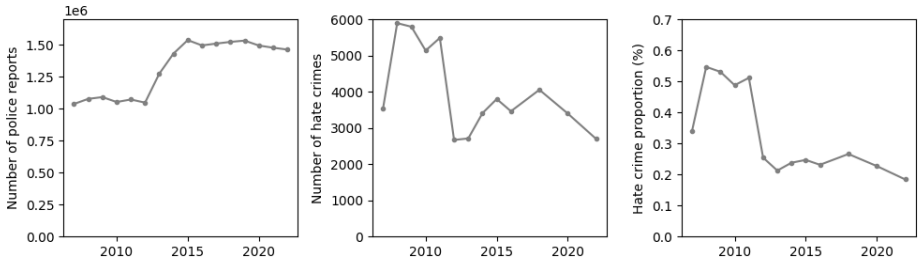
The paper's central claim is that model predictions for a rare binary attribute can be treated as a size measure in probability-proportional-to-size sampling, producing unbiased finite-population estimators for text corpora. Its H2P2 estimator uses the Hansen-Hurwitz total $\hat t_{HH}=\frac{1}{n}\sum_{i\in S} y_i/\pi_i$ with draw probabilities $\pi_i$ proportional to the predicted probability $\hat p_i$; Proposition 1 shows the variance tends to zero as the classifier's cross-entropy loss tends to zero, so classifier quality and annotation effort are directly interchangeable. Applied to all 1,463,762 Swedish police reports from 2022, the best domain-adapted transformer classifier with a manually annotated sample of $n=200$ gives an estimated 6,051 hate crimes (SE 548), a design effect of 0.0068 against simple random sampling, and an estimated police under-flagging of 2,260 to 4,452 hate crimes. Stratification-by-prediction and difference estimators give alternative totals of 4,618 (SE 263) and 6,193 (SE 1,220).
Load-bearing premise
Every real hate crime has to get a positive predicted probability from the classifier, and the sampling probabilities have to be normalized so that even the least likely reports can be drawn; if some true hate crimes get a zero or near-zero score, the estimate is biased downward or its variance explodes.
Editorial extensions
If this is right
- The H2P2 estimate implies that official hate crime totals based only on police-flagged reports miss an estimated 2,260 to 4,452 hate crimes in 2022, and this under-reporting can be quantified without annotating the full corpus.
- With labeled training data from previous years, an annual Swedish hate crime estimate requires about 200 expert annotations instead of the roughly 28,000-report simple random sample that would give the same precision, shortening and cheapening the production cycle.
- The better the classifier, the smaller the sampling variance, with the limiting case that a perfect classifier makes the estimator's variance zero; investment in classification quality and in annotation are interchangeable.
- In 2022 the transformer classifier was correct in roughly 62 percent (CI 0.55 to 0.69) of cases where it disagreed with police flags, so the model can serve as a higher-quality auxiliary variable than the police annotation.
- Stratification-by-prediction with difference estimation in the zero-stratum is the more practical route for domain sub-estimates such as antisemitic hate crimes, because pure SRS in a nearly empty stratum gives a bimodal distribution and an understated variance.
Reading between the lines
- Because the 2022 result rests on one sample of 200 author-annotated reports, the gap between the H2P2 estimate (6,051) and the stratified SRS estimate (4,618) is a sign that estimator choice and sampling variability matter at this scale; a replication with a larger annotated sample would settle which total is closer.
- The thick right tail that the paper documents for H2P2 suggests a concrete safeguard for production use: manually check the highest-probability reports not selected by the PPS draw, or add a deterministic high-probability stratum, to protect against low-probability false negatives.
- The same machinery transfers to other rare-event text populations—fraud reports, domestic violence, medical symptom mentions—wherever a fine-tuned classifier outputs probabilities and a rare binary label is costly to read.
- Swapping the Hansen-Hurwitz estimator for a without-replacement Horvitz-Thompson version, which the paper lists as future work, plus calibrating predicted probabilities to known marginal totals, could reduce the tail variance without changing the core idea.
Signed reviews
Editorial analysis
A structured set of objections, weighed in public.
Referee Report
Summary. The paper proposes using transformer-encoder predicted probabilities as an auxiliary variable for finite-population estimation of rare binary outcomes in text. Three estimators are presented: Hansen-Hurwitz with PPS sampling (H2P2), stratified-by-prediction with SRS, and stratified difference estimation. The method is applied to Swedish police reports to estimate the 2022 hate crime total and police under-reporting. Training BERT and RoBERTa models on 2007-2021 reports, the authors validate on a known-label 'incitement against ethnic group' subset with Monte Carlo and then report an H2P2 estimate of 6,051 hate crimes (SE 548) from n=200 manual annotations, with a design effect of 0.0068 relative to SRS.
Significance. If the theoretical claims hold, the practical contribution is substantial: reducing tens of thousands of manual annotations to a few hundred is highly valuable for official statistics and for text corpora generally. The Monte Carlo results on a real known-total corpus (SE 102 vs 600 for SRS, DEFF 0.029) provide genuine empirical support for the efficiency of the implemented procedure, and the concrete Swedish hate-crime application is timely and policy-relevant. The central limitation is that the estimator's theoretical foundation, as written, needs repair before those results can be interpreted as unbiased; once corrected, the approach could be a useful template for prediction-powered finite-population inference.
major comments (3)
- [§2.1, Eq. (1)] The definition π_i = p_i / Σ_{j∈S} p_j uses the random sample S in the denominator, but Hansen-Hurwitz unbiasedness requires fixed first-draw probabilities π_i = p_i / Σ_{j∈U} p_j. With a sample-dependent denominator, the expectation E[y_i / π_i] does not equal the population total, and the variance expression in Eq. (1) is not the Hansen-Hurwitz variance; this invalidates the sentence 'The HH estimator is unbiased' as applied to the proposed procedure. Please either define the inclusion probabilities with the fixed population sum or provide a separate unbiasedness proof for the estimator actually implemented.
- [§2.1, Proposition 1] The proof of Proposition 1 contains invalid equalities: it treats the random sample set S+ as having |S+| = t (the population total of positives), and it replaces population sums with sample sums in the variance decomposition. Perfect classification (p_i → 1 for positives, p_i → 0 for negatives) also cannot be reconciled with the earlier assumption p_i ∈ (0,1), and the limiting argument does not establish V(ŷ_HH) → 0 for fixed n. As written, the proposition does not support the efficiency claim; it should be restated and proved for the true Hansen-Hurwitz variance under fixed inclusion probabilities.
- [§4.1.1 and §4.2.2] Unbiasedness also requires p_i > 0 for every unit with y_i = 1. The paper's own evidence indicates this assumption is questionable for the 2022 application: the model struggles with Quran-burning and anti-Sámi cases (§4.1), the estimated full-set F1 is 0.80 (§4.1.1), and the single n=200 sample found zero positives in the stratum where both police and model predicted 'not hate crime' (§4.2.2). If true positives with very small predicted probabilities exist, the 6,051 estimate is biased downward and the reported SE 548 understates the variance. Please add diagnostics (e.g., the distribution of p_i among known positives in held-out data, sensitivity analyses under assumed numbers of undetected positives in the zero-predicted stratum) or temper the unbiasedness and efficiency claims accordingly.
minor comments (5)
- [§4.1.1 and Appendix B] The delta-method standard error for the full-set F1 treats the observed zero false negatives in the sampled stratum as exactly zero variance; this ignores the sampling zero-inflation and likely understates the uncertainty in F1.
- [Table 3 caption] The caption contains a typo: 'Stata 1' should be 'Stratum 1'.
- [References] Reference [40] is a placeholder ('To Do') and must be replaced with a complete citation.
- [§2.1] The variance notation mixes sample and population sums; using S in the population variance formula is confusing even after fixing the denominator issue.
- [Appendix A] The text says 'Hansen-Hurwits' but should say 'Hansen-Hurwitz'.
Circularity Check
No significant circularity: the estimators are standard design-based survey estimators using classifier predictions as auxiliary variables, and the efficiency claims are validated with known-label Monte Carlo data and manual annotation.
full rationale
The paper's derivation chain is not circular. The H2P2 estimator is the classical Hansen-Hurwitz estimator applied with predicted probabilities as size measures; its unbiasedness is imported from standard sampling theory (Cochran [1]; Hansen and Hurwitz [2]), not from the fitted model. Proposition 1, stating that variance goes to zero as cross-entropy loss goes to zero, is an asymptotic property of PPS sampling with a perfect size variable, not a definitional equivalence. The Monte Carlo experiment in Section 4.2.1 uses a held-out incitement-against-ethnic-group subset with known labels, and the 2022 application in Section 4.2.2 uses a manually annotated sample, so the headline estimate (6,051, SE 548) is not the classifier's own output renamed as a prediction. The full-population F1 estimate in Section 4.1.1 uses model predictions only to define sampling strata, while manual labels supply the inference; that is a valid design-based procedure. Self-citation [57] appears only for error-analysis context and future-work suggestions, not as a load-bearing justification of the estimator. The 'H2P2' label is an application of a known estimator, not a renaming of a known empirical pattern. Two correctness concerns (not circularity) should be flagged: Section 2.1 defines pi_i = p_i / sum_{j in S} p_j with a random sample denominator, whereas the Hansen-Hurwitz theorem requires a fixed population denominator sum_{j in U} p_j; and the reference list contains a placeholder entry, '[40] To Do. Reference we need to fix. Not at all, 2099.', which is a missing-reference flag but is not used to justify the method. Neither issue makes the derivation circular, so the circularity score is 0.
Assumptions & free parameters
assumptions (4)
- standard math The Hansen-Hurwitz estimator is unbiased when inclusion probabilities are fixed and proportional to a known positive size measure.
- domain assumption Predicted probabilities p_i are treated as a fixed auxiliary variable, with the population-level sum used implicitly as the PPS normalizer.
- domain assumption Unannotated police reports can be labeled as non-hate crimes in training without materially biasing the classifier.
- domain assumption The classifier trained on 2007-2021 flagged and keyword-selected reports transfers to the full 2022 population.
Cite this review
Pith. "Pith review of Prediction-powered estimators for finite population statistics in highly imbalanced textual data: Public hate crime estimation." pith.science (2026). https://pith.science/paper/MW6YU6SV
@misc{pith2026250504643,
  author       = {Pith},
  title        = {Pith review of: Prediction-powered estimators for finite population statistics in highly imbalanced textual data: Public hate crime estimation},
  year         = {2026},
  howpublished = {\url{https://pith.science/paper/MW6YU6SV}},
  note         = {Machine review of arXiv:2505.04643}
}
read the original abstract
Estimating population parameters in finite populations of text documents can be challenging when obtaining the labels for the target variable requires manual annotation. To address this problem, we combine predictions from a transformer encoder neural network with well-established survey sampling estimators using the model predictions as an auxiliary variable. The applicability is demonstrated in Swedish hate crime statistics based on Swedish police reports. Estimates of the yearly number of hate crimes and the police's under-reporting are derived using the Hansen-Hurwitz estimator, difference estimation, and stratified random sampling estimation. We conclude that if labeled training data is available, the proposed method can provide very efficient estimates with reduced time spent on manual annotation.
Figures


Forward citations
Cited by 1 Pith paper
-
Design-Based Prediction-Powered Inference for Spatial Data
Design-based prediction-powered inference for spatial data with misspecified sampling weights leaves a non-vanishing spatial remainder, so coverage can fall as labels accumulate.
Reference graph
Works this paper leans on
-
[1]
John Wiley & Sons, 3 edition, 1977
William Gemmell Cochran.Sampling techniques. John Wiley & Sons, 3 edition, 1977
work page 1977
-
[2]
On the theory of sampling from finite populations
Morris H Hansen and William N Hurwitz. On the theory of sampling from finite populations. The Annals of Mathematical Statistics, 14(4):333–362, 1943
work page 1943
-
[3]
Daniel G Horvitz and Donovan J Thompson. A generalization of sampling without replacement from a finite universe.Journal of the American Statistical Association, 47(260):663–685, 1952
work page 1952
-
[4]
Model assisted survey sampling
Carl-Erik Särndal, Bengt Swensson, and Jan Wretman. Model assisted survey sampling. Springer New York, NY, 1 edition, 2003
work page 2003
-
[5]
A Horvitz–Thompson-type estimator of species richness.Environmetrics, 22(7):901–910, 2011
Steen Magnussen. A Horvitz–Thompson-type estimator of species richness.Environmetrics, 22(7):901–910, 2011
work page 2011
-
[6]
Estimating population treatment effects from a survey subsample
Kara E Rudolph, Iván Díaz, Michael Rosenblum, and Elizabeth A Stuart. Estimating population treatment effects from a survey subsample. American Journal of Epidemiology, 180(7):737–748, 2014
work page 2014
-
[7]
Gianluca Boo, Edith Darin, Douglas R Leasure, Claire A Dooley, Heather R Chamberlain, Attila N Lázár, Kevin Tschirhart, Cyrus Sinai, Nicole A Hoff, Trevon Fuller, et al. High- resolution population estimation using household survey data and building footprints.Nature communications, 13(1):1330, 2022
work page 2022
-
[8]
Some Thoughts on Official Statistics and its Future (with discus- sion)
Yves Tillé, Marc Debusschere, Henri Luomaranta, Martin Axelson, Eva Elvers, Anders Holm- berg, and Richard Valliant. Some Thoughts on Official Statistics and its Future (with discus- sion). Journal of Official Statistics, 38(2):557–598, 2022
work page 2022
Show all 57 references
-
[9]
Statistics Canada’s Quality Assurance Framework
Statistics Canada. Statistics Canada’s Quality Assurance Framework. https://www150. statcan.gc.ca/n1/en/catalogue/12-586-X, 2017. Statistics Canada, Ottawa
2017
-
[10]
Lag om den officiella statistiken [Offi- cial Statistics Act]
Riksdagen [The Swedish Parliament]. Lag om den officiella statistiken [Offi- cial Statistics Act]. https://www.riksdagen.se/sv/dokument-och-lagar/dokument/ svensk-forfattningssamling/lag-200199-om-den-officiell_sfs-2001-99/ , 2001. SFS 2001:99
2001
-
[11]
Regulation (EC) No 223/2009 of the European Parliament and of the Council of 11 March 2009 on European Statistics, 2009
European Parliament and Council. Regulation (EC) No 223/2009 of the European Parliament and of the Council of 11 March 2009 on European Statistics, 2009. OJ L 87, p 164–173. 15
2009
-
[12]
The National Academies Press, Washington, DC, 2024
National Academies of Sciences, Engineering, and Medicine.Principles and Practices for a Federal Statistical Agency: Eighth Edition. The National Academies Press, Washington, DC, 2024
2024
-
[13]
Politics as Usual? Measuring Populism, Nationalism, and Authoritarianism in US Presidential Campaigns (1952–2020) with Neural Language Models
Bart Bonikowski, Yuchen Luo, and Oscar Stuhler. Politics as Usual? Measuring Populism, Nationalism, and Authoritarianism in US Presidential Campaigns (1952–2020) with Neural Language Models. Sociological Methods & Research, 51(4):1721–1787, 2022
1952
-
[14]
The augmented social scientist: Using sequential transfer learning to annotate millions of texts with human-level accuracy.Sociological Methods & Research, 53(3):1167–1200, 2024
Salomé Do, Étienne Ollion, and Rubing Shen. The augmented social scientist: Using sequential transfer learning to annotate millions of texts with human-level accuracy.Sociological Methods & Research, 53(3):1167–1200, 2024
2024
-
[15]
A deep language model for symptom extraction from clinical text and its application to extract COVID-19 symptoms from social media
Xiao Luo, Priyanka Gandhi, Susan Storey, and Kun Huang. A deep language model for symptom extraction from clinical text and its application to extract COVID-19 symptoms from social media. IEEE Journal of Biomedical and Health Informatics, 26(4):1737–1748, 2021
2021
-
[16]
Emergingindustry classification based on BERT model.Information Systems, 128:102484, 2025
BaochengYang, BingZhang, KevinCutsforth, ShanfuYu, andXiaowenYu. Emergingindustry classification based on BERT model.Information Systems, 128:102484, 2025
2025
-
[17]
Innovations in public health surveillance: An overview of novel use of data and analytic methods
Heather Rilkoff, Shannon Struck, Chelsea Ziegler, Laura Faye, Dana Paquette, and David Buckeridge. Innovations in public health surveillance: An overview of novel use of data and analytic methods. Canada Communicable Disease Report, 50(3-4):93, 2024
2024
-
[18]
Anmälda brott 2023 slutlig statistik [Reported Crimes 2023 Final Statistics].https://bra.se/download/18
Brottsförebyggande rådet [Swedish National Council for Crime Prevention] . Anmälda brott 2023 slutlig statistik [Reported Crimes 2023 Final Statistics].https://bra.se/download/18. 3d22500318e5f70da2846d9/1711454523087/Statistikrapport_anmalda_2023.pdf, 2024. Accessed: 2024-08-25
2023
-
[19]
Active Learning Literature Survey
Burr Settles. Active Learning Literature Survey. Computer Sciences Technical Report 1648, University of Wisconsin–Madison, 2009
2009
-
[20]
Jon Lundgren and Aravella Lejonstad. Polisanmälda hatbrott 2022 - En sammanställning av de ärenden som hatbrottsmarkerats av polisen [Hate crimes in police reports 2022 - a summary of reports marked as hate crimes by the police]. Brottsförebyggande rådet [Swedish National Coun...
2022
-
[21]
Prediction-powered inference.Science, 382(6671):669–674, 2023
Anastasios N Angelopoulos, Stephen Bates, Clara Fannjiang, Michael I Jordan, and Tijana Zrnic. Prediction-powered inference.Science, 382(6671):669–674, 2023
2023
-
[22]
Naoki Egami, Musashi Hinck, Brandon Stewart, and Hanying Wei. Using imperfect surrogates for downstream inference: Design-based supervised learning for social science applications of large language models.Advances in Neural Information Processing Systems, 36, 2024
2024
-
[23]
Natural language processing
Jacob Eisenstein. Natural language processing. MIT Press, 2019
2019
-
[24]
A survey on sentiment analysis methods, applications, and challenges
Mayur Wankhade, Annavarapu Chandra Sekhara Rao, and Chaitanya Kulkarni. A survey on sentiment analysis methods, applications, and challenges. Artificial Intelligence Review, 55(7):5731–5780, 2022
2022
-
[25]
Analytical mapping of opinion mining and sentiment analysis research during 2000–2015.Information Processing & Manage- ment, 53(1):122–150, 2017
Rajesh Piryani, Devaraj Madhavi, and Vivek Kumar Singh. Analytical mapping of opinion mining and sentiment analysis research during 2000–2015.Information Processing & Manage- ment, 53(1):122–150, 2017. 16
2000
-
[26]
Text classification algorithms: A survey.Information, 10(4):150, 2019
Kamran Kowsari, Kiana Jafari Meimandi, Mojtaba Heidarysafa, Sanjana Mendu, Laura Barnes, and Donald Brown. Text classification algorithms: A survey.Information, 10(4):150, 2019
2019
-
[27]
Attention is all you need.Advances in neural information processing systems, 30, 2017
Ashish Vaswani, Noam Shazeer, Niki Parmar, Jakob Uszkoreit, Llion Jones, Aidan N Gomez, Łukasz Kaiser, and Illia Polosukhin. Attention is all you need.Advances in neural information processing systems, 30, 2017
2017
-
[28]
Bert: Pre-training of deep bidirectional transformers for language understanding.arXiv preprint arXiv:1810.04805, 2018
Jacob Devlin, Ming-Wei Chang, Kenton Lee, and Kristina Toutanova. Bert: Pre-training of deep bidirectional transformers for language understanding.arXiv preprint arXiv:1810.04805, 2018
2018 arXiv
-
[29]
Roberta: A robustly optimized bert pretraining approach
Yinhan Liu, Myle Ott, Naman Goyal, Jingfei Du, Mandar Joshi, Danqi Chen, Omer Levy, Mike Lewis, Luke Zettlemoyer, and Veselin Stoyanov. Roberta: A robustly optimized bert pretraining approach. arXiv preprint arXiv:1907.11692, 2019
1907 arXiv
-
[30]
SciBERT: A pretrained language model for scientific text
Iz Beltagy, Kyle Lo, and Arman Cohan. SciBERT: A pretrained language model for scientific text. arXiv preprint arXiv:1903.10676, 2019
1903 arXiv
-
[31]
Chi Sun, Xipeng Qiu, Yige Xu, and Xuanjing Huang. How to fine-tune bert for text classi- fication? In Chinese computational linguistics: 18th China national conference, CCL 2019, Kunming, China, October 18–20, 2019, proceedings 18, pages 194–206. Springer, 2019
2019
-
[32]
A survey on text classification algorithms: From text to predictions.Information, 13(2):83, 2022
Andrea Gasparetto, Matteo Marcuzzo, Alessandro Zangari, and Andrea Albarelli. A survey on text classification algorithms: From text to predictions.Information, 13(2):83, 2022
2022
-
[33]
Chatgpt for Text Annotation? Mind the Hype!SocArXiv preprint, 2023
Etienne Ollion, Rubing Shen, Ana Macanovic, and Arnault Chatelain. Chatgpt for Text Annotation? Mind the Hype!SocArXiv preprint, 2023
2023
-
[34]
A survey of text classification with transformers: How wide? how large? how long? how accurate? how expensive? how safe? IEEE Access, 12:6518–6531, 2024
John Fields, Kevin Chovanec, and Praveen Madiraju. A survey of text classification with transformers: How wide? how large? how long? how accurate? how expensive? how safe? IEEE Access, 12:6518–6531, 2024
2024
-
[35]
Are chatbots reliable text annotators? sometimes.PNAS nexus, 4(4):pgaf069, 2025
Ross Deans Kristensen-McLachlan, Miceal Canavan, Marton Kárdos, Mia Jacobsen, and Lene Aarøe. Are chatbots reliable text annotators? sometimes.PNAS nexus, 4(4):pgaf069, 2025
2025
-
[36]
From words to watts: Benchmarking the energy costs of large language model inference
Siddharth Samsi, Dan Zhao, Joseph McDonald, Baolin Li, Adam Michaleas, Michael Jones, William Bergeron, Jeremy Kepner, Devesh Tiwari, and Vijay Gadepally. From words to watts: Benchmarking the energy costs of large language model inference. In2023 IEEE High Performance Extreme...
2023
-
[37]
Machine learning in official statistics
Martin Beck, Florian Dumpert, and Joerg Feuerhake. Machine learning in official statistics. arXiv preprint arXiv:1812.10422, 2018
2018 arXiv
-
[38]
Model-assisted survey regression estimation with the lasso
Kelly S McConville, F Jay Breidt, Thomas CM Lee, and Gretchen G Moisen. Model-assisted survey regression estimation with the lasso. Journal of Survey Statistics and Methodology, 5(2):131–158, 2017
2017
-
[39]
Brottsbalken [Swedish Penal Code], 1962
Sveriges Riksdag. Brottsbalken [Swedish Penal Code], 1962. SFS 1962:700
1962
-
[40]
Reference we need to fix
To Do. Reference we need to fix. Not at all, 2099. 17
-
[41]
Carina Djärv and Anna Gavell Frenzel. Polisens hatbrottsmarkering - Kvalitetsgranskning av polisens hatbrottsmarkering samt jämförelse mellan statistik baserad på polisens hatbrotts- markering och Brås hatbrottsstatistik [Police hate crime flagging - Quality Control of police ...
2018
-
[42]
Playing with Words at the National Library of Sweden - Making a Swedish BERT.arXiv preprint arXiv:2007.01658, 2020
Martin Malmsten, Love Börjeson, and Chris Haffenden. Playing with Words at the National Library of Sweden - Making a Swedish BERT.arXiv preprint arXiv:2007.01658, 2020
2007 arXiv
-
[43]
Don’t stop pretraining: Adapt language models to domains and tasks
SuchinGururangan, AnaMarasović, SwabhaSwayamdipta, KyleLo, IzBeltagy, DougDowney, and Noah A Smith. Don’t stop pretraining: Adapt language models to domains and tasks. arXiv preprint arXiv:2004.10964, 2020
2004 arXiv
-
[44]
Learning from positive and unlabeled data: A survey.Machine Learning, 109(4):719–760, 2020
Jessa Bekker and Jesse Davis. Learning from positive and unlabeled data: A survey.Machine Learning, 109(4):719–760, 2020
2020
-
[45]
Decoupled Weight Decay Regularization
Ilya Loshchilov and Frank Hutter. Decoupled Weight Decay Regularization. InInternational Conference on Learning Representations (ICLR), 2019
2019
-
[46]
Decoupled weight decay regularization
Ilya Loshchilov and Frank Hutter. Decoupled weight decay regularization. arXiv preprint arXiv:1711.05101, 2017
2017 arXiv
-
[47]
Deep Learning
Ian Goodfellow, Yoshua Bengio, and Aaron Courville. Deep Learning. MIT Press, 2016. http://www.deeplearningbook.org
2016
-
[48]
LEGAL-BERT: The muppets straight out of law school
Ilias Chalkidis, Manos Fergadiotis, Prodromos Malakasiotis, Nikolaos Aletras, and Ion An- droutsopoulos. LEGAL-BERT: The muppets straight out of law school. arXiv preprint arXiv:2010.02559, 2020
2010 arXiv
-
[49]
Downstream task performance of BERT models pre-trained using automatically de-identified clinical data
Thomas Vakili, Anastasios Lamproudis, Aron Henriksson, and Hercules Dalianis. Downstream task performance of BERT models pre-trained using automatically de-identified clinical data. In Proceedings of the Thirteenth Language Resources and Evaluation Conference, pages 4245– 4252, 2022
2022
-
[50]
Should you mask 15% in masked language modeling?arXiv preprint arXiv:2202.08005, 2022
Alexander Wettig, Tianyu Gao, Zexuan Zhong, and Danqi Chen. Should you mask 15% in masked language modeling?arXiv preprint arXiv:2202.08005, 2022
2022 arXiv
-
[51]
Spanbert: Improving pre-training by representing and predicting spans.Transactions of the association for computational linguistics, 8:64–77, 2020
Mandar Joshi, Danqi Chen, Yinhan Liu, Daniel S Weld, Luke Zettlemoyer, and Omer Levy. Spanbert: Improving pre-training by representing and predicting spans.Transactions of the association for computational linguistics, 8:64–77, 2020
2020
-
[52]
Albert: A lite bert for self-supervised learning of language representations
Zhenzhong Lan, Mingda Chen, Sebastian Goodman, Kevin Gimpel, Piyush Sharma, and Radu Soricut. Albert: A lite bert for self-supervised learning of language representations. arXiv preprint arXiv:1909.11942, 2019
1909 arXiv
-
[53]
Pmi-masking: Principled masking of correlated spans.arXiv preprint arXiv:2010.01825, 2020
Yoav Levine, Barak Lenz, Opher Lieber, Omri Abend, Kevin Leyton-Brown, Moshe Tennen- holtz, and Yoav Shoham. Pmi-masking: Principled masking of correlated spans.arXiv preprint arXiv:2010.01825, 2020
2010 arXiv
-
[54]
How to train BERT with an academic budget
Peter Izsak, Moshe Berchansky, and Omer Levy. How to train BERT with an academic budget. arXiv preprint arXiv:2104.07705, 2021. 18
2021 arXiv
-
[55]
Language models are few-shot learners
Tom Brown, Benjamin Mann, Nick Ryder, Melanie Subbiah, Jared D Kaplan, Prafulla Dhari- wal, Arvind Neelakantan, Pranav Shyam, Girish Sastry, Amanda Askell, et al. Language models are few-shot learners. Advances in neural information processing systems, 33:1877– 1901, 2020
1901
-
[56]
Llama: Open and efficient foundation language models.arXiv preprint arXiv:2302.13971, 2023
Hugo Touvron, Thibaut Lavril, Gautier Izacard, Xavier Martinet, Marie-Anne Lachaux, Tim- othée Lacroix, Baptiste Rozière, Naman Goyal, Eric Hambro, Faisal Azhar, et al. Llama: Open and efficient foundation language models.arXiv preprint arXiv:2302.13971, 2023
2023 arXiv
-
[57]
not hate crime
Holli Sargeant, Hannes Waldetoft, and Måns Magnusson. Classifying Hate: Legal and Ethical Evaluations of ML-Assisted Hate Crime Classification and Estimation in Sweden. InProceed- ings of the 2025 ACM Conference on Fairness, Accountability, and Transparency, FAccT ’25, New Yor...
2025
Reviewed August 16, 2026 · model on record in the stance chip above.
Discussion (0). Continue with ORCID to comment.