REVIEW 3 major objections 4 minor 1 cited by
Impact of Strong Anisotropy on Phase Diagram of Superfluid $^3$He in Aerogels
T0 review · 3 major / 4 minor · reviewed 2026-08-14 · deepseek-v4-flash
Pith's one-line read This paper shows that the polar phase of superfluid 3He in nematic aerogels keeps a nearly impurity-independent transition temperature even when the anisotropy correlation length is finite, and that the line-node T^3 low-temperature gap…
desk verdict Solid model calculation: Anderson-theorem-like Tc protection survives finite anisotropy in a planar-disorder model; low-pressure T^3 coefficient is a testable prediction, but the impurity correlator is idealized. read the letter →
The pith
A machine-rendered reading of the paper's core claim, the machinery that carries it, and where it could break.
The reading
What carries the argument
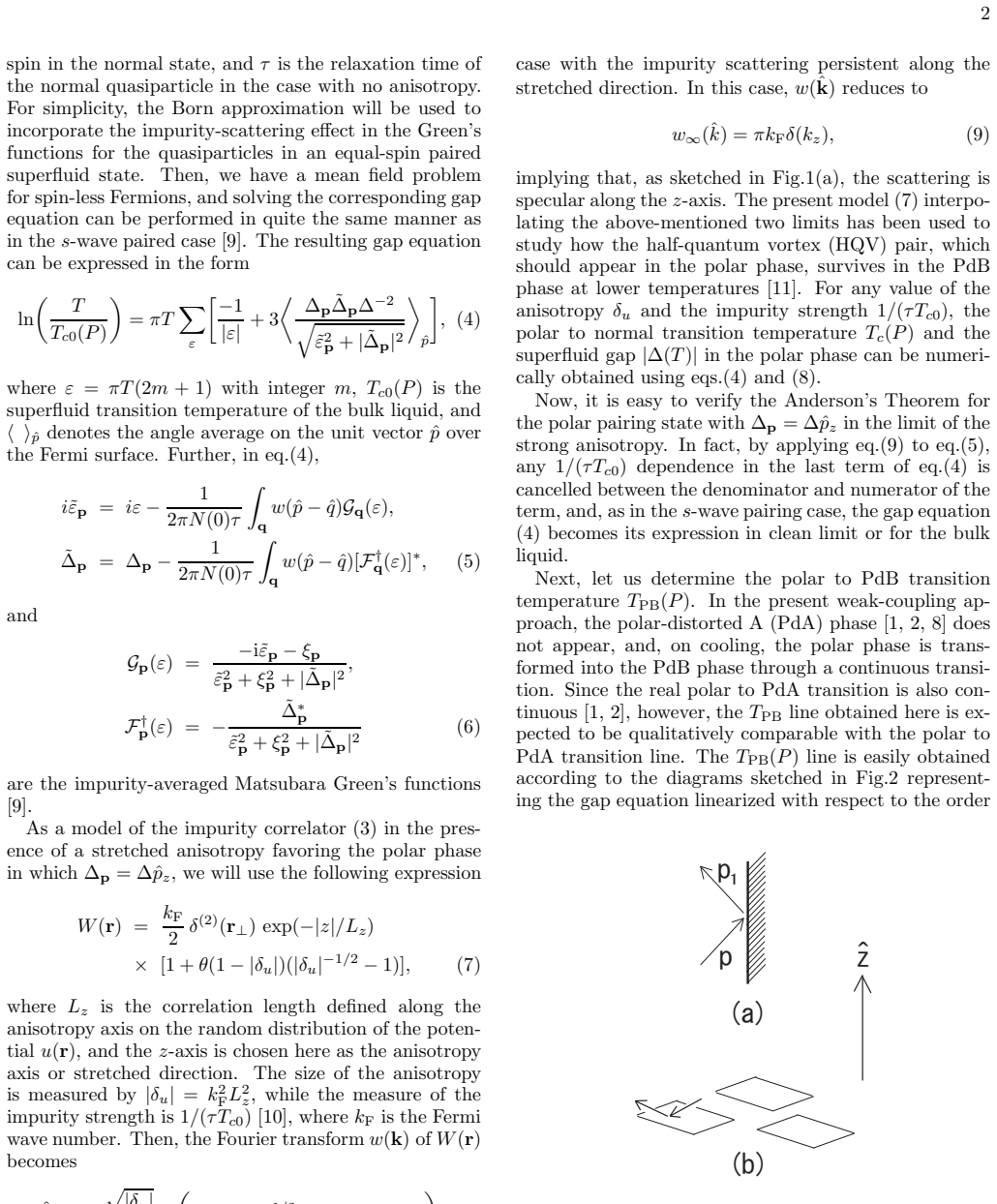
The central object is the impurity-scattering correlator W(r) = $k_F^{2}$ δ^(2)(r_perp) exp(-|z|/L_z), whose Fourier transform w(k) interpolates between the weak-anisotropy form w ≈ 1 - |δu| $k_z^{2}$ and the strong-anisotropy limit w∞ ∝ δ(k_z), where scattering is specular along the stretched z-axis. The key mechanism is that in this specular limit the impurity self-energy terms in the gap equation cancel between numerator and denominator, recovering the clean-limit Tc; the model's finite L_z allows the authors to test whether that cancellation survives moderate anisotropy. Numerically solving the gap equation with this w(k) generates Tc(P), the polar-to-PdB transition line TPB(P), and the $T^{3}$ coefficient of the energy gap. The ratio |δu| = $k_F^{2}$ $L_z^{2}$ is the dimensionless anisotropy measure, and 1/(τ Tc0(P)) the dimensionless impurity strength.
What would settle it
Measure the normal-to-polar Tc of superfluid 3He in an aerogel whose impurity scattering rate is varied by changing porosity while the strand structure's in-plane correlation length is independently characterized; if Tc drops noticeably with increasing impurity strength for a measured |δu| around 30, beyond the weak-coupling prediction of this model, the delta-function in-plane assumption is falsified. Alternatively, measuring the $T^{3}$ coefficient at zero pressure, where strong-coupling corrections are weak, would test the predicted order-unity enhancement over the clean-limit value.
Extended reading notes
Core claim
On the paper's own terms, the central discovery is that the strong-anisotropy limit of the polar phase—where impurity scattering is specular along the anisotropy axis and the gap equation reduces exactly to the clean-limit form—is not an isolated fine-tuned point. In the weak-coupling BCS approximation, the cancellation of impurity self-energy terms in the gap equation persists approximately for finite correlation length L_z along the anisotropy axis, so that Tc(P) depends only weakly on the impurity strength $τ^{{-1}}$ over a wide range of |δu| = $k_F^{2}$ $L_z^{2}$. The same model yields the polar-to-PdB transition line TPB(P), which is much more sensitive to impurities and shrinks as impurity scattering or anisotropy is increased. The low-temperature gap obeys 1 - |∆(T)|/|∆(0)| = a $T^{3}$/|∆(0)|^3 with the coefficient a near the clean-limit weak-coupling value 8.49 for strong anisotropy, and moderately enhanced for moderate anisotropy and low pressure; the $T^{3}$ form itself is robust. The paper further argues that a planar-distorted A phase with l-vector along the plane normal would show the same impurity-independent Tc in planar aerogels, and that a clear breakdown of the theorem occurs only with strong enough scattering (Anderson localization) or with magnetic impurities, where the polar phase is suppressed.
Load-bearing premise
The load-bearing premise is that the random scattering potential is uncorrelated in the plane perpendicular to the anisotropy axis (a delta function), so that each scattering event conserves the perpendicular momentum; if real nematic aerogels have a finite perpendicular correlation length from splayed strands and crossings, the near-cancellation of impurity effects on Tc could break down.
Editorial extensions
If this is right
- The polar phase of superfluid 3He should be realizable in nematic aerogels with only moderate global anisotropy, not only in the idealized strong-anisotropy limit.
- In such aerogels, the measured Tc(P) should lie close to the bulk value Tc0(P) and show only weak dependence on porosity, while the polar-to-PdB transition temperature drops sharply as impurity scattering increases.
- The low-temperature superfluid gap of the polar phase should follow the T^3 law with a coefficient of order 10 in weak coupling; at low pressures the coefficient should be larger than at high pressures, providing a clean experimental test.
- The same logic applied to planar aerogels implies that a planar-distorted A phase with its l-vector normal to the plane should also have impurity-independent Tc, widening the temperature window where half-quantum vortices can exist.
Reading between the lines
- A testable extension: engineered aerogels that vary the in-plane correlation length while holding L_z fixed would directly probe the delta-function assumption; the model predicts Tc should remain nearly impurity-independent only when that in-plane correlation length is negligible.
- The near-cancellation suggests that the Anderson-theorem analog for polar pairing is tied to the symmetry of the scattering rather than to the precise value of L_z, so similar robustness might appear in other nodal p-wave (or d-wave) states under strongly anisotropic disorder.
- If the T^3 coefficient at low pressure indeed comes out enhanced over the clean-limit value, the polar phase in aerogels would serve as a tunable laboratory for nodal quasiparticle transport in disordered superconductors.
Signed reviews
Editorial analysis
A structured set of objections, weighed in public.
Referee Report
Summary. Using the weak-coupling BCS formalism with Born-approximation impurity scattering, the authors study the polar pairing state of superfluid 3He in an anisotropically correlated random potential. The impurity correlator is chosen to interpolate between weak anisotropy and the columnar/specular limit, and the gap equation (4) is solved numerically for Tc and for the polar-to-PdB transition. In the infinite-anisotropy limit the gap equation is shown to reduce to the clean one, an analogue of Anderson's theorem; at finite Lz the numerical results show only weak impurity dependence of Tc over the parameter range considered. The paper also computes the low-temperature T^3 correction to the gap magnitude, compares the coefficient with NMR-inferred data, and discusses a planar-disorder variant and possible localization-induced breakdown.
Significance. The paper gives a clean demonstration that, within a specified disorder class, the p-wave Anderson theorem survives a finite longitudinal correlation length: the infinite-Lz cancellation is exact, the numerical solution uses the standard self-consistent BCS equations, and the low-pressure T^3 coefficient is a falsifiable prediction that was not used to fit the model. The qualitative agreement with the experimental phase diagram (Fig. 3) and the clear separation of the robust T^3 line-node behavior from the model-dependent coefficient are useful. The main significance risk is that the disorder class is idealized: the correlator has zero perpendicular correlation length, while the physical splayed and crossing aerogel structure is not of this form. Thus the claim about 'real aerogels' is the least secure part of the paper.
major comments (3)
- [Sec. 2, Eqs. (7)-(9)] The central finite-Lz result is obtained for a disorder correlator whose Fourier transform (8) depends only on k_z, so the perpendicular correlation length is zero by construction. In the limit (9) this is columnar disorder conserving p_z, and the Anderson-theorem cancellation in the polar phase is exact because the gap function depends only on p_z. For finite Lz the residual Tc shift is therefore controlled by a single longitudinal scale. The text itself motivates finite Lz by splayed strands and crossings in real nematic aerogels, but such disorder is not columnar even with long Lz: it mixes in-plane and out-of-plane momentum transfer and introduces a finite perpendicular correlation length. No estimate is given of how this non-columnar component modifies the near-cancellation. I therefore regard the statement that Anderson's theorem is 'apparently satisfied' in real aerogels (abstract and Sec. 4) as not yet established; at minimum it should be restricted to the columnar class of disorder, or supplemented by a calculation or estimate with finite perpendicular correlation length.
- [Sec. 2, Eqs. (5)-(6)] The entire finite-Lz analysis is performed in the Born approximation. The conclusion that Tc is nearly impurity independent over a wide range of strengths is therefore a statement about the Born self-energies; multiple-scattering (T-matrix) corrections are not controlled, and the concluding paragraph invokes Anderson localization only as a separate mechanism. The authors should state the expected domain of validity of the Born approximation for the parameters used (|δu| up to 3e3 and 1/(τTc0) up to order one), or show that the strong-anisotropy cancellation is not specific to the Born treatment.
- [Sec. 4, Eq. (11)] The coefficient a is a weak-coupling quantity that varies by 20-40% with anisotropy and impurity strength (8.49 clean to 8.97 and 10-12 in Fig. 4), and the route to the experimental value 0.38 involves a strong-coupling renormalization taken from Ref. [8] and not computed here. The low-pressure prediction is therefore best presented as a qualitative and falsifiable trend, not as a numerical prediction of the model. Please state the strong-coupling caveat next to Eq. (11) and in the conclusions.
minor comments (4)
- [References] Ref. [12] contains a typo: 'Fransis' should be 'Francis'; Refs. [13] and [14] also have inconsistent arXiv formatting.
- [Sec. 4, Eq. (11)] The symbols a and a are both used in the discussion of the T^3 coefficient; please define the two quantities consistently so that the reported experimental value 0.38 is unambiguous.
- [Fig. 3 caption] The notation (2πτ)^{-1}(mK) is dimensionful; state explicitly how it is related to the dimensionless 1/(τTc0) used in the text.
- [Sec. 4] The phrase 'a stronger scattering strength (2πτ)^{-1}=1(mK) than those used in Fig.3' should specify that the comparison is with (2πτ)^{-1}=0.7 in Fig.3, and explain why this stronger value was chosen.
Circularity Check
No significant circularity: the approximate Anderson theorem and T^3 gap law are computed consequences of an assumed disorder model, not fitted inputs or renamed results.
full rationale
The central quantities—the weak impurity-strength dependence of Tc and the T^3 low-temperature gap behavior—are computed from the gap equation (4) with the assumed correlator (7) and its Fourier transform (8). No parameter is fitted to reproduce the experimental Tc(P) or gap data; the comparison with experiments is qualitative, and the computed T^3 coefficients are independent numerical outputs. The infinite-anisotropy Anderson-theorem limit is derived exactly by substituting w∞(k)=πk_F δ(k_z) into Eq. (5), where the cancellation in Eq. (4) follows mathematically; this is a derived consequence, not a definitional restatement. The finite-Lz results are new numerical solutions, and the paper explicitly reports deviations such as the enhanced coefficient a at low pressure rather than absorbing them into adjustable parameters. The self-citations (Refs. [1], [11], [15]) are not load-bearing: Ref. [1] supplies the weak-anisotropy limiting form that Eq. (7) is designed to interpolate, while Refs. [11] and [15] are contextual or speculative. The main caveat is physical rather than logical: the delta-function perpendicular part of Eq. (7) omits splayed-strand and crossing effects, as the text itself acknowledges, but this is an assumption about applicability, not circularity. No fitted input is renamed as a prediction, and no load-bearing claim reduces to a self-citation chain.
Assumptions & free parameters
free parameters (2)
- |delta_u| (anisotropy parameter, = k_F^2 L_z^2) =
varied (4.4, 30, 3x10^3)
- 1/(tau Tc0) (dimensionless impurity scattering strength) =
varied ((2*pi*tau)^-1 (mK) = 0.3, 0.5, 0.7, 1.0)
assumptions (5)
- domain assumption Weak-coupling BCS mean-field theory with impurity self-energy in the Born approximation.
- ad hoc to paper Impurity correlator has the form W(r) = k_F^2 delta^(2)(r_perp) exp(-|z|/Lz) with interpolation (8).
- domain assumption Polar pairing order parameter is Delta_p = Delta p_hat_z with equal-spin pairing, and the transition to PdB is continuous; PdA phase is absent in weak coupling.
- domain assumption Bulk Tc0(P) from Ref [12] is used as input.
- domain assumption Clean-limit T^3 coefficient a=8.49 from Ref [8], and strong-coupling corrections from Ref [8] are used to compare with the experimental a=0.38.
Cite this review
Pith. "Pith review of Impact of Strong Anisotropy on Phase Diagram of Superfluid $^3$He in Aerogels." pith.science (2026). https://pith.science/paper/MWRYZA22
@misc{pith2026190810712,
  author       = {Pith},
  title        = {Pith review of: Impact of Strong Anisotropy on Phase Diagram of Superfluid $^3$He in Aerogels},
  year         = {2026},
  howpublished = {\url{https://pith.science/paper/MWRYZA22}},
  note         = {Machine review of arXiv:1908.10712}
}
abstract
Recently, one analog of the Anderson's Theorem for the $s$-wave superconductor has attracted much interest in the context of the $p$-wave polar pairing state of superfluid $^3$He in a model aerogel in the limit of strong uniaxial anisotropy. We discuss to what extent the theorem is satisfied in the polar phase in real aerogels by examining the normal to polar transition temperature $T_c$ and the low temperature behavior of the superfluid energy gap under an anisotropy of a moderate strength and comparing the obtained results with experimental data. The situation in which the Anderson's theorem clearly breaks down is also discussed.
Figures


Figures from the paper (1 more)

Forward citations
Cited by 1 Pith paper
-
Topological nodal line in superfluid $^3$He and the Anderson theorem
Measurement of the polar-phase gap in 3He in nafen shows the predicted T^3 temperature law, providing the first experimental evidence for a Dirac nodal line and supporting a generalized Anderson theorem.
Reference graph
Works this paper leans on
-
[8]
V. B. Eltsov, T. Kamppinen, J. Rysti, and G. E. Volovik, arXiv:1908.01645
work page Pith review arXiv 1908
- [1]
-
[2]
Dmitriev, A.A.Senin, A.A.Soldatov, and A.N.Yudin,et al., Phys
V.V. Dmitriev, A.A.Senin, A.A.Soldatov, and A.N.Yudin,et al., Phys. Rev. Lett. 115, 165304 (2015)
work page 2015
-
[3]
Dmitriev, A.A.Soldatov, and A.N.Yudin, Phys
V.V. Dmitriev, A.A.Soldatov, and A.N.Yudin, Phys. Rev. Lett. 120, 075301 (2018)
work page 2018
-
[4]
J. A. Sauls, Phys. Rev. B 88, 214503 (2013); I. A. Fomin, JETP 118, 765 (2014)
work page 2013
-
[5]
I. A. Fomin, JETP 127, 933 (2018)
work page 2018
-
[6]
P. W. Anderson, J. Phys. Chem. Sol. 11, 26 (1959)
work page 1959
-
[7]
V. V. Dmitriev, M. S. Kutuzov, A. A. Soldatov, A. N. Yudin, arXiv:1911.01193
work page Pith review arXiv 1911
Show all 16 references
-
[9]
A. A. Abrikosov, L. P. Gor’kov, I. E. Dzyaloshinski, Methods of Quantum Field Theory in Statistical Physics (Dover, 1963) Sec.39.3
1963
-
[10]
E. V. Thuneberg, S. K. Yip, M. Fogelstrom, J. A. Sauls, Phys. Rev. Lett. 80, 2861 (1998)
1998
- [11]
-
[12]
Volhardt and P, Wolfle, The Superfluid Phases of He- lium 3 (Taylor and Fransis, 2003)
D. Volhardt and P, Wolfle, The Superfluid Phases of He- lium 3 (Taylor and Fransis, 2003)
2003
-
[13]
Dmitriev, A.A.Soldatov, and A.N.Yudin, arXiv:1710.03097
V.V. Dmitriev, A.A.Soldatov, and A.N.Yudin, arXiv:1710.03097
-
[14]
A. M. Zimmerman, M.D.Nguyen, J.W.Scott, and W.P. Halperin, arxiv. 1908.01739
1908 arXiv
-
[15]
Nagamura and R
N. Nagamura and R. Ikeda, Phys. Rev. B 98, 094524 (2018)
2018
-
[16]
Fukuyama, S
H. Fukuyama, S. Ebisawa, and S. Maekawa, J. Phys. Soc. Jpn. 53, 3560 (1984); M. V. Sadovskii, Phys. Rep. 282, 225 (1997)
1984
Reviewed August 14, 2026 · model on record in the stance chip above.
Discussion (0). Continue with ORCID to comment.