REVIEW 3 major objections 4 minor 48 references
PC-BEV: An Efficient Polar-Cartesian BEV Fusion Framework for LiDAR Semantic Segmentation
T0 review · 3 major / 4 minor · reviewed 2026-08-11 · deepseek-v4-flash
Pith's one-line read A LiDAR segmentation network that fuses polar and Cartesian bird's-eye-view grids, with no range-view branch and no point-based interactions, reaches state-of-the-art mIoU while cutting the fusion step's cost by a factor of 170, the…
desk verdict Genuinely new BEV fusion idea and solid ablations, but the abstract overclaims against the paper's own numbers; worth a serious referee with a request for honest reframing. read the letter →
The pith
A machine-rendered reading of the paper's core claim, the machinery that carries it, and where it could break.
The reading
What carries the argument
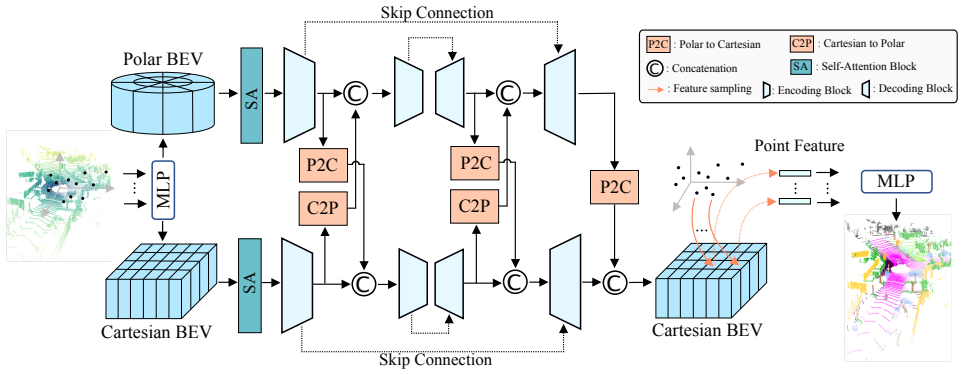
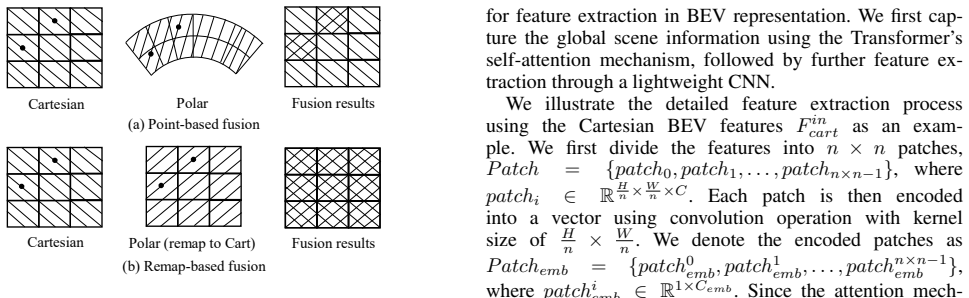
The load-bearing objects are the paired BEV grids—Cartesian (x–y) and polar (azimuth–radius)—and the PolarToCart/CartToPolar remap operators defined on them. For each Cartesian cell center the corresponding polar coordinates are computed as $\phi=\arctan2(y,x)$ and $\rho=\sqrt{x^2+y^2}$, yielding a fixed index mapping that is precomputed before inference; fusion is then a dense concatenation of remapped features, with zero padding where a cell has no counterpart. This remap replaces the grid sampling and scatter-back operations of point-based fusion, which treat each point individually and suffer cache misses and write-lock contention. The second component is a hybrid Transformer-CNN branch: a small number of self-attention blocks on patch embeddings capture global scene context, and a U-shaped CNN (following the structure of CPGNet) extracts local detail, with the two fused by addition at the BEV resolution.
What would settle it
Run PC-BEV and CPGNet under identical training and post-processing settings on SemanticKITTI: if PC-BEV still trails on vertical-object classes (person, pole, trunk, motorcyclist) by the margins visible in Table 2 (e.g., 62.5 vs 72.1 for person), that is direct evidence that BEV projection drops height information the range view retains. A reader can already check this: the paper reports CPGNet at 68.3 mIoU and PC-BEV at 67.2 on the SemanticKITTI test set, so the claim of outperforming 'previous multiview fusion approaches' is falsified by that baseline unless CPGNet is excluded.
Extended reading notes
Core claim
The paper's central claim is that a BEV-only model can replace multiview fusion for LiDAR segmentation if it fuses polar and Cartesian partitions of the same BEV space. Its key discovery is that the polar partition of BEV plays the role that range view used to play: it bins points by azimuth angle and radius, mimicking the spherical partition of a range image, while the Cartesian partition preserves axis-aligned structure; together the two branches carry enough complementary information for competitive segmentation. The fixed geometric relation between the two grids means the polar-to-Cartesian and Cartesian-to-polar alignments are known ahead of time, so fusion is a precomputed remap over the entire grid rather than a per-point gather/scatter, giving both a large speedup and dense context mixing. The authors present this as evidence that the prevailing assumption—that cross-view point-based interactions are necessary for high performance—is false.
Load-bearing premise
The load-bearing premise is that projecting a 3D LiDAR scan into bird's-eye-view grids—polar or Cartesian—does not throw away information that is essential for semantic segmentation, so a BEV-only model can match models that also consume the range view; the paper's own Table 2 shows a range-BEV fusion model (CPGNet) ahead of PC-BEV by 1.1 mIoU on the SemanticKITTI test set, which is consistent with some lost vertical detail.
Editorial extensions
If this is right
- LiDAR semantic segmentation can run entirely in bird's-eye view, eliminating range-view branches and their point-based cross-view alignment, which simplifies real-time deployment for autonomous driving.
- The precomputed remap makes feature fusion nearly free (0.04 ms versus 6.8–8.0 ms on a 2080Ti), so accuracy gains from fusion no longer compete with the inference budget.
- Fusing over the full BEV grid, rather than only where points exist, preserves contextual information around empty cells, which should improve recognition of small or occluded objects.
- The fixed-correspondence idea transfers to any pair of BEV grids linked by an analytic coordinate transform—log-polar, cylindrical, or camera BEV maps—so the method generalizes beyond LiDAR.
- The Transformer-CNN mixture shows that a few global self-attention blocks can add scene context to a fast convolutional BEV network, pointing to a lightweight recipe for other dense prediction tasks.
Reading between the lines
- Editorial inference: the polar BEV branch is effectively a 2D proxy for the range view, since both are angular–radial discretizations; the speedup comes from replacing an irregular, point-indexed correspondence with a regular analytic one, not from abandoning angular information altogether.
- Editorial inference: the reported 170x speedup applies to the feature-interaction operator only; end-to-end latency in the ablation (31 ms versus 27 ms for point-based fusion) shows the practical gain is real but much smaller than the headline multiplier.
- Editorial inference: a third partition, such as log-polar or a hexagonal grid, could be fused the same way whenever its correspondence to Cartesian BEV is fixed, offering a testable path to further accuracy gains.
- Editorial inference: the same remap-based dense fusion could be applied to multi-camera BEV segmentation or radar-LiDAR BEV fusion, because the correspondence is purely geometric; the authors mention multi-camera BEV as future work, so this is a natural next test.
Signed reviews
Editorial analysis
A structured set of objections, weighed in public.
Referee Report
Summary. The paper proposes PC-BEV, a LiDAR semantic segmentation framework that operates entirely in BEV space by fusing two BEV representations, one with polar partitioning and one with Cartesian partitioning. The method exploits the fixed grid correspondence between the two partitionings to replace point-based cross-view interactions with a precomputable remapping operation, yielding dense fusion at much lower cost. A hybrid Transformer-CNN backbone is also introduced. Experiments on SemanticKITTI and nuScenes report 66.4 mIoU on the SemanticKITTI val split, 67.2 on the test split, and 78.8 on the nuScenes val split, with a 170x speedup for the fusion operation and a 31 ms end-to-end latency.
Significance. The core idea of fusing polar and Cartesian BEV grids with fixed correspondences is elegant and practically useful: it replaces sparse, cache-unfriendly point-based feature interactions with a dense, precomputable remap, and the ablations in Table 5 support the contribution of each component. If the claims were fully supported, the paper would demonstrate that point-based multiview fusion is unnecessary for high-performance LiDAR segmentation. The work is weakened, however, by a headline performance claim that its own Table 2 contradicts: CPGNet, a multiview fusion method cited in the Related Work, achieves 68.3 mIoU on SemanticKITTI test versus PC-BEV's 67.2, yet the main-text comparison omits CPGNet and selectively claims superiority only over GFNet and AMVNet. The paper's genuine contributions are the remap-based dense fusion mechanism and its efficiency, not state-of-the-art accuracy over all prior multiview fusion methods.
major comments (3)
- [Main Results, Table 2 and accompanying text] The abstract and the contribution list claim that PC-BEV "outperforms previous multiview fusion approaches" in performance, but Table 2 reports CPGNet at 68.3 mIoU on SemanticKITTI test against PC-BEV's 67.2 mIoU. CPGNet is described in Related Works as a multiview fusion method (range-BEV with point-grid fusion), so this is a direct counterexample. The text after Table 2 compares only with GFNet and AMVNet and omits CPGNet, which is listed in the same table. The central performance claim is therefore unsupported and must be corrected or scoped explicitly.
- [Main Results, Table 1] The SemanticKITTI validation comparison omits CPGNet entirely, so the statement that the method "outperforms" prior fusion methods on the val split is based only on GFNet and AMVNet. If CPGNet has no published val result, the paper should say so; otherwise the val-based claim is incomplete and cannot be used to support the broad abstract claim.
- [Abstract, Tables 4 and 5] The 170x speedup is reported in Table 4 for the fusion operation alone (0.04 ms remap versus 6.8-8.0 ms for grid sampling plus scatter), not for the full network. Table 5 shows end-to-end latency of 31 ms for PC-BEV versus 39 ms for the point-based fusion variant, i.e., about 20% faster. The abstract's phrasing "outperforms previous multiview fusion approaches in terms of both performance and inference speed" and the "orders of magnitude faster" statement conflate these numbers; the speed advantage should be attributed to the fusion operation, with end-to-end latency reported separately as the smaller improvement.
minor comments (4)
- [Main Results, Table 2 text] The text says the comparison includes RPVNet, but Table 2 does not contain an RPVNet row; either add the result or remove RPVNet from the list of compared methods.
- [Table 4] The table formatting appears corrupted in the row for the point-based implementation: "0.040.3" should clearly separate the 0.04 ms remap latency from the 0.3 ms grid-sampling latency.
- [References] The reference for PolarNet is cited as "zha 2020" in the Related Work section; this should be the proper author citation (Zhang et al., 2020).
- [Figure 4 caption] The caption contains the stray token "•denotes" with a missing space; the notation should be cleaned up for readability.
Circularity Check
No circularity found: the central claims are empirical benchmark results and measured fusion-latency comparisons, not derivations from fitted inputs or self-citations.
full rationale
PC-BEV's contributions (polar/cartesian BEV fusion, remap-based alignment, transformer-CNN hybrid) are validated by external benchmarks (SemanticKITTI, nuScenes) and by ablations that compare variants of the proposed system. The remapping operation is defined as a fixed geometric correspondence (Eqs. 1-2) and its speedup is measured against point-based grid-sample/scatter implementations, including CPGNet's scatter and pytorch_scatter; no parameter is fitted to a subset and then renamed a prediction. The only self-citation, following the CNN model structure of (Li et al. 2022), is a borrowed architecture by a co-author and is not an assumption that entails the reported mIoU or speed numbers. The discrepancy where CPGNet scores 68.3 mIoU on SemanticKITTI test versus PC-BEV's 67.2 (Table 2) is a correctness or claim-support issue, not circularity, because the comparison is against an external method rather than a reduction of the paper's results to its inputs. Accordingly no circular step can be exhibited, and the score is 0.
Assumptions & free parameters
assumptions (2)
- domain assumption BEV projection from point clouds preserves the information needed for semantic segmentation, including when vertical structure is collapsed.
- standard math The polar and Cartesian grid correspondence is fixed and can be precomputed.
Cite this review
Pith. "Pith review of PC-BEV: An Efficient Polar-Cartesian BEV Fusion Framework for LiDAR Semantic Segmentation." pith.science (2026). https://pith.science/paper/MX2MZYQZ
@misc{pith2026241214821,
  author       = {Pith},
  title        = {Pith review of: PC-BEV: An Efficient Polar-Cartesian BEV Fusion Framework for LiDAR Semantic Segmentation},
  year         = {2026},
  howpublished = {\url{https://pith.science/paper/MX2MZYQZ}},
  note         = {Machine review of arXiv:2412.14821}
}
abstract
Although multiview fusion has demonstrated potential in LiDAR segmentation, its dependence on computationally intensive point-based interactions, arising from the lack of fixed correspondences between views such as range view and Bird's-Eye View (BEV), hinders its practical deployment. This paper challenges the prevailing notion that multiview fusion is essential for achieving high performance. We demonstrate that significant gains can be realized by directly fusing Polar and Cartesian partitioning strategies within the BEV space. Our proposed BEV-only segmentation model leverages the inherent fixed grid correspondences between these partitioning schemes, enabling a fusion process that is orders of magnitude faster (170$\times$ speedup) than conventional point-based methods. Furthermore, our approach facilitates dense feature fusion, preserving richer contextual information compared to sparse point-based alternatives. To enhance scene understanding while maintaining inference efficiency, we also introduce a hybrid Transformer-CNN architecture. Extensive evaluation on the SemanticKITTI and nuScenes datasets provides compelling evidence that our method outperforms previous multiview fusion approaches in terms of both performance and inference speed, highlighting the potential of BEV-based fusion for LiDAR segmentation. Code is available at \url{https://github.com/skyshoumeng/PC-BEV.}
Figures


Figures from the paper (1 more)
Reference graph
Works this paper leans on
-
[1]
, " * write output.state after.block = add.period write newline
ENTRY address archivePrefix author booktitle chapter edition editor eid eprint howpublished institution isbn journal key month note number organization pages publisher school series title type volume year label extra.label sort.label short.list INTEGERS output.state before.all mid.sentence after.sentence after.block FUNCTION init.state.consts #0 'before.a...
-
[2]
write newline
" write newline "" before.all 'output.state := FUNCTION n.dashify 't := "" t empty not t #1 #1 substring "-" = t #1 #2 substring "--" = not "--" * t #2 global.max substring 't := t #1 #1 substring "-" = "-" * t #2 global.max substring 't := while if t #1 #1 substring * t #2 global.max substring 't := if while FUNCTION word.in bbl.in capitalize " " * FUNCT...
-
[3]
Polarnet: An improved grid representation for online lidar point clouds semantic segmentation
2020. Polarnet: An improved grid representation for online lidar point clouds semantic segmentation
work page 2020
-
[4]
Alonso, I.; Riazuelo, L.; Montesano, L.; and Murillo, A. C. 2020. 3d-mininet: Learning a 2d representation from point clouds for fast and efficient 3d lidar semantic segmentation. IEEE Robotics and Automation Letters, 5(4): 5432--5439
work page 2020
-
[5]
Ando, A.; Gidaris, S.; Bursuc, A.; Puy, G.; Boulch, A.; and Marlet, R. 2023. Rangevit: Towards vision transformers for 3d semantic segmentation in autonomous driving. In CVPR, 5240--5250
work page 2023
-
[6]
Behley, J.; Garbade, M.; Milioto, A.; Quenzel, J.; Behnke, S.; Stachniss, C.; and Gall, J. 2019. Semantickitti: A dataset for semantic scene understanding of lidar sequences. In CVPR, 9297--9307
work page 2019
-
[7]
H.; Vora, S.; Liong, V
Caesar, H.; Bankiti, V.; Lang, A. H.; Vora, S.; Liong, V. E.; Xu, Q.; Krishnan, A.; Pan, Y.; Baldan, G.; and Beijbom, O. 2020. nuscenes: A multimodal dataset for autonomous driving. In CVPR, 11621--11631
2020
-
[8]
Cheng, H.-X.; Han, X.-F.; and Xiao, G.-Q. 2022. Cenet: Toward concise and efficient lidar semantic segmentation for autonomous driving. In ICME, 01--06. IEEE
work page 2022
Show all 48 references
-
[9]
Cheng, H.-X.; Han, X.-F.; and Xiao, G.-Q. 2023. TransRVNet: LiDAR semantic segmentation with transformer. IEEE Transactions on Intelligent Transportation Systems, 24(6): 5895--5907
2023
-
[10]
Cheng, M.; Hui, L.; Xie, J.; Yang, J.; and Kong, H. 2020. Cascaded non-local neural network for point cloud semantic segmentation. In IROS, 8447--8452. IEEE
2020
-
[11]
Cheng, R.; Razani, R.; Taghavi, E.; Li, E.; and Liu, B. 2021. 2-s3net: Attentive feature fusion with adaptive feature selection for sparse semantic segmentation network. In CVPR, 12547--12556
2021
-
[12]
Choy, C.; Gwak, J.; and Savarese, S. 2019. 4d spatio-temporal convnets: Minkowski convolutional neural networks. In CVPR, 3075--3084
2019
-
[13]
Cortinhal, T.; Tzelepis, G.; and Erdal Aksoy, E. 2020. SalsaNext: Fast, uncertainty-aware semantic segmentation of LiDAR point clouds. In International Symposium on Visual Computing, 207--222. Springer
2020
-
[14]
Fan, J.; Gao, B.; Ge, Q.; Ran, Y.; Zhang, J.; and Chu, H. 2023. SegTransConv: Transformer and CNN hybrid method for real-time semantic segmentation of autonomous vehicles. IEEE Transactions on Intelligent Transportation Systems
2023
-
[15]
Feng, D.; Haase-Sch \"u tz, C.; Rosenbaum, L.; Hertlein, H.; Glaeser, C.; Timm, F.; Wiesbeck, W.; and Dietmayer, K. 2020. Deep multi-modal object detection and semantic segmentation for autonomous driving: Datasets, methods, and challenges. IEEE Transactions on Intelligent Tra...
2020
-
[16]
Gao, B.; Pan, Y.; Li, C.; Geng, S.; and Zhao, H. 2021. Are we hungry for 3D LiDAR data for semantic segmentation? A survey of datasets and methods. IEEE Transactions on Intelligent Transportation Systems, 23(7): 6063--6081
2021
-
[17]
Gerdzhev, M.; Razani, R.; Taghavi, E.; and Bingbing, L. 2021. Tornado-net: multiview total variation semantic segmentation with diamond inception module. In ICRA, 9543--9549. IEEE
2021
-
[18]
Gu, Y.; Huang, Y.; Xu, C.; and Kong, H. 2022. Maskrange: A mask-classification model for range-view based lidar segmentation. arXiv preprint arXiv:2206.12073
2022 arXiv
-
[19]
Hu, Q.; Yang, B.; Xie, L.; Rosa, S.; Guo, Y.; Wang, Z.; Trigoni, N.; and Markham, A. 2020. Randla-net: Efficient semantic segmentation of large-scale point clouds. In CVPR, 11108--11117
2020
-
[20]
K.; and Booij, O
Kochanov, D.; Nejadasl, F. K.; and Booij, O. 2020. Kprnet: Improving projection-based lidar semantic segmentation. arXiv preprint arXiv:2007.12668
2020 arXiv
-
[21]
Kong, L.; Liu, Y.; Chen, R.; Ma, Y.; Zhu, X.; Li, Y.; Hou, Y.; Qiao, Y.; and Liu, Z. 2023. Rethinking range view representation for lidar segmentation. In ICCV, 228--240
2023
-
[22]
Li, X.; Li, W.; Ren, D.; Zhang, H.; Wang, M.; and Zuo, W. 2020 a . Enhanced blind face restoration with multi-exemplar images and adaptive spatial feature fusion. In CVPR, 2706--2715
2020
-
[23]
Li, X.; Zhang, G.; Pan, H.; and Wang, Z. 2022. Cpgnet: Cascade point-grid fusion network for real-time lidar semantic segmentation. In ICRA, 11117--11123. IEEE
2022
-
[24]
A.; Cao, D.; and Li, J
Li, Y.; Ma, L.; Zhong, Z.; Liu, F.; Chapman, M. A.; Cao, D.; and Li, J. 2020 b . Deep learning for lidar point clouds in autonomous driving: A review. IEEE Transactions on Neural Networks and Learning Systems, 32(8): 3412--3432
2020
-
[25]
E.; Nguyen, T
Liong, V. E.; Nguyen, T. N. T.; Widjaja, S.; Sharma, D.; and Chong, Z. J. 2020. Amvnet: Assertion-based multi-view fusion network for lidar semantic segmentation. arXiv preprint arXiv:2012.04934
2020 arXiv
-
[26]
Liu, H.; Wu, C.; and Wang, H. 2023. Real time object detection using LiDAR and camera fusion for autonomous driving. Scientific Reports, 13(1): 8056
2023
-
[27]
Milioto, A.; Vizzo, I.; Behley, J.; and Stachniss, C. 2019. Rangenet++: Fast and accurate lidar semantic segmentation. In IROS, 4213--4220. IEEE
2019
-
[28]
Park, J.; Kim, C.; Kim, S.; and Jo, K. 2023. PCSCNet: Fast 3D semantic segmentation of LiDAR point cloud for autonomous car using point convolution and sparse convolution network. Expert Systems with Applications, 212: 118815
2023
-
[29]
Park, S.-J.; Hong, K.-S.; and Lee, S. 2017. Rdfnet: Rgb-d multi-level residual feature fusion for indoor semantic segmentation. In ICCV, 4980--4989
2017
-
[30]
R.; Su, H.; Mo, K.; and Guibas, L
Qi, C. R.; Su, H.; Mo, K.; and Guibas, L. J. 2017. Pointnet: Deep learning on point sets for 3d classification and segmentation. In CVPR, 652--660
2017
-
[31]
Qiu, H.; Yu, B.; and Tao, D. 2022. GFNet: Geometric Flow Network for 3D Point Cloud Semantic Segmentation. arXiv preprint arXiv:2207.02605
2022 arXiv
-
[32]
Ronneberger, O.; Fischer, P.; and Brox, T. 2015. U-net: Convolutional networks for biomedical image segmentation. In International Conference on Medical image computing and computer-assisted intervention, 234--241. Springer
2015
-
[33]
A.; Sch \"u tt, P.; Quenzel, J.; and Behnke, S
Rosu, R. A.; Sch \"u tt, P.; Quenzel, J.; and Behnke, S. 2019. Latticenet: Fast point cloud segmentation using permutohedral lattices. arXiv preprint arXiv:1912.05905
2019 arXiv
-
[34]
Sanchez, J.; Deschaud, J.-E.; and Goulette, F. 2023. Domain generalization of 3d semantic segmentation in autonomous driving. In ICCV, 18077--18087
2023
-
[35]
scatter Contributors. 2020. pytorch scatter : pytorch scatter Benchmark. https://github.com/rusty1s/pytorch_scatter
2020
-
[36]
Siam, M.; Gamal, M.; Abdel-Razek, M.; Yogamani, S.; Jagersand, M.; and Zhang, H. 2018. A comparative study of real-time semantic segmentation for autonomous driving. In Proceedings of the IEEE conference on computer vision and pattern recognition workshops, 587--597
2018
-
[37]
Tang, H.; Liu, Z.; Zhao, S.; Lin, Y.; Lin, J.; Wang, H.; and Han, S. 2020. Searching efficient 3d architectures with sparse point-voxel convolution. In ECCV, 685--702. Springer
2020
-
[38]
Tatarchenko, M.; Park, J.; Koltun, V.; and Zhou, Q.-Y. 2018. Tangent convolutions for dense prediction in 3d. In CVPR, 3887--3896
2018
-
[39]
R.; Deschaud, J.-E.; Marcotegui, B.; Goulette, F.; and Guibas, L
Thomas, H.; Qi, C. R.; Deschaud, J.-E.; Marcotegui, B.; Goulette, F.; and Guibas, L. J. 2019. Kpconv: Flexible and deformable convolution for point clouds. In CVPR, 6411--6420
2019
-
[40]
Vaswani, A. 2017. Attention is all you need. arXiv preprint arXiv:1706.03762
2017 arXiv
-
[41]
Xu, G.; Li, J.; Gao, G.; Lu, H.; Yang, J.; and Yue, D. 2023. Lightweight real-time semantic segmentation network with efficient transformer and CNN. IEEE Transactions on Intelligent Transportation Systems, 24(12): 15897--15906
2023
-
[42]
Xu, J.; Zhang, R.; Dou, J.; Zhu, Y.; Sun, J.; and Pu, S. 2021. Rpvnet: A deep and efficient range-point-voxel fusion network for lidar point cloud segmentation. In CVPR, 16024--16033
2021
-
[43]
Ye, M.; Xu, S.; Cao, T.; and Chen, Q. 2021. Drinet: A dual-representation iterative learning network for point cloud segmentation. In ICCV, 7447--7456
2021
-
[44]
Zhang, L.; Danelljan, M.; Gonzalez-Garcia, A.; Van De Weijer, J.; and Shahbaz Khan, F. 2019. Multi-modal fusion for end-to-end RGB-T tracking. In ICCVW, 0--0
2019
-
[45]
Zhao, L.; Xu, S.; Liu, L.; Ming, D.; and Tao, W. 2022. SVASeg: Sparse voxel-based attention for 3D LiDAR point cloud semantic segmentation. Remote Sensing, 14(18): 4471
2022
-
[46]
Zhao, Y.; Bai, L.; and Huang, X. 2021. Fidnet: Lidar point cloud semantic segmentation with fully interpolation decoding. In IROS, 4453--4458. IEEE
2021
-
[47]
Zhou, Z.; Zhang, Y.; and Foroosh, H. 2021. Panoptic-polarnet: Proposal-free lidar point cloud panoptic segmentation. In CVPR, 13194--13203
2021
-
[48]
Zhu, X.; Zhou, H.; Wang, T.; Hong, F.; Ma, Y.; Li, W.; Li, H.; and Lin, D. 2021. Cylindrical and asymmetrical 3d convolution networks for lidar segmentation. In CVPR, 9939--9948
2021
Reviewed August 11, 2026 · model on record in the stance chip above.
Discussion (0). Continue with ORCID to comment.