REVIEW 3 major objections 6 minor 51 references
A new scenario-reduction cost function provably selects the best single scenario first, and about five scenarios suffice to approximate the full-distribution optimum within a few percent.
Reviewed by Pith at T0; open to challenge. T0 means a machine referee read the full paper against a public rubric. the ladder, T0–T4 →
T0 review · deepseek-v4-flash
2026-08-02 06:50 UTC pith:MYNWFNFG
load-bearing objection New cost function and an m=1 optimality theorem are real contributions; the paper is worth refereeing, but the 0.4% large-case claim is not resolved by experiments run at a 1% MIP gap. the 3 major comments →
Scenario Reduction for Two-Stage Stochastic Mixed-Integer Programs
The pith
A machine-rendered reading of the paper's core claim, the machinery that carries it, and where it could break.
Core claim
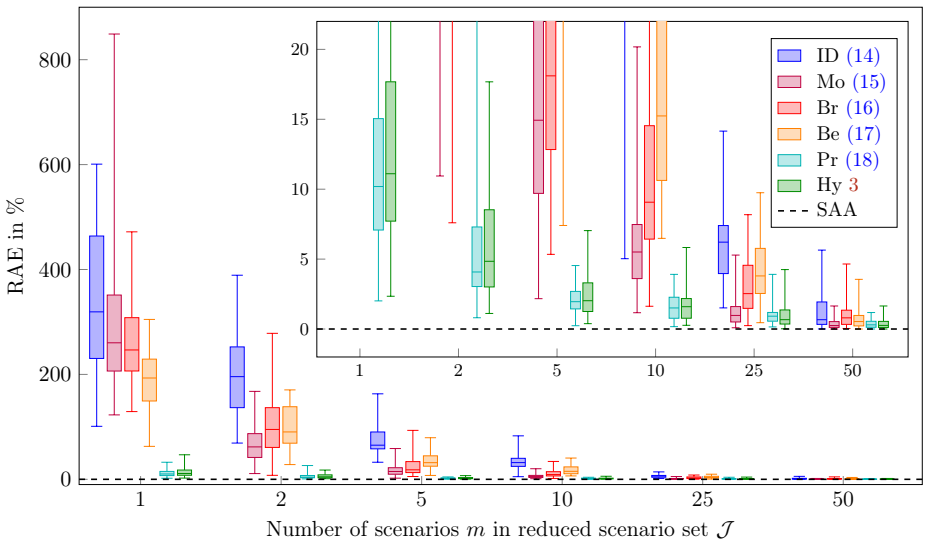
The central claim is that scenario reduction quality is governed by the choice of transportation cost function, and the paper's proposed asymmetric regret cost, cPr(ξi, ξj) = z(x*(ξj), ξi) − z(x*(ξi), ξi), makes the Forward Selection algorithm pick, on the first draw, the scenario whose single-scenario distribution minimizes the relative approximation error among all single-scenario distributions (Theorem 1). The proof exploits the observation that for m = 1 the distribution is a Dirac measure, so the two-stage problem reduces to the single-scenario problem, and the constant term z(x*(ξi), ξi) in cPr cancels in the minimization. Numerically, this first choice alone gives about 11.3% and 2.4%
What carries the argument
The central object is the transportation cost function cPr(ξi, ξj) = z(x*(ξj), ξi) − z(x*(ξi), ξi), the asymmetric regret of optimizing the first stage for scenario j and then observing scenario i, minus the cost when the decision is tailored to i. The load-bearing mechanism is Theorem 1: with Forward Selection's first draw, minimizing the transported mass under cPr is equivalent to minimizing the relative approximation error, because the subtractive term depends only on i and cancels. The paper also introduces a hybrid of an expected-value-problem-based cost function and cPr, where the former quickly prunes the scenario set and the latter refines it.
Load-bearing premise
The headline large-case accuracy (0.4% mean RAE at m = 5) is computed under a 1% MIP gap for every solve, including the reference solution, so the measured error is smaller than the solver's certified optimality tolerance.
What would settle it
Solve the large 300-bus case with the same scenario samples but a 0.01% MIP gap for the reference n = 1000 SAA and the m = 5 reduced problem; if the mean RAE is no longer around 0.4% or the ranking of cost functions changes, the headline number is an artifact of solver tolerance. Alternatively, on a different application, enumerate all single-scenario distributions and verify that Forward Selection's first pick under cPr attains the minimal RAE.
If this is right
- Replacing hundreds or thousands of scenarios with roughly five selected scenarios can bring two-stage stochastic MIPs within reach, since solution time typically scales badly with scenario count.
- The first scenario drawn by Forward Selection with cPr is provably the best single-scenario choice, giving a warm start that other cost functions do not guarantee.
- The method is consistent across random draws: cPr shows markedly lower variance in RAE across samples than competing cost functions.
- The hybrid algorithm delivers the same approximation quality as cPr but at 18x less wall-clock time and 66x less solver work on the 300-bus case, making the approach practical.
- Theorem 1's guarantee is limited to m = 1; the good behavior at m > 1 is empirical and not proven.
Where Pith is reading between the lines
- The proof structure suggests a recipe for other asymmetric regret functions: any cost of the form R(ξi, ξj) − const(ξi) with zero diagonal will inherit the m = 1 optimality property, so the result may transfer to other problem classes.
- One could test the hybrid's Phase-1 choice r = 50 sensitivity: the paper fixes r for both cases, and a principled stopping rule for pruning could further reduce computation.
- The reported 0.4% RAE on the large case is below the 1% MIP gap used for all solves; verifying with a tighter gap would separate the method's accuracy from solver tolerance.
- For convex second stages, duality might let cPr be evaluated from dual prices of the n² − n second-stage LPs without solving them all, a route the paper notes as future work.
Editorial analysis
A structured set of objections, weighed in public.
Referee Report
Summary. The paper considers scenario reduction for two-stage stochastic mixed-integer programs, revisiting the optimal mass transportation framework and the Forward Selection Algorithm. It reviews input-data-driven and optimization-problem-driven transportation cost functions, proposes a new asymmetric cost function cPr(ξi, ξj) = z(x*(ξj), ξi) − z(x*(ξi), ξi), and proves (Theorem 1, Appendix B) that the first scenario selected by Forward Selection with cPr minimizes the relative approximation error (RAE) among all single-scenario reductions. To reduce the computational burden of evaluating cPr, the paper proposes a hybrid algorithm that first prunes scenarios using the cost function of Morales et al. (2009) and then applies cPr to the pre-selected subset. Numerical experiments on two-stage stochastic unit commitment for a 24-bus system (n=200) and a 300-bus system (n=1000) report that around five scenarios suffice for roughly 2.1% and 0.4% RAE, with the hybrid algorithm cutting wall-clock time by a factor of 18 and solver work by a factor of 66 on the large case.
Significance. If the results hold, the paper offers a practical and scalable scenario-reduction method for two-stage stochastic MIPs, with a first-scenario optimality guarantee and a hybrid algorithm that makes the expensive cPr cost function usable. The strengths of the paper include: the proof of Theorem 1 is correct (though, as discussed below, the result is essentially definitional); the comparison of cost functions is carried out under a common algorithmic framework; the small-case experiments use a 0.01% MIP gap and are credible; and the code and data are publicly available. The main limitation is that the headline large-case accuracy, 0.4% RAE, is below the 1% MIP gap used to obtain the reference solutions, so the quantitative claim is not numerically resolved. The theoretical contribution is also weaker than it appears: Theorem 1 follows directly from the construction of cPr. Overall, the paper has merit, but the advertised large-case performance needs additional numerical support.
major comments (3)
- [§5.2, §5.2.1, Eq. (12)] The reported large-case mean RAE of 0.4% is smaller than the 1% MIP gap used for all MIPs, including the n=1000 reference SAA and the reduced m=5 problems. Since z*(Pn) is only known to within roughly ±1% and x*(Qm) is itself an approximate solution, the computed RAE is within solver noise; the true RAE could be near zero or well above the reported value. This is load-bearing because the abstract and conclusions advertise the 0.4% figure. The authors should either solve the reference and reduced problems with a much tighter gap (as in the small case) for at least a subset of draws, or provide rigorous bounds/sensitivity analysis that show the RAE is insensitive to the 1% termination tolerance.
- [Appendix B, Eq. (B.3)] Theorem 1 is correct but is a direct algebraic consequence of the definition of cPr. In Eq. (B.3), the term z(x*(ξi), ξi) is subtracted and is independent of j, so the Forward Selection objective collapses to the RAE numerator for m=1. Thus the theorem essentially restates the cost-function construction rather than revealing a new structural property. The paper should explicitly acknowledge this and avoid presenting the result as a deep optimality guarantee; the contribution is better framed as the identification of a cost function that makes the greedy first selection optimal by design.
- [§5.2.1, Figures 1–2] The comparison of cPr with other cost functions for m=1 is partly a tautology: by Theorem 1, cPr is engineered to minimize RAE at m=1, so its superior first-draw performance is expected. The more meaningful claims are for m>1 and for the hybrid algorithm. These empirical claims, however, inherit the numerical tolerance problem described above. Please report results with a common, tighter MIP gap for the small and large cases, or at least demonstrate that the reported RAE differences are not attributable to solver stopping criteria.
minor comments (6)
- [Abstract / §6] The abstract says “roughly 2.1% and 0.4% error” for five scenarios, while Section 5.1 reports around 2% and Section 6 reports 11.3% and 2.4% for one scenario. Please make the numbers consistent and clarify which m corresponds to each RAE.
- [Theorem 1 statement] The notation Q1 = {Q_j^1 : j ∈ I} and later Q1 ∈ Q1 is confusing. Use a different symbol for the family of distributions, e.g., \mathcal{Q}_1, and state the assumption z*(Pn)>0 in the theorem, not only in a footnote in the proof.
- [Appendix B] There is a notational inconsistency: the proof uses both ζ_j and ξ_j for the candidate scenarios. Please unify to ξ_j throughout.
- [§3.2, Algorithm 1] In line 4, the set J is used before any scenario is selected (J = {}). While the expression is correct, a short remark explaining the convention for J = {} would improve readability.
- [§4.2.4 / Table 1] The claim that cPr requires n MIPs and n^2−n LPs assumes all entries of the cost matrix are computed. The paper later uses heuristics (pre-reduction with cID and warm-starting, Appendix C). Please state clearly that the reported computational costs in Table 2 include those heuristics, so that the comparison with the exact cost matrix is not misleading.
- [§5.2.2] The paper does not discuss the effect of multiple optimal first-stage solutions x*(Qm) on the RAE. If the reduced MIP has several optima, the RAE may depend on which optimum is returned. A brief comment or a check with a different solver seed would strengthen the numerical claims.
Circularity Check
Theorem 1 is an algebraic consequence of the proposed cost function's definition; the m>1 empirical comparison is independent, but the headline 0.4% large-case claim is not numerically resolved.
specific steps
-
self definitional
[Section 4.2.4, Eq. (18); Theorem 1; Appendix B, Eqs. (B.2)-(B.3)]
"cPr(ξi, ξj) = z(x∗(ξj), ξi) − z(x∗(ξi), ξi) ... j∗ = arg min_{j∈I} Σ_i p_i cPr(ξ_i, ζ_j) = arg min_{j∈I} Σ_i p_i(z(x∗(ζ_j), ξ_i) − z(x∗(ξ_i), ξ_i)) = arg min_{j∈I} Σ_i p_i z(x∗(ζ_j), ξ_i), which is equivalent to the minimization of the RAE in Equation (B.1) and completes the proof."
The cost function is defined as the per-scenario regret term appearing in the RAE numerator, minus a term independent of the candidate scenario j. Appendix B shows the first Forward Selection draw minimizes Σ_i p_i z(x*(ξ_j), ξ_i), which is exactly the only j-dependent part of RAE(Pn, δ_{ξ_j}) because the denominator and z*(Pn) are constants. Theorem 1 therefore asserts that the scenario minimizing an objective defined to be the RAE numerator also minimizes the RAE. This is a valid but definitional equivalence: the optimality is built into Eq. (18) by construction, not discovered independently.
full rationale
The main theoretical result is self-definitional: cPr is designed as the pointwise RAE regret, and the proof in Appendix B (B.2)-(B.3) reduces the Forward Selection objective to the RAE numerator. The numerical experiments with m>1 and the hybrid algorithm are genuine external comparisons and mitigate the circularity; the small-case 0.01% MIP gap supports those results. The large-case 0.4% RAE is computed with a 1% MIP gap (Section 5.2), so the headline accuracy is numerically unresolved and not certified against solver tolerance, but this is a correctness/robustness issue rather than circularity. No load-bearing self-citation chain or imported uniqueness theorem was found; the citations to Morales et al. (2009) are prior-work references, not circular support.
Axiom & Free-Parameter Ledger
free parameters (2)
- r (pre-selection size) =
50
- MIP gap for large case =
1%
axioms (6)
- domain assumption The two-stage problem has relatively complete recourse and fixed recourse matrix W and technology matrix T independent of uncertainty.
- domain assumption Uncertainty appears only in the right-hand sides of second-stage constraints.
- domain assumption The reduced distribution Q must be supported on atoms of Pn (subset selection).
- domain assumption z*(Pn) > 0 for the RAE to be well-defined.
- standard math The Monge-Kantorovich distance and the Forward Selection algorithm of Dupačová et al. (2003) provide a valid greedy selection framework.
- domain assumption Single-scenario MIPs and second-stage LPs used to evaluate cost functions are solved exactly (or within the stated MIP gap).
read the original abstract
Two-stage stochastic mixed-integer programs are important tools for decision-making under uncertainty. Representing the uncertainty with many scenarios, however, can make them challenging to solve. Scenario reduction addresses this by finding a distribution supported on fewer scenarios that still yields similar optimal first-stage decisions. In this paper, we revisit the classical scenario reduction theory based on distances between probability distributions and the optimal mass transportation problem. The transportation problem's cost function captures scenario similarity and is central to the effectiveness of scenario reduction. We then review and compare various transportation cost functions from the literature and propose a new one. Using the Forward Selection Algorithm, we prove that our proposed cost function selects the best possible scenario from a given sample on the first draw with respect to the relative approximation error. To reduce the computational cost of evaluating this cost function, we further propose a hybrid algorithm with a scenario pre-selection phase. We assess solution quality and computational complexity on the two-stage stochastic unit commitment problem for small 24-bus and large 300-bus case studies. With only around five scenarios, the proposed cost function approximates the full-distribution optimum to within roughly 2.1% and 0.4% error for the small and large cases, respectively. In contrast, prevalent cost functions often need 25 scenarios or more to achieve that solution quality. The hybrid algorithm achieves similar solution quality while reducing wall-clock time by a factor of 18 and work (per Gurobi solver) by a factor of 66 on the large case study.
Figures


Reference graph
Works this paper leans on
-
[1]
Stabilized Benders decomposition for energy planning under climate uncertainty , year =
Göke, Leonard and Schmidt, Felix and Kendziorski, Mario , journal =. Stabilized Benders decomposition for energy planning under climate uncertainty , year =. doi:10.1016/j.ejor.2024.01.016 , groups =
-
[2]
Park, SangWoo and Xu, Qingyu and Hobbs, Benjamin F. , journal =. Comparing scenario reduction methods for stochastic transmission planning , year =. doi:10.1049/iet-gtd.2018.6362 , groups =
arXiv 2018
-
[3]
Optimization-Based Scenario Reduction for Data-Driven Two-Stage Stochastic Optimization , year =
Bertsimas, Dimitris and Mundru, Nishanth , journal =. Optimization-Based Scenario Reduction for Data-Driven Two-Stage Stochastic Optimization , year =. doi:10.1287/opre.2022.2265 , file =
arXiv 2022
-
[4]
and Louveaux, François , publisher =
Birge, John R. and Louveaux, François , publisher =. Introduction to Stochastic Programming , year =. doi:10.1007/978-1-4614-0237-4 , groups =
-
[5]
Bruninx, K. and Delarue, E. , booktitle =. Scenario reduction techniques and solution stability for stochastic unit commitment problems , year =. doi:10.1109/energycon.2016.7514074 , file =
arXiv 2016
-
[6]
Scenario reduction in stochastic programming , year =
Jitka Dupačová and Nicole Gröwe-Kuska and Werner Römisch , journal =. Scenario reduction in stochastic programming , year =. doi:10.1007/s10107-002-0331-0 , file =
-
[7]
Feng, Yonghan and Ryan, Sarah M. , booktitle =. Scenario reduction for stochastic unit commitment with wind penetration , year =. doi:10.1109/pesgm.2014.6939138 , file =
arXiv 2014
-
[8]
2025 , doi =
Golsefidi, Atefeh Hemmati and Pisinger, David , title =. 2025 , doi =
2025
-
[9]
Fundamentals and recent developments in stochastic unit commitment , year =
Håberg, Martin , journal =. Fundamentals and recent developments in stochastic unit commitment , year =. doi:10.1016/j.ijepes.2019.01.037 , file =
-
[10]
Scenario Reduction Algorithms in Stochastic Programming , year =
Heitsch, Holger and Römisch, Werner , journal =. Scenario Reduction Algorithms in Stochastic Programming , year =. doi:10.1023/a:1021805924152 , file =
-
[11]
A note on scenario reduction for two-stage stochastic programs , year =
Heitsch, Holger and Römisch, Werner , journal =. A note on scenario reduction for two-stage stochastic programs , year =. doi:10.1016/j.orl.2006.12.008 , file =
-
[12]
Henrion, R. and Römisch, W. , journal =. Problem-based optimal scenario generation and reduction in stochastic programming , year =. doi:10.1007/s10107-018-1337-6 , file =
-
[13]
Decision-based scenario clustering for decision-making under uncertainty , year =
Hewitt, Mike and Ortmann, Janosch and Rei, Walter , journal =. Decision-based scenario clustering for decision-making under uncertainty , year =. doi:10.1007/s10479-020-03843-x , file =
-
[14]
Homem-de-Mello, Tito and Valencia, Juan and Lagos, Felipe and Lagos, Guido , title =. 2024 , copyright =. doi:10.48550/arXiv.2411.03520 , file =
-
[15]
Problem-driven scenario clustering in stochastic optimization , year =
Keutchayan, Julien and Ortmann, Janosch and Rei, Walter , journal =. Problem-driven scenario clustering in stochastic optimization , year =. doi:10.1007/s10287-023-00446-2 , file =
-
[16]
and Shapiro, Alexander and Homem-de-Mello, Tito , journal =
Kleywegt, Anton J. and Shapiro, Alexander and Homem-de-Mello, Tito , journal =. The Sample Average Approximation Method for Stochastic Discrete Optimization , year =. doi:10.1137/s1052623499363220 , file =
-
[17]
On Mixed-Integer Programming Formulations for the Unit Commitment Problem , year =
Knueven, Bernard and Ostrowski, James and Watson, Jean-Paul , journal =. On Mixed-Integer Programming Formulations for the Unit Commitment Problem , year =. doi:10.1287/ijoc.2019.0944 , file =
arXiv 2019
-
[18]
Mohajerin Esfahani, Peyman and Kuhn, Daniel , journal =. Data-driven distributionally robust optimization using the Wasserstein metric: performance guarantees and tractable reformulations , year =. doi:10.1007/s10107-017-1172-1 , file =
-
[19]
Morales, J.M. and Pineda, S. and Conejo, A.J. and Carrion, M. , journal =. Scenario Reduction for Futures Market Trading in Electricity Markets , year =. doi:10.1109/tpwrs.2009.2016072 , file =
arXiv 2009
-
[20]
An Updated Version of the IEEE RTS 24-Bus System for Electricity Market and Power System Operation Studies
Christos Ordoudis and Pierre Pinson and. An Updated Version of the IEEE RTS 24-Bus System for Electricity Market and Power System Operation Studies. , year =
-
[21]
and Pichler, Alois , pages =
Pflug, Georg Ch. and Pichler, Alois , pages =. Approximations for Probability Distributions and Stochastic Optimization Problems , year =. Stochastic Optimization Methods in Finance and Energy , doi =
-
[22]
and Pichler, Alois , journal =
Pflug, Georg Ch. and Pichler, Alois , journal =. Dynamic generation of scenario trees , year =. doi:10.1007/s10589-015-9758-0 , file =
-
[23]
Wind Energy: Forecasting Challenges for Its Operational Management , year =
Pinson, Pierre , journal =. Wind Energy: Forecasting Challenges for Its Operational Management , year =. doi:10.1214/13-STS445 , file =
-
[24]
Stability of Stochastic Programming Problems , year =
Römisch, Werner , pages =. Stability of Stochastic Programming Problems , year =. Stochastic Programming , doi =
-
[25]
Römisch, W. and Wets, R. J.-B. , journal =. Stability of -approximate Solutions to Convex Stochastic Programs , year =. doi:10.1137/060657716 , file =
-
[26]
Scenario reduction revisited: fundamental limits and guarantees , year =
Rujeerapaiboon, Napat and Schindler, Kilian and Kuhn, Daniel and Wiesemann, Wolfram , journal =. Scenario reduction revisited: fundamental limits and guarantees , year =. doi:10.1007/s10107-018-1269-1 , file =
-
[27]
Lectures on stochastic programming , year =
Shapiro, Alexander , editor =. Lectures on stochastic programming , year =
-
[28]
IEEE Transactions on Power Apparatus and Systems , title =. 1979 , issn =. doi:10.1109/tpas.1979.319398 , file =
arXiv 1979
-
[29]
Takriti, S. and Birge, J.R. and Long, E. , journal =. A stochastic model for the unit commitment problem , year =. doi:10.1109/59.535691 , file =
-
[30]
and Wang, Jianhui and Liu, Andrew L
Zheng, Qipeng P. and Wang, Jianhui and Liu, Andrew L. , journal =. Stochastic Optimization for Unit Commitment—A Review , year =. doi:10.1109/tpwrs.2014.2355204 , file =
arXiv 2014
-
[31]
Zhuang, Yingrui and Cheng, Lin and Qi, Ning and Almassalkhi, Mads R. and Liu, Feng , journal =. Problem-Driven Scenario Reduction Framework for Power System Stochastic Operation , year =. doi:10.1109/tpwrs.2024.3523220 , file =
arXiv 2024
-
[32]
Evaluation of scenario-generation methods for stochastic programming , year =
Kaut, Michal and Wallace, Stein W , publisher =. Evaluation of scenario-generation methods for stochastic programming , year =
-
[33]
Kim, Kibaek and Mehrotra, Sanjay , journal =. A Two-Stage Stochastic Integer Programming Approach to Integrated Staffing and Scheduling with Application to Nurse Management , year =. doi:10.1287/opre.2015.1421 , file =
arXiv 2015
-
[34]
Comparison of scenario reduction techniques for the stochastic unit commitment , year =
Dvorkin, Yury and Wang, Yishen and Pandzic, Hrvoje and Kirschen, Daniel , booktitle =. Comparison of scenario reduction techniques for the stochastic unit commitment , year =. doi:10.1109/pesgm.2014.6939042 , file =
arXiv 2014
-
[35]
Pflug, G.Ch. , journal =. Scenario tree generation for multiperiod financial optimization by optimal discretization , year =. doi:10.1007/pl00011398 , file =
-
[36]
Carrion, M. and Arroyo, J.M. , journal =. A Computationally Efficient Mixed-Integer Linear Formulation for the Thermal Unit Commitment Problem , year =. doi:10.1109/tpwrs.2006.876672 , file =
arXiv 2006
-
[37]
Blanco, Ignacio and Morales, Juan M. , journal =. An Efficient Robust Solution to the Two-Stage Stochastic Unit Commitment Problem , year =. doi:10.1109/tpwrs.2017.2683263 , file =
arXiv 2017
-
[38]
Papavasiliou, Anthony and Oren, Shmuel S. , journal =. Multiarea Stochastic Unit Commitment for High Wind Penetration in a Transmission Constrained Network , year =. doi:10.1287/opre.2013.1174 , groups =
arXiv 2013
-
[39]
k-means++: The Advantages of Careful Seeding , year =
Arthur, David and Vassilvitskii, Sergei , booktitle =. k-means++: The Advantages of Careful Seeding , year =
-
[40]
Babaeinejadsarookolaee, Sogol and Birchfield, Adam and Christie, Richard D. and Coffrin, Carleton and DeMarco, Christopher and Diao, Ruisheng and Ferris, Michael and Fliscounakis, Stephane and Greene, Scott and Huang, Renke and Josz, Cedric and Korab, Roman and Lesieutre, Bernard and Maeght, Jean and Mak, Terrence W. K. and Molzahn, Daniel K. and Overbye,...
-
[41]
2025 , groups =
Werner, Yannick , title =. 2025 , groups =
2025
-
[42]
Julia: A fresh approach to numerical computing , year =
Bezanson, Jeff and Edelman, Alan and Karpinski, Stefan and Shah, Viral B , journal =. Julia: A fresh approach to numerical computing , year =
-
[43]
Mathematical Programming Computation , title =
Miles Lubin and Oscar Dowson and Joaquim. Mathematical Programming Computation , title =. 2023 , issn =. doi:10.1007/s12532-023-00239-3 , groups =
-
[44]
Werner, Yannick and Morales, Juan Miguel and Pineda, Salvador and Roald, Line and Wogrin, Sonja , title =. 2025 , copyright =. doi:10.48550/arXiv.2512.19614 , groups =
-
[45]
2020 , groups =
GitHub repository , publisher =. 2020 , groups =
2020
-
[46]
Decomposition algorithms for computational stochastic mixed-integer programming: A survey , year =
Romeijnders, Ward and Zhang, Yihang and Sen, Suvrajeet , journal =. Decomposition algorithms for computational stochastic mixed-integer programming: A survey , year =. doi:10.1016/j.ejor.2026.05.043 , file =
-
[47]
About the complexity of two-stage stochastic IPs , year =
Klein, Kim-Manuel , journal =. About the complexity of two-stage stochastic IPs , year =. doi:10.1007/s10107-021-01698-z , file =
-
[48]
A stochastic programming approach for supply chain network design under uncertainty , year =
Santoso, Tjendera and Ahmed, Shabbir and Goetschalckx, Marc and Shapiro, Alexander , journal =. A stochastic programming approach for supply chain network design under uncertainty , year =. doi:10.1016/j.ejor.2004.01.046 , groups =
-
[49]
and Van Woensel, Tom , journal =
Çelik, Şifa and Martin, Layla and Schrotenboer, Albert H. and Van Woensel, Tom , journal =. Exact Two-Step Benders Decomposition for the Time Window Assignment Traveling Salesperson Problem , year =. doi:10.1287/trsc.2024.0750 , file =
arXiv 2024
-
[50]
Cavaliere, Francesco and Fischetti, Matteo and Roberti, Roberto and Salvagnin, Domenico , journal =. Models and algorithms for the Time Window Assignment Traveling Salesperson Problem with stochastic travel times , year =. doi:10.1016/j.ejor.2025.07.034 , groups =
-
[51]
The IEEE Reliability Test System: A Proposed 2019 Update , year =
Barrows, Clayton and Preston, Eugene and Staid, Andrea and Stephen, Gord and Watson, Jean-Paul and Bloom, Aaron and Ehlen, Ali and Ikaheimo, Jussi and Jorgenson, Jennie and Krishnamurthy, Dheepak and Lau, Jessica and McBennett, Brendan and O’Connell, Matthew , journal =. The IEEE Reliability Test System: A Proposed 2019 Update , year =. doi:10.1109/tpwrs....
arXiv 2019
discussion (0)
Sign in with ORCID, Apple, or X to comment. Anyone can read and Pith papers without signing in.