Log-concavity and tunneling: adiabatic quantum optimization for convex functions (with a spike)
Pith reviewed 2026-06-26 08:11 UTC · model grok-4.3
The pith
Log-concavity of the ground state yields spectral gap bounds and extends tunneling to quadratic potentials in adiabatic quantum optimization.
A machine-rendered reading of the paper's core claim, the machinery that carries it, and where it could break.
Core claim
Log-concavity of the ground state is a key structural property for discrete 1D Schrödinger operators with convex potentials. It provides a discrete version of the Brascamp-Lieb result and leads to improved spectral gap bounds. This property also allows extending the perturbative analysis of tunneling in the Hamming weight with spike problem to the family of potentials with log-concave ground states, including quadratic potentials.
What carries the argument
Log-concavity of the ground state for a family of discrete 1D Schrödinger operators, which holds for convex potentials and enables both spectral gap bounds and extended perturbative tunneling analysis.
If this is right
- New spectral gap bounds for convex potentials that go beyond those by Jarret and Jordan.
- Extension of Reichardt's perturbative analysis of the Hamming weight with spike to quadratic potentials.
- Broader applicability of tunneling to convex potentials with spikes.
- The framework also covers certain potentials with local minima under stated conditions.
Where Pith is reading between the lines
- Numerical checks of ground-state log-concavity for specific quadratic potentials with spikes could directly test the extended analysis.
- The same structural property might simplify gap estimates in related discrete quantum systems beyond one dimension.
Load-bearing premise
Discrete 1D Schrödinger operators with convex potentials have log-concave ground states.
What would settle it
Finding a convex potential where the ground state of the corresponding discrete Schrödinger operator is not log-concave, or where the spectral gap bounds do not improve as claimed.
Figures
read the original abstract
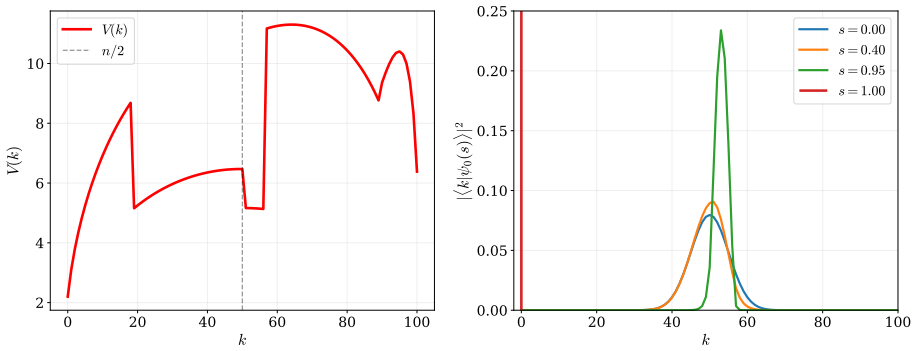
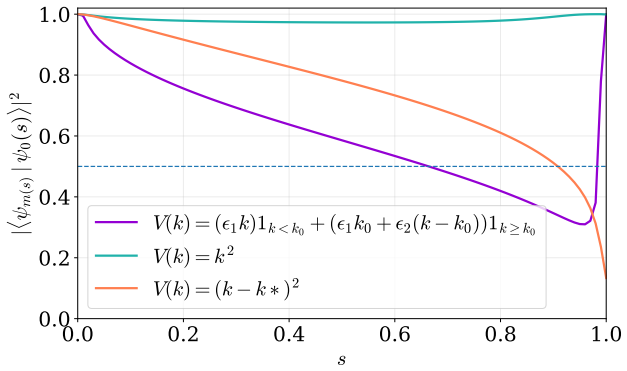
Quantum tunneling is expected to provide a computational speedup in quantum computing, a phenomenon that Adiabatic Quantum Optimization (AQO) aims to leverage. While some academic proofs of concept have been studied, such as the "Hamming weight with a spike" (HWS) problem, the algorithmic gains of this effect remain underexplored. In this work we extend the analysis underlying HWS to more general potentials. In the first half of the work, we establish (discrete) log-concavity of the ground state as a key structural property in this context. We devise a framework for establishing log-concavity of the ground state for a large family of discrete, 1-dimensional Schr\"odinger operators. The family includes convex potentials, but also certain potentials with local minima. In the convex case, this provides a discrete version of a continuous result by Brascamp and Lieb ('76). We demonstrate the utility of our result by establishing new spectral gap bounds, going beyond related results by Jarret and Jordan ('14) for convex potentials. In the second half of the work, we use our results on log-concavity to extend the perturbative analysis of HWS by Reichardt ('04) to the larger family of potentials with log-concave ground state. As a concrete instantiation, we use our result to extend the HWS analysis from a linear potential (which is exactly solvable) to a quadratic potential (which is no longer solvable). Our result strongly suggests the broader applicability of tunneling to convex potentials with spikes
Editorial analysis
A structured set of objections, weighed in public.
Referee Report
Summary. The paper establishes a framework proving log-concavity of the ground state for a family of discrete 1D Schrödinger operators (including convex potentials, as a discrete Brascamp-Lieb analog, and certain potentials with local minima). It applies this to derive new spectral gap bounds beyond Jarret-Jordan (2014) for convex potentials, and extends Reichardt's (2004) perturbative tunneling analysis from the linear Hamming-weight-with-spike problem to quadratic potentials with log-concave ground states, suggesting broader applicability of tunneling in AQO for convex functions with spikes.
Significance. If the discrete log-concavity result and its applications hold, the work supplies a structural property that strengthens gap estimates and extends tunneling analysis to a larger class of potentials. It builds directly on Brascamp-Lieb (1976), Jarret-Jordan (2014), and Reichardt (2004) without circularity or fitted parameters, and the concrete extension from linear to quadratic potentials is a clear incremental advance. The framework for log-concavity under stated conditions is positioned as the enabling step for both contributions.
major comments (2)
- [first half of the work] The log-concavity framework (first half) is load-bearing for both the gap bounds and the tunneling extension; the manuscript must explicitly verify that the discrete operator family satisfies the convexity or local-minima conditions without hidden restrictions on boundary terms or lattice size that could invalidate the ground-state property.
- [second half of the work] The extension of the perturbative analysis (second half) to quadratic potentials relies on log-concavity to carry over the gap lower bound; a direct comparison (e.g., explicit leading-order tunneling amplitude or gap scaling) between the exactly solvable linear case and the quadratic case is needed to substantiate that the result is not merely formal but quantitatively useful.
minor comments (2)
- Notation for the discrete Schrödinger operator (potential term, hopping) should be stated once at the outset with a clear reference to the continuous analog to avoid ambiguity in later sections.
- [Abstract] The abstract states the result 'strongly suggests' broader applicability; replace with a more precise statement of what is proved versus what is conjectured for general convex spiked potentials.
Simulated Author's Rebuttal
We thank the referee for the careful reading and the recommendation of minor revision. We address the two major comments point by point below.
read point-by-point responses
-
Referee: [first half of the work] The log-concavity framework (first half) is load-bearing for both the gap bounds and the tunneling extension; the manuscript must explicitly verify that the discrete operator family satisfies the convexity or local-minima conditions without hidden restrictions on boundary terms or lattice size that could invalidate the ground-state property.
Authors: The framework is stated for finite 1D lattices equipped with standard open (Dirichlet) boundary conditions, and the convexity (or local-minima) assumption is imposed directly on the potential V. The proof of log-concavity is uniform in the lattice size N and does not invoke any special boundary cancellations. We have added an explicit verification paragraph at the beginning of Section 2 that lists the precise assumptions on V and the boundary operator and confirms that they are satisfied for all convex potentials on any finite chain, with no additional hidden restrictions. revision: yes
-
Referee: [second half of the work] The extension of the perturbative analysis (second half) to quadratic potentials relies on log-concavity to carry over the gap lower bound; a direct comparison (e.g., explicit leading-order tunneling amplitude or gap scaling) between the exactly solvable linear case and the quadratic case is needed to substantiate that the result is not merely formal but quantitatively useful.
Authors: Log-concavity supplies an identical lower bound on the spectral gap for both potentials, so the leading exponential dependence of the tunneling amplitude on spike height is the same. To make the comparison quantitative we have inserted a new subsection (4.3) that computes the leading-order prefactor explicitly for the quadratic spike and contrasts it with the exactly solvable linear case; the quadratic prefactor differs only by a curvature-dependent constant that remains O(1) independent of system size. This shows the extension is not merely formal. revision: yes
Circularity Check
No significant circularity; derivation is self-contained
full rationale
The paper devises an independent framework to prove discrete log-concavity of the ground state for 1D Schrödinger operators under convex potentials (or local-minima conditions), explicitly positioned as a discrete analog of the external Brascamp-Lieb 1976 result. This property is then applied to derive new spectral-gap bounds (extending Jarret-Jordan 2014) and to extend Reichardt 2004 perturbative tunneling analysis to quadratic spiked potentials. No step reduces a claimed prediction or central result to a fitted parameter, self-citation chain, or definitional tautology; all load-bearing steps rely on the newly supplied proof framework and external citations whose authors do not overlap with the present work. The structure is therefore self-contained against external benchmarks.
Axiom & Free-Parameter Ledger
axioms (1)
- domain assumption Discrete 1D Schrödinger operators with convex potentials admit log-concave ground states (discrete Brascamp-Lieb analogue)
Reference graph
Works this paper leans on
-
[1]
Stochastic Processes and their Applications , volume =
Oliver Johnson , keywords =. Stochastic Processes and their Applications , volume =. 2007 , issn =. doi:https://doi.org/10.1016/j.spa.2006.10.006 , url =
-
[2]
2013 , publisher=
Analysis and geometry of Markov diffusion operators , author=. 2013 , publisher=
2013
-
[3]
The American Mathematical Monthly , volume=
Random walk and the theory of Brownian motion , author=. The American Mathematical Monthly , volume=. 1947 , publisher=
1947
-
[4]
1976 , publisher=
Brascamp, Herm Jan and Lieb, Elliott H , journal=. 1976 , publisher=
1976
-
[5]
Klartag, Bo'az and Lehec, Joseph , journal=
-
[6]
Rendiconti del Circolo Matematico di Palermo (1884-1940) , volume=
Fekete, Michael and P. Rendiconti del Circolo Matematico di Palermo (1884-1940) , volume=. 1912 , publisher=
1940
-
[7]
Logconcavity of discrete distributionsLogconcavity of Discrete Distributions
Pr \'e kopa, Andr \'a s. Logconcavity of discrete distributionsLogconcavity of Discrete Distributions. Encyclopedia of Optimization. 2009. doi:10.1007/978-0-387-74759-0_347
-
[8]
2014 , publisher=
Information and exponential families: in statistical theory , author=. 2014 , publisher=
2014
-
[9]
Optimization Methods and Software , volume=
A survey of fundamental operations on discrete convex functions of various kinds , author=. Optimization Methods and Software , volume=. 2021 , publisher=
2021
-
[10]
On quantum mean-field models and their quantum annealing , volume=
Bapst, Victor and Semerjian, Guilhem , year=. On quantum mean-field models and their quantum annealing , volume=. Journal of Statistical Mechanics: Theory and Experiment , publisher=. doi:10.1088/1742-5468/2012/06/p06007 , number=
-
[11]
and Peres, Yuval and Wilmer, Elizabeth L
Levin, David A. and Peres, Yuval and Wilmer, Elizabeth L. , biburl =
-
[12]
Communications in Mathematical Physics , publisher=
Ding, Jian and Lubetzky, Eyal and Peres, Yuval , year=. Communications in Mathematical Physics , publisher=. doi:10.1007/s00220-009-0781-9 , number=
-
[13]
2007 , eprint=
Glauber dynamics for the mean-field Ising model: cut-off, critical power law, and metastability , author=. 2007 , eprint=
2007
-
[14]
Mathematische Annalen , volume=
Das asymptotische Verteilungsgesetz der Eigenwerte linearer partieller Differentialgleichungen (mit einer Anwendung auf die Theorie der Hohlraumstrahlung) , author=. Mathematische Annalen , volume=. 1912 , publisher=
1912
-
[15]
Proceedings of the thirty-sixth annual ACM symposium on Theory of computing , pages=
The quantum adiabatic optimization algorithm and local minima , author=. Proceedings of the thirty-sixth annual ACM symposium on Theory of computing , pages=
-
[16]
SIAM Journal on Computing , volume=
On counting independent sets in sparse graphs , author=. SIAM Journal on Computing , volume=. 2002 , publisher=
2002
-
[17]
2024 , eprint=
Generalized Short Path Algorithms: Towards Super-Quadratic Speedup over Markov Chain Search for Combinatorial Optimization , author=. 2024 , eprint=
2024
-
[18]
2021 , eprint=
Analysis of Boolean Functions , author=. 2021 , eprint=
2021
-
[19]
2018 , eprint=
A Short Path Quantum Algorithm for Exact Optimization , author=. 2018 , eprint=
2018
-
[20]
American Journal of Mathematics , volume=
Logarithmic sobolev inequalities , author=. American Journal of Mathematics , volume=. 1975 , publisher=
1975
-
[21]
Jarret, Michael and Jordan, Stephen P. , year=. Journal of Mathematical Physics , publisher=. doi:10.1063/1.4878120 , number=
-
[22]
, title =
Jarret, Michael and Jordan, Stephen P. , title =. Quantum Information and Computation , month = mar, pages =. 2015 , issue_date =
2015
-
[23]
arXiv preprint quant-ph/0201031 , year=
Quantum adiabatic evolution algorithms versus simulated annealing , author=. arXiv preprint quant-ph/0201031 , year=
-
[24]
Statistics & Probability Letters , volume=
A note on statistical distances for discrete log-concave measures , author=. Statistics & Probability Letters , volume=. 2025 , publisher=
2025
-
[25]
Complex Analysis and Operator Theory , author =
On the. Complex Analysis and Operator Theory , author =. 2025 , pages =. doi:10.1007/s11785-025-01738-y , abstract =
-
[26]
Christopher S. Goodrich , keywords =. An application of a discrete Sobolev inequality to discretised Kirchhoff equations , journal =. 2026 , issn =. doi:https://doi.org/10.1016/j.jmaa.2025.130066 , url =
-
[27]
Miclo, Laurent , journal=
-
[28]
Aravinda, Heshan , year=. Entropy-variance inequalities for discrete log-concave random variables via degree of freedom , volume=. Discrete Mathematics , publisher=. doi:10.1016/j.disc.2023.113683 , number=
-
[29]
Combinatorics, Probability and Computing , volume=
Concentration functions and entropy bounds for discrete log-concave distributions , author=. Combinatorics, Probability and Computing , volume=. 2022 , publisher=
2022
-
[30]
Bounds for the adiabatic approximation with applications to quantum computation
Jansen, Sabine and Ruskai, Mary-Beth and Seiler, Ruedi , year=. Bounds for the adiabatic approximation with applications to quantum computation , volume=. Journal of Mathematical Physics , publisher=. doi:10.1063/1.2798382 , number=
-
[31]
Muthukrishnan, Siddharth and Albash, Tameem and Lidar, Daniel A. , year=. Tunneling and Speedup in Quantum Optimization for Permutation-Symmetric Problems , volume=. Physical Review X , publisher=. doi:10.1103/physrevx.6.031010 , number=
-
[32]
Preservation of log-concavity on summation , volume=
Johnson, Oliver and Goldschmidt, Christina , year=. Preservation of log-concavity on summation , volume=. doi:10.1051/ps:2006008 , journal=
-
[33]
Objective criteria for the evaluation of clustering methods
J. Keilson and H. Gerber , title =. Journal of the American Statistical Association , volume =. 1971 , publisher =. doi:10.1080/01621459.1971.10482273 , URL =
-
[34]
The Spectral Gap and Low-Energy Spectrum in Mean-Field Quantum Spin Systems , volume=
Manai, Chokri and Warzel, Simone , year=. The Spectral Gap and Low-Energy Spectrum in Mean-Field Quantum Spin Systems , volume=. doi:10.1017/fms.2023.111 , journal=
-
[35]
Kadowaki, Tadashi and Nishimori, Hidetoshi , year=. Physical Review E , publisher=. doi:10.1103/physreve.58.5355 , number=
-
[36]
Farhi, Edward and Goldstone, Jeffrey and Gutmann, Sam and Lapan, Joshua and Lundgren, Andrew and Preda, Daniel , year=. A Quantum Adiabatic Evolution Algorithm Applied to Random Instances of an. Science , publisher=. doi:10.1126/science.1057726 , number=
-
[37]
The performance of the quantum adiabatic algorithm on spike
Kong, Linghang and Crosson, Elizabeth , journal=. The performance of the quantum adiabatic algorithm on spike. 2017 , publisher=
2017
-
[38]
Cubitt, Toby and Perez-Garcia, David and Wolf, Michael M. , year=. Undecidability of the Spectral Gap , volume=. doi:10.1017/fmp.2021.15 , journal=
-
[39]
Proceedings of the National Academy of Sciences , volume =
Boris Altshuler and Hari Krovi and Jérémie Roland , title =. Proceedings of the National Academy of Sciences , volume =. 2010 , doi =. https://www.pnas.org/doi/pdf/10.1073/pnas.1002116107 , abstract =
-
[40]
Unstructured Adiabatic Quantum Optimization: Optimality with Limita- tions
Braida, Arthur and Chakraborty, Shantanav and Chaudhuri, Alapan and Cunningham, Joseph and Menavlikar, Rutvij and Novo, Leonardo and Roland, J. Unstructured. doi:10.22331/q-2025-07-11-1790 , url =
-
[41]
Roland, Jérémie and Cerf, Nicolas J. , year=. Adiabatic quantum search algorithm for structured problems , volume=. Physical Review A , publisher=. doi:10.1103/physreva.68.062312 , number=
-
[42]
Statistics and Probability Letters , volume =
Ultra Log-Concavity of Discrete Order Statistics , author =. Statistics and Probability Letters , volume =. 2023 , issn =. doi:10.1016/j.spl.2023.109900 , url =
-
[43]
2013 , publisher =
Stochastic Programming , author =. 2013 , publisher =
2013
-
[44]
Ben Andrews and Julie Clutterbuck. Proof of the fundamental gap conjecture. Journal of the American Mathematical Society. 2011. doi:10.1090/S0894-0347-2011-00699-1
-
[45]
Singer, I. M. and Wong, Bun and Yau, Shing-Tung and Yau, Stephen S.-T. , title =. Annali della Scuola Normale Superiore di Pisa - Classe di Scienze , pages =. 1985 , publisher =
1985
-
[46]
1986 , volume=
Qingchao Yu and Jia Qing Zhong , journal=. 1986 , volume=
1986
-
[47]
Diaconis, Persi and Stroock, Daniel , biburl =. Geometric Bounds for Eigenvalues of. Ann. Appl. Probab. , keywords =. doi:10.1214/aoap/1177005980 , fjournal =
-
[48]
1989 , publisher=
Sinclair, Alistair and Jerrum, Mark , journal=. 1989 , publisher=
1989
-
[49]
2016 IEEE 57th Annual Symposium on Foundations of Computer Science (FOCS) , pages=
Simulated quantum annealing can be exponentially faster than classical simulated annealing , author=. 2016 IEEE 57th Annual Symposium on Foundations of Computer Science (FOCS) , pages=. 2016 , organization=
2016
-
[50]
Physical Review A , volume=
Spectral-gap analysis for efficient tunneling in quantum adiabatic optimization , author=. Physical Review A , volume=. 2016 , publisher=
2016
-
[51]
Bergamaschi, Thiago , journal=
-
[52]
Montanaro, Ashley and Zhou, Leo , journal=
-
[53]
Proceedings of the 53rd Annual ACM SIGACT Symposium on Theory of Computing , pages=
Gily. Proceedings of the 53rd Annual ACM SIGACT Symposium on Theory of Computing , pages=
-
[54]
Quantum Information and Computation , pages=
Obstructions to classically simulating the quantum adiabatic algorithm , author=. Quantum Information and Computation , pages=
-
[55]
Physical Review A , volume=
Quantum search by local adiabatic evolution , author=. Physical Review A , volume=. 2002 , publisher=
2002
-
[56]
arXiv preprint arXiv:2510.02151 , year=
A quantum analogue of convex optimization , author=. arXiv preprint arXiv:2510.02151 , year=
-
[57]
Quantum , volume=
On quantum speedups for nonconvex optimization via quantum tunneling walks , author=. Quantum , volume=. 2023 , publisher=
2023
-
[58]
Chemical physics letters , volume=
Quantum annealing: A new method for minimizing multidimensional functions , author=. Chemical physics letters , volume=. 1994 , publisher=
1994
-
[59]
Gribling, Sander and Apers, Simon and Nieuwboer, Harold and Walter, Michael , journal=
-
[60]
2022 , publisher=
Log-concave sampling , author=. 2022 , publisher=
2022
-
[61]
2023 , publisher=
Gozlan, Nathael and Li, Xue-Mei and Madiman, Mokshay and Roberto, Cyril and Samson, P-M , journal=. 2023 , publisher=
2023
-
[62]
Statistics surveys , volume=
Log-concavity and strong log-concavity: a review , author=. Statistics surveys , volume=
-
[63]
Proceedings of the American Mathematical Society , volume=
Log-concave polynomials III: Mason’s ultra-log-concavity conjecture for independent sets of matroids , author=. Proceedings of the American Mathematical Society , volume=
-
[64]
Annals of Mathematics , volume=
Lorentzian polynomials , author=. Annals of Mathematics , volume=. 2020 , publisher=
2020
-
[65]
Bernoulli , volume=
Relative log-concavity and a pair of triangle inequalities , author=. Bernoulli , volume=
-
[66]
Journal of Combinatorial Theory, Series A , volume=
Ultra logconcave sequences and negative dependence , author=. Journal of Combinatorial Theory, Series A , volume=. 1997 , publisher=
1997
discussion (0)
Sign in with ORCID, Apple, or X to comment. Anyone can read and Pith papers without signing in.