REVIEW 4 major objections 5 minor 1 cited by
A generative foundation model for an all-in-one seismic processing framework
T0 review · 4 major / 5 minor · reviewed 2026-08-09 · deepseek-v4-flash
Pith's one-line read One generative diffusion model, GSFM, can simultaneously denoise, interpolate, and widen the bandwidth of seismic data, and the authors show that iterative self-supervised fine-tuning lets it transfer from synthetic training to unlabeled…
desk verdict A genuinely useful multi-task diffusion framework with solid synthetic experiments, but the field-data claims are built on a pseudo-label loop and an overreaching abstract; referee with a request for fair baselines. read the letter →
The pith
A machine-rendered reading of the paper's core claim, the machinery that carries it, and where it could break.
The reading
What carries the argument
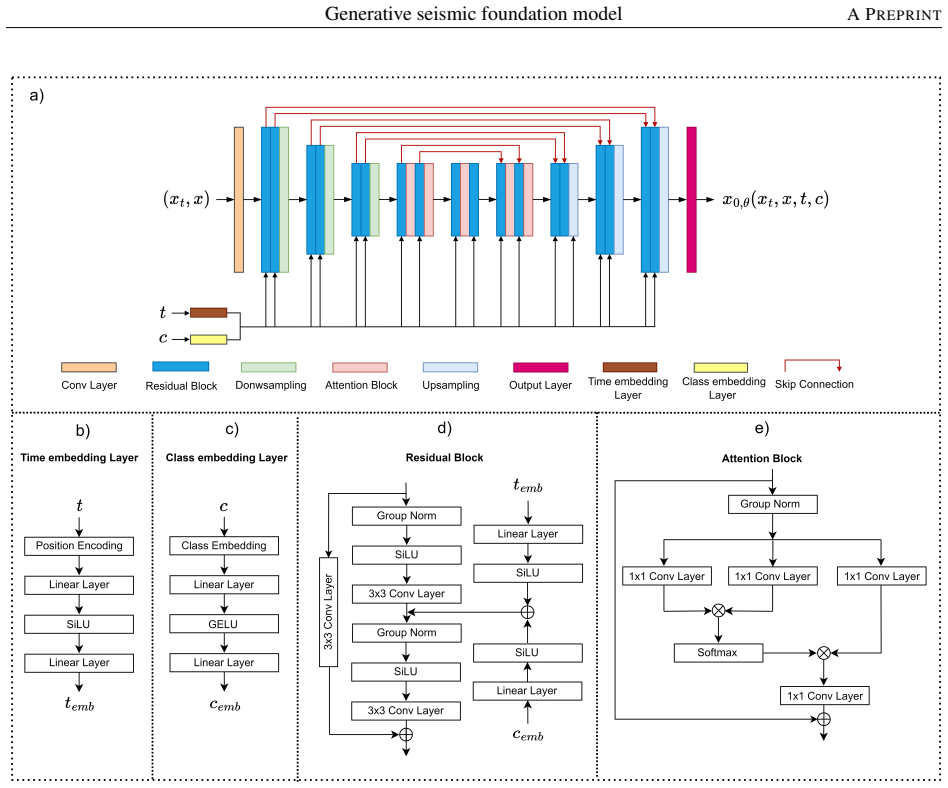
The central object is a dual-channel denoising diffusion model: channel one holds a noisy version of the target shot gather (labeled $x_0$), channel two holds the degraded data specific to the task, and a task label $c \in \{0,1,2,3\}$ is embedded alongside the time step. The network is trained to predict $x_0$ directly with the loss $\mathbb{E}\|x_0 - x_{0,\theta}(x_t, x, t, c)\|^2$, which lets inference use a single DDIM reverse step. The fine-tuning machinery is Algorithm 1, an iterative pseudo-labeling loop: the pre-trained model predicts field data, those predictions are corrupted by the task-specific degradation to form the conditioning channel, and the model is fine-tuned against them, with pseudo-labels regenerated at each of $S$ stages.
What would settle it
Start from a field dataset with independent ground truth, e.g., data whose true clean component is known from a reliable non-learning method or a controlled acquisition. Run the iterative fine-tuning and, at each stage, compute the mean squared error of the model output against both the independent truth and the model's own pseudo-labels. The central claim fails if the error to the independent truth stops decreasing while the error to the pseudo-labels keeps dropping.
Extended reading notes
Core claim
The authors claim that a generative diffusion model trained to predict the clean, complete, broadband target directly, rather than the added noise, can act as a multi-task seismic processing engine. The model takes two input channels: a noisy version of the ideal target and the task-degraded data, plus a class label that tells it which task is being asked. After pre-training on synthetic data, an iterative self-supervised loop refines the model on field data: the model's own predictions become pseudo-labels, are corrupted with the task-specific degradation, and the model is fine-tuned against them, with the pseudo-labels refreshed at fixed intervals. In their experiments the pre-trained model matches a conventionally fine-tuned benchmark on synthetic data, and the iterative strategy beats both benchmarks on field backscattered-noise attenuation, interpolation, and low-frequency extrapolation.
Load-bearing premise
The fine-tuning loop treats the model's own field-data predictions as trustworthy training targets; if those pseudo-labels carry systematic errors, the fine-tuned model will learn to reproduce them instead of the true signal.
Editorial extensions
If this is right
- One GSFM instance can replace four separately trained networks, cutting both training time and the need for task-specific labeled data.
- Because sampling starts from random noise, repeated predictions give a standard-deviation field that marks unreliable output regions; the paper shows this uncertainty correlates with residual error in interpolation.
- The iterative pseudo-label fine-tuning is a recipe for adapting any synthetic-pre-trained diffusion model to unlabeled field data, not just for the four tasks demonstrated.
- Direct $x_0$ prediction keeps accuracy at a single sampling step, so the generative model's inference cost is comparable to a conventional feed-forward network.
Reading between the lines
- If the pseudo-label loop is trustworthy, the same synthetic-pre-training-plus-iterative-self-distillation recipe should transfer to other label-scarce geophysical tasks such as multiple removal and ground-roll suppression.
- The uncertainty maps could be used as acquisition quality control: high-uncertainty patches would flag where additional receivers or source effort is needed, independent of any downstream imaging step.
- A sharper test of the pseudo-label assumption would be to fine-tune with a small set of manually verified labels and check whether the model's uncertainty only drops in places where those labels agree with its predictions.
Editorial analysis
A structured set of objections, weighed in public.
Referee Report
Summary. The paper proposes GSFM, a class-conditioned generative diffusion model intended to serve as an all-in-one seismic processing framework for denoising, backscattered noise attenuation, interpolation, and low-frequency extrapolation. The model is pre-trained on synthetic elastic shot gathers using an x0-prediction diffusion objective, then adapted to unlabeled field data through an iterative pseudo-label fine-tuning procedure (Algorithm 1). Synthetic experiments compare GSFM against a same-architecture supervised baseline (Benchmark 1) and a conventional pre-training-plus-fine-tuning baseline (Benchmark 2). Field experiments apply GSFM to a marine streamer dataset and compare against the two benchmarks, which are not adapted to field data. The paper also demonstrates uncertainty quantification via the standard deviation across stochastic samples.
Significance. If the field-data claims were validated, a single class-conditioned diffusion model that handles several seismic processing tasks and adapts to unlabeled field data without labeled ground truth would be a practical contribution, potentially reducing the need for task-specific models and providing useful uncertainty estimates. The strengths of the paper include the x0-targeted diffusion formulation, which enables single-step inference; the class-conditional multi-task architecture; the use of elastic synthetic modeling for pre-training; and the independent synthetic experiments, which reliably support the weaker claim that GSFM consistently outperforms Benchmark 1 and is competitive with Benchmark 2 on synthetic test data. The synthetic portion is generally well designed and reported. However, the field-data generalization claims are currently supported by evaluations that rely on the model's own outputs as pseudo-labels and as 'labeled data' in the interpolation MSE analysis, and the field comparison against benchmarks that are not fine-tuned on field data does not isolate the benefit of the proposed pseudo-label strategy.
major comments (4)
- [Algorithm 1, Section 5.2] Algorithm 1's iterative fine-tuning is circular with respect to correctness. Step 3 initializes x_pseudo with the pre-trained model's own predictions on field data, step 9 computes the loss against x_pseudo, and step 12 updates x_pseudo with the fine-tuned model's predictions. A decreasing training loss therefore only shows that the model is converging to its own outputs; it does not establish that the model is recovering the true signal on field data. The paper needs an external validation mechanism, such as independent field labels (e.g., manually quality-controlled outputs or paired well-log-constrained data), or a controlled experiment on held-out synthetic data that emulates the field distribution shift, to distinguish self-consistency from accuracy.
- [Section 5.3, Figure 11, Figure 14, Figure 15] The quantitative interpolation evaluation on field data uses the fine-tuned GSFM's own denoised output (Figure 6b) as the 'labeled data' against which MSE is computed. Figure 11 reports MSE trends across fine-tuning stages for this self-generated reference, and Figures 14 and 15 compare prediction means to the same denoised product. Consequently, the decreasing MSE across stages can be explained by the model becoming increasingly consistent with its own denoised estimate, rather than by more accurate interpolation of the missing signal. An independent reference for the missing traces (e.g., reserved traces from complete recordings, or a separate denoising method applied to the same field data) is needed to support the claim of improved interpolation accuracy.
- [Section 5.1, Figures 6, 12, 13] The field-data comparison is unfair because GSFM is iteratively fine-tuned on the exact field test shot gathers while Benchmark 1 and Benchmark 2 are used as pre-trained synthetic-only models without any field-data adaptation. The observed improvement could be attributable to any adaptation mechanism, not specifically to the pseudo-label strategy. A controlled comparison in which a benchmark is fine-tuned on the same field data with the same iteration budget (or, alternatively, GSFM is evaluated without field fine-tuning) is necessary to claim that the iterative pseudo-label strategy is the source of the field-data gains.
- [Abstract, Section 4.2-4.5, Tables 2 and 3] The abstract claims that GSFM 'surpasses benchmarks with equivalent architectures in all tasks,' but the reported synthetic results do not support this. Table 2 shows Benchmark 2 achieves lower MSE than GSFM at 20%, 30%, 40%, and 50% noise levels, and Table 3 shows Benchmark 2 lower at 20% through 50% missing levels. Section 4.5 reports that Benchmark 2 outperforms GSFM on low-frequency extrapolation (MSE 3.11e-07 vs. 6.0e-07), and Section 4.6 acknowledges this. The claim should be revised to state that GSFM consistently outperforms Benchmark 1 and is competitive with, or slightly behind, Benchmark 2 on some synthetic tasks, reserving any 'surpasses' claim for the specific head-to-head settings where the data support it.
minor comments (5)
- [Throughout] There are numerous typographical errors, including 'DSFM' in figure captions (Figures 2-5, 7-13), 'steamer survey' for 'streamer survey' in Section 5.1, 'finnaly' in Section 5.4, 'gudie' in Section 7, 'weak' for 'weak' in Section 1, and 'he' for 'the' in the caption of Figure 6. The manuscript would benefit from a careful proofreading pass.
- [Section 3.5, Figure 1] The text references 'Residual blocks (Figure 1d)' and 'Attention block (Figure 1e)', but the caption of Figure 1 lists '(e) The residual block. (d) The attention block.' The panel labels in the figure or the text references should be corrected for consistency.
- [Tables 4 and 5] The MSE values for the noise-targeted GSFM are non-monotonic in the number of sampling steps, with some entries dramatically worse at T=1000 than at T=500 (e.g., Table 4, 10% noise: 2.50e-01 at T=1000 vs. 1.01e-05 at T=500; Table 5, 20% missing: 2.50e-01 vs. 1.27e-05). This is suggestive of training instability or an evaluation artifact; the authors should clarify whether the noise-targeted model was fully converged and whether these results are reproducible.
- [Section 5.1, Table 1] Table 1 appears to have swapped values in the rows for dt and nt: it lists 'dt Recording sampling step 376' and 'nt Number of recording timesteps 1.6e-2 s', which are dimensionally inconsistent with the stated total time of 6.016 s. The table should be corrected.
- [Section 3.3, Algorithm 1] The term 'SSL' (self-supervised learning) is used for the fine-tuning strategy, but the training target is the model's own prediction on the same input, which is closer to self-training or pseudo-labeling than to classic self-supervised learning. The terminology should be clarified to avoid confusion with standard SSL approaches.
Circularity Check
Field-data 'enhanced performance' is a pseudo-label self-consistency loop: Algorithm 1 trains GSFM against its own field predictions, and Section 5.3 evaluates interpolation MSE against GSFM's own denoised output; synthetic benchmarks are independent, so partial circularity.
-
self definitional
[Section 3.3, Algorithm 1 (lines 3, 9, 12)]
"Initialize pseudo-labels xpseudo by predicting on field data x with the pre-trained model. ... Compute loss with respect to target xpseudo for this task: L(θ) = E[ ||xpseudo − x0,θ(xt, x̂, t, c)||2 ] ... After Nstage iterations, use the fine-tuned model to generate the updated pseudo-labels: xpseudo = GSFM(ϵ, x, t, c)"
The fine-tuning target x_pseudo is defined by the model itself: initialized from the pre-trained model's field-data predictions (line 3) and refreshed each stage by the current model's predictions (line 12). The loss (line 9) is minimized against this self-generated target, with the conditional input x̂ being a corruption of the same x_pseudo. Thus any reduction in this loss or any later-stage output 'improvement' relative to these pseudo-labels shows self-consistency, not convergence to true clean/complete/broadband field data. The abstract's claim that iterative fine-tuning 'delivers significantly enhanced performance' on field data rests on this loop, so the claimed field-data gain reduces to matching the model's own evolving outputs.
-
fitted input called prediction
[Section 5.3 and Figure 14 caption]
"Since the incomplete field data is generated by artificially removing 50% of the seismic traces from the denoised data, we can obtain corresponding labeled data. ... The differences between the mean of multiple interpolation results and the labeled data, where the labeled data is the denoised data (see Figure 6b)."
The quantitative evaluation of field-data interpolation uses as 'labeled data' the denoised output of GSFM from the preceding backscattered-noise task (Figure 6b), which is itself produced by the same model pipeline rather than by independent field observations. The MSE curves in Figure 11 therefore measure how closely the interpolated outputs match a model-generated proxy, not how correctly missing traces are recovered. Because the 200 shot gathers used for this evaluation are the same ones on which GSFM was iteratively fine-tuned, the decreasing MSE is a self-agreement/training-fit signal; it does not independently support the claimed generalization advantage over benchmarks.
full rationale
The synthetic-data portion (Sections 4.2–4.5) is self-contained: the pre-trained GSFM is evaluated against known labels and compared with same-architecture benchmarks, so it is not circular. The field-data claims, however, depend on a self-referential pseudo-label loop. Algorithm 1 initializes the fine-tuning target with the model's own field-data predictions and refreshes it with the current model's output, so the training objective is distance to a self-defined target; the reported field-data improvements are therefore not independent of the model's own outputs. Section 5.3 compounds this by calling GSFM's own denoised result the 'labeled data' for interpolation MSE, and by evaluating on the same shot gathers used for fine-tuning. No load-bearing self-citation or uniqueness-import issue was found; the circularity is confined to the field-data validation, while the synthetic benchmarks provide independent support for the base model. Score 6 reflects this partial but load-bearing circularity.
Assumptions & free parameters
free parameters (5)
- Fine-tuning iteration budget =
30000 iterations, S=10 stages, 3000 each
- Pre-training iteration count =
200,000
- Diffusion time steps =
1000
- Inference sampling steps =
1
- Training hyperparameters =
LR 1e-4 pretrain / 5e-5 fine-tune, batch 5/4, EMA 0.999
assumptions (5)
- domain assumption Ideal seismic data is clean, complete, and broadband, and one distribution can represent it across tasks
- domain assumption Synthetic velocity models from the Ovcharenko et al. workflow generalize to real marine data
- domain assumption Deepwave elastic modeling with Vp/Vs = sqrt(3) and Gardner density captures realistic shot gathers
- ad hoc to paper The model's own predictions can serve as valid fine-tuning targets on unlabeled field data
- standard math DDPM/DDIM forward and reverse processes and x0-prediction equivalence hold as described
Cite this review
Pith. "Pith review of A generative foundation model for an all-in-one seismic processing framework." pith.science (2026). https://pith.science/paper/MZZCV5C2
@misc{pith2026250201111,
  author       = {Pith},
  title        = {Pith review of: A generative foundation model for an all-in-one seismic processing framework},
  year         = {2026},
  howpublished = {\url{https://pith.science/paper/MZZCV5C2}},
  note         = {Machine review of arXiv:2502.01111}
}
read the original abstract
Seismic data often face challenges in their utilization due to noise contamination, incomplete acquisition, and limited low-frequency information, which hinder accurate subsurface imaging and interpretation. Traditional processing methods rely heavily on task-specific designs to address these challenges and fail to account for the variability of data. To address these limitations, we present a generative seismic foundation model (GSFM), a unified framework based on generative diffusion models (GDMs), designed to tackle multi-task seismic processing challenges, including denoising, backscattered noise attenuation, interpolation, and low-frequency extrapolation. GSFM leverages a pre-training stage on synthetic data to capture the features of clean, complete, and broadband seismic data distributions and applies an iterative fine-tuning strategy to adapt the model to field data. By adopting a target-oriented diffusion process prediction, GSFM improves computational efficiency without compromising accuracy. Synthetic data tests demonstrate GSFM surpasses benchmarks with equivalent architectures in all tasks and achieves performance comparable to traditional pre-training strategies, even after their fine-tuning. Also, field data tests suggest that our iterative fine-tuning approach addresses the generalization limitations of conventional pre-training and fine-tuning paradigms, delivering significantly enhanced performance across diverse tasks. Furthermore, GSFM's inherent probabilistic nature enables effective uncertainty quantification, offering valuable insights into the reliability of processing results.
Figures


Figures from the paper (14 more)


Forward citations
Cited by 1 Pith paper
-
Generative modeling of seismic data using diffusion models and its application to multi-purpose posterior sampling for noisy inverse problems
A single diffusion model with a power-law noise schedule can generate seismic data and perform posterior sampling for several noisy linear inverse problems without task-specific retraining.
Reference graph
Works this paper leans on
-
[1]
Seismic data analysis: Processing, inversion, and interpretation of seismic data
\"O z Yilmaz. Seismic data analysis: Processing, inversion, and interpretation of seismic data. Society of exploration geophysicists, 2001
work page 2001
-
[2]
An overview of full-waveform inversion in exploration geophysics
Jean Virieux and St \'e phane Operto. An overview of full-waveform inversion in exploration geophysics. Geophysics, 74 0 (6): 0 WCC1--WCC26, 2009
work page 2009
-
[3]
Lateral prediction for noise attenuation by tx and fx techniques
Ray Abma and Jon Claerbout. Lateral prediction for noise attenuation by tx and fx techniques. Geophysics, 60 0 (6): 0 1887--1896, 1995
work page 1995
-
[4]
Introduction to this special section—seismic noise
Chris Krohn, Shuki Ronen, Jeff Deere, and Necati Gulunay. Introduction to this special section—seismic noise. The Leading Edge, 27 0 (2): 0 163--165, 2008
work page 2008
-
[5]
Random noise attenuation by fx empirical-mode decomposition predictive filtering
Yangkang Chen and Jitao Ma. Random noise attenuation by fx empirical-mode decomposition predictive filtering. Geophysics, 79: 0 V81--V91, 2014
work page 2014
-
[6]
Random noise attenuation using local signal-and-noise orthogonalization
Yangkang Chen and Sergey Fomel. Random noise attenuation using local signal-and-noise orthogonalization. Geophysics, 80 0 (6): 0 WD1--WD9, 2015
work page 2015
-
[7]
Signal and noise separation in prestack seismic data using velocity-dependent seislet transform
Yang Liu, Sergey Fomel, and Cai Liu. Signal and noise separation in prestack seismic data using velocity-dependent seislet transform. Geophysics, 80 0 (6): 0 WD117--WD128, 2015
work page 2015
-
[8]
Static corrections for seismic reflection surveys
Mike Cox. Static corrections for seismic reflection surveys. Society of Exploration Geophysicists, 1999
work page 1999
Show all 72 references
-
[9]
Adaptive surface-related multiple elimination
Dirk J Verschuur, AJ Berkhout, and CPA Wapenaar. Adaptive surface-related multiple elimination. Geophysics, 57 0 (9): 0 1166--1177, 1992
1992
-
[10]
Closed-loop surface-related multiple elimination and its application to simultaneous data reconstruction
Gabriel A Lopez and DJ Verschuur. Closed-loop surface-related multiple elimination and its application to simultaneous data reconstruction. Geophysics, 80 0 (6): 0 V189--V199, 2015
2015
-
[11]
Seismic trace interpolation in the fx domain
Simon Spitz. Seismic trace interpolation in the fx domain. Geophysics, 56 0 (6): 0 785--794, 1991
1991
-
[12]
Seismic trace interpolation in the fxy domain
Yanghua Wang. Seismic trace interpolation in the fxy domain. Geophysics, 67 0 (4): 0 1232--1239, 2002
2002
-
[13]
The interpolation of sparse geophysical data
Yangkang Chen, Xiaohong Chen, Yufeng Wang, and Shaohuan Zu. The interpolation of sparse geophysical data. Surveys in Geophysics, 40: 0 73--105, 2019
2019
-
[14]
Velocity analysis for transversely isotropic media
Tariq Alkhalifah and Ilya Tsvankin. Velocity analysis for transversely isotropic media. Geophysics, 60 0 (5): 0 1550--1566, 1995
1995
-
[15]
Migration velocity analysis and waveform inversion
William W Symes. Migration velocity analysis and waveform inversion. Geophysical prospecting, 56 0 (6): 0 765--790, 2008
2008
-
[16]
Velocity analysis using ab semblance
Sergey Fomel. Velocity analysis using ab semblance. Geophysical Prospecting, 57 0 (3): 0 311--321, 2009
2009
-
[17]
Reverse time migration
Edip Baysal, Dan D Kosloff, and John WC Sherwood. Reverse time migration. Geophysics, 48 0 (11): 0 1514--1524, 1983
1983
-
[18]
Elastic reverse-time migration
Wen-Fong Chang and George A McMechan. Elastic reverse-time migration. Geophysics, 52 0 (10): 0 1365--1375, 1987
1987
-
[19]
A stable and practical implementation of least-squares reverse time migration
Yu Zhang, Lian Duan, and Yi Xie. A stable and practical implementation of least-squares reverse time migration. Geophysics, 80 0 (1): 0 V23--V31, 2015
2015
-
[20]
An overview of depth imaging in exploration geophysics
John Etgen, Samuel H Gray, and Yu Zhang. An overview of depth imaging in exploration geophysics. Geophysics, 74 0 (6): 0 WCA5--WCA17, 2009
2009
-
[21]
Inversion of seismic reflection data in the acoustic approximation
Albert Tarantola. Inversion of seismic reflection data in the acoustic approximation. Geophysics, 49 0 (8): 0 1259--1266, 1984
1984
-
[22]
A strategy for nonlinear elastic inversion of seismic reflection data
Albert Tarantola. A strategy for nonlinear elastic inversion of seismic reflection data. Geophysics, 51 0 (10): 0 1893--1903, 1986
1903
-
[23]
From tomography to full-waveform inversion with a single objective function
Tariq Alkhalifah and Yunseok Choi. From tomography to full-waveform inversion with a single objective function. Geophysics, 79 0 (2): 0 R55--R61, 2014
2014
-
[24]
Deep learning for geophysics: Current and future trends
Siwei Yu and Jianwei Ma. Deep learning for geophysics: Current and future trends. Reviews of Geophysics, 59 0 (3): 0 e2021RG000742, 2021
2021
-
[25]
Machine learning for seismic processing: The path to fulfilling promises
Song Hou and J \'e r \'e mie Messud. Machine learning for seismic processing: The path to fulfilling promises. In First International Meeting for Applied Geoscience & Energy, pages 3204--3208. Society of Exploration Geophysicists, 2021
2021
-
[26]
Deep-learning inversion of seismic data
Shucai Li, Bin Liu, Yuxiao Ren, Yangkang Chen, Senlin Yang, Yunhai Wang, and Peng Jiang. Deep-learning inversion of seismic data. IEEE Transactions on Geoscience and Remote Sensing, 58 0 (3): 0 2135--2149, 2020
2020
-
[27]
Deep-learning seismology
S Mostafa Mousavi and Gregory C Beroza. Deep-learning seismology. Science, 377 0 (6607): 0 eabm4470, 2022
2022
-
[28]
Applications of deep neural networks in exploration seismology: A technical survey
S Mostafa Mousavi, Gregory C Beroza, Tapan Mukerji, and Majid Rasht-Behesht. Applications of deep neural networks in exploration seismology: A technical survey. Geophysics, 89 0 (1): 0 WA95--WA115, 2024
2024
-
[29]
Deep learning for denoising
Siwei Yu, Jianwei Ma, and Wenlong Wang. Deep learning for denoising. Geophysics, 84 0 (6): 0 V333--V350, 2019
2019
-
[30]
Deep-learning-based seismic data interpolation: A preliminary result
Benfeng Wang, Ning Zhang, Wenkai Lu, and Jialin Wang. Deep-learning-based seismic data interpolation: A preliminary result. Geophysics, 84 0 (1): 0 V11--V20, 2019
2019
-
[31]
Desert low-frequency noise suppression by using adaptive dncnns based on the determination of high-order statistic
XT Dong, Y Li, and BJ Yang. Desert low-frequency noise suppression by using adaptive dncnns based on the determination of high-order statistic. Geophysical Journal International, 219 0 (2): 0 1281--1299, 2019
2019
-
[32]
Faultseg3d: Using synthetic data sets to train an end-to-end convolutional neural network for 3d seismic fault segmentation
Xinming Wu, Luming Liang, Yunzhi Shi, and Sergey Fomel. Faultseg3d: Using synthetic data sets to train an end-to-end convolutional neural network for 3d seismic fault segmentation. Geophysics, 84 0 (3): 0 IM35--IM45, 2019
2019
-
[33]
Building realistic structure models to train convolutional neural networks for seismic structural interpretation
Xinming Wu, Zhicheng Geng, Yunzhi Shi, Nam Pham, Sergey Fomel, and Guillaume Caumon. Building realistic structure models to train convolutional neural networks for seismic structural interpretation. Geophysics, 85 0 (4): 0 WA27--WA39, 2020
2020
-
[34]
Deep-learning full-waveform inversion using seismic migration images
Wei Zhang and Jinghuai Gao. Deep-learning full-waveform inversion using seismic migration images. IEEE Transactions on Geoscience and Remote Sensing, 60: 0 1--18, 2021
2021
-
[35]
Can deep learning compensate for sparse shots in the imaging domain? a potential alternative for reducing the acquisition cost of seismic data
Xintong Dong, Shaoping Lu, Jun Lin, Shukui Zhang, Kai Ren, and Ming Cheng. Can deep learning compensate for sparse shots in the imaging domain? a potential alternative for reducing the acquisition cost of seismic data. Geophysics, 89 0 (2): 0 V119--V137, 2024 a
2024
-
[36]
Seismic data reconstruction based on a multicascade self-guided network
Xintong Dong, Changxin Wei, Tie Zhong, Ming Cheng, Shiqi Dong, and Feng Li. Seismic data reconstruction based on a multicascade self-guided network. Geophysics, 89 0 (3): 0 V179--V195, 2024 b
2024
-
[37]
Mlreal: Bridging the gap between training on synthetic data and real data applications in machine learning
Tariq Alkhalifah, Hanchen Wang, and Oleg Ovcharenko. Mlreal: Bridging the gap between training on synthetic data and real data applications in machine learning. Artificial Intelligence in Geosciences, 3: 0 101--114, 2022
2022
-
[38]
Improving the generalization of deep neural networks in seismic resolution enhancement
Haoran Zhang, Tariq Alkhalifah, Yang Liu, Claire Birnie, and Xi Di. Improving the generalization of deep neural networks in seismic resolution enhancement. IEEE Geoscience and Remote Sensing Letters, 20: 0 1--5, 2022
2022
-
[39]
Deep denoising autoencoder for seismic random noise attenuation
Omar M Saad and Yangkang Chen. Deep denoising autoencoder for seismic random noise attenuation. Geophysics, 85 0 (4): 0 V367--V376, 2020
2020
-
[40]
The potential of self-supervised networks for random noise suppression in seismic data
Claire Birnie, Matteo Ravasi, Sixiu Liu, and Tariq Alkhalifah. The potential of self-supervised networks for random noise suppression in seismic data. Artificial Intelligence in Geosciences, 2: 0 47--59, 2021
2021
-
[41]
Trace-wise coherent noise suppression via a self-supervised blind-trace deep-learning scheme
Sixiu Liu, Claire Birnie, and Tariq Alkhalifah. Trace-wise coherent noise suppression via a self-supervised blind-trace deep-learning scheme. Geophysics, 88 0 (6): 0 V459--V472, 2023
2023
-
[42]
A self-supervised scheme for ground roll suppression
Sixiu Liu, Claire Birnie, Andrey Bakulin, Ali Dawood, Ilya Silvestrov, and Tariq Alkhalifah. A self-supervised scheme for ground roll suppression. Geophysical Prospecting, 2024 a
2024
-
[43]
Gabor-based learnable sparse representation for self-supervised denoising
Sixiu Liu, Shijun Cheng, and Tariq Alkhalifah. Gabor-based learnable sparse representation for self-supervised denoising. IEEE Transactions on Geoscience and Remote Sensing, 2024 b
2024
-
[44]
Noise attenuation in distributed acoustic sensing data using a guided unsupervised deep learning network
Omar M Saad, Matteo Ravasi, and Tariq Alkhalifah. Noise attenuation in distributed acoustic sensing data using a guided unsupervised deep learning network. Geophysics, 89 0 (6): 0 V573--V587, 2024
2024
-
[45]
An effective self-supervised learning method for attenuating various types of seismic noise
Shijun Cheng, Zhiyao Cheng, Chao Jiang, Weijian Mao, and Qingchen Zhang. An effective self-supervised learning method for attenuating various types of seismic noise. Geophysics, 89 0 (6): 0 1--78, 2024 a
2024
-
[46]
A self-supervised learning framework for seismic low-frequency extrapolation
Shijun Cheng, Yi Wang, Qingchen Zhang, Randy Harsuko, and Tariq Alkhalifah. A self-supervised learning framework for seismic low-frequency extrapolation. Journal of Geophysical Research: Machine Learning and Computation, 1 0 (3): 0 e2024JH000157, 2024 b
2024
-
[47]
Storseismic: A new paradigm in deep learning for seismic processing
Randy Harsuko and Tariq A Alkhalifah. Storseismic: A new paradigm in deep learning for seismic processing. IEEE Transactions on Geoscience and Remote Sensing, 60: 0 1--15, 2022
2022
-
[48]
Seismic foundation model (sfm): a new generation deep learning model in geophysics
Hanlin Sheng, Xinming Wu, Xu Si, Jintao Li, Sibo Zhang, and Xudong Duan. Seismic foundation model (sfm): a new generation deep learning model in geophysics. arXiv preprint arXiv:2309.02791, 2023
2023 arXiv
-
[49]
Meta-processing: A robust framework for multi-tasks seismic processing
Shijun Cheng, Randy Harsuko, and Tariq Alkhalifah. Meta-processing: A robust framework for multi-tasks seismic processing. Surveys in Geophysics, pages 1--36, 2024 c
2024
-
[50]
Conditional denoising diffusion probabilistic model for ground-roll attenuation
Yuanyuan Li, Hao Zhang, Jianping Huang, and Zhenchun Li. Conditional denoising diffusion probabilistic model for ground-roll attenuation. IEEE Transactions on Geoscience and Remote Sensing, 2024
2024
-
[51]
Diffusion models for multidimensional seismic noise attenuation and superresolution
Yuan Xiao, Kewen Li, Yimin Dou, Wentao Li, Zhixuan Yang, and Xinyuan Zhu. Diffusion models for multidimensional seismic noise attenuation and superresolution. Geophysics, 89 0 (5): 0 V479--V492, 2024
2024
-
[52]
Cold diffusion model for seismic denoising
Daniele Trappolini, Laura Laurenti, Giulio Poggiali, Elisa Tinti, Fabio Galasso, Alberto Michelini, and Chris Marone. Cold diffusion model for seismic denoising. Journal of Geophysical Research: Machine Learning and Computation, 1 0 (2): 0 e2024JH000179, 2024
2024
-
[53]
Seismic data interpolation based on denoising diffusion implicit models with resampling
Xiaoli Wei, Chunxia Zhang, Hongtao Wang, Chengli Tan, Deng Xiong, Baisong Jiang, Jiangshe Zhang, and Sang-Woon Kim. Seismic data interpolation based on denoising diffusion implicit models with resampling. arXiv preprint arXiv:2307.04226, 2023
2023 arXiv
-
[54]
Generative interpolation via a diffusion probabilistic model
Qi Liu and Jianwei Ma. Generative interpolation via a diffusion probabilistic model. Geophysics, 89 0 (1): 0 V65--V85, 2024
2024
-
[55]
Self-supervised diffusion model for 3-d seismic data reconstruction
Xinyang Wang, Qianyu Ge, Xintong Dong, Shiqi Dong, and Tie Zhong. Self-supervised diffusion model for 3-d seismic data reconstruction. arXiv preprint arXiv:2406.13252, 2024 a
2024 arXiv
-
[56]
Seismic data interpolation via denoising diffusion implicit models with coherence-corrected resampling
Xiaoli Wei, Chunxia Zhang, Hongtao Wang, Chengli Tan, Deng Xiong, Baisong Jiang, Jiangshe Zhang, and Sang-Woon Kim. Seismic data interpolation via denoising diffusion implicit models with coherence-corrected resampling. IEEE Transactions on Geoscience and Remote Sensing, 2024
2024
-
[57]
Seisresodiff: Seismic resolution enhancement based on a diffusion model
Hao-Ran Zhang, Yang Liu, Yu-Hang Sun, and Gui Chen. Seisresodiff: Seismic resolution enhancement based on a diffusion model. Petroleum Science, 2024 a
2024
-
[58]
Conditional denoising diffusion probabilistic model for seismic diffraction separation and imaging
Hao Zhang, Yuanyuan Li, and Jianping Huang. Conditional denoising diffusion probabilistic model for seismic diffraction separation and imaging. IEEE Transactions on Geoscience and Remote Sensing, 2024 b
2024
-
[59]
Generative diffusion model for seismic imaging improvement of sparsely acquired data and uncertainty quantification
Xingchen Shi, Shijun Cheng, Weijian Mao, and Wei Ouyang. Generative diffusion model for seismic imaging improvement of sparsely acquired data and uncertainty quantification. IEEE Transactions on Geoscience and Remote Sensing, 2024
2024
-
[60]
A prior regularized full waveform inversion using generative diffusion models
Fu Wang, Xinquan Huang, and Tariq A Alkhalifah. A prior regularized full waveform inversion using generative diffusion models. IEEE Transactions on Geoscience and Remote Sensing, 61: 0 1--11, 2023
2023
-
[61]
Controllable seismic velocity synthesis using generative diffusion models
Fu Wang, Xinquan Huang, and Tariq Alkhalifah. Controllable seismic velocity synthesis using generative diffusion models. Journal of Geophysical Research: Machine Learning and Computation, 1 0 (3): 0 e2024JH000153, 2024 b
2024
-
[62]
Learned regularizations for multi-parameter elastic full waveform inversion using diffusion models
Mohammad H Taufik, Fu Wang, and Tariq Alkhalifah. Learned regularizations for multi-parameter elastic full waveform inversion using diffusion models. Journal of Geophysical Research: Machine Learning and Computation, 1 0 (1): 0 e2024JH000125, 2024
2024
-
[63]
Deep diffusion models for seismic processing
Ricard Durall, Ammar Ghanim, Mario Ruben Fernandez, Norman Ettrich, and Janis Keuper. Deep diffusion models for seismic processing. Computers & Geosciences, 177: 0 105377, 2023
2023
-
[64]
Denoising diffusion probabilistic models
Jonathan Ho, Ajay Jain, and Pieter Abbeel. Denoising diffusion probabilistic models. Advances in neural information processing systems, 33: 0 6840--6851, 2020
2020
-
[65]
Denoising diffusion implicit models
Jiaming Song, Chenlin Meng, and Stefano Ermon. Denoising diffusion implicit models. arXiv preprint arXiv:2010.02502, 2020
2010 arXiv
-
[66]
Cold diffusion: Inverting arbitrary image transforms without noise
Arpit Bansal, Eitan Borgnia, Hong-Min Chu, Jie Li, Hamid Kazemi, Furong Huang, Micah Goldblum, Jonas Geiping, and Tom Goldstein. Cold diffusion: Inverting arbitrary image transforms without noise. Advances in Neural Information Processing Systems, 36, 2024
2024
-
[67]
High-resolution image synthesis with latent diffusion models
Robin Rombach, Andreas Blattmann, Dominik Lorenz, Patrick Esser, and Bj \"o rn Ommer. High-resolution image synthesis with latent diffusion models. In Proceedings of the IEEE/CVF conference on computer vision and pattern recognition, pages 10684--10695, 2022
2022
-
[68]
Optimizing a transformer-based network for a deep learning seismic processing workflow
Randy Harsuko and Tariq Alkhalifah. Optimizing a transformer-based network for a deep learning seismic processing workflow. Geophysics, 89 0 (4): 0 1--64, 2024
2024
-
[69]
Attention is all you need
Ashish Vaswani, Noam Shazeer, Niki Parmar, Jakob Uszkoreit, Llion Jones, Aidan N Gomez, ukasz Kaiser, and Illia Polosukhin. Attention is all you need. Advances in neural information processing systems, 30, 2017
2017
-
[70]
Multi-task learning for low-frequency extrapolation and elastic model building from seismic data
Oleg Ovcharenko, Vladimir Kazei, Tariq A Alkhalifah, and Daniel B Peter. Multi-task learning for low-frequency extrapolation and elastic model building from seismic data. IEEE Transactions on Geoscience and Remote Sensing, 60: 0 1--17, 2022
2022
-
[71]
Deepwave, September 2023
Alan Richardson. Deepwave, September 2023. URL https://doi.org/10.5281/zenodo.8381177
2023 doi
-
[72]
Formation velocity and density—the diagnostic basics for stratigraphic traps
GHF Gardner, LW Gardner, and ARw Gregory. Formation velocity and density—the diagnostic basics for stratigraphic traps. Geophysics, 39 0 (6): 0 770--780, 1974
1974
Reviewed August 9, 2026 · model on record in the stance chip above.
Discussion (0). Continue with ORCID to comment.