Searching for Extraterrestrial Intelligence with the SKA
Pith reviewed 2026-06-29 00:35 UTC · model grok-4.3
The pith
The SKA will play a pivotal role in next-generation technosignature searches by providing unmatched sensitivity, field of view, and spatial resolution.
A machine-rendered reading of the paper's core claim, the machinery that carries it, and where it could break.
Core claim
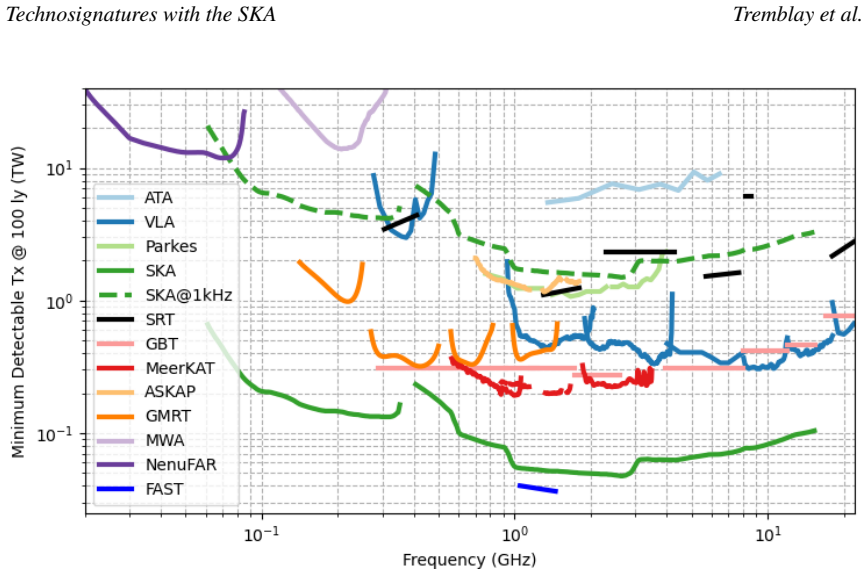
The SKA will play a pivotal role in the next-generation of technosignature searches, providing an unprecedented combination of sensitivity, field of view, and spatial resolution over its wavelength range, with its singular capabilities rendering it an indispensable instrument for the rapid identification and follow-up characterisation of promising technosignature candidates when wide-field high-resolution observations are integrated with machine learning and multi-wavelength diagnostics.
What carries the argument
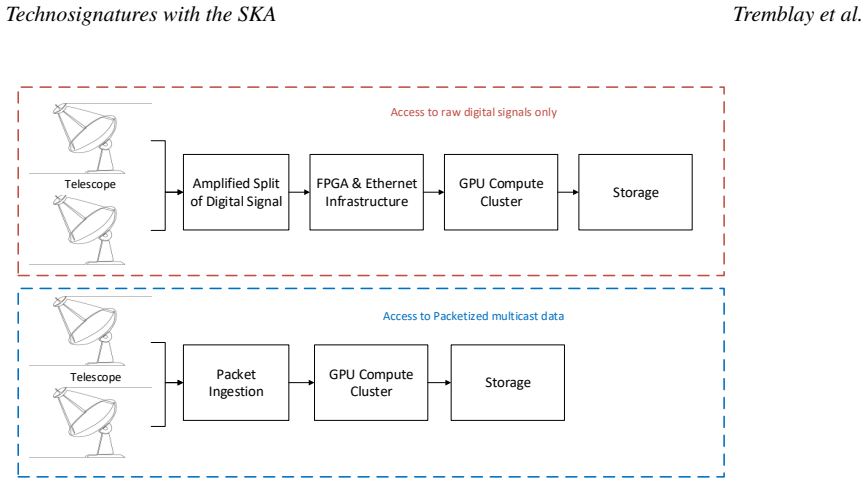
High temporal and spectral resolution data products for frequency-domain SETI, produced by the SKA's wide-field high-resolution observations.
If this is right
- Integrating wide-field high-resolution observations with machine learning and multi-wavelength diagnostics will represent key steps forward in technosignature searches.
- The SKA's capabilities will enable rapid identification and follow-up characterisation of promising technosignature candidates.
- Multiple SKA observing modes have the potential to substantially advance technosignature research.
- The search for technosignatures will increasingly align with mainstream astrophysics and complement biosignature searches.
Where Pith is reading between the lines
- SKA archives could later be re-analyzed with improved algorithms to search for missed technosignatures.
- Technical requirements for high-resolution data products may influence SKA hardware and software development priorities.
- Confirmed candidates would likely require coordinated observations with non-radio telescopes for stronger validation.
Load-bearing premise
The SKA will achieve and deliver the high temporal and spectral resolution data products needed for frequency-domain SETI and enable effective distinction of artificial signals from natural ones.
What would settle it
SKA observations that cannot produce the required high temporal and spectral resolution data products or that fail to allow reliable separation of artificial signals despite those products.
Figures
read the original abstract
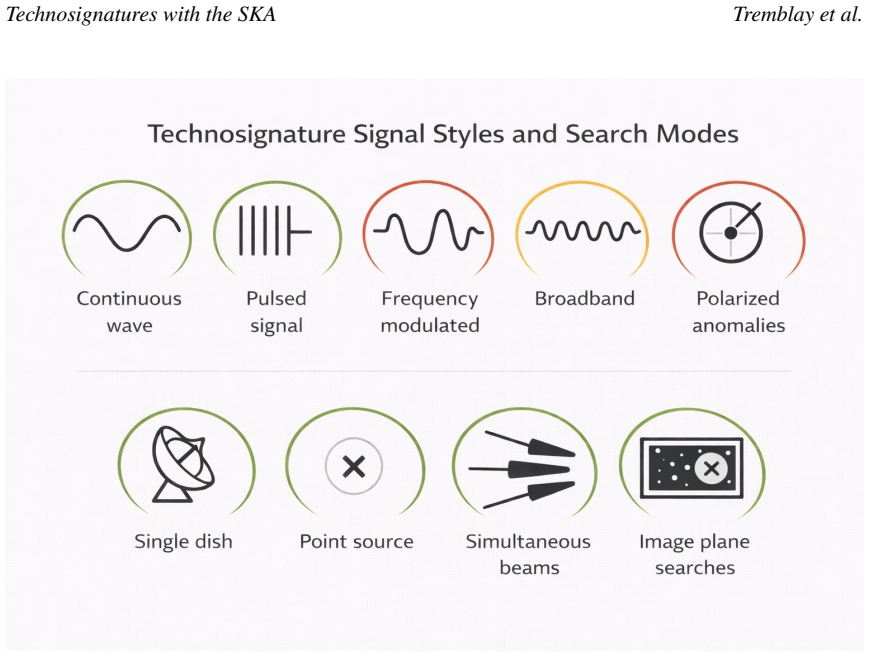
The search for technosignatures (also known as the Search for Extraterrestrial Intelligence or SETI) depends critically on our ability to distinguish artificial signals from the rich complexity of natural astrophysical phenomena and radio frequency interference from anthropogenic emissions. As the search for technosignatures increasingly aligns with mainstream astrophysics, complementing the search for biosignatures, it demands not only sophisticated statistical and computational approaches, but also deep domain knowledge across the electromagnetic spectrum. The SKA will play a pivotal role in the next-generation of technosignature searches, providing an unprecedented combination of sensitivity, field of view, and spatial resolution over its wavelength range. Integrating wide-field, high-resolution observations with machine learning and multi-wavelength diagnostics will represent key steps forward. The SKA's singular capabilities will render it an indispensable instrument for the rapid identification and follow-up characterisation of promising technosignature candidates. In this chapter, we discuss the request for high temporal and spectral resolution data products with a main focus on frequency-domain SETI. Nevertheless, multiple SKA observing modes have the potential to substantially advance technosignature research.
Editorial analysis
A structured set of objections, weighed in public.
Referee Report
Summary. The manuscript is a perspective chapter arguing that the SKA will play a pivotal role in next-generation technosignature searches through its combination of sensitivity, field of view, and spatial resolution. It focuses on the need to request high temporal and spectral resolution data products to enable frequency-domain SETI, while noting that multiple observing modes could advance the field when combined with machine learning and multi-wavelength diagnostics.
Significance. If the advocated data products are delivered, the discussion could help align SETI with mainstream astrophysics by guiding instrument requirements for distinguishing artificial signals. As a non-quantitative advocacy piece with no new derivations, data, or predictions, its primary value is in outlining community needs rather than advancing empirical results.
major comments (1)
- [Abstract] Abstract: the central claim that the SKA provides an 'unprecedented combination of sensitivity, field of view, and spatial resolution' is load-bearing for the argument that it will be 'indispensable' and 'pivotal,' yet the text states this without citing specific design specifications, performance metrics, or comparisons to existing facilities (e.g., MeerKAT or VLA); this leaves the justification for the requested data products unsubstantiated.
minor comments (1)
- The text refers to 'this chapter' and 'the request for high temporal and spectral resolution data products,' which implies it is part of a larger volume; adding a brief standalone introduction to the SKA-SETI context would improve readability for readers encountering it independently.
Simulated Author's Rebuttal
We thank the referee for their constructive review. The single major comment identifies a valid gap in substantiation within the abstract. We address it directly below and will revise the manuscript.
read point-by-point responses
-
Referee: [Abstract] Abstract: the central claim that the SKA provides an 'unprecedented combination of sensitivity, field of view, and spatial resolution' is load-bearing for the argument that it will be 'indispensable' and 'pivotal,' yet the text states this without citing specific design specifications, performance metrics, or comparisons to existing facilities (e.g., MeerKAT or VLA); this leaves the justification for the requested data products unsubstantiated.
Authors: We agree that the abstract presents the claim without immediate supporting metrics or citations, which weakens the justification for the requested data products. Although the body of the manuscript references SKA design documents and performance expectations, these are not carried into the abstract. We will revise the abstract to incorporate key quantitative specifications (e.g., sensitivity, FOV, and resolution values drawn from official SKA design reports) together with brief comparisons to MeerKAT and the VLA, supported by appropriate citations. This change will make the load-bearing claim explicit and traceable while preserving the perspective nature of the chapter. revision: yes
Circularity Check
No significant circularity
full rationale
The manuscript is a high-level discussion and advocacy piece on SKA capabilities for technosignature searches. It contains no equations, derivations, fitted parameters, predictions, or quantitative steps that could reduce to their own inputs by construction. Central claims rest on prospective instrument design goals and external instrument specifications rather than any internal chain that loops back on itself. This is the most common honest finding for perspective chapters without mathematical content.
Axiom & Free-Parameter Ledger
Reference graph
Works this paper leans on
-
[1]
doi: 10.1086/672273. D. P. Anderson et al.AJ, 170(2):111, Aug
-
[2]
doi: 10.3847/1538-3881/ade5ab. V.Arumugametal. Skaosciencedataproducts: asummary,June2025. URLhttps://doi.org/ 10.5281/zenodo.16950880. T. Barclay et al.AJ, 162(6):300, Dec
-
[3]
doi: 10.3847/1538-3881/ac2824. S. Bowyer et al.ICARUS, 53(1):147–155, Jan
-
[4]
doi: 10.1016/0019-1035(83)90028-3. S. Bowyer, D. Werthimer, and C. Donnelly. In G. S. Shostak, editor,Progress in the Search for Extraterrestrial Life., volume 74 ofAstronomical Society of the Pacific Conference Series, page 285, Jan
-
[5]
doi: 10.1146/annurev-astro-112320-035628. G. Brown and V. Gajjar. In246th Meeting of the American Astronomical Society, volume 246 of American Astronomical Society Meeting Abstracts, page 117.07, June
-
[6]
doi: 10.3847/1538-3881/ac5e3d. B. Brzycki et al.ApJ, 952(1):46, July
-
[7]
doi: 10.3847/1538-4357/acdee0. B. Brzycki et al.AJ, 168(6):284, Dec
-
[8]
doi: 10.3847/1538-3881/ad7e18. M. Caleb et al.MNRAS, 496(4):4565–4573, Aug
-
[9]
doi: 10.1093/mnras/staa1791. J. R. Callingham et al.Natr., 647(8090):603–607, Nov
-
[10]
doi: 10.1038/s41586-025-09715-3. C. Choza et al.AJ, 167(1):10, Jan
-
[11]
doi: 10.3847/1538-3881/acf576. P. F. Clancy.J. Br. Interplanet. Soc, 33:391–395, Nov
-
[12]
doi: 10.1038/184844a0. N. L. Cohen, M. A. Malkan, and J. M. Dickey.ICARUS, 41(2):198–204, Feb
-
[13]
W.D.CottonandF.Yusef-Zadeh.ApJS,227(1):10,Nov.2016
doi: 10.1086/170261. W.D.CottonandF.Yusef-Zadeh.ApJS,227(1):10,Nov.2016. doi: 10.3847/0067-0049/227/1/10. D. Czech et al.PASP, 133(1024):064502, June
-
[14]
doi: 10.1088/1538-3873/abf329. C. Donnelly et al.Acta Astronaut., 42(10):655–659,
-
[15]
ISSN 0094-5765. doi: https://doi. 23 Technosignatures with the SKA Tremblay et al. org/10.1016/S0094-5765(98)00021-6. URLhttps://www.sciencedirect.com/science/ article/pii/S0094576598000216. F. D. Drake.Physics Today, 14(4):40, Jan
-
[16]
doi: 10.1063/1.3057500. L. N. Driessen et al.MNRAS, 491(1):560–575, Jan
-
[17]
doi: 10.1093/mnras/stz3027. R. D. Ekers, K. Culler, J. Billingham, and L. Scheffer.SETI 2020 : a roadmap for the search for extraterrestrial intelligence / produced for the SETI Institute by the SETI Science & Technology Working Group
-
[18]
Enriquez and D
E. Enriquez and D. Price. turboSETI: Python-based SETI search algorithm. Astrophysics Source Code Library, record ascl:1906.006, June
1906
-
[19]
doi: 10.1051/0004-6361/202244242. V. Gajjar et al.AJ, 162(1):33, July
-
[20]
doi: 10.3847/1538-3881/abfd36. V. Gajjar et al.ApJ, 932(2):81, June
-
[21]
doi: 10.3847/1538-4357/ac6dd5. M. Garrett. In14th European VLBI Network Symposium & Users Meeting (EVN 2018), page 26, Nov
-
[22]
M. Garrett, A. Siemion, and W. van Cappellen.arXiv e-prints, art. arXiv:1709.01338, Sept
work page internal anchor Pith review Pith/arXiv arXiv
-
[23]
doi: 10.48550/arXiv.1709.01338. M. A. Garrett and A. P. V. Siemion.MNRAS, 519(3):4581–4588, Mar
work page internal anchor Pith review Pith/arXiv arXiv doi:10.48550/arxiv.1709.01338
-
[24]
doi: 10.1093/mnras/ stac2607. L. M. Gindilis and L. I. Gurvits.Acta Astronaut., 162:1–13, Sept
-
[25]
doi: 10.1016/j.actaastro. 2019.04.030. R. H. Gray.AJ, 159(5):228, May
-
[26]
doi: 10.3847/1538-3881/ab792b. D. Grigg, S. J. Tingay, and M. Sokolowski.AAP, 699:A307, July
-
[27]
doi: 10.1051/0004-6361/ 202554787. E. Haliki.IJA, 18(5):455–462, Oct
-
[28]
doi: 10.1017/S1473550418000459. J. Haqq-Misra, G. Profitiliotis, and R. Kopparapu.Technological Forecasting and Social Change, 218:124194, Sept. 2025a. doi: 10.1016/j.techfore.2025.124194. J. Haqq-Misra, C. Vidal, and G. Profitiliotis.Acta Astronaut., 229:831–838, Apr. 2025b. doi: 10.1016/j.actaastro.2025.01.048. I. Heywood.MNRAS, 525(1):L76–L81, Oct
-
[29]
doi: 10.1093/mnrasl/slad094. J. J. Hibbard et al.AJ, 171(1):26, Jan
-
[30]
doi: 10.3847/1538-3881/ae18d8. M. Hippke and D. H. Forgan.arXiv e-prints, art. arXiv:1712.06639, Dec
work page internal anchor Pith review Pith/arXiv arXiv doi:10.3847/1538-3881/ae18d8
-
[31]
doi: 10.48550/ arXiv.1712.06639. X. Hong et al.Science China Physics, Mechanics, and Astronomy, 69(1):219511, Nov
work page internal anchor Pith review Pith/arXiv arXiv
-
[32]
K.Houston,A.Siemion,andS.Croft.AJ,162(4):151,Oct.2021
doi: 10.1007/s11433-025-2751-2. K.Houston,A.Siemion,andS.Croft.AJ,162(4):151,Oct.2021. doi: 10.3847/1538-3881/ac052f. B.-L. Huang, Z.-Z. Tao, and T.-J. Zhang.AJ, 166(6):245, Dec
-
[33]
doi: 10.3847/1538-3881/ ad06b1. N. Hurley-Walker et al.NAT, 601(7894):526–530, Jan
-
[34]
doi: 10.1038/s41586-021-04272-x. H. Isaacson et al.PASP, 129(975):054501, May
-
[35]
doi: 10.1088/1538-3873/aa5800. B. Jacobson-Bell et al.AJ, 169(4):206, Apr
-
[36]
doi: 10.3847/1538-3881/adb8e7. O. A. Johnson et al.AJ, 166(5):193, Nov
-
[37]
doi: 10.3847/1538-3881/acf9f5. N. S. Kardashev.Nat. Astr., 278(5699):28–30, Mar
-
[38]
doi: 10.1038/278028a0. D. Kipping and G. Lewis.IJA, 24:e5, Mar
-
[39]
24 Technosignatures with the SKA Tremblay et al
doi: 10.1017/S1473550424000235. 24 Technosignatures with the SKA Tremblay et al. E. J. Korpela et al.AJ, 170(2):112, Aug
-
[40]
doi: 10.3847/1538-3881/ade5a7. B. C. Lacki et al.ApJs, 257(2):42, Dec
-
[41]
doi: 10.3847/1538-4365/ac168a. J.-K. Li et al.ApJ, 938(1):1, Oct
-
[42]
doi: 10.3847/1538-4357/ac90bd. M. G. Li et al.AJ, 166(5):182, Nov
-
[43]
doi: 10.3847/1538-3881/acf83d. P. X. Ma et al.Nat. Astr., 7:492–502, Apr
-
[44]
doi: 10.1038/s41550-022-01872-z. N. Madhusudhan et al.ApJl, 956(1):L13, Oct
-
[45]
L.Manunzaetal.ActaAstronaut.,233:155–167,Aug.2025
doi: 10.3847/2041-8213/acf577. L.Manunzaetal.ActaAstronaut.,233:155–167,Aug.2025. doi: 10.1016/j.actaastro.2025.04.007. J.-L. Margot et al.AJ, 166(5):206, Nov
-
[46]
doi: 10.3847/1538-3881/acfda4. L. A. Mason, M. A. Garrett, K. Wandia, and A. P. V. Siemion.MNRAS, 536(3):2127–2134, Jan
-
[47]
doi: 10.1093/mnras/stae2714. I. S. Morrison et al.PASA, 40:e019, Apr
-
[48]
doi: 10.1017/pasa.2023.15. K. Mráziková et al.Astrobiology, 24(4):407–422, Apr
-
[49]
doi: 10.1089/ast.2023.0046. A. R. Offringa et al.PASA, 32:e008, Mar
-
[50]
doi: 10.1017/pasa.2015.7. B. M. Oliver.ICARUS, 19(3):425–428, July
-
[51]
doi: 10.1016/0019-1035(73)90118-8. G. Oliver.Physica, 51(2):197–214, Jan
-
[52]
doi: 10.1016/0031-8914(71)90216-3. C. Painter et al.AJ, 169(4):222, Apr
-
[53]
doi: 10.3847/1538-3881/adbc5e. K. Perez et al.RNAAS, 4(6):97, June
-
[54]
doi: 10.3847/2515-5172/ab9f36. A. Potapov et al.AAP, 697:A53, May
-
[55]
doi: 10.1051/0004-6361/202453385. S. Prabu, S. J. Tingay, and A. Williams.PASA, 40:e056, Dec
-
[56]
doi: 10.1017/pasa.2023.56. D. C. Price.PASA, 41:e037, May
-
[57]
doi: 10.1017/pasa.2024.35. D. C. Price et al.AJ, 159(3):86, Mar
-
[58]
doi: 10.3847/1538-3881/ab65f1. D. Qasim et al.ACS Earth and Space Chemistry, 7(1):156–167, Jan
-
[59]
doi: 10.1088/0004-6256/144/2/38. R. C. Saide, M. A. Garrett, and N. Heeralall-Issur.MNRAS, 522(2):2393–2402, June
-
[60]
doi: 10.1093/mnras/stad378. S. Z. Sheikh, J. T. Wright, A. Siemion, and J. E. Enriquez.ApJ, 884(1):14, Oct
-
[61]
doi: 10.3847/1538-4357/ab3fa8. S. Z. Sheikh et al.AJ, 160(1):29, July
-
[62]
doi: 10.3847/1538-3881/ab9361. S. Z. Sheikh et al.Nat. Astr., 5:1153–1162, Oct
-
[63]
doi: 10.1038/s41550-021-01508-8. S. Z. Sheikh et al.AJ, 169(2):118, Feb
-
[64]
doi: 10.3847/1538-3881/ada3c7. H.P.Shuch. AHalf-centuryofSETIScience. InH.P.Shuch,editor,SearchingforExtraterrestrial Intelligence, page
-
[65]
doi: 10.1007/978-3-642-13196-7_1. A. Siemion et al. InAdvancing Astrophysics with the Square Kilometre Array (AASKA14), page 116, Apr
-
[66]
doi: 10.22323/1.215.0116. A. P. V. Siemion et al.ApJ, 767(1):94, Apr
-
[67]
doi: 10.1088/0004-637X/767/1/94. V.I.Slysh. InM.D.Papagiannis,editor,TheSearchforExtraterrestrialLife: RecentDevelopments, volume 112 ofIAU Symposium, pages 315–319, Jan
-
[68]
doi: 10.1093/mnras/stae303. O. M. Smirnov et al.MNRAS, 538(1):L89–L93, Mar. 2025a. doi: 10.1093/mnrasl/slaf015. O. M. Smirnov et al.MNRAS, 538(1):L62–L68, Mar. 2025b. doi: 10.1093/mnrasl/slaf009. S. Smith et al.Nat. Astr., 5:1148–1152, Oct
-
[69]
25 Technosignatures with the SKA Tremblay et al
doi: 10.1038/s41550-021-01479-w. 25 Technosignatures with the SKA Tremblay et al. M. Sokolowski, R. B. Wayth, and T. Ellement. InRadio Frequency Interference (RFI), page 7833541, Jan
-
[70]
doi: 10.1109/RFINT.2016.7833541. W. T. Sullivan, III, S. Brown, and C. Wetherill.Science, 199(4327):377–388, Jan
-
[71]
doi: 10.1126/science.199.4327.377. A. Suresh et al.AJ, 165(6):255, June
-
[72]
G.P.Swart,P.E.Dewdney,andA.Cremonini.JATIS,8:011021,Jan.2022
doi: 10.3847/1538-3881/acccf0. G.P.Swart,P.E.Dewdney,andA.Cremonini.JATIS,8:011021,Jan.2022. doi: 10.1117/1.JATIS. 8.1.011021. Z.-Z. Tao et al.AJ, 164(4):160, Oct
-
[73]
doi: 10.3847/1538-3881/ac8bd5. J. Tarter. In M. Fridlund, T. Henning, and H. Lacoste, editors,Earths: DARWIN/TPF and the Search for Extrasolar Terrestrial Planets, volume 539 ofESA Special Publication, pages 31–38, Oct
-
[74]
doi: 10.1038/s41550-025-02757-7. S. J. Tingay et al.PASA, 30:e007, Jan
-
[75]
doi: 10.1017/pasa.2012.007. S. J. Tingay, C. Tremblay, A. Walsh, and R. Urquhart.ApJl, 827(2):L22, Aug
-
[76]
doi: 10.3847/2041-8205/827/2/L22. S. J. Tingay, C. D. Tremblay, and S. Croft.ApJ, 856(1):31, Mar
-
[77]
doi: 10.3847/1538-4357/ aab363. C. Tremblay.A Search for Molecules at Low Frequency with the Murchison Widefield Array. PhD thesis, Curtin University, Australia, Dec
-
[78]
doi: 10.1017/pasa.2020.27. C. D. Tremblay and S. J. Tingay.ApJ, 972(1):76, Sept
-
[79]
doi: 10.3847/1538-4357/ad6b11. C. D. Tremblay et al.MNRAS, 471(4):4144–4154, Nov
-
[80]
doi: 10.1093/mnras/stx1838. C. D. Tremblay et al.ApJ, 860(2):145, June 2018a. doi: 10.3847/1538-4357/aac3e1. C. D. Tremblay et al.PASA, 35:e018, May 2018b. doi: 10.1017/pasa.2018.13. C.D.Tremblay,D.C.Price,andS.J.Tingay.PASA,39:e008,Mar.2022. doi: 10.1017/pasa.2022.5. C. D. Tremblay et al.AJ, 167(1):35, Jan
discussion (0)
Sign in with ORCID, Apple, or X to comment. Anyone can read and Pith papers without signing in.