The adaptive nature of confirmation bias
Pith reviewed 2026-06-26 05:56 UTC · model grok-4.3
The pith
Optimal evidence selection to minimize error in binary decisions produces confirmation bias as a rational strategy.
A machine-rendered reading of the paper's core claim, the machinery that carries it, and where it could break.
Core claim
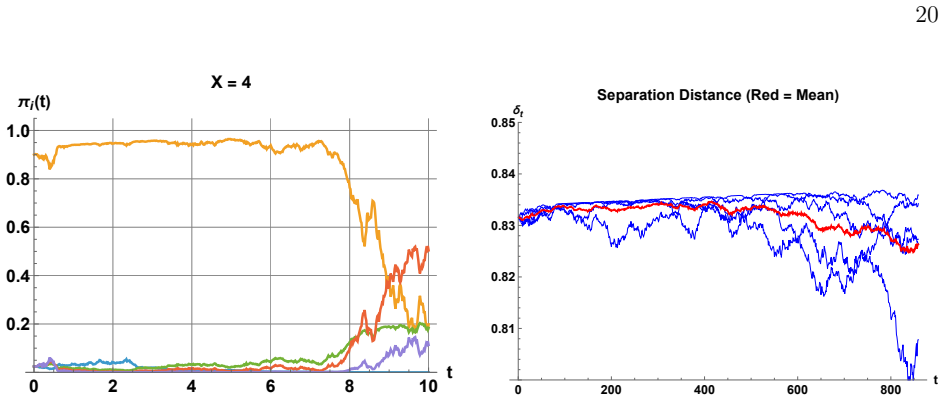
In the problem of binary hypothesis testing, an optimal evidence choice that minimises the expected error probability leads to a confirmation bias; in sequential evidence sampling this implicit optimality produces the smallest memory capacity together with an error probability that can be reduced exponentially in sample size.
What carries the argument
Modeling observations by matrices on the space of square-root probabilities, with optimality defined as minimising expected error probability in binary hypothesis testing.
If this is right
- Confirmation bias functions as a feature of rational evidence selection rather than a departure from it.
- Decision makers following the optimal rule operate with minimal memory storage requirements.
- Error probability decreases exponentially rather than linearly or polynomially with added samples.
- The identical evidence choice is obtained when the objective is switched from error minimisation to information maximisation.
Where Pith is reading between the lines
- The framework may predict that confirmation bias appears most strongly in tasks where memory capacity is tightly constrained.
- It suggests checking whether real sequential sampling behavior matches the matrix-based selection rule in controlled binary choice experiments.
- The equivalence between error-minimising and information-maximising rules could be tested by varying the cost of memory across different decision environments.
Load-bearing premise
Observations are modeled by matrices rather than random variables on a probability space, and optimality is defined as minimising expected error probability.
What would settle it
An experiment or simulation in which the evidence sequence that minimises expected error in a binary task fails to favor confirming evidence, or in which error probability does not drop exponentially with sample size under the optimal rule.
Figures
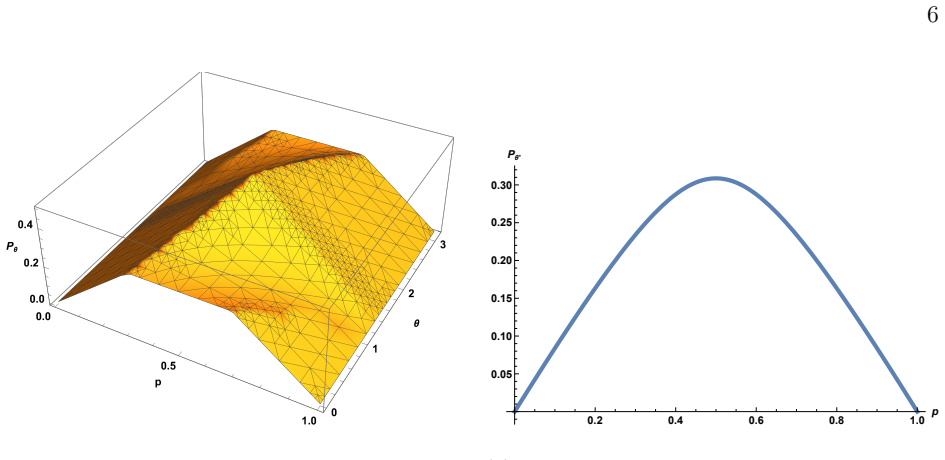
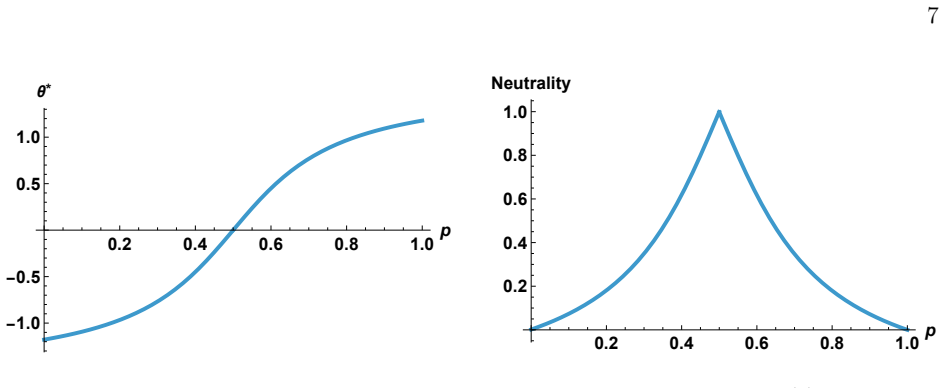
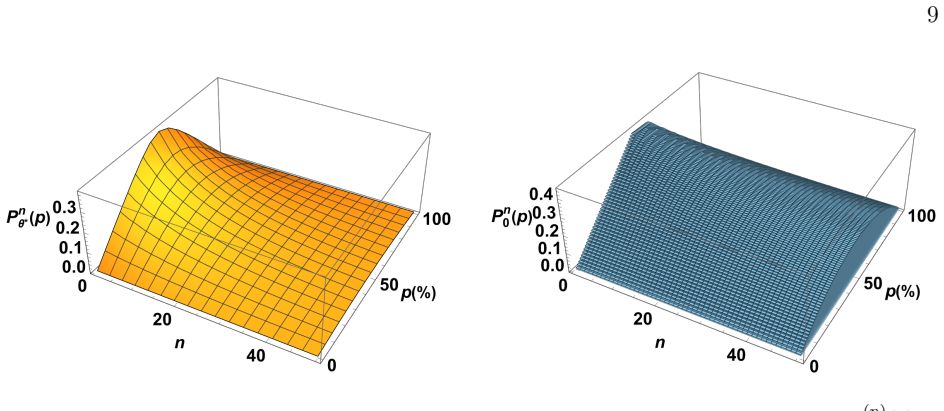
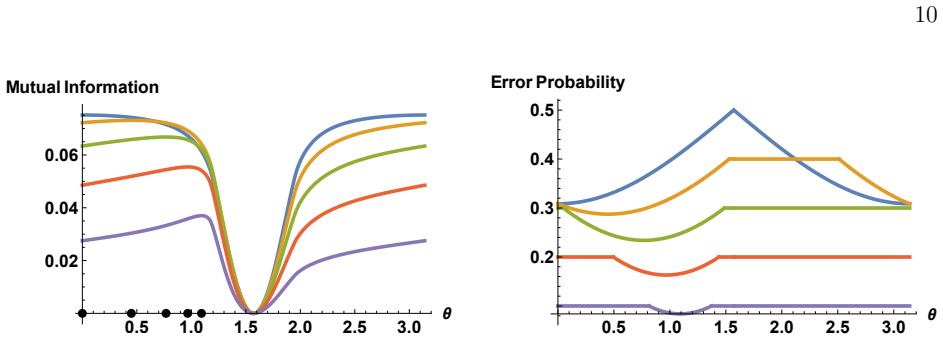
read the original abstract
In this paper, the phenomenon generally classified as confirmation bias is formulated on the space of square-root probabilities (or equivalently, using the structures of quantum probability). In this framework, observations are modelled by matrices, rather than random variables on a probability space. In the problem of binary hypothesis testing, an optimal evidence choice minimises the expected error probability. We show that the resulting optimal choice of evidence leads to a confirmation bias, thus revealing a surprising aspect of rationality that encompasses confirmation bias. Specifically, in sequential evidence sampling, the implicit optimality leads to two remarkable evolutionary advantages, namely, (a) the decision maker requires only the smallest memory capacity, and (b) the error probability can be reduced exponentially in sample size. A complementary approach based on the framework of active inference -- where the decision maker seeks evidence that provides maximum information -- is then considered. The resulting optimal evidence is shown to agree with the one obtained by minimising error probability. Our framework provides an easy-to-implement protocol for an active quantum inference, whereby the optimal evidence choice for making an inference is sought over the space of matrices.
Editorial analysis
A structured set of objections, weighed in public.
Referee Report
Summary. The paper claims that confirmation bias can be formulated in the space of square-root probabilities (quantum probability), where observations are modeled as matrices. In binary hypothesis testing, the evidence choice that minimizes expected error probability is shown to produce confirmation bias as an optimal strategy. In sequential sampling this yields two evolutionary advantages: minimal memory capacity and exponential reduction of error probability with sample size. The same optimal evidence is recovered from an active-inference (maximum-information) criterion, and the framework supplies a protocol for active quantum inference.
Significance. If the central derivation holds, the work supplies a concrete optimality-based account in which confirmation bias is not a departure from rationality but a direct consequence of it, together with explicit computational advantages (memory and exponential error decay) that are falsifiable in principle. The agreement between error-minimization and active-inference routes, and the provision of an implementable matrix protocol, are additional strengths.
major comments (3)
- [Observation model / binary hypothesis testing formulation] The observation model (matrices on the square-root probability space rather than random variables on a classical probability space) is load-bearing for the claim that optimality implies confirmation bias. The manuscript must demonstrate either that the bias result survives translation to ordinary random variables or that the matrix representation is required on independent grounds; otherwise the bias may be an artifact of the chosen representation.
- [Central optimality derivation] The derivation that the error-minimizing evidence choice produces confirmation bias (and the two stated advantages) is not visible in the abstract and must be checked for circularity: the optimality criterion must not be defined in a way that forces the bias by construction. Explicit steps linking the matrix structure to the bias behavior are required.
- [Sequential sampling / evolutionary advantages] The exponential error reduction and minimal-memory claims are stated as consequences of sequential sampling under the optimal policy. The precise scaling (e.g., which norm or distance yields the exponential rate) and the memory-capacity argument (which quantity is being minimized) need explicit verification against the matrix model.
minor comments (2)
- The abstract equates square-root probabilities with quantum probability structures; a brief clarifying sentence on the precise equivalence would help readers outside the subfield.
- Notation for the matrix observations and the error-probability functional should be introduced consistently before the optimality argument.
Simulated Author's Rebuttal
We thank the referee for their constructive and detailed comments. We respond point-by-point to the major comments below, indicating where revisions will be made to strengthen the manuscript.
read point-by-point responses
-
Referee: [Observation model / binary hypothesis testing formulation] The observation model (matrices on the square-root probability space rather than random variables on a classical probability space) is load-bearing for the claim that optimality implies confirmation bias. The manuscript must demonstrate either that the bias result survives translation to ordinary random variables or that the matrix representation is required on independent grounds; otherwise the bias may be an artifact of the chosen representation.
Authors: The matrix representation on the square-root probability space is motivated independently by the quantum cognition literature, where it captures non-commutative effects and interference that align with observed cognitive phenomena. To address the concern directly, the revised manuscript will include a new subsection comparing the classical random-variable formulation under the identical error-minimization criterion. We will demonstrate that confirmation bias does not arise classically, thereby establishing that the matrix structure is required on independent grounds. revision: yes
-
Referee: [Central optimality derivation] The derivation that the error-minimizing evidence choice produces confirmation bias (and the two stated advantages) is not visible in the abstract and must be checked for circularity: the optimality criterion must not be defined in a way that forces the bias by construction. Explicit steps linking the matrix structure to the bias behavior are required.
Authors: The optimality criterion is defined strictly as minimization of expected error probability, a standard objective that does not presuppose bias. Confirmation bias arises as a derived consequence of this minimization when performed in the matrix algebra. The revised manuscript will expand the central derivation with all intermediate algebraic steps, explicitly tracing how the matrix operations select confirming evidence without circularity. revision: yes
-
Referee: [Sequential sampling / evolutionary advantages] The exponential error reduction and minimal-memory claims are stated as consequences of sequential sampling under the optimal policy. The precise scaling (e.g., which norm or distance yields the exponential rate) and the memory-capacity argument (which quantity is being minimized) need explicit verification against the matrix model.
Authors: The revised manuscript will supply the missing explicit verification: the exponential rate will be stated with respect to the trace norm on the matrix space, and the memory-capacity argument will be formalized as the requirement to retain only the current square-root probability vector (rather than the full observation history). These calculations will be added to the sequential-sampling section. revision: yes
Circularity Check
No significant circularity detected
full rationale
The paper models observations via matrices on square-root probabilities and defines optimality as minimising expected error probability for binary hypothesis testing; it then derives that the resulting optimal evidence choice produces confirmation bias along with the stated memory and exponential-error advantages. This constitutes a derived consequence within the chosen framework rather than a definitional equivalence or a fitted input renamed as a prediction. The agreement with the active-inference formulation is shown separately and does not rely on load-bearing self-citation for the central claim. No equation or step reduces the target result to its inputs by construction, and the derivation remains self-contained against the stated modelling assumptions.
Axiom & Free-Parameter Ledger
axioms (2)
- domain assumption Observations can be modelled by matrices in the space of square-root probabilities.
- domain assumption Optimality is defined as minimising expected error probability in binary hypothesis testing.
invented entities (1)
-
Matrix-based observation model
no independent evidence
Reference graph
Works this paper leans on
-
[1]
Alloy, L. B. & Tabachnik, N. (1984) Assessment of covariation by humans and animals: The joint influence of prior expectations and current situational information.Psychological Review 91, 112-149
1984
-
[4]
& Romanczuk, P
Bergerot, C., Barfuss, W. & Romanczuk, P. (2024) Moderate confirmation bias enhances decision-making in groups of reinforcement-learning agents.PLOS Computational Biology20, e1012404
2024
-
[7]
Brody, D. C. (2027) Mathematical politics. To appear inSimplicity Behind Absurdity: The Power of Quantum Thinking, A. Iriki & A. Khrennikov (eds), Str¨ ungmann Forum Reports (Boston: The MIT Press)
2027
-
[9]
& Meister, B
Brody, D. & Meister, B. (1996a) Minimum decision cost for quantum ensembles.Physical Review Letters76, 1-5
-
[10]
Brody, D. C. & Meister, B. K. (1996b) Bayesian inference in quantum systems.PhysicaA223, 348-374
-
[11]
Brody, D. C. & Trewavas, A. J. (2022) Biological efficiency in processing information.Pro- ceedings of the Royal Society LondonA479, 20220809
2022
-
[13]
& Watts, P
Costello, F. & Watts, P. (2014) Surprisingly rational: Probability theory plus noise explains biases in judgment.Psychological Review121, 463-480
2014
-
[14]
(2003) The importance of cognitive errors in diagnosis and strategies to minimize them
Croskerry, P. (2003) The importance of cognitive errors in diagnosis and strategies to minimize them. Academic Medicine: Journal of the Association of American Medical Colleges,78, 775- 780
2003
-
[15]
D., Kakade, S
Daw, N. D., Kakade, S. & Dayan, P. (2002) Opponent interactions between serotonin and dopamine.Neural Networks15, 603-616
2002
-
[16]
& Smith, A
De Finetti, B., Machi, A. & Smith, A. (1993)Theory of Probability: A Critical Introductory Treatment. (New York: Wiley)
1993
-
[18]
Doherty, M. E. & Mynatt, C. R. (1986) The magical number one. In D. Moates & R. Butrick (Eds.),Inference Ohio University Interdisciplinary Conference 86, Proceedings of the Inter- disciplinary Conference on Inference; pp. 221-230. (Athens: Ohio University)
1986
-
[19]
Evans, J. St. B. T. (1989)Bias in human reasoning: Causes and consequences. (Hillsdale, NJ: Erlbaum). 14
1989
-
[20]
H., Hayden, B
Farashahi, S., Donahue, C. H., Hayden, B. Y., Lee, D. & Soltani, A. (2019) Flexible combi- nation of reward information across primates.Nature human behaviour3, 1215-1224
2019
-
[21]
Farmer, R. E. A. (1999)The macroeconomics of self-fulfilling prophecies. (Boston: The MIT Press)
1999
-
[22]
F., Levin, M
Fields, C., Friston, K., Glazebrook, J. F., Levin, M. (2022) A free energy principle for generic quantum systems.Progress in Biophysics and Molecular Biology173, 36-59
2022
-
[23]
(2016) Filter bubbles, echo chambers, and online news consumption
Flaxman, S., Sharad, G., & Rao, J. (2016) Filter bubbles, echo chambers, and online news consumption. Public Opinion Quarterly, 298-320
2016
-
[24]
Friston, K. J. (2013) Life as we know it.Journal of the Royal Society Interface10, 20130475
2013
-
[25]
& Harrison, L
Friston, K., Kilner, J. & Harrison, L. (2006) A free energy principle for the brain.Journal of Physiology – Pairs100, 70-87
2006
-
[26]
Gershman, S. J. (2015) Do learning rates adapt to the distribution of rewards?Psychonomic Bulletin and Review22, 1320-1327
2015
-
[27]
Gershman, S. J. (2020) Origin of perseveration in the trade-off between reward and complexity. Cognition204, 104394
2020
-
[28]
& Leung, T
Goette, L., Han, H. & Leung, T. K. (2020) Information overload and confirmation bias. Cam- bridge Working Papers in Economics
2020
-
[29]
L., Chater, N., Kemp, C., Perfors, A
Griffiths, T. L., Chater, N., Kemp, C., Perfors, A. & Tenenbaum, J. B. (2010) Probabilis- tic models of cognition: exploring representations and inductive biases.Trends in Cognitive Sciences14, 357-364
2010
-
[30]
& Khrennikov, A
Haven, E. & Khrennikov, A. (2016) Statistical and subjective interpretations of probability in quantum-like models of cognition and decision making.Journal of Mathematical Psychology 74, 82-91
2016
-
[33]
Holevo, A. S. (1973) Statistical decision theory for quantum systems.Journal of Multivariate Analysis3, 337-394
1973
-
[34]
& Protter, P
Jacod, J. & Protter, P. (2004)Probability Essentials(Heidelberg: Springer-Verlag)
2004
-
[35]
(2000) Seven (indeed, plus or minus two) and the detection of correlations.Psy- chological Review107, 397-402
Kareev, Y. (2000) Seven (indeed, plus or minus two) and the detection of correlations.Psy- chological Review107, 397-402
2000
-
[36]
Irreversibility and Heat Generation in the Computing Process
Landauer, R., 1961. Irreversibility and Heat Generation in the Computing Process. IBM Jour- nal of Research and Development 5, 183-191
1961
-
[37]
& Bogacz, R
Lefebvre, G., Summerfield, C. & Bogacz, R. (2022) A normative account of confirmation bias during reinforcement learning.Neural Computation34, 307-337
2022
-
[38]
Lilienfeld, S. O. (2017) Psychology’s replication crisis and the grant culture: Righting the ship. Perspectives on Psychological Science, 12(4), 660-664
2017
-
[39]
Lindley, D. V. 1956 On a Measure of the Information Provided by an Experiment.Annals of Mathematical Statistics27, 986-1005
1956
-
[40]
Lopes, L. L. (1982) Doing the impossible: A note on induction and experience of randomness. Journal of Experimental Psychology: Learning, Memory, and Cognition8, 626-636
1982
-
[41]
K., Hahn, U
Madsen, J. K., Hahn, U. & Pilditch, T. D. (2020) The impact of partial source dependence on belief and reliability revision.Journal of Experimental Psychology: Learning, Memory, and Cognition46, 1795-1805
2020
-
[42]
H., Peters, M
Odegaard, B., Grimaldi, P., Cho, S. H., Peters, M. A., Lau, H., & Basso, M. A. (2018) Su- 15 perior colliculus neuronal ensemble activity signals optimal rather than subjective confidence. Proceedings of the National Academy of Sciences115, E1588-E1597
2018
-
[43]
& Takahashi, T
Ohta, H., Satori, K., Takarada, Y., Arake, M., Ishizuka, T., Morimoto, Y. & Takahashi, T. (2021). The asymmetric learning rates of murine exploratory behavior in sparse reward envi- ronments.Neural Networks143, 218–229
2021
-
[44]
Ororbia, A. & Friston, K. 2023 Mortal Computation: A Foundation for Biomimetic Intelli- gence, arXiv:2311.09589
arXiv 2023
-
[45]
& Wynne, M
Pang, D., Bleetman, A., Bleetman, D. & Wynne, M. (2017) The foreign body that never was: the effects of confirmation bias.British Journal of Hospital Medicine,78, 350-351
2017
-
[46]
& Friston, K
Parr, T., Pezzulo, G. & Friston, K. J. (2022)Active Inference(Boston: The MIT Press)
2022
-
[47]
& Hills, T
Pilgrim, C., Sanborn, A., Malthouse, E. & Hills, T. T. (2024) Confirmation bias emerges from an approximation to Bayesian reasoning.Cognition245, 105693
2024
-
[48]
Pothos, E. M. & Busemeyer, J. R. (2013) Can quantum probability provide a new direction for cognitive modeling?Behavioral and Brain Sciences36, 255-327
2013
-
[49]
Pothos, E. M. & Busemeyer, J. R. (2022) Quantum cognition.Annual Reviews of Psychology 73, 749-778
2022
-
[50]
Ramirez, J. C. & Marshall, J. A. R. (2017) Can natural selection encode Bayesian priors? Journal of Theoretical Biology426, 57-66
2017
-
[52]
(2010) Wrongful Convictions: Adversarial and Inquisitorial Themes.North Carolina Journal of International Law and Commercial Regulation,35, 387-
Roach, K. (2010) Wrongful Convictions: Adversarial and Inquisitorial Themes.North Carolina Journal of International Law and Commercial Regulation,35, 387-
2010
-
[53]
E., Vivo, P
Sikder, O., Smith, R. E., Vivo, P. & Livan, G. (2020) A minimalistic model of bias, polarization and misinformation in social networks. Scientific reports, 10(1), 5493
2020
-
[54]
& Baronchelli, A
Starnini, M., Frasca, M. & Baronchelli, A. (2016) Emergence of metapopulations and echo chambers in mobile agents. Scientific reports, 6(1), 31834
2016
-
[55]
(2018) Fake news: How our brains lead us into echo chambers that promote racism and sexism
Stibel, J. (2018) Fake news: How our brains lead us into echo chambers that promote racism and sexism. USA Today. Retrieved October 8, 2018
2018
-
[56]
Stolyarova, A., Rakhshan, M., Peters, M. A. K., Lau, H., Soltani, A. & Izquierdo, A. (2019) Contributions of anterior cingulate cortex and basolateral amygdala to decision confidence and learning under uncertainty.Nature Communications10, 1-14
2019
-
[58]
S., Yearsley, J
Trueblood, J. S., Yearsley, J. M. & Pothos, E. M. (2017) A quantum probability framework for human probabilistic inference.Journal of Experimental Psychology: General146, 1307-1341
2017
-
[59]
(1960) On the failure to eliminate hypotheses in a conceptual task.Quarterly Journal of Experimental Psychology12, 129-140
Wason, P. (1960) On the failure to eliminate hypotheses in a conceptual task.Quarterly Journal of Experimental Psychology12, 129-140
1960
-
[60]
Wason, P. C. (1961) Response to affirmative and negative binary statements.British Journal of Psychology52, 133-142
1961
-
[62]
evidence
Zhu, J. Q., Sanborn, A. N. & Chater, N. (2020) The Bayesian sampler: Generic Bayesian inference causes incoherence in human probability judgments.Psychological Review127, 719- 748. 16 A. Rational updating of belief Our definition of a rational updating of belief under uncertainty, namely, that an update of the prior must be such that the posterior is the ...
2020
-
[63]
Similarly we have ˆR2 −( ˆR1 ˆΠ∗ 1 + ˆR2 ˆΠ∗
= ( ˆR1 − ˆR2)ˆΠ∗ 2 =p 2(ˆρ2 −γˆρ1)ˆΠ∗ 2 ≥0,(32) 25 whereγ=p 1/p2. Similarly we have ˆR2 −( ˆR1 ˆΠ∗ 1 + ˆR2 ˆΠ∗
-
[64]
bit” can only take two distinct values 0 and 1, a quantum bit, or a “qubit
= ( ˆR2 − ˆR1)ˆΠ∗ 1 =−p 2(ˆρ2 −γˆρ1)ˆΠ∗ 1 ≥0.(33) Hence if we writeη i and|η i⟩for the eigenvalues and eigenstates of the Hermitian matrix ˆρ2 −γˆρ1, then fromp 2 ≥0 we have it from (32) and (33) that ⟨ηi|(ˆρ2 −γˆρ1)ˆΠ∗ 2|ηi⟩=η i⟨ηi|ˆΠ∗ 2|ηi⟩ ≥0 (34) and that ⟨ηi|(ˆρ2 −γˆρ1)ˆΠ∗ 1|ηi⟩=η i⟨ηi|ˆΠ∗ 1|ηi⟩ ≤0.(35) Now ifη i <0 then it must be⟨η i|ˆΠ∗ 2|ηi⟩ ≤0, ...
2015
-
[65]
Belavkin, V. P. (1975) Optimal multiple quantum statistical hypothesis testing.Stochastics 1, 315-345
1975
-
[66]
Berger, J. O. (1985)Statistical Decision Theory and Bayesian Analysis(New York: Springer)
1985
-
[67]
Brody, D. C. (2022) Noise, fake news, and tenacious Bayesians.Frontiers in Psychology13, 797904
2022
-
[68]
Brody, D. C. (2023) Quantum formalism for the dynamics of cognitive psychology.Scientific Reports13, 16104
2023
-
[69]
Brody, D. C. (2026) Mathematical politics. InStr¨ ungmann Forum Report, Simplicity behind Absurdity, A. Iriki & A. Khrennikov (eds) (Berlin: Springer)
2026
-
[70]
Brody, D. C. & Hook, D. W. (2009) Information geometry in vapour–liquid equilibrium. Journal of PhysicsA42, 023001
2009
-
[71]
Busemeyer, J. R. & Wang, Z. (2015) What is quantum cognition, and how is it applied to psychology?Current Directions in Psychological Science24, 163-169
2015
-
[72]
DeGroot, M. H. (1970)Optimal Statistical Decisions(New York: McGraw-Hill)
1970
-
[73]
Gel’fand, I. M. & Yaglom, A. M. (1957) Calculation of the amount of information about a random function contained in another such function.Uspekhi Matematicheskikh Nauk12, 3-52
1957
-
[74]
Helstrom, C. W. (1967) Detection theory and quantum mechanics.Information and Control 10, 254-291
1967
-
[75]
Helstrom,C. W. (1976)Quantum Detection and Estimation Theory(New York: Academic Press)
1976
-
[76]
Holevo, A. S. (1973) Statistical decision theory for quantum systems.Journal of Multivariate Analysis3, 337-394. 31
1973
-
[77]
G., Ross, L
Lord, C. G., Ross, L. & Lepper, M. R. (1979) Biased assimilation and attitude polarization: The effects of prior theories on subsequently considered evidence.Journal of Personality and Social Psychology37, 2098-2109
1979
-
[78]
Malley, J. D. & Hornstein, J. (1993) Quantum statistical inference.Statistical Science8, 433- 457
1993
-
[79]
& Khrennikov, A
Ozawa, M. & Khrennikov, A. (2023) Nondistributivity of human logic and violation of response replicability effect in cognitive psychology.Journal of Mathematical Psychology112, 102739
2023
-
[80]
Rao, C. R. (1954) On the use and interpretation of distance functions in statisticsBull. Inst. Int. Stat.34, 90-97
1954
-
[81]
Stratonovich, R. L. (1973) The quantum generalization of optimal statistical estimation and hypothesis testing.Stochastics1, 87-126
1973
-
[82]
P., Kennedy, K
Yuen, H. P., Kennedy, K. S. & Lax, M. (1975) Optimum testing of multiple hypotheses in quantum detection theory.IEEE Transactions on Information Theory21, 125-1xx
1975
discussion (0)
Sign in with ORCID, Apple, or X to comment. Anyone can read and Pith papers without signing in.