REVIEW 2 minor 40 references
Neural Phase Correlation
T0 review · 0 major / 2 minor · reviewed 2026-06-27 · grok-4.3
Pith's one-line read A learned basis generalizes phase correlation from rigid translations to non-rigid deformations and unitary quantum dynamics.
desk verdict The abstract sketches a learned phase correlation that replaces the fixed Fourier basis and claims to handle non-rigid registration plus quantum eigenstate recovery, but without methods or equations the results stay uncheckable. read the letter →
The pith
A machine-rendered reading of the paper's core claim, the machinery that carries it, and where it could break.
The reading
What carries the argument
A learned basis for decomposing the inter-observation transformation in the Fourier domain, replacing the fixed Fourier basis of classical phase correlation.
What would settle it
Applying the trained model to wavefunction pairs evolved under a different potential, such as an anharmonic oscillator, and checking whether it recovers the correct eigenstates and energy levels.
Extended reading notes
Core claim
We introduce a learned generalization of phase correlation that lifts this restriction by learning the basis on which the transformation decomposes. The same algebraic primitive extends to dense non-rigid deformations and to unitary dynamics.
Load-bearing premise
That a data-driven basis learned for phase correlation will extend to non-rigid and unitary transformations without merely memorizing dataset-specific mappings or losing the original algebraic advantages.
Editorial analysis
A structured set of objections, weighed in public.
Referee Report
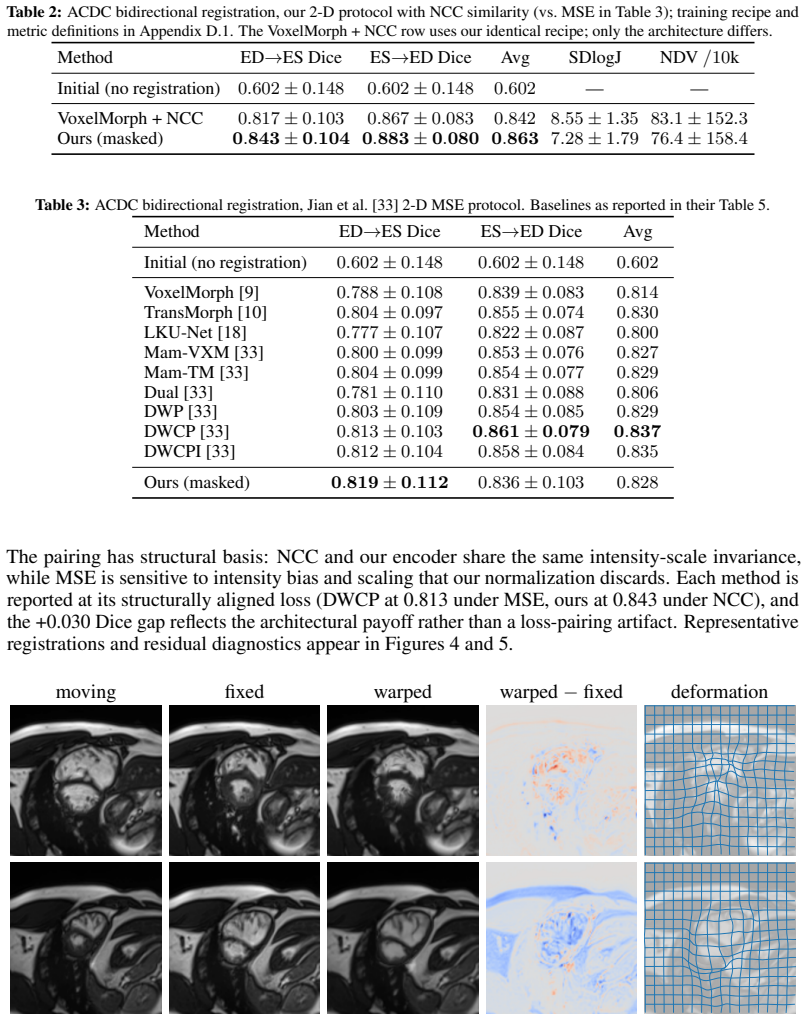
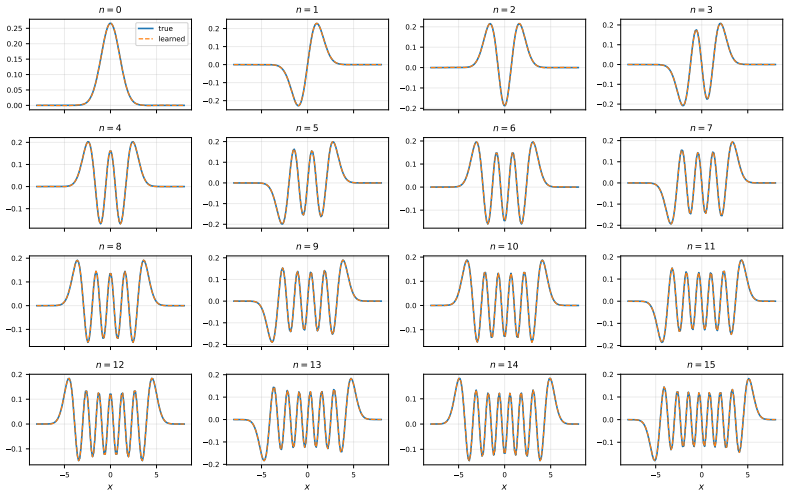
Summary. The paper introduces Neural Phase Correlation, a learned generalization of classical phase correlation that replaces the fixed Fourier basis with a data-driven basis on which the unknown transformation decomposes. This extension is claimed to support dense non-rigid deformations and unitary dynamics while retaining the algebraic structure of the original method. Experiments report that the framework matches or exceeds published baselines on bidirectional registration for the ACDC cardiac-MRI dataset and reaches state-of-the-art on the CAMUS echocardiography dataset without auxiliary scoring or adaptive smoothness. The same architecture is applied to pairs of time-evolved wavefunctions of the 1-D quantum harmonic oscillator, recovering the Hermite-function eigenstates and the quantized energy levels of the unknown Hamiltonian from observation pairs alone.
Significance. If the central claims hold, the work would meaningfully extend an algebraic registration primitive to non-rigid and quantum settings while preserving its relational character, offering a potential alternative to purely encoder-decoder pipelines in medical image registration and a novel route to Hamiltonian recovery from dynamical observations. The quantum experiment, in particular, demonstrates an unusual cross-domain application that could stimulate further work at the intersection of learning and physics.
minor comments (2)
- [Abstract] The abstract states that the method 'matches state-of-the-art without auxiliary scoring or adaptive-smoothness mechanisms,' but does not identify the precise prior methods or report the numerical margins; a table comparing Dice, Hausdorff, or TRE values against the cited baselines would strengthen the claim.
- [Abstract] The quantum experiment is described only at the level of recovered eigenstates and energy levels; without the explicit loss, the form of the learned basis, or an ablation on training-set size, it is difficult to assess whether the recovery follows from the phase-correlation structure or from dataset-specific fitting.
Simulated Author's Rebuttal
We thank the referee for their review of our manuscript. The summary accurately captures the core contribution of Neural Phase Correlation as a learned generalization of classical phase correlation. We note the 'uncertain' recommendation and the positive assessment of potential significance, particularly regarding the quantum experiment. No major comments are listed in the report, so we have no specific points to address at this time. We remain available to provide additional details or clarifications should the editor or referee request them.
Circularity Check
No significant circularity identified
full rationale
The abstract and provided context contain no equations, training procedures, or derivation steps that can be inspected for reduction to inputs. Claims of recovering eigenstates and matching baselines are presented as empirical outcomes without visible self-definitional mappings, fitted-input predictions, or load-bearing self-citations. No load-bearing step reduces by construction to the paper's own data or prior author work, so the derivation chain cannot be shown circular from the given material.
Assumptions & free parameters
Cite this review
Pith. "Pith review of Neural Phase Correlation." pith.science (2026). https://pith.science/paper/N4KTZMSP
@misc{pith2026260618496,
  author       = {Pith},
  title        = {Pith review of: Neural Phase Correlation},
  year         = {2026},
  howpublished = {\url{https://pith.science/paper/N4KTZMSP}},
  note         = {Machine review of arXiv:2606.18496}
}
read the original abstract
Correspondence is fundamentally relational: it seeks the unknown transformation between two observations of a common scene, not the content of either. Yet the dominant learning-based methods do not represent the transformation as a first-class object in the architecture. They encode each image independently and let a learned similarity function or a deep decoder discover the mapping implicitly. Phase correlation is the canonical exception, measuring the inter-image relationship directly in the Fourier domain, but the rigidity of its fixed basis confines it to global translation. We introduce a learned generalization of phase correlation that lifts this restriction by learning the basis on which the transformation decomposes. The same algebraic primitive extends to dense non-rigid deformations and to unitary dynamics. On the ACDC cardiac-MRI benchmark the framework matches or exceeds prior published baselines on both registration directions. On CAMUS echocardiography it matches state-of-the-art without auxiliary scoring or adaptive-smoothness mechanisms. Applied to time-evolved wavefunction pairs of the 1-D quantum harmonic oscillator, the same framework recovers the Hermite-function eigenstates and the quantized energy levels of the unknown Hamiltonian from observation pairs alone.
Figures


Figures from the paper (11 more)





Reference graph
Works this paper leans on
-
[1]
David G. Lowe. Distinctive image features from scale-invariant keypoints.International Journal of Computer Vision, 60(2):91–110, 2004
2004
-
[2]
R2D2: Reliable and repeatable detector and descriptor
Jerome Revaud, Cesar De Souza, Martin Humenberger, and Philippe Weinzaepfel. R2D2: Reliable and repeatable detector and descriptor. InAdvances in Neural Information Processing Systems (NeurIPS), 2019
2019
-
[3]
SuperGlue: Learning feature matching with graph neural networks
Paul-Edouard Sarlin, Daniel DeTone, Tomasz Malisiewicz, and Andrew Rabinovich. SuperGlue: Learning feature matching with graph neural networks. InIEEE Conference on Computer Vision and Pattern Recognition (CVPR), 2020
2020
-
[4]
RoMa: Robust dense feature matching
Johan Edstedt, Qiyu Sun, Georg Bökman, Mårten Wadenbäck, and Michael Felsberg. RoMa: Robust dense feature matching. InIEEE Conference on Computer Vision and Pattern Recognition (CVPR), 2024
2024
-
[5]
FlowNet: Learning optical flow with convolutional networks
Alexey Dosovitskiy, Philipp Fischer, Eddy Ilg, Philip Häusser, Caner Hazirbas, Vladimir Golkov, Patrick van der Smagt, Daniel Cremers, and Thomas Brox. FlowNet: Learning optical flow with convolutional networks. InIEEE International Conference on Computer Vision (ICCV), 2015
2015
-
[6]
PWC-Net: CNNs for optical flow using pyramid, warping, and cost volume
Deqing Sun, Xiaodong Yang, Ming-Yu Liu, and Jan Kautz. PWC-Net: CNNs for optical flow using pyramid, warping, and cost volume. InIEEE Conference on Computer Vision and Pattern Recognition (CVPR), 2018. 9
2018
-
[7]
RAFT: Recurrent all-pairs field transforms for optical flow
Zachary Teed and Jia Deng. RAFT: Recurrent all-pairs field transforms for optical flow. InEuropean Conference on Computer Vision (ECCV), 2020
2020
-
[8]
LoFTR: Detector-free local feature matching with transformers
Jiaming Sun, Zehong Shen, Yuang Wang, Hujun Bao, and Xiaowei Zhou. LoFTR: Detector-free local feature matching with transformers. InIEEE Conference on Computer Vision and Pattern Recognition (CVPR), 2021
2021
Show all 40 references
-
[9]
Sabuncu, John Guttag, and Adrian V
Guha Balakrishnan, Amy Zhao, Mert R. Sabuncu, John Guttag, and Adrian V . Dalca. V oxelMorph: A learning framework for deformable medical image registration.IEEE Transactions on Medical Imaging, 38(8):1788–1800, 2019
2019
-
[10]
Segars, Ye Li, and Eric C
Junyu Chen, Yong Du, Yufan He, William P. Segars, Ye Li, and Eric C. Frey. TransMorph: Transformer for unsupervised medical image registration.Medical Image Analysis, 82:102615, 2022
2022
-
[11]
Kuglin and Donald C
Charles D. Kuglin and Donald C. Hines. The phase correlation image alignment method. InIEEE Conference on Cybernetics and Society, pages 163–165, 1975
1975
-
[12]
Cohen and Max Welling
Taco S. Cohen and Max Welling. Group equivariant convolutional networks. InInternational Conference on Machine Learning (ICML), 2016
2016
-
[13]
Worrall, Stephan J
Daniel E. Worrall, Stephan J. Garbin, Daniyar Turmukhambetov, and Gabriel J. Brostow. Harmonic networks: Deep translation and rotation equivariance. InIEEE Conference on Computer Vision and Pattern Recognition (CVPR), 2017
2017
-
[14]
General E(2)-equivariant steerable CNNs
Maurice Weiler and Gabriele Cesa. General E(2)-equivariant steerable CNNs. InAdvances in Neural Information Processing Systems (NeurIPS), 2019
2019
-
[15]
Cohen, Mario Geiger, and Maurice Weiler
Taco S. Cohen, Mario Geiger, and Maurice Weiler. A general theory of equivariant CNNs on homogeneous spaces. InAdvances in Neural Information Processing Systems (NeurIPS), 2020
2020
-
[16]
de V os, Floris F
Bob D. de V os, Floris F. Berendsen, Max A. Viergever, Marius Staring, and Ivana Išgum. End-to-end unsupervised deformable image registration with a convolutional neural network. InDeep Learning in Medical Image Analysis (DLMIA), MICCAI Workshops, pages 204–212. Springer, 2017
2017
-
[17]
Stendahl, Lawrence H
Xiaoran Zhang, John C. Stendahl, Lawrence H. Staib, Albert J. Sinusas, Alex Wong, and James S. Duncan. Adaptive correspondence scoring for unsupervised medical image registration. InEuropean Conference on Computer Vision (ECCV), 2024
2024
-
[18]
U-Net vs transformer: Is U-Net outdated in medical image registration? InMedical Image Computing and Computer-Assisted Intervention (MICCAI), 2022
Xi Jia, Joseph Bartlett, Tianyang Zhang, Wenqi Lu, Zhaowen Qiu, and Jinming Duan. U-Net vs transformer: Is U-Net outdated in medical image registration? InMedical Image Computing and Computer-Assisted Intervention (MICCAI), 2022
2022
-
[19]
MambaMorph: A mamba-based framework for medical MR-CT deformable registration
Tao Guo, Yinuo Wang, Shihao Shu, Weimin Yuan, Diansheng Chen, Zhouping Tang, Cai Meng, and Xiangzhi Bai. MambaMorph: A mamba-based framework for medical MR-CT deformable registration. arXiv preprint arXiv:2401.13934, 2024
2024
-
[20]
Decoder-only image registration.IEEE Transactions on Medical Imaging, 2024
Xi Jia, Wenqi Lu, Xinxing Cheng, and Jinming Duan. Decoder-only image registration.IEEE Transactions on Medical Imaging, 2024
2024
-
[21]
and Steven L
Bethany Lusch, Nathan Kutz, J. and Steven L. Brunton. Deep learning for universal linear embeddings of nonlinear dynamics.Nature Communications, 9(1):4950, 2018
2018
-
[22]
Learning deep neural network representations for Koopman operators of nonlinear dynamical systems, 2017
Naoya Takeishi, Yoshinobu Kawahara, and Takehisa Yairi. Learning deep neural network representations for Koopman operators of nonlinear dynamical systems, 2017
2017
-
[23]
Solving the quantum many-body problem with artificial neural networks.Science, 355(6325):602–606, 2017
Giuseppe Carleo and Matthias Troyer. Solving the quantum many-body problem with artificial neural networks.Science, 355(6325):602–606, 2017
2017
-
[24]
Physics-informed neural networks for quantum eigenvalue problems, 2022
Henry Jin, Marios Mattheakis, and Pavlos Protopapas. Physics-informed neural networks for quantum eigenvalue problems, 2022
2022
-
[25]
Solving the quantum many-body Hamiltonian learning problem with neural differential equations, 2024
Timothy Kao et al. Solving the quantum many-body Hamiltonian learning problem with neural differential equations, 2024
2024
-
[26]
Roland Memisevic and Geoffrey E. Hinton. Unsupervised learning of image transformations. InIEEE Conference on Computer Vision and Pattern Recognition (CVPR), 2007
2007
-
[27]
Roland Memisevic and Geoffrey E. Hinton. Learning to represent spatial transformations with factored higher-order Boltzmann machines.Neural Computation, 22(6):1473–1492, 2010. 10
2010
-
[28]
On multi-view feature learning
Roland Memisevic. On multi-view feature learning. InInternational Conference on Machine Learning (ICML), 2012
2012
-
[29]
Learning to relate images.IEEE Transactions on Pattern Analysis and Machine Intelligence, 35(8):1829–1846, 2013
Roland Memisevic. Learning to relate images.IEEE Transactions on Pattern Analysis and Machine Intelligence, 35(8):1829–1846, 2013
2013
-
[30]
Differentiable top-k with optimal transport
Yujia Xie, Hanjun Dai, Minshuo Chen, Bo Dai, Tuo Zhao, Hongyuan Zha, Wei Wei, and Tomas Pfister. Differentiable top-k with optimal transport. InAdvances in Neural Information Processing Systems (NeurIPS), volume 33, pages 20520–20531, 2020
2020
-
[31]
A log-Euclidean framework for statistics on diffeomorphisms
Vincent Arsigny, Olivier Commowick, Xavier Pennec, and Nicholas Ayache. A log-Euclidean framework for statistics on diffeomorphisms. InMedical Image Computing and Computer-Assisted Intervention (MICCAI), pages 924–931. Springer, 2006
2006
-
[32]
Deep learning techniques for automatic MRI cardiac multi-structures segmentation and diagnosis: Is the problem solved?IEEE Transactions on Medical Imaging, 37(11):2514–2525, 2018
Olivier Bernard, Alain Lalande, Clement Zotti, Frederick Cervenansky, Xin Yang, Pheng-Ann Heng, Irem Cetin, Karim Lekadir, Oscar Camara, Miguel Angel Gonzalez Ballester, et al. Deep learning techniques for automatic MRI cardiac multi-structures segmentation and diagnosis: Is t...
2018
-
[33]
Disentangling progress in medical image registration: Beyond trend- driven architectures towards domain-specific strategies.Medical Image Analysis, 2025
Bailiang Jian, Jiazhen Pan, Rohan Jena, Morteza Ghahremani, Huaqi Bell Li, Daniel Rueckert, Christian Wachinger, and Benedikt Wiestler. Disentangling progress in medical image registration: Beyond trend- driven architectures towards domain-specific strategies.Medical Image Ana...
2025
-
[34]
Deep learning for segmentation using an open large-scale dataset in 2D echocardiography.IEEE Transactions on Medical Imaging, 38(9):2198–2210, 2019
Sarah Leclerc, Erik Smistad, Joao Pedrosa, Andreas Østvik, Frederic Cervenansky, Florian Espinosa, Torvald Espeland, Erik Andreas Rye Berg, Pierre-Marc Jodoin, Thomas Grenier, Carole Lartizien, Jan D’hooge, Lasse Løvstakken, and Olivier Bernard. Deep learning for segmentation ...
2019
-
[35]
I. M. Gel’fand.Lectures on Linear Algebra. Dover Publications, New York, 1989. Translated from the Russian by A. Shenitzer
1989
-
[36]
Srinivasan, Matthew Tancik, Jonathan T
Ben Mildenhall, Pratul P. Srinivasan, Matthew Tancik, Jonathan T. Barron, Ravi Ramamoorthi, and Ren Ng. NeRF: Representing scenes as neural radiance fields for view synthesis. InEuropean Conference on Computer Vision (ECCV), 2020
2020
-
[37]
Marcus, Tracy H
Daniel S. Marcus, Tracy H. Wang, Jamie Parker, John G. Csernansky, John C. Morris, and Randy L. Buckner. Open access series of imaging studies (OASIS): Cross-sectional MRI data in young, middle aged, nondemented, and demented older adults.Journal of Cognitive Neuroscience, 19(...
2007
-
[38]
Peter J. Schmid. Dynamic mode decomposition of numerical and experimental data.Journal of Fluid Mechanics, 656:5–28, 2010
2010
-
[39]
permutation matrices are orthogonal
Lintao Li, Linyu Han, H. Y . Ye, Yiting Xiang, and Tian Zhang. Deep learning in remote sensing image matching: A survey.ISPRS Journal of Photogrammetry and Remote Sensing, 225:88–112, 2025. A Classical phase correlation Phase correlation [11] is a Fourier-domain technique for ...
2025
-
[40]
C.2 Stage 2: Bilinear interaction on filter responses Classical phase correlation forms the cross-power spectrum ˆy(k)·ˆx(k)by multiplying per-frequency Fourier coefficients
established empirically that filter pairs in the factored bilinear architecture converge to Fourier harmonic pairs when trained on pure-translation data, so the Fourier-filter limit case in our reduction is realized by training rather than imposed. C.2 Stage 2: Bilinear intera...
2023
Reviewed June 27, 2026 · model on record in the stance chip above.
Discussion (0). Continue with ORCID to comment.