REVIEW 4 major objections 4 minor 85 references
Text-conditioned synthesis of 3D scenes in which multiple people coordinate around a shared object, trained on newly captured and synthetic data.
Reviewed by Pith at T0; open to challenge. T0 means a machine referee read the full paper against a public rubric. the ladder, T0–T4 →
T0 review · deepseek-v4-flash
2026-08-03 20:15 UTC pith:N5A3XNH7
load-bearing objection New task and a plausible framework, but the object-geometry blind spot and thin evaluation keep the strong claims from landing. the 4 major comments →
Learning to Generate Human-Human-Object Interactions from Textual Descriptions
The pith
A machine-rendered reading of the paper's core claim, the machinery that carries it, and where it could break.
Core claim
The central claim is that a text-driven HHOI generator can be assembled from two independently trained diffusion models: one predicting a person's pose, scale, and position relative to a canonical object frame (HOI), and one predicting a second person's relative pose with respect to the first (HHI). During a single reverse-diffusion sampling process, the two estimates are reconciled by an inconsistency loss that minimizes variance across the shared human representations and a collision loss that penalizes capsule-level interpenetration. The authors argue this decomposition lets the model generalize to an arbitrary number of people by adding HOI/HHI samples, while the guided sampling ensures
What carries the argument
The core mechanism is a pair of score-based diffusion models trained with denoising score matching: an HOI model operating on (rotation, translation, scale, body-pose embedding) in an object-centric frame, and an HHI model operating on (body poses, relative rotation/translation) in a person-centric frame. At inference, both are solved as a probability-flow ODE, and the two streams are coupled by an inconsistency loss that drives variance of each person's pose, scale, translation, and rotation toward zero across the HOI/HHI views, plus a collision loss computed on a 24-capsule approximation of each body. A low-dimensional body-pose embedding (126D → 10D) learned by a small MLP keeps the diffu
Load-bearing premise
The HOI diffusion model never receives the object mesh as input; it assumes a fixed object instance per scenario, so the text prompt alone must carry the object's geometry—if a new instance differs from training shapes, generated interactions may become implausible.
What would settle it
Hold out a novel object instance of a category seen in training (e.g., a chair with a different seat height) and generate HHOIs with the same text prompts. If human-object penetration ratios or hand/hip contact distances degrade sharply relative to objects drawn from the training distribution, the fixed-M assumption is the cause.
If this is right
- Text-to-HHOI generation becomes feasible with a unified sampling process, producing coherent dyadic scenes that outperform single-human HOI baselines on body-pose and distance Fréchet distances.
- The decomposition supports scaling to 3–5 people without retraining, with reported 100% generation success in the tested multi-human settings.
- Generated HHOIs can be used as end-frame constraints for motion in-betweening, enabling multi-human motion that respects object interaction.
- The synthetic data pipeline, combining text-to-image models and human mesh recovery, expands HHOI coverage to outdoor and large-object scenarios that are hard to capture in a studio.
- The captured and synthetic dataset itself provides a new benchmark for future HHOI research.
Where Pith is reading between the lines
- If the fixed-object-instance assumption is relaxed and the HOI model is conditioned on the actual object mesh, the framework could generalize to unseen object shapes; text-only conditioning is likely the bottleneck for fine-grained contact realism.
- Because the HHI set must form a directed acyclic graph, the formulation could be recast as graph generation over humans plus object, connecting naturally to scene-graph and multi-agent generation work.
- The capsule-based collision loss is a modular component that could transfer to other multi-agent generation tasks (e.g., hand-object manipulation or multi-robot coordination) where physical non-penetration matters.
- A testable boundary condition is the 'implicit object' case: scenes where the object is present but not directly contacted (e.g., a desk between two people). The paper's data only partially covers these, so generation quality there is an open question.
Editorial analysis
A structured set of objections, weighed in public.
Referee Report
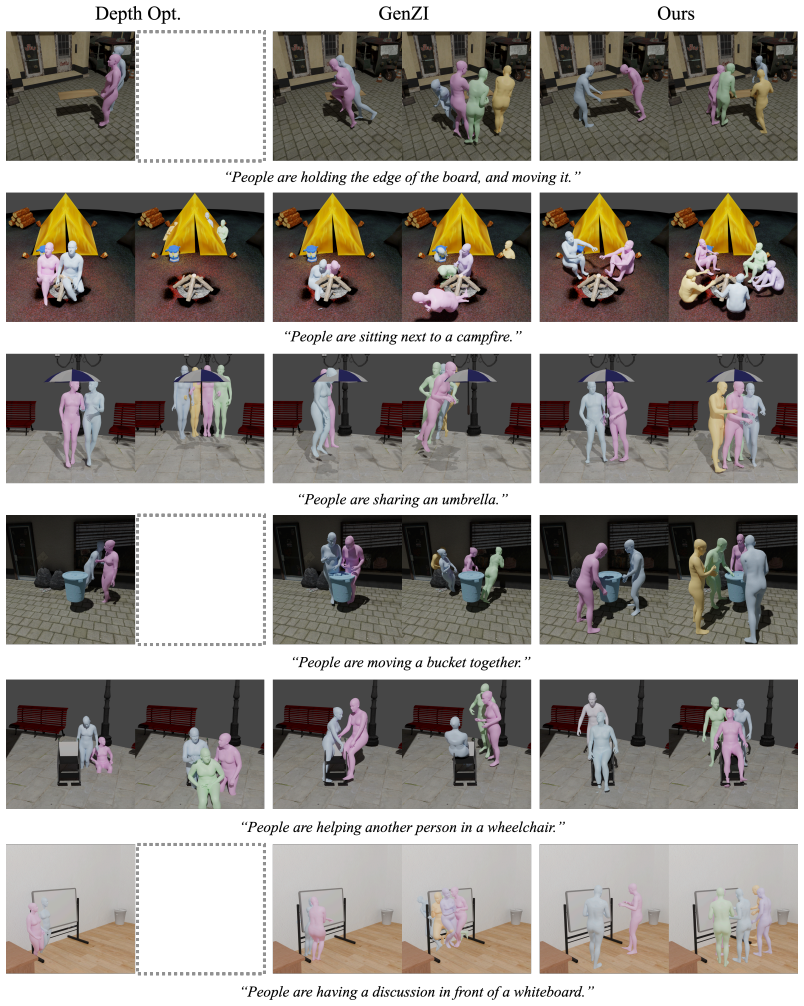
Summary. The paper introduces Human-Human-Object Interactions (HHOI) as a new generative modeling problem: given a textual description and an object, synthesize spatially and posturally plausible configurations of multiple humans interacting with that object. The authors contribute a new multi-view captured HHOI dataset, a synthetic data augmentation pipeline using image diffusion models, and a score-based framework that first trains separate HOI and HHI diffusion models and then combines them during ODE-based sampling through an inconsistency loss and a collision loss. They also extend the framework to multi-human settings and apply it to motion in-betweening. Quantitative and qualitative comparisons against two adapted baselines are reported on dyadic and multi-human generation.
Significance. If the central claims hold, this is a useful step toward text-driven multi-human object-interaction synthesis, a relatively underexplored area. The decomposition into HOI and HHI models with guided sampling is a practical and reasonably principled strategy, and the new dataset plus synthetic pipeline is a concrete contribution to the community. The paper also demonstrates a downstream application to object-aware multi-human motion generation. However, the evidence for the core claims is weakened by several load-bearing gaps: the implemented HOI model does not actually consume object geometry despite the formal definition in Eq. (1), the quantitative comparisons lack variance information and significance tests, and the main realism metric is computed with the authors' own pose encoder without independent validation. These issues do not invalidate the framework, but they need to be addressed before the claimed levels of realism and robustness can be accepted.
major comments (4)
- [Sec. 3.1 / Sec. 3.2, Eq. (1)] The formal model defines p^M_c as conditioned on the object mesh M (Eq. 1), but Sec. 3.2 states: "For simplicity, we do not use a mesh instance M as input when modeling HOI; rather, we assume a fixed M is provided for each scenario." The score network Ψ_HOI therefore receives only (ϕ_t, t, c), not geometry. This is an internal mismatch between the stated objective and the implementation. Since Table 3 measures contact distance and penetration against the same canonical meshes used during training, the near-zero contact distances do not demonstrate generalization to other object instances of a category. Please either condition on a mesh representation or explicitly restrict the claim to fixed canonical meshes, and evaluate on held-out object instances to test object-instance generalization.
- [Tables 1–3, Sec. 5.2] All quantitative results are reported as point estimates without error bars, number of seeds, or significance tests. Table 2 in particular reports 100.0% success for 3-, 4-, and 5-human generation with no variance; the 100% values are especially hard to assess given the small number of trials suggested by Fig. 3 ("failed in 10 trials"). To support the claim of "consistently outperforming" the baselines, please report mean and standard deviation over multiple seeds and, where appropriate, confidence intervals or paired tests.
- [Sec. 5.1, Metrics] The primary body-pose realism metric, Body Pose FD, is computed using the authors' own body pose encoder, which is also the representation used inside the generative model (Sec. 3.1). This creates a risk of favorable bias toward the proposed method because the metric is defined in a space learned jointly with the modeling objective. Please justify why this metric is not circular, or supplement it with an independent metric such as per-joint position error or an FD computed with a fixed, independently trained pose encoder. The same concern applies to the Distance FD, where details of the distribution and normalization are not given.
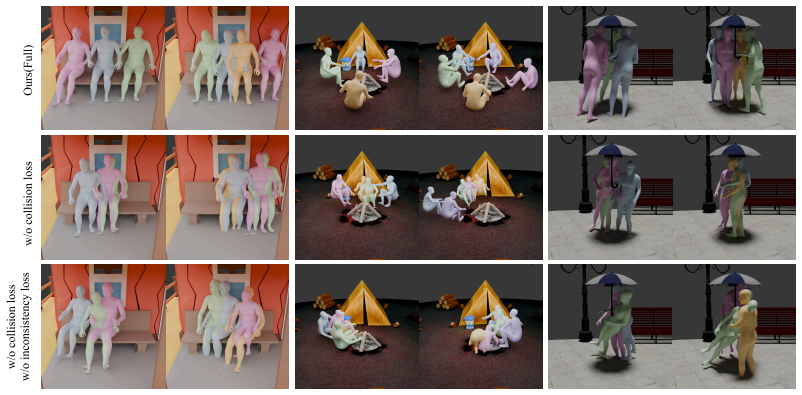
- [Sec. 3.3, Fig. 12] The two proposed sampling losses, L_inc and L_col, are central to the unified HHOI generation framework, but they are ablated only qualitatively in Fig. 12. Without quantitative ablation on the dyadic and multi-human metrics, it is unclear how much of the improvement over the baselines in Tables 1–3 comes from these losses rather than from the underlying diffusion models. Please provide a quantitative ablation isolating the contributions of the inconsistency loss and the collision loss.
minor comments (4)
- [Sec. 4 vs. Appendix A.3] Sec. 4 states that CORE4D provides object annotations for "six object categories," but Appendix A.3 lists five CORE4D categories (board, box, bucket, chair, desk). Please reconcile this discrepancy.
- [Sec. 3.3, Eqs. (12)–(13)] The definition of N'_i says "the number of HHIs where human H_i appears as a target (i.e., in pairs of the form H_i → H_j)", but in the notation H_i → H_j, H_i is the source. The formulas in Eqs. (12)–(13) also use mixed indices (R_{H_j_n}, H_j_n) that are not clearly defined. Please clarify the indexing and the source/target convention.
- [Sec. 5.1] There is a typo: "We acccount generation success" should be "We count generation success." Also, "Penetration ration" should be "Penetration ratio."
- [Abstract / Sec. 1] The abstract says "we train an text-to-HOI and text-to-HHI model" — "an" should be "a." Please proofread for similar grammatical errors.
Circularity Check
No significant circularity: the core HOI/HHI decomposition, guided-sampling losses, and evaluations are independently grounded in held-out data and external benchmarks.
full rationale
Walking the derivation chain, none of the load-bearing steps reduces to its own inputs. Eq. (1) defines the HOI distribution p^M_c, but Sec. 3.2 immediately states 'For simplicity, we do not use a mesh instance M as input when modeling HOI; rather, we assume a fixed M is provided for each scenario.' This is an implementation/generalization gap (the score network sees text, not mesh geometry), not a circular definition: the model is still trained by denoising score matching (Eq. 6) on held-out HOI/HHI samples, and the output is not used to define the training target. The guided HHOI samples (Eq. 15) combine two separately trained score networks with hand-designed inconsistency and collision losses (Eqs. 9, 14); these losses are not fitted parameters and are not hidden renamings of the evaluation metrics (mesh vertex penetration vs capsule overlap; contact distance is not optimized at all). Evaluation is against a held-out test split of CORE4D and the collected dataset (FD, CLIP, user study), so the central realism claim is not forced by construction. The paper does cite the authors' earlier works [1, 31] for text augmentation and PF-ODE augmentation, and [30] for synthetic HOI data, but these are methodological dependencies on external prior frameworks with independent validation; they are not invoked as a uniqueness theorem or as the sole support for the HHOI claim. The stated limitation (cannot directly learn HHOIs from HOI-only or HHI-only data) is a scope restriction, not a tautology. I find no equation where the predicted quantity equals a fitted input by definition.
Axiom & Free-Parameter Ledger
free parameters (5)
- guided sampling weight λ1(t) =
min(100000, 100/t^2)
- guided sampling weight λ2(t) =
min(1600000, 1600/t^2)
- guided loss start time =
t=0.5
- body pose latent dimension H =
10
- per-capsule radii (24 values) =
learned via Chamfer distance on 922K poses
axioms (8)
- domain assumption SMPL-X parametric body model adequately represents human pose and shape for HHOI.
- ad hoc to paper HHOI can be decomposed into independent HOI and HHI distributions that can be recombined via guided sampling.
- domain assumption Two humans engaging in an HHI share the same scale.
- ad hoc to paper Human pairs not explicitly connected by an HHI are assumed non-colliding (implicit HHI).
- domain assumption A 24-capsule approximation with learned radii is sufficient for physical plausibility.
- domain assumption CLIP text embeddings plus LLM-based prompt augmentation sufficiently specify the interaction geometry.
- domain assumption Pretrained image diffusion models (ComA, Flux) generate unbiased and sufficiently diverse HHOI priors.
- standard math Denoising score matching yields correct conditional scores for the modeled distributions.
read the original abstract
The way humans interact with each other, including interpersonal distances, spatial configuration, and motion, varies significantly across different situations. To enable machines to understand such complex, context-dependent behaviors, it is essential to model multiple people in relation to the surrounding scene context. In this paper, we present a novel research problem to model the correlations between two people engaged in a shared interaction involving an object. We refer to this formulation as Human-Human-Object Interactions (HHOIs). To overcome the lack of dedicated datasets for HHOIs, we present a newly captured HHOIs dataset and a method to synthesize HHOI data by leveraging image generative models. As an intermediary, we obtain individual human-object interaction (HOIs) and human-human interaction (HHIs) from the HHOIs, and with these data, we train an text-to-HOI and text-to-HHI model using score-based diffusion model. Finally, we present a unified generative framework that integrates the two individual model, capable of synthesizing complete HHOIs in a single advanced sampling process. Our method extends HHOI generation to multi-human settings, enabling interactions involving more than two individuals. Experimental results show that our method generates realistic HHOIs conditioned on textual descriptions, outperforming previous approaches that focus only on single-human HOIs. Furthermore, we introduce multi-human motion generation involving objects as an application of our framework.
Figures





Reference graph
Works this paper leans on
-
[1]
S. Baik, H. Kim, and H. Joo. Learning 3d object spatial relationships from pre-trained 2d diffusion models. ICCV, 2025. 3, 4, 5, 18
2025
-
[2]
Baradel*, M
F. Baradel*, M. Armando, S. Galaaoui, R. Brégier, P. Weinzaepfel, G. Rogez, and T. Lucas*. Multi-hmr: Multi-person whole-body human mesh recovery in a single shot.ECCV, 2024. 7, 18
2024
-
[3]
B. L. Bhatnagar, X. Xie, I. A. Petrov, C. Sminchisescu, C. Theobalt, and G. Pons-Moll. Behave: Dataset and method for tracking human object interactions.CVPR, 2022. 2
2022
-
[4]
M. J. Black, P. Patel, J. Tesch, and J. Yang. Bedlam: A synthetic dataset of bodies exhibiting detailed lifelike animated motion.CVPR, 2023. 2
2023
-
[5]
Bochkovskii, A
A. Bochkovskii, A. Delaunoy, H. Germain, M. Santos, Y . Zhou, S. R. Richter, and V . Koltun. Depth pro: Sharp monocular metric depth in less than a second.ICLR, 2025. 7, 18
2025
-
[6]
Z. Cao, H. Gao, K. Mangalam, Q.-Z. Cai, M. V o, and J. Malik. Long-term human motion prediction with scene context.ECCV, 2020. 2
2020
-
[7]
R. T. Q. Chen. torchdiffeq, 2018. URLhttps://github.com/rtqichen/torchdiffeq. 5
2018
-
[8]
H. Ci, M. Wu, W. Zhu, X. Ma, H. Dong, F. Zhong, and Y . Wang. Gfpose: Learning 3d human pose prior with gradient fields.CVPR, 2023. 3
2023
-
[9]
Connect cloud research
CloudResearch. Connect cloud research. URL https://connect.cloudresearch.com/researcher/. 18
-
[10]
Diller and A
C. Diller and A. Dai. Cg-hoi: Contact-guided 3d human-object interaction generation.CVPR, 2024. 1, 3
2024
-
[11]
K. Fan, J. Tang, W. Cao, R. Yi, M. Li, J. Gong, J. Zhang, Y . Wang, C. Wang, and L. Ma. Freemotion: A unified framework for number-free text-to-motion synthesis.ECCV, 2024. 1, 3
2024
-
[12]
Z. Fan, O. Taheri, D. Tzionas, M. Kocabas, M. Kaufmann, M. J. Black, and O. Hilliges. ARCTIC: A dataset for dexterous bimanual hand-object manipulation.CVPR, 2023. 2, 3
2023
-
[13]
H.-S. Fang, J. Li, H. Tang, C. Xu, H. Zhu, Y . Xiu, Y .-L. Li, and C. Lu. Alphapose: Whole-body regional multi-person pose estimation and tracking in real-time.TPAMI, 2022. 18
2022
-
[14]
Fieraru, M
M. Fieraru, M. Zanfir, E. Oneata, A.-I. Popa, V . Olaru, and C. Sminchisescu. Three-dimensional recon- struction of human interactions.CVPR, 2020. 2, 3
2020
-
[15]
Garrido-Jurado, R
S. Garrido-Jurado, R. Muñoz-Salinas, F. J. Madrid-Cuevas, and M. J. Marín-Jiménez. Automatic generation and detection of highly reliable fiducial markers under occlusion.Pattern Recognition, 2014. 15
2014
-
[16]
Ghosh, R
A. Ghosh, R. Dabral, V . Golyanik, C. Theobalt, and P. Slusallek. Remos: 3d motion-conditioned reaction synthesis for two-person interactions.ECCV, 2024. 2, 3
2024
-
[17]
W. Guo, X. Bie, X. Alameda-Pineda, and F. Moreno-Noguer. Multi-person extreme motion prediction. CVPR, 2022. 2
2022
-
[18]
Guzov, A
V . Guzov, A. Mir, T. Sattler, and G. Pons-Moll. Human poseitioning system (hps): 3d human pose estimation and self-localization in large scenes from body-mounted sensors.CVPR, 2021. 1, 2
2021
-
[19]
Guzov, J
V . Guzov, J. Chibane, R. Marin, Y . He, Y . Saracoglu, T. Sattler, and G. Pons-Moll. Interaction replica: Tracking human–object interaction and scene changes from human motion.3DV, 2024. 1, 2
2024
-
[20]
Han and H
S. Han and H. Joo. Learning canonicalized 3d human-object spatial relations from unbounded synthesized images.ICCV, 2023. 3
2023
-
[21]
C.-H. P. Huang, H. Yi, M. Höschle, M. Safroshkin, T. Alexiadis, S. Polikovsky, D. Scharstein, and M. J. Black. Capturing and inferring dense full-body human-scene contact.CVPR, 2022. 2, 4 11
2022
-
[22]
Huang, O
Y . Huang, O. Taheri, M. J. Black, and D. Tzionas. Intercap: Joint markerless 3d tracking of humans and objects in interaction.GCPR, 2022. 2
2022
-
[23]
Ionescu, D
C. Ionescu, D. Papava, V . Olaru, and C. Sminchisescu. Human3.6m: Large scale datasets and predictive methods for 3d human sensing in natural environments.TPAMI, 2008. 4
2008
-
[24]
Jiang, Z
N. Jiang, Z. He, Z. Wang, H. Li, Y . Chen, S. Huang, and Y . Zhu. Autonomous character-scene interaction synthesis from text instruction.SIGGRAPH Asia, 2024. 3
2024
-
[25]
Jiang, Z
N. Jiang, Z. Zhang, H. Li, X. Ma, Z. Wang, Y . Chen, T. Liu, Y . Zhu, and S. Huang. Scaling up dynamic human-scene interaction modeling.CVPR, 2024. 2
2024
-
[26]
H. Joo, H. Liu, L. Tan, L. Gui, B. Nabbe, I. Matthews, T. Kanade, S. Nobuhara, and Y . Sheikh. Panoptic studio: A massively multiview system for social motion capture.CVPR, 2015. 1, 3, 15
2015
-
[27]
H. Joo, T. Simon, M. Cikara, and Y . Sheikh. Towards social artificial intelligence: Nonverbal social signal prediction in a triadic interaction.CVPR, 2019. 3
2019
-
[28]
Karunratanakul, K
K. Karunratanakul, K. Preechakul, E. Aksan, T. Beeler, S. Suwajanakorn, and S. Tang. Optimizing diffusion noise can serve as universal motion priors.CVPR, 2024. 2, 9
2024
-
[29]
Kerbl, G
B. Kerbl, G. Kopanas, T. Leimkühler, and G. Drettakis. 3d gaussian splatting for real-time radiance field rendering.SIGGRAPH, 2023. 15
2023
-
[30]
H. Kim, S. Han, P. Kwon, and H. Joo. Beyond the contact: Discovering comprehensive affordance for 3d objects from pre-trained 2d diffusion models.ECCV, 2024. 1, 3, 7
2024
-
[31]
H. Kim, S. Baik, and H. Joo. David: Modeling dynamic affordance of 3d objects using pre-trained video diffusion models.ICCV, 2025. 3, 5
2025
-
[32]
J. Kim, J. Kim, J. Na, and H. Joo. Parahome: Parameterizing everyday home activities towards 3d generative modeling of human-object interactions.CVPR, 2025. 2, 3
2025
-
[33]
Kulkarni, D
N. Kulkarni, D. Rempe, K. Genova, A. Kundu, J. Johnson, D. Fouhey, and L. Guibas. Nifty: Neural object interaction fields for guided human motion synthesis.CVPR, 2024. 3
2024
-
[34]
J. N. Kundu, H. Buckchash, P. Mandikal, A. Jamkhandi, V . B. Radhakrishnan, et al. Cross-conditioned recurrent networks for long-term synthesis of inter-person human motion interactions.WACV, 2020. 2, 3
2020
-
[35]
B. F. Labs. Flux.https://github.com/black-forest-labs/flux, 2024. 7
2024
-
[36]
J. Li, A. Clegg, R. Mottaghi, J. Wu, X. Puig, and C. K. Liu. Controllable human-object interaction synthesis.ECCV, 2024. 1, 3
2024
-
[37]
Li and A
L. Li and A. Dai. GenZI: Zero-shot 3D human-scene interaction generation.CVPR, 2024. 3, 7, 18
2024
-
[38]
R. Li, Y . Zhang, Y . Zhang, Y . Zhang, M. Su, J. Guo, Z. Liu, Y . Liu, and X. Li. Interdance: Reactive 3d dance generation with realistic duet interactions.arXiv preprint arXiv:2412.16982, 2024. 3
Pith/arXiv arXiv 2024
-
[39]
Liang, W
H. Liang, W. Zhang, W. Li, J. Yu, and L. Xu. Intergen: Diffusion-based multi-human motion generation under complex interactions.IJCV, 2024. 1, 2, 3, 10
2024
-
[40]
D. Lim, C. Jeong, and Y . M. Kim. Mammos: Mapping multiple human motion with scene understanding and natural interactions.ICCVW, 2023. 1, 3
2023
-
[41]
Y . Liu, C. Zhang, R. Xing, B. Tang, B. Yang, and L. Yi. Core4d: A 4d human-object-human interaction dataset for collaborative object rearrangement.arXiv preprint arXiv:2406.19353, 2024. 2, 3, 6, 15
Pith/arXiv arXiv 2024
-
[42]
Müller, V
L. Müller, V . Ye, G. Pavlakos, M. Black, and A. Kanazawa. Generative proxemics: A prior for 3d social interaction from images.CVPR, 2024. 2, 3
2024
-
[43]
Chatgpt: Optimizing language models for dialogue, 2023
OpenAI. Chatgpt: Optimizing language models for dialogue, 2023. URL https://openai.com/blog/ chatgpt. 18
2023
-
[44]
Pavlakos, V
G. Pavlakos, V . Choutas, N. Ghorbani, T. Bolkart, A. A. A. Osman, D. Tzionas, and M. J. Black. Expressive body capture: 3D hands, face, and body from a single image.CVPR, 2019. 4, 15
2019
-
[45]
Radford, J
A. Radford, J. W. Kim, C. Hallacy, A. Ramesh, G. Goh, S. Agarwal, G. Sastry, A. Askell, P. Mishkin, J. Clark, et al. Learning transferable visual models from natural language supervision.ICML, 2021. 5, 7 12
2021
-
[46]
Rombach, A
R. Rombach, A. Blattmann, D. Lorenz, P. Esser, and B. Ommer. High-resolution image synthesis with latent diffusion models.CVPR, 2022. 2, 7
2022
-
[47]
Shafir, G
Y . Shafir, G. Tevet, R. Kapon, and A. H. Bermano. Human motion diffusion as a generative prior.ICLR,
-
[48]
M. Shan, L. Dong, Y . Han, Y . Yao, T. Liu, I. Nwogu, G.-J. Qi, and M. Hill. Towards open domain text-driven synthesis of multi-person motions.ECCV, 2024. 1, 3
2024
-
[49]
Siyao, T
L. Siyao, T. Gu, Z. Yang, Z. Lin, Z. Liu, H. Ding, L. Yang, and C. C. Loy. Duolando: Follower gpt with off-policy reinforcement learning for dance accompaniment.ICLR, 2024. 3
2024
-
[50]
W. Song, X. Zhang, S. Li, Y . Gao, A. Hao, X. Hou, C. Chen, N. Li, and H. Qin. Hoianimator: Generating text-prompt human-object animations using novel perceptive diffusion models.CVPR, 2024. 1, 3
2024
-
[51]
Song and S
Y . Song and S. Ermon. Generative modeling by estimating gradients of the data distribution.NeurIPS,
-
[52]
Song and S
Y . Song and S. Ermon. Improved techniques for training score-based generative models.NeurIPS, 2020. 3
2020
-
[53]
Y . Song, J. Sohl-Dickstein, D. P. Kingma, A. Kumar, S. Ermon, and B. Poole. Score-based generative modeling through stochastic differential equations.ICLR, 2021. 3, 5
2021
-
[54]
Suhail, A
M. Suhail, A. Mittal, B. Siddiquie, C. Broaddus, J. Eledath, G. Medioni, and L. Sigal. Energy-based learning for scene graph generation.CVPR, 2021. 3
2021
-
[55]
Tanaka and K
M. Tanaka and K. Fujiwara. Role-aware interaction generation from textual description.ICCV, 2023. 1, 3
2023
-
[56]
P. Vincent. A connection between score matching and denoising autoencoders.Neural computation, 23(7): 1661–1674, 2011. 4
2011
-
[57]
von Marcard, R
T. von Marcard, R. Henschel, M. Black, B. Rosenhahn, and G. Pons-Moll. Recovering accurate 3d human pose in the wild using imus and a moving camera.ECCV, 2018. 1, 2, 4
2018
-
[58]
M. Wu, F. Zhong, Y . Xia, and H. Dong. TarGF: Learning target gradient field for object rearrangement. NeurIPS, 2022. 3
2022
-
[59]
Xiang, Y
F. Xiang, Y . Qin, K. Mo, Y . Xia, H. Zhu, F. Liu, M. Liu, H. Jiang, Y . Yuan, H. Wang, et al. Sapien: A simulated part-based interactive environment.CVPR, 2020. 19
2020
-
[60]
L. Xu, Z. Song, D. Wang, J. Su, Z. Fang, C. Ding, W. Gan, Y . Yan, X. Jin, X. Yang, et al. Actformer: A gan-based transformer towards general action-conditioned 3d human motion generation.ICCV, 2023. 1, 3
2023
-
[61]
L. Xu, X. Lv, Y . Yan, X. Jin, S. Wu, C. Xu, Y . Liu, Y . Zhou, F. Rao, X. Sheng, et al. Inter-x: Towards versatile human-human interaction analysis.CVPR, 2024. 2, 3
2024
-
[62]
L. Xu, Y . Zhou, Y . Yan, X. Jin, W. Zhu, F. Rao, X. Yang, and W. Zeng. Regennet: Towards human action-reaction synthesis.CVPR, 2024. 1, 3
2024
-
[63]
S. Xu, Z. Li, Y .-X. Wang, and L.-Y . Gui. Interdiff: Generating 3d human-object interactions with physics-informed diffusion.ICCV, 2023. 1, 3
2023
-
[64]
S. Xu, Z. Wang, Y .-X. Wang, and L.-Y . Gui. Interdreamer: Zero-shot text to 3d dynamic human-object interaction.NeurIPS, 2024. 3
2024
-
[65]
Z. Yang, A. Zeng, C. Yuan, and Y . Li. Effective whole-body pose estimation with two-stages distillation. ICCV, 2023. 7, 15
2023
-
[66]
H. Yi, J. Thies, M. J. Black, X. B. Peng, and D. Rempe. Generating human interaction motions in scenes with text control.arXiv preprint arXiv:2404.10685, 2024. 3
Pith/arXiv arXiv 2024
-
[67]
Zhang, H
J. Zhang, H. Luo, H. Yang, X. Xu, Q. Wu, Y . Shi, J. Yu, L. Xu, and J. Wang. Neuraldome: A neural modeling pipeline on multi-view human-object interactions.CVPR, 2023. 1, 2
2023
-
[68]
Zhang, M
J. Zhang, M. Wu, and H. Dong. Generative category-level object pose estimation via diffusion models. NeurIPS, 2024. 3, 4, 16
2024
-
[69]
Zhang, J
J. Zhang, J. Zhang, Z. Song, Z. Shi, C. Zhao, Y . Shi, J. Yu, L. Xu, and J. Wang. Hoi-mˆ 3: Capture multiple humans and objects interaction within contextual environment.CVPR, 2024. 1, 2, 3 13
2024
-
[70]
X. Zhang, B. L. Bhatnagar, S. Starke, I. Petrov, V . Guzov, H. Dhamo, E. Pérez-Pellitero, and G. Pons- Moll. Force: Dataset and method for intuitive physics guided human-object interaction.arXiv preprint arXiv:2403.11237, 2024. 2
Pith/arXiv arXiv 2024
-
[71]
Y . Zhang, H. Yang, C. Luo, J. Peng, Y . Wang, and Z. Zhang. Ood-hoi: Text-driven 3d whole-body human-object interactions generation beyond training domains.arXiv preprint arXiv:2411.18660, 2024. 1, 3
Pith/arXiv arXiv 2024
-
[72]
K. Zhao, S. Wang, Y . Zhang, T. Beeler, and S. Tang. COINS: Compositional human-scene interaction synthesis with semantic control.ECCV, 2022. 1
2022
-
[73]
Zheng, R
Y . Zheng, R. Shao, Y . Zhang, T. Yu, Z. Zheng, Q. Dai, and Y . Liu. Deepmulticap: Performance capture of multiple characters using sparse multiview cameras.ICCV, 2021. 1, 3
2021
-
[74]
Zheng, Y
Y . Zheng, Y . Yang, K. Mo, J. Li, T. Yu, Y . Liu, C. K. Liu, and L. J. Guibas. Gimo: Gaze-informed human motion prediction in context.ECCV, 2022. 1, 2
2022
-
[75]
Zheng, T
Z. Zheng, T. Yu, Y . Liu, and Q. Dai. Pamir: Parametric model-conditioned implicit representation for image-based human reconstruction.TPAMI, 2021. 7, 15
2021
-
[76]
{prompt}
Y . Zhou, C. Barnes, J. Lu, J. Yang, and H. Li. On the continuity of rotation representations in neural networks.CVPR, 2019. 4 14 Appendix A Data Collection Details A.1 Multiview HHOIs Data Capture System To capture Human-Human-Object Interactions (HHOIs), we adopt a multi-camera setup inspired by Panoptic Studio [26]. As shown in Fig. 5, our system is co...
2019
-
[77]
person",
Each sentence must contain a word that clearly refers to a person. Feel free to use varied words such as "person", "someone", "man", "woman", "individual", or other natural alternatives
-
[80]
Keep the sentences simple and avoid unnecessary embellishments
Do not include any objects other than the main two (human, {object}). Keep the sentences simple and avoid unnecessary embellishments
-
[82]
{prompt}
Maintain diversity in the overall sentence pool. Avoid repeating similar expressions, but do not allow metaphors that are too distant. Step 2 After creating each sentence, carefully check whether it meets all the conditions in step 1. If any sentence does not satisfy the conditions, rewrite it. Step 3 Once all {N} sentences are created, output them with o...
-
[83]
person",
Each sentence must contain a word that clearly refers to two people. Feel free to use varied words such as "person", "someone", "man", "woman", "individual", or other natural alternatives
discussion (0)
Sign in with ORCID, Apple, or X to comment. Anyone can read and Pith papers without signing in.