REVIEW 3 major objections 4 minor 61 references
A Deep Inverse-Mapping Model for a Flapping Robotic Wing
T0 review · 3 major / 4 minor · reviewed 2026-08-07 · deepseek-v4-flash
Pith's one-line read A sequence-to-sequence model with an adaptive Fourier-spectrum layer learns to recover flapping-wing kinematics from force measurements, beating transformer-based baselines by about 11% in median error while running roughly ten times…
desk verdict A useful new dataset and a plausible new layer, but the headline performance claims are not statistically significant and the inverse mapping's well-posedness is never checked. read the letter →
The pith
A machine-rendered reading of the paper's core claim, the machinery that carries it, and where it could break.
The reading
What carries the argument
The load-bearing component is the Adaptive Spectrum Layer (ASL), a differentiable front-end that transforms each input force window with a real FFT, discards frequencies above a learned low-pass cutoff, encodes each remaining bin by its magnitude and phase (as cosine and sine), passes that representation through fully connected layers and a gating mechanism that weights frequency bins, multiplies the learned weights back onto the complex spectrum, and returns to the time domain with an inverse FFT plus a skip connection. This layer sits before a bidirectional GRU encoder and attention-equipped GRU decoder, giving the model simultaneous access to time-domain and frequency-domain structure. For periodic signals like a flapping wing, the ASL amplifies relevant harmonics and suppresses noise, and the paper's ablations single out the low-pass cutoff and gating as the most consequential design choices.
What would settle it
Replay the model's predicted wing-angle trajectories on the experimental wing and compare the measured aerodynamic force window with the force window that was commanded; if the achieved force differs by more than the training loss, the learned inverse mapping is not physically consistent, and if two different angle trajectories produce the same force window and the model outputs a blend of both, the mapping is multi-valued.
Extended reading notes
Core claim
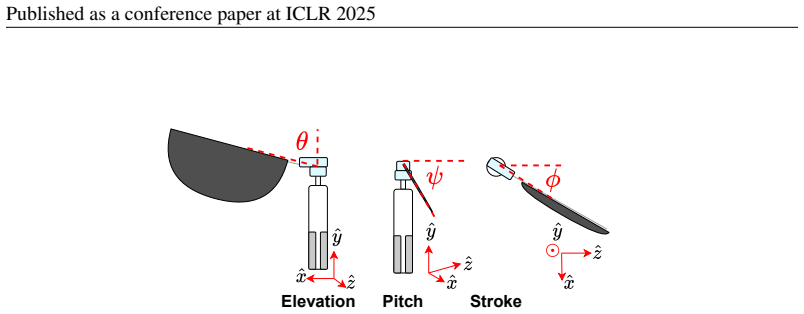
The central discovery is that the inverse aerodynamics of a flapping wing—recovering the time-varying stroke, elevation, and pitch angles from a window of measured aerodynamic forces and torques—can be approximated accurately by a relatively small recurrent model trained end-to-end on experimental data. On the authors' own 153-event air dataset and on the open-source 548-event mineral-oil dataset, the proposed Seq2Seq+ASL model predicts the three wing angles with the best or second-best mean absolute error among seven compared methods, including Transformer, Autoformer, FEDformer, and NLinear. The model also runs about ten times faster at inference than the transformer baseline, and the Fourier layer contributes consistent gains over plain Seq2Seq across both datasets. The authors interpret this as evidence that the inverse mapping is learnable from data and that transformer architectures are not automatically the best choice for this kind of time-series control problem.
Load-bearing premise
The approach rests on the assumption that a short window of future force measurements determines the wing angles uniquely enough that a single learned function can reproduce them; if several wing motions generate the same force trace, the model will output an average that may not be a physically realizable motion.
Editorial extensions
If this is right
- A model of this size and speed (about 2 ms per prediction, roughly ten times faster than the transformer baseline) fits inside the control loop of a flapping-wing micro air vehicle, whose wingbeat period is typically tens of milliseconds.
- The same trained model, without per-condition retuning, achieves comparable or better median error on both the air dataset and the separate mineral-oil dataset, covering Reynolds numbers from about 1,000 to 50,000.
- The Adaptive Spectrum Layer independently improves accuracy over plain Seq2Seq on both datasets and metrics (by roughly 11%, 2%, 7%, and 17%), indicating that explicit frequency-domain representation learning helps for periodic flapping signals.
- These results support the paper's reading that transformer architectures are not automatically superior for time-series inverse problems, since the lighter recurrent model matches or beats them on accuracy and far exceeds them on latency.
Reading between the lines
- If the force-to-kinematics map is not one-to-one, the fixed-window conditional distribution the network estimates may be multi-valued, and mean-absolute-error training would return a blend of equally valid motions; replaying predicted angles on the wing and comparing achieved forces to commanded forces would directly test physical realizability.
- The same Seq2Seq-plus-ASL recipe could transfer to other periodic inverse-control problems, such as recovering cardiac pacing signals from pressure traces or insulin infusion from glucose readings, whenever a synchronized input-outcome dataset exists.
- The bench-top single-wing demonstration leaves open whether the inverse map carries over to a full two-winged airframe with body dynamics; a natural next test is to train on whole-vehicle force and torque commands and evaluate closed-loop stability rather than per-event angle error.
Editorial analysis
A structured set of objections, weighed in public.
Referee Report
Summary. This manuscript addresses the inverse mapping from aerodynamic force measurements to wing kinematics for a flapping-wing system. The authors introduce a Seq2Seq model augmented by an Adaptive Spectrum Layer (ASL), which performs a learned weighted filtering in the Fourier domain. The model is trained and evaluated on two datasets: a new experimental dataset (153 events, 10 kHz kinematics and 5 kHz force recordings, at Reynolds numbers 1,000-50,000) and the open-source Bayiz & Cheng dataset (548 events). The reported results show lower mean and median MAE for Seq2Seq+ASL on the authors' dataset and lower median MAE on the open-source dataset, together with roughly 10x shorter inference time than a Transformer baseline. The authors argue that the model is suitable for real-time onboard control of flapping-wing robots.
Significance. If the results are robust, the paper provides a useful data-driven tool for inverse modeling of a complex aeroelastic system, plus a new open dataset and open-source implementation. The ASL idea is simple and plausible for periodic signals. However, the two load-bearing claims—(i) that the model is superior to transformer baselines and (ii) that it learns physically realizable inverse mappings—are not established by the current evidence. The reported Wilcoxon p-values do not support the superiority claim, and the absence of forward-consistency validation leaves the inverse-map well-posedness question open. The paper would be a solid contribution after these points are addressed.
major comments (3)
- [Section 5, Table 2] The claim that Seq2Seq+ASL is superior to Transformer-based models is not supported by the statistical evidence reported in the same section. The Wilcoxon signed-rank test gives p=0.06 for the authors' dataset (where Seq2Seq+ASL wins on 2/3 of the roughly 23 test events) and p=0.58 for the open-source dataset. Neither reaches the 0.05 threshold, and p=0.58 is strong evidence of no detectable difference on the larger dataset. In addition, on the open-source mean MAE the Transformer (0.1123 rad) is slightly better than Seq2Seq+ASL (0.1130 rad). The 10-15% improvements in Table 2 may therefore be within sampling variability. The authors should report per-event paired differences with confidence intervals or a bootstrap analysis, state the number of test events, and temper the abstract and conclusion wording accordingly.
- [Section 3.1, Eq. (2); Section 6] The paper does not test whether the learned inverse mapping is well-posed. The model minimizes MAE between predicted and measured angles; under L1 loss, if the conditional distribution p(phi_t, theta_t, psi_t | F_{t:t+tau}) has multiple modes, as is physically plausible because force is a low-dimensional projection of a history-dependent aerodynamic state, the optimal prediction is a conditional median that may not be a physically realizable trajectory and may not reproduce the commanded force when executed. The paper evaluates only angle MAE against recorded kinematics and never checks forward consistency, i.e., whether applying the predicted kinematics to the wing or to a forward model regenerates the input forces. A concrete remedy is to feed predicted kinematic trajectories into the open-source forward model (or the physical wing) and report the resulting force/torque error; additionally, a nearest-neighbor or clustering analysis of training force windows with divergent true kinematics would quantify the degree of non-uniqueness.
- [Section 4.1; Section 6] The control-oriented interpretation of the model is under-specified because the authors' experimental wing is driven only through the stroke angle phi, while theta and psi are passively determined by fluid-structure interaction. The model, however, outputs all three angles as the 'required input' kinematics, and the conclusion says the framework 'converts force and torque commands into wing actuation.' With a single-axis drive, the predicted theta(t) and psi(t) cannot be commanded directly. The authors should either explain how the predicted passive angles are realized in a single-axis actuation system, for example by solving for the motor stroke profile that produces them, or explicitly restrict the control claim to a device that can command all three degrees of freedom.
minor comments (4)
- [Abstract; Section 5] The headline '11% improvement on the test datasets median loss' is ambiguous. The open-source median MAE improves by about 11% relative to Transformer, but the 'ours' median comparison does not give the same number. Specify the dataset and baseline for the headline percentage.
- [Section 3.1, Eqs. (1)-(2)] The temporal indexing is inconsistent: Eq. (1) conditions on forces in [t0, t0+tau] to predict kinematics in [0,t0], while Eq. (2) conditions on forces in [t,t+tau] to predict kinematics at t. Please clarify the relationship between these two formulations and the meaning of a 'future' force window in real-time control.
- [Appendix A.5] The appendix notes that AutoFormer and FedFormer required an additional linear layer to adapt their input/output dimensions. Since the main comparison is against these models, this adaptation should be described in the main text and discussed as a potential source of disadvantage for those baselines.
- [Appendix A.3] Hyperparameters are reported for a single seed (3407) and a single data split. Reporting mean and standard deviation over multiple seeds and splits, or at least the distribution of per-event losses, would materially strengthen the comparison.
Circularity Check
No significant circularity: the inverse mapping is trained and tested on independent held-out experimental data, with no fitted parameter renamed as a prediction.
full rationale
The paper's derivation chain is self-contained against data. The inverse mapping in Eq. (2) is a learned regression from synchronized force and kinematics events, trained on 75% of the events and evaluated on a held-out 15% test set (Section 5); no parameter is fitted to the test metric and then reported as a prediction. The adaptive-spectrum layer's weights and gating are learned (Section 3.2, Appendix A.2), not hand-fitted constants derived from the target angles, and the comparison models are external baselines evaluated under the same split. The only self-citations (Beatus & Cohen 2015; Perl et al. 2023) are background statements about passive wing dynamics and flight stability, and no load-bearing claim of the inverse-mapping result rests on them. The closest potential circularity concern, that a finite force window may admit multiple wing kinematics and that MAE training could output a non-realizable conditional average, is a well-posedness and identifiability correctness risk, not a case where the predicted output equals the input by construction or where a fitted parameter is renamed as a prediction. No circular step can be exhibited under the hard rules, so the appropriate finding is no significant circularity.
Assumptions & free parameters
free parameters (3)
- ASL frequency cutoff (freq_threshold) =
210 Hz (our dataset), 200 Hz (open-source)
- Feature window size =
512 samples (our dataset), 256 samples (open-source)
- Network hidden sizes and embedding sizes =
e.g., enc_hidden_size 110/100, embedding_size 10/30
assumptions (4)
- domain assumption The inverse force-to-kinematics mapping is well-posed and can be approximated by a finite window function
- domain assumption Euler angle representation with three angles fully captures wing kinematics
- domain assumption Force sensor readings and camera tracking are accurately synchronized
- domain assumption Random split by events provides independent training and test windows
Cite this review
Pith. "Pith review of A Deep Inverse-Mapping Model for a Flapping Robotic Wing." pith.science (2026). https://pith.science/paper/N5DOLJEL
@misc{pith2026250209378,
  author       = {Pith},
  title        = {Pith review of: A Deep Inverse-Mapping Model for a Flapping Robotic Wing},
  year         = {2026},
  howpublished = {\url{https://pith.science/paper/N5DOLJEL}},
  note         = {Machine review of arXiv:2502.09378}
}
read the original abstract
In systems control, the dynamics of a system are governed by modulating its inputs to achieve a desired outcome. For example, to control the thrust of a quad-copter propeller the controller modulates its rotation rate, relying on a straightforward mapping between the input rotation rate and the resulting thrust. This mapping can be inverted to determine the rotation rate needed to generate a desired thrust. However, in complex systems, such as flapping-wing robots where intricate fluid motions are involved, mapping inputs (wing kinematics) to outcomes (aerodynamic forces) is nontrivial and inverting this mapping for real-time control is computationally impractical. Here, we report a machine-learning solution for the inverse mapping of a flapping-wing system based on data from an experimental system we have developed. Our model learns the input wing motion required to generate a desired aerodynamic force outcome. We used a sequence-to-sequence model tailored for time-series data and augmented it with a novel adaptive-spectrum layer that implements representation learning in the frequency domain. To train our model, we developed a flapping wing system that simultaneously measures the wing's aerodynamic force and its 3D motion using high-speed cameras. We demonstrate the performance of our system on an additional open-source dataset of a flapping wing in a different flow regime. Results show superior performance compared with more complex state-of-the-art transformer-based models, with 11% improvement on the test datasets median loss. Moreover, our model shows superior inference time, making it practical for onboard robotic control. Our open-source data and framework may improve modeling and real-time control of systems governed by complex dynamics, from biomimetic robots to biomedical devices.
Figures


Figures from the paper (4 more)


Reference graph
Works this paper leans on
-
[1]
Neural machine translation by jointly learning to align and translate
Dzmitry Bahdanau, Kyunghyun Cho, and Yoshua Bengio. Neural machine translation by jointly learning to align and translate. arXiv preprint arXiv:1409.0473, 2014
arXiv 2014
-
[2]
Flapping wing aerodynamics with prssm [dataset]
Yagiz Bayiz and Bo Cheng. Flapping wing aerodynamics with prssm [dataset]. https://datadryad.org/stash/dataset/doi:10.5061/dryad.zgmsbccbs, 2021 a . URL https://datadryad.org/stash/dataset/doi:10.5061/dryad.zgmsbccbs
-
[3]
Yagiz E Bayiz and Bo Cheng. State-space aerodynamic model reveals high force control authority and predictability in flapping flight. Journal of the Royal Society Interface, 18 0 (181): 0 20210222, 2021 b
work page 2021
-
[4]
Tsevi Beatus and Itai Cohen. Wing-pitch modulation in maneuvering fruit flies is explained by an interplay between aerodynamics and a torsional spring. Physical Review E, 92 0 (2): 0 022712, 2015
work page 2015
-
[5]
Energy-minimizing kinematics in hovering insect flight
Gordon J Berman and Z Jane Wang. Energy-minimizing kinematics in hovering insect flight. Journal of fluid mechanics, 582: 0 153--168, 2007
work page 2007
-
[6]
Smart wing rotation and trailing-edge vortices enable high frequency mosquito flight
Richard J Bomphrey, Toshiyuki Nakata, Nathan Phillips, and Simon M Walker. Smart wing rotation and trailing-edge vortices enable high frequency mosquito flight. Nature, 544 0 (7648): 0 92--95, 2017
work page 2017
-
[7]
Probabilistic demand forecasting at scale
Joos-Hendrik B \"o se, Valentin Flunkert, Jan Gasthaus, Tim Januschowski, Dustin Lange, David Salinas, Sebastian Schelter, Matthias Seeger, and Yuyang Wang. Probabilistic demand forecasting at scale. Proceedings of the VLDB Endowment, 10 0 (12): 0 1694--1705, 2017
work page 2017
-
[8]
Time series analysis: forecasting and control
George EP Box, Gwilym M Jenkins, Gregory C Reinsel, and Greta M Ljung. Time series analysis: forecasting and control. John Wiley & Sons, 2015
2015
Show all 61 references
-
[9]
Reduced-order unsteady aerodynamic models at low reynolds numbers
Steven L Brunton, Clarence W Rowley, and David R Williams. Reduced-order unsteady aerodynamic models at low reynolds numbers. Journal of Fluid Mechanics, 724: 0 203--233, 2013
2013
-
[10]
Brunton, Joshua L
Steven L. Brunton, Joshua L. Proctor, and J. Nathan Kutz. Discovering governing equations from data by sparse identification of nonlinear dynamical systems. Proceedings of the National Academy of Sciences, 113 0 (15): 0 3932--3937, 2016. doi:10.1073/pnas.1517384113. URL https:...
2016 doi
-
[11]
Spectral temporal graph neural network for multivariate time-series forecasting
Defu Cao, Yujing Wang, Juanyong Duan, Ce Zhang, Xia Zhu, Congrui Huang, Yunhai Tong, Bixiong Xu, Jing Bai, Jie Tong, et al. Spectral temporal graph neural network for multivariate time-series forecasting. Advances in neural information processing systems, 33: 0 17766--17778, 2020
2020
-
[12]
Design, development and flight-testing of a robotic hummingbird
David Coleman, Moble Benedict, Vikram Hrishikeshavan, and Inderjit Chopra. Design, development and flight-testing of a robotic hummingbird. In AHS 71st annual forum, pp.\ 5--7, 2015
2015
-
[13]
Learning forward models for robots
Anthony Dearden and Yiannis Demiris. Learning forward models for robots. In IJCAI, volume 5, pp.\ 1440, 2005
2005
-
[14]
The aerodynamics and control of free flight manoeuvres in Drosophila
Michael H Dickinson and Florian T Muijres. The aerodynamics and control of free flight manoeuvres in Drosophila . Phil. Trans. R. Soc. B, 371 0 (1704): 0 20150388, 2016
2016
-
[15]
Dickinson, Fritz-Olaf Lehmann, and Sanjay P
Michael H. Dickinson, Fritz-Olaf Lehmann, and Sanjay P. Sane. Wing rotation and the aerodynamic basis of insect flight. Science, 284 0 (5422): 0 1954--1960, 1999. doi:10.1126/science.284.5422.1954. URL https://www.science.org/doi/abs/10.1126/science.284.5422.1954
1954
-
[16]
Turbulence modeling in the age of data
Karthik Duraisamy, Gianluca Iaccarino, and Heng Xiao. Turbulence modeling in the age of data. Annual Review of Fluid Mechanics, 51 0 (1): 0 357--377, 2019. doi:10.1146/annurev-fluid-010518-040547. URL https://doi.org/10.1146/annurev-fluid-010518-040547
2019 doi
-
[17]
Leading-edge vortices in insect flight
CP Ellington, C vandenBerg, AP Willmott, and ALR Thomas. Leading-edge vortices in insect flight. Nature, 384 0 (6610): 0 626--630, December 1996. ISSN 0028-0836. doi:10.1038/384626a0
1996 doi
-
[18]
Perturbation analysis of 6DoF flight dynamics and passive dynamic stability of hovering fruit fly Drosophila melanogaster
Na Gao, Hikaru Aono, and Hao Liu. Perturbation analysis of 6DoF flight dynamics and passive dynamic stability of hovering fruit fly Drosophila melanogaster. Journal of Theoretical Biology, 270 0 (1): 0 98--111, 2011
2011
-
[19]
Horn and Brian G
Berthold K.P. Horn and Brian G. Schunck. Determining optical flow. Artificial Intelligence, 17 0 (1): 0 185--203, 1981. ISSN 0004-3702. doi:https://doi.org/10.1016/0004-3702(81)90024-2. URL https://www.sciencedirect.com/science/article/pii/0004370281900242
1981
-
[20]
Speed control and force-vectoring of bluebottle flies in a magnetically levitated flight mill
Shih-Jung Hsu, Neel Thakur, and Bo Cheng. Speed control and force-vectoring of bluebottle flies in a magnetically levitated flight mill. Journal of Experimental Biology, 222 0 (4): 0 jeb187211, 2019
2019
-
[21]
Helbling, Michael Karpelson, and Robert Wood
Noah Jafferis, E. Helbling, Michael Karpelson, and Robert Wood. Untethered flight of an insect-sized flapping-wing microscale aerial vehicle. Nature, 570: 0 491--495, 06 2019. doi:10.1038/s41586-019-1322-0
2019 doi
-
[22]
Muijres, Christophe De Wagter, Bart D
Matěj Karásek, Florian T. Muijres, Christophe De Wagter, Bart D. W. Remes, and Guido C. H. E. de Croon. A tailless aerial robotic flapper reveals that flies use torque coupling in rapid banked turns. Science, 361 0 (6407): 0 1089--1094, September 2018. ISSN 0036-8075, 1095-920...
2018 doi
-
[23]
Development of the Nano Hummingbird : A Tailless flapping wing micro air vehicle
Matthew Keennon, Karl Klingebiel, Henry Won, and Alexander Andriukov. Development of the Nano Hummingbird : A Tailless flapping wing micro air vehicle. In 50th AIAA Aerospace Sciences Meeting including the New Horizons Forum and Aerospace Exposition , pp.\ 1--24, 2012
2012
-
[24]
Fourier neural operator for parametric partial differential equations
Zongyi Li, Nikola Kovachki, Kamyar Azizzadenesheli, Burigede Liu, Kaushik Bhattacharya, Andrew Stuart, and Anima Anandkumar. Fourier neural operator for parametric partial differential equations. arXiv preprint arXiv:2010.08895, 2020
2010 arXiv
-
[25]
Time-series forecasting with deep learning: a survey
Bryan Lim and Stefan Zohren. Time-series forecasting with deep learning: a survey. Philosophical Transactions of the Royal Society A: Mathematical, Physical and Engineering Sciences, 379 0 (2194): 0 20200209, February 2021. ISSN 1471-2962. doi:10.1098/rsta.2020.0209. URL http:...
2021
-
[26]
Reynolds averaged turbulence modelling using deep neural networks with embedded invariance
Julia Ling, Andrew Kurzawski, and Jeremy Templeton. Reynolds averaged turbulence modelling using deep neural networks with embedded invariance. Journal of Fluid Mechanics, 807: 0 155–166, 2016. doi:10.1017/jfm.2016.615
2016 doi
-
[27]
Ma, Pakpong Chirarattananon, Sawyer B
Kevin Y. Ma, Pakpong Chirarattananon, Sawyer B. Fuller, and Robert J. Wood. Controlled Flight of a Biologically Inspired , Insect - Scale Robot . Science, 340 0 (6132): 0 603--607, 2013. doi:10.1126/science.1231806
2013 doi
-
[28]
Machine learning reveals the control mechanics of an insect wing hinge
Johan M Melis, Igor Siwanowicz, and Michael H Dickinson. Machine learning reveals the control mechanics of an insect wing hinge. Nature, pp.\ 1--9, 2024
2024
-
[29]
Flexible clap and fling in tiny insect flight
Laura A Miller and Charles S Peskin. Flexible clap and fling in tiny insect flight. Journal of Experimental Biology, 212 0 (19): 0 3076--3090, 2009
2009
-
[30]
Trend analysis of climate time series: A review of methods
Manfred Mudelsee. Trend analysis of climate time series: A review of methods. Earth-science reviews, 190: 0 310--322, 2019
2019
-
[31]
Flies evade looming targets by executing rapid visually directed banked turns
Florian T Muijres, Michael J Elzinga, Johan M Melis, and Michael H Dickinson. Flies evade looming targets by executing rapid visually directed banked turns. Science, 344 0 (6180): 0 172--177, 2014. doi:10.1126/science.1248955
2014 doi
-
[32]
A fluid–structure interaction model of insect flight with flexible wings
Toshiyuki Nakata and Hao Liu. A fluid–structure interaction model of insect flight with flexible wings. Journal of Computational Physics, 231 0 (4): 0 1822--1847, 2012. ISSN 0021-9991. doi:https://doi.org/10.1016/j.jcp.2011.11.005. URL https://www.sciencedirect.com/science/art...
2012 doi
-
[33]
Bomphrey
Toshiyuki Nakata, Hao Liu, and Richard J. Bomphrey. A cfd-informed quasi-steady model of flapping-wing aerodynamics. Journal of Fluid Mechanics, 783: 0 323–343, 2015. doi:10.1017/jfm.2015.537
2015 doi
-
[34]
Development and flight performance of a biologically-inspired tailless flapping-wing micro air vehicle with wing stroke plane modulation
Quoc-Viet Nguyen and Woei Leong Chan. Development and flight performance of a biologically-inspired tailless flapping-wing micro air vehicle with wing stroke plane modulation. Bioinspiration & Biomimetics, 14 0 (1): 0 016015, dec 2018. doi:10.1088/1748-3190/aaefa0. URL https:/...
2018 doi
-
[35]
Model learning for robot control: a survey
Duy Nguyen-Tuong and Jan Peters. Model learning for robot control: a survey. Cognitive processing, 12: 0 319--340, 2011
2011
-
[36]
Neural-fly enables rapid learning for agile flight in strong winds
Michael O’Connell, Guanya Shi, Xichen Shi, Kamyar Azizzadenesheli, Anima Anandkumar, Yisong Yue, and Soon-Jo Chung. Neural-fly enables rapid learning for agile flight in strong winds. Science Robotics, 7 0 (66): 0 eabm6597, 2022
2022
-
[37]
Lateral instability in fruit flies is determined by wing–wing interaction and wing elevation kinematics
Illy Perl, Roni Maya, Oron Sabag, and Tsevi Beatus. Lateral instability in fruit flies is determined by wing–wing interaction and wing elevation kinematics . Physics of Fluids, 35 0 (4): 0 041904, 04 2023. ISSN 1070-6631. doi:10.1063/5.0138255. URL https://doi.org/10.1063/5.0138255
2023 doi
-
[38]
Sampled softmax with random fourier features
Ankit Singh Rawat, Jiecao Chen, Felix Xinnan X Yu, Ananda Theertha Suresh, and Sanjiv Kumar. Sampled softmax with random fourier features. Advances in Neural Information Processing Systems, 32, 2019
2019
-
[39]
The aerodynamics of insect flight
Sanjay P Sane. The aerodynamics of insect flight. Journal of experimental biology, 206 0 (23): 0 4191--4208, 2003
2003
-
[40]
The aerodynamic effects of wing rotation and a revised quasi-steady model of flapping flight
Sanjay P Sane and Michael H Dickinson. The aerodynamic effects of wing rotation and a revised quasi-steady model of flapping flight. Journal of experimental biology, 205 0 (8): 0 1087--1096, 2002
2002
-
[41]
Bidirectional recurrent neural networks
Mike Schuster and Kuldip K Paliwal. Bidirectional recurrent neural networks. IEEE transactions on Signal Processing, 45 0 (11): 0 2673--2681, 1997
1997
-
[42]
Recent progress in flapping wing aerodynamics and aeroelasticity
Wei Shyy, Hikaru Aono, Satish Kumar Chimakurthi, Pat Trizila, C-K Kang, Carlos ES Cesnik, and Hao Liu. Recent progress in flapping wing aerodynamics and aeroelasticity. Progress in Aerospace Sciences, 46 0 (7): 0 284--327, 2010
2010
-
[43]
Simantirakis, Eva G
Emmanuel N. Simantirakis, Eva G. Arkolaki, and Panos E. Vardas. Novel pacing algorithms: do they represent a beneficial proposition for patients, physicians, and the health care system? EP Europace, 11 0 (10): 0 1272--1280, 08 2009. ISSN 1099-5129. doi:10.1093/europace/eup204....
2009 doi
-
[44]
Stoffer and Hernando Ombao
David S. Stoffer and Hernando Ombao. Editorial: Special issue on time series analysis in the biological sciences. Journal of Time Series Analysis, 33 0 (5): 0 701--703, September 2012. ISSN 0143-9782. doi:10.1111/j.1467-9892.2012.00805.x
2012
-
[45]
Insect flight dynamics: stability and control
Mao Sun. Insect flight dynamics: stability and control. Reviews of Modern Physics, 86 0 (2): 0 615, 2014
2014
-
[46]
Synthesis and stabilization of complex behaviors through online trajectory optimization
Yuval Tassa, Tom Erez, and Emanuel Todorov. Synthesis and stabilization of complex behaviors through online trajectory optimization. In 2012 IEEE/RSJ International Conference on Intelligent Robots and Systems, pp.\ 4906--4913, 2012. doi:10.1109/IROS.2012.6386025
2012
-
[47]
Algorithms for automated insulin delivery: An overview
A Thomas and L Heinemann. Algorithms for automated insulin delivery: An overview. J Diabetes Sci Technol, 16 0 (5): 0 1228--1238, Sep 2022. doi:10.1177/19322968211008442. URL https://doi.org/10.1177/19322968211008442
2022 doi
-
[48]
Untethered flight of an at-scale dual-motor hummingbird robot with bio-inspired decoupled wings
Zhan Tu, Fan Fei, and Xinyan Deng. Untethered flight of an at-scale dual-motor hummingbird robot with bio-inspired decoupled wings. IEEE Robotics and Automation Letters, 5 0 (3): 0 4194--4201, 2020. doi:10.1109/LRA.2020.2974717
2020
-
[49]
Gomez, Lukasz Kaiser, and Illia Polosukhin
Ashish Vaswani, Noam Shazeer, Niki Parmar, Jakob Uszkoreit, Llion Jones, Aidan N. Gomez, Lukasz Kaiser, and Illia Polosukhin. Attention is all you need, 2023
2023
-
[50]
Quick Estimates of Flight Fitness in Hovering Animals, Including Novel Mechanisms for Lift Production
Torkel Weis-Fogh. Quick Estimates of Flight Fitness in Hovering Animals, Including Novel Mechanisms for Lift Production . Journal of Experimental Biology, 59 0 (1): 0 169--230, 08 1973. ISSN 0022-0949. doi:10.1242/jeb.59.1.169. URL https://doi.org/10.1242/jeb.59.1.169
1973 doi
-
[51]
J. P. Whitney and R. J. Wood. Aeromechanics of passive rotation in flapping flight. Journal of Fluid Mechanics, 660: 0 197–220, 2010. doi:10.1017/S002211201000265X
2010 doi
-
[52]
Autoformer: Decomposition transformers with auto-correlation for long-term series forecasting
Haixu Wu, Jiehui Xu, Jianmin Wang, and Mingsheng Long. Autoformer: Decomposition transformers with auto-correlation for long-term series forecasting. Advances in neural information processing systems, 34: 0 22419--22430, 2021
2021
-
[53]
Adaptive temporal-frequency network for time-series forecasting
Zhangjing Yang, Weiwu Yan, Xiaolin Huang, and Lin Mei. Adaptive temporal-frequency network for time-series forecasting. IEEE Transactions on Knowledge and Data Engineering, 34 0 (4): 0 1576--1587, 2022. doi:10.1109/TKDE.2020.3003420
2022
-
[54]
Details of insect wing design and deformation enhance aerodynamic function and flight efficiency
John Young, Simon M Walker, Richard J Bomphrey, Graham K Taylor, and Adrian LR Thomas. Details of insect wing design and deformation enhance aerodynamic function and flight efficiency. Science, 325 0 (5947): 0 1549--1552, 2009
2009
-
[55]
Climsim: A large multi-scale dataset for hybrid physics-ml climate emulation, 2024
Sungduk Yu et al. Climsim: A large multi-scale dataset for hybrid physics-ml climate emulation, 2024
2024
-
[56]
Are transformers effective for time series forecasting? Proceedings of the AAAI conference on artificial intelligence, 37 0 (9): 0 11121--11128, 2023
Ailing Zeng, Muxi Chen, Lei Zhang, and Qiang Xu. Are transformers effective for time series forecasting? Proceedings of the AAAI conference on artificial intelligence, 37 0 (9): 0 11121--11128, 2023
2023
-
[57]
Fedformer: Frequency enhanced decomposed transformer for long-term series forecasting
Tian Zhou, Ziqing Ma, Qingsong Wen, Xue Wang, Liang Sun, and Rong Jin. Fedformer: Frequency enhanced decomposed transformer for long-term series forecasting. In International conference on machine learning, pp.\ 27268--27286. PMLR, 2022
2022
-
[58]
write newline
" write newline "" before.all 'output.state := FUNCTION n.dashify 't := "" t empty not t #1 #1 substring "-" = t #1 #2 substring "--" = not "--" * t #2 global.max substring 't := t #1 #1 substring "-" = "-" * t #2 global.max substring 't := while if t #1 #1 substring * t #2 gl...
-
[59]
@esa (Ref
\@ifxundefined[1] #1\@undefined \@firstoftwo \@secondoftwo \@ifnum[1] #1 \@firstoftwo \@secondoftwo \@ifx[1] #1 \@firstoftwo \@secondoftwo [2] @ #1 \@temptokena #2 #1 @ \@temptokena \@ifclassloaded agu2001 natbib The agu2001 class already includes natbib coding, so you should ...
-
[60]
\@lbibitem[] @bibitem@first@sw\@secondoftwo \@lbibitem[#1]#2 \@extra@b@citeb \@ifundefined br@#2\@extra@b@citeb \@namedef br@#2 \@nameuse br@#2\@extra@b@citeb \@ifundefined b@#2\@extra@b@citeb @num @parse #2 @tmp #1 NAT@b@open@#2 NAT@b@shut@#2 \@ifnum @merge>\@ne @bibitem@firs...
-
[61]
@open @close @open @close and [1] URL: #1 \@ifundefined chapter * \@mkboth \@ifxundefined @sectionbib * \@mkboth * \@mkboth\@gobbletwo \@ifclassloaded amsart * \@ifclassloaded amsbook * \@ifxundefined @heading @heading NAT@ctr thebibliography [1] @ \@biblabel @NAT@ctr \@bibset...
Reviewed August 7, 2026 · model on record in the stance chip above.
Discussion (0). Continue with ORCID to comment.