Optimal quantum locally differentially private mechanisms in the high-privacy regime
Pith reviewed 2026-06-29 17:33 UTC · model grok-4.3
The pith
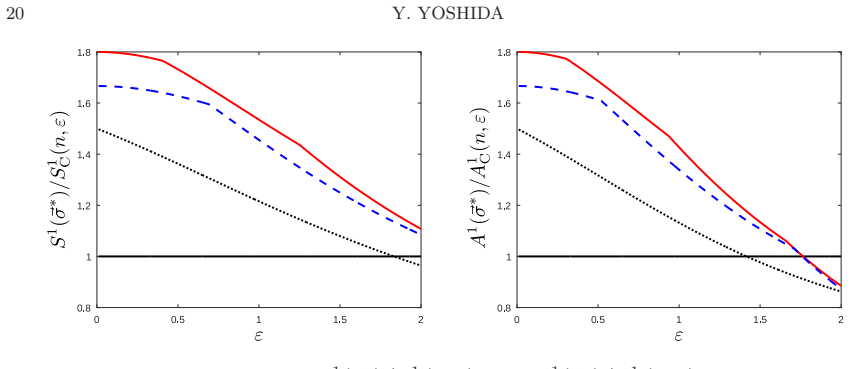
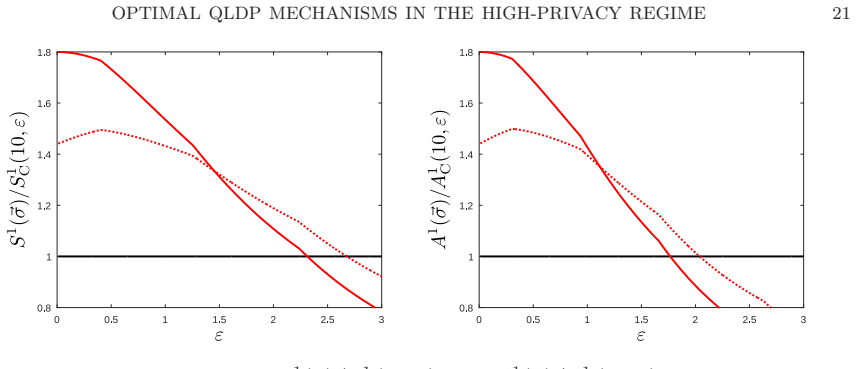
Optimal LDP and QLDP mechanisms achieve classical and quantum values with the same asymptotic ratio Q/C independent of utility in the high-privacy regime.
A machine-rendered reading of the paper's core claim, the machinery that carries it, and where it could break.
Core claim
In the high-privacy regime the optimal QLDP mechanisms attain the quantum value Q and the optimal LDP mechanisms attain the classical value C; the ratio Q/C is independent of the choice among the listed utility functions and satisfies Q/C >= 3/2 whenever the protected data are drawn from an alphabet of size n >= 3.
What carries the argument
The high-privacy regime obtained by sending the privacy parameter epsilon to zero while holding the utility (Holevo information or error exponent) fixed.
If this is right
- Explicit optimal LDP and QLDP mechanisms exist that saturate the classical and quantum bounds.
- The same limiting ratio Q/C governs every utility function examined.
- Quantum advantage appears automatically for any n-ary private data with n at least 3.
- The advantage is expressed solely through the ratio and does not depend on further details of the utility.
Where Pith is reading between the lines
- The independence of the ratio from utility choice may allow designers to pick whichever utility is easiest to compute without changing the predicted quantum gain.
- The same limiting construction could be tested on small quantum devices that implement the optimal QLDP map for ternary inputs.
- If the ratio remains constant for still other utilities, the result would strengthen the case that quantum local privacy offers a universal multiplicative improvement in the high-privacy limit.
Load-bearing premise
The privacy parameter must be driven to zero while the chosen utility measure is held constant.
What would settle it
An explicit calculation showing that the limiting ratio Q/C differs for two different utility functions, or that no mechanism reaches the stated classical or quantum optimum.
Figures
read the original abstract
We optimize the trade-off between privacy and utility in the high-privacy regime. We adopt local differential privacy (LDP) and its quantum extension, quantum local differential privacy (QLDP), for privacy protection, and investigate utility functions including the Holevo information (which reduces to the mutual information in the classical case) and the error exponents in symmetric and asymmetric hypothesis testing. These utility functions have classical and quantum optimal values, which are denoted by $C$ and $Q$, respectively, in this abstract for simplicity. In this paper, we provide optimal LDP and QLDP mechanisms achieving the classical and quantum optimal values in the high-privacy regime, and prove that the asymptotic ratio $Q/C$ in this regime takes the same value regardless of the utility function. Our results reveal quantum advantages (more precisely, $Q/C\ge3/2$) for the above utility functions when the protected private data are $n$-ary with $n\ge3$.
Editorial analysis
A structured set of objections, weighed in public.
Referee Report
Summary. The paper optimizes the privacy-utility trade-off under local differential privacy (LDP) and its quantum extension (QLDP) in the high-privacy regime (ε → 0 with utility fixed). It constructs explicit optimal mechanisms achieving the classical optimum C and quantum optimum Q for utilities including Holevo information (reducing to mutual information classically) and symmetric/asymmetric hypothesis-testing error exponents. The central results are that the asymptotic ratio Q/C is independent of the utility function and that Q/C ≥ 3/2 for n-ary inputs with n ≥ 3, establishing quantum advantages.
Significance. If the derivations hold, the utility-independence of the limiting Q/C ratio is a strong structural result that unifies several privacy-utility settings. The explicit optimal mechanisms and the concrete lower bound of 3/2 for n ≥ 3 provide both constructive and information-theoretic value for quantum private data processing. The work strengthens the case for quantum advantages in local privacy beyond specific utilities.
minor comments (2)
- [Introduction / Section 2] The high-privacy regime is defined via ε → 0 while holding utility fixed; a brief remark on the order of limits (e.g., whether n is fixed or grows) would clarify applicability to finite-alphabet settings.
- [Abstract] Notation for the classical and quantum optimal values (C and Q) is introduced in the abstract but the precise definitions appear only after the utility functions are stated; moving the definitions forward would improve readability.
Simulated Author's Rebuttal
We thank the referee for their positive summary of the manuscript and for recommending minor revision. No major comments were listed in the report, so there are no specific points requiring point-by-point response or manuscript changes at this stage.
Circularity Check
No significant circularity in derivation chain
full rationale
The paper constructs optimal LDP/QLDP mechanisms for the ε→0 high-privacy limit while holding utility (Holevo information or hypothesis-testing error exponents) fixed, then proves the resulting asymptotic Q/C ratio is utility-independent and ≥3/2 for n-ary inputs with n≥3. These steps rest on the standard definitions of LDP, QLDP, and the listed utility functions; the limiting procedure and explicit mechanism constructions do not reduce the claimed ratio to a fitted parameter, self-citation, or input-by-construction. No load-bearing step matches any of the enumerated circularity patterns.
Axiom & Free-Parameter Ledger
axioms (3)
- standard math Standard definition of epsilon-local differential privacy for classical mechanisms
- standard math Standard definition of quantum local differential privacy for quantum channels
- domain assumption Holevo information and hypothesis-testing error exponents are the utility functions under optimization
Reference graph
Works this paper leans on
-
[1]
K. M. R. Audenaert, J. Calsamiglia, R. Mu˜ noz Tapia, E. Bagan, Ll. Masanes, A. Acin, and F. Ver- straete. Discriminating states: the quantum Chernoff bound. Phys. Rev. Lett. , 98(16):160501, 2007
2007
-
[2]
R. Bhatia. Matrix Analysis . Springer, 2013
2013
-
[3]
B¨ ottcher and I
A. B¨ ottcher and I. M. Spitkovsky. A gentle guide to the basics o f two projections theory. Linear Algebra Appl., 432(6):1412–1459, 2010
2010
-
[4]
Calsamiglia, R
J. Calsamiglia, R. Mu˜ noz Tapia, Ll. Masanes, A. Acin, and E. Bagan . Quantum Chernoff bound as a measure of distinguishability between density matrices: Applicat ion to qubit and gaussian states. Phys. Rev. A , 77(3):032311, 2008
2008
-
[5]
J. C. Duchi, M. I. Jordan, and M. J. Wainwright. Local privacy an d statistical minimax rates. In 2013 IEEE 54th Annual Symposium on Foundations of Computer S cience—FOCS 2013 , pages 429–438. IEEE Computer Soc., Los Alamitos, CA, 2013
2013
-
[6]
C. Dwork. Differential privacy. In Automata, languages and programming. Part II , volume 4052 of Lecture Notes in Comput. Sci. , pages 1–12. Springer, Berlin, 2006
2006
-
[7]
Dwork, F
C. Dwork, F. McSherry, K. Nissim, and A. Smith. Calibrating noise t o sensitivity in private data analysis. In Theory of cryptography, volume 3876 of Lecture Notes in Comput. Sci. , pages 265–284. Springer, Berlin, 2006
2006
-
[8]
Fickus, E
M. Fickus, E. Gomez-Leos, and J. W. Iverson. Radon–Hurwitz G rassmannian codes. IEEE Trans. Inform. Theory, 71(4):3203–3213, 2025
2025
-
[9]
Fickus, J
M. Fickus, J. W. Iverson, J. Jasper, and D. G. Mixon. Harmonic G rassmannian codes. Appl. Comput. Harmon. Anal. , 65:1–39, 2023
2023
- [10]
-
[11]
Fickus, J
M. Fickus, J. Jasper, D. G. Mixon, and C. E. Watson. A brief intr oduction to equi-chordal and equi-isoclinic tight fusion frames. In Wavelets and Sparsity XVII , volume 10394, pages 186–194. SPIE, 2017
2017
-
[12]
Tables of the existence of equiangular tight frames
M. Fickus and D. G. Mixon. Tables of the existence of equiangular tight frames. Preprint, available at https://arxiv.org/abs/1504.00253v2, 2016
work page internal anchor Pith review Pith/arXiv arXiv 2016
-
[13]
Q. Geng, P. Kairouz, S. Oh, and P. Viswanath. The staircase me chanism in differential privacy. IEEE J. Sel. Topics Signal Process. , 9(7):1176–1184, 2015
2015
-
[14]
Geng and P
Q. Geng and P. Viswanath. The optimal noise-adding mechanism in differential privacy. IEEE Trans. Inform. Theory , 62(2):925–951, 2016
2016
-
[15]
Geng and P
Q. Geng and P. Viswanath. Optimal noise adding mechanisms for a pproximate differential privacy. IEEE Trans. Inform. Theory , 62(2):952–969, 2016
2016
-
[16]
M. R. Grace and S. Guha. Perturbation theory for quantum inf ormation. In 2022 IEEE Informa- tion Theory Workshop (ITW) , pages 500–505, 2022
2022
-
[17]
J. Guan. Optimal mechanisms for quantum local differential priv acy. In Proceedings of the 2025 ACM SIGSAC Conference on Computer and Communications Secur ity, pages 3737–3749. Asso- ciation for Computing Machinery, New York, 2025
2025
-
[18]
M. Hayashi. Quantum Information Theory: Mathematical Foundation, Sec ond Edition . Springer, Berlin, Heidelberg, 2017. OPTIMAL QLDP MECHANISMS IN THE HIGH-PRIV ACY REGIME 45
2017
-
[19]
Hiai and D
F. Hiai and D. Petz. Introduction to Matrix Analysis and Applications . Springer, 2014
2014
-
[20]
Holohan, D
N. Holohan, D. J. Leith, and O. Mason. Optimal differentially priva te mechanisms for randomised response. IEEE Trans. Inf. Forensics Secur. , 12(11):2726–2735, 2017
2017
-
[21]
Kairouz, S
P. Kairouz, S. Oh, and P. Viswanath. Extremal mechanisms for local differential privacy. J. Mach. Learn. Res., 17:Paper No. 17, 51, 2016
2016
- [22]
-
[23]
D. W. Kribs, D. Mammarella, and R. Pereira. Isoclinic subspaces a nd quantum error correction. Oper. Matrices, 15(2):571–580, 2021
2021
-
[24]
D. W. Kribs, R. Pereira, and M. Taank. Generalized Knill–Laflamme theorem for families of isoclinic subspaces. Can. Math. Bull. , 68(3):992–1010, 2025
2025
-
[25]
Lesniewski and M
A. Lesniewski and M. B. Ruskai. Monotone Riemannian metrics an d relative entropy on noncom- mutative probability spaces. J. Math. Phys. , 40(11):5702–5724, 1999
1999
-
[26]
Nagaj, P
D. Nagaj, P. Wocjan, and Y. Zhang. Fast amplification of QMA. Quantum Inf. Comput. , 9(11&12):1053–1068, 2009
2009
-
[27]
S.-H. Nam, H.-Y. Park, S.-H. Lee, and J. Bae. Quantum advanta ge in locally differentially private hypothesis testing. Preprint, available at https://arxiv.org/abs/2501.10152v3, 2025
work page internal anchor Pith review arXiv 2025
- [28]
-
[29]
T. Nuradha, S. Bhalerao, and F. Leditzky. Privacy-utility trad eoffs in quantum information pro- cessing. Preprint, available at https://arxiv.org/abs/2602.10510v1, 2026
-
[30]
Park, S.-H
H.-Y. Park, S.-H. Nam, and S.-H. Lee. Exactly optimal and commu nication-efficient private esti- mation via block designs. IEEE J. Sel. Areas Inf. Theory , 5:123–134, 2024
2024
-
[31]
D. Petz. Monotone metrics on matrix spaces. Linear Algebra Appl. , 244:81–96, 1996
1996
-
[32]
D. Petz. Information-geometry on quantum state. Quantum Probab. Commun. , X:135–157, 1998
1998
-
[33]
Petz and C
D. Petz and C. Sud´ ar. Geometries of quantum states. J. Math. Phys. , 37(6):2662–2673, 1996
1996
-
[34]
S. Wang, L. Huang, P. Wang, Y. Nie, H. Xu, W. Yang, X.-Y. Li, and C. Qiao. Mu- tual information optimally local private discrete distribution estimat ion. Preprint, available at https://arxiv.org/abs/1607.08025v1, 2016
work page internal anchor Pith review Pith/arXiv arXiv 2016
-
[35]
Ye and A
M. Ye and A. Barg. Optimal schemes for discrete distribution es timation under locally differential privacy. IEEE Trans. Inform. Theory , 64(8):5662–5676, 2018
2018
-
[36]
Y. Yoshida. Mathematical comparison of classical and quantum mechanisms in optimization under local differential privacy. J. Phys. A , 58(3):035301, 2025
2025
-
[37]
Yoshida and M
Y. Yoshida and M. Hayashi. Classical mechanism is optimal in classic al-quantum differentially private mechanisms. In 2020 IEEE International Symposium on Information Theory (I SIT), pages 1973–1977. 2020. Yuuya Yoshida, Independent Researcher, Komaki, Aichi, 485 -0003, Japan Email address : yyoshida9130@gmail.com
2020
discussion (0)
Sign in with ORCID, Apple, or X to comment. Anyone can read and Pith papers without signing in.