REVIEW 3 major objections 5 minor 144 references
A Practical Approach to Formal Methods: An Eclipse Integrated Development Environment (IDE) for Security Protocols
T0 review · 3 major / 5 minor · reviewed 2026-08-12 · deepseek-v4-flash
Pith's one-line read The paper argues that an Eclipse IDE wrapping Alice & Bob notation, the AnBx compiler, OFMC, and ProVerif makes formal verification of security protocols usable by non-specialists, and supports this with student surveys showing high…
desk verdict A genuinely useful tool paper with one solid benchmark and an honest limitations section; the abstract's educational-impact claim outruns the evidence. read the letter →
The pith
A machine-rendered reading of the paper's core claim, the machinery that carries it, and where it could break.
The reading
What carries the argument
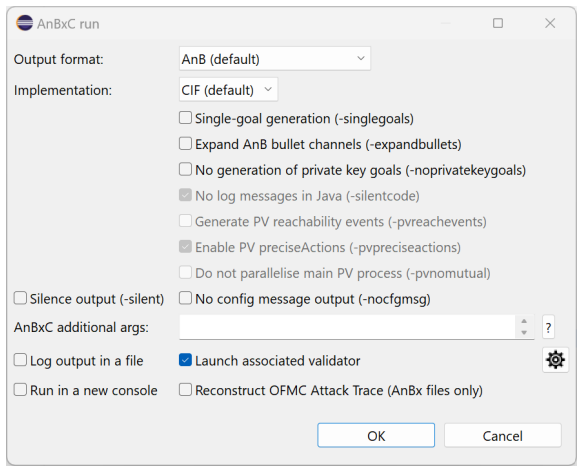
The load-bearing object is the AnBx IDE itself: an Eclipse plug-in whose grammar-based editor provides scoping, type and arity checking, and quick fixes on AnB, AnBx, ProVerif, and OFMC/IF specifications, and whose task scheduler, console colouring, single-goal parallel verification, and attack-trace reconstruction automate the loop between modelling and verification. The Alice & Bob notation (and its AnBx extension) is a high-level, human-readable way to write a protocol as message exchanges between named agents, with goals stated separately; the compiler turns AnBx into AnB for OFMC and into applied-pi for ProVerif, and generates Java implementations, so the same model is verified at abstract and concrete levels.
What would settle it
A controlled comparison in which similar students are randomly assigned to design and verify a protocol using either the AnBx IDE or a plain command-line toolchain, then take an objective applied-cryptography test and submit independently scored protocol models; if IDE users do not significantly outperform the control group on correctness or misconception reduction, the central claim is not supported.
Extended reading notes
Core claim
The central claim is that integrating a high-level protocol notation with automated verification tools inside an IDE turns formal verification into a workable workflow for non-experts. Concretely, the AnBx IDE supports editing, validation, verification, and Java code generation from a single AnBx model; it automates intermediate steps such as IF-file generation, single-goal verification in parallel, and OFMC attack-trace reconstruction into AnB and Java. Survey responses from 35 university students indicate that the IDE was important to completing their projects and that they would use it again; the paper also reports that the IDE addresses six documented barriers to formal-method adoption — complexity, limited tool integration, unfamiliar interfaces, interpretability of results, scalability, and documentation.
Load-bearing premise
The load-bearing premise is that students' self-reported survey ratings accurately measure real learning and workflow benefit, rather than gratitude or social-desirability bias; the paper itself acknowledges in Section 6.4 that the evaluation relies on the accuracy of self-assessment surveys.
Editorial extensions
If this is right
- Practitioners and students with limited formal-methods background can complete verified security-protocol projects, which lowers the main barrier to formal methods adoption identified in expert surveys.
- Parallel single-goal verification cuts ProVerif verification time by at least half on the benchmarked protocols, making iterative verification practical on multicore machines.
- Because the same AnBx model feeds OFMC, ProVerif, and the Java and Docker code generator, verified designs can be executed directly, reducing translation errors between specification and implementation.
- The IDE's immediate validation and quick fixes can forestall common cryptographic mistakes during modelling, which is the mechanism by which it claims to help learners grasp applied cryptography.
Reading between the lines
- A natural next step not tested in the paper is whether IDE-assisted users can later design and verify a new protocol without the IDE; the survey measures self-perception, not retention or transfer.
- The misconception survey and the IDE's error messages target the same failures (for example, confusing public and symmetric keys), which suggests the IDE's pedagogical value may come from immediate corrective feedback rather than from explanations; a pre/post misconception test would separate those channels.
- The paper's architecture — a browser-style editor, a task scheduler, single-goal parallelisation, and trace reconstruction — appears transferable to other security verification tools or other domain-specific languages, although the paper only lists this as future work.
Editorial analysis
A structured set of objections, weighed in public.
Referee Report
Summary. The paper presents the AnBx IDE, an Eclipse-based development environment for designing, verifying, and implementing security protocols. It builds on the AnB/AnBx notation, the AnBx compiler and code generator, OFMC, and ProVerif, and adds editing support, validation, task scheduling, result visualisation, attack-trace reconstruction, and Dockerised Java code generation. The authors evaluate the IDE against six barriers to formal-method adoption drawn from the literature, report a misconception survey of 59 cybersecurity students, a satisfaction survey of 35 students, usage statistics from the Eclipse Marketplace, and a benchmark comparing all-goal versus single-goal parallel verification. The paper claims that the IDE is valuable as a workflow aid and helps users grasp essential cybersecurity concepts, including users with limited formal-methods or cryptography backgrounds.
Significance. If the effectiveness claims were substantiated, the AnBx IDE would be a useful practical contribution to lowering the adoption barrier for formal verification of security protocols, particularly in educational settings. The paper's strengths include a detailed and specific account of the tool's features, a reproducible benchmark (Table 1) with concrete timing data for eleven protocols, long-term usage statistics, and an honest and explicit statement of assumptions and limitations in Section 6.4. However, the central claim that the IDE 'helps users grasp essential cybersecurity concepts' is not supported by the evidence presented: the evaluation relies entirely on self-reported Likert ratings from a self-selected student sample, with no control group, no pre/post measurement of learning, and no objective learning-gain metric. The paper's own Section 6.4 acknowledges that the evaluation depends on the accuracy of self-assessment surveys.
major comments (3)
- [Abstract and Section 6.2] The abstract's claim that the IDE 'helps users grasp essential cybersecurity concepts' is not supported by the study design. The misconception survey in Section 2.3 and the user-evaluation survey in Section 6.2 were administered to almost entirely disjoint cohorts; there is no pre-test/post-test comparison within the same group of users, and no comparison condition involving a different tool or method. The Likert items in Section 6.2 measure perceived usefulness and satisfaction, not actual gains in conceptual understanding. The evidence can support a claim about perceived usefulness, but not a causal claim about learning.
- [Section 6.4] The assumptions paragraph explicitly states that the evaluation 'relies on the accuracy of self-assessment surveys in capturing users' perceptions of the IDE's usability and educational impact.' This is an unverified premise that is load-bearing for the paper's educational-effectiveness claim. Since the survey in Section 6.2 is the sole evidence for that claim, the stated assumption is not a minor caveat but a gap in the chain of evidence. The paper should either provide an objective learning-gain measure (e.g., a pre/post knowledge test on the same cohort) or explicitly restrict the paper's claims to perceived usefulness and user satisfaction.
- [Section 6.2, 'Importance of Tools' and 'Verification Tasks'] The interpretation of the survey results overstates their significance. The participants chose to use the toolkit as part of their project proposals (as the paper notes for pedagogical reasons), so the sample is self-selected, and the high ratings may reflect selection bias rather than the IDE's intrinsic value. The statement that most students rated the tools as 'Very important' for completing their projects is anecdotal self-report; the paper itself admits that 'it is not possible to perform a quantitative evaluation, as projects are very different in nature.' The average mark of 67/100 for IDE users is not compared against a matched control group and cannot substantiate a workflow-effectiveness claim.
minor comments (5)
- [Section 2.3] There is a typo in the phrase 'Most of of the participants'; it should be 'Most of the participants'.
- [Section 6.2] The sentence 'Participants appreciated the ability to monitor tasks and ure verification processes' contains a typo: 'ure' should be 'use'.
- [Section 5.2.6] The sentence 'Theuseralso hastheoption to sort the list of protocols alphabetically' is missing spaces; it should read 'The user also has the option'.
- [Section 5.1.4] In the discussion of the ProVerif scoping example, 'evente' should probably be 'event e' (the event name).
- [Table 1] The table would be easier to read if the benchmark methodology included standard deviations or at least a statement that the measurements are averages over 20 runs; the current presentation gives no indication of variance across runs.
Circularity Check
No circular derivation chain: the IDE effectiveness claim rests on user surveys and external usage data, not on a self-referential reduction.
full rationale
The paper's central claim is an empirical usability and educational-effectiveness claim about an IDE, not a derived mathematical result. There is no fitted parameter later renamed as a prediction, no equation that reduces to an input by construction, and no uniqueness theorem imported from the authors' own prior work to force a particular choice. The self-citations (e.g., [26], [33], [37], [79], [83]) document the lineage of the AnBx language, compiler, and prototype; they do not by themselves entail the effectiveness claim, which is supported by user surveys and Eclipse Marketplace statistics. Section 6.4 explicitly acknowledges that the evaluation 'relies on the accuracy of self-assessment surveys in capturing users' perceptions of the IDE's usability and educational impact,' and Section 6.2 concedes 'it is not possible to perform a quantitative evaluation, as projects are very different in nature.' These are validity limitations (self-report, no control condition, disjoint cohorts for the knowledge survey and the satisfaction survey), not circular reductions: the survey responses are an independent empirical input, not a restatement of the conclusion. The verification-time benchmark against external tools OFMC and ProVerif is self-contained. No circular step can be exhibited, so the score is 0.
Assumptions & free parameters
assumptions (4)
- domain assumption Dolev-Yao attacker model: the adversary controls the network and can compose and decompose messages symbolically.
- domain assumption OFMC is sound and complete; ProVerif is sound but may report false attacks.
- domain assumption AnBx compiler translations to AnB, ProVerif, and Java preserve the protocol's security properties.
- ad hoc to paper Survey respondents' self-assessments and ratings are accurate.
Cite this review
Pith. "Pith review of A Practical Approach to Formal Methods: An Eclipse Integrated Development Environment (IDE) for Security Protocols." pith.science (2026). https://pith.science/paper/N5KWYJPV
@misc{pith2026241117926,
  author       = {Pith},
  title        = {Pith review of: A Practical Approach to Formal Methods: An Eclipse Integrated Development Environment (IDE) for Security Protocols},
  year         = {2026},
  howpublished = {\url{https://pith.science/paper/N5KWYJPV}},
  note         = {Machine review of arXiv:2411.17926}
}
read the original abstract
To develop trustworthy distributed systems, verification techniques and formal methods, including lightweight and practical approaches, have been employed to certify the design or implementation of security protocols. Lightweight formal methods offer a more accessible alternative to traditional fully formalised techniques by focusing on simplified models and tool support, making them more applicable in practical settings. The technical advantages of formal verification over manual testing are increasingly recognised in the cybersecurity community. However, for practitioners, formal modelling and verification are often too complex and unfamiliar to be used routinely. In this paper, we present an Eclipse IDE for the design, verification, and implementation of security protocols and evaluate its effectiveness, including feedback from users in educational settings. It offers user-friendly assistance in the formalisation process as part of a Model-Driven Development approach. This IDE centres around the Alice & Bob (AnB) notation, the AnBx Compiler and Code Generator, the OFMC model checker, and the ProVerif cryptographic protocol verifier. For the evaluation, we identify the six most prominent limiting factors for formal method adoption, based on relevant literature in this field, and we consider the IDE's effectiveness against those criteria. Additionally, we conducted a structured survey to collect feedback from university students who have used the toolkit for their projects. The findings demonstrate that this contribution is valuable as a workflow aid and helps users grasp essential cybersecurity concepts, even for those with limited knowledge of formal methods or cryptography. Crucially, users reported that the IDE has been an important component to complete their projects and that they would use again in the future, given the opportunity.
Figures


Figures from the paper (8 more)




Reference graph
Works this paper leans on
-
[1]
R. Garcia, P. Modesti, A practical approach to formal methods: An Eclipse integrated development environment (IDE) for security protocols, Electronics 13 (23) (2024).doi: 10.3390/electronics13234660
-
[2]
M. Vanhoef, F. Piessens, Key reinstallation attacks: Forcing nonce reuse in WPA2, in: B. Thuraisingham, D. Evans, T. Malkin, D. Xu (Eds.), Proceedings of the 2017 ACM SIGSAC Conference on Computer and Communications Security, CCS 2017, Dal- las, TX, USA, October 30 - November 03, 2017, ACM, 2017, pp. 1313–1328. doi: 10.1145/3133956.3134027
arXiv 2017
-
[3]
Cassidy, Diagnosis of the OpenSSL Heartbleed Bug, available online: https:// www.seancassidy.me/diagnosis-of-the-openssl-heartbleed-bug.html (accessed on 22 November 2024) (2014)
S. Cassidy, Diagnosis of the OpenSSL Heartbleed Bug, available online: https:// www.seancassidy.me/diagnosis-of-the-openssl-heartbleed-bug.html (accessed on 22 November 2024) (2014)
2014
-
[4]
Fogel, S
B. Fogel, S. Farmer, H. Alkofahi, A. Skjellum, M. Hafiz, POODLEs, More POODLEs, FREAK Attacks Too: How Server Administrators Responded to Three Serious Web Vulnerabilities, Springer International Publishing, 2016, pp. 122–137. doi:10.1007/ 978-3-319-30806-7_8
2016
-
[5]
E. S. Alashwali, K. Rasmussen, What’s in a Downgrade? A Taxonomy of Downgrade Attacks in the TLS Protocol and Application Protocols Using TLS, Springer International Publishing, 2018, pp. 468–487.doi:10.1007/978-3-030-01704-0_27
-
[6]
C. Cremers, M. Horvat, S. Scott, T. van der Merwe, Automated analysis and verification of tls 1.3: 0-rtt, resumption and delayed authentication, in: 2016 IEEE Symposium on Security and Privacy (SP), IEEE, 2016.doi:10.1109/sp.2016.35
-
[7]
K. Bhargavan, B. Blanchet, N. Kobeissi, Verified models and reference implementations for the TLS 1.3 standard candidate, in: 2017 IEEE Symposium on Security and Privacy, SP 2017, San Jose, CA, USA, May 22-26, 2017, IEEE Computer Society, 2017, pp. 483–502. doi:10.1109/SP.2017.26
-
[8]
B. Blanchet, Composition theorems for cryptoverif and application to TLS 1.3 (2018) 16– 30doi:10.1109/csf.2018.00009
arXiv 2018
Show all 144 references
-
[9]
K.Cohn-Gordon, C.Cremers, B.Dowling, L.Garratt, D.Stebila, Aformalsecurityanalysis of the signal messaging protocol, J. Cryptol. 33 (4) (2020) 1914–1983. doi:10.1007/ S00145-020-09360-1. 35
2020
-
[10]
Blanchet, An efficient cryptographic protocol verifier based on Prolog rules, in: Com- puter Security Foundations Workshop, IEEE, IEEE Computer Society, 2001, pp
B. Blanchet, An efficient cryptographic protocol verifier based on Prolog rules, in: Com- puter Security Foundations Workshop, IEEE, IEEE Computer Society, 2001, pp. 0082–
2001
-
[11]
Meier, B
S. Meier, B. Schmidt, C. Cremers, D. A. Basin, The TAMARIN prover for the symbolic analysis of security protocols, in: N. Sharygina, H. Veith (Eds.), Computer Aided Verifi- cation - 25th International Conference, CAV 2013, Saint Petersburg, Russia, July 13-19,
2013
-
[12]
Basin, S
D. Basin, S. Mödersheim, L. Viganò, OFMC: A symbolic model checker for security protocols, International Journal of Information Security 4 (3) (2005) 181–208. doi: 10.1007/s10207-004-0055-7
2005 doi
-
[13]
M.Dark, S.Belcher, M.Bishop, I.Ngambeki, Practice, practice, practice...secureprogram- mer!, in: Proceeding of the 19th Colloquium for Information System Security Education, 2015
2015
-
[14]
NIST, Cve-2020-13777, available online: https://nvd.nist.gov/vuln/detail/ CVE-2020-13777/ (accessed on 22 November 2024) (2020)
2020
-
[15]
Garavel, M
H. Garavel, M. H. ter Beek, J. van de Pol, The 2020 expert survey on formal methods, in: M. H. ter Beek, D. Nickovic (Eds.), Formal Methods for Industrial Critical Systems - 25th InternationalConference, FMICS2020, Vienna, Austria, September2-3, 2020, Proceedings, Vol. 12327 o...
2020
-
[16]
Kulik, B
T. Kulik, B. Dongol, P. G. Larsen, H. D. Macedo, S. Schneider, P. W. V. Tran-Jørgensen, J. Woodcock, A survey of practical formal methods for security, Formal Aspects Comput. 34 (1) (2022) 1–39.doi:10.1145/3522582
2022 doi
-
[17]
Dolev, A
D. Dolev, A. Yao, On the security of public-key protocols, IEEE Transactions on Informa- tion Theory 2 (29) (1983).doi:10.1109/tit.1983.1056650
1983
-
[18]
Sommerville, Software Engineering, 9th edition, Addison-Wesley, 2010
I. Sommerville, Software Engineering, 9th edition, Addison-Wesley, 2010
2010
-
[19]
Bugliesi, R
M. Bugliesi, R. Focardi, Language based secure communication, in: Computer Security Foundations Symposium, 2008. CSF’08. IEEE 21st, 2008, pp. 3–16.doi:10.1109/csf. 2008.17
2008 doi
-
[20]
Avalle, A
M. Avalle, A. Pironti, R. Sisto, Formal verification of security protocol implementa- tions: a survey, Formal Aspects of Computing 26 (1) (2014) 99–123. doi:10.1007/ s00165-012-0269-9
2014
-
[21]
J. A. Davis, M. Clark, D. Cofer, A. Fifarek, J. Hinchman, J. Hoffman, B. Hulbert, S. P. Miller, L. Wagner, Study on the Barriers to the Industrial Adoption of Formal Methods, Springer Berlin Heidelberg, 2013, pp. 63–77.doi:10.1007/978-3-642-41010-9_5
2013 doi
-
[22]
Skevoulis, V
S. Skevoulis, V. Makarov, Integrating formal methods tools into undergraduate computer science curriculum, in: Proceedings. Frontiers in Education. 36th Annual Conference, IEEE, 2006, pp. 1–6.doi:10.1109/fie.2006.322570
2006
-
[23]
Scheurer, Formal Methods: The Problem Is Education, Springer Berlin Heidelberg, 2000, pp
T. Scheurer, Formal Methods: The Problem Is Education, Springer Berlin Heidelberg, 2000, pp. 198–210. doi:10.1007/3-540-40891-6_18. 36
2000 doi
-
[24]
Pomorova, S
O. Pomorova, S. Lysenko, Formal and intelligent methods for security and resilience: Ed- ucation and training issues, Information & Security: An International Journal 35 (2016) 133–150. doi:10.11610/isij.3507
2016 doi
-
[25]
Avalle, A
M. Avalle, A. Pironti, D. Pozza, R. Sisto, JavaSPI: A framework for security protocol implementation, International Journal of Secure Software Engineering 2 (4) (2011) 34–48. doi:10.4018/jsse.2011100103
2011 doi
-
[26]
Modesti, AnBx: Automatic generation and verification of security protocols implemen- tations, in: 8th International Symposium on Foundations & Practice of Security, Vol
P. Modesti, AnBx: Automatic generation and verification of security protocols implemen- tations, in: 8th International Symposium on Foundations & Practice of Security, Vol. 9482 of LNCS, Springer, 2015, pp. 156–173.doi:10.1007/978-3-319-30303-1_10
2015 doi
-
[27]
Almousa, S
O. Almousa, S. Mödersheim, L. Viganò, Alice and Bob: Reconciling formal models and implementation, in: C. Bodei, G.-L. Ferrari, C. Priami (Eds.), Programming Languages with Applications to Biology and Security: Essays Dedicated to Pierpaolo Degano on the Occasion of His 65th B...
2015 doi
-
[28]
D. J. J. Wing, Lightweight formal methods, H. Saiedian. An invitation to formal methods. IEEE Computer (1996). doi:10.1007/3-540-45251-6_1
1996 doi
-
[29]
Zamansky, M
A. Zamansky, M. Spichkova, G. Rodríguez-Navas, P. Herrmann, J. O. Blech, Towards classification of lightweight formal methods, in: E. Damiani, G. Spanoudakis, L. A. Ma- ciaszek (Eds.), Proceedings of the 13th International Conference on Evaluation of Novel Approaches to Softwa...
2018 doi
-
[30]
A. D. Brucker, D. Marmsoler, Teaching Formal Methods in Application Domains: A Case Study in Computer and Network Security, Springer Nature Switzerland, 2024, pp. 124–140. doi:10.1007/978-3-031-71379-8_8
2024 doi
-
[31]
Brambilla, J
M. Brambilla, J. Cabot, M. Wimmer, Model-Driven Software Engineering in Practice, Sec- ond Edition, Synthesis Lectures on Software Engineering, Morgan & Claypool Publishers,
-
[32]
P. H. Nguyen, M. E. Kramer, J. Klein, Y. L. Traon, An extensive systematic review on the model-driven development of secure systems, Inf. Softw. Technol. 68 (2015) 62–81. doi:10.1016/J.INFSOF.2015.08.006
2015 doi
-
[33]
Garcia, P
R. Garcia, P. Modesti, An IDE for the design, verification and implementation of security protocols, in: 2017 IEEE International Symposium on Software Reliability Engineering Workshops, ISSRE Workshops 2017, Toulouse, France, October 23-26, 2017, IEEE Com- puter Society, 2017,...
2017 doi
-
[34]
Bettini, Implementing domain-specific languages with Xtext and Xtend, Packt Publish- ing Ltd, 2016
L. Bettini, Implementing domain-specific languages with Xtext and Xtend, Packt Publish- ing Ltd, 2016
2016
-
[35]
Eclipse Community, Xtext documentation, available online:http://eclipse.org/Xtext/ documentation/ (accessed on 22 November 2024)
2024
-
[36]
S. Mödersheim, Algebraic properties in alice and bob notation, in: Proceedings of the The Forth International Conference on Availability, Reliability and Security, ARES 2009, March 16-19, 2009, Fukuoka, Japan, IEEE Computer Society, 2009, pp. 433–440.doi: 10.1109/ARES.2009.95. 37
2009 doi
-
[37]
Bugliesi, S
M. Bugliesi, S. Calzavara, S. Mödersheim, P. Modesti, Security protocol specification and verification with anbx, Journal of Information Security and Applications 30 (2016) 46–63. doi:10.1016/j.jisa.2016.05.004
2016 doi
-
[38]
Blanchet, V
B. Blanchet, V. Cheval, V. Cortier, ProVerif with Lemmas, Induction, Fast Subsumption, and Much More, in: 43RD IEEE Symposium on Security and Privacy (S&P’22), San Francisco, United States, 2022.doi:10.1109/sp46214.2022.9833653
2022
-
[39]
Shaukat, A
R. Shaukat, A. Shahoor, A. Urooj, Probing into code analysis tools: A comparison of C# supporting static code analyzers, in: 2018 15th International Bhurban Conference on Applied Sciences and Technology (IBCAST), 2018, pp. 455–464.doi:10.1109/IBCAST. 2018.8312264
2018
-
[40]
Fetaji, S
M. Fetaji, S. Loskovska, B. Fetaji, M. Ebibi, Combining virtual learning environment and integrated development environment to enhance e-learning, in: 2007 29th International Conference on Information Technology Interfaces, 2007, pp. 319–324.doi:10.1109/ITI. 2007.4283790
2007
-
[41]
M. Broy, A. Brucker, A. Fantechi, M. Gleirscher, K. Havelund, M. A. Kuppe, A. Mendes, A. Platzer, J. Ringert, A. Sullivan, Does every computer scientist need to know formal methods?, Form. Asp. Comput.Just Accepted (Jun. 2024).doi:10.1145/3670795
2024 doi
-
[42]
Gleirscher, D
M. Gleirscher, D. Marmsoler, Formal methods in dependable systems engineering: a survey of professionals from europe and north america, Empir. Softw. Eng. 25 (6) (2020) 4473–
2020
-
[43]
J. M. Spivey, Z Notation - a reference manual (2. ed.), Prentice Hall International Series in Computer Science, Prentice Hall, 1992
1992
-
[44]
B. J. Wadsworth, Piaget’s Theory of Cognitive and Affective Development: Foundations of Constructivism, Longman Publishing, 1996
1996
-
[45]
J. S. Bruner, The Process of Education, Harvard University Press, 2009.doi:10.2307/j. ctvk12qst
2009 doi
-
[46]
Raimondo, S
M. Raimondo, S. Marrone, S. Bernardi, A. Palladino, Demonstrating the necessity of model generation in security protocol verification, in: 28th IEEE International Conference on Emerging Technologies and Factory Automation, ETFA 2023, Sinaia, Romania, September 12-15, 2023, IEE...
2023
-
[47]
L. C. Paulson, T. Nipkow, M. Wenzel, From LCF to isabelle/hol, Formal Aspects Comput. 31 (6) (2019) 675–698.doi:10.1007/S00165-019-00492-1
2019 doi
-
[48]
Abadi, R
M. Abadi, R. Needham, Prudent engineering practice for cryptographic protocols, in: 1994 IEEE Computer Society Symposium on Research in Security and Privacy, 1994. Proceed- ings., 1994, pp. 122–136.doi:10.1109/32.481513
1994 doi
-
[49]
K. R. M. Leino, V. Wüstholz, The dafny integrated development environment, in: C. Dubois, D. Giannakopoulou, D. Méry (Eds.), Proceedings 1st Workshop on Formal Integrated Development Environment, F-IDE 2014, Grenoble, France, April 6, 2014, Vol. 149 of EPTCS, 2014, pp. 3–15.do...
2014 doi
-
[50]
Unwin, H
A. Unwin, H. Hofmann, Gui and command-line - conflict or synergy?, in: K. Berk, M. Pourahmadi (Eds.), Proceedings of the 31st Symposium on the Interface: models, predictions, and computing, Schaumburg, Illinois, June 9 - 12, 1999, Computing science and statistics, Interface Fo...
1999
-
[51]
Tabassum, S
M. Tabassum, S. Watson, H. R. Lipford, Comparing educational approaches to secure programming: Tool vs. TA, in: Thirteenth Symposium on Usable Privacy and Security, SOUPS 2017, Santa Clara, CA, USA, July 12-14, 2017, USENIX Association, 2017. URL https://www.usenix.org/confere...
2017
-
[52]
Kuusinen, Software developers as users: Developer experience of a cross-platform in- tegrated development environment, in: P
K. Kuusinen, Software developers as users: Developer experience of a cross-platform in- tegrated development environment, in: P. Abrahamsson, L. Corral, M. Oivo, B. Russo (Eds.), Product-Focused Software Process Improvement - 16th International Conference, PROFES2015, Bolzano,...
2015 doi
-
[53]
Lindmeier, A
A. Lindmeier, A. Mühling, Keeping secrets: K-12 students’ understanding of cryptography, in: T. Brinda, M. Armoni (Eds.), WiPSCE ’20: Workshop in Primary and Secondary Computing Education, Virtual Event, Germany, October 28-30, 2020, ACM, 2020, pp. 14:1–14:10. doi:10.1145/3421...
2020
-
[54]
J. Geels, Ordinary users do not understand digital signatures, in: Proceedings of the 13th Nordic Conference on Human-Computer Interaction, NordiCHI 2024, Uppsala, Sweden, October 13-16, 2024, ACM, 2024, pp. 66:1–66:15.doi:10.1145/3679318.3685402
2024
-
[55]
A. M. Braga, R. Dahab, N. Antunes, N. Laranjeiro, M. Vieira, Understanding how to use static analysis tools for detecting cryptography misuse in software, IEEE Trans. Reliab. 68 (4) (2019) 1384–1403.doi:10.1109/TR.2019.2937214
2019
-
[56]
Gleirscher, S
M. Gleirscher, S. Foster, J. Woodcock, New opportunities for integrated formal methods, ACM Comput. Surv. 52 (6) (2020) 117:1–117:36.doi:10.1145/3357231
2020 doi
-
[57]
R. J. van Glabbeek, P. Höfner, D. van der Wal, Analysing awn-specifications using mcrl2 (extended abstract), in: C. A. Furia, K. Winter (Eds.), Integrated Formal Methods - 14th InternationalConference, IFM2018, Maynooth, Ireland, September5-7, 2018, Proceedings, Vol. 11023 of ...
2018 doi
-
[58]
Runge, I
T. Runge, I. Schaefer, L. Cleophas, T. Thüm, D. G. Kourie, B. W. Watson, Tool support for correctness-by-construction, in: A. Koziolek, I. Schaefer, C. Seidl (Eds.), Software Engineering 2021, Fachtagung des GI-Fachbereichs Softwaretechnik, 22.-26. Februar 2021, Braunschweig/V...
2021
-
[59]
Fares, J
E. Fares, J. Bodeveix, M. Filali, Correct pattern-based development through refinements and weakest preconditions calculus, in: D. Marmsoler, M. Sun (Eds.), Formal Aspects of Component Software - 20th International Conference, FACS 2024, Milan, Italy, September 9-10, 2024, Pro...
2024 doi
-
[60]
Bonfanti, M
S. Bonfanti, M. Carissoni, A. Gargantini, A. Mashkoor, Asm2c++: A tool for code gener- ation from abstract state machines to arduino, in: C. W. Barrett, M. D. Davies, T. Kahsai 39 (Eds.), NASA Formal Methods - 9th International Symposium, NFM 2017, Moffett Field, CA, USA, May ...
2017 doi
-
[61]
Lowe, A hierarchy of authentication specifications, in: CSFW’97, IEEE Computer Society Press, 1997, pp
G. Lowe, A hierarchy of authentication specifications, in: CSFW’97, IEEE Computer Society Press, 1997, pp. 31–43
1997
- [62]
-
[63]
Barbosa, G
M. Barbosa, G. Barthe, K. Bhargavan, B. Blanchet, C. Cremers, K. Liao, B. Parno, Sok: Computer-aided cryptography, in: 42nd IEEE Symposium on Security and Privacy, SP 2021, San Francisco, CA, USA, 24-27 May 2021, IEEE, 2021, pp. 777–795.doi:10.1109/ SP40001.2021.00008
2021
-
[64]
Team, Avispa v1.0 user manual, available online:https://people.rennes.inria.fr/ Thomas.Genet/Crypt/AVISPA_manual.pdf (accessed on 22 November 2024)
A. Team, Avispa v1.0 user manual, available online:https://people.rennes.inria.fr/ Thomas.Genet/Crypt/AVISPA_manual.pdf (accessed on 22 November 2024)
2024
-
[65]
Delaune, L
S. Delaune, L. Hirschi, A survey of symbolic methods for establishing equivalence-based properties in cryptographic protocols, Journal of Logical and Algebraic Methods in Pro- gramming 87 (2017) 127–144.doi:10.1016/j.jlamp.2016.10.005
2017 doi
-
[66]
Blanchet, B
B. Blanchet, B. Smyth, V. Cheval, ProVerif 2.05: Automatic cryptographic protocol veri- fier, user manual and tutorial, available online:https://bblanche.gitlabpages.inria. fr/proverif/manual.pdf (accessed on 22 November 2024) (2023)
2023
-
[67]
Carlsen, Optimal privacy and authentication on a portable communications system, ACM SIGOPS Oper
U. Carlsen, Optimal privacy and authentication on a portable communications system, ACM SIGOPS Oper. Syst. Rev. 28 (3) (1994) 16–23.doi:10.1145/182110.182112
1994
-
[68]
compute.dtu.dk/~samo/ (accessed on 22 November 2024)
Sebastian Mödersheim, OFMC distribution and tutorials, available online:https://www2. compute.dtu.dk/~samo/ (accessed on 22 November 2024)
2024
-
[69]
ITU-T Recommendation H.530: Symmetric Security Procedures for H.510 (Mobility for H.323 Multimedia Systems and Services) (2002)
2002
-
[70]
Kaufman, Internet key exchange (IKEv2) protocol, Tech
C. Kaufman, Internet key exchange (IKEv2) protocol, Tech. rep. (2005)
2005
-
[71]
S. International Organization for Standardization, Genève, ISO/IEC 9798-2:2008, Infor- mation technology – Security techniques – Entity Authentication – Part 2: Mechanisms using symmetric encipherment algorithms, Third edition (2008)
2008
-
[72]
S. International Organization for Standardization, Genève, ISO/IEC 9798-4:1999, Infor- mation technology – Security techniques – Entity Authentication – Part 3: Mechanisms using a cryptographic check function, Second edition (1999)
1999
-
[73]
Concepts Tools 17 (3) (1996) 93–102.doi:10.1007/3-540-61042-1_43
G.Lowe, Breakingandfixingtheneedham-schroederpublic-keyprotocolusingFDR,Softw. Concepts Tools 17 (3) (1996) 93–102.doi:10.1007/3-540-61042-1_43
1996 doi
-
[74]
R. M. Needham, M. D. Schroeder, Using encryption for authentication in large networks of computers, Commun. ACM 21 (12) (1978) 993–999.doi:10.1145/359657.359659
1978
-
[75]
D. J. Otway, O. Rees, Efficient and timely mutual authentication, ACM SIGOPS Oper. Syst. Rev. 21 (1) (1987) 8–10.doi:10.1145/24592.24594. 40
1987
-
[76]
L. C. Paulson, Inductive analysis of the internet protocol TLS, ACM Trans. Inf. Syst. Secur. 2 (3) (1999) 332–351.doi:10.1145/322510.322530
1999
-
[77]
T. Y. Woo, S. S. Lam, Authentication for distributed systems, Computer 25 (1) (1992) 39–52. doi:10.1109/2.108052
1992 doi
-
[78]
L. C. Paulson, The yahalom protocol, in: Security Protocols: 7th International Workshop, Cambridge, UK, April 19-21, 1999. Proceedings 7, Springer, 2000, pp. 78–84. doi:10. 1007/10720107_11
1999
-
[79]
Garcia, P
R. Garcia, P. Modesti, Automatic generation of security protocols attacks specifications and implementations, Cyber Security and Applications 2 (2024) 100038.doi:10.1016/j. csa.2024.100038
2024
-
[80]
Likert, A technique for the measurement of attitudes., Archives of psychology (1932)
R. Likert, A technique for the measurement of attitudes., Archives of psychology (1932)
1932
-
[81]
L. A. Clark, D. Watson, Constructing validity: New developments in creating objective measuring instruments., Psychological assessment 31 (12) (2019) 1412. doi:10.1037/ pas0000626
2019
-
[82]
doi:10.1109/csfw.2001.930138
2001
-
[83]
Modesti, Integrating formal methods for security in software security education, Infor- matics in Education 19 (3) (2020) 425–454.doi:10.15388/infedu.2020.19
P. Modesti, Integrating formal methods for security in software security education, Infor- matics in Education 19 (3) (2020) 425–454.doi:10.15388/infedu.2020.19
2020 doi
-
[84]
K. R. M. Leino, Dafny: An automatic program verifier for functional correctness, in: E. M. Clarke, A. Voronkov (Eds.), Logic for Programming, Artificial Intelligence, and Reasoning - 16th International Conference, LPAR-16, Dakar, Senegal, April 25-May 1, 2010, Revised Selected...
2010 doi
-
[85]
Brezocnik, B
Z. Brezocnik, B. Vlaovic, A. Vreze, Spinrcp: the eclipse rich client platform integrated development environment for the spin model checker, in: N. Rungta, O. Tkachuk (Eds.), 2014 International Symposium on Model Checking of Software, SPIN 2014, Proceedings, San Jose, CA, USA,...
2014 doi
-
[86]
G. J. Holzmann, The SPIN Model Checker - primer and reference manual, Addison-Wesley, 2004
2004
-
[87]
org, [Online; accessed 14 October 2024] (2024)
LimeSurvey Team, Limesurvey: an open source survey tool,https://www.limesurvey. org, [Online; accessed 14 October 2024] (2024)
2024
-
[88]
S. Owre, J. M. Rushby, N. Shankar, PVS: A prototype verification system, in: D. Kapur (Ed.), Automated Deduction - CADE-11, 11th International Conference on Automated Deduction, Saratoga Springs, NY, USA, June 15-18, 1992, Proceedings, Vol. 607 of Lecture Notes in Computer Sci...
1992 doi
- [89]
-
[90]
Braghin, M
C. Braghin, M. Lilli, E. Riccobene, M. Baba, Kant: A domain-specific language for mod- eling security protocols, in: F. J. D. Mayo, L. F. Pires, E. Seidewitz (Eds.), Proceedings of the 12th International Conference on Model-Based Software and Systems Engineering, MODELSWARD 20...
2024 doi
-
[91]
Glouche, T
Y. Glouche, T. Genet, O. Heen, O. Courtay, A security protocol animator tool for avispa, in: ARTIST2 workshop on security specification and verification of embedded systems, Pisa, 2006, pp. 1–7. URL https://people.irisa.fr/Thomas.Genet/span/
2006
-
[92]
Masci, C
P. Masci, C. A. Muñoz, An integrated development environment for the prototype verifica- tion system, in: R. Monahan, V. Prevosto, J. Proença (Eds.), Proceedings Fifth Workshop on Formal Integrated Development Environment, F-IDE@FM 2019, Porto, Portugal, 7th October 2019, Vol....
2019 doi
-
[93]
Armando, D
A. Armando, D. Basin, Y. Boichut, Y. Chevalier, L. Compagna, J. Cuéllar, P. H. Drielsma, P.-C. Héam, O. Kouchnarenko, J. Mantovani, et al., The AVISPA tool for the automated validation of internet security protocols and applications, in: Computer Aided Verification, Springer, ...
2005 doi
-
[94]
doi:10.18420/SE2021_34
-
[95]
Lifepillar, Vim mode for formal languages, available online: https://github.com/ lifepillar/vim-formal-package (accessed on 22 November 2024)
2024
-
[96]
B. F. Jorden Whitefield, Ralf Sasse, Sublime Text 3 plug-in for Tamarin, available on- line: https://github.com/tamarin-prover/editor-sublime (accessed on 22 November 2024)
2024
-
[97]
Boichut, T
Y. Boichut, T. Genet, Y. Glouche, O. Heen, Using animation to improve formal specifica- tions of security protocols, in: 2nd Conference on Security in Network Architectures and Information Systems (SARSSI 2007), 2007, pp. 169–182
2007
-
[98]
Nicolas, V
G. Nicolas, V. Cheval, ProVerif Syntax Highlighting for VS Code, available online:https: //marketplace.visualstudio.com/items?itemName=georgio.proverif-vscode (ac- cessed on 22 November 2024)
2024
-
[99]
Rusinowitch, Automated analysis of security protocols, in: L
M. Rusinowitch, Automated analysis of security protocols, in: L. Brim, O. Grumberg (Eds.), 12th International Workshop on Functional and Constraint Logic Programming, WFLP 2003, in connection with RDP’03, Federated Conference on Rewriting, Deduction and Programming, Boulder, C...
2003 doi
-
[100]
de Ruiter, ProVerif Editor, available online:https://proverifeditor.sourceforge
J. de Ruiter, ProVerif Editor, available online:https://proverifeditor.sourceforge. net/ (accessed on 22 November 2024)
2024
-
[101]
78–94.doi:10.1109/csf.2012.25
B.Schmidt, S.Meier, C.Cremers, D.Basin, AutomatedanalysisofDiffie-Hellmanprotocols and advanced security properties, in: Computer Security Foundations Symposium (CSF), 2012 IEEE 25th, IEEE, 2012, pp. 78–94.doi:10.1109/csf.2012.25. 42 Appendix A. AnBx IDE key features and requi...
2012 doi
-
[102]
Malladi, B
S. Malladi, B. Blanchet, ProVerif Web interface, available online:http://proverif20. paris.inria.fr/index.php (accessed on 22 November 2024)
2024
-
[104]
Úlfur Jóhann Edvardsson, V. J. L. Hoffmann, OFMC-GUI, available online: https:// github.com/ulfur88/OFMC-GUI (accessed on 22 November 2024)
2024
-
[107]
Open Eclipse and selectHelp→ Eclipse Marketplace
-
[108]
Search forAnBx, then selectAnBx IDEfrom the list and pressInstall
-
[109]
Alternatively, use the Eclipse Update Manager: • Open Help→ Install New Software..., add the following update site URL:https://www
Ensure the update site is active for future updates by checkingHelp→ Install New Soft- ware...→ Manage..., and verifying that the update site is enabled. Alternatively, use the Eclipse Update Manager: • Open Help→ Install New Software..., add the following update site URL:http...
-
[110]
In Eclipse, selectAnBx Tools→ Configuration
-
[111]
• Config File: Path toanbxc.cfg
Set the paths to: • AnBxC Exe Path: Path toanbxc.exe. • Config File: Path toanbxc.cfg. • ProVerif Exe Path: Path toproverif.exe. • OFMC Exe Path: Path toofmc.exe. Optionally, configure a folder for logging tool outputs via the configuration interface. Addi- tional details are ...
-
[112]
Selecting a protocol, such asFresh_From_A.AnBx, from thecasestudies folder
-
[113]
Clicking theAnBxC button on the toolbar
-
[114]
Choosing an output format (e.g.,AnB, ProVerif Typed, orJava)
-
[115]
Appendix B.5
Observing the verification results in the Console view. Appendix B.5. Creating a New Project To create a new AnBx project:
-
[116]
Select File→ New→ Project→ AnBx Project
-
[117]
Create new AnBx/AnB files inside thesrc folder: File→ New→ Other→ AnBx file
-
[118]
44 Appendix B.6
Similarly, create ProVerif files under thesrc folder: File→ New→ Other→ PV file. 44 Appendix B.6. Running Protocol Verification and Code Generation The output of verification or code generation will be displayed in theConsole view. If the Console is not visible: • Select Windo...
-
[120]
Choose the output formatAnB (default)and tickLaunch associated validator
-
[121]
• Specify the number of sessions (e.g., 1, 2, 3, etc.)
(Only the first time) Configure OFMC: • Click on the icon. • Specify the number of sessions (e.g., 1, 2, 3, etc.). • If the session number (n) is greater than 1, the tool will sequentially verify the protocol for 1 session andn sessions. • Click OK
-
[122]
Appendix D.1.2
The compiler will translate the file from.AnBx to .AnB and automatically run OFMC to verify the protocol against its specified security goals. Appendix D.1.2. Verifying .AnB or .IF Files
-
[123]
Select the .AnB or .IF file in Eclipse and click theOFMC button in the Eclipse toolbar
-
[124]
• If the session number (n) is greater than 1, the tool will sequentially verify the protocol for 1 session andn sessions
Configure OFMC as follows: • Specify the number of sessions (e.g., 1, 2, 3, etc.). • If the session number (n) is greater than 1, the tool will sequentially verify the protocol for 1 session andn sessions
-
[125]
48 Figure D.19: ProVerif Protocol Verification Appendix D.2
Click OK to begin the verification process. 48 Figure D.19: ProVerif Protocol Verification Appendix D.2. ProVerif Protocol Verification ProVerif is used to verify protocols specified in.AnBx or .PV files. It supports advanced verification of security goals using symbolic model...
-
[126]
Select the .AnBx file in Eclipse and click theAnBxC button in the Eclipse toolbar
-
[127]
Choose the output formatProVerif (default)and tickLaunch associated validator
-
[128]
• Options includepitype (process type inference) andsolve (solver for symbolic traces)
(Optional) Configure ProVerif: • Click on the icon to set options for ProVerif. • Options includepitype (process type inference) andsolve (solver for symbolic traces)
-
[129]
The compiler will translate the file from.AnBx to .PV and automatically run ProVerif to verify the protocol against its specified security goals
Click OK. The compiler will translate the file from.AnBx to .PV and automatically run ProVerif to verify the protocol against its specified security goals. Appendix D.2.2. Verifying .PV Files
-
[130]
Select the .PV file in Eclipse and click theProVerif button in the Eclipse toolbar
-
[131]
Configure the verification options: • Default options arepitype and solve
-
[132]
Appendix D.3
Click OK to run ProVerif and verify the protocol. Appendix D.3. Notes on Verification • Verification results are displayed in the Eclipse console or associated output window. • If verification fails, inspect the error messages and ensure that the protocol and its config- urati...
-
[133]
Download and configure the Eclipse plug-in as described in Appendix B
-
[134]
Key parameters include: • pathstemplates: Location of the template files (.st)
Ensure the configuration fileanbxc.cfg is correctly set up. Key parameters include: • pathstemplates: Location of the template files (.st). • pathjavadest: Path where the generated Java files will be stored
-
[135]
Appendix E.2
Verify thatpathjavadest points to the source folder of your Java project in Eclipse (e.g., C:/JavaProjects/genAnBx/src/). Appendix E.2. Generating Java Code To generate Java code for an AnBx protocol file (e.g.,Fresh_From_A.AnBx) using Eclipse:
-
[136]
Open your Eclipse workspace
-
[137]
Click on theAnBxC button in the toolbar
-
[138]
Select the desired output format (Java for standard generation)
-
[139]
The generated files will include Java source files and a corresponding.properties configu- ration file for the protocol
Press OK. The generated files will include Java source files and a corresponding.properties configu- ration file for the protocol. Appendix E.3. Setting Up and Running the Project in Eclipse To run the generated Java code in Eclipse:
-
[140]
• Specify a project name and location (e.g.,C:/JavaProjects/genAnBx)
Create a New Java Project: • Navigate toFile→ New→ Project→ Java Project. • Specify a project name and location (e.g.,C:/JavaProjects/genAnBx). • Click Finish
-
[141]
• Navigate toJava Build Path→ Libraries
Add the AnBxJ.jar Library: • Right-click on the project folder and selectProperties. • Navigate toJava Build Path→ Libraries. • If AnBxJ.jar is not listed, clickAdd External JARs...and select theAnBxJ.jar file
-
[142]
Ensure Proper Configuration: • Verify that thekeypath in anbxc.cfg points to the correct keystore location. • The default value for keystores is: 50 # Paths keypath = ../../keystore/ • Expand the keystore file into a folder at the same level as the src folder (e.g., C:/JavaPro...
-
[143]
• If you do not see the new files, refresh the folder to load them
Generate and Import Code: • AftergeneratingJavacode, Thegeneratedfileswillappearunderthespecifiedprotocol folder (e.g., src/Prot for protocol Prot). • If you do not see the new files, refresh the folder to load them
-
[144]
• Otherwise, use thebuild.xml ant file generated alongside the Java code
Run the Project: • If Run associated validatoris enabled (see Figure 9), the program will execute imme- diately after being built. • Otherwise, use thebuild.xml ant file generated alongside the Java code. • Right-click on thebuild.xml file and selectRun As→ Ant Build
-
[145]
• Check the console output for details on errors or missing dependencies
If the application does not run as expected: • Refresh the workspace and rebuild the project. • Check the console output for details on errors or missing dependencies. Appendix F. Additional Features and Components Information about these features and components can be found i...
-
[2013]
8044 of Lecture Notes in Computer Science, Springer, 2013, pp
Proceedings, Vol. 8044 of Lecture Notes in Computer Science, Springer, 2013, pp. 696–701. doi:10.1007/978-3-642-39799-8_48
2013 doi
-
[2017]
doi:10.2200/S00751ED2V01Y201701SWE004
-
[4546]
doi:10.1007/S10664-020-09836-5
Reviewed August 12, 2026 · model on record in the stance chip above.
Discussion (0). Continue with ORCID to comment.