REVIEW 4 major objections 4 minor 34 references
Mamba Knockout for Unraveling Factual Information Flow
T0 review · 4 major / 4 minor · reviewed 2026-08-07 · deepseek-v4-flash
Pith's one-line read Mamba and Transformer models share a common factual-information pathway: subject tokens feed the final token at late-intermediate layers.
desk verdict A genuinely useful extension of attention knockout to Mamba, with a plausible central finding, but the Mamba-1 kernel indexing and an unexplained self-knockout surge need to be resolved before the cross-architecture claims fully land. read the letter →
The pith
A machine-rendered reading of the paper's core claim, the machinery that carries it, and where it could break.
The reading
What carries the argument
The paper relies on the Mamba recurrence $x(t+1)=A(t)x(t)+B(t)u(t)$, $y(t)=C(t)x(t)$, with $A(t)=\bar{A}^{\Delta(t)}$, and on two attention-equivalent views: the hidden-attention kernel $M_{i,j}=Q_i\cdot H_{i,j}\cdot K_j$ for Mamba-1, and the implicit linear attention matrix $L\circ(XMX^{\top})$ for Mamba-2. Zeroing an entry at a specific layer implements token-to-token knockout. Feature knockout classifies each SSM channel as context-dependent or context-independent by the one-third of channels with largest and smallest $\|\bar{A}\|_1$ values, respectively.
What would settle it
Run the feature knockout with a median split instead of top and bottom thirds; if the middle third reproduces the same probability drop as the slow-decay third, the claimed dichotomy is an artifact of the cutoff.
Extended reading notes
Core claim
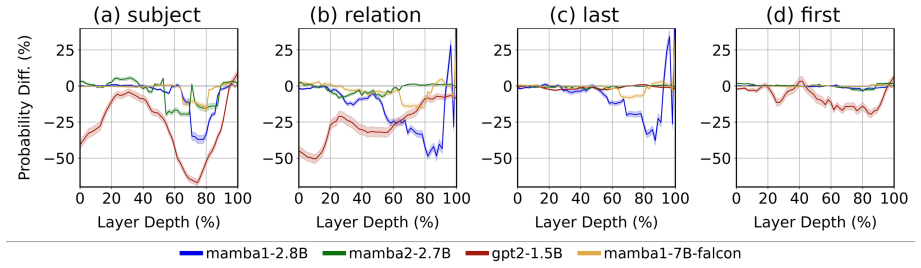
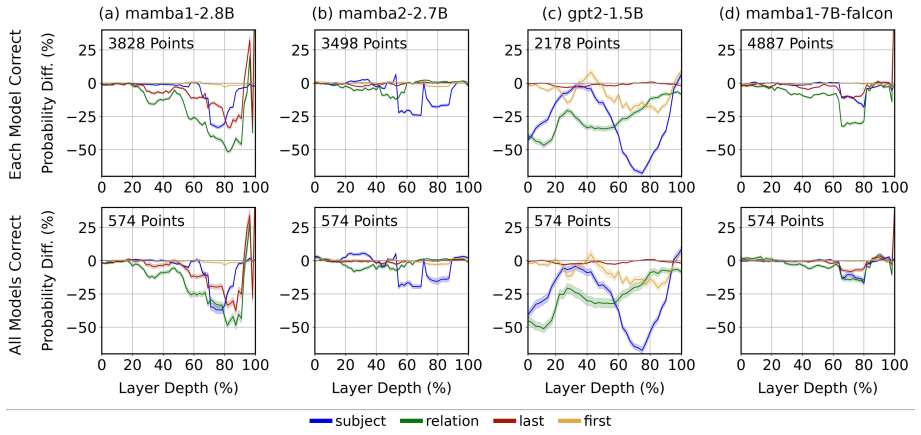
Across every model tested, zeroing the token-to-token connection from subject tokens to the final token in late-intermediate layers reliably drops correct-token probability, whereas knockouts of other token connections produce model-specific effects. Within Mamba models, the same effect is reproduced by knocking out only the slow-decay, context-dependent features, while fast-decay, context-independent features have little impact. The paper also finds architecture-specific quirks: GPT-2 shows a strong first-token bias, Mamba-1 shows a marked dependence on the final token, and Mamba-1 and Falcon-Mamba exhibit a surprising surge in correct-token probability when the final token's self-connection is blocked. These results are presented as evidence that the subject-to-final-token pathway is a universal feature of factual recall in large language models, with variations in other pathways attributable to architectural design.
Load-bearing premise
The feature-level conclusion rests on the untested assumption that ranking features by $\|\bar{A}\|_1$ and splitting at the one-third quantiles separates genuinely different functional roles.
Editorial extensions
If this is right
- Attention-style knockout works on Mamba-1, Mamba-2, and Transformer models alike, making it a general interpretability tool for state-space architectures.
- The subject-to-final-token transfer in late-intermediate layers is a shared mechanism for factual attribute prediction across all inspected architectures.
- Context-dependent features are the effective carriers of cross-token factual information: knocking them out alone mirrors full knockout.
- Architecture-specific patterns, such as GPT-2's first-token bias and Mamba-1's final-token dependence, are tied to each model's internal design rather than to the shared fact-recall pathway.
Reading between the lines
- If the norm-based feature split tracks true memory decay, the same feature knockout could serve as a cheap diagnostic for localizing facts within an SSM, which the paper does not explicitly pursue.
- The Mamba-1 surge in correct-token probability when the final token's self-connection is blocked may indicate redundant self-reinforcement in late layers; a testable extension is whether removing that self-connection improves calibration on factual queries.
- The method generalizes in principle to other gated linear RNNs with attention-equivalent kernels, though the paper only demonstrates Mamba-1 and Mamba-2.
- The observed universal pathway for factual recall suggests that architectural inductive biases, rather than the attention mechanism itself, drive most cross-model differences in information flow.
Editorial analysis
A structured set of objections, weighed in public.
Referee Report
Summary. The paper proposes extending the attention-knockout interpretability method from Transformers to Mamba-1 and Mamba-2 state-space models. To do so, it relies on the 'hidden attention' formulation for Mamba-1 and the implicit linear-attention formulation for Mamba-2, then reports layer-wise effects of zeroing token-to-token connections on COUNTERFACT fact-recall prompts across Mamba-1, Mamba-2, Falcon-Mamba, GPT-2, Llama, and Mistral models. The central empirical claim is that, across all models, knocking out the final token's connection to subject tokens in late-intermediate layers causes a consistent drop in correct-token probability, while other source-token knockouts reveal architecture-specific patterns. The paper additionally introduces a 'feature knockout' that partitions SSM features into context-dependent and context-independent groups by the magnitude of ||\bar{A}||_1, and reports that knocking out context-dependent features mimics the all-features effect while context-independent features have little impact. The manuscript includes code and several ablation experiments on window size, dataset subset, and model scale.
Significance. If the central result holds, the paper would be a useful step toward a unified interpretability toolkit for SSM-based and attention-based language models, and its feature-level decomposition could inform pruning and fine-tuning studies. The paper has genuine strengths: it covers multiple model families and sizes, it provides several ablations (dataset selection, window size, additional Transformer baselines), and the proposed knockout interventions are parameter-free in the sense that they zero existing kernel or attention entries rather than fitting new parameters. The main source of significance is the cross-architecture convergence on subject-to-final-token flow, which is an interesting and falsifiable empirical claim. However, the significance is currently capped by two unresolved issues: the Mamba-1 hidden-attention formula in Section 3.3 appears to be index-inconsistent with the causal SSM unrolling, and the self-knockout surge in Figure 2 remains unexplained. Both issues directly affect the validity of the 'across all models' claim.
major comments (4)
- [Section 3.3] The hidden-attention kernel formula is inconsistent with the causal SSM recurrence. For an SSM with x(t+1)=A(t)x(t)+B(t)u(t) and y(t)=C(t)x(t), the coefficient of input token i in output token j (with i<=j) is C_j (prod_{t=i+1}^j A(t)) B_i, not C_i (prod_{t=i}^j A(t)) B_j. The printed M_{i,j}=Q_i H_{i,j} K_j with i<=j therefore cannot represent information flowing from earlier token i to later token j; it places C at the earlier index and B at the later index and includes the wrong product range. Since Section 3.1 defines knockout at index (c,r) as preventing token c from attending to token r, the index convention in Section 3.3 must be corrected and the product range must be i+1..j for a source i and recipient j. If the released code follows the printed formula, the Mamba-1 knockout is not severing subject-to-final-token attention, and the central claim for Mamba-1 is not supported. The paper needs to state the correct index mapping and, ideally, verify in code that the zeroed entry corresponds to the intended causal path.
- [Section 4.2.2 / Figure 2] The self-knockout result is a serious confound for the Mamba-1 and Falcon-Mamba analyses. The paper reports that zeroing the final token's connection to itself raises correct-token probability to nearly 1 regardless of baseline probability. A clean causal severing of 'attention from the last token to itself' would be expected to remove, at most, a small self-information term; a uniform surge to near-certainty is more consistent with an off-target intervention, such as inadvertently zeroing the input injection at the final position or changing the effective normalization. The paper acknowledges the result and defers it, but this unexplained behavior undermines the use of the same knockout mechanism as evidence for the Mamba-1 leg of the 'consistent across all models' claim. The authors should either explain the mechanism, provide a control intervention that reproduces the effect, or qualify the cross-model conclusions until this is resolved.
- [Section 3.5 / Figure 6] The feature classification underlying the feature-knockout experiment is not adequately justified. The paper splits features into context-dependent and context-independent using the largest and lowest one-third of ||\bar{A}||_1 values, but it gives no theoretical argument or ablation showing that this norm-based split corresponds to a functionally meaningful distinction between inter-token transmission and single-token enrichment. In addition, the description 'zeroing out their outputs' is underspecified: it is not clear whether the intervention zeros the feature's contribution in the hidden-attention kernel, in the SSM state update, or in the layer output, and whether it applies to all token positions or only the subject-to-final path. Because Section 4.4's conclusion that context-dependent features reproduce the all-features knockout depends entirely on this classification and intervention, the paper should provide a precise implementation description and an ablation over the split ratio (e.g., quartiles, median, or data-driven thresholds).
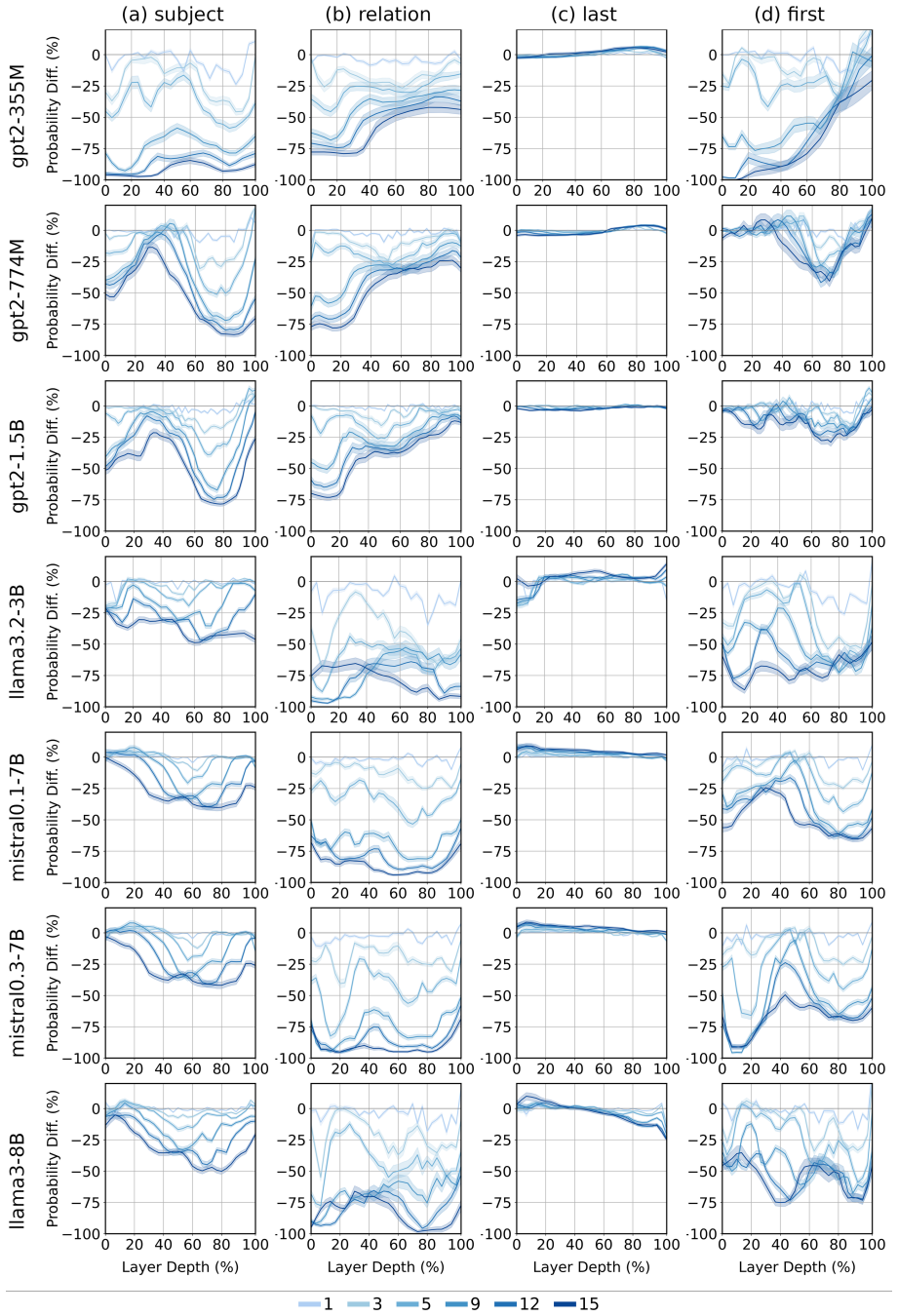
- [Figures 1-6 and Section 4] The quantitative support for the main empirical claims is currently qualitative. The figures show relative changes in correct-token probability but no error bars, confidence intervals, or significance tests over the 672 examples. The paper repeatedly states that a knockout 'causes a notable drop' or 'consistently reduces performance,' but without variance information it is impossible to assess whether the reported differences are reliable or whether the apparent cross-model consistency could arise from a small number of high-impact outliers. Reporting per-example distributions, bootstrap intervals, or paired significance tests (e.g., comparing knockout vs. baseline over the same prompts) would substantially strengthen the central claim.
minor comments (4)
- [Section 3.5] The notation A(t) = \bar{A}\Delta(t) appears to be missing a superscript; the text should read A(t) = \bar{A}^{\Delta(t)} to be consistent with the subsequent product formula \bar{A}^{\sum \Delta(t)}.
- [References] The Mistral citation is attributed to 'Fengqing Jiang, 2024', which is a master's thesis and not the correct reference for the Mistral language model. The paper should cite the actual Mistral 7B paper (Jiang et al., 2023) or otherwise clarify which model was used.
- [Section 4.6] The sentence 'blocking 37.5% of blocks' should read 'blocking 37.5% of layers' for clarity.
- [Section 4.2.2 / Figure 1 caption] The figure caption states the x-axis is 'relative depth of the first layer within the 9-layer attention knockout window,' which is clear, but the y-axis label 'relative change in correct-token probability' should specify whether the change is relative to the baseline probability of each sample or to the aggregate. Please state the normalization in the caption or in Section 4.
Circularity Check
No significant circularity: direct knockout interventions, a fixed a priori feature split, and only a non-load-bearing self-citation.
full rationale
The paper's central evidence is the attention-knockout intervention: entries of the Mamba kernel or Mamba-2 implicit attention matrix, and of GPT-2 attention, are directly zeroed, with no parameters fitted to the observed probability drops. The COUNTERFACT subset is an external benchmark, and the comparison to Geva et al. (2023) is an external methodological baseline. The feature-knockout split in Section 3.5 is fixed a priori by the largest and lowest one-third of ||Abar||_1 values; it is not tuned to the downstream effect, so the Section 4.4 finding is not a fitted input renamed as a prediction. There is a mild definitional flavor: 'context-dependent' is defined as slow decay, which is the very property that allows cross-token information retention, and the paper itself notes the analysis 'remains correlational and does not yet establish causation.' This lowers the epistemic weight of the feature-knockout claim but does not make it circular. The only self-citation is Ben-Kish et al. (2025), which includes a current author (Raja Giryes); it is cited alongside external works (Ali et al., 2024; Dao and Gu, 2024) as general motivation and is not load-bearing for the method or conclusions. No uniqueness theorem is imported from the authors' prior work, and no ansatz is smuggled in via self-citation. The reviewer's concern about the Mamba-1 kernel index convention in Section 3.3 is a potential correctness issue, not a circularity issue; likewise, the unexplained self-knockout surge in Figure 2 is an empirical anomaly but not an input-output equivalence. Overall, the main subject-token knockout result is self-contained and parameter-free, so any circularity is negligible.
Assumptions & free parameters
free parameters (2)
- Feature classification split ratio =
1/3 vs 1/3
- Knockout window size =
9 layers
assumptions (3)
- domain assumption The hidden attention kernel representation of Mamba-1 (Ali et al. 2024) and the linear attention equivalence of Mamba-2 (Dao and Gu 2024) exactly describe token-to-token contributions in pretrained Mamba models.
- ad hoc to paper The decay of the state-transition product, quantified by ||Abar||_1, determines whether a feature transmits information between tokens (context-dependent) or processes a single token (context-independent).
- domain assumption Zeroing a single kernel entry has no off-target effects on other token interactions or on the model's normalization.
Cite this review
Pith. "Pith review of Mamba Knockout for Unraveling Factual Information Flow." pith.science (2026). https://pith.science/paper/N6DZQHJ2
@misc{pith2026250524244,
  author       = {Pith},
  title        = {Pith review of: Mamba Knockout for Unraveling Factual Information Flow},
  year         = {2026},
  howpublished = {\url{https://pith.science/paper/N6DZQHJ2}},
  note         = {Machine review of arXiv:2505.24244}
}
read the original abstract
This paper investigates the flow of factual information in Mamba State-Space Model (SSM)-based language models. We rely on theoretical and empirical connections to Transformer-based architectures and their attention mechanisms. Exploiting this relationship, we adapt attentional interpretability techniques originally developed for Transformers--specifically, the Attention Knockout methodology--to both Mamba-1 and Mamba-2. Using them we trace how information is transmitted and localized across tokens and layers, revealing patterns of subject-token information emergence and layer-wise dynamics. Notably, some phenomena vary between mamba models and Transformer based models, while others appear universally across all models inspected--hinting that these may be inherent to LLMs in general. By further leveraging Mamba's structured factorization, we disentangle how distinct "features" either enable token-to-token information exchange or enrich individual tokens, thus offering a unified lens to understand Mamba internal operations.
Figures


Figures from the paper (17 more)






Reference graph
Works this paper leans on
-
[1]
online" 'onlinestring :=
ENTRY address archivePrefix author booktitle chapter edition editor eid eprint eprinttype howpublished institution journal key month note number organization pages publisher school series title type volume year doi pubmed url lastchecked label extra.label sort.label short.list INTEGERS output.state before.all mid.sentence after.sentence after.block STRING...
-
[2]
write newline
" write newline "" before.all 'output.state := FUNCTION n.dashify 't := "" t empty not t #1 #1 substring "-" = t #1 #2 substring "--" = not "--" * t #2 global.max substring 't := t #1 #1 substring "-" = "-" * t #2 global.max substring 't := while if t #1 #1 substring * t #2 global.max substring 't := if while FUNCTION word.in bbl.in capitalize " " * FUNCT...
-
[3]
Ameen Ali, Itamar Zimerman, and Lior Wolf. 2024. https://arxiv.org/abs/2403.01590 The hidden attention of mamba models . Preprint, arXiv:2403.01590
arXiv 2024
-
[4]
Assaf Ben-Kish, Itamar Zimerman, Shady Abu-Hussein, Nadav Cohen, Amir Globerson, Lior Wolf, and Raja Giryes. 2025. Decimamba: Exploring the length extrapolation potential of mamba. In The Thirteenth International Conference on Learning Representations (ICLR)
work page 2025
-
[5]
Sid Black, Stella Biderman, Eric Hallahan, Quentin Anthony, Leo Gao, Laurence Golding, Horace He, Connor Leahy, Kyle McDonell, Jason Phang, et al. 2022. Gpt-neox-20b: An open-source autoregressive language model. arXiv preprint arXiv:2204.06745
arXiv 2022
-
[6]
Trenton Bricken, Adly Templeton, Joshua Batson, Brian Chen, Adam Jermyn, Tom Conerly, Nick Turner, Cem Anil, Carson Denison, Amanda Askell, et al. 2023. Towards monosemanticity: Decomposing language models with dictionary learning. Transformer Circuits Thread, 2
2023
-
[7]
Arthur Conmy, Augustine Mavor-Parker, Aengus Lynch, Stefan Heimersheim, and Adri \`a Garriga-Alonso. 2023. Towards automated circuit discovery for mechanistic interpretability. Advances in Neural Information Processing Systems, 36:16318--16352
work page 2023
-
[8]
Tri Dao and Albert Gu. 2024. Transformers are ssms: Generalized models and efficient algorithms through structured state space duality. arXiv preprint arXiv:2405.21060
arXiv 2024
Show all 34 references
-
[9]
Nelson Elhage, Tristan Hume, Catherine Olsson, Nicholas Schiefer, Tom Henighan, Shauna Kravec, Zac Hatfield-Dodds, Robert Lasenby, Dawn Drain, Carol Chen, et al. 2022. Toy models of superposition. arXiv preprint arXiv:2209.10652
2022 arXiv
-
[10]
Nelson Elhage, Neel Nanda, Catherine Olsson, Tom Henighan, Nicholas Joseph, Ben Mann, Amanda Askell, Yuntao Bai, Anna Chen, Tom Conerly, et al. 2021. A mathematical framework for transformer circuits. Transformer Circuits Thread, 1(1):12
2021
-
[11]
Matthew Finlayson, Aaron Mueller, Sebastian Gehrmann, Stuart Shieber, Tal Linzen, and Yonatan Belinkov. 2021. Causal analysis of syntactic agreement mechanisms in neural language models. arXiv preprint arXiv:2106.06087
2021 arXiv
-
[12]
Mor Geva, Jasmijn Bastings, Katja Filippova, and Amir Globerson. 2023. Dissecting recall of factual associations in auto-regressive language models. arXiv preprint arXiv:2304.14767
2023 arXiv
-
[13]
Mor Geva, Roei Schuster, Jonathan Berant, and Omer Levy. 2021. https://arxiv.org/abs/2012.14913 Transformer feed-forward layers are key-value memories . Preprint, arXiv:2012.14913
2021 arXiv
-
[14]
Aaron Grattafiori, Abhimanyu Dubey, Abhinav Jauhri, Abhinav Pandey, Abhishek Kadian, Ahmad Al-Dahle, Aiesha Letman, Akhil Mathur, Alan Schelten, Alex Vaughan, et al. 2024. The llama 3 herd of models. arXiv preprint arXiv:2407.21783
2024 arXiv
-
[16]
Albert Gu and Tri Dao. 2024. https://arxiv.org/abs/2312.00752 Mamba: Linear-time sequence modeling with selective state spaces . Preprint, arXiv:2312.00752
2024 arXiv
-
[17]
Xiangming Gu, Tianyu Pang, Chao Du, Qian Liu, Fengzhuo Zhang, Cunxiao Du, Ye Wang, and Min Lin. 2024. https://arxiv.org/abs/2410.10781 When attention sink emerges in language models: An empirical view . Preprint, arXiv:2410.10781
2024 arXiv
-
[18]
Peter Hase, Mohit Bansal, Been Kim, and Asma Ghandeharioun. 2023. https://arxiv.org/abs/2301.04213 Does localization inform editing? surprising differences in causality-based localization vs. knowledge editing in language models . Preprint, arXiv:2301.04213
2023 arXiv
-
[19]
Tommy Ip. 2023. https://github.com/tommyip/mamba2-minimal/blob/main/mamba2.py Github repository for mamba implementation . Accessed: 2024-10-26
2023
-
[20]
Fengqing Jiang. 2024. Identifying and mitigating vulnerabilities in llm-integrated applications. Master's thesis, University of Washington
2024
-
[21]
Angelos Katharopoulos, Apoorv Vyas, Nikolaos Pappas, and Fran c ois Fleuret. 2020. https://proceedings.mlr.press/v119/katharopoulos20a.html Transformers are RNN s: Fast autoregressive transformers with linear attention . In Proceedings of the 37th International Conference on M...
2020
-
[22]
Kevin Meng, David Bau, Alex Andonian, and Yonatan Belinkov. 2022. Locating and editing factual associations in gpt. Advances in Neural Information Processing Systems, 35:17359--17372
2022
-
[23]
Kevin Meng, Arnab Sen Sharma, Alex Andonian, Yonatan Belinkov, and David Bau. 2023. https://arxiv.org/abs/2210.07229 Mass-editing memory in a transformer . Preprint, arXiv:2210.07229
2023 arXiv
-
[24]
Paul Michel, Omer Levy, and Graham Neubig. 2019. Are sixteen heads really better than one? Advances in neural information processing systems, 32
2019
-
[25]
Lee, and Alberto Bietti
Eshaan Nichani, Jason D. Lee, and Alberto Bietti. 2024. https://arxiv.org/abs/2412.06538 Understanding factual recall in transformers via associative memories . Preprint, arXiv:2412.06538
2024 arXiv
-
[26]
Chris Olah, Nick Cammarata, Ludwig Schubert, Gabriel Goh, Michael Petrov, and Shan Carter. 2020. Zoom in: An introduction to circuits. Distill, 5(3):e00024--001
2020
-
[27]
Catherine Olsson, Nelson Elhage, Neel Nanda, Nicholas Joseph, Nova DasSarma, Tom Henighan, Ben Mann, Amanda Askell, Yuntao Bai, Anna Chen, et al. 2022. In-context learning and induction heads. arXiv preprint arXiv:2209.11895
2022 arXiv
-
[28]
Adam Paszke, Sam Gross, Francisco Massa, Adam Lerer, James Bradbury, Gregory Chanan, Trevor Killeen, Zeming Lin, Natalia Gimelshein, Luca Antiga, Alban Desmaison, Andreas Köpf, Edward Yang, Zach DeVito, Martin Raison, Alykhan Tejani, Sasank Chilamkurthy, Benoit Steiner, Lu Fan...
2019 arXiv
-
[29]
Alec Radford, Jeffrey Wu, Rewon Child, David Luan, Dario Amodei, Ilya Sutskever, et al. 2019. Language models are unsupervised multitask learners. OpenAI blog, 1(8):9
2019
-
[30]
Arnab Sen Sharma, David Atkinson, and David Bau. 2024. https://arxiv.org/abs/2404.03646 Locating and editing factual associations in mamba . Preprint, arXiv:2404.03646
2024 arXiv
-
[31]
Roger Waleffe, Wonmin Byeon, Duncan Riach, Brandon Norick, Vijay Korthikanti, Tri Dao, Albert Gu, Ali Hatamizadeh, Sudhakar Singh, Deepak Narayanan, Garvit Kulshreshtha, Vartika Singh, Jared Casper, Jan Kautz, Mohammad Shoeybi, and Bryan Catanzaro. 2024. https://arxiv.org/abs/...
2024 arXiv
-
[32]
Kevin Wang, Alexandre Variengien, Arthur Conmy, Buck Shlegeris, and Jacob Steinhardt. 2022. Interpretability in the wild: a circuit for indirect object identification in gpt-2 small, 2022. URL https://arxiv. org/abs/2211.00593, 2
2022 arXiv
-
[33]
Thomas Wolf, Lysandre Debut, Victor Sanh, Julien Chaumond, Clement Delangue, Anthony Moi, Pierric Cistac, Tim Rault, Rémi Louf, Morgan Funtowicz, Joe Davison, Sam Shleifer, Patrick von Platen, Clara Ma, Yacine Jernite, Julien Plu, Canwen Xu, Teven Le Scao, Sylvain Gugger, Mari...
2020 arXiv
-
[34]
Guangxuan Xiao, Yuandong Tian, Beidi Chen, Song Han, and Mike Lewis. 2024. https://arxiv.org/abs/2309.17453 Efficient streaming language models with attention sinks . Preprint, arXiv:2309.17453
2024 arXiv
-
[35]
Itamar Zimerman, Ameen Ali Ali, and Lior Wolf. 2025. Explaining modern gated-linear RNN s via a unified implicit attention formulation. In The Thirteenth International Conference on Learning Representations (ICLR)
2025
Reviewed August 7, 2026 · model on record in the stance chip above.
Discussion (0). Sign in to comment.