REVIEW 3 major objections 5 minor 12 cited by
A Fourier Space Perspective on Diffusion Models
T0 review · 3 major / 5 minor · reviewed 2026-08-15 · deepseek-v4-flash
Pith's one-line read The paper claims that the standard diffusion noising schedule corrupts high-frequency details so fast it breaks the reverse step's Gaussian assumption, degrading generated fine detail; an equal-SNR schedule fixes this at no FID cost.
desk verdict Clear paper on frequency-aware forward processes, but the headline causal claim is confounded by changing loss weighting alongside forward noise, so the high-frequency gains cannot yet be attributed to equal-rate noising. read the letter →
The pith
A machine-rendered reading of the paper's core claim, the machinery that carries it, and where it could break.
The reading
What carries the argument
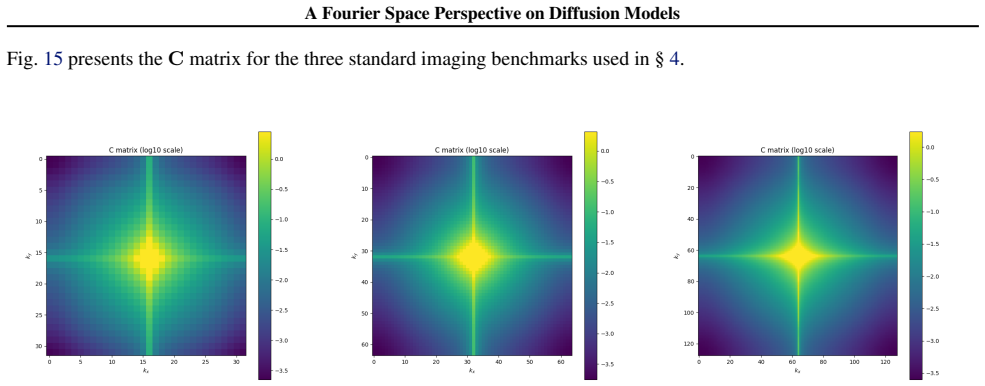
The load-bearing object is the per-frequency Signal-to-Noise Ratio in the Fourier domain, $\mathrm{SNR}_t(i) = \frac{\alpha_t C_i}{(1-\alpha_t)\Sigma_{ii}}$, where $C_i$ is the variance of the $i$-th Fourier coefficient of the data and $\Sigma_{ii}$ the variance of the added noise at that coordinate. Under DDPM the noise variance is flat, so for power-law data the high-frequency SNR is orders of magnitude below the low-frequency SNR at every timestep; 'faster noising' then means a larger SNR drop per time increment, and 'earlier' means a smaller SNR at every fixed time. EqualSNR re-weights the noise so that $\Sigma_{ii} \propto C_i$, making the SNR equal across all frequencies at each timestep and removing the hierarchy. The framework also carries the explanation: the reverse kernel $q(y_{t-1} \mid y_t)$ is Gaussian only when the forward noise is small relative to the signal variance, and the SNR is exactly the quantity that measures that ratio, so it pinpoints where the Gaussian assumption breaks and defines a calibration procedure for comparing schedules fairly.
What would settle it
Construct (or find) a natural-image-like dataset whose high-frequency Fourier marginals are exactly Gaussian while still following the power law in variance, and compare DDPM against EqualSNR on it: if the DDPM high-frequency deficit persists, the normality violation is not the main driver; if it vanishes, the proposed mechanism is confirmed.
Extended reading notes
Core claim
The central claim is that the DDPM forward process, acting on data whose Fourier variance decays as a power law, noises high-frequency components faster and earlier than low-frequency ones, and that this unequal treatment breaks the Gaussianity assumption of the reverse process for exactly those components. In a finite-time model each reverse transition $q(y_{t-1} \mid y_t)$ is approximated by a Gaussian; the paper proves that when the forward noise is large relative to the signal variance, the true posterior can stay a constant total-variation distance away from any Gaussian, and that this is precisely the situation at high frequencies under DDPM. On CIFAR-10 the KL divergence of the reverse posterior from its Gaussian approximation is $1.8\times10^{-2}$ at a high frequency versus $3.1\times10^{-4}$ at a low frequency, and the paper ties this to the observable failure of DDPM: a logistic regression on two summary statistics of the spectral magnitudes separates DDPM-generated images from real ones almost 100% of the time. The proposed alternative, EqualSNR, sets the per-frequency SNR equal across all coordinates at every timestep by making the noise variance proportional to the data variance in Fourier space. With this schedule the normality violations shrink to match low-frequency levels, the same detector drops to near-chance accuracy, FID on CIFAR-10, CelebA, and LSUN Church is on par with DDPM (better on the highest-resolution dataset), and a synthetic sparse-dots task where high frequencies dominate shows a marked quality gain. The paper therefore claims that the low-to-high frequency generation hierarchy is not essential to diffusion models.
Load-bearing premise
The argument depends on high-frequency detail patterns in real images being far from bell-shaped, as in the paper's two-peak toy example; if they were effectively bell-shaped, the reverse step's Gaussian approximation would hold and fast noising would not produce the degradation the paper blames on it.
Editorial extensions
If this is right
- The low-to-high frequency generation hierarchy is a side effect of the DDPM noise schedule, not an ingredient diffusion models need: a hierarchy-free schedule trains and samples stably with equal or better fidelity.
- Any modality with a power-law spectrum, such as images, audio, video, and protein density maps, inherits the same fast-noising distortion, so equal-SNR forward processes become a natural default there.
- EqualSNR reaches its final FID with fewer timesteps than DDPM, so the schedule also offers a sampling-cost saving at fixed quality.
- The per-frequency SNR defines a direct design space for task-tuned schedules, such as spending more steps on the frequencies that matter for a downstream application, without changing the network architecture.
- Spectral summary statistics exposed a quality gap that FID missed, so frequency-aware evaluation should accompany FID when fine detail matters.
Reading between the lines
- The paper's own Figure 1 shows the same power-law spectrum in audio, video, and protein density maps, yet its experiments stop at natural images; the direct next test is EqualSNR on those modalities, where the same high-frequency gain is predicted.
- An alternative reading of the results is plainer than the normality story: giving every frequency an equal SNR also gives fine details as many refinement steps as coarse structure, so per-frequency quality should improve under any account of discretisation error; measuring per-frequency reconstruction error per timestep would separate the resource-allocation effect from the Gaussianity mechanism.
- If high-frequency fidelity is what defeats spectral detectors, equal-rate schedules also lower the cost of realistic forgeries in detail-rich domains; the paper flags the DeepFake implication in its impact statement but does not quantify how much harder detection becomes at full resolution.
- All experiments use deterministic DDIM sampling while the normality argument is made for the stochastic reverse kernel; repeating the comparison with true ancestral sampling would show whether the equal-rate benefit belongs to the forward process or to the sampler.
Signed reviews
Editorial analysis
A structured set of objections, weighed in public.
Referee Report
Summary. The paper studies the forward noising process of DDPM in Fourier space. It observes that for data with a power-law spectral variance, standard white-noise corruption makes high-frequency components reach low SNR faster and earlier than low-frequency components. The authors argue that this fast noising violates the Gaussianity assumption for the reverse-process conditional at finite discretization, leading to degraded high-frequency sample quality. They propose EqualSNR, a Fourier-space forward process whose noise covariance is matched to the data covariance so that all frequencies have equal SNR at each timestep, and provide an ELBO-based training loss and a DDIM-style sampler. Experiments on CIFAR10, CelebA, LSUN Church, and a synthetic dots dataset report FID comparable to DDPM and improved high-frequency statistics under a Fourier-space discriminator.
Significance. If the central claim holds, the paper would provide a crisp explanation of a widely observed phenomenon and show that the low-to-high frequency generation hierarchy is not essential to diffusion models. The paper's empirical contribution is substantial: EqualSNR is competitive on standard benchmarks and improves high-frequency fidelity, with careful calibration of average SNR. The ELBO connection (Proposition 2) and the covariance-matching construction (Definition 2) are clean. However, the causal mechanism asserted in the abstract is not yet isolated: the comparison changes both the forward process and the loss weighting, and the theoretical results are toy examples rather than a general theorem. The paper also ships many auxiliary analyses (SNR heatmaps, per-frequency variance trajectories) that are useful for the community.
major comments (3)
- [§4, Algorithm 1, Table 1] The experimental comparison does not isolate the forward process from the loss objective. EqualSNR is trained with L_t = ||C^{-1/2}(y0 - \hat y0)||^2, while the DDPM baseline is trained with unweighted pixel-space MSE; in Fourier space this is an unweighted loss. Because high-frequency entries of C are orders of magnitude smaller than low-frequency ones, the C^{-1/2} weighting massively increases the penalty on high-frequency errors, so a U-Net with limited capacity will devote more capacity to high frequencies even if the forward SNR profile is unchanged. Table 1 compares EqualSNR against DDPM under different calibrations but never varies the loss weighting while holding the forward process fixed (or vice versa). The high-frequency gains in Table 2 and Figs. 5-6, and the dots result in Fig. 6, could therefore be due to the objective rather than to equal-rate noising. The manuscript should include an ablation where, for example, DDPM is trained with the C^{-1/2}-weighted loss or EqualSNR is trained with an unweighted loss, to identify the cause of the improvements.
- [§3.2 / §3.1] The theoretical justification of the Gaussian-violation mechanism is developed for the stochastic reverse process q(yt-1|yt), but all experiments (Algorithm 2 and the standard DDIM sampler) use deterministic DDIM sampling. The statement in §3.2 that 'a similar property holds here' for DDIM is asserted without derivation or direct verification. Since the empirical claims in §4 are obtained with DDIM, the paper should either prove or empirically test the analogous normality-violation statement for the deterministic DDIM update, or at least discuss why the stochastic analysis transfers.
- [§3.1, Proposition 3] Proposition 3 is a counterexample with a two-component Gaussian-mixture prior D0 = 1/2 N(-1, delta^2) + 1/2 N(1, delta^2) and forward noise variance 4. It shows that such a prior can produce a non-Gaussian reverse conditional. However, the paper does not establish that actual high-frequency Fourier coefficients of natural images satisfy the premise; these coefficients are approximately sums over many pixels and are expected to be near-Gaussian by the central limit theorem. The empirical KDE/KL evidence in Fig. 3 uses one timestep and shows KL values of order 10^-2, and the claim that such small violations accumulate into the visible high-frequency degradation in §4 is not supported by a quantitative error-propagation argument. The abstract's causal statement 'faster noising ... results in violations ... leads to degraded generation quality' is therefore stronger than what the theoretical results and experiments currently establish.
minor comments (5)
- [§2, Eq. (4)] The calculation of the noise covariance in Fourier space assumes that the discrete Fourier transform is unitary (up to a normalization constant); this should be stated explicitly so the reader can follow the covariance computation.
- [Definition 2] The phrase 'universal constant' for c should be replaced by 'constant independent of frequency' to avoid confusion with the standard meaning of universal constants in probability theory.
- [§3.1 and §A.6] The numbering of propositions is inconsistent: the informal Proposition 1 in §3.1 is formalized as Proposition 3 in §A.6; please align the numbering.
- [§A.3] The derivation of the calibrated alpha_eq^t should spell out the averaging measure (equal weights over frequencies) and state that the calibration is performed on the training set, so that the values in Table 1 are reproducible.
- [§B.1, Eq. (13)] Equation (13) uses y0 on the right-hand side while the surrounding text says the model predicts a clean estimate; the notation should be corrected to \hat y0.
Circularity Check
No significant circularity: the EqualSNR equal-SNR property is definitional, not a fitted prediction, and the main claims rest on independent theoretical and empirical evidence.
full rationale
The paper's derivation chain is self-contained. The claim that DDPM noises high frequencies faster and earlier follows directly from the SNR definition s_DDPM_t(i)=α_t C_i/(1−α_t) together with the empirically documented Fourier power law; it is an implication, not an assumed conclusion. EqualSNR is defined by choosing noise covariance Σ_ii=cC_i, so equal SNR across frequencies holds by construction, but the paper does not present that definition as a derived prediction; the substantive contributions are the normality-violation analysis, the alternate forward process, and the empirical comparisons. Proposition 3 is a standalone counterexample: a two-component mixture prior with added noise yields a non-Gaussian reverse conditional. It does not assume the high-frequency generation result, and the bridge to real data is supported by the Monte Carlo and KDE evidence in Fig. 3 and the KL numbers in §3.1, not by the proposition alone. The experiments are benchmarked against external data and metrics: the Dzanic-style classifier is trained on real versus generated Fourier magnitudes, and FID is reported against standard imaging datasets. No parameter is fitted to the outcome and then renamed a prediction; the calibration in §A.3 merely matches average SNR across forward processes as a normalization. The self-citations in §5 (Williams et al. 2023, Falck et al. 2022) are related-work references on U-Net spectral properties and are not load-bearing for the central claim. Two caveats are worth flagging, but they are not circularity in the formal sense. First, the EqualSNR comparison in Section 4 changes both the forward noise covariance and the training loss L_t=||C^{-1/2}(y0−ŷ0)||^2, so the observed high-frequency improvements are not isolated to the noising rate; this is an experimental confound, not a reduction by construction. Second, the statement in §3.2 that a similar normality-violation property holds for deterministic DDIM is asserted without derivation even though DDIM is used in experiments; this is an omitted justification, not a circular step. Appendix B's stated limitations about resolution, FlippedSNR, and modality coverage also indicate an honest, non-circular presentation. Overall, the paper's main comparison is against external benchmarks and its theoretical results do not reduce to their inputs by definition.
Assumptions & free parameters
free parameters (1)
- Fourier signal variance matrix C =
Diag(Cov(y0)) estimated from training data
assumptions (5)
- domain assumption Target data modalities (images, audio, proteins, materials) exhibit exponentially decaying variance and magnitude in the Fourier domain (Fourier power law).
- ad hoc to paper The toy two-component mixture in Proposition 3 transfers to real high-frequency Fourier coefficients of natural images.
- ad hoc to paper The reverse-process normality violation observed for stochastic DDPM also holds for deterministic DDIM sampling.
- domain assumption A U-Net retains its inductive bias when operating on pixel-space inputs while the training loss is computed in Fourier space.
- standard math In the limit T to infinity, the reverse transition q(y_{t-1}|y_t) converges to a Gaussian (Feller 1954).
Cite this review
Pith. "Pith review of A Fourier Space Perspective on Diffusion Models." pith.science (2026). https://pith.science/paper/N6N2FHNE
@misc{pith2026250511278,
  author       = {Pith},
  title        = {Pith review of: A Fourier Space Perspective on Diffusion Models},
  year         = {2026},
  howpublished = {\url{https://pith.science/paper/N6N2FHNE}},
  note         = {Machine review of arXiv:2505.11278}
}
read the original abstract
Diffusion models are state-of-the-art generative models on data modalities such as images, audio, proteins and materials. These modalities share the property of exponentially decaying variance and magnitude in the Fourier domain. Under the standard Denoising Diffusion Probabilistic Models (DDPM) forward process of additive white noise, this property results in high-frequency components being corrupted faster and earlier in terms of their Signal-to-Noise Ratio (SNR) than low-frequency ones. The reverse process then generates low-frequency information before high-frequency details. In this work, we study the inductive bias of the forward process of diffusion models in Fourier space. We theoretically analyse and empirically demonstrate that the faster noising of high-frequency components in DDPM results in violations of the normality assumption in the reverse process. Our experiments show that this leads to degraded generation quality of high-frequency components. We then study an alternate forward process in Fourier space which corrupts all frequencies at the same rate, removing the typical frequency hierarchy during generation, and demonstrate marked performance improvements on datasets where high frequencies are primary, while performing on par with DDPM on standard imaging benchmarks.
Figures


Figures from the paper (26 more)




Forward citations
Cited by 12 Pith papers
-
A First-Principles Theory of Slow Thinking and Active Perception
Active lifting of data distributions via latent-sequence sampling and max-rate uncertainty reduction formally derives slow-thinking LLMs and places them on representation and sampler hierarchies that can be climbed.
-
PRISM: Principled Reference Identification for Schrodinger Bridge Model
The optimal bridge reference is v = x*(T) P, proportional to the destroyed-information spectrum, but real image statistics break this prediction and favor white noise.
-
Enhancing Membership Inference Attacks on Diffusion Models from a Frequency-Domain Perspective
Removing high-frequency components from reconstruction-error scores improves membership inference attacks on diffusion models, demonstrated on DDIM and Stable Diffusion.
-
Commitment Before Realization: When Classifier-Free Guidance Becomes Unnecessary in Masked Diffusion Language Models
A prompt-specific commitment horizon, identified by comparing guided versus base-only continuations, marks an early point where classifier-free guidance can be removed with little loss in constraint success.
-
CSGen: A Multi-Domain Curvilinear Structure Generation Model via Hierarchical Multimodal Diffusion
CSGen generates curvilinear structure images from layout and text conditions, improving structural fidelity and downstream segmentation over ControlNet and LoRA baselines.
-
WaiT for the Signal: Simple Frequency-Aware Flow-Matching
WaiT delays high-frequency wavelet bands in flow-matching image generation until coarse structure emerges, improving quality and cutting compute, with a reported SOTA FID of 1.30 on ImageNet 512.
-
Manifold-Constrained Noise Optimization for Diverse Diffusion Sampling
By optimizing each new starting noise on a fixed-radius, low-frequency sphere, MoNO recovers per-prompt diversity in distilled text-to-image models while keeping image quality roughly stable.
-
End-to-End Training for Autoregressive Video Diffusion via Self-Resampling
Resampling Forcing trains autoregressive video diffusion models on self-resampled degraded histories with a causal mask, achieving stable long-horizon generation without a teacher or discriminator.
-
Adaptive Transition State Refinement with Learned Equilibrium Flows
AEFM is a learned, structure-only refinement method that iteratively improves low-fidelity transition state geometries toward DFT-quality structures.
-
LSSGen: Leveraging Latent Space Scaling in Flow and Diffusion for Efficient Text to Image Generation
A latent-space scaling framework that replaces pixel-space upscaling with a trainable latent upsampler and noise compensation, yielding faster high-resolution text-to-image generation.
-
Cloud Diffusion Part 1: Theory and Motivation
Replacing white noise with scale-invariant noise tuned to an image set's power-law statistics could make diffusion models faster, sharper, and more controllable, this theory paper argues.
-
Perceptually Aligning Representations of Music via Noise-Augmented Autoencoders
Noise-augmented training of an audio autoencoder organizes representations so that perceptually salient information survives in coarse structures, improving musical surprisal estimates and EEG prediction.
Reference graph
Works this paper leans on
- [1]
-
[2]
Align your latents: High-resolution video synthesis with latent diffusion models
Andreas Blattmann, Robin Rombach, Huan Ling, Tim Dockhorn, Seung Wook Kim, Sanja Fidler, and Karsten Kreis. Align your latents: High-resolution video synthesis with latent diffusion models. In Proceedings of the IEEE/CVF Conference on Computer Vision and Pattern Recognition, pages 22563--22575, 2023
2023
-
[3]
Video generation models as world simulators
Tim Brooks, Bill Peebles, Connor Holmes, Will DePue, Yufei Guo, Li Jing, David Schnurr, Joe Taylor, Troy Luhman, Eric Luhman, Clarence Ng, Ricky Wang, and Aditya Ramesh. Video generation models as world simulators. 2024. URL https://openai.com/research/video-generation-models-as-world-simulators
2024
-
[4]
Sampling is as easy as learning the score: theory for diffusion models with minimal data assumptions
Sitan Chen, Sinho Chewi, Jerry Li, Yuanzhi Li, Adil Salim, and Anru Zhang. Sampling is as easy as learning the score: theory for diffusion models with minimal data assumptions. In The Eleventh International Conference on Learning Representations, 2023. URL https://openreview.net/forum?id=zyLVMgsZ0U_
work page 2023
-
[5]
Time series diffusion in the frequency domain
Jonathan Crabb \'e , Nicolas Huynh, Jan Stanczuk, and Mihaela van der Schaar. Time series diffusion in the frequency domain. arXiv preprint arXiv:2402.05933, 2024
arXiv 2024
-
[6]
Diffusion is spectral autoregression, 2024
Sander Dieleman. Diffusion is spectral autoregression, 2024. URL https://sander.ai/2024/09/02/spectral-autoregression.html
work page 2024
-
[7]
Fourier Spectrum Discrepancies in Deep Network Generated Image
Tarik Dzanic, Karan Shah, and Freddie Witherden. Fourier Spectrum Discrepancies in Deep Network Generated Image . Advances in neural information processing systems, 33: 0 3022--3032, 2020
work page 2020
-
[8]
A multi-resolution framework for U-Nets with applications to hierarchical VAEs
Fabian Falck, Christopher Williams, Dominic Danks, George Deligiannidis, Christopher Yau, Chris C Holmes, Arnaud Doucet, and Matthew Willetts. A multi-resolution framework for U-Nets with applications to hierarchical VAEs . Advances in Neural Information Processing Systems, 35: 0 15529--15544, 2022
work page 2022
Show all 52 references
-
[9]
Diffusion processes in one dimension
William Feller. Diffusion processes in one dimension. Transactions of the American Mathematical Society, 77: 0 1--31, 1954. URL https://api.semanticscholar.org/CorpusID:32048987
1954
-
[10]
Gud: Generation with unified diffusion
Mathis Gerdes, Max Welling, and Miranda CN Cheng. Gud: Generation with unified diffusion. arXiv preprint arXiv:2410.02667, 2024
2024 arXiv
-
[11]
Wavelet score-based generative modeling
Florentin Guth, Simon Coste, Valentin De Bortoli, and Stephane Mallat. Wavelet score-based generative modeling. Advances in neural information processing systems, 35: 0 478--491, 2022
2022
-
[12]
Gans trained by a two time-scale update rule converge to a local nash equilibrium
Martin Heusel, Hubert Ramsauer, Thomas Unterthiner, Bernhard Nessler, and Sepp Hochreiter. Gans trained by a two time-scale update rule converge to a local nash equilibrium. Advances in neural information processing systems, 30, 2017
2017
-
[13]
Denoising diffusion probabilistic models
Jonathan Ho, Ajay Jain, and Pieter Abbeel. Denoising diffusion probabilistic models. Advances in neural information processing systems, 33: 0 6840--6851, 2020
2020
-
[14]
Imagen video: High definition video generation with diffusion models
Jonathan Ho, William Chan, Chitwan Saharia, Jay Whang, Ruiqi Gao, Alexey Gritsenko, Diederik P Kingma, Ben Poole, Mohammad Norouzi, David J Fleet, et al. Imagen video: High definition video generation with diffusion models. arXiv preprint arXiv:2210.02303, 2022
-
[15]
simple diffusion: End-to-end diffusion for high resolution images
Emiel Hoogeboom, Jonathan Heek, and Tim Salimans. simple diffusion: End-to-end diffusion for high resolution images. In International Conference on Machine Learning, pages 13213--13232. PMLR, 2023
2023
-
[16]
Wavedm: Wavelet-based diffusion models for image restoration
Yi Huang, Jiancheng Huang, Jianzhuang Liu, Mingfu Yan, Yu Dong, Jiaxi Lyu, Chaoqi Chen, and Shifeng Chen. Wavedm: Wavelet-based diffusion models for image restoration. IEEE Transactions on Multimedia, 2024
2024
-
[17]
Natural image statistics: A probabilistic approach to early computational vision., volume 39
Aapo Hyv \"a rinen, Jarmo Hurri, and Patrick O Hoyer. Natural image statistics: A probabilistic approach to early computational vision., volume 39. Springer Science & Business Media, 2009
2009
-
[18]
Rethinking fid: Towards a better evaluation metric for image generation
Sadeep Jayasumana, Srikumar Ramalingam, Andreas Veit, Daniel Glasner, Ayan Chakrabarti, and Sanjiv Kumar. Rethinking fid: Towards a better evaluation metric for image generation. In Proceedings of the IEEE/CVF Conference on Computer Vision and Pattern Recognition, pages 9307--...
2024
-
[19]
Low-light image enhancement with wavelet-based diffusion models
Hai Jiang, Ao Luo, Haoqiang Fan, Songchen Han, and Shuaicheng Liu. Low-light image enhancement with wavelet-based diffusion models. ACM Transactions on Graphics (TOG), 42 0 (6): 0 1--14, 2023
2023
-
[20]
Shaping inductive bias in diffusion models through frequency-based noise control
Thomas Jiralerspong, Berton Earnshaw, Jason Hartford, Yoshua Bengio, and Luca Scimeca. Shaping inductive bias in diffusion models through frequency-based noise control. arXiv preprint arXiv:2502.10236, 2025
2025 arXiv
-
[21]
The kinetics human action video dataset
Will Kay, Joao Carreira, Karen Simonyan, Brian Zhang, Chloe Hillier, Sudheendra Vijayanarasimhan, Fabio Viola, Tim Green, Trevor Back, Paul Natsev, et al. The kinetics human action video dataset. arXiv preprint arXiv:1705.06950, 2017
2017 arXiv
-
[22]
Understanding diffusion objectives as the elbo with simple data augmentation
Diederik Kingma and Ruiqi Gao. Understanding diffusion objectives as the elbo with simple data augmentation. Advances in Neural Information Processing Systems, 36, 2024
2024
-
[23]
Variational diffusion models
Diederik Kingma, Tim Salimans, Ben Poole, and Jonathan Ho. Variational diffusion models. Advances in neural information processing systems, 34: 0 21696--21707, 2021
2021
-
[24]
Learning multiple layers of features from tiny images
Alex Krizhevsky, Geoffrey Hinton, et al. Learning multiple layers of features from tiny images. 2009
2009
-
[25]
Scalable emulation of protein equilibrium ensembles with generative deep learning
Sarah Lewis, Tim Hempel, Jos \'e Jim \'e nez Luna, Michael Gastegger, Yu Xie, Andrew YK Foong, Victor Garc \' a Satorras, Osama Abdin, Bastiaan S Veeling, Iryna Zaporozhets, et al. Scalable emulation of protein equilibrium ensembles with generative deep learning. bioRxiv, page...
2024
-
[26]
On error propagation of diffusion models
Yangming Li and Mihaela van der Schaar. On error propagation of diffusion models. In The Twelfth International Conference on Learning Representations, 2023
2023
-
[27]
On aliased resizing and surprising subtleties in gan evaluation
Gaurav Parmar, Richard Zhang, and Jun-Yan Zhu. On aliased resizing and surprising subtleties in gan evaluation. In CVPR, 2022
2022
-
[28]
Spectral diffusion processes
Angus Phillips, Thomas Seror, Michael Hutchinson, Valentin De Bortoli, Arnaud Doucet, and Emile Mathieu. Spectral diffusion processes. arXiv preprint arXiv:2209.14125, 2022
2022 arXiv
-
[29]
Wavelet diffusion models are fast and scalable image generators
Hao Phung, Quan Dao, and Anh Tran. Wavelet diffusion models are fast and scalable image generators. In Proceedings of the IEEE/CVF conference on computer vision and pattern recognition, pages 10199--10208, 2023
2023
-
[30]
On the spectral bias of neural networks
Nasim Rahaman, Aristide Baratin, Devansh Arpit, Felix Draxler, Min Lin, Fred Hamprecht, Yoshua Bengio, and Aaron Courville. On the spectral bias of neural networks. In International conference on machine learning, pages 5301--5310. PMLR, 2019
-
[31]
Generative modelling with inverse heat dissipation
Severi Rissanen, Markus Heinonen, and Arno Solin. Generative modelling with inverse heat dissipation. arXiv preprint arXiv:2206.13397, 2022
2022 arXiv
-
[32]
High-resolution image synthesis with latent diffusion models
Robin Rombach, Andreas Blattmann, Dominik Lorenz, Patrick Esser, and Bj \"o rn Ommer. High-resolution image synthesis with latent diffusion models. In Proceedings of the IEEE/CVF conference on computer vision and pattern recognition, pages 10684--10695, 2022
2022
-
[33]
U-net: Convolutional networks for biomedical image segmentation
Olaf Ronneberger, Philipp Fischer, and Thomas Brox. U-net: Convolutional networks for biomedical image segmentation. In Medical image computing and computer-assisted intervention--MICCAI 2015: 18th international conference, Munich, Germany, October 5-9, 2015, proceedings, part...
2015
-
[34]
Rolling diffusion models
David Ruhe, Jonathan Heek, Tim Salimans, and Emiel Hoogeboom. Rolling diffusion models. arXiv preprint arXiv:2402.09470, 2024
2024 arXiv
-
[35]
Deep unsupervised learning using nonequilibrium thermodynamics
Jascha Sohl-Dickstein, Eric Weiss, Niru Maheswaranathan, and Surya Ganguli. Deep unsupervised learning using nonequilibrium thermodynamics. In International conference on machine learning, pages 2256--2265. PMLR, 2015
2015
-
[36]
Denoising diffusion implicit models
Jiaming Song, Chenlin Meng, and Stefano Ermon. Denoising diffusion implicit models. arXiv preprint arXiv:2010.02502, 2020 a
2010 arXiv
-
[37]
Score-based generative modeling through stochastic differential equations
Yang Song, Jascha Sohl-Dickstein, Diederik P Kingma, Abhishek Kumar, Stefano Ermon, and Ben Poole. Score-based generative modeling through stochastic differential equations. arXiv preprint arXiv:2011.13456, 2020 b
2011 arXiv
-
[38]
Gtzan music/speech collection, 1999
George Tzanetakis. Gtzan music/speech collection, 1999. URL http://marsyas.info/index.html
1999
-
[39]
Modelling the power spectra of natural images: statistics and information
van A Van der Schaaf and JH van van Hateren. Modelling the power spectra of natural images: statistics and information. Vision research, 36 0 (17): 0 2759--2770, 1996
1996
-
[40]
Score-based denoising diffusion with non-isotropic gaussian noise models
Vikram Voleti, Christopher Pal, and Adam Oberman. Score-based denoising diffusion with non-isotropic gaussian noise models. arXiv preprint arXiv:2210.12254, 2022
2022 arXiv
-
[41]
Frequency compensated diffusion model for real-scene dehazing
Jing Wang, Songtao Wu, Zhiqiang Yuan, Qiang Tong, and Kuanhong Xu. Frequency compensated diffusion model for real-scene dehazing. Neural Networks, 175: 0 106281, 2024
2024
-
[42]
De novo design of protein structure and function with rfdiffusion
Joseph L Watson, David Juergens, Nathaniel R Bennett, Brian L Trippe, Jason Yim, Helen E Eisenach, Woody Ahern, Andrew J Borst, Robert J Ragotte, Lukas F Milles, et al. De novo design of protein structure and function with rfdiffusion. Nature, 620 0 (7976): 0 1089--1100, 2023
2023
-
[43]
The emergence of deepfake technology: A review
Mika Westerlund. The emergence of deepfake technology: A review. Technology innovation management review, 9 0 (11), 2019
2019
-
[44]
A unified framework for u-net design and analysis
Christopher Williams, Fabian Falck, George Deligiannidis, Chris C Holmes, Arnaud Doucet, and Saifuddin Syed. A unified framework for u-net design and analysis. Advances in Neural Information Processing Systems, 36: 0 27745--27782, 2023
2023
-
[45]
Score-optimal diffusion schedules
Christopher Williams, Andrew Campbell, Arnaud Doucet, and Saifuddin Syed. Score-optimal diffusion schedules. arXiv preprint arXiv:2412.07877, 2024
2024 arXiv
-
[46]
No free lunch theorems for optimization
David H Wolpert and William G Macready. No free lunch theorems for optimization. IEEE transactions on evolutionary computation, 1 0 (1): 0 67--82, 1997
1997
-
[47]
Emdb—the electron microscopy data bank
The wwPDB Consortium. Emdb—the electron microscopy data bank. Nucleic Acids Research, 52 0 (D1): 0 D456--D465, 11 2023. ISSN 0305-1048. doi:10.1093/nar/gkad1019. URL https://doi.org/10.1093/nar/gkad1019
2023 doi
-
[48]
Diffusion probabilistic model made slim
Xingyi Yang, Daquan Zhou, Jiashi Feng, and Xinchao Wang. Diffusion probabilistic model made slim. In Proceedings of the IEEE/CVF Conference on computer vision and pattern recognition, pages 22552--22562, 2023
2023
-
[49]
Towards understanding the working mechanism of text-to-image diffusion model
Mingyang Yi, Aoxue Li, Yi Xin, and Zhenguo Li. Towards understanding the working mechanism of text-to-image diffusion model. arXiv preprint arXiv:2405.15330, 2024
2024 arXiv
-
[50]
Mattergen: a generative model for inorganic materials design
Claudio Zeni, Robert Pinsler, Daniel Z \"u gner, Andrew Fowler, Matthew Horton, Xiang Fu, Sasha Shysheya, Jonathan Crabb \'e , Lixin Sun, Jake Smith, et al. Mattergen: a generative model for inorganic materials design. arXiv preprint arXiv:2312.03687, 2023
2023 arXiv
-
[51]
Frequency domain diffusion model with scale-dependent noise schedule
Amir Ziashahabi, Baturalp Buyukates, Artan Sheshmani, Yi-Zhuang You, and Salman Avestimehr. Frequency domain diffusion model with scale-dependent noise schedule. In 2024 IEEE International Symposium on Information Theory (ISIT), pages 19--24. IEEE, 2024
2024
-
[52]
write newline
" write newline "" before.all 'output.state := FUNCTION n.dashify 't := "" t empty not t #1 #1 substring "-" = t #1 #2 substring "--" = not "--" * t #2 global.max substring 't := t #1 #1 substring "-" = "-" * t #2 global.max substring 't := while if t #1 #1 substring * t #2 gl...
Reviewed August 15, 2026 · model on record in the stance chip above.
Discussion (0). Continue with ORCID to comment.