The GAPS programme at TNG ?. TOI-1533: a compact system hosting a super-Neptune-mass pair with disparate radii
Pith reviewed 2026-07-01 01:32 UTC · model grok-4.3
The pith
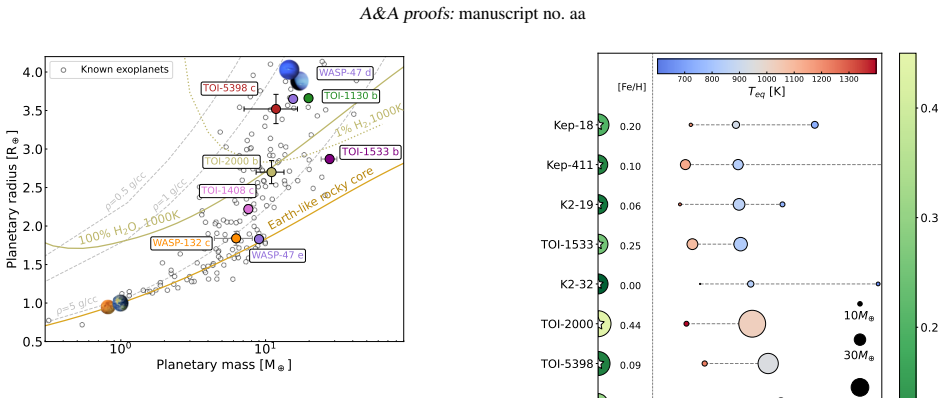
TOI-1533 hosts an inner sub-Neptune and outer super-Neptune with mass ratio near 0.8.
A machine-rendered reading of the paper's core claim, the machinery that carries it, and where it could break.
Core claim
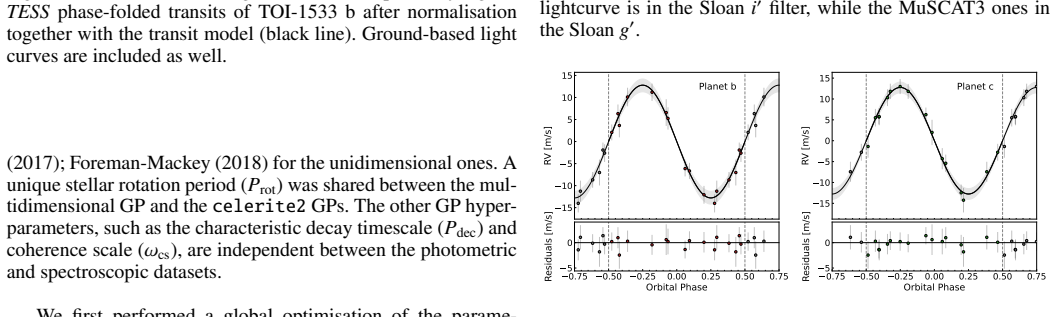
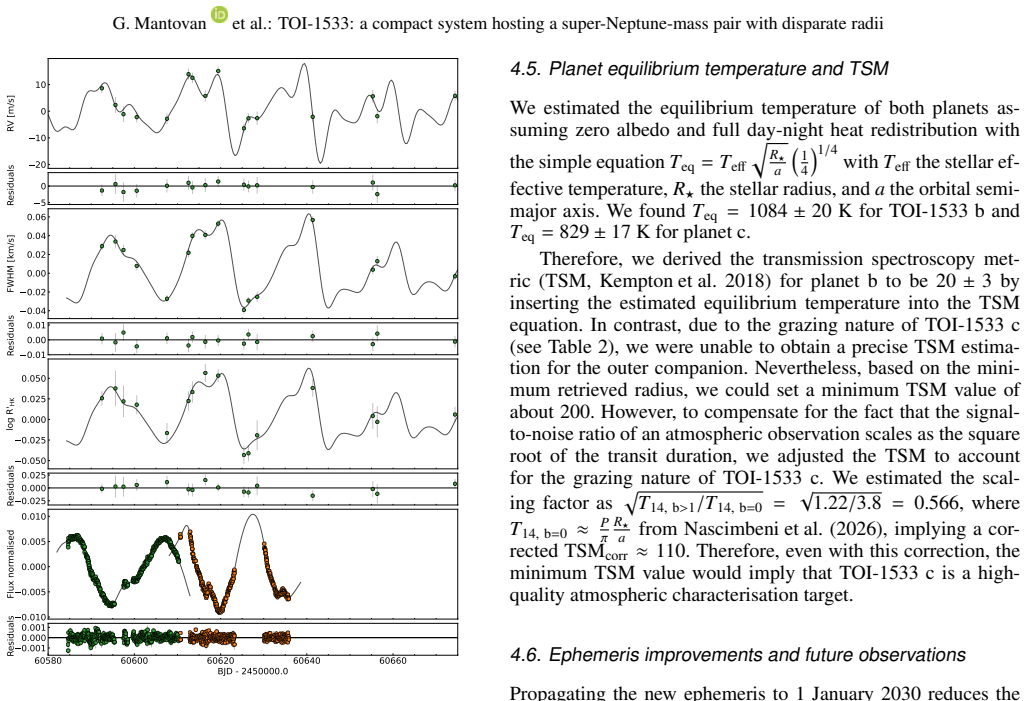
TOI-1533 b and c form a compact pair where the inner sub-Neptune and outer super-Neptune have a mass ratio M_b/M_c of about 0.8, with the outer companion at super-Neptune mass of roughly 40 Earth masses; both planets transit and their Keplerian signals are isolated from stellar activity through multi-dimensional Gaussian process modeling of radial velocities, activity indicators, and simultaneous photometry.
What carries the argument
Multi-dimensional Gaussian process formalism that combines radial velocity data, spectroscopic activity indicators, and simultaneous photometry to separate stellar activity modulation from the two planetary Keplerian signals.
If this is right
- The system architecture supports a gentle disc-migration mechanism for hot Jupiters rather than high-eccentricity scattering.
- The low density of the outer planet indicates retention of a substantial H/He envelope.
- This adds a new example to the rare population of hot Jupiters that host low-mass inner companions.
- Refined mass and radius measurements can better constrain the interior structure and formation conditions of both planets.
Where Pith is reading between the lines
- Comparison of this pair with other compact systems could test whether the similar masses but different radii arise from different accretion histories at their formation locations.
- Long-term radial velocity monitoring might reveal additional planets or measure any tidal evolution between the two bodies.
- The near-unity mass ratio may constrain models of how multiple planets can migrate together without strong scattering.
Load-bearing premise
The periodic signals detected at high significance in the radial velocity and transit data after Gaussian process modeling are produced by orbiting planets rather than by residual stellar activity or noise.
What would settle it
A longer series of radial velocity observations that fails to recover two periodic signals at periods of 3.63 days and 8.06 days with amplitudes matching the reported masses would show the signals are not planetary.
Figures

read the original abstract
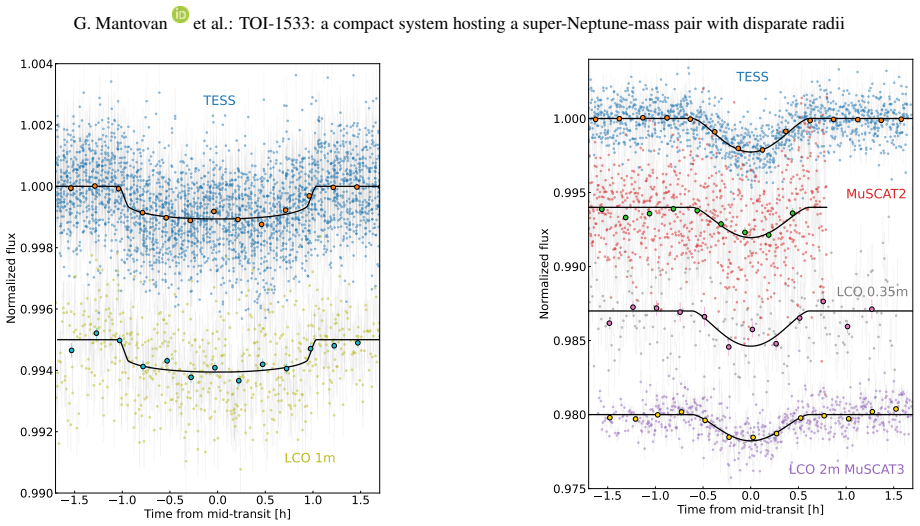
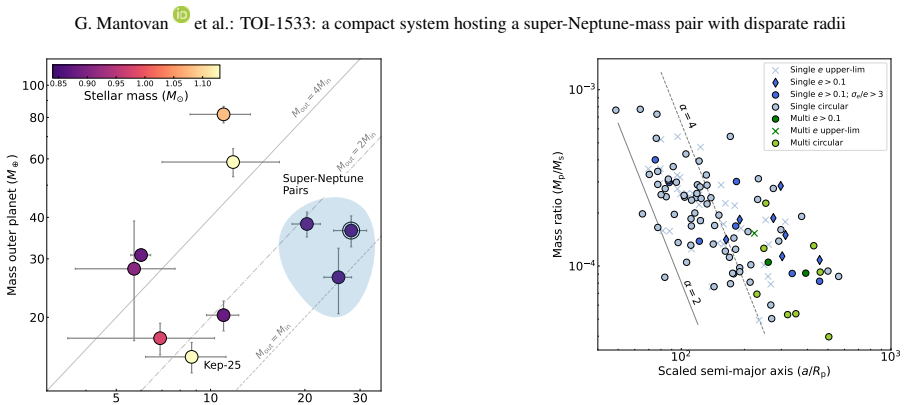
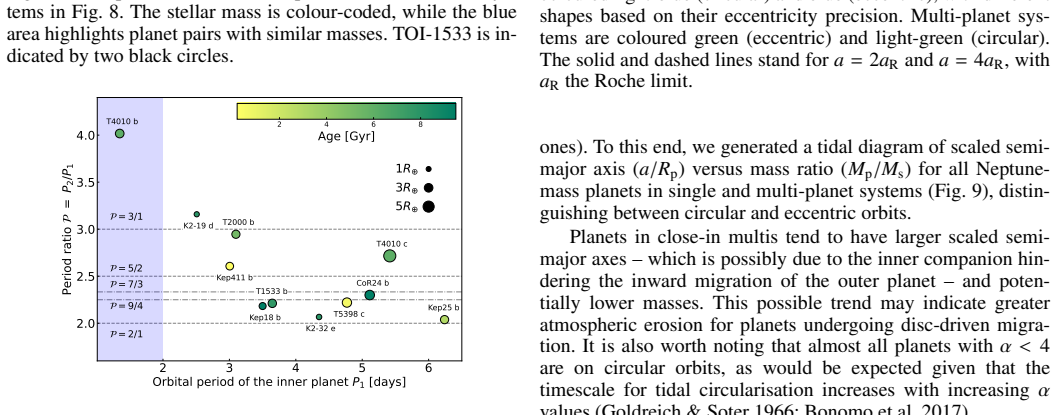
The present-day architecture of planetary systems contains information about their formation and migration histories. The origin of hot Jupiters (HJs, P $\lesssim$ 10 d, $R_{\rm p} > 8 R_\oplus$) has long been a matter of debate. While most of them are found to be ``lonely'', there is a rare population of HJs hosting small companions on inner orbits (eight known as of May 2026). Their peculiar architecture suggests a gentle disc-migration mechanism. In this study, we present the discovery and characterisation of the multi-planet system TOI-1533, comprising an inner sub-Neptune (TOI-1533 b, $P_{\rm orb} = 3.63$ d, $R_{\rm p} = 3.15 R_\oplus$) and an outer hot giant planet (TOI-1533 c, $P_{\rm orb} = 8.06$ d, $R_{\rm p} > 7.5 R_\oplus$) with substantial H/He by mass ($\rho_{\rm p} < 0.48$ g cm$^{-3}$), both transiting an active K-dwarf star ($T_{\rm eff} \approx$ 5130 K; $V$ (mag) $\approx$ 11). Our joint modelling of stellar activity and planetary signals from radial velocities (HARPS-N) and transits (TESS) allows us to detect their Keplerian signals (approximately $10~\sigma$) and to isolate the stellar modulation. The inclusion of simultaneous photometry in the multi-dimensional Gaussian processes formalism was a fundamental addition to the spectroscopic activity indicators, enabling the disentanglement of stellar activity from planetary signals. The mass ratio of the two confirmed planets ($M_{\rm b} / M_{\rm c}$ about 0.8), together with the super-Neptune mass of the large outer companion ($M_{\rm c} \approx 40 M_\oplus$), makes this system unusual compared to the other few HJs with low-mass inner companions.
Editorial analysis
A structured set of objections, weighed in public.
Referee Report
Summary. The paper reports the discovery and characterization of the compact multi-planet system TOI-1533 around an active K-dwarf, consisting of an inner transiting sub-Neptune (planet b: P=3.63 d, R=3.15 R_⊕) and an outer transiting hot giant (planet c: P=8.06 d, R>7.5 R_⊕, M_c≈40 M_⊕, ρ_c<0.48 g cm^{-3}). Joint modeling of TESS photometry and HARPS-N RVs employs multi-dimensional Gaussian processes to separate stellar activity from the planetary Keplerian signals, yielding ~10σ detections; the resulting mass ratio M_b/M_c≈0.8 is presented as making the architecture unusual relative to the small sample of hot Jupiters with inner low-mass companions.
Significance. If the planetary signals are robustly isolated from activity, the system adds a well-characterized example to the rare population of hot Jupiters with inner sub-Neptune companions, providing constraints on gentle disc-migration scenarios. The use of simultaneous photometry within the multi-dimensional GP framework is noted as enabling the activity removal, and the disparate radii at comparable masses offer a testbed for interior structure models of super-Neptunes.
major comments (2)
- [Abstract] Abstract: the claim of ~10σ Keplerian detections after joint RV+transit modeling with multi-dimensional GP is presented without reported mass uncertainties, without specification of the GP kernel forms or hyperparameters, and without any discussion of activity aliases or residual-signal tests. These omissions directly affect assessment of whether the signals are planetary rather than residual activity.
- [RV and activity modeling (inferred from abstract description)] The central confirmation of both planets rests on the multi-dimensional GP disentanglement step that incorporates simultaneous photometry alongside spectroscopic indicators; the manuscript provides no validation details (e.g., kernel selection criteria, cross-validation, or injection-recovery tests) for this step, which is load-bearing for the reported masses and the architectural comparison.
minor comments (2)
- [Abstract] The density upper limit ρ_p < 0.48 g cm^{-3} for planet c is stated without the explicit mass and radius values (with uncertainties) used to compute it.
- No statement is made regarding public release of the RV time series, transit photometry, or analysis code, which would support reproducibility of the GP modeling.
Simulated Author's Rebuttal
We thank the referee for the constructive and detailed report. The two major comments correctly identify areas where the abstract and modeling sections would benefit from greater technical specificity. We address each point below and will revise the manuscript to incorporate the requested details.
read point-by-point responses
-
Referee: [Abstract] Abstract: the claim of ~10σ Keplerian detections after joint RV+transit modeling with multi-dimensional GP is presented without reported mass uncertainties, without specification of the GP kernel forms or hyperparameters, and without any discussion of activity aliases or residual-signal tests. These omissions directly affect assessment of whether the signals are planetary rather than residual activity.
Authors: We agree that the abstract, as a concise summary, omitted key quantitative and methodological details. In the revised version we will update the abstract to report the planetary masses and uncertainties (M_b and M_c with 1σ errors), specify the multi-dimensional GP kernel (quasi-periodic plus white-noise terms) and representative hyperparameters, and explicitly note that activity-alias checks and residual-signal tests are presented in Section 4. The ~10σ significance is obtained from the marginal posterior distributions of the Keplerian amplitudes after the joint fit; we will make this explicit. revision: yes
-
Referee: [RV and activity modeling (inferred from abstract description)] The central confirmation of both planets rests on the multi-dimensional GP disentanglement step that incorporates simultaneous photometry alongside spectroscopic indicators; the manuscript provides no validation details (e.g., kernel selection criteria, cross-validation, or injection-recovery tests) for this step, which is load-bearing for the reported masses and the architectural comparison.
Authors: The referee is correct that the current text does not provide a dedicated validation subsection for the multi-dimensional GP step. While Section 3 describes the framework and the role of simultaneous photometry, we will add in revision an explicit paragraph on model validation: kernel selection via BIC comparison among several kernels, leave-one-out cross-validation results on the activity indicators, and injection-recovery tests that recover the planetary signals at the reported significances while suppressing activity aliases. These additions will directly support the robustness of the masses and the architectural discussion. revision: yes
Circularity Check
No significant circularity; observational fit to new data
full rationale
The paper reports an observational discovery and parameter estimation for TOI-1533 b and c. Planetary masses and radii are obtained by fitting Keplerian signals to new HARPS-N RV and TESS transit data after multi-dimensional GP modeling of stellar activity; the ~10σ detections and derived M_b/M_c ratio follow directly from those fits and are compared to external literature systems. No load-bearing step reduces by the paper's own equations or self-citations to a tautological input. The architecture claim is a post-fit comparison, not a derivation that loops back on itself.
Axiom & Free-Parameter Ledger
free parameters (2)
- planet masses and radii
- GP hyperparameters for stellar activity
axioms (2)
- domain assumption Radial-velocity variations after GP subtraction are purely Keplerian.
- domain assumption Transit signals are planetary and not false positives from background eclipsing binaries.
Reference graph
Works this paper leans on
-
[1]
Quenching of Carbon Monoxide and Methane in the Atmospheres of Cool Brown Dwarfs and Hot Jupiters. , keywords =. doi:10.1088/0004-637X/738/1/72 , archivePrefix =. 1106.3525 , primaryClass =
-
[2]
The effects of snowlines on C/O in planetary atmospheres
The Effects of Snowlines on C/O in Planetary Atmospheres. , keywords =. doi:10.1088/2041-8205/743/1/L16 , archivePrefix =. 1110.5567 , primaryClass =
work page internal anchor Pith review Pith/arXiv arXiv doi:10.1088/2041-8205/743/1/l16 2041
-
[3]
Beyond Equilibrium Temperature: How the Atmosphere/Interior Connection Affects the Onset of Methane, Ammonia, and Clouds in Warm Transiting Giant Planets. , keywords =. doi:10.3847/1538-3881/abc5bd , archivePrefix =. 2010.00146 , primaryClass =
-
[4]
Chemical Diversity in Protoplanetary Disks and Its Impact on the Formation History of Giant Planets. , keywords =. doi:10.3847/1538-4357/ac8b11 , archivePrefix =. 2206.14685 , primaryClass =
-
[5]
Breaking Degeneracies in Formation Histories by Measuring Refractory Content in Gas Giants. , keywords =. doi:10.3847/1538-4357/aca614 , archivePrefix =. 2211.09080 , primaryClass =
-
[6]
Water Enrichment from Pebble Drift in Disks with Gap-forming Planets. , keywords =. doi:10.3847/1538-4357/ad891d , archivePrefix =. 2412.04681 , primaryClass =
-
[7]
On the radiative equilibrium of irradiated planetary atmospheres
On the radiative equilibrium of irradiated planetary atmospheres. , keywords =. doi:10.1051/0004-6361/200913396 , archivePrefix =. 1006.4702 , primaryClass =
work page internal anchor Pith review Pith/arXiv arXiv doi:10.1051/0004-6361/200913396
-
[8]
petitRADTRANS: a Python radiative transfer package for exoplanet characterization and retrieval
petitRADTRANS. A Python radiative transfer package for exoplanet characterization and retrieval. , keywords =. doi:10.1051/0004-6361/201935470 , archivePrefix =. 1904.11504 , primaryClass =
work page internal anchor Pith review Pith/arXiv arXiv doi:10.1051/0004-6361/201935470 1904
-
[9]
The NASA Exoplanet Archive and Exoplanet Follow-up Observing Program: Data, Tools, and Usage. , keywords =. doi:10.3847/PSJ/ade3c2 , archivePrefix =. 2506.03299 , primaryClass =
-
[10]
Validation of TESS exoplanet candidates orbiting solar analogues in the all-sky PLATO input catalogue. , keywords =. doi:10.1093/mnras/stac2451 , archivePrefix =. 2208.12276 , primaryClass =
-
[11]
, year = 1995, month = nov, volume =
A Jupiter-mass companion to a solar-type star. , year = 1995, month = nov, volume =. doi:10.1038/378355a0 , adsurl =
-
[12]
Journal of Astronomical Telescopes, Instruments, and Systems , year = 2015, month = jan, volume =
Transiting Exoplanet Survey Satellite (TESS). Journal of Astronomical Telescopes, Instruments, and Systems , year = 2015, month = jan, volume =. doi:10.1117/1.JATIS.1.1.014003 , adsurl =
work page internal anchor Pith review doi:10.1117/1.jatis.1.1.014003 2015
-
[13]
Software and Cyberinfrastructure for Astronomy IV , year = 2016, editor =
The TESS science processing operations center. Software and Cyberinfrastructure for Astronomy IV , year = 2016, editor =. doi:10.1117/12.2233418 , adsurl =
-
[14]
The TESS Objects of Interest Catalog from the TESS Prime Mission. , keywords =. doi:10.3847/1538-4365/abefe1 , archivePrefix =. 2103.12538 , primaryClass =
-
[15]
Photometry of 10 Million Stars from the First Two Years of TESS Full Frame Images: Part I. , keywords =. doi:10.3847/2515-5172/abca2e , archivePrefix =. 2011.06459 , primaryClass =
-
[16]
Journal of Geophysical Research (Planets) , keywords =
Hot Jupiters: Origins, Structure, Atmospheres. Journal of Geophysical Research (Planets) , keywords =. doi:10.1029/2020JE006629 , archivePrefix =. 2102.05064 , primaryClass =
-
[17]
Giant Planets at Small Orbital Distances
Giant Planets at Small Orbital Distances. , keywords =. doi:10.1086/309935 , archivePrefix =. astro-ph/9511109 , primaryClass =
work page internal anchor Pith review Pith/arXiv arXiv doi:10.1086/309935
-
[18]
Bayesian Analysis of Hot Jupiter Radius Anomalies: Evidence for Ohmic Dissipation?
Bayesian Analysis of Hot-Jupiter Radius Anomalies: Evidence for Ohmic Dissipation?. , keywords =. doi:10.3847/1538-3881/aaba13 , archivePrefix =. 1709.04539 , primaryClass =
work page internal anchor Pith review Pith/arXiv arXiv doi:10.3847/1538-3881/aaba13
-
[19]
The Mass-Metallicity Relation for Giant Planets
The Mass-Metallicity Relation for Giant Planets. , keywords =. doi:10.3847/0004-637X/831/1/64 , archivePrefix =. 1511.07854 , primaryClass =
work page internal anchor Pith review Pith/arXiv arXiv doi:10.3847/0004-637x/831/1/64
-
[20]
Planetary Radii across Five Orders of Magnitude in Mass and Stellar Insolation: Application to Transits. , keywords =. doi:10.1086/512120 , archivePrefix =. astro-ph/0612671 , primaryClass =
work page internal anchor Pith review Pith/arXiv arXiv doi:10.1086/512120
-
[21]
Grain opacity and the bulk composition of extrasolar planets. I. Results from scaling the ISM opacity. , keywords =. doi:10.1051/0004-6361/201321479 , archivePrefix =. 1403.5272 , primaryClass =
work page internal anchor Pith review Pith/arXiv arXiv doi:10.1051/0004-6361/201321479
-
[22]
Frontiers in Astronomy and Space Sciences , keywords =
Warm giant exoplanet characterisation: current state, challenges and outlook. Frontiers in Astronomy and Space Sciences , keywords =. doi:10.3389/fspas.2023.1179000 , archivePrefix =. 2304.12782 , primaryClass =
-
[23]
Analysis of the planetary mass uncertainties on the accuracy of atmospherical retrieval. , keywords =. doi:10.1051/0004-6361/202244881 , archivePrefix =. 2211.02897 , primaryClass =
-
[24]
Quick-look Pipeline Lightcurves for 9.1 Million Stars Observed over the First Year of the TESS Extended Mission. , keywords =. doi:10.3847/2515-5172/ac2ef0 , archivePrefix =. 2110.05542 , primaryClass =
-
[25]
TESS Science Processing Operations Center FFI Target List Products. , keywords =. doi:10.3847/2515-5172/abc9b3 , archivePrefix =. 2011.05495 , primaryClass =
-
[26]
Kepler Presearch Data Conditioning II - A Bayesian Approach to Systematic Error Correction. , keywords =. doi:10.1086/667697 , archivePrefix =. 1203.1383 , primaryClass =
-
[27]
Kepler Presearch Data Conditioning I Architecture and Algorithms for Error Correction in Kepler Light Curves. , keywords =. doi:10.1086/667698 , archivePrefix =. 1203.1382 , primaryClass =
-
[28]
, year = 2014, month = jan, volume =
Multiscale Systematic Error Correction via Wavelet-Based Bandsplitting in Kepler Data. , year = 2014, month = jan, volume =. doi:10.1086/674989 , adsurl =
doi:10.1086/674989 2014
-
[29]
Kepler Data Validation I Architecture, Diagnostic Tests, and Data Products for Vetting Transiting Planet Candidates. , keywords =. doi:10.1088/1538-3873/aab694 , archivePrefix =. 1803.04526 , primaryClass =
work page internal anchor Pith review Pith/arXiv arXiv doi:10.1088/1538-3873/aab694
-
[30]
American Astronomical Society Meeting Abstracts \#233 , year = 2019, series =
TESS Follow-up Observing Program Working Group (TFOP WG) Sub Group 1 (SG1): Ground-based Time-series Photometry. American Astronomical Society Meeting Abstracts \#233 , year = 2019, series =
2019
-
[31]
Tapir: A web interface for transit/eclipse observability
-
[32]
Summary of the content and survey properties
Gaia Data Release 3. Summary of the content and survey properties. , keywords =. doi:10.1051/0004-6361/202243940 , archivePrefix =. 2208.00211 , primaryClass =
-
[33]
Las Cumbres Observatory Global Telescope Network
Las Cumbres Observatory Global Telescope Network. , keywords =. doi:10.1086/673168 , archivePrefix =. 1305.2437 , primaryClass =
work page internal anchor Pith review Pith/arXiv arXiv doi:10.1086/673168
-
[34]
Real-time processing of the imaging data from the network of Las Cumbres Observatory Telescopes using BANZAI. Software and Cyberinfrastructure for Astronomy V , year = 2018, editor =. doi:10.1117/12.2314340 , archivePrefix =. 1811.04163 , primaryClass =
work page internal anchor Pith review Pith/arXiv arXiv doi:10.1117/12.2314340 2018
-
[35]
European Physical Journal Web of Conferences , year = 2011, series =
TRAPPIST: a robotic telescope dedicated to the study of planetary systems. European Physical Journal Web of Conferences , year = 2011, series =. doi:10.1051/epjconf/20101106002 , archivePrefix =. 1101.5807 , primaryClass =
-
[36]
The Messenger , year = 2011, month = sep, volume =
TRAPPIST: TRAnsiting Planets and PlanetesImals Small Telescope. The Messenger , year = 2011, month = sep, volume =
2011
-
[37]
Observatorio El Sauce: Hosting Robotic Science in Chile. , year = 2021, series =. doi:10.22201/ia.14052059p.2021.53.12 , adsurl =
-
[38]
The Messenger , year = 2003, month = dec, volume =
Setting New Standards with HARPS. The Messenger , year = 2003, month = dec, volume =
2003
-
[39]
Chasing exoplanets with the La Silla 3.6-m telescope
HARPS: ESO's coming planet searcher. Chasing exoplanets with the La Silla 3.6-m telescope. The Messenger , keywords =
-
[40]
The Journal of Open Source Software , keywords =
ACTIN: A tool to calculate stellar activity indices. The Journal of Open Source Software , keywords =. doi:10.21105/joss.00667 , archivePrefix =. 1811.11172 , primaryClass =
-
[41]
Stellar chromospheric activity of 1674 FGK stars from the AMBRE-HARPS sample. I. A catalogue of homogeneous chromospheric activity. , keywords =. doi:10.1051/0004-6361/202039765 , archivePrefix =. 2012.10199 , primaryClass =
-
[42]
Three years of Sun-as-a-star radial-velocity observations on the approach to solar minimum
Three years of Sun-as-a-star radial-velocity observations on the approach to solar minimum. , keywords =. doi:10.1093/mnras/stz1215 , archivePrefix =. 1904.12186 , primaryClass =
work page internal anchor Pith review Pith/arXiv arXiv doi:10.1093/mnras/stz1215 1904
-
[43]
Intrinsic Colors, Temperatures, and Bolometric Corrections of Pre-Main Sequence Stars
Intrinsic Colors, Temperatures, and Bolometric Corrections of Pre-main-sequence Stars. , keywords =. doi:10.1088/0067-0049/208/1/9 , archivePrefix =. 1307.2657 , primaryClass =
work page internal anchor Pith review Pith/arXiv arXiv doi:10.1088/0067-0049/208/1/9
-
[44]
On the Occurrence Rate of Hot Jupiters in Different Stellar Environments
On the Occurrence Rate of Hot Jupiters in Different Stellar Environments. , keywords =. doi:10.1088/0004-637X/799/2/229 , archivePrefix =. 1412.1731 , primaryClass =
work page internal anchor Pith review Pith/arXiv arXiv doi:10.1088/0004-637x/799/2/229
-
[45]
A Framework for Prioritizing the TESS Planetary Candidates Most Amenable to Atmospheric Characterization. , keywords =. doi:10.1088/1538-3873/aadf6f , archivePrefix =. 1805.03671 , primaryClass =
work page internal anchor Pith review Pith/arXiv arXiv doi:10.1088/1538-3873/aadf6f
-
[46]
An Efficient Automated Validation Procedure for Exoplanet Transit Candidates
An Efficient Automated Validation Procedure for Exoplanet Transit Candidates. , keywords =. doi:10.1088/0004-637X/761/1/6 , archivePrefix =. 1206.1568 , primaryClass =
work page internal anchor Pith review Pith/arXiv arXiv doi:10.1088/0004-637x/761/1/6
-
[47]
A search for transiting planets around FGKM dwarfs and subgiants in the TESS full frame images of the Southern ecliptic hemisphere. , keywords =. doi:10.1093/mnras/staa2438 , archivePrefix =. 2008.09832 , primaryClass =
-
[48]
Search for exoplanets in open clusters of the Southern ecliptic hemisphere and their frequency
A PSF-based Approach to TESS High quality data Of Stellar clusters (PATHOS) - II. Search for exoplanets in open clusters of the Southern ecliptic hemisphere and their frequency. , keywords =. doi:10.1093/mnras/staa1465 , archivePrefix =. 2005.12281 , primaryClass =
-
[49]
The GAPS Programme at TNG. XXXV. Fundamental properties of transiting exoplanet host stars. , keywords =. doi:10.1051/0004-6361/202243467 , archivePrefix =. 2205.15796 , primaryClass =
-
[50]
The GAPS programme with HARPS-N at TNG. X. Differential abundances in the XO-2 planet-hosting binary. , keywords =. doi:10.1051/0004-6361/201526375 , archivePrefix =. 1506.01614 , primaryClass =
-
[51]
, year = 1973, month = sep, volume =
The nitrogen abundance of the very metal-poor star HD 122563. , year = 1973, month = sep, volume =. doi:10.1086/152374 , adsurl =
doi:10.1086/152374 1973
-
[52]
Modelling of Stellar Atmospheres , year = 2003, editor =
New Grids of ATLAS9 Model Atmospheres. Modelling of Stellar Atmospheres , year = 2003, editor =. doi:10.48550/arXiv.astro-ph/0405087 , archivePrefix =. astro-ph/0405087 , primaryClass =
-
[53]
The GAPS Programme at TNG. XXV. Stellar atmospheric parameters and chemical composition through GIARPS optical and near-infrared spectra. , keywords =. doi:10.1051/0004-6361/202038511 , archivePrefix =. 2007.00475 , primaryClass =
-
[54]
Departures from LTE for neutral Li in late-type stars. , keywords =. doi:10.1051/0004-6361/200912221 , archivePrefix =. 0906.0899 , primaryClass =
-
[55]
, keywords =
The Tycho-2 catalogue of the 2.5 million brightest stars. , keywords =
-
[56]
The GAPS programme with HARPS-N at TNG. XI. Pr 0211 in M 44: the first multi-planet system in an open cluster. , keywords =. doi:10.1051/0004-6361/201527933 , archivePrefix =. 1602.00009 , primaryClass =
-
[57]
An Ultra-short Period Rocky Super-Earth with a Secondary Eclipse and a Neptune-like Companion around K2-141. , keywords =. doi:10.3847/1538-3881/aaa5b5 , archivePrefix =. 1801.03502 , primaryClass =
-
[58]
batman: BAsic Transit Model cAlculatioN in Python. , keywords =. doi:10.1086/683602 , archivePrefix =. 1507.08285 , primaryClass =
-
[59]
Efficient, uninformative sampling of limb darkening coefficients for two-parameter laws. , keywords =. doi:10.1093/mnras/stt1435 , archivePrefix =. 1308.0009 , primaryClass =
-
[60]
EXOFAST: A Fast Exoplanetary Fitting Suite in IDL. , keywords =. doi:10.1086/669497 , archivePrefix =. 1206.5798 , primaryClass =
-
[61]
A new extensive library of PHOENIX stellar atmospheres and synthetic spectra. , keywords =. doi:10.1051/0004-6361/201219058 , archivePrefix =. 1303.5632 , primaryClass =
-
[62]
LDTK: Limb Darkening Toolkit. , keywords =. doi:10.1093/mnras/stv1857 , archivePrefix =. 1508.02634 , primaryClass =
-
[63]
Journal of Global Optimization , keywords =
Differential Evolution - A Simple and Efficient Heuristic for global Optimization over Continuous Spaces. Journal of Global Optimization , keywords =. doi:10.1023/A:1008202821328 , adsurl =
-
[64]
Communications in Applied Mathematics and Computational Science , keywords =
Ensemble samplers with affine invariance. Communications in Applied Mathematics and Computational Science , keywords =. doi:10.2140/camcos.2010.5.65 , adsurl =
-
[65]
emcee: The MCMC Hammer. , keywords =. doi:10.1086/670067 , archivePrefix =. 1202.3665 , primaryClass =
-
[66]
Statistical Science , year = 1992, month = jan, volume =
Inference from Iterative Simulation Using Multiple Sequences. Statistical Science , year = 1992, month = jan, volume =. doi:10.1214/ss/1177011136 , adsurl =
-
[67]
On detecting terrestrial planets with timing of giant planet transits. , keywords =. doi:10.1111/j.1365-2966.2005.08922.x , adsurl =
-
[68]
The Use of Transit Timing to Detect Terrestrial-Mass Extrasolar Planets. Science , keywords =. doi:10.1126/science.1107822 , archivePrefix =. astro-ph/0412028 , primaryClass =
-
[69]
Revisiting Kepler-11 and Kepler-9
TRADES: A new software to derive orbital parameters from observed transit times and radial velocities. Revisiting Kepler-11 and Kepler-9. , keywords =. doi:10.1051/0004-6361/201424080 , archivePrefix =. 1408.2844 , primaryClass =
-
[70]
HARPS-N radial velocities confirm the low densities of the Kepler-9 planets. , keywords =. doi:10.1093/mnras/stz181 , archivePrefix =. 1901.05471 , primaryClass =
-
[71]
Exploiting timing capabilities of the CHEOPS mission with warm-Jupiter planets. , keywords =. doi:10.1093/mnras/stab1782 , archivePrefix =. 2106.11331 , primaryClass =
-
[72]
A Recommendation to Retire VESPA for Exoplanet Validation. , keywords =. doi:10.3847/2515-5172/acd9a6 , adsurl =
-
[73]
Modeling Kepler Transit Light Curves as False Positives: Rejection of Blend Scenarios for Kepler-9, and Validation of Kepler-9 d, A Super-earth-size Planet in a Multiple System. , keywords =. doi:10.1088/0004-637X/727/1/24 , archivePrefix =. 1008.4393 , primaryClass =
-
[74]
General framework, models, and performance
PASTIS: Bayesian extrasolar planet validation - I. General framework, models, and performance. , keywords =. doi:10.1093/mnras/stu601 , archivePrefix =. 1403.6725 , primaryClass =
-
[75]
A new formalism for the floating-mean and Keplerian periodograms
The generalised Lomb-Scargle periodogram. A new formalism for the floating-mean and Keplerian periodograms. , keywords =. doi:10.1051/0004-6361:200811296 , archivePrefix =. 0901.2573 , primaryClass =
-
[76]
Annals of Statistics , year = 1978, month = jul, volume =
Estimating the Dimension of a Model. Annals of Statistics , year = 1978, month = jul, volume =
1978
-
[77]
Kass and Adrian E
Robert E. Kass and Adrian E. Raftery , title =. Journal of the American Statistical Association , volume =. 1995 , publisher =
1995
-
[78]
, year = 2008, month = feb, volume =
First Speckle Interferometry at SOAR Telescope with Electron-Multiplication CCD. , year = 2008, month = feb, volume =. doi:10.1086/528809 , adsurl =
doi:10.1086/528809 2008
-
[79]
Ten Years of Speckle Interferometry at SOAR. , keywords =. doi:10.1088/1538-3873/aaa7d9 , archivePrefix =. 1801.04772 , primaryClass =
-
[80]
SOAR TESS Survey. I. Sculpting of TESS Planetary Systems by Stellar Companions. , keywords =. doi:10.3847/1538-3881/ab55e9 , archivePrefix =. 1908.10871 , primaryClass =
discussion (0)
Sign in with ORCID, Apple, or X to comment. Anyone can read and Pith papers without signing in.