REVIEW 3 major objections 6 minor 29 references
Confinement effect on solar thermal heating process of TiN solutions
T0 review · 3 major / 6 minor · reviewed 2026-08-14 · deepseek-v4-flash
Pith's one-line read This paper claims that a parameter-free model—Mie extinction, heat diffusion, and a container-confinement absorption correction—quantitatively reproduces measured solar heating and vaporization in TiN nanoparticle solutions, and explains…
desk verdict Temperature part is a useful engineering model, but the vaporization claim is broken by a dimensionally invalid equation. read the letter →
The pith
A machine-rendered reading of the paper's core claim, the machinery that carries it, and where it could break.
The reading
What carries the argument
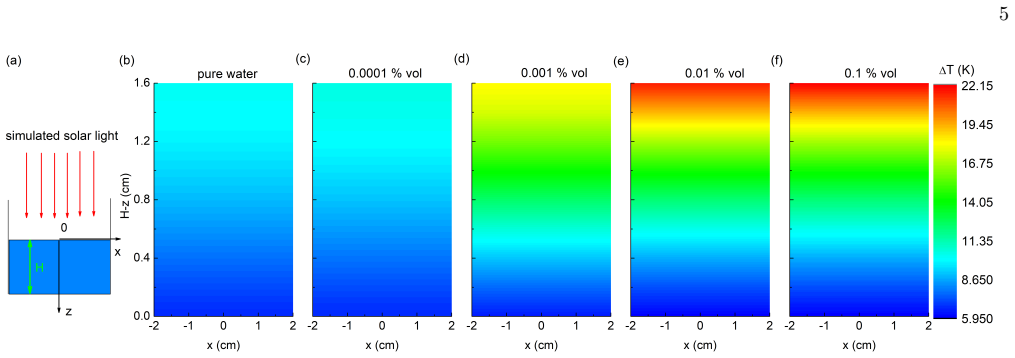
The load-bearing object is the confinement-corrected effective absorption coefficient in Eq. (5): $\alpha(\omega) = \alpha_w(\omega) + N Q_{\mathrm{ext}}$ when $1/\alpha(\omega) \le H$, and $\alpha = 1/H$ when the Beer-Lambert penetration depth would exceed the beaker height $H$. This single switch concentrates the absorbed solar energy into the container volume, producing the high surface temperatures and the agreement in Fig. 1b. The rest of the machinery is standard: Mie theory supplies the extinction cross section $Q_{\mathrm{ext}}$ for TiN nanoparticles from a Drude-Lorentz dielectric function; an analytical solution of the heat diffusion equation (Eq. (7)) gives the spatial temperature profile; and the interface energy balance (Eq. (9)) converts the surface temperature difference into vaporized mass using a convective heat-transfer coefficient. The confinement switch is what carries the argument: without it the calculated temperatures are too low, and with it no adjustable parameters are needed.
What would settle it
Measure pure-water or very dilute TiN solution temperature rise under the same AM1.5 solar simulator in beakers of the same diameter but different heights. The confinement model predicts the absorbed power per unit volume should drop as $1/H$ (so taller beakers heat more slowly), while standard Beer-Lambert absorption would predict almost no height dependence since water's intrinsic absorption is weak. A clear disagreement would falsify Eq. (5).
Extended reading notes
Core claim
On the paper's own terms, the central discovery is that the solar-thermal response of a TiN nanofluid is governed by an effective absorption coefficient that switches from the Beer-Lambert value to the reciprocal of the container height once the predicted penetration depth exceeds that height. Combining this correction with Mie-scattering extinction cross sections, an analytical heat-diffusion solution, and an energy balance at the liquid-vapor interface, the authors obtain time-dependent temperature rises $\Delta T_{\mathrm{ave}}(t)$ and vaporized weights for TiN solutions without adjustable parameters. The calculated curves agree with the measured data of Ref. [6], especially at concentrations $\ge 10^{-3}$ vol %. The same calculation shows that temperature rise saturates as concentration increases, that photons are localized near the surface at high concentration, and that this surface localization is why floating plasmonic membranes are more efficient steam generators than randomly dispersed nanoparticles.
Load-bearing premise
The whole fit rests on the untested idea that when sunlight would penetrate deeper than the beaker, the photon mean free path is limited by the beaker height, so the absorption coefficient is simply the reciprocal of that height.
Editorial extensions
If this is right
- At concentrations above about $10^{-3}$ vol %, adding more TiN nanoparticles barely changes the temperature profile; the absorbed energy saturates because light is already absorbed near the surface.
- The effective penetration depth of sunlight in the nanofluid shrinks rapidly with concentration, so heating becomes confined to a thin surface layer rather than the whole beaker.
- Floating or surface-localized photothermal agents should give larger liquid-vapor temperature differences than the same mass of particles dispersed in the bulk, because the surface temperature determines the vaporization rate.
- The model predicts an approximately linear time dependence of vaporized weight, consistent with less noisy steam-generation measurements, and can be used to estimate steam output for new concentrations and container sizes.
- Because the calculation has no adjustable parameters, new experiments on other TiN concentrations or beaker geometries can be checked directly against the same formulas.
Reading between the lines
- Extending beyond the paper, a direct test of the confinement idea would be to vary the beaker height while keeping everything else fixed; the model predicts that the absorbed power per unit volume scales as $1/H$ in the confinement regime, whereas ordinary Beer-Lambert absorption would predict almost no height dependence for dilute, weakly absorbing water.
- The same theoretical structure should transfer to other plasmonic colloids by changing only the dielectric function, suggesting a general way to rank materials for nanofluid steam generators before running an experiment.
- Because the evaporation prediction depends only on surface temperature difference, infrared imaging of the liquid surface during illumination would provide a stringent, independent check of the mechanism proposed for floating membranes.
- The saturation of heating beyond roughly $10^{-2}$ vol % implies that performance gains are better sought by concentrating particles at the interface than by raising nanoparticle loading.
Signed reviews
Editorial analysis
A structured set of objections, weighed in public.
Referee Report
Summary. The manuscript proposes an analytical model for solar-driven heating and vaporization of aqueous TiN nanoparticle solutions. The model combines Mie-scattering extinction cross sections for TiN nanoparticles, an analytical solution of the heat diffusion equation with an effective absorption coefficient, and an energy-balance equation at the liquid-vapor interface. The authors compare their calculated time-dependent temperature rises and vaporized weights with experimental data from Ref. [6] for several nanoparticle concentrations, claiming quantitative agreement without adjustable parameters. They further conclude that localized heating near the surface explains the higher efficiency of floating plasmonic membranes over randomly dispersed nanoparticles.
Significance. If the model were validated as claimed, it would provide a simple analytic design tool for solar steam generation with plasmonic nanofluids. The paper has strengths: it uses a standard Mie-theory framework with literature TiN dielectric data, an explicit heat equation, and direct comparison to published experiments rather than fitted data. However, the central validation rests on two fragile elements: the confinement rule in Eq. (5), which is imposed rather than derived and substantially changes the pure-water absorption, and the vaporization equation in Eq. (9), which has a unit inconsistency and appears to be used algebraically rather than as a rate equation. Because both elements are load-bearing for the claimed quantitative agreement, the significance is conditional on correcting them.
major comments (3)
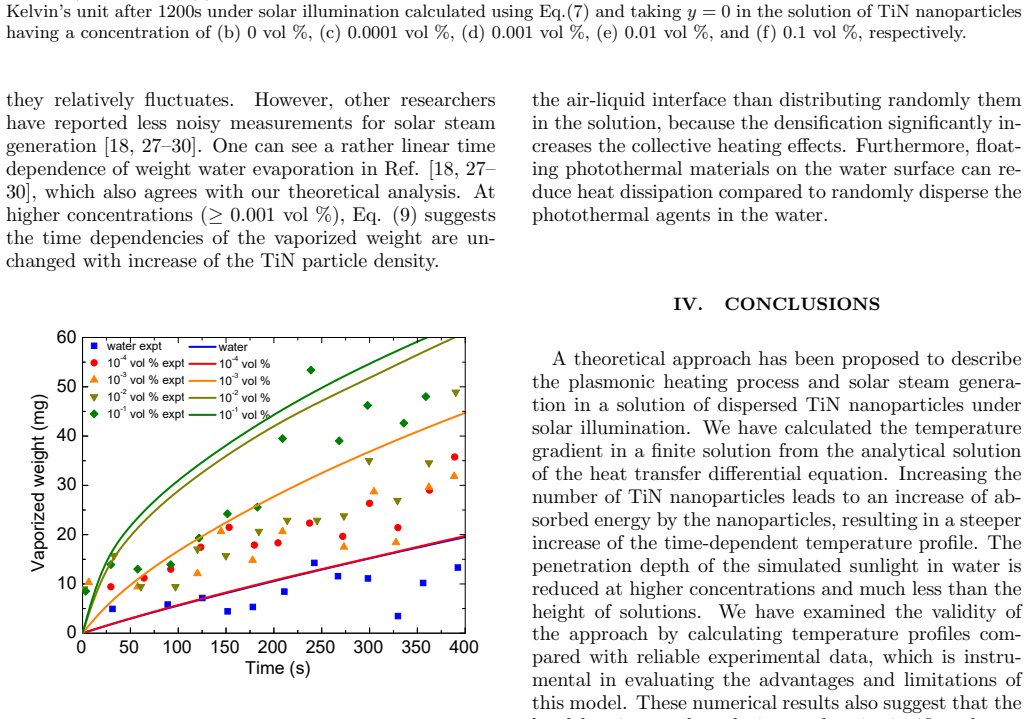
- [Section III, Eq. (9) and Fig. 3] Equation (9) is dimensionally inconsistent as written: the left side, (πD²/4) hc ΔT_surface(t), has units of power, while the right side, −L Δm, has units of energy if Δm is a mass. If Δm is intended as a mass-loss rate, then the cumulative vaporized weight plotted in Fig. 3 should be the time integral of that rate, which is not what the text describes. With the stated hc = 10,000 W/(m²K), D = 4 cm, and a surface temperature rise of about 10 K, the left side is approximately 125 W, about 100 times the 1.26 W solar power incident on the beaker; integrating that rate over 400 s would vaporize roughly 22 g, not the tens of milligrams shown in Fig. 3. The plotted curves appear instead to use the algebraic relation Δm = A hc ΔT_surface / L, which omits the required time integration and is not a valid energy balance. This makes the vaporization part of the central claim irreproducible as stated.
- [Section II, Eq. (5)] The confinement rule in the second line of Eq. (5), which sets α = 1/H whenever the Beer-Lambert penetration depth exceeds the beaker height, is not derived from optics or heat transfer. For a homogeneous absorbing slab of thickness H, the volume-averaged absorbed fraction is 1 − exp(−αH); in the limit αH << 1 this fraction is approximately αH, so the effective absorption coefficient should remain approximately α, not jump to 1/H. Replacing α with 1/H changes the absorption across the beaker from a small value to about 63% and is applied to pure water and the most dilute solutions. This rule is precisely the ingredient that converts the underestimation in Fig. 1a into the apparent agreement in Fig. 1b. Without independent justification, the claimed validation of the model is circular rather than predictive.
- [Abstract and Section III, Eq. (9)] The abstract and conclusions state that the model works 'without introducing any adjustable parameters,' but the convection coefficient hc in Eq. (9) is selected from the broad literature range 50–10000 W/(m²K) with the justification that the medium is steam. No sensitivity analysis is provided, and the vaporization result depends critically on choosing the upper end of that range. Even if the unit inconsistency in Eq. (9) were repaired, the value of hc would remain a fitted parameter in the vaporization channel, contradicting the parameter-free claim.
minor comments (6)
- [Section II, Eq. (2)] The Laplace-transformed heat equation is misprinted: the term (p/κ) ∂ΔT̄/∂t should involve p times the Laplace-transformed temperature, not a time derivative of it. This makes the printed derivation impossible to follow, although Eq. (4) may still be correct if it follows Ref. [22].
- [Section II, Eq. (3)] The last integration variable in Eq. (3) is written as 'dn' but should be 'dv' to match the factor cos(vz) and the denominator terms.
- [Section II, Eq. (6)] The sentence listing the Lorentz damping parameters repeats 'γ1 = 1.42 eV' twice; the second occurrence should presumably be γ2.
- [References] References [8] and [21] are the same paper; one duplicate should be removed or replaced with the other.
- [Throughout] There are typographical errors such as 'breaker' for 'beaker' in Sections II and III; these should be corrected.
- [Conclusions] The concluding statement that the calculations give 'strong evidence' for the advantage of floating plasmonic membranes is an extrapolation: the manuscript only models randomly dispersed nanoparticles, not a floating membrane geometry. This claim should be tempered or supported by a direct calculation.
Circularity Check
No significant circularity: the model's predictions are not equivalent to their inputs by construction.
full rationale
I cannot exhibit a specific circular reduction in this paper. The temperature calculation uses Mie scattering with an independently fitted TiN dielectric function [25], the AM1.5 solar spectrum, water thermal properties, and an analytic heat equation solution from Bartholomeusz [22]; none of these is calibrated to the target temperature data. The confinement rule in Eq. (5) is an ad hoc assumption introduced in Section II ('By assuming that the photon mean free path is limited by the height of the beaker'), but it is an input to the model rather than a quantity derived from the output temperature, and it is not numerically fitted to the data. Similarly, h_c in Eq. (9) is selected from a handbook range rather than fitted, so the vaporization curve is not a statistically forced fit. The self-citations to Refs. [8] and [21] provide context only and do not carry the derivation. The serious problems in the paper are correctness risks, not circularity: Eq. (9) has incompatible units (the left side is power while the right side is energy if Delta-m is a mass), and the confinement ansatz lacks independent derivation. These should be weighed as correctness concerns, but they do not make the derivation circular.
Assumptions & free parameters
free parameters (3)
- Convection heat transfer coefficient hc =
10000 W/(m^2K)
- TiN Drude-Lorentz dielectric parameters =
epsilon_inf=5.18, omega_p≈7.38 eV, Gamma_D≈0.26 eV, oscillator terms from Ref. [25]
- Nanoparticle radius R =
50 nm
assumptions (6)
- domain assumption The substrate absorbs the light instantaneously and there are no radiative or convective heat losses, so the analytic heat equation solution Eq. (4) applies.
- domain assumption The effective absorption coefficient is the sum of water absorption and N Qext (Beer-Lambert) for dilute, isolated particles.
- ad hoc to paper When the penetration depth exceeds the beaker height, the effective absorption coefficient is set to 1/H.
- domain assumption Reflectivity R≈0 and infinite spot size beta=0.
- domain assumption The TiN dielectric function is accurately described by the Drude-Lorentz fit to thin-film data in Eq. (6).
- ad hoc to paper Evaporation is the only heat sink at the liquid-vapor interface, with hc≈10000 W/(m^2K), and weight loss follows Eq. (9).
Cite this review
Pith. "Pith review of Confinement effect on solar thermal heating process of TiN solutions." pith.science (2026). https://pith.science/paper/N7O45JUU
@misc{pith2026190806375,
  author       = {Pith},
  title        = {Pith review of: Confinement effect on solar thermal heating process of TiN solutions},
  year         = {2026},
  howpublished = {\url{https://pith.science/paper/N7O45JUU}},
  note         = {Machine review of arXiv:1908.06375}
}
read the original abstract
We propose a theoretical approach to describe quantitatively the heating process in aqueous solutions of dispersed TiN nanoparticles under solar illumination. The temperature gradients of solution with different concentrations of TiN nanoparticles are calculated when confinement effects of the container on the solar absorption are taken into account. We find that the average penetration of solar radiation into the solution is significantly reduced with increasing the nanoparticle concentration. At high concentrations, our numerical results show that photons are localized near the surface of the solution. Moreover, the heat energy balance equation at the vapor-liquid interface is used to describe the solar steam generation. The theoretical time dependence of temperature rise and vaporization weight losses is consistent with experiments. Our calculations give strong evidence that the substantially localized heating near the vapor-liquid interface is the main reason for the more efficient steam generation process by floating plasmonic membranes when compared to randomly dispersed nanoparticles. The validated theoretical model suggests that our approach can be applied towards new predictions and other experimental data descriptions.
Figures

Reference graph
Works this paper leans on
- [6]
-
[1]
S. Lal, S. E. Clare, and N. J. Halas, Acc. Chem. Res. 41, 1842-1851, (2008)
work page 2008
-
[2]
V. T. T. Duong, A. D. Phan, N. T. H. Lien, D. T. Hue, D. Q. Hoa, D. T. Nga, T. H. Nhung, and N. A. Viet, Phys. Status Solidi A 215, 1700564 (2018)
work page 2018
-
[3]
H. A. Atwater and A. Polman, Nat. Mater. 9, 205-213 (2010)
work page 2010
- [4]
-
[5]
N. K. Pathak, Parthasarathi, P. S. Kumara, and R. P. Sharma, Phys. Chem. Chem. Phys.21, 9441-9449 (2019)
work page 2019
-
[7]
P.R. West S. Ishii G.V. Naik N.K. Emani V.M. Shalaev A. Boltasseva, Laser Photonics Rev. 4, 795-808 (2010)
work page 2010
-
[9]
G. V. Naik, J. Kim, and A. Boltasseva, Opt. Mater. Ex- press 1, 1090-1099 (2011)
work page 2011
Show all 29 references
-
[10]
Aouadi and M
S. Aouadi and M. Debessai, J. Vac. Sci. Technol. A 22, 1975-1979 (2004)
2004
-
[11]
R. P. Sugavaneshwar, S. Ishii, T. D. Dao, A. Ohi, T. Nabatame, and T. Nagao, ACS Photonics 5, 814-819 (2018)
2018
-
[12]
Guler, A
U. Guler, A. V. Kildishev, A. Boltasseva, and V. M. Sha- laev, Faraday Discuss. 178, 71-86 (2015)
2015
-
[13]
G. V. Naik, J. L. Schroeder, X. Ni, A. V. Kildishev, T. D. Sands, and A. Boltasseva, Opt. Mater. Express 2, 478- 489 (2012)
2012
-
[14]
S. Yick, A. T. Murdock, P. J. Martin, D. F. Kennedy, T. Maschmeyer, and A. Bendavid, Nanoscale 10, 7566-7574 (2018)
2018
-
[15]
Notarianni, K
M. Notarianni, K. Vernon, A. Chou, M. Aljada, J. Liu, and N. Motta, Solar Energy 106, 23-37 (2014)
2014
-
[16]
Zhang, Q
C. Zhang, Q. Luo, J. Shi, L. Yue, Z. Wang, X. Chena, and S. Huang, Nanoscale 9, 2852-2864 (2017)
2017
-
[17]
Wang, Environ
P. Wang, Environ. Sci.: Nano 5, 1078-1089 (2018)
2018
-
[18]
Neumann, A
O. Neumann, A. S. Urban, J. Day, S. Lal, P. Nordlander, and N. J. Halas, ACS Nano 7, 42-49 (2013)
2013
-
[19]
Sousa-Castillo, O
A. Sousa-Castillo, O. Ameneiro-Prieto, M. Comesana- Hermoa, R. Yu, J. M. Vila-Fungueirino, M. Perez- Lorenzo, F. Rivadulla, F. J. G. de Abajo, M. A. Correa- Duarte, Nano Energy 37, 118-125 (2017)
2017
-
[20]
H. Duan, R. Chen, Y. Zheng, and C. Xu, Opt. Express 26, 29957 (2018)
2018
-
[21]
A. D. Phan, N. B. Le, N. T. H. Lien, and K. Wakabayashi, J. Phys. Chem. C 122, 19801-19806 (2018)
2018
-
[22]
B. J. Bartholomeusz, J. Appl. Phys. 64, 3815 (1988)
1988
-
[23]
G. M. Hale and M. R. Querry, Appl. Opt. 12, 555-563 (1973)
1973
-
[24]
Quinten, Optical Properties of Nanoparticle Systems , (Wiley, Weinheim, Germany, 2011)
M. Quinten, Optical Properties of Nanoparticle Systems , (Wiley, Weinheim, Germany, 2011)
2011
-
[25]
Reddy, U
H. Reddy, U. Guler, Z. Kudyshev, A. V. Kildishev, V. M. Shalaev, and A. Boltasseva, ACS Photonics 4, 14131420 (2017)
2017
-
[26]
Y. A. Cengel, Heat Transfer: A Practical Approach (Mc- GrawHill: Boston, 1998)
1998
-
[27]
C. Ma, J. Yan, Y. Huang, C. Wang, and G. Yang, Sci. Adv. 4, eaas9894 (2018)
2018
-
[28]
A. Guo, Y. Fu, G. Wang, and X. Wang, RSC Adv. 7, 4815-4824 (2017)
2017
-
[29]
F. S. Awad, H. D. Kiriarachchi, K. M. AbouZeid, U. Ozgur, and M. S. El-Shall, ACS Appl. Energy Mater. 1, 976-985 (2018)
2018
-
[30]
X. Wang, Y. He, X. Liu, G. Cheng, and J. Zhu, Appl. Energy 195, 414-425 (2017)
2017
Reviewed August 14, 2026 · model on record in the stance chip above.
Discussion (0). Continue with ORCID to comment.