REVIEW 3 major objections 4 minor 53 references
Multi-NARP Laser Driving Scheme for Multiplexed Quantum Networks
T0 review · 3 major / 4 minor · reviewed 2026-08-15 · deepseek-v4-flash
Pith's one-line read A single chirped, spectrally notched laser pulse can invert many quantum dots at once, opening wavelength-division multiplexed single-photon sources.
desk verdict Multi-notch ARP is a genuine extension with solid simulations, but the experiment tests an excited-state proxy and leaves the central background-free extraction claim unmeasured. read the letter →
The pith
A machine-rendered reading of the paper's core claim, the machinery that carries it, and where it could break.
The reading
What carries the argument
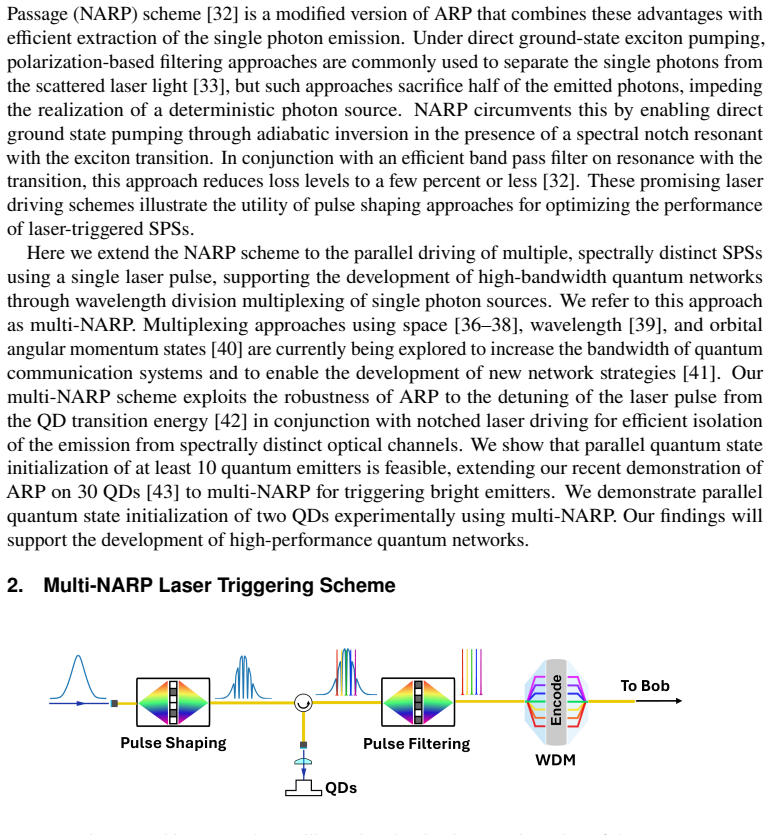
The load-bearing object is the modified spectral amplitude mask $A(\omega)=\prod_{i=1}^N[1-\exp[-(\omega-\omega_i)^2/\delta^2]]$ placed on a chirped pulse, where $\omega_i$ is the transition frequency of the $i$-th quantum dot and $\delta$ is the notch width. The quadratic phase $\Phi(\omega)=\phi''(\omega-\omega_0)^2/2$ produces the linear frequency sweep of adiabatic rapid passage, while each notch lets the pulse drive its emitter on resonance while suppressing scattered laser light at that wavelength. This combination keeps the system on a single dressed state throughout the pulse, so inversion is robust and immune to phonon-mediated dephasing, while the notches make the channels spectrally separable.
What would settle it
Drive a ground-state exciton transition in a single InGaAs quantum dot with a one-notch chirped pulse, collect the emitted single photons without polarization filtering, and measure their extraction efficiency, purity, and indistinguishability; if the ground-state inversion fidelity or photon quality differs materially from the excited-state-proxy results, or if the notch cannot suppress scattered laser light at that transition, the central claim fails. A second check is to run the 10-emitter simulation with unequal dipole moments and asymmetric transition energies and look for a loss of the inversion plateau.
Extended reading notes
Core claim
The central claim is that multi-NARP, the extension of notch-filtered adiabatic rapid passage to a pulse containing one spectral notch per emitter, performs high-fidelity quantum state inversion in every targeted quantum dot simultaneously. Because adiabatic rapid passage is insensitive to pulse-area and detuning fluctuations, the notches do not destroy the robustness of the inversion, and because the excitation is direct ground-state pumping without polarization filtering, nearly all emitted single photons can be collected. Simulations show the same inversion plateau that characterizes single-emitter NARP when five or ten dots are driven in parallel, and the plateau survives when electron-phonon coupling is included for positively chirped pulses. Experimentally, two telecom-compatible InGaAs dots are inverted together by a two-notch pulse, with the ground-state emission used as a proxy for the excited-state occupation. The authors therefore conclude that at least ten emitters can be triggered by one pulse, enabling an order-of-magnitude increase in quantum communication bandwidth.
Load-bearing premise
The experiments demonstrate multi-NARP on the first excited-state transition, using the ground-state emission only as a proxy, while the claims of near-unity extraction and background-free single photons depend on the directly driven ground-state transition behaving the same way.
Editorial extensions
If this is right
- One shaped pulse can initialize 10 or more spectrally distinct quantum emitters, so a single excitation line can feed a wavelength-division multiplexed quantum network.
- Since no polarization filtering is needed, photon extraction can approach unity instead of the 50 percent ceiling of standard resonant-excitation schemes.
- Positive chirp suppresses excitation-induced dephasing from electron-phonon coupling, preserving the indistinguishability and purity advantages of adiabatic rapid passage.
- The required pulse shape can be produced with standard 4f pulse shapers or passive chirped fiber Bragg gratings, making field deployment plausible.
- The channel count scales with the pulse bandwidth divided by notch width, so shorter transform-limited pulses or narrower notches directly increase multiplexing capacity.
Reading between the lines
- The experiment verifies inversion on the excited-state transition using ground-state emission as a proxy; the paper's central performance claims would be more directly tested by driving the ground-state transition itself and measuring the single-photon purity and indistinguishability of the emitted photons.
- Because the simulation treats emitters with equal dipole moments and symmetric detunings, real ensembles with uneven dipole strengths and asymmetric spectra may show a spread in inversion fidelity; the robustness argument suggests the spread should be modest, but this is a prediction of the paper's logic, not a demonstrated fact.
- If the scheme is combined with cavity or waveguide collection, the bandwidth gain could apply to chip-scale networks rather than only free-space or fiber-coupled planar samples.
- A straightforward testable extension would be to drive three or more dots with one notched pulse and measure the photon statistics of each demultiplexed channel simultaneously.
Signed reviews
Editorial analysis
A structured set of objections, weighed in public.
Referee Report
Summary. The paper extends the notch-filtered adiabatic rapid passage (NARP) scheme to multi-NARP, in which a single chirped, spectrally notched laser pulse simultaneously inverts multiple spectrally distinct quantum dots. The authors present optical Bloch simulations with electron-phonon coupling for five and ten emitters, showing robust inversion for suitable notch spacings and pulse areas, and report an experimental demonstration on two InGaAs quantum dots. The experiment, however, drives the first excited state transition and uses ground-state emission as a proxy for the excited-state occupation, so the laser notch and the detected emission are spectrally separated. The abstract and conclusion claim near-unity extraction efficiency, background-free single-photon emission, and the feasibility of triggering at least ten emitters, but the experimental evidence for the first two claims is indirect and the ten-emitter claim is simulation-only.
Significance. If the full claims held, the scheme would be a valuable step toward multiplexed quantum-dot single-photon sources that combine ARP robustness with spectral filtering without polarization loss. The numerical work is a genuine strength: it models electron-phonon coupling, maps the parameter regions of robust inversion, and shows that positively chirped multi-NARP pulses reproduce the phonon-free inversion dynamics in the strong-driving regime. The experimental demonstration on telecom-compatible dots is also relevant. The key weakness is that the experiment does not test the operational geometry on which the brightness and background-free claims rest, namely a spectral notch placed on the emitting transition. Those claims are therefore predictions rather than demonstrated results, and the paper should either add a ground-state-resonant experiment or explicitly mark them as projected benefits.
major comments (3)
- [Section 4, Fig. 3] The experimental demonstration drives the first excited state (ES) transition and uses ground-state emission as a proxy for ES occupation, so the laser notch is centered on the ES transition while detection occurs at the GS transition, separated by the ES-GS splitting. In this configuration the GS detection channel is automatically free of scattered laser light, so the experiment does not test the key multi-NARP feature of a spectral notch at the emitting transition enabling background-free collection without polarization filtering. The abstract's claims of near-unity extraction efficiency and background-free single-photon emission are therefore not supported by the presented experiment; these claims should either be demonstrated with direct ground-state excitation or explicitly reframed as predicted benefits.
- [Section 4, Fig. 3; Section 5] The experimental data are presented without error bars, and the two-dot demonstration does not measure single-photon purity, indistinguishability, or extraction efficiency. The claim that simultaneous triggering of at least ten emitters is possible is supported only by simulation (Fig. S3). The paper should clearly separate experimentally established facts from numerical predictions and provide uncertainty estimates for the measured inversion plateaus.
- [Section 3, Fig. 2(e)] The statement that positively chirped multi-NARP pulses lead to complete suppression of phonon-mediated dephasing is based on visual agreement of the solid curves in Fig. 2(e) with the phonon-free results in Fig. 2(d) for pulse areas larger than 5π. A quantitative figure of merit, such as the maximum deviation in exciton occupation or a defined fidelity threshold, should be stated so that this robustness claim can be evaluated.
minor comments (4)
- [Section 2] The word "indistiguishability" should be corrected to "indistinguishability".
- [Section 4] The text refers to "Fig. 3(d)" for the two-notch simulations, but the caption of Fig. 3 defines only panels (a)-(c); the reference should be corrected.
- [Section 2] The relation between the chirp parameter α and the spectral chirp φ'' is stated without a clear derivation or definition of the pulse amplitude envelope; the pulse-shape convention should be spelled out so that the α formula can be checked.
- [Section 5] The statement that multi-NARP provides "at least a ten-fold enhancement in the bandwidth" depends on the assumed pulse bandwidth and notch width; the specific parameter assumptions behind this factor should be stated explicitly.
Circularity Check
No significant circularity: the multi-NARP extension is separately simulated from Bloch equations, and prior NARP work is cited as independent experimental support rather than as a definitional input.
full rationale
The paper's central derivation is not circular. The multi-notch amplitude mask A(ω) = Π_i [1 − exp(−(ω−ω_i)^2/δ^2)] is an explicit extension of the single-notch NARP mask, and the inversion dynamics are evaluated by integrating the optical Bloch equations including electron-phonon coupling. The simulations are not fitted to the claimed outcome: parameters such as τ0 = 120 fs, δ = 1 meV, and φ′′ = 0.5 ps2 are stated as experimental values, and the two-notch simulation in Fig. 3 uses the experimental QD separation, but the predicted plateau behavior is an independent calculation rather than a curve fit. The experimental demonstration is performed on the first excited state transition with ground-state emission used as a proxy for excited-state occupation; this is an explicit validation limitation stated in Section 4, not a circular step, because the proxy is disclosed and does not enter the theoretical derivation. The scheme does build on the authors' earlier NARP and parallel-ARP papers, particularly Refs. [32] and [43], but those works are independently published with their own experimental support, and the multi-notch extension is separately derived and tested in this paper. No parameter is fitted to the central inversion result, and no definitional equivalence between input and output is present. The main weakness of the paper is experimental scope—two quantum dots on a non-emitting transition and a simulation-only 10-emitter claim—but that is a support limitation, not circular reasoning.
Assumptions & free parameters
free parameters (4)
- Pulse duration tau0 =
120 fs
- Notch width delta =
1 meV in simulations
- Chirp phi'' =
0.5 ps^2 (simulation), 0.3 ps^2 (experiment)
- QD transition energies and dipole moments =
Symmetric detunings, equal dipole moments
assumptions (5)
- domain assumption Optical Bloch equations with electron-phonon coupling model the QD dynamics.
- domain assumption Adiabatic rapid passage remains valid when the amplitude mask contains multiple spectral notches.
- domain assumption Positive chirp suppresses phonon-induced dephasing because of low phonon occupancy at low temperature.
- ad hoc to paper Ground-state emission is a valid proxy for the excited-state occupation in the experimental demonstration.
- standard math Standard properties of the adiabatic theorem.
Cite this review
Pith. "Pith review of Multi-NARP Laser Driving Scheme for Multiplexed Quantum Networks." pith.science (2026). https://pith.science/paper/N7QIC3SB
@misc{pith2026250617445,
  author       = {Pith},
  title        = {Pith review of: Multi-NARP Laser Driving Scheme for Multiplexed Quantum Networks},
  year         = {2026},
  howpublished = {\url{https://pith.science/paper/N7QIC3SB}},
  note         = {Machine review of arXiv:2506.17445}
}
read the original abstract
We extend the recently developed NARP scheme for laser-triggered single-photon sources to the simultaneous excitation of multiple emitters with varying transition energies, laying the groundwork for wavelength-division multiplexing in quantum optical networks. Our Multi-NARP scheme does not rely on polarization filtering and thus enables the near-unity extraction efficiency of single photons from each quantum dot. Our approach also offers the advantages of robustness to variations in the laser pulse parameters and immunity to excitation-induced dephasing tied to electron-phonon coupling. We show that simultaneous triggering of at least 10 emitters is possible, enabling the development of high-bandwidth quantum networks.
Figures


Figures from the paper (1 more)

Reference graph
Works this paper leans on
-
[1]
Device-independent quantum key distribution with single-photon sources,
J.Kołodyński,A.Máttar,P.Skrzypczyk,E.Woodhead,D.Cavalcanti,K.Banaszek,andA.Acín,“Device-independent quantum key distribution with single-photon sources,” Quantum4, 260 (2020)
work page 2020
-
[2]
Quantum-dot single photon sources for the quantum internet,
C.-Y. Lu and J.-W. Pan, “Quantum-dot single photon sources for the quantum internet,” Nat. Nanotechnol.16, 1294–1296 (2021)
work page 2021
-
[3]
S. Rodt and S. Reitzenstein, “Integrated nanophotonics for the development of fully functional quantum circuits based on on-demand single-photon emitters,” APL Photonics6, 010901 (2021)
work page 2021
-
[4]
Deterministic Integration of Single Photon Sources in Silicon Based Photonic Circuits,
I. E. Zadeh, A. W. Elshaari, K. D. Jöns,et al., “Deterministic Integration of Single Photon Sources in Silicon Based Photonic Circuits,” Nano Lett.16, 2289–2294 (2016)
work page 2016
-
[5]
Enhancing quantum cryptography with quantum dot single-photon sources,
M.Bozzio,M.Vyvlecka,M.Cosacchi,C.Nawrath,T.Seidelmann,J.C.Loredo,S.L.Portalupi,V.M.Axt,P.Michler, and P. Walther, “Enhancing quantum cryptography with quantum dot single-photon sources,” npj Quantum Inf.8, 104 (2022)
work page 2022
-
[6]
Enhancing secure key rates of satellite QKD using a quantum dot single-photon source
P. Chaiwongkhot, S. Hosseini, A. Ahmadi, B. L. Higgins, D. Dalacu, P. J. Poole, R. L. Williams, M. E. Reimer, T. Jennewein, “Enhancing secure key rates of satellite QKD using a quantum dot single-photon source,” arXiv, 2009.11818 (2020)
work page Pith review arXiv 2020
-
[7]
Y.Zhang,X.Ding,Y.Li, et al.,“ExperimentalSingle-PhotonQuantumKeyDistributionSurpassingtheFundamental Weak Coherent-State Rate Limit,” Phys. Rev. Lett.134, 210801 (2025)
work page 2025
-
[8]
A. Delteil, Z. Sun, S. Fält, and A. Imamoğlu, “Realization of a Cascaded Quantum System: Heralded Absorption of a Single Photon Qubit by a Single-Electron Charged Quantum Dot,” Phys. Rev. Lett.118, 177401 (2017)
work page 2017
Show all 53 references
-
[9]
Gigahertz-Clocked Teleportation of Time-Bin Qubits with a Quantum Dot in the Telecommunication C Band,
M.Anderson,T.Müller,J.Skiba-Szymanska1,A.B.Krysa,J.Huwer,R.M.Stevenson,J.Heffernan,D.A.Ritchie,and A. J. Shields, “Gigahertz-Clocked Teleportation of Time-Bin Qubits with a Quantum Dot in the Telecommunication C Band,” Phys. Rev. Appl.13, 054052 (2020)
2020
-
[10]
Aversatilesingle-photon-basedquantumcomputingplatform,
N.Maring,A.Fyrillas,M.Pont et al.,“Aversatilesingle-photon-basedquantumcomputingplatform,”Nat.Photonics 18, 603–609 (2024)
2024
-
[11]
Deterministic storage and retrieval of telecom light from a quantum dot single-photon source interfaced with an atomic quantum memory,
S. E. Thomas, L. Wagner, R. Joos,et al., “Deterministic storage and retrieval of telecom light from a quantum dot single-photon source interfaced with an atomic quantum memory,” Sci. Adv.10, eadi7346 (2024)
2024
-
[12]
Coherentlightscattering from a telecom C-band quantum dot,
L.Wells,T.M ¨üller,R.M.Stevenson,J.Skiba-Szymanska,D.A.Ritchie,andA.J.Shields,“Coherentlightscattering from a telecom C-band quantum dot,” Nat. Commun.14, 8371 (2023)
2023
-
[13]
High-performance semiconductor quantum-dot single-photon sources,
P. Senellart, G. Solomon and A. White, “High-performance semiconductor quantum-dot single-photon sources,” Nat. Nanotechnol. 12, 1026–1039 (2017)
2017
-
[14]
Near-optimal single-photon sources in the solid state,
N. Somaschi, V. Giesz, L. De Santis,et al., “Near-optimal single-photon sources in the solid state,” Nat. Photon.10, 340 (2016)
2016
-
[15]
On-demand generation of background-free single photons from a solid-state source,
L. Schweickert, K. D. Jöns, K. D. Zeuner, S. F. Covre da Silva; H. Huang, T. Lettner, M. Reindl, J. Zichi; R. Trotta; A. Rastelli, V. Zwiller, “On-demand generation of background-free single photons from a solid-state source,” Appl. Phys. Lett.112, 093106 (2018)
2018
-
[16]
Controlling the photon number coherence of solid-state quantum light sources for quantum cryptography,
Y. Karli, D. A. Vajner, F, Kappe,et al., “Controlling the photon number coherence of solid-state quantum light sources for quantum cryptography,” npj Quantum Inf.10, 17 (2024)
2024
-
[17]
Bright Single InAsP Quantum Dots at Telecom Wavelengths in Position-Controlled InP Nanowires: The Role of the Photonic Waveguide,
S. Haffouz, K. D. Zeuner, D. Dalacu,et al., “Bright Single InAsP Quantum Dots at Telecom Wavelengths in Position-Controlled InP Nanowires: The Role of the Photonic Waveguide,” Nano Lett.,18, 3047–3052 (2018)
2018
-
[18]
On-Demand Generation of Indistinguishable Photons in the Telecom C-Band Using Quantum Dot Devices,
D. A. Vajner, P. Holewa, E. Zie ¸ba-Ostój, et al., “On-Demand Generation of Indistinguishable Photons in the Telecom C-Band Using Quantum Dot Devices,” ACS Photonics,11, 339–347 (2024)
2024
-
[19]
Two-Photon Interference from an InAs Quantum Dot emitting in the Telecom C-Band,
J. Kim, J. Kaupp, Y. Reum,et al., “Two-Photon Interference from an InAs Quantum Dot emitting in the Telecom C-Band, ” arXiv, 2501.15970 (2025)
2025 arXiv
-
[20]
Bright Source of Purcell-Enhanced, Triggered, Single Photons in the Telecom C-Band,
C. Nawrath, R. Joos, S. Kolatschek,et al., “Bright Source of Purcell-Enhanced, Triggered, Single Photons in the Telecom C-Band,” Adv. Quantum Technol.,6, 2300111 (2023)
2023
-
[21]
Coherence in single photon emission from droplet epitaxy and Stranski–Krastanov quantum dots in the telecom C-band,
M. Anderson, T. Müller, J. Skiba-Szymanska,et al., “Coherence in single photon emission from droplet epitaxy and Stranski–Krastanov quantum dots in the telecom C-band,” Appl. Phys. Lett.,118, 014003 (2021)
2021
-
[22]
Proposed Robust and High-Fidelity Preparation of Excitons and Biexcitons in Semiconductor Quantum Dots Making Active Use of Phonons,
M. Glässl, A. M. Barth, and V. M. Axt, “Proposed Robust and High-Fidelity Preparation of Excitons and Biexcitons in Semiconductor Quantum Dots Making Active Use of Phonons,” Phys. Rev. Lett.,110, 147401 (2013)
2013
-
[23]
Phonon Effects on Population Inversion in Quantum Dots: Resonant, Detuned and Frequency-Swept Excitations,
D. E. Reiter, S. Lüker, K. Gawarecki,et al., “Phonon Effects on Population Inversion in Quantum Dots: Resonant, Detuned and Frequency-Swept Excitations,” Acta Phys. Polonica A,122, 1065–1068 (2012)
2012
-
[24]
Filter-free single-photon quantum dot resonance fluorescence in an integrated cavity-waveguide device,
T. Huber, M. Davanco, M. Müller,et al., “Filter-free single-photon quantum dot resonance fluorescence in an integrated cavity-waveguide device,” Optica,7, 380–385 (2020)
2020
-
[25]
On-chip deterministic operation of quantum dots in dual-mode waveguides for a plug-and-play single-photon source,
R. Uppu, H. T. Eriksen, H. Thyrrestrup,et al., “On-chip deterministic operation of quantum dots in dual-mode waveguides for a plug-and-play single-photon source,” Nat. Commun.,11, 3782 (2020)
2020
-
[26]
Triggered Single Photons from a Quantum Dot,
C. Santori, M. Pelton, G. Solomon, Y. Dale, and Y. Yamamoto, “Triggered Single Photons from a Quantum Dot,” Phys. Rev. Lett.,86, 1502 (2001)
2001
-
[27]
Subpicosecond adiabatic rapid passage on a single semiconductor quantum dot: Phonon-mediated dephasing in the strong-driving regime,
R. Mathew, E. Dilcher, A. Gamouras,et al., “Subpicosecond adiabatic rapid passage on a single semiconductor quantum dot: Phonon-mediated dephasing in the strong-driving regime,” Phys. Rev. B,90, 035316 (2014)
2014
-
[28]
Deterministic and Robust Generation of Single Photons from a Single Quantum Dot with 99.5% Indistinguishability Using Adiabatic Rapid Passage,
Y.-J. Wei, Y.-M. He, M.-C. Chen,et al., “Deterministic and Robust Generation of Single Photons from a Single Quantum Dot with 99.5% Indistinguishability Using Adiabatic Rapid Passage,” Nano Lett.,14, 6515–6519 (2014)
2014
-
[29]
Coherently driving a single quantum two-level system with dichromatic laser pulses,
Y.-M. He, H. Wang, C. Wang,et al., “Coherently driving a single quantum two-level system with dichromatic laser pulses,” Nat. Phys.,15, 941–946 (2019)
2019
-
[30]
CoherentDynamicsinQuantumEmittersunderDichromaticExcitation,
Z.X.Koong,E.Scerri,M.Rambach et al.,“CoherentDynamicsinQuantumEmittersunderDichromaticExcitation,” Phys. Rev. Lett.,126, 047403 (2021)
2021
-
[31]
Swing-Up of Quantum Emitter Population Using Detuned Pulses,
T. K. Bracht, M. Cosacchi, T. Seidelmann,et al., “Swing-Up of Quantum Emitter Population Using Detuned Pulses,” PRX Quantum,2, 040354 (2021)
2021
-
[32]
Notch-filteredadiabaticrapidpassageforopticallydrivenquantum light sources,
G.R.Wilbur,A.Binai-Motlagh,A.Clarke, et al.,“Notch-filteredadiabaticrapidpassageforopticallydrivenquantum light sources,” APL Photonics,7, 111302 (2022)
2022
-
[33]
A dark-field microscope for background-free detection of resonance fluorescence from single semiconductor quantum dots operating in a set-and-forget mode,
A. V. Kuhlmann, J. Houel, D. Brunner, A. Ludwig, D. Reuter, A. D. Wieck, and R. J Warburton, “A dark-field microscope for background-free detection of resonance fluorescence from single semiconductor quantum dots operating in a set-and-forget mode,” Rev. Sci. Instrum.,84,073905 (2013)
2013
-
[34]
Demonstrating the decoupling regime of the electron-phonon interaction in a quantum dot using chirped optical excitation,
T. Kaldewey, S. Lüker, A. V. Kuhlmann,et al., “Demonstrating the decoupling regime of the electron-phonon interaction in a quantum dot using chirped optical excitation,” Phys. Rev. B,95, 241306(R) (2017)
2017
-
[35]
Suppression of decoherence tied to electron–phonon coupling in telecom-compatible quantum dots: low-threshold reappearance regime for quantum state inversion,
A. Ramachandran, G. R. Wilbur, S. O’Neal, D. G. Deppe, and K. C. Hall, “Suppression of decoherence tied to electron–phonon coupling in telecom-compatible quantum dots: low-threshold reappearance regime for quantum state inversion,” Opt. Lett.,45, 6498–6501 (2020)
2020
-
[36]
Quantum communication multiplexing in LP-modes enabled by photonic lanterns,
I. Beraza, M. Zahidy, R. Mueller,et al., “Quantum communication multiplexing in LP-modes enabled by photonic lanterns,” arXiv, 2502.12865 (2025)
2025 arXiv
-
[37]
Record-High Secret Key Rate for Joint Classical and Quantum Transmission Over a 37-Core Fiber,
B. Da Lio, D. Bacco, D. Cozzolino,et al., “Record-High Secret Key Rate for Joint Classical and Quantum Transmission Over a 37-Core Fiber,” 2018 IEEE Photonics Conf. (IPC), Reston, VA, USA, 1–2,(2018)
2018
-
[38]
Multiplexed Single Photons from Deterministically Positioned Nanowire Quantum Dots,
Z.-X. Koong, G. Ballesteros-Garcia, R. Proux,et al., “Multiplexed Single Photons from Deterministically Positioned Nanowire Quantum Dots,” Phys. Rev. Appl.,14, 034011 (2020)
2020
-
[39]
Wavelength division multiplexing of continuous variable quantum key distribution and 18.3 Tbit/s data channels,
T. A. Eriksson, T. Hirano, B. J. Puttnam,et al., “Wavelength division multiplexing of continuous variable quantum key distribution and 18.3 Tbit/s data channels,” Commun. Phys.,2, 9 (2019)
2019
-
[40]
Photonic integrated chip enabling orbital angular momentum multiplexing for quantum communication,
M. Zahidy, Y. Liu, D. Cozzolino,et al., “Photonic integrated chip enabling orbital angular momentum multiplexing for quantum communication,” Nanophotonics,11, 821–827 (2022)
2022
-
[41]
2×N twin-field quantum key distribution network configuration based on polarization, wavelength, and time division multiplexing,
C. H. Park, M. K. Woo, B. K. Park,et al., “2×N twin-field quantum key distribution network configuration based on polarization, wavelength, and time division multiplexing,” npj Quantum Inf.,8, 48 (2022)
2022
-
[42]
Experimental quantification of the robustness of adiabatic rapid passage for quantum state inversion in semiconductor quantum dots,
A. Ramachandran, J. Fraser-Leach, S. O’Neal, D. G. Deppe, and K. C. Hall, “Experimental quantification of the robustness of adiabatic rapid passage for quantum state inversion in semiconductor quantum dots,” Opt. Express,29, 41766–41775 (2021)
2021
-
[43]
Robust parallel laser driving of quantum dots for multiplexing of quantum light sources,
A. Ramachandran, G. R. Wilbur, R. Mathew,et al., “Robust parallel laser driving of quantum dots for multiplexing of quantum light sources,” Sci. Rep.,14, 5356 (2024)
2024
-
[44]
Compact chirped fiber bragg gratings for single-photon generation from quantum dots,
V. Remesh, R. G. Krämer, R. Schwarz,et al., “Compact chirped fiber bragg gratings for single-photon generation from quantum dots,” APL Photonics,8, 101301 (2023)
2023
-
[45]
Effect of detuning on the phonon induced dephasing of optically driven InGaAs/GaAs quantum dots,
A. J. Ramsay, T. M. Godden, S. J. Boyle,et al., “Effect of detuning on the phonon induced dephasing of optically driven InGaAs/GaAs quantum dots,” J. Appl. Phys.,109, 102415 (2011)
2011
-
[46]
Influence of acoustic phonons on the optical control of quantum dots driven by adiabatic rapid passage,
S. Lüker, K. Gawarecki, D. E. Reiter, A. Grodecka-Grad, V. M. Axt, P. Machnikowski, and T. Kuhn, “Influence of acoustic phonons on the optical control of quantum dots driven by adiabatic rapid passage,” Phys. Rev B,85, 121302(R) (2012)
2012
-
[47]
Chirped laser excitation of quantum dot excitons coupled to a phonon bath,
A. Debnath, C. Meier, B. Chatel, and T. Amand, “Chirped laser excitation of quantum dot excitons coupled to a phonon bath,” Phys. Rev B,86, 161304(R) (2012)
2012
-
[48]
Manipulating Quantum Structures Using Laser Pulses,
B. W. Shore, “Manipulating Quantum Structures Using Laser Pulses,” (Cambridge University Press, 2011)
2011
-
[49]
Simultaneous Deterministic Control of Distant Qubits in Two Semiconductor Quantum Dots,
A. Gamouras, R. Mathew, S. Freisem, D. G. Deppe, K. C. Hall, “Simultaneous Deterministic Control of Distant Qubits in Two Semiconductor Quantum Dots,” Nano Lett.,13, 4666 (2013)
2013
-
[50]
Transform-limited single photons from a single quantum dot,
A.V.Kuhlmann,J.H.Prechtel,J.Houel,A.Ludwig,D.Reuter,A.D.Wieck,andR.J.Warburton,“Transform-limited single photons from a single quantum dot,” Nat. Commun.,6, 8204 (2015)
2015
-
[51]
SUPER Scheme in Action: Experimental Demonstration of Red-Detuned Excitation of a Quantum Emitter,
Y. Karli, F. Kappe, V. Remesh,et al. “SUPER Scheme in Action: Experimental Demonstration of Red-Detuned Excitation of a Quantum Emitter,” Nano Lett.,22, 6567–6572 (2022)
2022
-
[52]
Highly efficient and indistinguishable single-photon sources via phonon-decoupled two-color excitation,
L. Vannucci, and N. Gregersen, “Highly efficient and indistinguishable single-photon sources via phonon-decoupled two-color excitation,” Phys. Rev. B,107, 195306 (2023)
2023
-
[53]
Interplay of Rabi oscillations and quantum interference in semiconductor quantum dots,
H. Htoon, T. Takagahara, D. Kulik,et al., “Interplay of Rabi oscillations and quantum interference in semiconductor quantum dots,” Phys. Rev. Lett.,88, 087401 (2002)
2002
Reviewed August 15, 2026 · model on record in the stance chip above.
Discussion (0). Continue with ORCID to comment.