AC Conductance in n-InSb Structures with Quantum Well. Acoustic Studies
Pith reviewed 2026-06-25 22:55 UTC · model grok-4.3
The pith
A parallel conducting layer accounts for the unusual magnetic field dependences of SAW attenuation and velocity in n-InSb quantum well structures.
A machine-rendered reading of the paper's core claim, the machinery that carries it, and where it could break.
Core claim
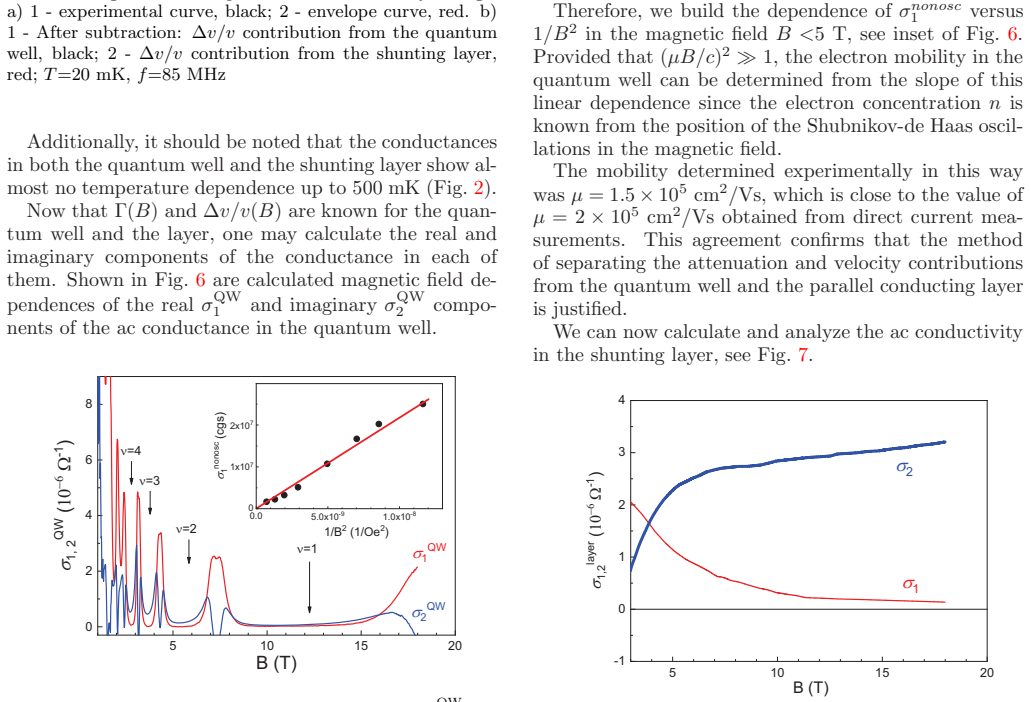
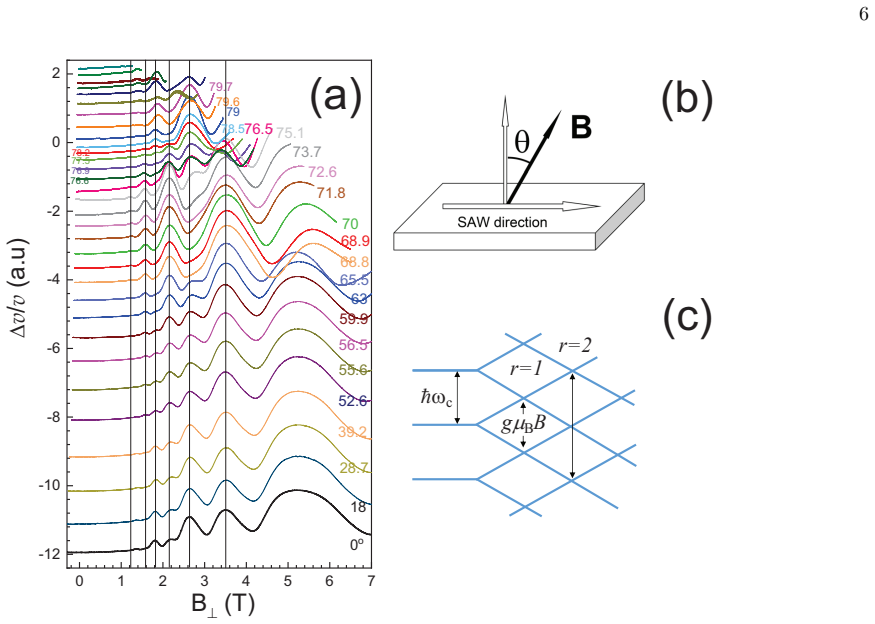
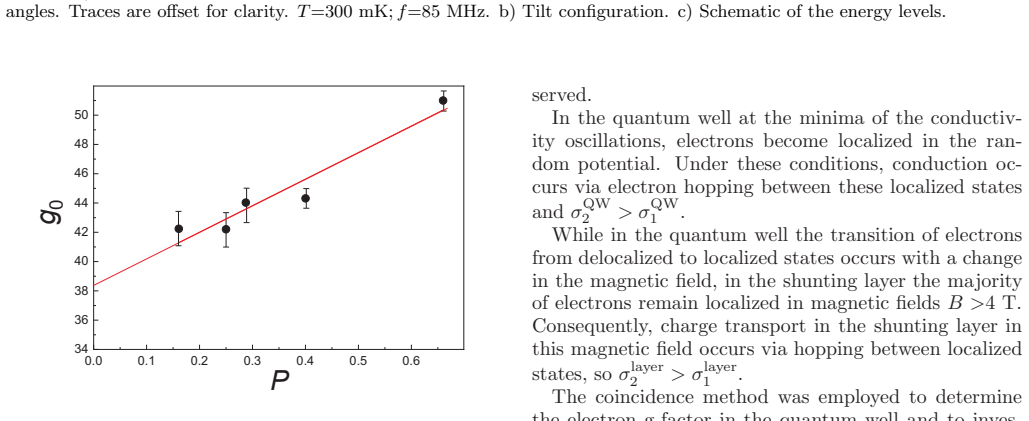
The central claim is that the presence of a conducting layer parallel to the quantum well produces the observed anomalous magnetic field dependences of surface acoustic wave attenuation and velocity. Separation of the quantum-well and shunting-layer signals identifies their distinct conduction mechanisms. Application of the coincidence technique determines the electron g-factor in the quantum well and its dependence on the degree of spin polarization.
What carries the argument
Separation of quantum-well and parallel-shunting-layer contributions through combined surface acoustic wave attenuation, velocity, and coincidence-technique measurements in magnetic fields.
If this is right
- The quantum well and the parallel shunting layer follow distinct conduction mechanisms.
- The electron g-factor in the quantum well varies with the degree of spin polarization.
- Acoustic methods can isolate parallel conduction effects that would otherwise mask individual layer properties.
- The separation works across the full range of fields to 18 T and temperatures to 20 mK.
Where Pith is reading between the lines
- Similar parallel layers could mask intended quantum-well behavior in other heterostructure devices.
- Acoustic separation techniques might be applied to probe parallel paths in additional material systems.
- The observed g-factor dependence could be tested against models that include spin-polarization effects at higher fields.
Load-bearing premise
The unusual magnetic field dependences arise exclusively from a parallel conducting layer rather than from other mechanisms such as interface states or changes inside the quantum well itself.
What would settle it
If samples confirmed to lack any parallel conducting layer still display the same anomalous magnetic field dependences of SAW attenuation and velocity, the attribution would be falsified.
Figures
read the original abstract
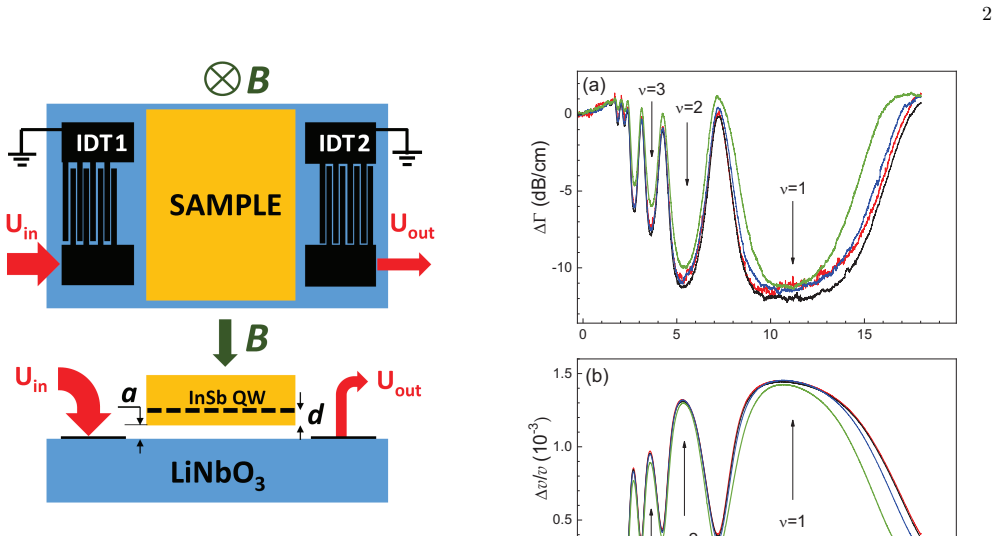
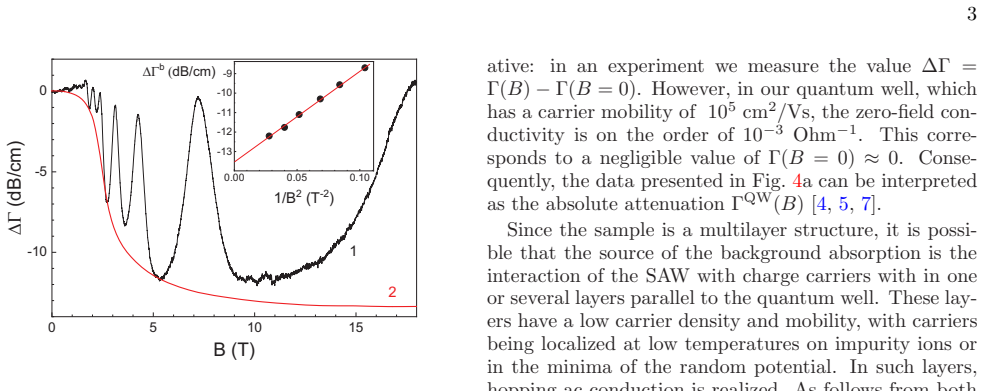
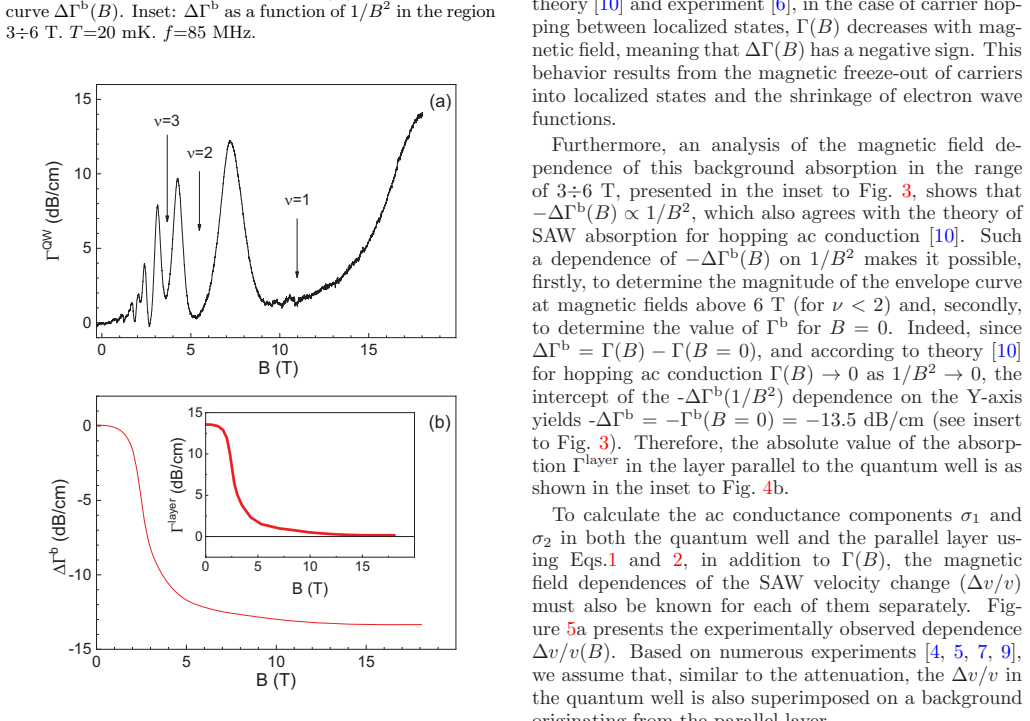
We studied the ac conductance of an $n$-InSb quantum well structure using acoustic methods in magnetic fields up to 18 T and at temperatures ranging from 20 to 500 mK. We attribute the unusual magnetic field dependences of surface acoustic wave (SAW) attenuation and velocity observed in the experiment to the presence of a conducting layer parallel to the quantum well in the sample. We successfully separated the contributions from both the quantum well and the shunting layer, enabling the identification of their distinct conduction mechanisms. Furthermore, by employing the coincidence technique, we determined the electron g-factor in the quantum well and investigated its dependence on the degree of spin polarization.
Editorial analysis
A structured set of objections, weighed in public.
Referee Report
Summary. The manuscript reports acoustic measurements of AC conductance in an n-InSb quantum well structure using surface acoustic waves (SAW) in magnetic fields up to 18 T and temperatures 20–500 mK. The central claim is that the observed unusual magnetic-field dependences of SAW attenuation and velocity arise from a conducting layer parallel to the quantum well; the authors state they have separated the quantum-well and shunting-layer contributions, identified their distinct conduction mechanisms, and extracted the electron g-factor in the quantum well via the coincidence technique together with its dependence on spin polarization.
Significance. If the two-channel decomposition is shown to be unique and the g-factor extraction is supported by explicit data and fits, the work would add to understanding of parallel conduction in InSb heterostructures and spin properties in narrow-gap systems. The contactless acoustic probe is a methodological asset for AC transport studies.
major comments (2)
- [Results / Data Analysis sections] The manuscript states successful separation of quantum-well and shunting-layer conductivities but supplies neither the explicit two-layer circuit model (series/parallel combination with geometric factors) nor the fitting procedure, error analysis, or exclusion criteria used to obtain the individual conductivities. This information is required to assess whether the decomposition is unique or whether interface states, disorder, or field-induced changes inside the quantum well could produce equivalent signatures (load-bearing for the attribution claim in the abstract).
- [Discussion section] No quantitative comparison is presented between the extracted layer conductivities and alternative models (e.g., single-layer with interface states). Without such tests the claim that the parallel layer is the origin of the observed B-dependences cannot be evaluated.
minor comments (2)
- [Abstract] The abstract would benefit from a brief statement of the extracted g-factor value and the frequency range of the SAW measurements.
- [Figure captions] Figure captions should specify the SAW frequency, the fitting parameters shown, and any normalization applied to attenuation/velocity data.
Simulated Author's Rebuttal
We thank the referee for the constructive comments on our manuscript. We address the concerns about the two-layer decomposition below and will revise the manuscript accordingly to strengthen the presentation of our analysis.
read point-by-point responses
-
Referee: [Results / Data Analysis sections] The manuscript states successful separation of quantum-well and shunting-layer conductivities but supplies neither the explicit two-layer circuit model (series/parallel combination with geometric factors) nor the fitting procedure, error analysis, or exclusion criteria used to obtain the individual conductivities. This information is required to assess whether the decomposition is unique or whether interface states, disorder, or field-induced changes inside the quantum well could produce equivalent signatures (load-bearing for the attribution claim in the abstract).
Authors: We agree that the original manuscript did not provide sufficient detail on the two-layer model. In the revised version we will add an explicit description of the equivalent-circuit model for the parallel conducting layers (including geometric factors), the fitting procedure, error analysis, and the exclusion criteria used to establish uniqueness of the decomposition. This will allow direct evaluation of whether alternative explanations could produce equivalent signatures. revision: yes
-
Referee: [Discussion section] No quantitative comparison is presented between the extracted layer conductivities and alternative models (e.g., single-layer with interface states). Without such tests the claim that the parallel layer is the origin of the observed B-dependences cannot be evaluated.
Authors: We will add to the revised Discussion a quantitative comparison of the extracted conductivities against alternative models, including a single-layer scenario with interface states. This will show that the parallel-shunting-layer description provides the best account of the observed magnetic-field dependences in SAW attenuation and velocity. revision: yes
Circularity Check
No circularity: experimental attribution without self-referential derivation
full rationale
The manuscript is an experimental acoustic study of AC conductance in an n-InSb quantum well. It reports measured SAW attenuation and velocity versus magnetic field, attributes the dependences to a parallel shunting layer, and states that contributions were separated to identify distinct mechanisms. No equations, ansatzes, or functional forms are presented whose outputs reduce by construction to inputs defined within the paper itself. The separation is performed on measured data; no load-bearing step invokes a self-citation chain, renames a fitted parameter as a prediction, or imports uniqueness from prior author work. The work therefore contains no circular steps of the enumerated kinds.
Axiom & Free-Parameter Ledger
Reference graph
Works this paper leans on
-
[1]
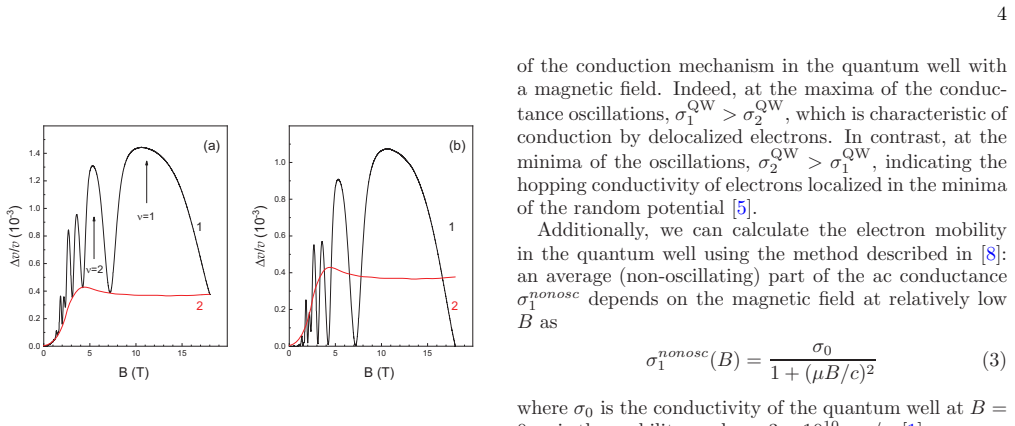
Note that the char- acteristic shape of the ∆ v/v envelope (curve 2) versus magnetic field is qualitatively similar to ∆ v/v (B) in the case of hopping conductance measured in [ 6]
was constructed based on previous ex- perimental data: in the case of SA W interaction with carriers in the quantum well the value of ∆ v/v at its minima approaches 0 [ 4, 5, 7, 9]. Note that the char- acteristic shape of the ∆ v/v envelope (curve 2) versus magnetic field is qualitatively similar to ∆ v/v (B) in the case of hopping conductance measured in ...
-
[2]
Theory of quantum transport in a two- dimensional electron system under magnetic fields
Ando, T., 1974. Theory of quantum transport in a two- dimensional electron system under magnetic fields. IV. oscillatory conductivity. J. Phys. Soc. Jpn. 37, 1233– 1239
1974
-
[3]
InAs-AlSb quantum wells in tilted magnetic fields
Brosig, S., Ensslin, K., Jansen, A.G., Nguyen, C., Brar, B., Thomas, M., Kroemer, H., 2000. InAs-AlSb quantum wells in tilted magnetic fields. Phys. Rev. B 61, 13045– 13048. doi:doi:10.1103/PhysRevB.61.13045
-
[4]
Ising quantum hall ferromagnetism in InSb-based two- dimensional electronic systems
Chokomakoua, J.C., Goel, N., Chung, S.J., Santos, M.B., Hicks, J.L., Johnson, M.B., Murphy, S.Q., 2004. Ising quantum hall ferromagnetism in InSb-based two- dimensional electronic systems. Phys. Rev. B 69, 235315. doi:doi:10.1103/PhysRevB.69.235315
-
[5]
Drichko, I.L., Diakonov, A.M., Smirnov, I.Y., Andri- anov, G.O., Mironov, O.A., Myronov, M., Leadley, D.R., Whall, T.E., 2005a. High-frequency transport in p-type Si/SiGe heterostructures studied with surface acoustic waves in the quantum hall regime. Phys. Rev. B 71, 045333. doi:doi:10.1103/PhysRevB.71.045333
-
[6]
High-frequency hopping con- ductivity in the quantum hall effect regime: Acous- tical studies
Drichko, I.L., Diakonov, A.M., Smirnov, I.Y., Galperin, Y.M., Toropov, A.I., 2000. High-frequency hopping con- ductivity in the quantum hall effect regime: Acous- tical studies. Phys. Rev. B 62, 7470–7477. doi:doi: 10.1103/PhysRevB.62.7470
-
[7]
Mechanisms of low-temperature high-frequency conductivity in systems with a dense array of Ge 0.7Si0.3 quantum dots in silicon
Drichko, I.L., Dyakonov, A.M., Smirnov, I.Y., Suslov, A.V., Galperin, Y.M., Yakimov, A.I., Nikiforov, A.I., 2005b. Mechanisms of low-temperature high-frequency conductivity in systems with a dense array of Ge 0.7Si0.3 quantum dots in silicon. J. Exp. Theor. Phys. 101, 1122–
-
[8]
doi:doi:10.1134/1.2163927
-
[9]
Drichko, I.L., Malysh, V.A., Smirnov, I.Y., Suslov, A.V., Mironov, O.A., Kummer, M., von K¨ anel, H.,
-
[10]
Acoustoelectric effects in very high-mobility p- SiGe/Ge/SiGe heterostructure at low temperatures in high magnetic fields. J. Appl. Phys. 114, 074302. doi:doi: 10.1063/1.4818436
-
[11]
Contact-free de- termination of the parameters of a 2d electron gas in GaAs/AlGaAs heterostructures
Drichko, I.L., Smirnov, I.Y., 1997. Contact-free de- termination of the parameters of a 2d electron gas in GaAs/AlGaAs heterostructures. Semiconductors 31, 933–936
1997
-
[12]
Drichko, I.L., Smirnov, I.Y., Suslov, A.V., Leadley, D.R.,
-
[13]
Acoustic studies of ac conductivity mechanisms in GaAs/AlGaAs in the integer and fractional quantum hall effect regime. Phys. Rev. B 83, 235318. doi:doi: 10.1103/PhysRevB.83.235318
-
[14]
Acoustical properties of semiconductors in hopping conductivity regime
Galperin, Y.M., Priev, E.Y., 1986. Acoustical properties of semiconductors in hopping conductivity regime. Sov. Phys. Solid State 28, 385–389
1986
-
[15]
Kagan, V.D., 1997. Propagation of a surface acoustic wave in a layered system containing a two-dimensional conducting layer. Semiconductors 31, 407–411. doi:doi: 10.1134/1.1187321
-
[16]
Spectroscopy of rashba spin splitting in insb quantum wells
Khodaparast, G.A., Doezema, R.E., Chung, S.J., Goldammer, K.J., Santos, M.B., 2004. Spectroscopy of rashba spin splitting in insb quantum wells. Phys. Rev. B 70, 155322. doi:doi:10.1103/PhysRevB.70.155322
-
[17]
Limiting scatter- ing processes in high-mobility InSb quantum wells grown on GaSb buffer systems
Lehner, C.A., Tschirky, T., Ihn, T., Dietsche, W., Keller, J., F¨ alt, S., Wegscheider, W., 2018. Limiting scatter- ing processes in high-mobility InSb quantum wells grown on GaSb buffer systems. Phys. Rev. Mater. 2, 054601. doi:doi:10.1103/PhysRevMaterials.2.054601
-
[18]
Lei, Z., Lehner, C.A., Rubi, K., Cheah, E., Karalic, M., Mittag, C., Alt, L., Scharnetzky, J., M¨ arki, P., Zeitler, U., Wegscheider, W., Ihn, T., Ensslin, K.,
-
[19]
Electronic g factor and magnetotransport in InSb quantum wells. Phys. Rev. Res. 2, 033213. doi:doi: 10.1103/PhysRevResearch.2.033213
-
[20]
Theory of magnetic susceptibility in metals at low temperature
Lifshits, I.M., Kosevich, A.M., 1956. Theory of magnetic susceptibility in metals at low temperature. Sov. Phys. JETP 2, 636–645
1956
-
[21]
Giant enhanced g-factors in an InSb two-dimensional gas
Nedniyom, B., Nicholas, R.J., Emeny, M.T., Buckle, L., Gilbertson, A.M., Buckle, P.D., Ashley, T., 2009. Giant enhanced g-factors in an InSb two-dimensional gas. Phys. Rev. B 80, 125328. doi:doi:10.1103/PhysRevB.80.125328
-
[22]
Low-frequency conduc- tivity due to hopping processes in silicon
Pollak, M., Geballe, T.H., 1961. Low-frequency conduc- tivity due to hopping processes in silicon. Phys. Rev. 122, 1742–1746. doi:doi:10.1103/PhysRev.122.1742
-
[23]
Yang, K.F., Liu, H.W., Mishima, T.D., Santos, M.B., Nagase, K., Hirayama, Y., 2011. Nonlinear magnetic field dependence of spin polarization in high-density two- dimensional electron systems. New J. Phys. 13, 083010. doi:doi:10.1088/1367-2630/13/8/083010
-
[24]
Zhi, Z., Wu, Y., Ruan, H., Liu, J., Huang, P., Yao, S., Liu, X., Tang, C., Yao, Q., Sun, L., Zhang, Y., Xiao, Y., Che, R., Kou, X., 2025. Tunable interfacial rashba spin–orbit coupling in asymmetric AlInSb/InSb/CdTe quantum well heterostructures. Appl. Phys. Lett. 126, 012104. doi:doi:10.1063/5.0233964
discussion (0)
Sign in with ORCID, Apple, or X to comment. Anyone can read and Pith papers without signing in.