Unsupervised Disentanglement Without Compromises : How Functional Orthogonality Enforces Identifiability
Pith reviewed 2026-06-26 14:58 UTC · model grok-4.3
The pith
An orthogonality constraint on the Jacobian identifies general nonlinear generative factors without independence assumptions.
A machine-rendered reading of the paper's core claim, the machinery that carries it, and where it could break.
Core claim
We prove that this condition yields identifiability of general nonlinear generative models, without requiring statistical independence or causal assumptions, provided the latent domain admits all combinations of factor values.
What carries the argument
The orthogonality constraint on the Jacobian of the generative mapping, enforcing that distinct latent factors act through locally orthogonal directions.
If this is right
- Identifiability holds for general nonlinear generative models under the stated condition.
- Statistical independence between latent factors is not required.
- Causal assumptions are unnecessary for the identifiability result.
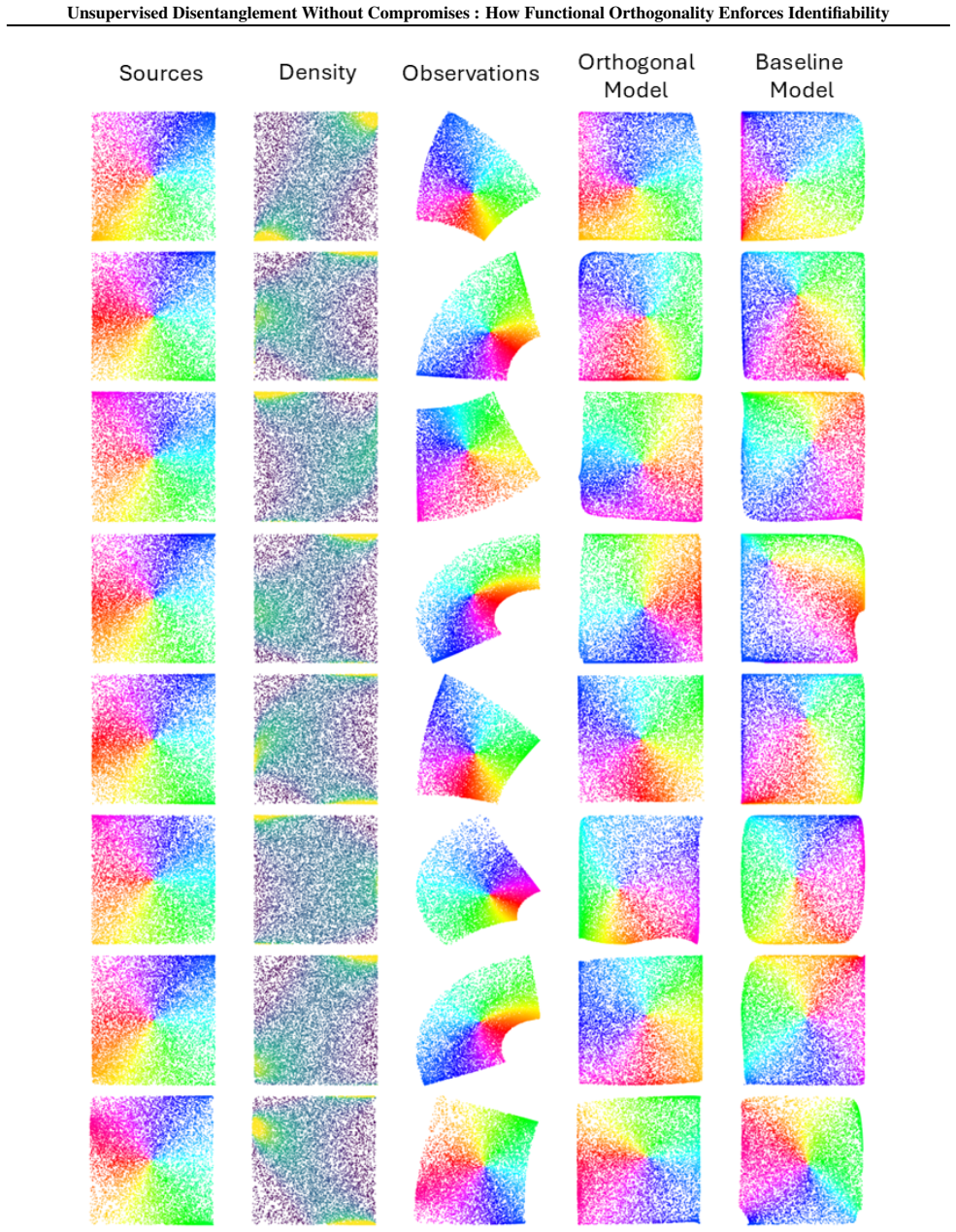
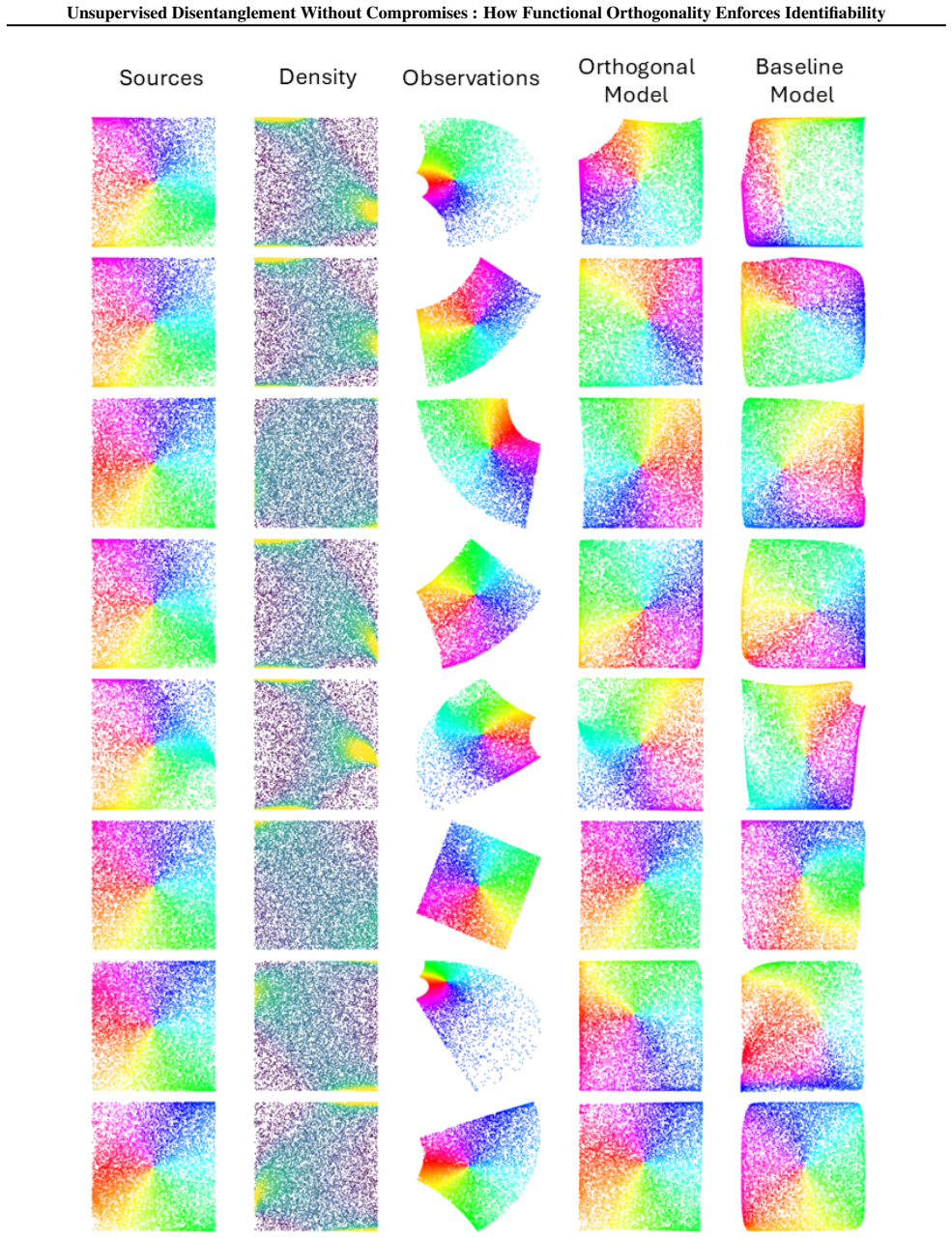
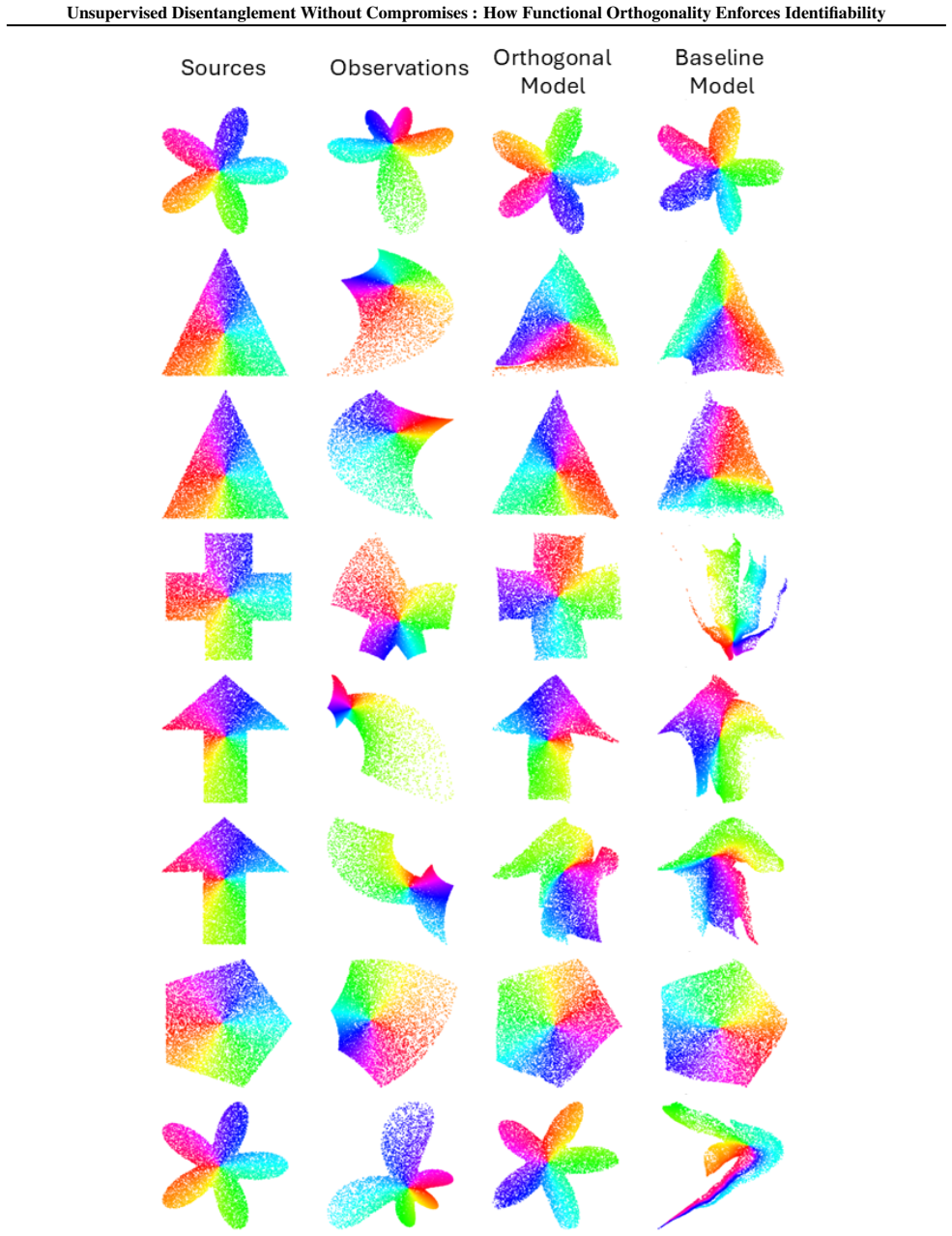
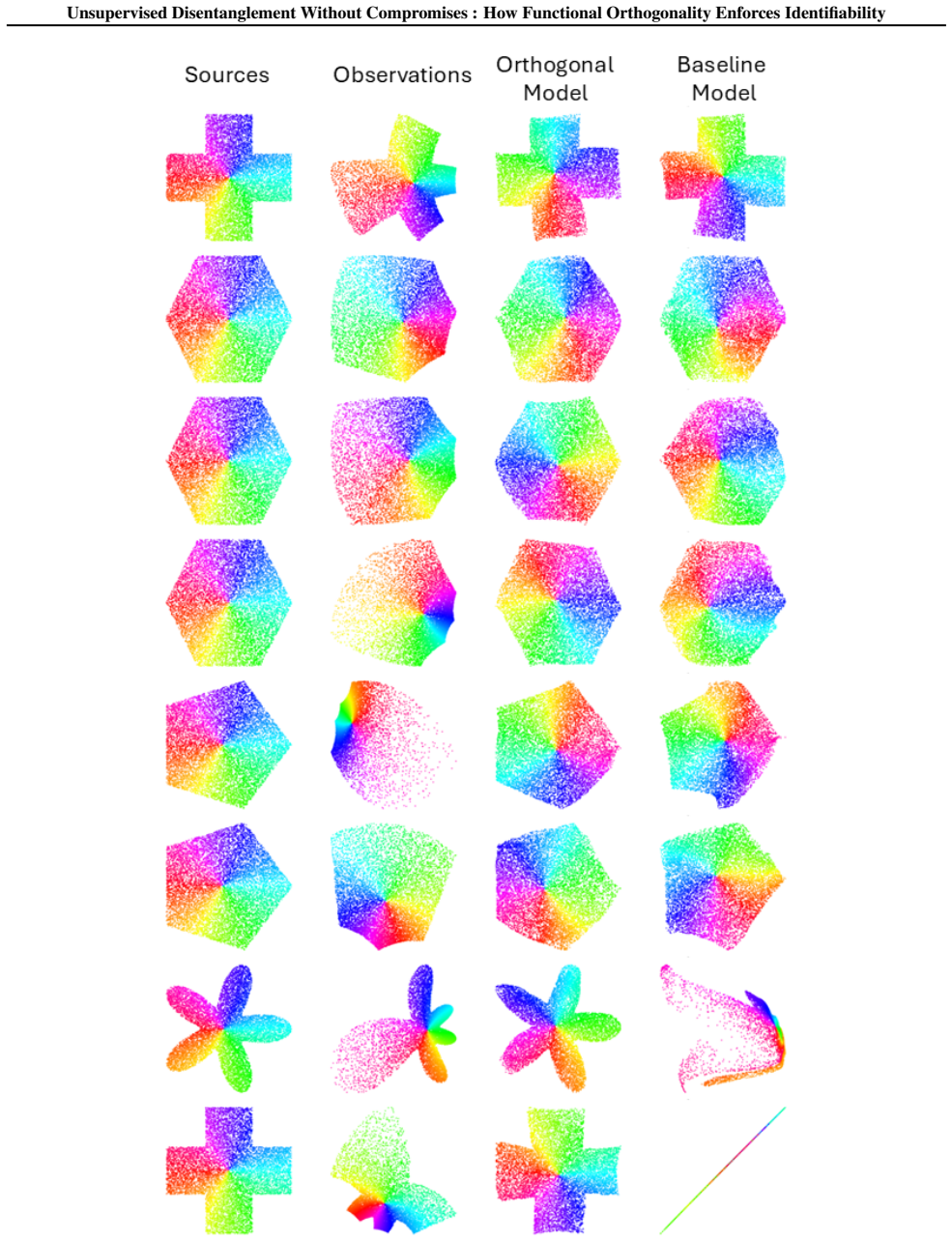
- Orthogonality-regularized normalizing flows recover ground-truth factors in experiments.
- The observed success of VAEs can be explained by implicit satisfaction of the orthogonality condition.
Where Pith is reading between the lines
- Relaxing full combinatorial coverage would likely allow non-unique recoveries even when orthogonality holds.
- The same constraint could be imposed on other generative architectures to test identifiability beyond flows.
- Empirical checks on datasets whose factors do not span all combinations would directly test the necessity of the coverage assumption.
Load-bearing premise
The latent domain must admit every possible combination of factor values.
What would settle it
A concrete nonlinear generative model in which the Jacobian remains orthogonal everywhere yet two distinct factorizations produce identical observations when some factor combinations are missing from the latent domain.
Figures
read the original abstract
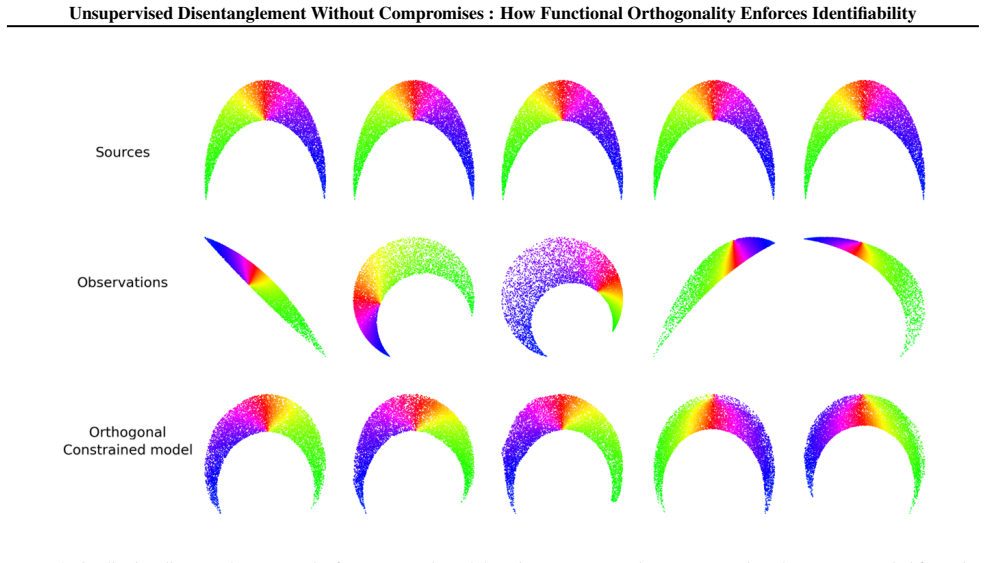
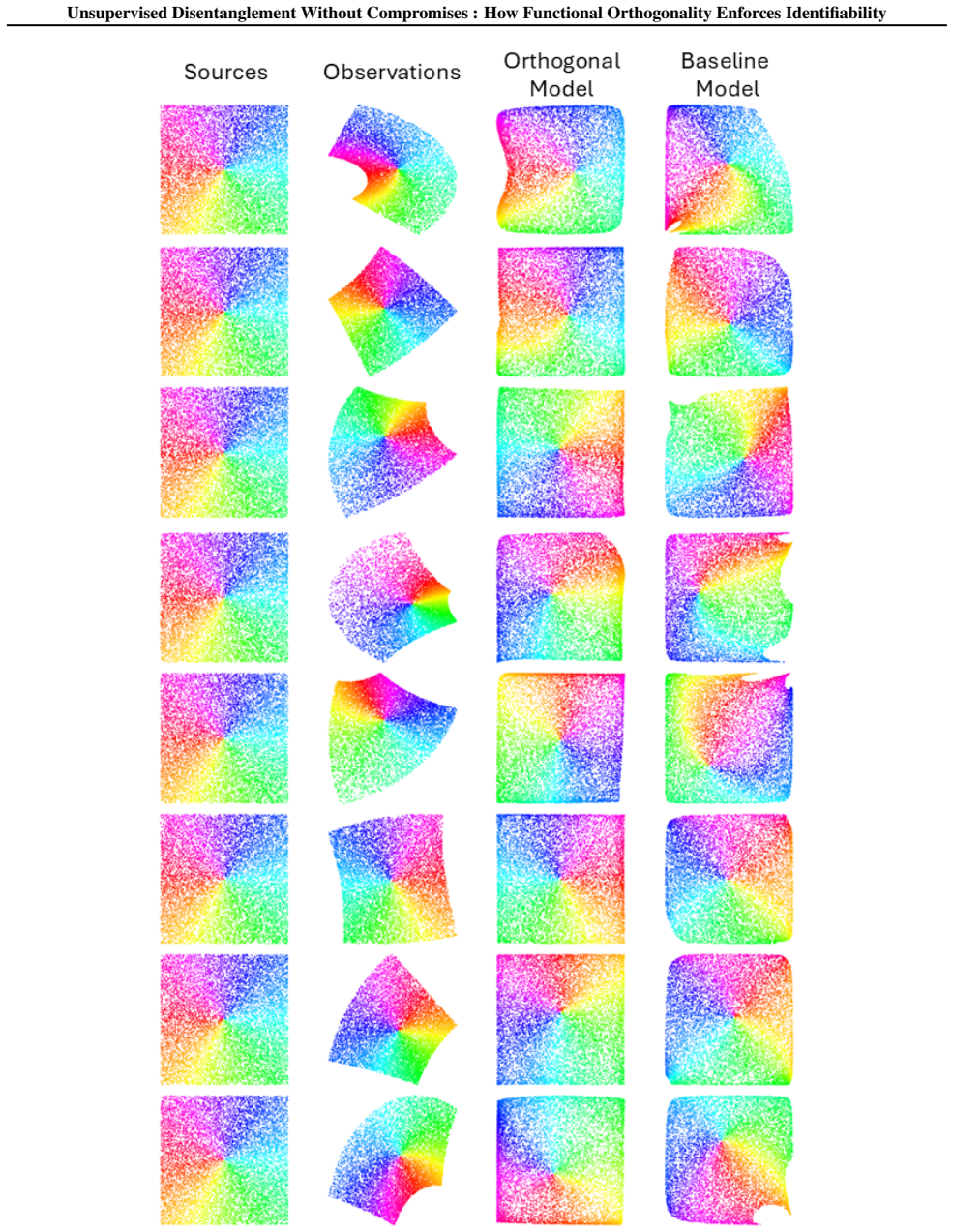
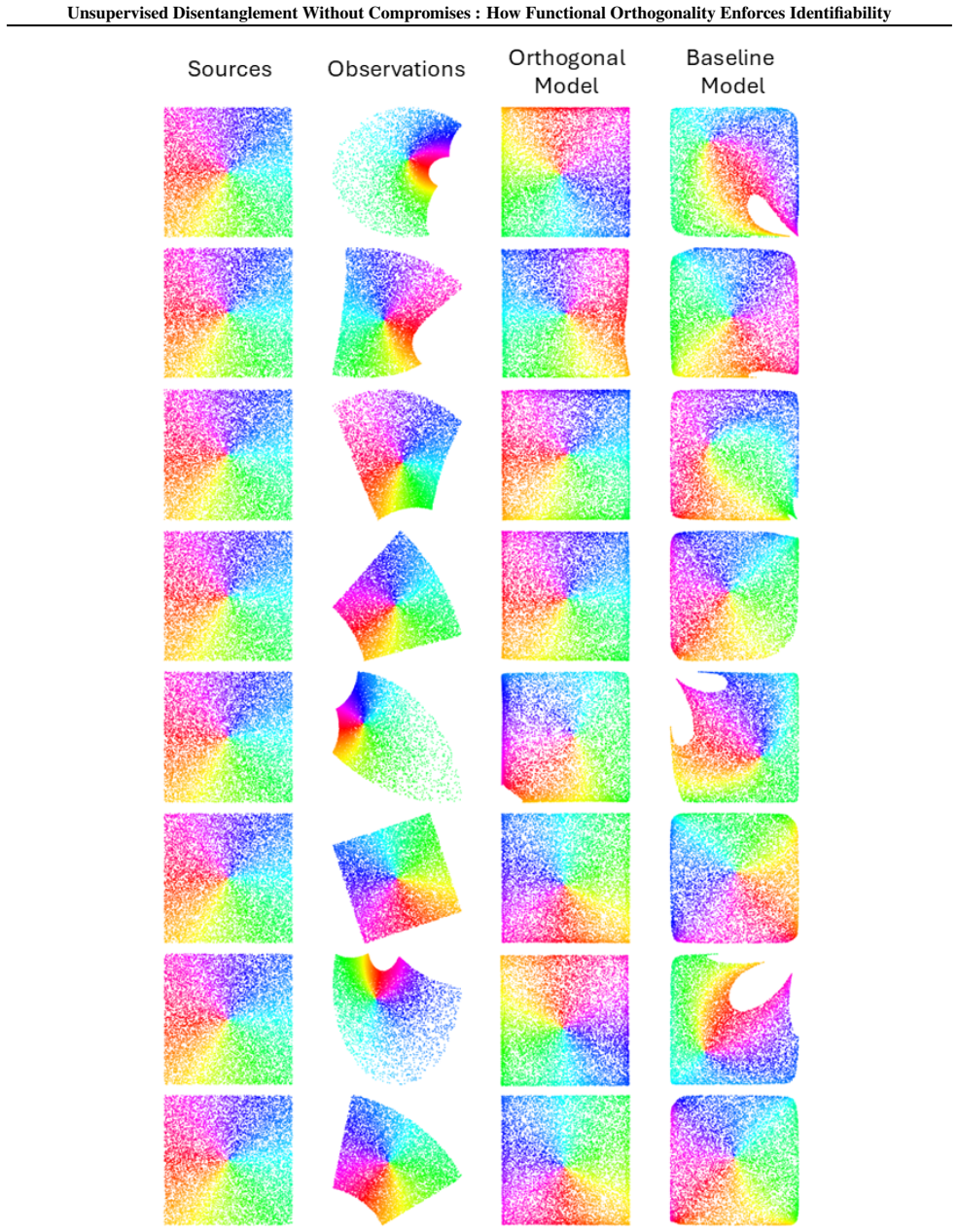
This paper explores unsupervised disentangled representation learning from a functional perspective. We define latent concepts as factors that influence observations through locally orthogonal directions, formalized as an orthogonality constraint on the Jacobian of the generative mapping. We prove that this condition yields identifiability of general nonlinear generative models, without requiring statistical independence or causal assumptions, provided the latent domain admits all combinations of factor values. Experiments with orthogonality-regularized normalizing flows empirically confirm the theory, demonstrate reliable recovery of ground-truth factors, and shed light on the success of VAEs. These findings challenge the prevailing impossibility claims for unsupervised disentanglement and provide a principled alternative foundation.
Editorial analysis
A structured set of objections, weighed in public.
Referee Report
Summary. The paper claims that defining latent factors via locally orthogonal directions (formalized as an orthogonality constraint on the Jacobian of the generative mapping) yields identifiability for general nonlinear generative models without statistical independence or causal assumptions, provided the latent domain has full combinatorial coverage of factor values. It supports the claim with a proof and with experiments on orthogonality-regularized normalizing flows that recover ground-truth factors on synthetic data and offer insight into VAE behavior.
Significance. If the conditional identifiability result holds, the work is significant: it supplies a functional-orthogonality route to identifiability that avoids the independence and causal assumptions common in the literature and directly challenges impossibility theorems for unsupervised disentanglement. The machine-checked or explicit derivation (if present) and the reproducible flow experiments constitute concrete strengths that could guide new regularization strategies.
minor comments (2)
- [§3] §3 (or wherever the main theorem is stated): the precise statement of the domain-coverage assumption should be repeated verbatim in the theorem box so readers can immediately see the exact premise under which the Jacobian-orthogonality condition implies unique recovery.
- [Experiments] The experimental section would benefit from an explicit ablation that isolates the orthogonality regularizer from other flow hyperparameters to confirm that the reported factor recovery is attributable to the Jacobian constraint rather than the flow architecture alone.
Simulated Author's Rebuttal
We thank the referee for their positive assessment of the work, recognition of its significance in providing a functional-orthogonality route to identifiability, and recommendation for minor revision. We will prepare a revised manuscript addressing any minor points.
Circularity Check
No significant circularity; conditional identifiability theorem is self-contained
full rationale
The paper states a conditional mathematical result: Jacobian orthogonality of the generative mapping implies identifiability of general nonlinear models when the latent domain has full combinatorial coverage, without independence or causal assumptions. This follows directly from the stated definitions and the explicit domain-coverage premise; the abstract and reader's summary indicate no reduction of the claim to fitted parameters, self-referential equations, or load-bearing self-citations. The derivation chain is a proof under premises that are declared upfront rather than smuggled in, making the result independent of its own outputs.
Axiom & Free-Parameter Ledger
axioms (1)
- domain assumption The latent domain admits all combinations of factor values
Reference graph
Works this paper leans on
-
[1]
arXiv preprint arXiv:1312.6114 , year=
Auto-encoding variational bayes , author=. arXiv preprint arXiv:1312.6114 , year=
-
[2]
arXiv preprint arXiv:1702.08658 , year=
Towards deeper understanding of variational autoencoding models , author=. arXiv preprint arXiv:1702.08658 , year=
-
[3]
European Conference on Computer Vision , pages=
Sequential Representation Learning via Static-Dynamic Conditional Disentanglement , author=. European Conference on Computer Vision , pages=. 2024 , organization=
2024
-
[4]
Proceedings of the AAAI Conference on Artificial Intelligence , volume=
Multi-level variational autoencoder: Learning disentangled representations from grouped observations , author=. Proceedings of the AAAI Conference on Artificial Intelligence , volume=
-
[5]
IEEE transactions on pattern analysis and machine intelligence , volume=
Representation learning: A review and new perspectives , author=. IEEE transactions on pattern analysis and machine intelligence , volume=. 2013 , publisher=
2013
-
[6]
Advances in neural information processing systems , volume=
Isolating sources of disentanglement in variational autoencoders , author=. Advances in neural information processing systems , volume=
-
[7]
arXiv preprint arXiv:1611.02731 , year=
Variational lossy autoencoder , author=. arXiv preprint arXiv:1611.02731 , year=
-
[8]
International conference on learning representations , year=
beta-vae: Learning basic visual concepts with a constrained variational framework , author=. International conference on learning representations , year=
-
[9]
International conference on machine learning , pages=
Disentangling by factorising , author=. International conference on machine learning , pages=. 2018 , organization=
2018
-
[10]
International conference on machine learning , pages=
Weakly-supervised disentanglement without compromises , author=. International conference on machine learning , pages=. 2020 , organization=
2020
-
[11]
arXiv preprint arXiv:1905.01258 , year=
Disentangling factors of variation using few labels , author=. arXiv preprint arXiv:1905.01258 , year=
arXiv 1905
-
[12]
International Conference on Machine Learning , pages=
An identifiable double vae for disentangled representations , author=. International Conference on Machine Learning , pages=. 2021 , organization=
2021
-
[13]
IEEE Transactions on Pattern Analysis and Machine Intelligence , volume=
Disentangled representation learning , author=. IEEE Transactions on Pattern Analysis and Machine Intelligence , volume=. 2024 , publisher=
2024
-
[14]
International Conference on Machine Learning , pages=
Commutative lie group vae for disentanglement learning , author=. International Conference on Machine Learning , pages=. 2021 , organization=
2021
-
[15]
arXiv preprint arXiv:1812.02230 , year=
Towards a definition of disentangled representations , author=. arXiv preprint arXiv:1812.02230 , year=
-
[16]
Advances in Neural Information Processing Systems , volume=
An image is worth more than a thousand words: Towards disentanglement in the wild , author=. Advances in Neural Information Processing Systems , volume=
-
[17]
arXiv preprint arXiv:2311.08815 , year=
Self-supervised disentanglement by leveraging structure in data augmentations , author=. arXiv preprint arXiv:2311.08815 , year=
-
[18]
Conference on Uncertainty in Artificial Intelligence , pages=
Hidden markov nonlinear ica: Unsupervised learning from nonstationary time series , author=. Conference on Uncertainty in Artificial Intelligence , pages=. 2020 , organization=
2020
-
[19]
Advances in neural information processing systems , volume=
Unsupervised feature extraction by time-contrastive learning and nonlinear ica , author=. Advances in neural information processing systems , volume=
-
[20]
international conference on machine learning , pages=
Challenging common assumptions in the unsupervised learning of disentangled representations , author=. international conference on machine learning , pages=. 2019 , organization=
2019
-
[21]
Independent component analysis: Theory and applications , pages=
Independent component analysis , author=. Independent component analysis: Theory and applications , pages=. 1998 , publisher=
1998
-
[22]
Helsinki Univ
Independent component analysis and blind source separation , author=. Helsinki Univ. Technol., Espoo, Finland, Tech. Rep , year=
-
[23]
Patterns , volume=
Nonlinear independent component analysis for principled disentanglement in unsupervised deep learning , author=. Patterns , volume=. 2023 , publisher=
2023
-
[24]
Neural networks , volume=
Nonlinear independent component analysis: Existence and uniqueness results , author=. Neural networks , volume=. 1999 , publisher=
1999
-
[25]
Annals of the Institute of Statistical Mathematics , volume=
Identifiability of latent-variable and structural-equation models: from linear to nonlinear , author=. Annals of the Institute of Statistical Mathematics , volume=. 2024 , publisher=
2024
-
[26]
Advances in neural information processing systems , volume=
On the identifiability of nonlinear ICA: Sparsity and beyond , author=. Advances in neural information processing systems , volume=
-
[27]
Artificial intelligence and statistics , pages=
Nonlinear ICA of temporally dependent stationary sources , author=. Artificial intelligence and statistics , pages=. 2017 , organization=
2017
-
[28]
Advances in Neural Information Processing Systems , volume=
Weakly supervised causal representation learning , author=. Advances in Neural Information Processing Systems , volume=
-
[29]
International Conference on Machine Learning , pages=
Citris: Causal identifiability from temporal intervened sequences , author=. International Conference on Machine Learning , pages=. 2022 , organization=
2022
-
[30]
arXiv preprint arXiv:2004.08697 , year=
Causalvae: Structured causal disentanglement in variational autoencoder , author=. arXiv preprint arXiv:2004.08697 , year=
arXiv 2004
-
[31]
arXiv preprint arXiv:2403.08335 , year=
A sparsity principle for partially observable causal representation learning , author=. arXiv preprint arXiv:2403.08335 , year=
-
[32]
arXiv preprint arXiv:2107.10483 , year=
Efficient neural causal discovery without acyclicity constraints , author=. arXiv preprint arXiv:2107.10483 , year=
-
[33]
Advances in Neural Information Processing Systems , volume=
Nonparametric identifiability of causal representations from unknown interventions , author=. Advances in Neural Information Processing Systems , volume=
-
[34]
Conference on Causal Learning and Reasoning , pages=
Disentanglement via mechanism sparsity regularization: A new principle for nonlinear ICA , author=. Conference on Causal Learning and Reasoning , pages=. 2022 , organization=
2022
-
[35]
Causal Representation Learning Workshop at NeurIPS 2023 , year=
Triangular monotonic generative models can perform causal discovery , author=. Causal Representation Learning Workshop at NeurIPS 2023 , year=
2023
-
[36]
Proceedings of the IEEE , volume=
Toward causal representation learning , author=. Proceedings of the IEEE , volume=. 2021 , publisher=
2021
-
[37]
Advances in neural information processing systems , volume=
Independent mechanism analysis, a new concept? , author=. Advances in neural information processing systems , volume=
-
[38]
Advances in Neural Information Processing Systems , volume=
Embrace the gap: VAEs perform independent mechanism analysis , author=. Advances in Neural Information Processing Systems , volume=
-
[39]
arXiv preprint arXiv:2312.13438 , year=
Independent mechanism analysis and the manifold hypothesis , author=. arXiv preprint arXiv:2312.13438 , year=
-
[40]
Advances in Neural Information Processing Systems , volume=
Function classes for identifiable nonlinear independent component analysis , author=. Advances in Neural Information Processing Systems , volume=
-
[41]
arXiv preprint arXiv:2410.22559 , year=
Unpicking Data at the Seams: Understanding Disentanglement in VAEs , author=. arXiv preprint arXiv:2410.22559 , year=
-
[42]
Proceedings of the IEEE/CVF international conference on computer vision , pages=
Orthogonal jacobian regularization for unsupervised disentanglement in image generation , author=. Proceedings of the IEEE/CVF international conference on computer vision , pages=
-
[43]
European conference on computer vision , pages=
The hessian penalty: A weak prior for unsupervised disentanglement , author=. European conference on computer vision , pages=. 2020 , organization=
2020
-
[44]
International Conference on Learning Representations , year=
Overcoming the disentanglement vs reconstruction trade-off via Jacobian supervision , author=. International Conference on Learning Representations , year=
-
[45]
International Conference on Machine Learning , pages=
Orthogonality-enforced latent space in autoencoders: An approach to learning disentangled representations , author=. International Conference on Machine Learning , pages=. 2023 , organization=
2023
-
[46]
1998 , publisher=
Theory of point estimation , author=. 1998 , publisher=
1998
-
[47]
2009 , publisher=
Causality , author=. 2009 , publisher=
2009
-
[48]
2017 , publisher=
Elements of causal inference: foundations and learning algorithms , author=. 2017 , publisher=
2017
-
[49]
Analyse g
Darmois, George , journal=. Analyse g. 1953 , publisher=
1953
-
[50]
Wiley interdisciplinary reviews: computational statistics , volume=
Principal component analysis , author=. Wiley interdisciplinary reviews: computational statistics , volume=. 2010 , publisher=
2010
-
[51]
International conference on artificial intelligence and statistics , pages=
Variational autoencoders and nonlinear ica: A unifying framework , author=. International conference on artificial intelligence and statistics , pages=. 2020 , organization=
2020
-
[52]
arXiv preprint arXiv:2001.04872 , year=
Disentanglement by nonlinear ica with general incompressible-flow networks (gin) , author=. arXiv preprint arXiv:2001.04872 , year=
arXiv 2001
-
[53]
arXiv preprint arXiv:2402.06578 , year=
On the universality of volume-preserving and coupling-based normalizing flows , author=. arXiv preprint arXiv:2402.06578 , year=
-
[54]
International Conference on Learning Representations , year=
Nonlinear ICA using volume-preserving transformations , author=. International Conference on Learning Representations , year=
-
[55]
Proceedings of the IEEE/CVF conference on computer vision and pattern recognition , pages=
Orthogonal adaptation for modular customization of diffusion models , author=. Proceedings of the IEEE/CVF conference on computer vision and pattern recognition , pages=
-
[56]
Advances in neural information processing systems , volume=
Exploring low-dimensional subspace in diffusion models for controllable image editing , author=. Advances in neural information processing systems , volume=
-
[57]
2000 , publisher=
Inversion theory and conformal mapping , author=. 2000 , publisher=
2000
-
[58]
The American Mathematical Monthly , volume=
History of the Riemann mapping theorem , author=. The American Mathematical Monthly , volume=. 1973 , publisher=
1973
-
[59]
IEEE transactions on pattern analysis and machine intelligence , volume=
Normalizing flows: An introduction and review of current methods , author=. IEEE transactions on pattern analysis and machine intelligence , volume=. 2020 , publisher=
2020
-
[60]
2013 , publisher=
Matrix Computations, forth edition , author=. 2013 , publisher=
2013
-
[61]
Advances in neural information processing systems , volume=
Residual flows for invertible generative modeling , author=. Advances in neural information processing systems , volume=
-
[62]
arXiv preprint arXiv:1605.08803 , year=
Density estimation using real nvp , author=. arXiv preprint arXiv:1605.08803 , year=
-
[63]
Advances in neural information processing systems , volume=
Pytorch: An imperative style, high-performance deep learning library , author=. Advances in neural information processing systems , volume=
-
[64]
Advances in neural information processing systems , volume=
Neural spline flows , author=. Advances in neural information processing systems , volume=
-
[65]
Advances in neural information processing systems , volume=
A new learning algorithm for blind signal separation , author=. Advances in neural information processing systems , volume=
-
[66]
Quaestiones geographicae , volume=
Comparison of values of Pearson's and Spearman's correlation coefficients on the same sets of data , author=. Quaestiones geographicae , volume=
-
[67]
Mathematische Annalen , volume=
Beweis der invarianz der dimensionenzahl , author=. Mathematische Annalen , volume=. 1911 , publisher=
1911
-
[68]
Advances in Neural Information Processing Systems , volume=
When is unsupervised disentanglement possible? , author=. Advances in Neural Information Processing Systems , volume=
-
[69]
arXiv preprint arXiv:1711.00848 , year=
Variational inference of disentangled latent concepts from unlabeled observations , author=. arXiv preprint arXiv:1711.00848 , year=
-
[70]
International conference on learning representations , year=
A framework for the quantitative evaluation of disentangled representations , author=. International conference on learning representations , year=
-
[71]
arXiv preprint arXiv:2412.06329 , year=
Normalizing flows are capable generative models , author=. arXiv preprint arXiv:2412.06329 , year=
-
[72]
Advances in neural information processing systems , volume=
Improved variational inference with inverse autoregressive flow , author=. Advances in neural information processing systems , volume=
-
[73]
3D Shapes Dataset , author=
-
[74]
Loic Matthey and Irina Higgins and Demis Hassabis and Alexander Lerchner , title =. 2017
2017
discussion (0)
Sign in with ORCID, Apple, or X to comment. Anyone can read and Pith papers without signing in.