REVIEW 3 major objections 5 minor 1 cited by
Imprints of Large-Scale Structures in the Anisotropies of the Cosmological Gravitational Wave Background
T0 review · 3 major / 5 minor · reviewed 2026-08-07 · deepseek-v4-flash
Pith's one-line read Cosmological gravitational-wave background anisotropies are predicted to correlate with galaxy density through the late ISW effect, a signature that could separate cosmological from astrophysical signals.
desk verdict New CGWB-LSS cross-correlation probe with a plausible ISW-dominance claim; main risk is an unverified low-ell approximation and an idealized forecast. read the letter →
The pith
A machine-rendered reading of the paper's core claim, the machinery that carries it, and where it could break.
The reading
What carries the argument
The machinery is the line-of-sight solution of the linearized kinetic equation for gravitons, decomposed into initial-condition, early-time line-of-sight, and ISW contributions. The load-bearing element is the late-ISW kernel $I^{\rm ISW}_\ell$ built from the growth rate $\mathrm{d}g/\mathrm{d}\eta\simeq -(4/5)(\eta/\eta_0)^3$ during dark-energy domination, together with the Bessel-integral estimate of Eq. (52) that removes the early-time terms from the galaxy cross-correlation. A second ingredient is the $f_{\rm NL}$ bridge for scalar-induced GWs, which couples long-wavelength curvature modes to the short-scale GW source and generates the initial anisotropy, and the corresponding scale-dependent galaxy bias that lets $f_{\rm NL}$ enter the galaxy side of the correlation. These pieces together produce the characteristic large-scale slope and the forecast signal-to-noise behavior.
What would settle it
A decisive numerical check is to compute $C^{\rm CGWB-gal}_\ell$ at $\ell=2$-$5$ with and without the initial-condition and early-time line-of-sight terms; if the difference is comparable to the cosmic-variance error from the variance formula of Eq. (60), the claimed ISW-only dominance and source-independent universality fail. A decisive observational check is to measure the large-scale angular slope of the GW-galaxy correlation in future survey data: the predicted $\sim 1/\sqrt{(\ell+1)^3}$ shape is the fingerprint that would separate a cosmological from an astrophysical background.
Extended reading notes
Core claim
The central claim is that $C^{\rm CGWB-gal}_\ell$ is nonzero and essentially equal to the late-ISW piece $C^{\rm ISW-gal}_\ell$. The initial-condition and early-time line-of-sight terms are suppressed by a Bessel factor $((\eta_0-\eta_z)/(\eta_0-\eta_{\rm in}))^{\ell\pm 1/2}$, whose magnitude at the lowest multipoles is only $\sim 0.1$-$0.3$, and the paper argues from full numerical integration that those terms are subdominant. The resulting large-scale estimate is $C^{\rm ISW-gal}_\ell \sim 1/\sqrt{(\ell+1)^3} + A f_{\rm NL}/(\ell\sqrt{(\ell+1)^3})$, which differs from the astrophysical scaling $C^{\rm AGW-gal}_\ell \sim 1/(\ell+1/2)$. For scalar-induced GWs with local non-Gaussianity, $f_{\rm NL}$ enters both the GW background amplitude and the galaxy scale-dependent bias, and the paper forecasts $\sigma(f_{\rm NL})\sim 10$ with cosmic variance only, $\sigma(f_{\rm NL})\sim 11.75$ with interferometer noise included, and a joint analysis that improves galaxy-only constraints by about 4%.
Load-bearing premise
The claim that the cross-correlation is completely driven by the late ISW effect rests on the assumption that the early-time initial-condition and line-of-sight terms are strongly suppressed at low multipoles by the Bessel factor $((\eta_0-\eta_z)/(\eta_0-\eta_{\rm in}))^{\ell\pm 1/2}$; at $\ell=2$-$5$ that factor is only $\sim 0.1$-$0.3$, so the assertion must be validated by the full numerical integration against the ISW-only curve.
Editorial extensions
If this is right
- If the prediction holds, a detection of CGWB$\times$LSS at low multipoles would distinguish cosmological from astrophysical GW backgrounds by their angular slope: roughly $1/\sqrt{(\ell+1)^3}$ rather than $1/(\ell+1/2)$.
- Because the late ISW effect dominates, the cross-correlation becomes a nearly source-independent cosmological probe, robust to how the CGWB was generated.
- For scalar-induced GWs with local non-Gaussianity, the same cross-correlation carries $f_{\rm NL}$ information, with forecast $\sigma(f_{\rm NL})\sim 10$ under cosmic variance alone and a joint analysis improving galaxy-only constraints by about 4%.
- Signal-to-noise estimates indicate the cross-correlation could be distinguishable from noise for favorable $f_{\rm NL}$ values, with the SNR peaking near $f_{\rm NL}=-0.1$.
Reading between the lines
- Beyond the paper's claims, the implied frequency independence of the late-ISW contribution suggests the angular slope of the CGWB$\times$LSS correlation should be stable across GW frequency bands after rescaling by the monopole, so a measured slope that changes with frequency would flag astrophysical contamination.
- Beyond the paper's claims, because the late ISW is shared with the CMB, a joint analysis of CGWB$\times$LSS and CMB$\times$LSS could isolate the gravitational-wave transfer function and provide a dark-energy consistency test without CMB temperature foregrounds.
- Beyond the paper's forecast, the quoted 4% improvement assumes full sky, no mask, and no shot noise; realistic survey masks and parameter degeneracies will dilute it, but the multi-tracer strategy can still be combined with other forthcoming probes.
- A testable extension is to look for the same $1/\sqrt{(\ell+1)^3}$ shape in the cross-correlation of the stochastic background with galaxy surveys before GW anisotropy maps reach detection threshold, using the ISW-galaxy correlation as a template.
Editorial analysis
A structured set of objections, weighed in public.
Referee Report
Summary. The paper computes the angular cross-correlation between anisotropes of the cosmological gravitational wave background (CGWB) and the galaxy density contrast, using a Boltzmann treatment of tensor modes and specializing the CGWB to scalar-induced gravitational waves (SIGWs) with local primordial non-Gaussianity. It argues that at large angular scales this cross-correlation is dominated by the late integrated Sachs-Wolfe (ISW) effect, with the scaling C_ℓ^CGWB−gal ≈ C_ℓ^ISW−gal ∝ 1/√(ℓ+1)^3 plus a term ∝ f_NL/(ℓ√(ℓ+1)^3), in contrast to the astrophysical gravitational wave background (AGWB)−galaxy correlation scaling ∼1/(ℓ+1/2). Using an LSST-like galaxy survey and ET+CE noise, the paper performs an SNR analysis and Fisher forecasts, reporting σ(f_NL) ≈ 10 from the cross-correlation alone and a roughly 4% improvement when the cross-correlation is combined with galaxy clustering.
Significance. If the ISW-dominance result is robust, the paper provides a potentially useful, source-universal baseline for separating cosmological from astrophysical gravitational wave backgrounds, and it identifies a new multi-tracer route to constraining f_NL. The analytic estimates are instructive, the relevant equations are presented transparently, and the numerical pipeline builds on public codes. The two main caveats are that the central low-multipole numerical check behind the universality claim is not yet reproducible because the modified GW CLASS code is not public, and that the detectability and forecast numbers rest on several explicitly optimistic assumptions. With those caveats addressed, the work would be a solid contribution to the CGWB×LSS literature.
major comments (3)
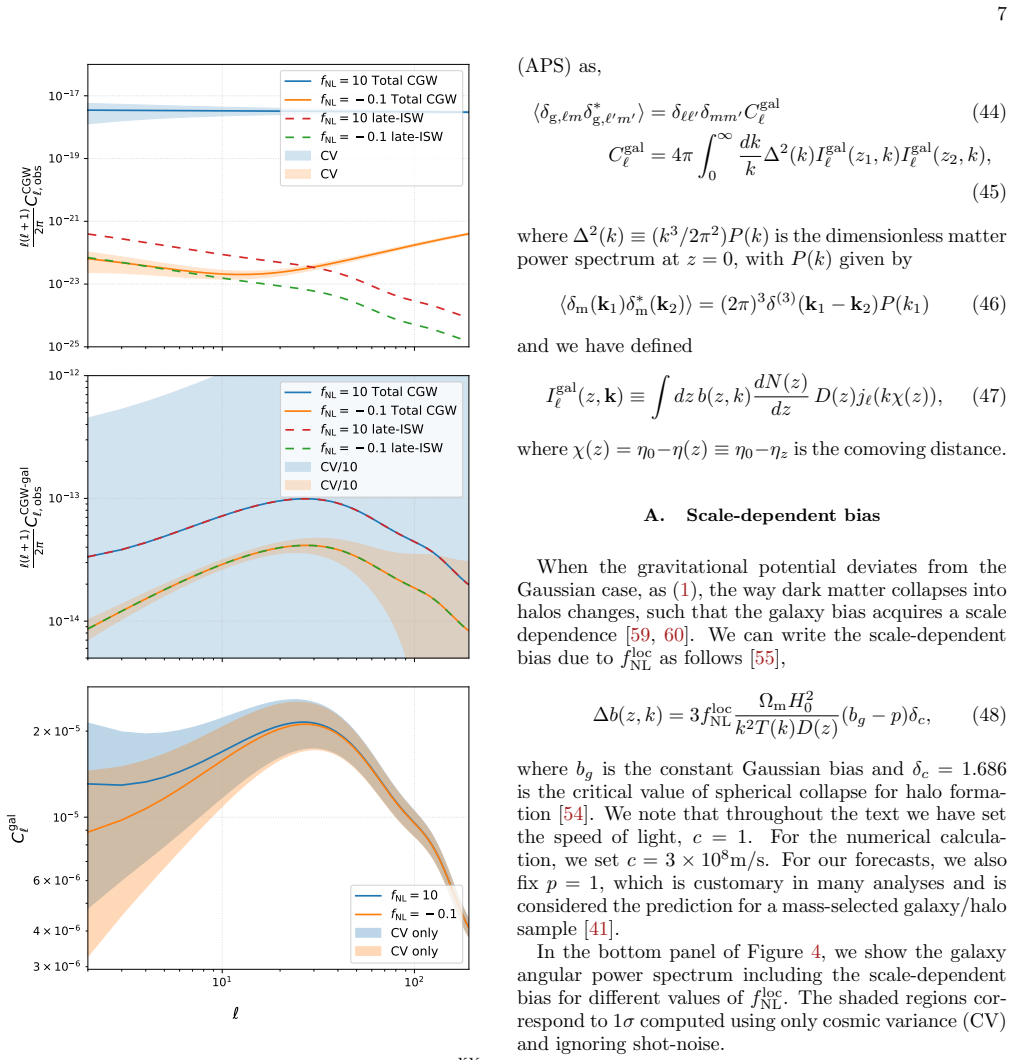
- [Sec. IV, Eq. (52), Fig. 4] The universality claim that the cross-correlation is "completely driven by the ISW effect" and therefore "general for all possible sources of CGWB anisotropies" rests on the suppression of the initial-condition term (32) and Schwarschild/Sachs-Wolfe term (33 evaluated at η_in) in the Bessel integral (51), as estimated in Eq. (52). For the adopted LSST-like bins (z≈0.3–1.1), the suppression is not overwhelming at the lowest multipoles: at ℓ=2–5 the factor in Eq. (52) is of order 0.1–0.3, exactly where the ISW signal is largest. The analytic estimate therefore does not by itself establish that the early-time contributions are negligible. The paper states that the total and late-ISW-only curves coincide in the middle panel of Fig. 4, but the modified GW CLASS code is not public, so this decisive numerical check cannot be independently verified. I request a quantitative breakdown of [C_total^(CGWB−gal) − C_ISW^(CGWB−gal)]/C_total^(CGWB−gal) for ℓ=2–20, or release of the code, so the low-ℓ residual is quantified. If the residual is not small, the universality statement and the clean shape distinction from the AGWB scaling (ℓ+1/2)^{-1} need to be qualified. Also, even in the ISW-dominated limit the observed cross-correlation (58) retains a source-dependent prefactor Ω_GW(q)(4−n_GW(q)), so the universality applies to the shape, not to the amplitude; this should be stated explicitly.
- [Sec. V.B, Eq. (60), Table I] The detectability statements in Section V rely on a chain of optimistic choices: a detection threshold SNR>1, full-sky coverage f_sky=1, no integral constraint, no shot noise in the galaxy sample, and a CGWB monopole amplitude fixed five orders of magnitude above the ET+CE sensitivity at f_pivot=63 Hz. The text labels these as optimistic, but the SNR values in Table I and Fig. 5 are nonetheless presented as the paper's detection prospects. For the "general CGWB" model, the CV-only SNR is only about 2.7–3.0, so a realistic sky fraction, a mask, or the integral constraint could move the claimed detection below threshold. I recommend adding at least a simple robustness test (e.g., f_sky<1 or a non-ideal noise case) or, failing that, rewording the abstract and conclusions so that the "could be distinguishable from noise" claim is explicitly tied to the idealized assumptions.
- [Sec. V.C, Table II] The Fisher forecast varies only f_NL while holding all cosmological and nuisance parameters fixed, ignores cross-covariance between galaxy bins, and drops the galaxy−cross covariance because the galaxy autocorrelation amplitude is about nine orders of magnitude larger. The authors acknowledge that realistic scenarios will worsen the constraint, but the 4% and 3.5% improvement numbers are therefore upper limits rather than expected constraints. I would ask that this be stated explicitly in the abstract or conclusions, so the quantitative claim is not over-read.
minor comments (5)
- [Sec. III, Eq. (42)] The Gaussian selection function appears to have a typo: the exponent should be −(z−z_bin)^2/(2σ_z^2), not −(z−z_bin)^2/(2πσ_z^2).
- [Sec. IV, Eq. (52)] The display of Eq. (52) is hard to parse: the placement of parentheses and exponents should be made explicit, and the dimensional consistency of the expression should be checked.
- [Sec. IV and Sec. V.C] There are small typos: "fromm" in Section IV and "CGBW" in Section V.C should be corrected.
- [Fig. 4 caption] The color references in the caption and text are inconsistent ("red and green dashed" vs. the text saying "green line"); please unify them.
- [Sec. II.A, around Eq. (28)] The notation for the expansion order of the background in powers of f_NL is described as "(f_NL^{2n})"; this should be written unambiguously, e.g., as proportional to (f_NL^2)^n.
Circularity Check
No circularity: the CGWB×LSS cross-correlation is derived from Boltzmann transport with no fitted inputs; the ISW-dominance claim is an approximation to be validated numerically, not a definitional reduction.
full rationale
The paper's derivation chain is self-contained against standard Boltzmann transport. The CGWB anisotropies in Eq. (5) come from solving the linear Boltzmann equation with initial-condition, Sachs-Wolfe and ISW terms; the galaxy density contrast in Eq. (43) uses standard bias and selection functions. The central claim that C^{CGW-gal}_ℓ ≃ C^{ISW-gal}_ℓ is supported by the analytic Bessel-integral suppression estimate (Eqs. 51–52) and by a full numerical comparison (Fig. 4, middle panel); it is an approximation to be checked at low ℓ, not a definitional identity and not a fitted parameter. The f_NL forecast in Sec. V treats f_NL as an input and computes σ(f_NL) from Fisher information; no prediction reduces to a fitted value. The SIGW background and anisotropy expressions cite external public literature and public codes (GW CLASS, Multi CLASS, and the public ngsigw-results repository); the only in-house self-citations ([39] on single-field soft theorems and [41] on angular-correlation integral constraints) are contextual or a caveat and carry no load in the computation. The possible low-ℓ failure of the ISW-dominance approximation is a correctness and validation risk, not a circularity.
Assumptions & free parameters
free parameters (3)
- Short-scale curvature power amplitude A_s =
3e-3
- Fiducial f_NL^loc values =
-0.1, 0.4, 1.2
- CGWB monopole normalization =
5 orders of magnitude above ET+CE sensitivity at fpivot=63 Hz
assumptions (6)
- standard math Boltzmann equation for collisionless massless gravitons in a linearly perturbed FLRW metric (Eqs. 2-5).
- domain assumption SIGW source is described by a monochromatic peak in the curvature power spectrum with A_s = 3e-3 and local-type non-Gaussianity (Eqs. 1, 23, 29).
- domain assumption Long-wavelength modes relevant for the cross-correlation re-entered during matter domination, with T(k << 1) = 1 and growth rate dg/deta = -(4/5)(eta/eta0)^3 (Eqs. 33, 35-36).
- domain assumption Galaxy bias is the sum of a linear Gaussian bias and the scale-dependent non-Gaussian correction with p = 1 and delta_c = 1.686 (Eqs. 40, 48).
- ad hoc to paper Detection forecasts assume full-sky coverage (fsky = 1), no integral constraint, no shot noise, and an optimistic SNR threshold of 1 (Section V).
- ad hoc to paper The CGWB monopole amplitude is taken to be five orders of magnitude above ET+CE sensitivity at fpivot = 63 Hz.
Cite this review
Pith. "Pith review of Imprints of Large-Scale Structures in the Anisotropies of the Cosmological Gravitational Wave Background." pith.science (2026). https://pith.science/paper/NBA2SBCP
@misc{pith2026250515084,
  author       = {Pith},
  title        = {Pith review of: Imprints of Large-Scale Structures in the Anisotropies of the Cosmological Gravitational Wave Background},
  year         = {2026},
  howpublished = {\url{https://pith.science/paper/NBA2SBCP}},
  note         = {Machine review of arXiv:2505.15084}
}
abstract
We compute the cross-correlation between the anisotropies of the cosmological gravitational wave background (CGWB) and the galaxy density contrast. We show that the cross-correlation is non-zero due to the {\it late} integrated Sachs-Wolfe (ISW) effect experienced by tensor modes. We study the detection prospects of the cross-correlation signal against cosmic variance (CV), and in the light of incoming LSS and GW surveys, where we found that the signal under certain conditions could be distinguishable from noise. In addition, by considering a CGWB sourced by scalar-induced gravitational waves, and the inclusion of a scale-dependent galaxy bias, we use the cross-correlation to forecast local primordial non-Gaussianity, where we find $\sigma(f_\text{NL}^\text{loc})\sim10$ for CV only and a LSST-like survey. Moreover, by combining the Fisher information of CGWB$\times$LSS with LSS, we are able to improve the constraints by 4\% compared to an LSS-only analysis. Our results imply that a cross-correlation between GW anisotropies and LSS can indeed come from a stochastic background of cosmological origin and could be used to distinguish it from an astrophysical one.
Figures

Figures from the paper (1 more)

Forward citations
Cited by 1 Pith paper
-
Do Pulsar Timing Datasets Favor Massive Gravity?
A one-parameter massive-gravity correlation curve gives lower chi-square than the Hellings-Downs curve for current pulsar-timing data, but the parameter is fitted to the data, so the result is not a prediction.
Reference graph
Works this paper leans on
-
[1]
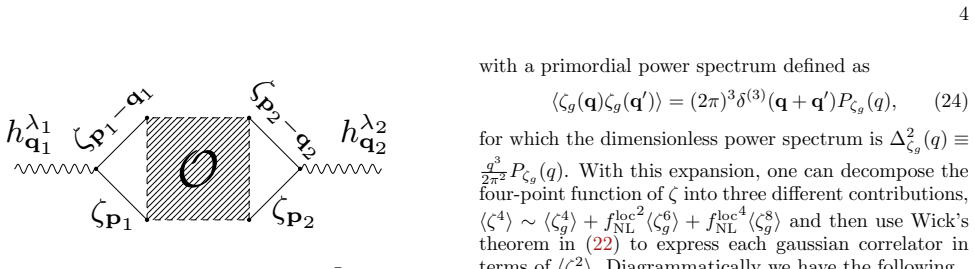
Background Once the solution (19) is known, we can compute the background GW energy density spectrum as the monopole term ¯ΩGW(q) = q5 48π2a2H 2 X +,× ⟨hλ(η, q)hλ′(η, q′)⟩, (21) where the over-bar denotes a time average over the os- cillations of the tensor modes. Explicitly the graviton two-point function is given by ⟨hλ1 (η, q1)hλ2 (η, q2)⟩ = 16 Z d3p1 ...
-
[2]
Anisotropies As we mentioned at the beginning of this section, anisotropies in the GW energy spectrum can arise from both initial conditions and propagation effects. The for- mer contribution, for the case of SIGWs, appears only when there is a coupling between the short scale q−1 ∗ at which the GW was produced and a cosmological scale k−1. Primordial loc...
-
[3]
C. Caprini and D. G. Figueroa, Cosmological Backgrounds of Gravitational Waves, Class. Quant. Grav. 35 (2018) 163001 [1801.04268]
arXiv 2018
-
[4]
Next, we compute the SNR of the cross-correlation for a LSST-like survey
We begin by estimating the maximum SNR that could come from the ISW effect. Next, we compute the SNR of the cross-correlation for a LSST-like survey. Lastly, after studying the detectability of the CGWB-LSS cross- correlation signal, we use it in a Fisher-matrix forecast of the constraints on f loc NL.5 Our main focus is the detectability of the CGWB- LSS...
-
[5]
LIGO Scientific, Virgocollaboration, Observation of Gravitational Waves from a Binary Black Hole Merger , Phys. Rev. Lett. 116 (2016) 061102 [ 1602.03837]
arXiv 2016
-
[6]
Maggiore, Gravitational wave experiments and early universe cosmology, Phys
M. Maggiore, Gravitational wave experiments and early universe cosmology, Phys. Rept. 331 (2000) 283 [gr-qc/9909001]
arXiv 2000
-
[7]
D. J. Reardon et al., Search for an Isotropic Gravitational-wave Background with the Parkes Pulsar Timing Array, Astrophys. J. Lett. 951 (2023) L6 [2306.16215]
arXiv 2023
-
[8]
NANOGrav collaboration, The NANOGrav 15 yr Data Set: Evidence for a Gravitational-wave Background , Astrophys. J. Lett. 951 (2023) L8 [ 2306.16213]
arXiv 2023
Show all 72 references
-
[9]
Xu et al., Searching for the Nano-Hertz Stochastic Gravitational Wave Background with the Chinese Pulsar Timing Array Data Release I , Res
H. Xu et al., Searching for the Nano-Hertz Stochastic Gravitational Wave Background with the Chinese Pulsar Timing Array Data Release I , Res. Astron. Astrophys. 23 (2023) 075024 [ 2306.16216]
2023 arXiv
-
[10]
Search for gravitational wave signals , Astron
EPTA, InPTA:collaboration, The second data release from the European Pulsar Timing Array - III. Search for gravitational wave signals , Astron. Astrophys. 678 (2023) A50 [2306.16214]
2023 arXiv
-
[11]
NANOGrav collaboration, The NANOGrav 15 yr Data Set: Search for Signals from New Physics , Astrophys. J. Lett. 951 (2023) L11 [ 2306.16219]
2023 arXiv
-
[12]
KAGRA, Virgo, LIGO Scientificcollaboration, Upper limits on the isotropic gravitational-wave background from Advanced LIGO and Advanced Virgo’s third observing run , Phys. Rev. D 104 (2021) 022004 [ 2101.12130]
2021
-
[13]
D. G. Figueroa, M. Pieroni, A. Ricciardone and P. Simakachorn, Cosmological Background Interpretation of Pulsar Timing Array Data , Phys. Rev. Lett. 132 (2024) 171002 [2307.02399]
2024 arXiv
-
[14]
Ellis, M
J. Ellis, M. Fairbairn, G. Franciolini, G. H¨ utsi, A. Iovino, M. Lewicki et al., What is the source of the PTA GW signal?, Phys. Rev. D 109 (2024) 023522 [ 2308.08546]
2024 arXiv
-
[15]
Ricciardone, L
A. Ricciardone, L. V. Dall’Armi, N. Bartolo, D. Bertacca, M. Liguori and S. Matarrese, Cross-Correlating Astrophysical and Cosmological Gravitational Wave Backgrounds with the Cosmic Microwave Background , Phys. Rev. Lett. 127 (2021) 271301 [2106.02591]
2021 arXiv
-
[16]
C. R. Contaldi, Anisotropies of Gravitational Wave Backgrounds: A Line Of Sight Approach , Phys. Lett. B 771 (2017) 9 [ 1609.08168]
2017 arXiv
-
[17]
J.-P. Li, S. Wang, Z.-C. Zhao and K. Kohri, Primordial non-Gaussianity f N Land anisotropies in scalar-induced gravitational waves, JCAP 10 (2023) 056 [ 2305.19950]
2023 arXiv
-
[18]
LISA Cosmology Working Groupcollaboration, Probing anisotropies of the Stochastic Gravitational Wave Background with LISA , JCAP 11 (2022) 009 [ 2201.08782]
2022 arXiv
-
[19]
Scelfo, N
G. Scelfo, N. Bellomo, A. Raccanelli, S. Matarrese and L. Verde, GW×LSS: chasing the progenitors of merging binary black holes , JCAP 09 (2018) 039 [ 1809.03528]
2018 arXiv
-
[20]
Braglia and S
M. Braglia and S. Kuroyanagi, Probing prerecombination physics by the cross-correlation of stochastic gravitational waves and CMB anisotropies , Phys. Rev. D 104 (2021) 123547 [2106.03786]
2021 arXiv
-
[21]
Perna, A
G. Perna, A. Ricciardone, D. Bertacca and S. Matarrese, Non-Gaussianity from the cross-correlation of the 13 astrophysical Gravitational Wave Background and the Cosmic Microwave Background , JCAP 10 (2023) 014 [2302.08429]
2023 arXiv
-
[22]
Z.-C. Zhao, S. Wang, J.-P. Li and K. Kohri, Study of primordial non-Gaussianity fNL and gNL with the cross-correlations between the scalar-induced gravitational waves and the cosmic microwave background , [2412.02500]
-
[23]
Cusin, C
G. Cusin, C. Pitrou, M. Pijnenburg and A. Sesana, Measuring anisotropies in the PTA band with cross-correlations, [2502.17401]
-
[24]
M. Bosi, N. Bellomo and A. Raccanelli, Constraining extended cosmologies with GW ×LSS cross-correlations, JCAP 11 (2023) 086 [ 2306.03031]
2023 arXiv
-
[25]
Semenzato, J
F. Semenzato, J. A. Casey-Clyde, C. M. F. Mingarelli, A. Raccanelli, N. Bellomo, N. Bartolo et al., Cross-Correlating the Universe: The Gravitational Wave Background and Large-Scale Structure, [2411.00532]
-
[26]
Pedrotti, M
A. Pedrotti, M. Mancarella, J. Bel and D. Gerosa, Cosmology with the angular cross-correlation of gravitational-wave and galaxy catalogs: forecasts for next-generation interferometers and the Euclid survey , [2504.10482]
-
[27]
Giannantonio, R
T. Giannantonio, R. Scranton, R. G. Crittenden, R. C. Nichol, S. P. Boughn, A. D. Myers et al., Combined analysis of the integrated Sachs-Wolfe effect and cosmological implications, Phys. Rev. D 77 (2008) 123520 [ 0801.4380]
2008 arXiv
-
[28]
Libanore, M
S. Libanore, M. C. Artale, D. Karagiannis, M. Liguori, N. Bartolo, Y. Bouffanais et al., Gravitational Wave mergers as tracers of Large Scale Structures , JCAP 02 (2021) 035 [2007.06905]
2021 arXiv
-
[29]
R. K. Sachs and A. M. Wolfe, Perturbations of a cosmological model and angular variations of the microwave background, Astrophys. J. 147 (1967) 73
1967
-
[30]
R. G. Crittenden and N. Turok, Looking for Lambda with the Rees-Sciama effect, Phys. Rev. Lett. 76 (1996) 575 [astro-ph/9510072]
1996 arXiv
-
[31]
Dom` enech,Scalar Induced Gravitational Waves Review , Universe 7 (2021) 398 [ 2109.01398]
G. Dom` enech,Scalar Induced Gravitational Waves Review , Universe 7 (2021) 398 [ 2109.01398]
2021 arXiv
-
[32]
Cooray, Integrated sachs-Wolfe effect: Large scale structure correlation, Phys
A. Cooray, Integrated sachs-Wolfe effect: Large scale structure correlation, Phys. Rev. D 65 (2002) 103510 [astro-ph/0112408]
2002 arXiv
-
[33]
S. Ho, C. Hirata, N. Padmanabhan, U. Seljak and N. Bahcall, Correlation of CMB with large-scale structure: I. ISW Tomography and Cosmological Implications , Phys. Rev. D 78 (2008) 043519 [ 0801.0642]
2008 arXiv
-
[34]
Giannantonio, A
T. Giannantonio, A. J. Ross, W. J. Percival, R. Crittenden, D. Bacher, M. Kilbinger et al., Improved Primordial Non-Gaussianity Constraints from Measurements of Galaxy Clustering and the Integrated Sachs-Wolfe Effect , Phys. Rev. D 89 (2014) 023511 [ 1303.1349]
2014 arXiv
-
[35]
Wang, Z.-C
S. Wang, Z.-C. Zhao, J.-P. Li and Q.-H. Zhu, Implications of pulsar timing array data for scalar-induced gravitational waves and primordial black holes: Primordial non-Gaussianity fNL considered, Phys. Rev. Res. 6 (2024) L012060 [2307.00572]
2024 arXiv
-
[36]
Sasaki, T
M. Sasaki, T. Suyama, T. Tanaka and S. Yokoyama, Primordial black holes—perspectives in gravitational wave astronomy, Class. Quant. Grav. 35 (2018) 063001 [1801.05235]
2018 arXiv
-
[37]
B. Carr, S. Clesse, J. Garcia-Bellido, M. Hawkins and F. Kuhnel, Observational evidence for primordial black holes: A positivist perspective, Phys. Rept. 1054 (2024) 1 [2306.03903]
2024 arXiv
-
[38]
R.-g. Cai, S. Pi and M. Sasaki, Gravitational Waves Induced by non-Gaussian Scalar Perturbations , Phys. Rev. Lett. 122 (2019) 201101 [ 1810.11000]
2019 arXiv
-
[39]
Bravo and G
R. Bravo and G. A. Palma, Unifying attractor and nonattractor models of inflation under a single soft theorem , Phys. Rev. D 107 (2023) 043524 [ 2009.03369]
2023 arXiv
-
[40]
Tanaka and Y
T. Tanaka and Y. Urakawa, Dominance of gauge artifact in the consistency relation for the primordial bispectrum , JCAP 05 (2011) 014 [ 1103.1251]
2011 arXiv
-
[41]
Pajer, F
E. Pajer, F. Schmidt and M. Zaldarriaga, The Observed Squeezed Limit of Cosmological Three-Point Functions , Phys. Rev. D 88 (2013) 083502 [ 1305.0824]
2013 arXiv
-
[42]
G. L. Pimentel, Inflationary Consistency Conditions from a Wavefunctional Perspective, JHEP 02 (2014) 124 [1309.1793]
2014 arXiv
-
[43]
R. A. Isaacson, Gravitational Radiation in the Limit of High Frequency. I. The Linear Approximation and Geometrical Optics, Phys. Rev. 166 (1968) 1263
1968
-
[44]
Chaussidon et al., Constraining primordial non-Gaussianity with DESI 2024 LRG and QSO samples , [2411.17623]
E. Chaussidon et al., Constraining primordial non-Gaussianity with DESI 2024 LRG and QSO samples , [2411.17623]
2024 arXiv
-
[45]
5 10-3 10-2 10-1 10010-10 10-9 10-8 10-7 10-6 10-5 10-4 FIG
publicly available at https://github.com/zachjweiner/ ngsigw-results. 5 10-3 10-2 10-1 10010-10 10-9 10-8 10-7 10-6 10-5 10-4 FIG. 2. Background induced GW spectrum Ω GW(q) for a monochromatic source with As = 3 × 10⁻³ for various values of f loc NL. By showing the spectrum as...
-
[46]
Riquelme et al., Primordial non-Gaussianity with angular correlation function: integral constraint and validation for DES , Mon
W. Riquelme et al., Primordial non-Gaussianity with angular correlation function: integral constraint and validation for DES , Mon. Not. Roy. Astron. Soc. 523 (2023) 603 [2209.07187]
2023 arXiv
-
[47]
L. R. Abramo and K. E. Leonard, Why multi-tracer surveys beat cosmic variance, Mon. Not. Roy. Astron. Soc. 432 (2013) 318 [ 1302.5444]
2013 arXiv
-
[48]
Unal, Imprints of Primordial Non-Gaussianity on Gravitational Wave Spectrum, Phys
C. Unal, Imprints of Primordial Non-Gaussianity on Gravitational Wave Spectrum, Phys. Rev. D 99 (2019) 041301 [1811.09151]
2019 arXiv
-
[49]
Adshead, K
P. Adshead, K. D. Lozanov and Z. J. Weiner, Non-Gaussianity and the induced gravitational wave background, JCAP 10 (2021) 080 [ 2105.01659]
2021 arXiv
- [50]
-
[51]
Bartolo, D
N. Bartolo, D. Bertacca, V. De Luca, G. Franciolini, S. Matarrese, M. Peloso et al., Gravitational wave anisotropies from primordial black holes , JCAP 02 (2020) 028 [1909.12619]
2020 arXiv
-
[52]
Tada and S
Y. Tada and S. Yokoyama, Primordial black holes as biased tracers, Phys. Rev. D 91 (2015) 123534 [ 1502.01124]
2015 arXiv
-
[53]
J.-P. Li, S. Wang, Z.-C. Zhao and K. Kohri, Complete analysis of the background and anisotropies of scalar-induced gravitational waves: primordial non-Gaussianity f N Land g N Lconsidered, JCAP 06 (2024) 039 [ 2309.07792]
2024 arXiv
-
[54]
Maggiore, Gravitational Waves
M. Maggiore, Gravitational Waves. Vol. 2: Astrophysics and Cosmology. Oxford University Press, 3, 2018
2018
-
[55]
Dodelson and F
S. Dodelson and F. Schmidt, Modern Cosmology. Academic Press, 2020, 10.1016/C2017-0-01943-2
2020 doi
-
[56]
D. H. Lyth and A. R. Liddle, The Primordial Density Perturbation. 6, 2009, 10.1017/cbo9780511819209
2009 doi
-
[57]
Schulze, L
F. Schulze, L. Valbusa Dall’Armi, J. Lesgourgues, A. Ricciardone, N. Bartolo, D. Bertacca et al., GW CLASS: Cosmological Gravitational Wave Background in the cosmic linear anisotropy solving system , JCAP 10 (2023) 025 [2305.01602]
2023 arXiv
-
[58]
Bellomo, J
N. Bellomo, J. L. Bernal, G. Scelfo, A. Raccanelli and L. Verde, Beware of commonly used approximations. Part I. Errors in forecasts, JCAP 10 (2020) 016 [ 2005.10384]
2020 arXiv
-
[59]
J. L. Bernal, N. Bellomo, A. Raccanelli and L. Verde, Beware of commonly used approximations. Part II. Estimating systematic biases in the best-fit parameters , JCAP 10 (2020) 017 [2005.09666]
2020 arXiv
-
[60]
D. Blas, J. Lesgourgues and T. Tram, The cosmic linear anisotropy solving system (class). part ii: Approximation schemes, Journal of Cosmology and Astroparticle Physics 2011 (2011) 034034
2011
-
[61]
LSST Dark Energy Sciencecollaboration, The LSST Dark Energy Science Collaboration (DESC) Science Requirements Document, [1809.01669]
-
[62]
De Vicente, E
J. De Vicente, E. S´ anchez and I. Sevilla-Noarbe, DNF – Galaxy photometric redshift by Directional Neighbourhood Fitting, Mon. Not. Roy. Astron. Soc. 459 (2016) 3078 [1511.07623]. 14
2016 arXiv
-
[63]
Dalal, O
N. Dalal, O. Dore, D. Huterer and A. Shirokov, The imprints of primordial non-gaussianities on large-scale structure: scale dependent bias and abundance of virialized objects , Phys. Rev. D 77 (2008) 123514 [ 0710.4560]
2008 arXiv
-
[64]
Slosar, C
A. Slosar, C. Hirata, U. Seljak, S. Ho and N. Padmanabhan, Constraints on local primordial non-Gaussianity from large scale structure, JCAP 08 (2008) 031 [ 0805.3580]
2008 arXiv
-
[65]
Alonso, C
D. Alonso, C. R. Contaldi, G. Cusin, P. G. Ferreira and A. I. Renzini, Noise angular power spectrum of gravitational wave background experiments, Phys. Rev. D 101 (2020) 124048 [2005.03001]
2020 arXiv
-
[66]
Alonso, G
D. Alonso, G. Cusin, P. G. Ferreira and C. Pitrou, Detecting the anisotropic astrophysical gravitational wave background in the presence of shot noise through cross-correlations , Phys. Rev. D 102 (2020) 023002 [ 2002.02888]
2020 arXiv
-
[67]
Terasawa, Y
R. Terasawa, Y. Nan and M. Takada, On the equivalence between galaxy angular correlation function and power spectrum in constraining primordial non-Gaussianity , [2501.12661]
-
[68]
G. Jung, M. Citran, B. van Tent, L. Dumilly and N. Aghanim, Constraints on primordial non-Gaussianity from Planck PR4 data , [2504.00884]
-
[69]
Euclid collaboration, Euclid. I. Overview of the Euclid mission, Astron. Astrophys. 697 (2025) A1 [ 2405.13491]
2025
-
[70]
DESI collaboration, The Dark Energy Spectroscopic Instrument (DESI) , [1907.10688]
1907 arXiv
-
[71]
Corbin and N
V. Corbin and N. J. Cornish, Detecting the cosmic gravitational wave background with the big bang observer , Class. Quant. Grav. 23 (2006) 2435 [ gr-qc/0512039]
2006 arXiv
-
[72]
Kawamura et al., Current status of space gravitational wave antenna DECIGO and B-DECIGO , PTEP 2021 (2021) 05A105 [ 2006.13545]
S. Kawamura et al., Current status of space gravitational wave antenna DECIGO and B-DECIGO , PTEP 2021 (2021) 05A105 [ 2006.13545]
2021 arXiv
Reviewed August 7, 2026 · model on record in the stance chip above.
Discussion (0). Continue with ORCID to comment.