REVIEW 4 major objections 6 minor 8 cited by
HumanEdit: A High-Quality Human-Rewarded Dataset for Instruction-based Image Editing
T0 review · 4 major / 6 minor · reviewed 2026-08-11 · deepseek-v4-flash
Pith's one-line read HumanEdit claims that a human-rewarded, four-stage annotation pipeline can produce instruction-editing pairs aligned with human preferences, and delivers a 5,751-pair dataset plus a benchmark to support that claim.
desk verdict A genuinely useful released dataset for instruction-based editing, but the 'high-quality' claim rests on unverified DALL-E 2 alignment — especially shaky for Counting and Relation — so the benchmark scores should be read with caution. read the letter →
The pith
A machine-rendered reading of the paper's core claim, the machinery that carries it, and where it could break.
The reading
What carries the argument
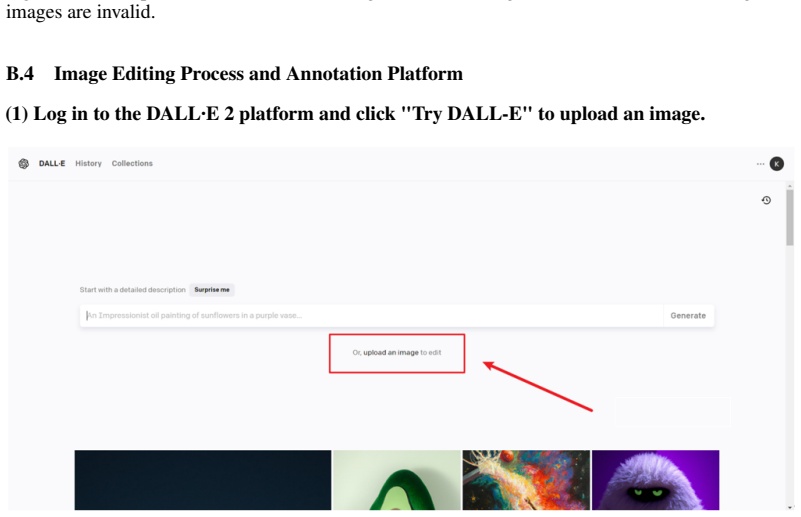
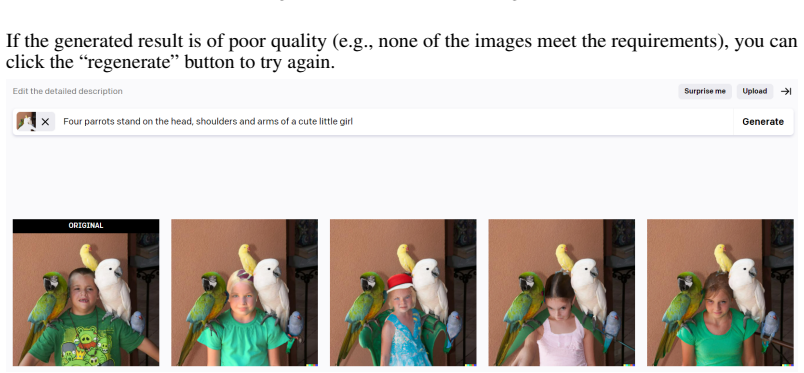
The four-stage annotation pipeline is the load-bearing mechanism: after a tutorial and quiz select annotators, images are curated from high-resolution sources, annotators create instructions and use DALL-E 2 with masks to generate edited images, and administrators perform a two-tier quality review that returns or discards submissions. Roughly 20,000 annotated images were reduced to 5,751 retained pairs. The six-category taxonomy (Action, Add, Counting, Relation, Remove, Replace) is the organizing device that turns the collection into a benchmark capable of reporting per-task strengths and weaknesses.
What would settle it
A count audit of the Counting subset: automatically or manually count the relevant objects in the ground-truth target images and compare against the numbers stated in the instructions; if a substantial share of pairs violates the stated count, the fidelity claim collapses. A complementary test is a human-preference study in which fresh annotators judge whether each target image satisfies its instruction, with the pass rate reported.
Extended reading notes
Core claim
HumanEdit is a 5,751-pair dataset for instruction-guided image editing in which every pair was hand-built: annotators wrote the edit instruction, drew the mask, and used DALL-E 2 to generate the edited image, and administrators then accepted, returned for re-annotation, or discarded each submission. The central claim is that roughly 2,500 hours of human effort across four stages make the dataset better aligned with human preferences than prior large-scale editing datasets built largely from language models and synthesis pipelines. A further contribution is the six-way taxonomy of editing tasks (Action, Add, Counting, Relation, Remove, Replace), which the authors argue supports fine-grained evaluation, and the release of a benchmark with mask-free and mask-provided baselines showing, for example, that most methods perform better on Add than on Remove. The dataset also provides masks for every image while keeping a mask-free subset, and it draws on high-resolution images from diverse sources rather than a single dataset.
Load-bearing premise
The reliability of the dataset rests on the assumption that DALL-E 2's edited images, after human review, actually do what the instruction says; if the model's known failures in counting and spatial-relation edits slip through the reviewers' filter, the dataset's ground truth can be systematically wrong.
Editorial extensions
If this is right
- Models fine-tuned on HumanEdit should produce edits that follow user instructions more faithfully than models trained only on auto-generated editing data, as measured by human preference.
- The six-part taxonomy makes per-task reporting possible; the benchmark numbers indicate Relation and Action edits are the hardest for current methods, pointing to where training data and architectures must improve.
- The provided masks enable mask-conditioned training, while the mask-free subset allows evaluation of whether purely instruction-driven localization can replace explicit masks.
- The HI-EDIT benchmark gives future work a fixed, human-verified test bed, making results across editing models comparable.
- The mask-versus-mask-free split lets researchers measure how much spatial supervision is actually needed for reliable instruction editing.
Reading between the lines
- At 5,751 pairs, the dataset's practical value may be more as an evaluation benchmark than as a large-scale training corpus; scaling the pipeline to millions of pairs would be costly, though the quality-controlled subset could be used to filter or validate larger auto-generated collections.
- Because DALL-E 2 is weakest at Counting and Relation edits, the retained pairs in those categories may over-represent easy instances, which would make benchmark scores on those categories optimistic relative to real-world difficulty.
- The fact that only 46.5 percent of instructions are detailed enough for mask-free editing suggests natural user instructions are often spatially ambiguous, signaling a need for research on instruction-driven region grounding.
- The human-rewarded annotation scheme could transfer to other instruction-following generation tasks, such as video or 3D editing, where alignment with human preference is currently a bottleneck.
Editorial analysis
A structured set of objections, weighed in public.
Referee Report
Summary. The paper introduces HumanEdit, a dataset of 5,751 instruction-based image-editing pairs constructed on real high-resolution images, with masks for every pair, six instruction categories (Action, Add, Counting, Relation, Remove, Replace), and a 400-pair core subset. The authors describe a four-stage annotation pipeline in which human annotators create instructions and use DALL-E 2 to produce edited targets, followed by administrator review that they term human-rewarded. The paper reports dataset statistics, compares with prior editing datasets, and benchmarks eight methods in mask-free and mask-provided settings. The central claim is that HumanEdit is a high-quality, human-rewarded dataset that supports both masked and mask-free editing and serves as a versatile benchmark.
Significance. If the quality claim can be substantiated, HumanEdit would be a useful community resource: it provides real-image editing pairs, detailed masks, a six-category taxonomy for fine-grained evaluation, and an open benchmark with multiple baselines. The paper's strengths include the detailed four-stage pipeline description, the explicit documentation of failure cases in Appendix C, the release of the dataset, and the breadth of reported statistics and baseline comparisons. The significance, however, rests on the validity of the DALL-E 2 targets as ground truth, and that validity is not yet independently established.
major comments (4)
- [Section 2, Stage 4 and Appendix C] The central 'high-quality' claim depends on the assumption that each retained DALL-E 2 edited image is a faithful realization of its instruction. Appendix C explicitly documents DALL-E 2's limited editing capabilities for counting and relational edits, including cases where the model removes rather than adds objects (Fig. 48) and where instructed relations could not be achieved despite dozens of trials (Figs. 46, 49). Because the Counting subset (698 pairs) and Relation subset (410 pairs) in Table 1 are produced by the same model and filtered only by internal administrator review, the paper does not demonstrate that the retained targets satisfy their instructions. I request inter-annotator agreement on a random sample, an independent instruction-target alignment check, or category-wise retention statistics from the 20,000 annotated images to the final 5,751. This is load-bearing because Tables 3-5 use these targets as ground truth for evaluation.
- [Section 3 and Figure 6(a)] The proportion of the dataset that supports mask-free editing is reported inconsistently: the abstract says 'a subset', the text in Section 3 says '46.5% of the data supporting editing without masks', and Figure 6(a) reports 'no need for mask 53.1%' with 'need mask 46.9%'. Since the benchmark includes mask-free settings (Tables 3 and 5), the exact split and the criterion used to determine it must be clarified. Without this, the mask-free benchmark results are not reproducible.
- [Section 4, Tables 3-5] The benchmark evaluates models by comparing their outputs to DALL-E 2 targets using L1, L2, CLIP-I, DINO, and CLIP-T. If some retained targets contain the artifacts or misalignments documented in Appendix C, then these scores partly measure fidelity to imperfect targets rather than editing quality. I recommend adding a human evaluation on a sample of model outputs, at least on HumanEdit-core, or reporting per-instance instruction-target alignment scores to validate the benchmark conclusions.
- [Section 2, Stage 4] The 'human-rewarded' mechanism is described only as 'annotators with good performance receive higher rewards, while those with poor performance are removed from the annotator teams.' No details are given on the reward scheme, the scoring rubric used by administrators, or the number of administrators and their agreement. Since this quality-control procedure is the primary evidence for the dataset's quality claim, it should be quantified, for example by reporting the number of administrators per submission and the rate of returned versus discarded submissions.
minor comments (6)
- [Table 1] The header contains a typo: 'Rmove' should be 'Remove'.
- [Figure 2] The label 'Toturial' is a typo and should be 'Tutorial'.
- [Section 3] The sentence 'MagicBrush has only 46.6 input images above 1000' appears to mean 46.6% of images, not 46.6 images; please correct the typo.
- [Introduction] The Introduction mentions 'Vendi Score calculations' but does not define or cite the Vendi Score; please add a definition and reference.
- [Appendix C.1] The sentence 'with the resulting images mostly [Podell et al., 2023, Ge et al., 2024b] showing a reduction in the number of objects' contains stray citation markers that interrupt the prose; these should be removed or moved to the end of the sentence.
- [Table 2] The column 'Real-world Scenario' is defined as 'whether images edited by users in the real world are included', but HumanEdit is marked with a checkmark even though its instructions are created by annotators rather than collected from real user editing requests. The column definition or the table entry should be clarified to avoid overclaiming.
Circularity Check
No circularity: HumanEdit is a dataset-and-benchmark paper with no fitted parameters or derivations that reduce to their own inputs.
full rationale
The paper's contribution is a curated dataset and an evaluation benchmark. There is no claimed derivation chain in which a prediction is computed from fitted parameters: the ground-truth edited images are produced by DALL-E 2 and accepted or rejected by human annotators and administrators, which is an external filtering process rather than a quantity derived from the paper's own equations. The benchmark tables report standard metrics (L1, L2, CLIP-I, DINO, CLIP-T) for independently published baselines on the new data; those baselines are not used to define the dataset's ground truth, so no result is forced by construction. The inclusion of Meissonic, a baseline authored by overlapping researchers, is a self-citation, but it is used as one of several comparison systems and does not carry the paper's central claim; the dataset's value would stand or fall independently of that baseline. Appendix C candidly documents DALL-E 2 failures, including counting and relational edits, and states that such failures were excluded from the released data. This is a transparency statement about data quality, not a circular step: even if the retained pairs inherit some DALL-E 2 artifacts, that would be a validity or correctness risk, not a reduction of the benchmark's conclusions to its inputs. The six-category taxonomy is a labeling scheme applied to instructions, and the 'mask-free versus masked' distinction is a dataset property, not a prediction derived from prior outputs. Accordingly, no step in the paper exhibits self-definition, fitted-input-called-prediction, load-bearing self-citation, imported uniqueness, ansatz-smuggling, or renaming of a known result.
Assumptions & free parameters
assumptions (4)
- domain assumption DALL-E 2 generated edited images, after human filtering, are valid ground-truth targets for the given editing instructions.
- domain assumption Human annotator and administrator review reliably identifies 'high-quality' edits.
- ad hoc to paper The six instruction categories (Action, Add, Counting, Relation, Remove, Replace) cover the diverse space of real-world editing instructions.
- domain assumption Unsplash images provide a representative broad set of real-world scenes.
Cite this review
Pith. "Pith review of HumanEdit: A High-Quality Human-Rewarded Dataset for Instruction-based Image Editing." pith.science (2026). https://pith.science/paper/NC2USPTS
@misc{pith2026241204280,
  author       = {Pith},
  title        = {Pith review of: HumanEdit: A High-Quality Human-Rewarded Dataset for Instruction-based Image Editing},
  year         = {2026},
  howpublished = {\url{https://pith.science/paper/NC2USPTS}},
  note         = {Machine review of arXiv:2412.04280}
}
abstract
We present HumanEdit, a high-quality, human-rewarded dataset specifically designed for instruction-guided image editing, enabling precise and diverse image manipulations through open-form language instructions. Previous large-scale editing datasets often incorporate minimal human feedback, leading to challenges in aligning datasets with human preferences. HumanEdit bridges this gap by employing human annotators to construct data pairs and administrators to provide feedback. With meticulously curation, HumanEdit comprises 5,751 images and requires more than 2,500 hours of human effort across four stages, ensuring both accuracy and reliability for a wide range of image editing tasks. The dataset includes six distinct types of editing instructions: Action, Add, Counting, Relation, Remove, and Replace, encompassing a broad spectrum of real-world scenarios. All images in the dataset are accompanied by masks, and for a subset of the data, we ensure that the instructions are sufficiently detailed to support mask-free editing. Furthermore, HumanEdit offers comprehensive diversity and high-resolution $1024 \times 1024$ content sourced from various domains, setting a new versatile benchmark for instructional image editing datasets. With the aim of advancing future research and establishing evaluation benchmarks in the field of image editing, we release HumanEdit at https://huggingface.co/datasets/BryanW/HumanEdit.
Figures


Figures from the paper (53 more)






Forward citations
Cited by 8 Pith papers
-
AInimation: Animating from Prompt to AI-Generated Responses
Animating prompt elements into their positions in an AI response improved users' ability to locate content, spot edits, and verify instructions in three lab experiments with 16 participants.
-
DanceOPD: On-Policy Generative Field Distillation
Hard-routed, single low-noise on-policy velocity matching composes conflicting image-generation capabilities into one flow student better than joint training, merging, or dense OPD baselines.
-
Trade-offs in Image Generation: How Do Different Dimensions Interact?
A new benchmark and VLM-as-judge metric map trade-offs among ten image-generation dimensions across 14 models, with a visualization called DTM.
-
ComplexBench-Edit: Benchmarking Complex Instruction-Driven Image Editing via Compositional Dependencies
Introduces a benchmark for chain-dependent image editing instructions plus a region-aware consistency metric, and shows a chain-of-thought prompt improves a Gemini-based editor.
-
KRIS-Bench: Benchmarking Next-Level Intelligent Image Editing Models
A new benchmark, KRIS-Bench, evaluates image editing models on knowledge-grounded reasoning across factual, conceptual, and procedural tasks, and finds large performance gaps in current models.
-
SRUM: Fine-Grained Self-Rewarding for Unified Multimodal Models
A unified multimodal model can improve its own text-to-image generation by using its understanding module as a rewarder in a global-plus-local reward-weighted training loop.
-
Track Any Anomalous Object: A Granular Video Anomaly Detection Pipeline
TAO pipelines object-centric anomaly scores into SAM2 prompts with a temporal consistency filter to obtain pixel-level anomaly segmentation and tracking.
-
MIND-Edit: MLLM Insight-Driven Editing via Language-Vision Projection
MIND-Edit combines instruction rewriting with MLLM-derived visual embeddings to guide diffusion-based image editing, but the reported numbers only partly support the claim of state-of-the-art performance.
Reference graph
Works this paper leans on
-
[2]
Jinbin Bai, Tian Ye, Wei Chow, Enxin Song, Qing-Guo Chen, Xiangtai Li, Zhen Dong, Lei Zhu, and Shuicheng Yan. Meissonic: Revitalizing masked generative transformers for efficient high- resolution text-to-image synthesis. arXiv preprint arXiv:2410.08261,
-
[5]
An Item is Worth a Prompt: Versatile Image Editing with Disentangled Control
Aosong Feng, Weikang Qiu, Jinbin Bai, Kaicheng Zhou, Zhen Dong, Xiao Zhang, Rex Ying, and Leandros Tassiulas. An item is worth a prompt: Versatile image editing with disentangled control. arXiv preprint arXiv:2403.04880,
-
[6]
Guid- ing instruction-based image editing via multimodal large language models
Tsu-Jui Fu, Wenze Hu, Xianzhi Du, William Yang Wang, Yinfei Yang, and Zhe Gan. Guid- ing instruction-based image editing via multimodal large language models. arXiv preprint arXiv:2309.17102,
-
[7]
Seed-data-edit technical report: A hybrid dataset for instructional image editing
Yuying Ge, Sijie Zhao, Chen Li, Yixiao Ge, and Ying Shan. Seed-data-edit technical report: A hybrid dataset for instructional image editing. arXiv preprint arXiv:2405.04007, 2024a. Zhiqi Ge, Juncheng Li, Qifan Yu, Wei Zhou, Siliang Tang, and Yueting Zhuang. Demon24: Acm mm24 demonstrative instruction following challenge. In Proceedings of the 32nd ACM Int...
-
[10]
Fine-tuning multimodal llms to follow zero-shot demonstrative instructions
Juncheng Li, Kaihang Pan, Zhiqi Ge, Minghe Gao, Wei Ji, Wenqiao Zhang, Tat-Seng Chua, Siliang Tang, Hanwang Zhang, and Yueting Zhuang. Fine-tuning multimodal llms to follow zero-shot demonstrative instructions. In The Twelfth International Conference on Learning Representations, 2023a. Juncheng Li, Siliang Tang, Linchao Zhu, Wenqiao Zhang, Yi Yang, Tat-Se...
work page 2014
-
[12]
Glide: Towards photorealistic image generation and editing with text-guided diffusion models
Alex Nichol, Prafulla Dhariwal, Aditya Ramesh, Pranav Shyam, Pamela Mishkin, Bob McGrew, Ilya Sutskever, and Mark Chen. Glide: Towards photorealistic image generation and editing with text-guided diffusion models. arXiv preprint arXiv:2112.10741,
-
[14]
amused: An open muse reproduction
Suraj Patil, William Berman, Robin Rombach, and Patrick von Platen. amused: An open muse reproduction. arXiv preprint arXiv:2401.01808,
-
[15]
Sdxl: Improving latent diffusion models for high-resolution image synthesis
Dustin Podell, Zion English, Kyle Lacey, Andreas Blattmann, Tim Dockhorn, Jonas Müller, Joe Penna, and Robin Rombach. Sdxl: Improving latent diffusion models for high-resolution image synthesis. arXiv preprint arXiv:2307.01952,
Show all 25 references
-
[16]
Hierarchical text- conditional image generation with clip latents
Aditya Ramesh, Prafulla Dhariwal, Alex Nichol, Casey Chu, and Mark Chen. Hierarchical text- conditional image generation with clip latents. arXiv preprint arXiv:2204.06125, 1(2):3,
-
[17]
Fast high-resolution image synthesis with latent adversarial diffusion distillation
Axel Sauer, Frederic Boesel, Tim Dockhorn, Andreas Blattmann, Patrick Esser, and Robin Rombach. Fast high-resolution image synthesis with latent adversarial diffusion distillation. arXiv preprint arXiv:2403.12015,
-
[18]
Laion-5b: An open large-scale dataset for training next generation image-text models, 2022a
Christoph Schuhmann, Romain Beaumont, Richard Vencu, Cade Gordon, Ross Wightman, Mehdi Cherti, Theo Coombes, Aarush Katta, Clayton Mullis, Mitchell Wortsman, Patrick Schramowski, Srivatsa Kundurthy, Katherine Crowson, Ludwig Schmidt, Robert Kaczmarczyk, and Jenia Jitsev. Laion...
-
[19]
Relationbooth: Towards relation-aware customized object generation.arXiv preprint arXiv:2410.23280,
Qingyu Shi, Lu Qi, Jianzong Wu, Jinbin Bai, Jingbo Wang, Yunhai Tong, Xiangtai Li, and Ming- Husang Yang. Relationbooth: Towards relation-aware customized object generation.arXiv preprint arXiv:2410.23280,
-
[21]
Editworld: Simulating world dynamics for instruction-following image editing
Ling Yang, Bohan Zeng, Jiaming Liu, Hong Li, Minghao Xu, Wentao Zhang, and Shuicheng Yan. Editworld: Simulating world dynamics for instruction-following image editing. arXiv preprint arXiv:2405.14785, 2024a. Ling Yang, Zhilong Zhang, Zhaochen Yu, Jingwei Liu, Minkai Xu, Stefan...
-
[22]
Mvgamba: Unify 3d content generation as state space sequence modeling
34 Xuanyu Yi, Zike Wu, Qiuhong Shen, Qingshan Xu, Pan Zhou, Joo-Hwee Lim, Shuicheng Yan, Xinchao Wang, and Hanwang Zhang. Mvgamba: Unify 3d content generation as state space sequence modeling. arXiv preprint arXiv:2406.06367, 2024a. Xuanyu Yi, Zike Wu, Qingshan Xu, Pan Zhou, J...
-
[23]
Style transfer for anime sketches with enhanced residual u-net and auxiliary classifier gan
Lvmin Zhang, Yi Ji, Xin Lin, and Chunping Liu. Style transfer for anime sketches with enhanced residual u-net and auxiliary classifier gan. In 2017 4th IAPR Asian conference on pattern recogni- tion (ACPR), pages 506–511. IEEE,
2017
-
[25]
Magictailor: Component-controllable personalization in text-to-image diffusion models
Donghao Zhou, Jiancheng Huang, Jinbin Bai, Jiaze Wang, Hao Chen, Guangyong Chen, Xiaowei Hu, and Pheng-Ann Heng. Magictailor: Component-controllable personalization in text-to-image diffusion models. arXiv preprint arXiv:2410.13370,
-
[2014]
A survey on hallucination in large vision-language models
Hanchao Liu, Wenyuan Xue, Yifei Chen, Dapeng Chen, Xiutian Zhao, Ke Wang, Liping Hou, Rongjun Li, and Wei Peng. A survey on hallucination in large vision-language models. arXiv preprint arXiv:2402.00253,
-
[2017]
Hive: Harnessing human feedback for instructional visual editing
Shu Zhang, Xinyi Yang, Yihao Feng, Can Qin, Chia-Chih Chen, Ning Yu, Zeyuan Chen, Huan Wang, Silvio Savarese, Stefano Ermon, et al. Hive: Harnessing human feedback for instructional visual editing. In Proceedings of the IEEE/CVF Conference on Computer Vision and Pattern Recogn...
-
[2018]
Unified generative and discriminative training for multi-modal large language models
Wei Chow, Juncheng Li, Qifan Yu, Kaihang Pan, Hao Fei, Zhiqi Ge, Shuai Yang, Siliang Tang, Hanwang Zhang, and Qianru Sun. Unified generative and discriminative training for multi-modal large language models. arXiv preprint arXiv:2411.00304,
-
[2019]
Bahjat Kawar, Shiran Zada, Oran Lang, Omer Tov, Huiwen Chang, Tali Dekel, Inbar Mosseri, and Michal Irani
URL https://arxiv.org/abs/1812.04948. Bahjat Kawar, Shiran Zada, Oran Lang, Omer Tov, Huiwen Chang, Tali Dekel, Inbar Mosseri, and Michal Irani. Imagic: Text-based real image editing with diffusion models. In Conference on Computer Vision and Pattern Recognition 2023,
2023 arXiv
-
[2020]
Consistent3d: Towards consistent high-fidelity text-to-3d generation with deterministic sampling prior
Zike Wu, Pan Zhou, Xuanyu Yi, Xiaoding Yuan, and Hanwang Zhang. Consistent3d: Towards consistent high-fidelity text-to-3d generation with deterministic sampling prior. arXiv preprint arXiv:2401.09050,
-
[2021]
Gpt-4 technical report
R OpenAI. Gpt-4 technical report. arxiv 2303.08774. View in Article, 2(5), 2023a. R OpenAI. Gpt-4v (ision) system card. Citekey: gptvision, 2023b. Kaihang Pan, Siliang Tang, Juncheng Li, Zhaoyu Fan, Wei Chow, Shuicheng Yan, Tat-Seng Chua, Yueting Zhuang, and Hanwang Zhang. Aut...
-
[2022]
Hq-edit: A high-quality dataset for instruction-based image editing
Mude Hui, Siwei Yang, Bingchen Zhao, Yichun Shi, Heng Wang, Peng Wang, Yuyin Zhou, and Cihang Xie. Hq-edit: A high-quality dataset for instruction-based image editing. arXiv preprint arXiv:2404.09990,
-
[2023]
Integrating view conditions for image synthesis
Jinbin Bai, Zhen Dong, Aosong Feng, Xiao Zhang, Tian Ye, Kaicheng Zhou, and Mike Zheng Shou. Integrating view conditions for image synthesis. arXiv preprint arXiv:2310.16002,
-
[2024]
The llama 3 herd of models
Abhimanyu Dubey, Abhinav Jauhri, Abhinav Pandey, Abhishek Kadian, Ahmad Al-Dahle, Aiesha Letman, Akhil Mathur, Alan Schelten, Amy Yang, Angela Fan, et al. The llama 3 herd of models. arXiv preprint arXiv:2407.21783,
Reviewed August 11, 2026 · model on record in the stance chip above.
Discussion (0). Continue with ORCID to comment.