Monte Carlo Energy Aggregation for Mobile 3D Gaussian Splatting
Pith reviewed 2026-06-30 06:36 UTC · model grok-4.3
The pith
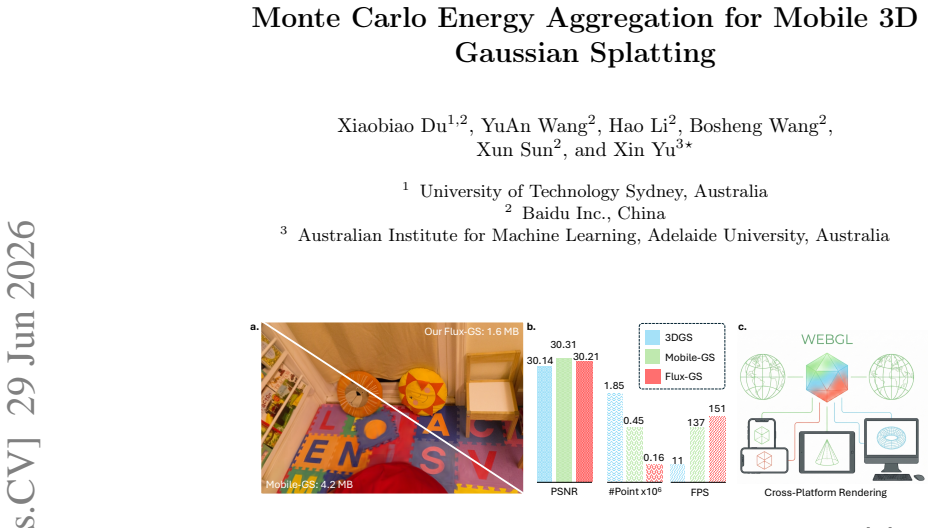
Flux-GS reduces 3D Gaussian Splatting parameters for mobile rendering by aggregating specular energy into a compact latent space via Monte Carlo sampling.
A machine-rendered reading of the paper's core claim, the machinery that carries it, and where it could break.
Core claim
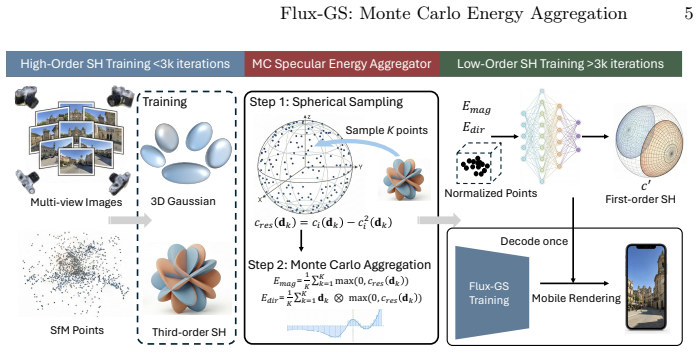
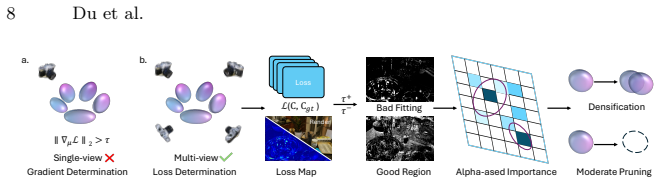
Flux-GS achieves high-fidelity mobile rendering by sampling third-order radiance residuals with a Monte Carlo Specular Energy Aggregator that compresses specular energy into a compact latent space, restoring high-frequency content through an Attribute-Conditioned SH Enhancement module that predicts offsets from intrinsic Gaussian attributes, and enforcing multi-view consistency with alpha-based densification and pruning.
What carries the argument
Monte Carlo Specular Energy Aggregator that samples third-order radiance residuals and aggregates specular energy into a compact latent space while preserving salient lighting features.
If this is right
- Model size drops substantially while visual quality remains competitive with full high-order baselines.
- Inference runs in real time on resource-constrained mobile hardware without added pre-training steps.
- Multi-view structure consistency improves and redundant Gaussians are removed more precisely than single-view methods.
- High-frequency detail recovery occurs at no extra inference cost through attribute-conditioned offsets.
Where Pith is reading between the lines
- The latent-space aggregation may transfer to other radiance field representations that also suffer from high-order coefficient overhead on edge devices.
- Attribute-conditioned prediction could be tested for robustness under changing lighting or dynamic objects beyond static scenes.
- The multi-view pruning rule might reduce overfitting artifacts in sparse capture setups where view coverage varies widely.
Load-bearing premise
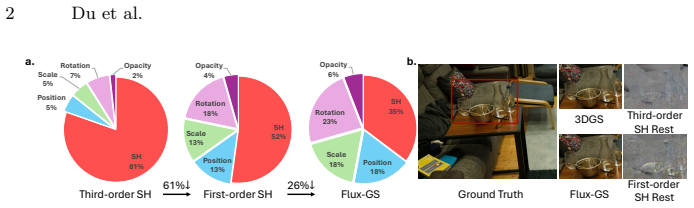
The Monte Carlo Specular Energy Aggregator can fold third-order radiance residuals into lower-order bands while retaining visually important specular features without distillation or pre-training.
What would settle it
Side-by-side rendering on scenes with strong specular highlights where Flux-GS outputs show clear loss of highlight sharpness or color shifts relative to full-order spherical harmonic baselines.
Figures
read the original abstract
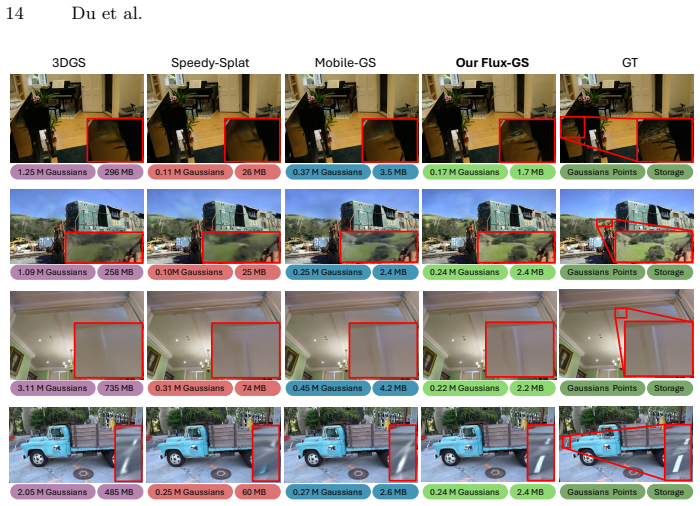
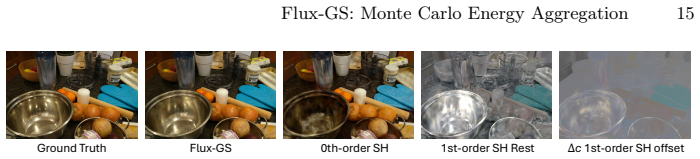
Recent advances in 3D Gaussian Splatting have demonstrated unprecedented success in novel view synthesis. However, the substantial inference and storage overhead driven by high-order Spherical Harmonics (SH) are primary bottlenecks for mobile platforms. In this paper, we present Flux-GS, a real-time Gaussian Splatting method designed to achieve high-fidelity rendering with significantly reduced overhead for resource-constrained mobile platforms. We first propose a Monte Carlo Specular Energy Aggregator, sampling third-order radiance residuals and aggregating specular energy into a compact latent space. In this way, our method effectively preserves visually salient lighting features in lower-order bands without expensive distillation or pre-training. To mitigate the high-frequency details lost during compression, we introduce an Attribute-Conditioned SH Enhancement module. This module predicts Gaussian-aware offsets based on intrinsic Gaussian attributes, which enhance the first-order SH representation prior to inference, without extra inference costs. Furthermore, the original single-view gradient-based densification is prone to producing excessive Gaussians and overfitting to a certain view. We address these limitations by proposing a Multi-view Alpha-based Densification and Pruning strategy. By leveraging multi-view guidance, we ensure multi-view structure consistency and the precise removal of redundant primitives. Extensive experiments demonstrate that Flux-GS achieves substantial parameter reduction while maintaining competitive visual quality, offering a robust and scalable solution for real-time mobile rendering. Code: \textcolor{magenta}{\href{https://xiaobiaodu.github.io/flux-gs-project/}{https://xiaobiaodu.github.io/flux-gs-project/}}.
Editorial analysis
A structured set of objections, weighed in public.
Referee Report
Summary. The paper proposes Flux-GS, a real-time 3D Gaussian Splatting method for mobile platforms that reduces overhead from high-order Spherical Harmonics. It introduces a Monte Carlo Specular Energy Aggregator to sample third-order radiance residuals and fold specular energy into a compact latent space (preserving salient features without distillation or pre-training), an Attribute-Conditioned SH Enhancement module that predicts Gaussian-aware offsets to recover high-frequency details in first-order SH at no extra inference cost, and a Multi-view Alpha-based Densification and Pruning strategy to enforce multi-view consistency and remove redundant primitives. The central claim is that these components deliver substantial parameter reduction while maintaining competitive visual quality.
Significance. If the components function as described and the efficiency claims are validated, the work would represent a practical contribution toward deploying high-fidelity novel-view synthesis on resource-constrained devices. The design choice to avoid distillation or pre-training is a positive aspect that could improve deployability. However, the manuscript text supplies no quantitative metrics, baselines, ablations, or experimental results to support any of these claims, so the actual significance cannot be determined from the provided content.
major comments (2)
- [Abstract] Abstract: the assertion that 'extensive experiments demonstrate substantial parameter reduction with competitive visual quality' is unsupported by any metrics, tables, baselines, ablation studies, or quantitative evidence in the manuscript text. This is load-bearing for the central efficiency claim.
- [Abstract] Abstract: the Monte Carlo Specular Energy Aggregator is presented as sampling third-order radiance residuals and aggregating specular energy into a compact latent space without quality loss or pre-training, yet no equations, sampling strategy, variance analysis, or loss formulation are supplied. This is the load-bearing mechanism for the claimed parameter reduction via lower-order SH.
minor comments (1)
- [Abstract] Abstract: the provided code link is not accompanied by any discussion of implementation details, reproducibility, or experimental setup.
Simulated Author's Rebuttal
We thank the referee for the careful reading and constructive feedback. The two major comments correctly identify that the current manuscript text does not contain the quantitative results or technical derivations needed to support the abstract claims. We will revise the manuscript to address both points directly.
read point-by-point responses
-
Referee: [Abstract] Abstract: the assertion that 'extensive experiments demonstrate substantial parameter reduction with competitive visual quality' is unsupported by any metrics, tables, baselines, ablation studies, or quantitative evidence in the manuscript text. This is load-bearing for the central efficiency claim.
Authors: We agree that the abstract claim is unsupported by any metrics or tables in the submitted manuscript text. The experimental section was omitted from the version provided for review. In the revision we will insert the full set of quantitative results, including PSNR/SSIM/LPIPS tables, parameter counts, runtime measurements on mobile hardware, baseline comparisons, and ablation studies that substantiate the parameter-reduction and quality claims. revision: yes
-
Referee: [Abstract] Abstract: the Monte Carlo Specular Energy Aggregator is presented as sampling third-order radiance residuals and aggregating specular energy into a compact latent space without quality loss or pre-training, yet no equations, sampling strategy, variance analysis, or loss formulation are supplied. This is the load-bearing mechanism for the claimed parameter reduction via lower-order SH.
Authors: We acknowledge that the abstract summarizes the aggregator but supplies none of the requested technical details. The revised manuscript will expand the method section with the precise Monte Carlo sampling procedure, the radiance-residual formulation, variance-reduction analysis, and the training loss that enables aggregation without distillation or pre-training. revision: yes
Circularity Check
No significant circularity; derivations are self-contained algorithmic proposals.
full rationale
The paper introduces three new modules (Monte Carlo Specular Energy Aggregator for third-order residual sampling into latent space, Attribute-Conditioned SH Enhancement for offset prediction, and Multi-view Alpha-based Densification and Pruning) as independent contributions to achieve parameter reduction. The abstract and method descriptions present these as novel algorithmic additions without equations, derivations, or self-citations that reduce claimed performance metrics to fitted parameters or prior self-referential results by construction. No load-bearing step matches any enumerated circularity pattern; the central efficiency claim rests on the empirical behavior of the proposed components rather than tautological redefinitions or fitted-input predictions.
Axiom & Free-Parameter Ledger
Reference graph
Works this paper leans on
-
[1]
In: 2025 IEEE/CVF Winter Conference on Applications of Computer Vision (WACV)
Ali, M.S., Bae, S.H., Tartaglione, E.: Elmgs: Enhancing memory and computation scalability through compression for 3d gaussian splatting. In: 2025 IEEE/CVF Winter Conference on Applications of Computer Vision (WACV). pp. 2591–2600. IEEE (2025)
2025
-
[2]
In: Proceedings of the IEEE/CVF International Conference on Computer Vision
Barron, J.T., Mildenhall, B., Tancik, M., Hedman, P., Martin-Brualla, R., Srini- vasan, P.P.: Mip-nerf: A multiscale representation for anti-aliasing neural radiance fields. In: Proceedings of the IEEE/CVF International Conference on Computer Vision. pp. 5855–5864 (2021)
2021
-
[3]
In: Proceedings of the IEEE/CVF Conference on Computer Vision and Pattern Recognition
Barron, J.T., Mildenhall, B., Verbin, D., Srinivasan, P.P., Hedman, P.: Mip- nerf 360: Unbounded anti-aliased neural radiance fields. In: Proceedings of the IEEE/CVF Conference on Computer Vision and Pattern Recognition. pp. 5470– 5479 (2022)
2022
- [4]
-
[5]
arXiv preprint arXiv:2503.08511 (2025)
Chen, Y., Li, M., Wu, Q., Lin, W., Harandi, M., Cai, J.: Pcgs: Progressive com- pression of 3d gaussian splatting. arXiv preprint arXiv:2503.08511 (2025)
-
[6]
In: European Conference on Computer Vision
Chen,Y.,Wu,Q.,Lin,W.,Harandi,M.,Cai,J.:Hac:Hash-gridassistedcontextfor 3d gaussian splatting compression. In: European Conference on Computer Vision. pp. 422–438. Springer (2024) Flux-GS: Monte Carlo Energy Aggregation 23
2024
-
[7]
ArXiv:2501.12255 [cs.CV] https://arxiv.org/abs/2501.12255
Chen, Y., Wu, Q., Lin, W., Harandi, M., Cai, J.: Hac++: Towards 100x compres- sion of 3d gaussian splatting. arXiv preprint arXiv:2501.12255 (2025)
-
[8]
In: Proceedings of the IEEE/CVF Conference on Computer Vision and Pattern Recognition
Chen, Z., Funkhouser, T., Hedman, P., Tagliasacchi, A.: Mobilenerf: Exploiting the polygon rasterization pipeline for efficient neural field rendering on mobile architectures. In: Proceedings of the IEEE/CVF Conference on Computer Vision and Pattern Recognition. pp. 16569–16578 (2023)
2023
-
[9]
In: Proceedings of the IEEE/CVF Conference on Computer Vision and Pattern Recognition
Du, H., Li, L., Huang, Z., Yu, X.: Object-goal visual navigation via effective ex- ploration of relations among historical navigation states. In: Proceedings of the IEEE/CVF Conference on Computer Vision and Pattern Recognition. pp. 2563– 2573 (2023)
2023
-
[10]
In: European Conference on Computer Vision
Du, H., Yu, X., Zheng, L.: Learning object relation graph and tentative policy for visual navigation. In: European Conference on Computer Vision. pp. 19–34. Springer (2020)
2020
-
[11]
arXiv preprint arXiv:2105.09447 (2021)
Du, H., Yu, X., Zheng, L.: Vtnet: Visual transformer network for object goal nav- igation. arXiv preprint arXiv:2105.09447 (2021)
-
[12]
arXiv preprint arXiv:2407.16988 (2024)
Du, X., Sun, H., Lu, M., Zhu, T., Yu, X.: Dreamcar: Leveraging car-specific prior for in-the-wild 3d car reconstruction. arXiv preprint arXiv:2407.16988 (2024)
-
[13]
3drealcar: An in-the-wild rgb-d car dataset with 360-degree views,
Du, X., Sun, H., Wang, S., Wu, Z., Sheng, H., Ying, J., Lu, M., Zhu, T., Zhan, K., Yu, X.: 3drealcar: An in-the-wild rgb-d car dataset with 360-degree views. arXiv preprint arXiv:2406.04875 (2024)
-
[14]
MVGS: Multi-view Regulated Gaussian Splatting for Novel View Synthesis
Du, X., Wang, Y., Yu, X.: Mvgs: Multi-view-regulated gaussian splatting for novel view synthesis. arXiv preprint arXiv:2410.02103 (2024)
work page internal anchor Pith review Pith/arXiv arXiv 2024
-
[15]
In: The Fourteenth International Conference on Learning Repre- sentations (2026)
Du, X., Wang, Y., Zhan, K., Yu, X.: Mobile-gs: Real-time gaussian splatting for mobile devices. In: The Fourteenth International Conference on Learning Repre- sentations (2026)
2026
-
[16]
Advances in neural information processing systems37, 140138–140158 (2024)
Fan, Z., Wang, K., Wen, K., Zhu, Z., Xu, D., Wang, Z., et al.: Lightgaussian: Unbounded 3d gaussian compression with 15x reduction and 200+ fps. Advances in neural information processing systems37, 140138–140158 (2024)
2024
-
[17]
In: European Conference on Computer Vision
Fang,G.,Wang,B.:Mini-splatting:Representingsceneswithaconstrainednumber of gaussians. In: European Conference on Computer Vision. pp. 165–181. Springer (2024)
2024
-
[18]
In: Proceedings of the Computer Vision and Pattern Recognition Con- ference
Feng, G., Chen, S., Fu, R., Liao, Z., Wang, Y., Liu, T., Hu, B., Xu, L., Pei, Z., Li, H., et al.: Flashgs: Efficient 3d gaussian splatting for large-scale and high-resolution rendering. In: Proceedings of the Computer Vision and Pattern Recognition Con- ference. pp. 26652–26662 (2025)
2025
-
[19]
In: European Conference on Computer Vision
Girish, S., Gupta, K., Shrivastava, A.: Eagles: Efficient accelerated 3d gaussians with lightweight encodings. In: European Conference on Computer Vision. pp. 54–71. Springer (2024)
2024
-
[20]
In: International Conference on Algorithms and Architectures for Parallel Processing
Guo, T., Du, H., Huo, H., Liu, B., Yu, X.: Who is being impersonated? deepfake audio detection and impersonated identification via extraction of id-specific fea- tures. In: International Conference on Algorithms and Architectures for Parallel Processing. pp. 301–320. Springer (2024)
2024
-
[21]
In: Proceedings of the IEEE/CVF Conference on Computer Vision and Pattern Recognition
Guo, T., Liu, C., Yu, X.: Beyond single-view sufficiency: Cvbench for cross-view human understanding. In: Proceedings of the IEEE/CVF Conference on Computer Vision and Pattern Recognition. pp. 7154–7164 (2026)
2026
-
[22]
In: Australasian Joint Conference on Artificial Intelligence
Guo,T.,Logan,P.A.,Wackwitz,T.,Martin,D.:Plnet-12:Avision-languagebench- mark for zero-shot physical literacy analysis across 12 fundamental movements. In: Australasian Joint Conference on Artificial Intelligence. pp. 242–254. Springer (2025) 24 Du et al
2025
-
[23]
In: Computer Graphics Forum
Hahlbohm, F., Friederichs, F., Weyrich, T., Franke, L., Kappel, M., Castillo, S., Stamminger, M., Eisemann, M., Magnor, M.: Efficient perspective-correct 3d gaus- sian splatting using hybrid transparency. In: Computer Graphics Forum. p. e70014. Wiley Online Library (2025)
2025
-
[24]
In: Proceedings of the IEEE/CVF Conference on Computer Vision and Pattern Recognition
Hamdi, A., Melas-Kyriazi, L., Mai, J., Qian, G., Liu, R., Vondrick, C., Ghanem, B., Vedaldi, A.: Ges: Generalized exponential splatting for efficient radiance field rendering. In: Proceedings of the IEEE/CVF Conference on Computer Vision and Pattern Recognition. pp. 19812–19822 (2024)
2024
-
[25]
In: Proceedings of the Computer Vision and Pattern Recognition Conference
Hanson, A., Tu, A., Lin, G., Singla, V., Zwicker, M., Goldstein, T.: Speedy-splat: Fast 3d gaussian splatting with sparse pixels and sparse primitives. In: Proceedings of the Computer Vision and Pattern Recognition Conference. pp. 21537–21546 (2025)
2025
-
[26]
In: Proceedings of the Computer Vision and Pattern Recognition Conference
Hanson, A., Tu, A., Singla, V., Jayawardhana, M., Zwicker, M., Goldstein, T.: Pup 3d-gs: Principled uncertainty pruning for 3d gaussian splatting. In: Proceedings of the Computer Vision and Pattern Recognition Conference. pp. 5949–5958 (2025)
2025
-
[27]
ACM Transactions on Graphics (ToG)37(6), 1–15 (2018)
Hedman, P., Philip, J., Price, T., Frahm, J.M., Drettakis, G., Brostow, G.: Deep blending for free-viewpoint image-based rendering. ACM Transactions on Graphics (ToG)37(6), 1–15 (2018)
2018
-
[28]
In: The Thirteenth International Conference on Learning Representations (2025)
Hou, Q., Rauwendaal, R., Li, Z., Le, H., Farhadzadeh, F., Porikli, F., Bourd, A., Said, A.: Sort-free gaussian splatting via weighted sum rendering. In: The Thirteenth International Conference on Learning Representations (2025)
2025
-
[29]
In: ACM SIGGRAPH 2024 Conference Papers
Huang, B., Yu, Z., Chen, A., Geiger, A., Gao, S.: 2d gaussian splatting for geo- metrically accurate radiance fields. In: ACM SIGGRAPH 2024 Conference Papers. pp. 1–11 (2024)
2024
-
[30]
In: ACM SIGGRAPH 2024 Conference Papers
Jiang, Y., Yu, C., Xie, T., Li, X., Feng, Y., Wang, H., Li, M., Lau, H., Gao, F., Yang, Y., et al.: Vr-gs: A physical dynamics-aware interactive gaussian splatting system in virtual reality. In: ACM SIGGRAPH 2024 Conference Papers. pp. 1–1 (2024)
2024
-
[31]
ACM Transactions on Graphics (ToG)42(4), 1–14 (2023)
Kerbl, B., Kopanas, G., Leimkühler, T., Drettakis, G.: 3d gaussian splatting for real-time radiance field rendering. ACM Transactions on Graphics (ToG)42(4), 1–14 (2023)
2023
-
[32]
arXiv preprint arXiv:2404.09591 (2024)
Kheradmand, S., Rebain, D., Sharma, G., Sun, W., Tseng, J., Isack, H., Kar, A., Tagliasacchi, A., Yi, K.M.: 3d gaussian splatting as markov chain monte carlo. arXiv preprint arXiv:2404.09591 (2024)
-
[33]
ACM Transactions on Graphics36(4) (2017)
Knapitsch, A., Park, J., Zhou, Q.Y., Koltun, V.: Tanks and temples: Benchmarking large-scale scene reconstruction. ACM Transactions on Graphics36(4) (2017)
2017
-
[34]
ACM Transactions on Graphics (TOG)41(6), 1–15 (2022)
Kopanas, G., Leimkühler, T., Rainer, G., Jambon, C., Drettakis, G.: Neural point catacaustics for novel-view synthesis of reflections. ACM Transactions on Graphics (TOG)41(6), 1–15 (2022)
2022
-
[35]
Op- timized minimal 3d gaussian splatting.arXiv preprint arXiv:2503.16924, 2025
Lee, J.C., Ko, J.H., Park, E.: Optimized minimal 3d gaussian splatting. arXiv preprint arXiv:2503.16924 (2025)
-
[36]
In: Proceedings of the IEEE/CVF Conference on Computer Vision and Pattern Recognition
Lee, J.C., Rho, D., Sun, X., Ko, J.H., Park, E.: Compact 3d gaussian representation for radiance field. In: Proceedings of the IEEE/CVF Conference on Computer Vision and Pattern Recognition. pp. 21719–21728 (2024)
2024
-
[37]
IEEE Transactions on Circuits and Systems for Video Technology (2026)
Li, S., Wu, C., Li, H., Gao, X., Liao, Y., Yu, L.: Gscodec studio: A modular frame- work for gaussian splat compression. IEEE Transactions on Circuits and Systems for Video Technology (2026)
2026
-
[38]
arXiv preprint arXiv:2306.16928 (2023) Flux-GS: Monte Carlo Energy Aggregation 25
Liu, M., Xu, C., Jin, H., Chen, L., Xu, Z., Su, H., et al.: One-2-3-45: Any single image to 3d mesh in 45 seconds without per-shape optimization. arXiv preprint arXiv:2306.16928 (2023) Flux-GS: Monte Carlo Energy Aggregation 25
-
[39]
Liu, X., Wu, X., Zhang, P., Wang, S., Li, Z., Kwong, S.: Compgs: Efficient 3d scene representation viacompressedgaussiansplatting.In:Proceedingsofthe32ndACM International Conference on Multimedia. pp. 2936–2944 (2024)
2024
-
[40]
In: Proceedings of the Computer Vision and Pattern Recognition Conference
Liu, Y., Zhong, Z., Zhan, Y., Xu, S., Sun, X.: Maskgaussian: Adaptive 3d gaussian representation from probabilistic masks. In: Proceedings of the Computer Vision and Pattern Recognition Conference. pp. 681–690 (2025)
2025
-
[41]
Long, X., Guo, Y.C., Lin, C., Liu, Y., Dou, Z., Liu, L., Ma, Y., Zhang, S.H., Habermann, M., Theobalt, C., et al.: Wonder3d: Single image to 3d using cross- domain diffusion. arXiv preprint arXiv:2310.15008 (2023)
-
[42]
In: Proceedings of the IEEE/CVF Conference on Computer Vision and Pattern Recognition
Lu, T., Yu, M., Xu, L., Xiangli, Y., Wang, L., Lin, D., Dai, B.: Scaffold-gs: Struc- tured 3d gaussians for view-adaptive rendering. In: Proceedings of the IEEE/CVF Conference on Computer Vision and Pattern Recognition. pp. 20654–20664 (2024)
2024
-
[43]
In: SIGGRAPH Asia 2024 Conference Papers
Mallick, S.S., Goel, R., Kerbl, B., Steinberger, M., Carrasco, F.V., De La Torre, F.: Taming 3dgs: High-quality radiance fields with limited resources. In: SIGGRAPH Asia 2024 Conference Papers. pp. 1–11 (2024)
2024
-
[44]
Commu- nications of the ACM65(1), 99–106 (2021)
Mildenhall, B., Srinivasan, P.P., Tancik, M., Barron, J.T., Ramamoorthi, R., Ng, R.: Nerf: Representing scenes as neural radiance fields for view synthesis. Commu- nications of the ACM65(1), 99–106 (2021)
2021
-
[45]
In: 2025 International Conference on 3D Vision (3DV)
Niemeyer, M., Manhardt, F., Rakotosaona, M.J., Oechsle, M., Duckworth, D., Gosula, R., Tateno, K., Bates, J., Kaeser, D., Tombari, F.: Radsplat: Radiance field-informed gaussian splatting for robust real-time rendering with 900+ fps. In: 2025 International Conference on 3D Vision (3DV). pp. 134–144. IEEE (2025)
2025
-
[46]
Proceedings of the ACM on Computer Graphics and Interactive Techniques7(1), 1–17 (2024)
Papantonakis, P., Kopanas, G., Kerbl, B., Lanvin, A., Drettakis, G.: Reducing the memory footprint of 3d gaussian splatting. Proceedings of the ACM on Computer Graphics and Interactive Techniques7(1), 1–17 (2024)
2024
-
[47]
ACM Transactions on Graphics (TOG)43(4), 1–17 (2024)
Radl, L., Steiner, M., Parger, M., Weinrauch, A., Kerbl, B., Steinberger, M.: Stopthepop: Sorted gaussian splatting for view-consistent real-time rendering. ACM Transactions on Graphics (TOG)43(4), 1–17 (2024)
2024
-
[48]
arXiv preprint arXiv:2403.17898 (2024)
Ren, K., Jiang, L., Lu, T., Yu, M., Xu, L., Ni, Z., Dai, B.: Octree-gs: Towards consistent real-time rendering with lod-structured 3d gaussians. arXiv preprint arXiv:2403.17898 (2024)
-
[49]
In: Proceedings of the IEEE/CVF Conference on Computer Vision and Pattern Recognition
Ren, S., Wen, T., Fang, Y., Lu, B.: Fastgs: Training 3d gaussian splatting in 100 seconds. In: Proceedings of the IEEE/CVF Conference on Computer Vision and Pattern Recognition. pp. 26094–26103 (2026)
2026
-
[50]
In: European Conference on Computer Vision
Rota Bulò, S., Porzi, L., Kontschieder, P.: Revising densification in gaussian splat- ting. In: European Conference on Computer Vision. pp. 347–362. Springer (2024)
2024
-
[51]
arXiv preprint arXiv:2304.10261 , year=
Shen, Q., Yang, X., Wang, X.: Anything-3d: Towards single-view anything recon- struction in the wild. arXiv preprint arXiv:2304.10261 (2023)
-
[52]
Shin, S., Park, J., Cho, S.: Locality-aware gaussian compression for fast and high- quality rendering. arXiv preprint arXiv:2501.05757 (2025)
-
[53]
In: Proceedings of the 32nd ACM International Conference on Multimedia
Sun, X., Lee, J.C., Rho, D., Ko, J.H., Ali, U., Park, E.: F-3dgs: Factorized coor- dinates and representations for 3d gaussian splatting. In: Proceedings of the 32nd ACM International Conference on Multimedia. pp. 7957–7965 (2024)
2024
-
[54]
Sun, X., Georgiev, I., Fei, Y., Hašan, M.: Stochastic ray tracing of 3d transparent gaussians. arXiv preprint arXiv:2504.06598 (2025)
-
[55]
In: ACM SIGGRAPH 2023 Conference Proceedings
Tancik, M., Weber, E., Ng, E., Li, R., Yi, B., Kerr, J., Wang, T., Kristoffersen, A., Austin, J., Salahi, K., Ahuja, A., McAllister, D., Kanazawa, A.: Nerfstudio: A modular framework for neural radiance field development. In: ACM SIGGRAPH 2023 Conference Proceedings. SIGGRAPH ’23 (2023) 26 Du et al
2023
-
[56]
Advances in neural information processing systems37, 51532–51551 (2024)
Wang, Y., Li, Z., Guo, L., Yang, W., Kot, A., Wen, B.: Contextgs: Compact 3d gaussian splatting with anchor level context model. Advances in neural information processing systems37, 51532–51551 (2024)
2024
-
[57]
In: Eu- ropean Conference on Computer Vision
Xie, S., Zhang, W., Tang, C., Bai, Y., Lu, R., Ge, S., Wang, Z.: Mesongs: Post- training compression of 3d gaussians via efficient attribute transformation. In: Eu- ropean Conference on Computer Vision. pp. 434–452. Springer (2024)
2024
-
[58]
arXiv preprint arXiv:2401.01339 (2024)
Yan, Y., Lin, H., Zhou, C., Wang, W., Sun, H., Zhan, K., Lang, X., Zhou, X., Peng, S.: Street gaussians for modeling dynamic urban scenes. arXiv preprint arXiv:2401.01339 (2024)
-
[59]
arXiv preprint arXiv:2404.18454 (2024)
Ye, K., Hou, Q., Zhou, K.: 3d gaussian splatting with deferred reflection. arXiv preprint arXiv:2404.18454 (2024)
-
[60]
ACM Transactions on Graphics (TOG)38(6), 1–14 (2019)
Yifan, W., Serena, F., Wu, S., Öztireli, C., Sorkine-Hornung, O.: Differentiable sur- face splatting for point-based geometry processing. ACM Transactions on Graphics (TOG)38(6), 1–14 (2019)
2019
-
[61]
optimizing-sparsifying
Zhang, Y., Jia, W., Niu, W., Yin, M.: Gaussianspa: An" optimizing-sparsifying" simplification framework for compact and high-quality 3d gaussian splatting. In: Proceedings of the Computer Vision and Pattern Recognition Conference. pp. 26673–26682 (2025)
2025
-
[62]
arXiv preprint arXiv:2403.15530 (2024)
Zhang, Z., Hu, W., Lao, Y., He, T., Zhao, H.: Pixel-gs: Density control with pixel- aware gradient for 3d gaussian splatting. arXiv preprint arXiv:2403.15530 (2024)
discussion (0)
Sign in with ORCID, Apple, or X to comment. Anyone can read and Pith papers without signing in.