REVIEW 5 major objections 6 minor 42 references
High Performance Space Debris Tracking in Complex Skylight Backgrounds with a Large-Scale Dataset
T0 review · 5 major / 6 minor · reviewed 2026-08-07 · deepseek-v4-flash
Pith's one-line read Tracking space debris as line segments beats generic MOT trackers.
desk verdict Real benchmark contribution and sensible endpoint representation, but the 73.2% real-data MOTA is not yet supported by the evidence; the synthetic results are partly self-confirming. read the letter →
The pith
A machine-rendered reading of the paper's core claim, the machinery that carries it, and where it could break.
The reading
What carries the argument
The load-bearing representation is the line-segment streak model: each debris object is a rectangle with length, width, angle, and constant velocity, convolved with a Gaussian point-spread function (Eq. 6), and rendered onto real sky backgrounds. SDT-Net's machinery is endpoint detection and association: two heatmap channels mark left and right endpoints; a line-source embedding with a push-pull loss pairs endpoints into objects; and a debris offset module predicts per-frame endpoint displacement, yielding a nearest-neighbour association between frames. A Region-of-Interest Feature Enhancement module multiplies backbone features by a predicted segmentation mask to emphasize debris cues. Together these turn tracking into a detection-plus-offset problem that avoids box IoU association for thin, elongated targets.
What would settle it
Measure the tracker on a large set of real debris sequences across multiple telescopes; if real streaks show non-constant angular rates, strong brightness gradients, or PSF shapes that substantially differ from the Gaussian-rectangle model, and SDT-Net's MOTA advantage over the generic trackers shrinks or reverses, the central claim fails. A concrete check is to fit the simulator's parameter distributions to real tracked debris and compute the distributional distance; if real debris frequently falls outside the simulated parameter ranges, the benchmark is not representative.
Extended reading notes
Core claim
The paper's central claim is that space debris in long-exposure astronomical images should be modeled as moving line segments rather than points or boxes, and that a tracker built on this representation — SDT-Net — achieves state-of-the-art multi-object tracking on the new SDTD benchmark and on real telescope data. SDT-Net localizes each streak by predicting left- and right-endpoint heatmaps, pairs endpoints through a CornerNet-style embedding loss, and associates detections across frames by predicting endpoint offsets between consecutive frames, with a segmentation mask used to enhance debris features and suppress background. On SDTD, it reports MOTA 87.7 on the debris split and 70.3 on the dense split, improving over the compared generic trackers; on the Antarctic Station data, it reports MOTA 73.2, better than the 69.3 of the strongest baseline. The paper also presents SDTD as the first public benchmark for space debris tracking, with 18,040 synthetic videos built from 16,040 real sky-survey backgrounds.
Load-bearing premise
The realism of the SDTD simulator — debris are placed as constant-velocity, Gaussian-blurred rectangles with sampled brightness, and the paper does not quantitatively validate these statistics against real debris beyond visual comparison.
Editorial extensions
If this is right
- A tracker trained solely on synthetic streaks over real sky backgrounds can outperform generic box-based trackers on real telescope footage, suggesting synthetic data can substitute for hard-to-obtain real debris annotations.
- The endpoint-pairing design removes dependence on bounding-box overlap, so tracking remains stable for thin, elongated targets where boxes are poor descriptors.
- The SDTD dataset gives the community a standardized benchmark with sparse and dense debris splits, enabling direct comparison of future trackers on up to five overlapping streaks per frame.
- The reported transfer from synthetic training to Antarctic observations indicates that a single model could serve new optical monitoring stations without per-site training data.
Reading between the lines
- The simulator's realism is the main risk: debris are rendered as constant-velocity, Gaussian-blurred rectangles, so if real debris show non-constant motion, intensity gradients, or atmospheric distortion, the reported margins could shrink; a quantitative comparison of simulated versus real streak statistics would settle this.
- The endpoint-pairing detector could be applied to other streak-detection problems such as meteor trails or satellite streaks in survey images, where the same line-source abstraction holds.
- The Antarctic evaluation is small (36 sequences, 2,228 frames), so the 73.2 MOTA should be read as a transferability proof of concept until tested on a larger, multi-site real set.
- Because the segmentation mask suppresses stars and sky gradients, the Region-of-Interest Feature Enhancement module may generalize as a standalone astronomical streak enhancer, useful for detection tasks beyond tracking.
Editorial analysis
A structured set of objections, weighed in public.
Referee Report
Summary. The paper proposes SDT-Net, a deep learning tracker for space debris that appears as line sources in astronomical images, and introduces SDTD, a synthetic dataset built by injecting simulated moving line-source debris into ZTF background images. SDT-Net detects left/right endpoints of each streak, uses a segmentation-mask-based Region-of-Interest Feature Enhancement (RoI-FE) module, and performs cross-frame association by predicting endpoint offsets. The authors report state-of-the-art results on SDTD test splits (MOTA 87.7 on the debris split, 70.3 on the dense split) and on a real Antarctic dataset (MOTA 73.2 vs. 69.3 for OCSORT), claiming strong transferability to real-world scenarios.
Significance. If the real-world transferability claim survives scrutiny, the work would be a valuable contribution: it is the first large-scale benchmark for space debris tracking, uses a plausible observation-based simulation idea, and demonstrates a tailored architecture that outperforms generic MOT baselines on both synthetic and real data. The paper includes comparisons with many standard trackers and provides an ablation study, which is helpful. However, the central transferability claim rests on a small, incompletely specified real-data evaluation, and the synthetic benchmark may largely reflect the simulator's own generative assumptions. The absence of released code/data, unspecified simulator parameters, and missing statistical rigor currently prevent independent verification of the main claims.
major comments (5)
- [5.5 (Table 4)] The real-data evaluation (Section 5.5, Table 4) is the primary support for the paper's headline transferability claim, but it reports only aggregate MOTA/HOTA/DetA over 36 sequences without error bars, a per-sequence breakdown, or a statistical test. Since the gap over OCSORT is 3.9 MOTA points (73.2 vs. 69.3), the result may be within run-to-run or sequence-to-sequence variability. Furthermore, the paper does not specify how predicted line-source endpoints are converted to detections for MOTA computation (e.g., bounding boxes, IoU threshold, unmatched-endpoint handling). Please provide per-sequence results, confidence intervals (e.g., bootstrap across sequences), and a precise matching protocol.
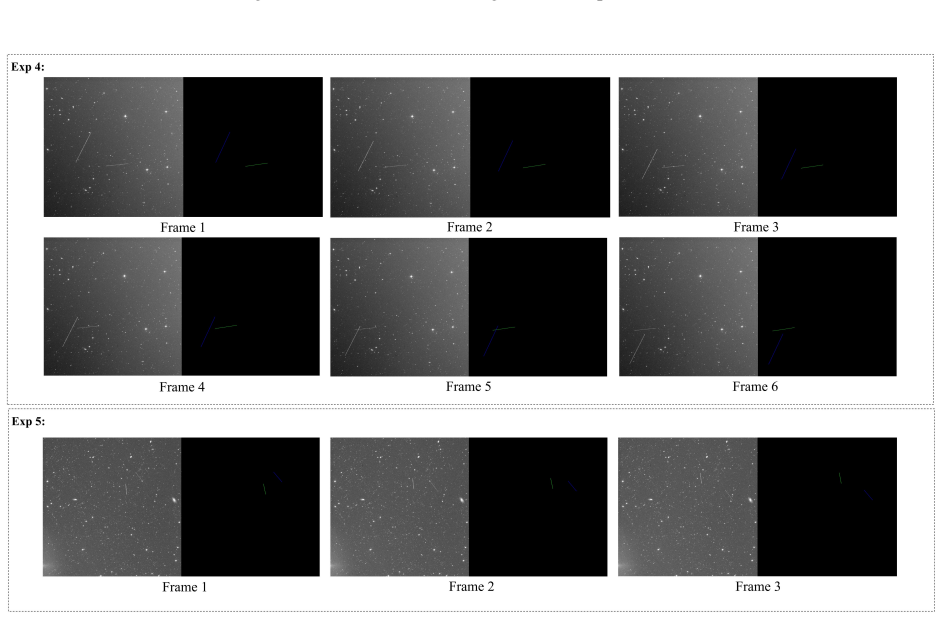
- [3.2 and 4.5] The synthetic benchmark (Table 2) is generated by the authors' own simulator (Section 3.2), and SDT-Net's endpoint/velocity design mirrors that simulator: debris are rectangles moving at constant velocity (Eq. (5)), detected as endpoint pairs, and associated by offset prediction (Eq. (13)). However, the simulator's parameter distributions (K, l_k, w_k, θ_k, v_k, δ_psf, S, truncation) are never specified, and no quantitative validation against real debris statistics is provided (Fig. 8 and Fig. 12(b) are qualitative). To support the claim that SDTD captures real debris, please report the parameter ranges and a quantitative comparison of simulated vs. real debris in terms of length, width, velocity, and intensity profile.
- [3.3.1] The construction of the SDTD train/test split is not fully specified. The paper states that 1,000 of the 16,040 ZTF images are used to create two test sets, but it does not state whether the remaining 15,040 images are used for training, whether the test images are disjoint from training images at the base-image level, or how the 1,000 images were sampled. If any base image appears in both training and test videos, the reported numbers are optimistically biased. Please describe the split procedure and verify that no leakage occurs.
- [5.4 (Table 3)] The ablation study contains internal inconsistencies that make the contribution of individual modules unclear. The text says 'The complete SDT-Net (row c)' but row (c) lacks the offset module, while row (d) is the full model; the RoI-FE comparison is described as 'rows b and d', but those rows differ in both RoI-FE and the offset module. Please correct the row references and report ablations that vary one component at a time so that the gains of LSE, RoI-FE, and the offset module can be isolated.
- [5.3 (Table 2) and 3.3.2] The comparison with existing MOT methods (Table 2) is difficult to interpret without a description of how the line-source annotations are converted to the bounding-box format expected by DeepSORT, ByteTrack, OCSORT, etc. Additionally, the dense debris test set is described in Section 3.3.2 as containing 'usually more than three' debris, but Table 2 defines it as 1 ≤ n ≤ 5, which overlaps with the debris split (n ≤ 2). Please clarify the representation used for all methods and the precise density ranges of the test splits.
minor comments (6)
- [Equations (5) and (6)] There are typographical errors in the equations: Eq. (5) uses x1_l for the first frame's x-coordinate, which should be x1_k; Eq. (6) writes the Gaussian exponent as (y - y2_c)^2, which appears to be a typo for (y - y_c)^2.
- [Abstract / Introduction / Table 1] The number of debris instances is inconsistent: the abstract says 250,000 synthetic debris, the introduction says 25,000 annotated debris instances, and Table 1 reports 65,562 images while the text mentions 62,562 frames. Please reconcile these numbers.
- [Section 5.5] The section title 'Qualitative Results' contains the quantitative real-world evaluation (Table 4); consider renaming it to something like 'Real-World Evaluation' and moving qualitative examples to a separate subsection.
- [Section 6] The conclusion states 'we conduct a user study on real-world data,' but no user study is described in the paper; this appears to be a wording error that should be corrected.
- [Section 5.1] The association radius r is set to 200, but the unit is not specified and no sensitivity analysis is provided; since this parameter directly affects data association, a brief discussion would be useful.
- [Figure 5 caption] The caption's explanation of green/red boxes in terms of IoU is unclear and could be mistaken for a metric description; please rephrase to clarify the visualization convention.
Circularity Check
No significant circularity: the headline transferability claim rests on an independent real-data evaluation, not on the synthetic benchmark.
full rationale
The synthetic SDTD benchmark is generated by the authors' own simulator: Eq. (5) produces each new center by constant-velocity displacement, and Eq. (15) trains SDT-Net's offset head to predict exactly c_t - c_{t-1}. Consequently the synthetic Table 2 results partly reward a tracker whose motion model is aligned with the generator; this is a simulator-realism/domain-gap concern, not circularity, because supervised training and evaluation on the same distribution is standard benchmark practice. The paper does not rename a fitted parameter as a prediction, and it does not rely on any self-citation to justify its architecture or dataset. The abstract's load-bearing claim, 'strong transferability to real-world scenarios,' is supported by Section 5.5 and Table 4 on 36 real Antarctic sequences with expert annotations, which is external to the simulation pipeline. The absence of confidence intervals and per-sequence statistics in Table 4 weakens the statistical force of that result but does not make it circular.
Assumptions & free parameters
free parameters (3)
- Simulator parameter distributions for line length l_k, width w_k, velocity angle θ_k, velocity magnitude v_k, and…
- PSF diffusion standard deviation δ_psf and scale factor S
- Loss weights and association radius =
λ_emb=1, λ_hm=10, λ_off=0.1, r=200
assumptions (3)
- domain assumption Simulated streaks are representative of real space debris appearance
- domain assumption Space debris moves with constant velocity over short video sequences
- domain assumption ZTF sky backgrounds are representative of skylight complexity at other observatories
Cite this review
Pith. "Pith review of High Performance Space Debris Tracking in Complex Skylight Backgrounds with a Large-Scale Dataset." pith.science (2026). https://pith.science/paper/ND56RMMW
@misc{pith2026250602614,
  author       = {Pith},
  title        = {Pith review of: High Performance Space Debris Tracking in Complex Skylight Backgrounds with a Large-Scale Dataset},
  year         = {2026},
  howpublished = {\url{https://pith.science/paper/ND56RMMW}},
  note         = {Machine review of arXiv:2506.02614}
}
read the original abstract
With the rapid development of space exploration, space debris has attracted more attention due to its potential extreme threat, leading to the need for real-time and accurate debris tracking. However, existing methods are mainly based on traditional signal processing, which cannot effectively process the complex background and dense space debris. In this paper, we propose a deep learning-based Space Debris Tracking Network~(SDT-Net) to achieve highly accurate debris tracking. SDT-Net effectively represents the feature of debris, enhancing the efficiency and stability of end-to-end model learning. To train and evaluate this model effectively, we also produce a large-scale dataset Space Debris Tracking Dataset (SDTD) by a novel observation-based data simulation scheme. SDTD contains 18,040 video sequences with a total of 62,562 frames and covers 250,000 synthetic space debris. Extensive experiments validate the effectiveness of our model and the challenging of our dataset. Furthermore, we test our model on real data from the Antarctic Station, achieving a MOTA score of 73.2%, which demonstrates its strong transferability to real-world scenarios. Our dataset and code will be released soon.
Figures


Figures from the paper (9 more)


Reference graph
Works this paper leans on
-
[1]
Can a satellite dodge space debris? Acta Astronautica, 2024
JI Katz. Can a satellite dodge space debris? Acta Astronautica, 2024
work page 2024
-
[2]
Space debris and satellite laser ranging combined using a megahertz system
Michael A Steindorfer, Peiyuan Wang, Franz Koidl, and Georg Kirchner. Space debris and satellite laser ranging combined using a megahertz system. Nature Communications, 16(1):1–12, 2025
work page 2025
-
[3]
Infrared point target detection with improved template matching
Ruiming Liu, Yanhong Lu, Chenglong Gong, and Yang Liu. Infrared point target detection with improved template matching. Infrared Physics & Technology, 55(4):380–387, 2012
work page 2012
-
[4]
Space object detection in images using matched filter bank and bayesian update
Timothy S Murphy, Marcus J Holzinger, and Brien Flewelling. Space object detection in images using matched filter bank and bayesian update. Journal of Guidance, Control, and Dynamics, 40(3):497–509, 2017
work page 2017
-
[5]
Min-Song Wei, Fei Xing, and Zheng You. A real-time detection and positioning method for small and weak targets using a 1d morphology-based approach in 2d images. Light: Science & Applications, 7(5):18006–18006, 2018
work page 2018
-
[6]
Ping Jiang, Chengzhi Liu, Wenbo Yang, Zhe Kang, and Zhenwei Li. Automatic space debris extraction channel based on large field of view photoelectric detection system. Publications of the Astronomical Society of the Pacific, 134(1032):024503, 2022
work page 2022
-
[7]
Object detection in 20 years: A survey
Zhengxia Zou, Keyan Chen, Zhenwei Shi, Yuhong Guo, and Jieping Ye. Object detection in 20 years: A survey. Proceedings of the IEEE, 111(3):257–276, 2023
2023
-
[8]
Visual object tracking with discriminative filters and siamese networks: a survey and outlook
Sajid Javed, Martin Danelljan, Fahad Shahbaz Khan, Muhammad Haris Khan, Michael Felsberg, and Jiri Matas. Visual object tracking with discriminative filters and siamese networks: a survey and outlook. IEEE transactions on pattern analysis and machine intelligence, 45(5):6552–6574, 2022
work page 2022
Show all 42 references
-
[9]
The lyman-alpha solar telescope (lst) for the aso-s mission—i
Hui Li, Bo Chen, Li Feng, Ying Li, Yu Huang, Jing-Wei Li, Lei Lu, Jian-Chao Xue, Bei-Li Ying, Jie Zhao, et al. The lyman-alpha solar telescope (lst) for the aso-s mission—i. scientific objectives and overview. Research in Astronomy and Astrophysics, 19(11):158, 2019
2019
-
[10]
Science with the 2.5-meter wide field survey telescope (wfst)
Tinggui Wang, Guilin Liu, Zhenyi Cai, Jinjun Geng, Min Fang, Haoning He, Ji-an Jiang, Ning Jiang, Xu Kong, Bin Li, et al. Science with the 2.5-meter wide field survey telescope (wfst). Science China Physics, Mechanics & Astronomy, 66(10):109512, 2023
2023
-
[11]
A new pattern for detection of streak-like space target from single optical images
Bin Lin, Lijun Zhong, Sheng Zhuge, Xia Yang, Yang Yang, Kunpeng Wang, and Xiaohu Zhang. A new pattern for detection of streak-like space target from single optical images. IEEE Transactions on Geoscience and Remote Sensing, 60:1–13, 2021
2021
-
[12]
Simulation of astronomical images from optical survey telescopes using a comprehensive photon monte carlo approach
JR Peterson, JG Jernigan, SM Kahn, AP Rasmussen, E Peng, Z Ahmad, J Bankert, C Chang, C Claver, DK Gilmore, et al. Simulation of astronomical images from optical survey telescopes using a comprehensive photon monte carlo approach. The Astrophysical Journal Supplement Series, 2...
2015
-
[13]
Updated point spread function simulations for jwst with webbpsf
Marshall D Perrin, Anand Sivaramakrishnan, Charles-Philippe Lajoie, Erin Elliott, Laurent Pueyo, Swara Ravin- dranath, and Loïc Albert. Updated point spread function simulations for jwst with webbpsf. In Space telescopes and instrumentation 2014: optical, infrared, and millime...
2014
-
[14]
Sdebrisnet: A spatial–temporal saliency network for space debris detection
Jiang Tao, Yunfeng Cao, and Meng Ding. Sdebrisnet: A spatial–temporal saliency network for space debris detection. Applied Sciences, 13(8):4955, 2023
2023
-
[15]
Sstd: Stripe-like space target detection using single-point weak supervision
Zijian Zhu, Ali Zia, Xuesong Li, Bingbing Dan, Yuebo Ma, Enhai Liu, and Rujin Zhao. Sstd: Stripe-like space target detection using single-point weak supervision. arXiv preprint arXiv:2407.18097, 2024
2024 arXiv
-
[16]
Are we ready for autonomous driving? the kitti vision benchmark suite
Andreas Geiger, Philip Lenz, and Raquel Urtasun. Are we ready for autonomous driving? the kitti vision benchmark suite. In 2012 IEEE conference on computer vision and pattern recognition, pages 3354–3361. IEEE, 2012. 12 A PREPRINT - S EPTEMBER 17, 2025
2012
-
[17]
Simple online and realtime tracking
Alex Bewley, Zongyuan Ge, Lionel Ott, Fabio Ramos, and Ben Upcroft. Simple online and realtime tracking. In 2016 IEEE international conference on image processing (ICIP), pages 3464–3468. Ieee, 2016
2016
-
[18]
An introduction to the kalman filter
Greg Welch, Gary Bishop, et al. An introduction to the kalman filter. 1995
1995
-
[19]
The hungarian method for the assignment problem
Harold W Kuhn. The hungarian method for the assignment problem. Naval research logistics quarterly, 2(1- 2):83–97, 1955
1955
-
[20]
Simple online and realtime tracking with a deep association metric
Nicolai Wojke, Alex Bewley, and Dietrich Paulus. Simple online and realtime tracking with a deep association metric. In 2017 IEEE international conference on image processing (ICIP), pages 3645–3649. IEEE, 2017
2017
-
[21]
Tracking objects as points
Xingyi Zhou, Vladlen Koltun, and Philipp Krähenbühl. Tracking objects as points. In European conference on computer vision, pages 474–490. Springer, 2020
2020
-
[22]
Objects as points
Xingyi Zhou, Dequan Wang, and Philipp Krähenbühl. Objects as points. arXiv preprint arXiv:1904.07850, 2019
1904 arXiv
-
[23]
Bytetrack: Multi-object tracking by associating every detection box
Yifu Zhang, Peize Sun, Yi Jiang, Dongdong Yu, Fucheng Weng, Zehuan Yuan, Ping Luo, Wenyu Liu, and Xinggang Wang. Bytetrack: Multi-object tracking by associating every detection box. In European conference on computer vision, pages 1–21. Springer, 2022
2022
-
[24]
Space debris automation detection and extraction based on a wide-field surveillance system
Ping Jiang, Chengzhi Liu, Wenbo Yang, Zhe Kang, Cunbo Fan, and Zhenwei Li. Space debris automation detection and extraction based on a wide-field surveillance system. The Astrophysical Journal Supplement Series, 259(1):4, 2022
2022
-
[25]
Enhanced yolov8-based method for space debris detection using cross-scale feature fusion
Yang Guo, Xianlong Yin, Yao Xiao, Zhengxu Zhao, Xu Yang, and Chenggang Dai. Enhanced yolov8-based method for space debris detection using cross-scale feature fusion. Discover Applied Sciences, 7(2):95, 2025
2025
-
[26]
Detection and classification of astronomical targets with deep neural networks in wide-field small aperture telescopes
Peng Jia, Qiang Liu, and Yongyang Sun. Detection and classification of astronomical targets with deep neural networks in wide-field small aperture telescopes. The Astronomical Journal, 159(5):212, 2020
2020
-
[27]
Faster r-cnn: Towards real-time object detection with region proposal networks
Shaoqing Ren, Kaiming He, Ross Girshick, and Jian Sun. Faster r-cnn: Towards real-time object detection with region proposal networks. Advances in neural information processing systems, 28, 2015
2015
-
[28]
Deep residual learning for image recognition
Kaiming He, Xiangyu Zhang, Shaoqing Ren, and Jian Sun. Deep residual learning for image recognition. In Proceedings of the IEEE conference on computer vision and pattern recognition, pages 770–778, 2016
2016
-
[29]
The zwicky transient facility
Eric Bellm. The zwicky transient facility. In The Third Hot-wiring the Transient Universe Workshop, volume 27, 2014
2014
-
[30]
Astronomical data analysis software and systems xii
Harry Edward Payne, Robert I Jedrzejewski, and Richard N Hook. Astronomical data analysis software and systems xii. Astronomical Data Analysis Software and Systems XII, 295, 2003
2003
-
[31]
Distinguishing features of ccd astrometry of faint geo objects
Vladimir Kouprianov. Distinguishing features of ccd astrometry of faint geo objects. Advances in Space Research, 41(7):1029–1038, 2008
2008
-
[32]
Deep layer aggregation
Fisher Yu, Dequan Wang, Evan Shelhamer, and Trevor Darrell. Deep layer aggregation. InProceedings of the IEEE conference on computer vision and pattern recognition, pages 2403–2412, 2018
2018
-
[33]
Cornernet: Detecting objects as paired keypoints
Hei Law and Jia Deng. Cornernet: Detecting objects as paired keypoints. In Proceedings of the European conference on computer vision (ECCV), pages 734–750, 2018
2018
-
[34]
Lsd: A line segment detector
Rafael Grompone V on Gioi, Jérémie Jakubowicz, Jean-Michel Morel, and Gregory Randall. Lsd: A line segment detector. Image Processing On Line, 2:35–55, 2012
2012
-
[35]
Real-time multiple people tracking with deeply learned candidate selection and person re-identification
Long Chen, Haizhou Ai, Zijie Zhuang, and Chong Shang. Real-time multiple people tracking with deeply learned candidate selection and person re-identification. In 2018 IEEE international conference on multimedia and expo (ICME), pages 1–6. IEEE, 2018
2018
-
[36]
Chained-tracker: Chaining paired attentive regression results for end-to-end joint multiple- object detection and tracking
Jinlong Peng, Changan Wang, Fangbin Wan, Yang Wu, Yabiao Wang, Ying Tai, Chengjie Wang, Jilin Li, Feiyue Huang, and Yanwei Fu. Chained-tracker: Chaining paired attentive regression results for end-to-end joint multiple- object detection and tracking. In Computer Vision–ECCV 20...
2020
-
[37]
Yolox: Exceeding yolo series in 2021
Z Ge. Yolox: Exceeding yolo series in 2021. arXiv preprint arXiv:2107.08430, 2021
2021 arXiv
-
[38]
Observation-centric sort: Rethinking sort for robust multi-object tracking
Jinkun Cao, Jiangmiao Pang, Xinshuo Weng, Rawal Khirodkar, and Kris Kitani. Observation-centric sort: Rethinking sort for robust multi-object tracking. In Proceedings of the IEEE/CVF conference on computer vision and pattern recognition, pages 9686–9696, 2023
2023
-
[39]
Mmdetection: Open mmlab detection toolbox and benchmark
Kai Chen, Jiaqi Wang, Jiangmiao Pang, Yuhang Cao, Yu Xiong, Xiaoxiao Li, Shuyang Sun, Wansen Feng, Ziwei Liu, Jiarui Xu, et al. Mmdetection: Open mmlab detection toolbox and benchmark. arXiv preprint arXiv:1906.07155, 2019. 13 A PREPRINT - S EPTEMBER 17, 2025
1906 arXiv
-
[40]
Pytorch: An imperative style, high-performance deep learning library
Adam Paszke, Sam Gross, Francisco Massa, Adam Lerer, James Bradbury, Gregory Chanan, Trevor Killeen, Zeming Lin, Natalia Gimelshein, Luca Antiga, et al. Pytorch: An imperative style, high-performance deep learning library. Advances in neural information processing systems, 32, 2019
2019
-
[41]
Evaluating multiple object tracking performance: the clear mot metrics
Keni Bernardin and Rainer Stiefelhagen. Evaluating multiple object tracking performance: the clear mot metrics. EURASIP Journal on Image and Video Processing, 2008:1–10, 2008
2008
-
[42]
Hota: A higher order metric for evaluating multi-object tracking
Jonathon Luiten, Aljosa Osep, Patrick Dendorfer, Philip Torr, Andreas Geiger, Laura Leal-Taixé, and Bastian Leibe. Hota: A higher order metric for evaluating multi-object tracking. International journal of computer vision, 129:548–578, 2021. 14 A PREPRINT - S EPTEMBER 17, 2025...
2021
Reviewed August 7, 2026 · model on record in the stance chip above.
Discussion (0). Sign in to comment.