REVIEW 4 major objections 5 minor 42 references
Beyond Induction Heads: In-Context Meta Learning Induces Multi-Phase Circuit Emergence
T0 review · 4 major / 5 minor · reviewed 2026-08-07 · deepseek-v4-flash
Pith's one-line read In-context meta-learning emerges through three distinct attention circuits, not one induction-head jump.
desk verdict Clean, well-controlled study of staged circuit formation in task-inference ICL; worth refereeing, though the three-phase partition rests on one unvaried threshold. read the letter →
The pith
A machine-rendered reading of the paper's core claim, the machinery that carries it, and where it could break.
The reading
What carries the argument
The load-bearing objects are three attention metrics computed from the causal attention maps of each layer: Bigram (attention from the query token to itself), Label Attention (attention from the query to label tokens in the context), and Chunk Example (attention from each x to its paired ℓ). The paper also uses a $\Delta$-Accuracy measure, Acc(t+Δ t)−Acc(t) with Δ t=100, and a fixed threshold of 0.025 to mark phase boundaries. The controlled ICML task, with random per-task label assignments and the query absent from the context, forces task inference so that any accuracy gain beyond memorization must come from context. The metrics do the work of making otherwise invisible attention patterns measurable and testable during training.
What would settle it
Systematically sweep the ΔAccuracy threshold used to mark phases (for example, 0.01, 0.015, 0.02, 0.03, 0.04, 0.05) on the same runs shown in Figure 3; if the number or location of phases changes with the threshold, the three-phase claim is a threshold artifact rather than a property of the circuits themselves.
Extended reading notes
Core claim
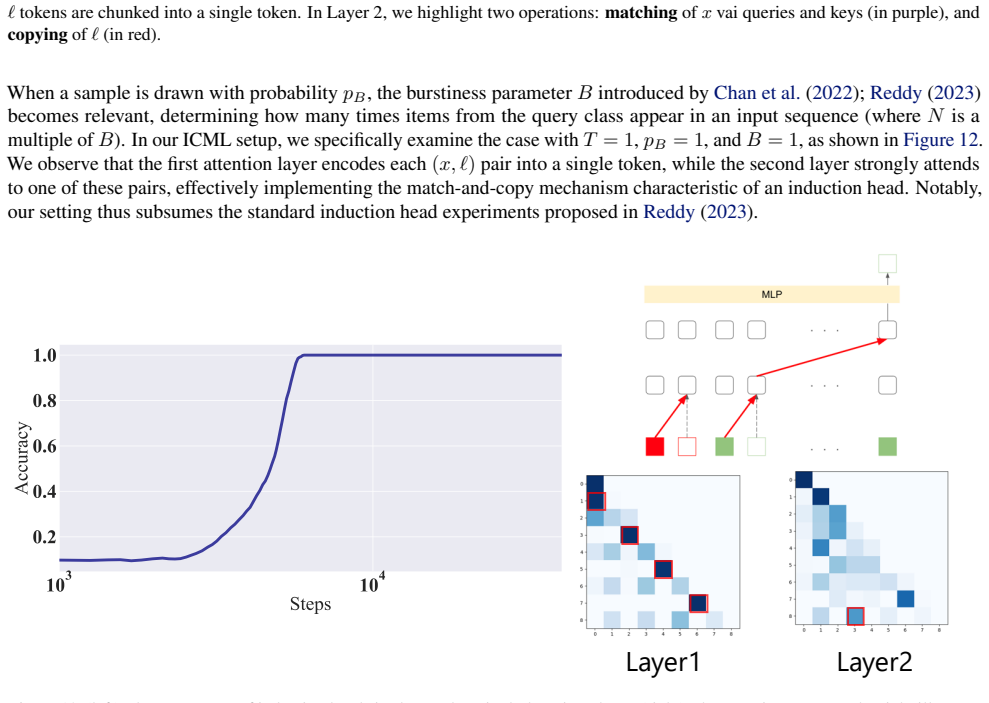
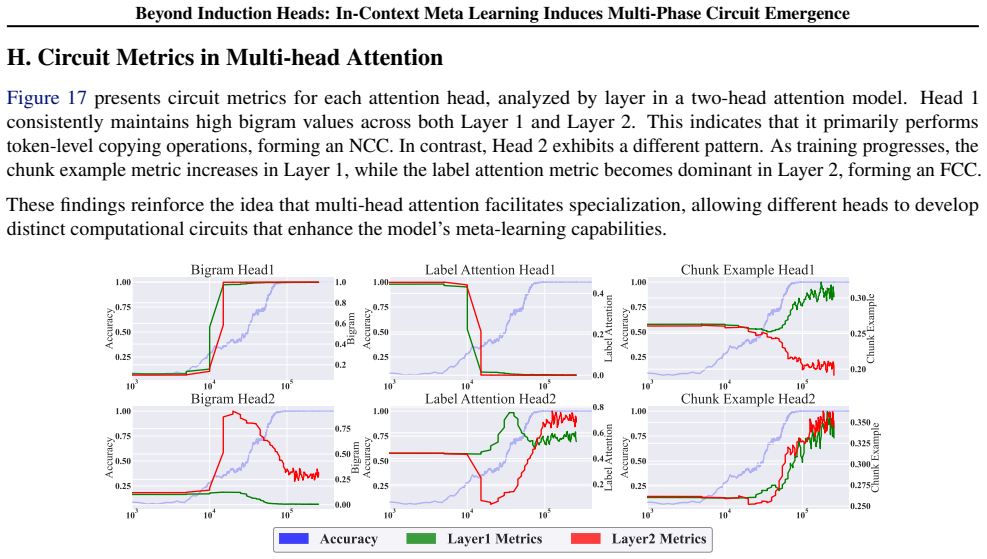
This paper claims that in its proposed In-Context Meta-Learning (ICML) setting, a two-layer attention-only transformer acquires task-inference in-context learning through three ordered circuit phases, and it gives names, attention patterns, and metrics for each. Phase 1 (Non-Context Circuit, NCC) uses bigram attention in both layers, relying on memorized weights to answer the query without reading the context, which caps accuracy near 1/T. Phase 2 (Semi-Context Circuit, SCC) adds label attention in layer 1 while keeping bigram attention in layer 2, reaching roughly 75% accuracy because a label seen in the context can rule out one hypothesis. Phase 3 (Full-Context Circuit, FCC) chunks each (x, ℓ) pair into one token in layer 1 and attends to labels in layer 2, reaching 100% accuracy by abstracting the task. Using three attention metrics, the paper shows that circuit changes align with abrupt accuracy jumps; pruning experiments show each circuit alone reproduces its phase's accuracy; and in multi-head models the phases are hidden in the accuracy curve even though circuit metrics still change abruptly, with heads specializing in parallel. The same layer-wise pattern, chunk-example attention early and label attention later, appears in GPT2-XL on a sentiment classification prompt.
Load-bearing premise
The three-phase split rests on treating an accuracy jump of more than 0.025 over 100 training steps as the boundary between phases, and a different threshold could change when, or whether, the phases appear.
Editorial extensions
If this is right
- If the three-phase picture is correct, induction heads are only one endpoint of a developmental sequence, and task-inference in-context learning should be analyzed with circuits that read labels and chunk example pairs, not just match-and-copy.
- The SCC's label-attention mechanism provides a circuit-level explanation for why LLMs keep high in-context learning accuracy under randomized labels: the model can exploit task-relevant label statistics before it has learned any (x, ℓ) correspondence.
- Because pruning each phase's circuit reproduces that phase's accuracy, circuit identity is causal for performance at each plateau, so interventions on attention can steer which phase the model lands in.
- Multi-head models can hide phase transitions: smooth accuracy curves do not imply smooth circuit formation, so circuit metrics may reveal abrupt internal changes even when loss decreases smoothly.
- Data statistics control phase skipping: few tasks, many classes, high within-class noise, or Zipfian sampling can suppress early phases, giving a testable handle on when task inference emerges.
Reading between the lines
- Beyond the paper: if phase transitions are discrete at the circuit level, then curve-smoothing choices (larger batch, more heads, averaged metrics) may hide rather than remove them; monitoring the three attention metrics during training could serve as an early-warning signal for capability jumps in larger models.
- Beyond the paper: the ordering NCC → SCC → FCC suggests a curriculum prediction—training on data that makes labels task-informative early should bring the SCC phase forward, while removing label-set statistics should delay or eliminate it.
- Beyond the paper: the SCC's reliance on labels alone predicts that a label-set-only probe, feeding the model only the unordered labels without their paired inputs, should show the same roughly 75% accuracy plateau at the same training step; that experiment is directly runnable with the released code.
Editorial analysis
A structured set of objections, weighed in public.
Referee Report
Summary. The paper studies how a two-layer, attention-only transformer acquires in-context learning (ICL) in a new task setting called In-Context Meta-Learning (ICML), where the model must infer a task from labeled examples rather than copy an answer from context. The authors report that training proceeds through three discrete phases—Non-Context Circuit (NCC), Semi-Context Circuit (SCC), and Full-Context Circuit (FCC)—each characterized by a distinct combination of attention patterns. They introduce attention-based metrics for these circuits, provide a theoretical accuracy analysis for SCC, show consistency with random-label robustness, explore how data properties alter phase structure, and extend the analysis to multi-head attention and GPT2-XL.
Significance. If the multi-phase claim is robust, the paper extends mechanistic interpretability of ICL beyond induction heads, connecting toy experiments to phenomena such as task vectors and random-label robustness. Strengths include a clean controlled setup, released code, a theoretical derivation for SCC accuracy that is empirically verified (Figure 5), and pruning experiments (Appendix C) that independently test the role of each identified circuit. These contributions are valuable regardless of the exact threshold used, but the central discrete-phase claim and the LLM generalization claim require stronger evidence.
major comments (4)
- [Section 4.1, Figure 3] The definition of phase boundaries uses the hand-set threshold ΔAccuracy > 0.025 with Δt = 100, and the paper never tests sensitivity to these choices or compares against an independent change-point detection method. Since the number and location of phases is the load-bearing premise for the claim that 'a unique circuit emerges in each phase,' the current evidence does not establish discreteness; it shows that three intervals can be carved from the accuracy curve with this particular threshold. I ask the authors to report phase boundaries across thresholds, window sizes, and random seeds, or to apply a model-free change-point criterion (e.g., Bayesian change-point analysis) to verify that three phases are not an artifact of the chosen threshold.
- [Section 4.2, Table 2 and Figure 4] The three attention metrics in Table 2 were defined after inspecting attention maps, and the phase boundaries in Figure 3 were chosen after observing accuracy jumps. The 'close correspondence' between metric transitions and phase boundaries in Figure 4 is therefore partly built into the analysis. This circularity is partially mitigated by the pruning experiments in Appendix C and the theoretical SCC analysis in Section 4.3, but the alignment claim should be validated by applying pre-specified metrics and threshold procedures to held-out seeds or newly trained models, rather than only to the runs used to define them.
- [Section 6, Figure 10] The GPT2-XL analysis uses raw attention probabilities averaged over all heads in each layer, from a single prompt format, with no error bars, no baseline comparison (e.g., random labels or permuted prompts), and no statistical test for the layer-wise differences. The claim that the observed circuits 'generalize to LLMs' is not supported by this evidence. Please add multiple prompts or seeds, confidence intervals, and a null model for attention, such as comparing to attention on shuffled token sequences.
- [Section 4.4, Figure 7] The claims that the model 'skips Phase 1' or 'skips Phase 2' for different values of K, ε, α, and β are made by visual inspection of the accuracy curves in Figure 7, without applying the operational ΔAccuracy criterion used elsewhere. Because these skipping claims are used to support the multi-phase framework, they should be evaluated with the same threshold-based or change-point procedure, and the results should be reported systematically.
minor comments (5)
- [Sections 3.2 and 4.2] The direction of attention is described inconsistently: Section 3.2 says p^{µ,h}_{ij} quantifies how strongly position i attends to position j, while Section 4.2 defines p^{µ,h}_{i,j} as the attention from token j to token i. Please unify the notation, especially because Table 2 depends on it.
- [Appendix F, Figure 6, Figure 7(a), Appendix N, References] There are several typos and formatting issues: 'Birstiness' in Appendix F header, 'Traning Accuracy' in Figure 6, 'nunber' in Figure 7(a), 'Experimemt' in Appendix N title, and 'V on Oswald' in the references (should be 'von Oswald').
- [Appendix J, Figure 19] The axis labels in Figure 19 contain the literal placeholder '/glyph1197', which appears to be a rendering error and should be fixed.
- [Figure 4 and Figure 2 captions] Figure 2 states that lighter-shaded curves indicate different random seeds, but Figure 4 does not clarify whether the metric curves are averaged over seeds or shown for a single run. Please state this explicitly for all plots.
- [Section 6, Figure 10] The metric definitions for the GPT2-XL analysis are too loose; for example, 'p(query,query)' needs clarification when there are multiple query-related positions in the prompt, and the averaging over heads and tokens should be specified precisely.
Circularity Check
No significant circularity: the central multi-phase claim is an empirical finding with independent theoretical, pruning, and external-model checks; the hand-set DeltaAccuracy threshold is a robustness concern, not a definitional reduction.
full rationale
The paper's central claim is that an ICML-trained transformer passes through three phases with distinct attention circuits. The phase boundaries are operationalized by a hand-chosen DeltaAccuracy threshold (Section 4.1), and the three attention metrics in Table 2 are defined from the visualized attention patterns. These choices are post hoc and could inflate the apparent alignment in Figure 4, but they do not constitute circularity: the circuit metrics are not fitted to the accuracy curve, the phases are not derived from the metrics, and the central claim would fail if the attention patterns did not actually change at those boundaries. The SCC theoretical accuracy (Section 4.3 and Appendix D) is a parameter-free combinatorial derivation tested against a pruned model, and the pruning experiments (Appendix C) and GPT2-XL layer analysis (Section 6) provide independent support. The only self-citations (Furuta et al. 2024; Minegishi et al. 2025) appear as background in Section K and are not load-bearing. Threshold sensitivity and post-hoc metric selection are methodological limitations, not circular reasoning.
Assumptions & free parameters
free parameters (1)
- Phase transition threshold Delta-Accuracy =
0.025
assumptions (4)
- domain assumption Two-layer attention-only transformer with a token-wise MLP classifier is a sufficient model class to study in-context meta-learning circuit emergence.
- domain assumption The synthetic task distribution (T=3, K=64, L=32, N=4, epsilon=0.1, pB=0) captures the essential characteristics of practical in-context meta-learning.
- domain assumption Attention probabilities are the right level of analysis for identifying circuits.
- ad hoc to paper The phase segmentation threshold Delta-Accuracy = 0.025 is a valid way to define learning phases.
invented entities (1)
-
Named circuits NCC, SCC, FCC (Non-Context, Semi-Context, Full-Context Circuit)
independent evidence
Cite this review
Pith. "Pith review of Beyond Induction Heads: In-Context Meta Learning Induces Multi-Phase Circuit Emergence." pith.science (2026). https://pith.science/paper/ND7ML7JQ
@misc{pith2026250516694,
  author       = {Pith},
  title        = {Pith review of: Beyond Induction Heads: In-Context Meta Learning Induces Multi-Phase Circuit Emergence},
  year         = {2026},
  howpublished = {\url{https://pith.science/paper/ND7ML7JQ}},
  note         = {Machine review of arXiv:2505.16694}
}
read the original abstract
Transformer-based language models exhibit In-Context Learning (ICL), where predictions are made adaptively based on context. While prior work links induction heads to ICL through a sudden jump in accuracy, this can only account for ICL when the answer is included within the context. However, an important property of practical ICL in large language models is the ability to meta-learn how to solve tasks from context, rather than just copying answers from context; how such an ability is obtained during training is largely unexplored. In this paper, we experimentally clarify how such meta-learning ability is acquired by analyzing the dynamics of the model's circuit during training. Specifically, we extend the copy task from previous research into an In-Context Meta Learning setting, where models must infer a task from examples to answer queries. Interestingly, in this setting, we find that there are multiple phases in the process of acquiring such abilities, and that a unique circuit emerges in each phase, contrasting with the single-phases change in induction heads. The emergence of such circuits can be related to several phenomena known in large language models, and our analysis lead to a deeper understanding of the source of the transformer's ICL ability.
Figures


Figures from the paper (18 more)






Reference graph
Works this paper leans on
-
[1]
write newline
" write newline "" before.all 'output.state := FUNCTION n.dashify 't := "" t empty not t #1 #1 substring "-" = t #1 #2 substring "--" = not "--" * t #2 global.max substring 't := t #1 #1 substring "-" = "-" * t #2 global.max substring 't := while if t #1 #1 substring * t #2 global.max substring 't := if while FUNCTION format.date year duplicate empty "emp...
-
[2]
Understanding in-context learning in transformers and llms by learning to learn discrete functions
Bhattamishra, S., Patel, A., Blunsom, P., and Kanade, V. Understanding in-context learning in transformers and llms by learning to learn discrete functions. arXiv preprint arXiv:2310.03016, 2023
arXiv 2023
-
[3]
Brown, T. B., Mann, B., Ryder, N., Subbiah, M., Kaplan, J., Dhariwal, P., Neelakantan, A., Shyam, P., Sastry, G., Askell, A., Agarwal, S., Herbert-Voss, A., Krueger, G., Henighan, T., Child, R., Ramesh, A., Ziegler, D. M., Wu, J., Winter, C., Hesse, C., Chen, M., Sigler, E., Litwin, M., Gray, S., Chess, B., Clark, J., Berner, C., McCandlish, S., Radford, ...
arXiv 2005
-
[4]
Chan, S. C. Y., Santoro, A., Lampinen, A. K., Wang, J. X., Singh, A., Richemond, P. H., McClelland, J., and Hill, F. Data distributional properties drive emergent in-context learning in transformers. arXiv preprint arXiv:2205.05055, 2022
arXiv 2022
-
[5]
Revisiting in-context learning inference circuit in large language models
Cho, H., Kato, M., Sakai, Y., and Inoue, N. Revisiting in-context learning inference circuit in large language models. arXiv preprint arXiv:2410.04468, 2024
arXiv 2024
-
[7]
N., Lynch, A., Heimersheim, S., and Garriga-Alonso, A
Conmy, A., Mavor-Parker, A. N., Lynch, A., Heimersheim, S., and Garriga-Alonso, A. Towards automated circuit discovery for mechanistic interpretability, 2023 b . URL https://arxiv.org/abs/2304.14997
arXiv 2023
-
[8]
Crosbie, J. and Shutova, E. Induction heads as an essential mechanism for pattern matching in in-context learning. arXiv preprint arXiv:2407.07011, 2024
arXiv 2024
-
[9]
Why can GPT learn in-context? language models secretly perform gradient descent as meta-optimizers
Dai, D., Sun, Y., Dong, L., Hao, Y., Ma, S., Sui, Z., and Wei, F. Why can GPT learn in-context? language models secretly perform gradient descent as meta-optimizers. In Findings of the Association for Computational Linguistics: ACL 2023, pp.\ 4005--4019, 2023
work page 2023
Show all 42 references
-
[10]
Selective induction heads: How transformers select causal structures in context
D'Angelo, F., Croce, F., and Flammarion, N. Selective induction heads: How transformers select causal structures in context. In The Thirteenth International Conference on Learning Representations, 2025. URL https://openreview.net/forum?id=bnJgzAQjWf
2025
-
[11]
A survey on in-context learning
Dong, Q., Li, L., Dai, D., Zheng, C., Ma, J., Li, R., Xia, H., Xu, J., Wu, Z., Chang, B., Sun, X., Li, L., and Sui, Z. A survey on in-context learning. arXiv preprint arXiv:2301.00234, 2024
2024 arXiv
-
[12]
L., Malach, E., and Goel, S
Edelman, E., Tsilivis, N., Edelman, B. L., Malach, E., and Goel, S. The evolution of statistical induction heads: In-context learning markov chains. In Globerson, A., Mackey, L., Belgrave, D., Fan, A., Paquet, U., Tomczak, J., and Zhang, C. (eds.), Advances in Neural Informati...
2024
-
[13]
A mathematical framework for transformer circuits
Elhage, N., Nanda, N., Olsson, C., Henighan, T., Joseph, N., Mann, B., Askell, A., Bai, Y., Chen, A., Conerly, T., DasSarma, N., Drain, D., Ganguli, D., Hatfield-Dodds, Z., Hernandez, D., Jones, A., Kernion, J., Lovitt, L., Ndousse, K., Amodei, D., Brown, T., Clark, J., Kaplan...
2021
-
[14]
Towards empirical interpretation of internal circuits and properties in grokked transformers on modular polynomials
Furuta, H., Minegishi, G., Iwasawa, Y., and Matsuo, Y. Towards empirical interpretation of internal circuits and properties in grokked transformers on modular polynomials. Transactions on Machine Learning Research, 2024. ISSN 2835-8856. URL https://openreview.net/forum?id=MzSf70uXJO
2024
-
[15]
D., Tillman, H., Goh, G., Troll, R., Radford, A., Sutskever, I., Leike, J., and Wu, J
Gao, L., la Tour, T. D., Tillman, H., Goh, G., Troll, R., Radford, A., Sutskever, I., Leike, J., and Wu, J. Scaling and evaluating sparse autoencoders, 2024. URL https://arxiv.org/abs/2406.04093
2024 arXiv
-
[16]
S., and Valiant, G
Garg, S., Tsipras, D., Liang, P. S., and Valiant, G. What can transformers learn in-context? a case study of simple function classes. In Advances in Neural Information Processing Systems, volume 35, pp.\ 30583--30598, 2022
2022
-
[17]
Learning to grok: Emergence of in-context learning and skill composition in modular arithmetic tasks
He, T., Doshi, D., Das, A., and Gromov, A. Learning to grok: Emergence of in-context learning and skill composition in modular arithmetic tasks. In The Thirty-eighth Annual Conference on Neural Information Processing Systems, 2024. URL https://openreview.net/forum?id=aVh9KRZdRk
2024
-
[18]
In-context learning creates task vectors
Hendel, R., Geva, M., and Globerson, A. In-context learning creates task vectors. In The 2023 Conference on Empirical Methods in Natural Language Processing, 2023. URL https://openreview.net/forum?id=QYvFUlF19n
2023
-
[19]
Loss landscape degeneracy drives stagewise development in transformers, 2025
Hoogland, J., Wang, G., Farrugia-Roberts, M., Carroll, L., Wei, S., and Murfet, D. Loss landscape degeneracy drives stagewise development in transformers, 2025. URL https://arxiv.org/abs/2402.02364
2025 arXiv
-
[20]
Meta-learning in neural networks: A survey
Hospedales, T., Antoniou, A., Micaelli, P., and Storkey, A. Meta-learning in neural networks: A survey. IEEE transactions on pattern analysis and machine intelligence, 44 0 (9): 0 5149--5169, 2021
2021
-
[21]
and Suzuki, T
Kim, J. and Suzuki, T. Transformers learn nonlinear features in context: Nonconvex mean-field dynamics on the attention landscape. arXiv preprint arXiv:2402.01258, 2024
2024 arXiv
-
[22]
Circuit component reuse across tasks in transformer language models
Merullo, J., Eickhoff, C., and Pavlick, E. Circuit component reuse across tasks in transformer language models. arXiv preprint arXiv:2310.08744, 2024
2024 arXiv
-
[23]
M eta ICL : Learning to learn in context
Min, S., Lewis, M., Zettlemoyer, L., and Hajishirzi, H. M eta ICL : Learning to learn in context. In Carpuat, M., de Marneffe, M.-C., and Meza Ruiz, I. V. (eds.), Proceedings of the 2022 Conference of the North American Chapter of the Association for Computational Linguistics:...
2022 doi
-
[24]
Rethinking the role of demonstrations: What makes in-context learning work? arXiv preprint arXiv:2202.12837, 2022 b
Min, S., Lyu, X., Holtzman, A., Artetxe, M., Lewis, M., Hajishirzi, H., and Zettlemoyer, L. Rethinking the role of demonstrations: What makes in-context learning work? arXiv preprint arXiv:2202.12837, 2022 b
2022 arXiv
-
[25]
Bridging lottery ticket and grokking: Understanding grokking from inner structure of networks
Minegishi, G., Iwasawa, Y., and Matsuo, Y. Bridging lottery ticket and grokking: Understanding grokking from inner structure of networks. Transactions on Machine Learning Research, 2025. ISSN 2835-8856. URL https://openreview.net/forum?id=eQeYyup1tm
2025
-
[26]
Progress measures for grokking via mechanistic interpretability
Nanda, N., Chan, L., Lieberum, T., Smith, J., and Steinhardt, J. Progress measures for grokking via mechanistic interpretability. arXiv preprint arXiv:2301.05217, 2023
2023 arXiv
-
[27]
Zoom in: An introduction to circuits
Olah, C., Cammarata, N., Schubert, L., Goh, G., Petrov, M., and Carter, S. Zoom in: An introduction to circuits. Distill, 2020. URL https://distill.pub/2020/circuits/zoom-in
2020
-
[28]
In-context learning and induction heads
Olsson, C., Elhage, N., Nanda, N., Joseph, N., DasSarma, N., Henighan, T., Mann, B., Askell, A., Bai, Y., Chen, A., Conerly, T., Drain, D., Ganguli, D., Hatfield-Dodds, Z., Hernandez, D., Johnston, S., Jones, A., Kernion, J., Lovitt, L., Ndousse, K., Amodei, D., Brown, T., Cla...
2022 arXiv
-
[29]
F., Lubana, E
Park, C. F., Lubana, E. S., and Tanaka, H. Competition dynamics shape algorithmic phases of in-context learning. In The Thirteenth International Conference on Learning Representations, 2025. URL https://openreview.net/forum?id=XgH1wfHSX8
2025
-
[30]
Pretraining task diversity and the emergence of non-bayesian in-context learning for regression
Raventos, A., Paul, M., Chen, F., and Ganguli, S. Pretraining task diversity and the emergence of non-bayesian in-context learning for regression. In Thirty-seventh Conference on Neural Information Processing Systems, 2023. URL https://openreview.net/forum?id=BtAz4a5xDg
2023
-
[31]
The mechanistic basis of data dependence and abrupt learning in an in-context classification task
Reddy, G. The mechanistic basis of data dependence and abrupt learning in an in-context classification task. arXiv preprint arXiv:2312.03002, 2023
2023 arXiv
-
[32]
Identifying semantic induction heads to understand in-context learning
Ren, J., Guo, Q., Yan, H., Liu, D., Zhang, Q., Qiu, X., and Lin, D. Identifying semantic induction heads to understand in-context learning. arXiv preprint arXiv:2402.13055, 2024
2024 arXiv
-
[33]
K., Chan, S
Singh, A. K., Chan, S. C. Y., Moskovitz, T., Grant, E., Saxe, A. M., and Hill, F. The transient nature of emergent in-context learning in transformers. arXiv preprint arXiv:2311.08360, 2023
2023 arXiv
-
[34]
K., Moskovitz, T., Hill, F., Chan, S
Singh, A. K., Moskovitz, T., Hill, F., Chan, S. C., and Saxe, A. M. What needs to go right for an induction head? a mechanistic study of in-context learning circuits and their formation. In Forty-first International Conference on Machine Learning, 2024. URL https://openreview....
2024
-
[35]
L., McDougall, C., MacDiarmid, M., Freeman, C
Templeton, A., Conerly, T., Marcus, J., Lindsey, J., Bricken, T., Chen, B., Pearce, A., Citro, C., Ameisen, E., Jones, A., Cunningham, H., Turner, N. L., McDougall, C., MacDiarmid, M., Freeman, C. D., Sumers, T. R., Rees, E., Batson, J., Jermyn, A., Carter, S., Olah, C., and H...
2024
-
[36]
S., Mueller, A., Wallace, B
Todd, E., Li, M., Sharma, A. S., Mueller, A., Wallace, B. C., and Bau, D. Function vectors in large language models. In The Twelfth International Conference on Learning Representations, 2024. URL https://openreview.net/forum?id=AwyxtyMwaG
2024
-
[37]
N., Kaiser, L
Vaswani, A., Shazeer, N., Parmar, N., Uszkoreit, J., Jones, L., Gomez, A. N., Kaiser, L. u., and Polosukhin, I. Attention is all you need. In Guyon, I., Luxburg, U. V., Bengio, S., Wallach, H., Fergus, R., Vishwanathan, S., and Garnett, R. (eds.), Advances in Neural Informatio...
2017
-
[38]
a., Mordvintsev, A., Zhmoginov, A., and Vladymyrov, M
Von Oswald, J., Niklasson, E., Randazzo, E., Sacramento, J. a., Mordvintsev, A., Zhmoginov, A., and Vladymyrov, M. Transformers learn in-context by gradient descent. In Proceedings of the 40th International Conference on Machine Learning, ICML'23. JMLR.org, 2023
2023
-
[39]
A., Vladymyrov, M., Pascanu, R., and Sacramento, J
von Oswald, J., Niklasson, E., Schlegel, M., Kobayashi, S., Zucchet, N., Scherrer, N., Miller, N., Sandler, M., y Arcas, B. A., Vladymyrov, M., Pascanu, R., and Sacramento, J. Uncovering mesa-optimization algorithms in transformers. arXiv preprint arXiv:2309.05858, 2023
2023 arXiv
-
[40]
Interpretability in the wild: a circuit for indirect object identification in gpt-2 small
Wang, K., Variengien, A., Conmy, A., Shlegeris, B., and Steinhardt, J. Interpretability in the wild: a circuit for indirect object identification in gpt-2 small. arXiv preprint arXiv:2211.00593, 2022
2022 arXiv
-
[41]
T., and Ni, L
Wang, Y., Yao, Q., Kwok, J. T., and Ni, L. M. Generalizing from a few examples: A survey on few-shot learning. ACM computing surveys (csur), 53 0 (3): 0 1--34, 2020
2020
-
[42]
M., Raghunathan, A., Liang, P., and Ma, T
Xie, S. M., Raghunathan, A., Liang, P., and Ma, T. An explanation of in-context learning as implicit bayesian inference. arXiv preprint arXiv:2111.02080, 2021
2021 arXiv
-
[43]
Zipf, G. K. Human Behavior and the Principle of Least Effort. Addison-Wesley, Cambridge, MA, 1949
1949
Reviewed August 7, 2026 · model on record in the stance chip above.
Discussion (0). Sign in to comment.