REVIEW 4 major objections 5 minor 17 references
Rethinking Text-Based Image Retrieval in Specific Domain
T0 review · 4 major / 5 minor · reviewed 2026-08-15 · deepseek-v4-flash
Pith's one-line read A new benchmark and a soft-label fine-tuning method raise text-based image retrieval in surveillance by an average of 7.8 mAP@20 points over standard contrastive fine-tuning.
desk verdict Solid, useful paper with a new multi-match surveillance benchmark and a soft-label fine-tuning method that consistently beats ITC, but the unreleased data and missing overlap checks make the headline numbers provisional. read the letter →
The pith
A machine-rendered reading of the paper's core claim, the machinery that carries it, and where it could break.
The reading
What carries the argument
The central machinery is the pair consisting of the DSMM-TBIR data engine and the SAFT fine-tuning framework. The engine uses Distribution-Aware Prompting (DAP), an LLM prompt that turns statistical text distributions into natural queries, and Centroid-Guided Diversity Sampling (CGDS), which clusters the image pool with K-means in an embedding space and samples within clusters for diversity. Multi-Expert Collaborative Filtering then takes the union of the top-1000 candidates from four different universal embedding models per query, and manual verification converts that union into multi-match labels. SAFT's machinery is a frozen universal multi-modal teacher that emits soft image-to-text, text-to-image, and image-to-image distributions; SASS, a bidirectional KL loss on the cross-modal soft labels, and ISD, a KL loss on intra-modal image similarity, are added to the standard contrastive objective to counter false negatives in a compressed semantic space.
What would settle it
Take a random sample of images outside the top-1000 union for each query and have independent annotators judge relevance; if any nontrivial fraction are relevant, the benchmark's multi-match labels are incomplete and reported mAP gains are partly an artifact of unlabeled positives. The benchmark release should include the full verification protocol so this check can be run.
Extended reading notes
Core claim
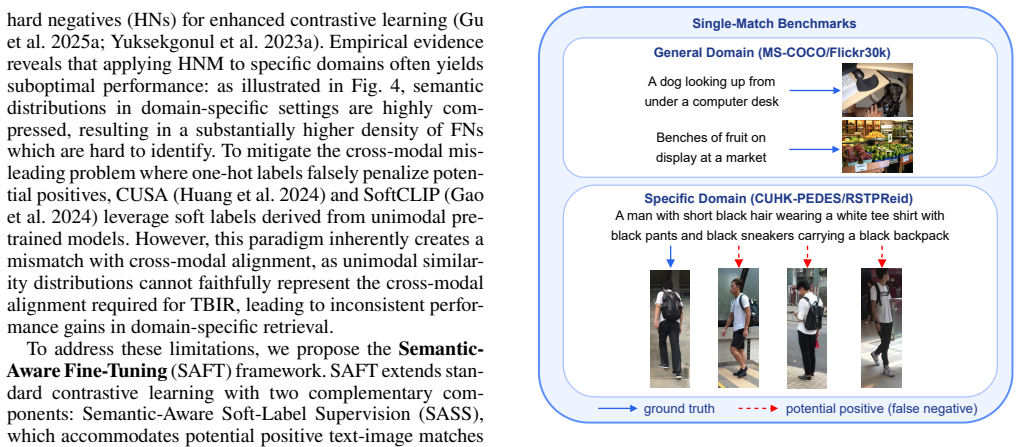
The paper's central claim is that the single-match assumption underlying most TBIR benchmarks misleads both evaluation and training in specific domains. Its SecMM-TBIR benchmark contains multiple verified matches per query across pedestrian and vehicle surveillance scenarios, and the proposed SAFT framework turns multi-match structure into training signal. Semantic-Aware Soft-Label Supervision (SASS) replaces rigid one-hot labels with a teacher's cross-modal similarity distributions via bidirectional KL divergence, and Intra-modal Structural Distillation (ISD) transfers the teacher's image-image similarity distribution. The paper reports that SAFT yields an average gain of 7.8 mAP@20 over standard ITC fine-tuning across six CLIP-style models, with consistent improvements on Flickr30K and MS-COCO and additional gains on Fashion200K and compositional reasoning benchmarks.
Load-bearing premise
The load-bearing premise is that the union of the four expert embedders' top-1000 candidates plus manual verification finds every relevant query-image pair, with no missed positives that would be counted as negatives during training or evaluation.
Editorial extensions
If this is right
- In specific domains with compressed semantics, models fine-tuned by SAFT should retrieve multiple correct images per query instead of being forced to rank all but one as negatives.
- Freezing the text encoder during domain fine-tuning is preferable to joint cross-modal tuning; the paper reports that joint tuning consistently hurts retrieval on SecMM-TBIR.
- Standard image self-supervision and threshold-based hard negative mining provide marginal or negative gains under dense false negatives, so they are not the right tools for domain-specific retrieval.
- Because SAFT also improves Flickr30K, MS-COCO, Fashion200K, and the ARO compositional reasoning benchmark, its benefits are not limited to surveillance and do not sacrifice general-domain capability.
- The DSMM-TBIR pipeline is reusable for other verticals such as medical or retail search, using the same LLM/VLM query generation and multi-expert verification stages.
Reading between the lines
- A testable extension is to apply SAFT to a separately built multi-match benchmark in another vertical; the paper's pipeline suggests the margin should transfer, but current evidence is limited to surveillance and fashion.
- If the SecMM-TBIR labels were replaced by exhaustive annotation, the measured advantage of SAFT could shrink, because part of what it learns compensates for false negatives in the training set; that would change the interpretation without necessarily invalidating the method.
- The teacher-dependent design implies a model-selection rule: when the frozen teacher is much stronger than the student, SASS and ISD should help most, and gains should flatten as the student approaches the teacher.
- The data engine could be inverted to build training sets as well as benchmarks, turning unlabeled domain video into contrastive pairs enriched with the same multi-expert candidate union.
Signed reviews
Editorial analysis
A structured set of objections, weighed in public.
Referee Report
Summary. The paper addresses text-based image retrieval in domain-specific, semantically compressed settings such as surveillance. It introduces SecMM-TBIR, a multi-match benchmark of 50k surveillance images and 200 queries, built through a three-phase pipeline that uses LLM/VLM generation, clustering-based sampling, and multi-expert candidate retrieval followed by manual verification. It also proposes SAFT, a fine-tuning framework combining the standard ITC loss with Semantic-Aware Soft-Label Supervision (SASS) and Intra-modal Structural Distillation (ISD), where a frozen universal multi-modal embedder supplies cross-modal and intra-modal soft targets. Experiments on six CLIP-like models report an average mAP@20 gain of 7.8 points over ITC fine-tuning on SecMM-TBIR, with additional gains on Flickr30K, MS-COCO, Fashion200K, and ARO.
Significance. If the benchmark and method are sound, the paper makes a useful contribution: it identifies a real limitation of single-match TBIR evaluation in narrow domains, proposes a concrete data-construction pipeline, and demonstrates a training recipe that consistently improves over ITC across several architectures. The loss definitions in Section 3.3 are clear and the ablation studies, especially the tables showing incremental contributions of SASS and ISD, support the internal consistency of the method. The promised public release of the benchmark would be valuable to the community. However, the central empirical claims rest on a benchmark whose label completeness has not been demonstrated and on an unreleased internal training set whose decoupling from the benchmark is only asserted, so the headline gains cannot currently be independently verified.
major comments (4)
- [Section 3.1, Phase 2 and Phase 3; Eq. (1); Appendix A] The benchmark labels are defined as the union of top-1000 retrieval candidates from four expert embedders, followed by manual verification. Any true positive that is not retrieved by any of the four experts can never receive a positive label, and mAP@20 will penalize a model that retrieves such an unlabeled true positive. Because the paper's headline claim is the +7.8 mAP@20 gain on SecMM-TBIR, label completeness is load-bearing, yet no recall estimate for the candidate-generation step and no inter-annotator agreement statistics are reported. The authors should report the distribution of labeled positives per query, Cohen's kappa or a similar agreement measure for the manual verification, and an independent estimate of the false-negative rate in C(q), for example by annotating a random sample of images outside the candidate union.
- [Section 4.1, Specialized Internal Dataset] The paper states that the Specialized Internal Dataset is 'decoupled from SecMM-TBIR benchmark', but both the training set and the benchmark are built from real-world surveillance pedestrian and vehicle images, and no overlap or near-duplicate analysis is provided. Since both datasets are unreleased, readers cannot rule out that some benchmark images or near-duplicates appeared in the internal training set, which would inflate the reported +5.4/+10.3 mAP@20 gains over ITC through memorization rather than algorithmic improvement. The authors should provide quantitative overlap statistics (e.g., image hash or embedding-similarity distributions between the training set and SecMM-TBIR) or release both datasets so that the decoupling claim can be checked.
- [Section 4.2, Tables 1 and 3] All results are reported as point estimates without error bars, confidence intervals, or multiple seeds. The benchmark contains only 200 queries, so the per-query variance may be substantial, and the claimed 7.8-point average gain could in principle be within optimization or sampling noise for some model/domain combinations. The authors should report mean and standard deviation over at least three fine-tuning runs, or an equivalent query-level statistical test, for the main comparison between ITC and SAFT.
- [Section 3.3 and Section 3.1, Phase 2] There is a preference-alignment risk between the benchmark labels and the teacher model used by SAFT. The candidate set C(q) is generated by four multi-modal embedders, and SAFT distills soft targets from UniME-V2, also a large multi-modal embedder; if these models share a common notion of relevance, the evaluation could reward SAFT for matching the same embedder preferences that determined which labels exist, rather than for better retrieval per se. A concrete test would be to construct a small held-out subset whose labels come from exhaustive manual annotation independent of the four expert retrievers and to re-report SAFT versus ITC on that subset.
minor comments (5)
- [Figure 1 caption and Table 4] The caption states that MobileCLIP-S1 is allowed to 'outperform 2B pretrained embedders', but this holds only on the vehicle subset: in Table 4 the pedestrian mAP@20 of MobileCLIP-S1 with SAFT is 54.9, below UniME-V2-2B's 57.4. The claim should be qualified.
- [Table 2] The table formatting is difficult to read; the '−3.3', '−1.8', etc. values are visually merged with the preceding numbers, and the model order (T-22, T-45, M-S0, M-S1, B/16, B/32) differs from the order in Table 1. This should be cleaned up.
- [Appendix C, Table 9] The Fashion200K evaluation uses a modified test set generated with Qwen3-VL and Qwen-3.5 rather than the original split, so the numbers in Table 9 are not directly comparable to published Fashion200K results. The authors should state this clearly in the main text or report results on the original test split.
- [Section 2.2] There is a typo: 'In contrasct' should be 'In contrast'.
- [Section 3.2, Eq. (2)] The definition of the hard-negative threshold alpha uses a margin beta, but the signs and relative scale are not discussed; clarifying why a positive margin excludes false negatives while retaining hard negatives would help readers reproduce the analysis in Table 5.
Circularity Check
No circular step meets the required reduction test; the method is empirically grounded and externally corroborated.
full rationale
The paper's central claims are empirical: SAFT is a composite loss (Eq. 10) with KL distillations from a frozen teacher (Eqs. 5-9), and the main evaluation is mAP on SecMM-TBIR plus standard externally labeled benchmarks (Flickr30K, MS-COCO, Fashion200K, ARO). No claimed result reduces to its own input by construction: the SecMM-TBIR labels are formed by a union of top-K candidates from Qwen3-VL-Embedding, Jina-v4, RZen-v2, and SigLIP (Eq. 1) followed by manual verification, while the SAFT teacher UniME-V2 is not one of those four expert embedders. Manual verification means positives are not defined solely by embedder agreement, and the teacher-student distillation does not equal the label-generation process. The central +7.8 mAP@20 claim is also corroborated on general-domain benchmarks with independently constructed labels, so the result is not forced by the benchmark construction. The only apparent author self-citation is RzenEmbed (Jian et al. 2025b), used as one of four expert retrievers in benchmark construction; it is not load-bearing to the derivation of SAFT. Two validity concerns are real but are not circularity: Section 4.1 asserts the specialized internal training set is 'decoupled from SecMM-TBIR benchmark' without reporting overlap or deduplication statistics, and Section 3.1 Phase 3 / Appendix A report no inter-annotator agreement for the manual relevance labels. These could indicate leakage or label incompleteness, but they do not demonstrate an equation-level reduction of the paper's predictions to its inputs. Overall circularity score is therefore 0.
Assumptions & free parameters
free parameters (3)
- SASS loss weight alpha =
1.0
- ISD loss weight beta =
0.75
- Teacher temperature tau_o =
not reported
assumptions (3)
- domain assumption Specific TBIR domains exhibit sharp semantic compression, making one-hot contrastive labels misleading.
- domain assumption UniME-V2 provides faithful cross-modal and intra-modal similarity distributions for the target domains.
- domain assumption Manual verification of the candidate union yields unbiased and complete multi-match labels.
Cite this review
Pith. "Pith review of Rethinking Text-Based Image Retrieval in Specific Domain." pith.science (2026). https://pith.science/paper/NEETUPBA
@misc{pith2026260810524,
  author       = {Pith},
  title        = {Pith review of: Rethinking Text-Based Image Retrieval in Specific Domain},
  year         = {2026},
  howpublished = {\url{https://pith.science/paper/NEETUPBA}},
  note         = {Machine review of arXiv:2608.10524}
}
read the original abstract
Driven by the rapid advancement of vision-language representation learning, Text-based Image Retrieval (TBIR) has made notable progress. However, existing benchmarks are predominantly constructed on an exclusive single-match assumption between query and images. While effective in general scenarios, this assumption fails to reflect practical system performance in specific domains (e.g., surveillance), where a single query often corresponds to multiple relevant candidate images. To address this limitation, we design a Domain-Specific Multi-Match Text-based Image Retrieval (DSMM-TBIR) data engine. Leveraging this engine, we construct Security Multi-Match TBIR (SecMM-TBIR), a benchmark comprising 50k surveillance images with 200 comprehensive queries. Furthermore, we observe that vanilla contrastive learning in specific domains suffers from severe false negatives, forcing the model to push apart semantically similar pairs and thus degrading retrieval performance. We propose the Semantic-Aware Fine-Tuning (SAFT) framework to address semantic compression in specific domains, which incorporates Semantic-Aware Soft-Label Supervision (SASS) and Intra-modal Structural Distillation (ISD) to establish a promising paradigm for domain-specific TBIR tasks. Experiments across diverse CLIP-like models demonstrate that SAFT yields an average mAP@20 gain of 7.8 points on SecMM-TBIR over standard image-text contrastive (ITC) fine-tuning, while also improving general-domain performance. The entire benchmark will be released to facilitate further research.
Figures


Figures from the paper (4 more)


Reference graph
Works this paper leans on
-
[4]
jina-embeddings-v4: Universal Embeddings for Multimodal Multilingual Retrieval. arXiv:2506.18902. Han, X.; Wu, Z.; Huang, P. X.; Zhang, X.; Zhu, M.; Li, Y.; Zhao, Y.; and Davis, L. S
-
[8]
Detect Anything via Next Point Prediction. arXiv:2510.12798. Ko, H.; and Park, C.-M
-
[9]
InProceedingsoftheComputerVisionandPattern Recognition Conference, 25897–25906
Bringing clip to the clinic: Dynamicsoftlabelsandnegation-awarelearningformedical analysis. InProceedingsoftheComputerVisionandPattern Recognition Conference, 25897–25906. Krishna, R.; Zhu, Y.; Groth, O.; Johnson, J.; Hata, K.; Kravitz,J.;Chen,S.;Kalantidis,Y.;Li,L.-J.;Shamma,D.A.; Bernstein,M.S.;andFei-Fei,L.2017. VisualGenome:Con- necting Language and V...
arXiv 2017
-
[12]
Dinov2: Learning robust visual fea- tureswithoutsupervision.arXivpreprintarXiv:2304.07193. Plummer, B. A.; Wang, L.; Cervantes, C. M.; Caicedo, J. C.; Hockenmaier, J.; and Lazebnik, S
-
[13]
Dinov3.arXiv preprint arXiv:2508.10104. Srinivasa, R. S.; Cho, J.; Yang, C.; Saidutta, Y. M.; Lee, C.- H.; Shen, Y.; and Jin, H
-
[14]
Tschannen, M.; Gritsenko, A.; Wang, X.; Naeem, M
Cwcl: Cross-modal transfer with continuously weighted contrastive loss.Advances in Neural Information Processing Systems, 36: 78496–78513. Tschannen, M.; Gritsenko, A.; Wang, X.; Naeem, M. F.; Alabdulmohsin, I.; Parthasarathy, N.; Evans, T.; Beyer, L.; Xia, Y.; Mustafa, B.; Hénaff, O.; Harmsen, J.; Steiner, A.; andZhai,X.2025. SigLIP2:MultilingualVision-L...
arXiv 2025
-
[16]
InProceedings of the IEEE/CVF International Conference on Computer Vision (ICCV), 21970–21980
TinyCLIP: CLIP Distillation via Affinity Mimicking and Weight Inheritance. InProceedings of the IEEE/CVF International Conference on Computer Vision (ICCV), 21970–21980. Yuksekgonul, M.; Bianchi, F.; Kalluri, P.; Jurafsky, D.; and Zou, J. 2023a. When and why Vision-Language Models behave like Bags-of-Words, and what to do about it? In International Confer...
-
[17]
PLIP: Language-Image Pre-training for Person Representation Learning. arXiv:2305.08386. A Benchmark Details We construct SecMM-TBIR with our proposed DSMM- TBIR pipeline, with the Adaptive Data Pool Curation stage servingasthecorecomponentofourdatapreparationwork- flow. In this stage, we build the image and caption pools by aggregating multi-source data d...
Show all 17 references
-
[755]
Loshchilov,I.;andHutter,F.2019
Springer. Loshchilov,I.;andHutter,F.2019. DecoupledWeightDecay Regularization. InInternational Conference on Learning Representations (ICLR). Lu, M.; Weinberger, E.; Kim, C.; and Lee, S.-I
2019
-
[2014]
InComputer Vision– ECCV 2014: 13th European Conference, Zurich, Switzer- land, September 6-12, 2014, Proceedings, Part V 13, 740–
Microsoft coco: Common objects in context. InComputer Vision– ECCV 2014: 13th European Conference, Zurich, Switzer- land, September 6-12, 2014, Proceedings, Part V 13, 740–
2014
-
[2017]
arXiv:1708.01311
Automatic Spatially-aware Fashion Concept Discovery. arXiv:1708.01311. Huang, H.; Nie, Z.; Wang, Z.; and Shang, Z
-
[2021]
InProceedings of the International Conference on Machine Learning (ICML), 4904–4916
Scaling up visual and vision-language representation learning with noisy text supervision. InProceedings of the International Conference on Machine Learning (ICML), 4904–4916. Jian, W.; Zhang, Y.; Liang, D.; Xie, C.; He, Y.; Leng, D.; and Yin, Y. 2025a. Rzenembed: Towards comp...
-
[2022]
InProceedings of the 2022 Conference on Empirical Methods in Natural Language Processing, 3876–3887
Med- clip:Contrastivelearningfromunpairedmedicalimagesand text. InProceedings of the 2022 Conference on Empirical Methods in Natural Language Processing, 3876–3887. Wu, K.; Peng, H.; Zhou, Z.; Xiao, B.; Liu, M.; Yuan, L.; Xuan, H.; Valenzuela, M.; Chen, X. S.; Wang, X.; Chao, ...
2022
-
[2023]
InProceedings of the IEEE/CVF Conference on Computer Vision and Pattern Recognition (CVPR), 2818–2829
Reproducible scaling laws for contrastive language-image learning. InProceedings of the IEEE/CVF Conference on Computer Vision and Pattern Recognition (CVPR), 2818–2829. Ding,Z.;Ding,C.;Shao,Z.;andTao,D.2021. Semantically Self-Aligned Network for Text-to-Image Part-aware Perso...
2021 arXiv
-
[2024]
InProceedings of the AAAI ConferenceonArtificialIntelligence,volume38,1860–1868
Softclip: Softer cross-modal alignment makes clip stronger. InProceedings of the AAAI ConferenceonArtificialIntelligence,volume38,1860–1868. Gu, T.; Yang, K.; Feng, Z.; Wang, X.; Zhang, Y.; Long, D.; Chen,Y.;Cai,W.;andDeng,J.2025a.BreakingtheModality Barrier: Universal Embeddi...
-
[2025]
Chen, D.; Wang, Y.; Xie, Y.; Chen, S.; Peng, W.; Tang, M.; Fang, M.; Chen, C
Qwen3-VL Technical Report.arXiv preprint arXiv:2511.21631. Chen, D.; Wang, Y.; Xie, Y.; Chen, S.; Peng, W.; Tang, M.; Fang, M.; Chen, C. P.; Li, P.; and Zhang, W
-
[2026]
Jia, C.;Yang, Y.; Xia,Y.; Chen, Y.-T.;Parekh, Z.; Pham,H.; Le, Q.; Sung, Y.-H.; Li, Z.; and Duerig, T
Few Shots Text to Image Re- trieval:NewBenchmarkingDatasetandOptimizationMeth- ods.arXiv preprint arXiv:2603.25891. Jia, C.;Yang, Y.; Xia,Y.; Chen, Y.-T.;Parekh, Z.; Pham,H.; Le, Q.; Sung, Y.-H.; Li, Z.; and Duerig, T
Reviewed August 15, 2026 · model on record in the stance chip above.
Discussion (0). Continue with ORCID to comment.