REVIEW 3 major objections 5 minor 58 references
Automated Learning of Semantic Embedding Representations for Diffusion Models
T0 review · 3 major / 5 minor · reviewed 2026-08-15 · deepseek-v4-flash
Pith's one-line read Diffusion models trained only to denoise can learn image semantics that beat dedicated self-supervised learners on four of six benchmarks.
desk verdict Reasonable Diff-AE extension, but the SOTA claim rests on test-set t selection and a single seed. read the letter →
The pith
A machine-rendered reading of the paper's core claim, the machinery that carries it, and where it could break.
The reading
What carries the argument
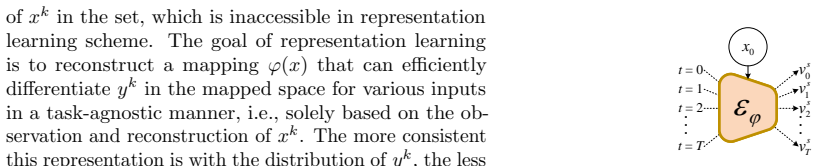
The load-bearing object is the encoder $\varepsilon_\varphi$ that maps a clean image $x_0$ together with a noise level $t$ to a vector $v^s_t$, injected into every transformer block of a DiT backbone through adaptive layer normalization (adaLN). The objective is the diffusion noise-prediction loss with this vector as conditioning, $L_{simple} = \mathbb{E}_{x,\epsilon,t}\left[\lVert \epsilon - \epsilon_\theta(x_t, t, \varepsilon_\varphi(x_0,t))\rVert_2^2\right]$. This recasts the diffusion model as $T$ denoising autoencoders — networks that learn to undo corruption added to an image, one per noise level — so the only way the encoder can help the denoiser is to summarise, for the whole dataset, the rule that maps each corrupted version back to its source; the authors argue such denoising rules amount to knowledge about how images of particular classes are generated. No labels, data augmentation beyond horizontal flipping, or auxiliary losses are used, so any semantic content in $v^s_t$ must come from the denoising objective itself.
What would settle it
Re-run the pipeline but choose the best timestep on a held-out validation split, fitting each linear probe on training data only, then report test accuracy at that timestep; if the margins over MAE on CIFAR100 and Tiny-IN and over DMJD on OCT2017 shrink to a point or reverse, the headline comparison is an artifact of test-set model selection. As a second check, freeze the encoder and retrain the denoiser with scrambled $v^s_t$ inputs; if linear probe accuracy barely drops, the embeddings themselves are not carrying the semantic signal.
Extended reading notes
Core claim
DiER (Diffusion Embedding Representations) trains a timestep-conditioned encoder together with a Diffusion Transformer backbone using only the standard diffusion noise-prediction loss, with the encoder's output $v^s_t = \varepsilon_\varphi(x_0,t)$ fed into every block via adaptive layer normalization. The central claim is that these vectors are semantically meaningful image embeddings: at the best timestep, linear probe accuracy reaches 59.7 on CIFAR10, 98.1 on OCT2017, 37.7 (top-1) and 67.3 (top-5) on CIFAR100, and 36.7 (top-1) and 62.5 (top-5) on Tiny-IN, ahead of every compared self-supervised method on these four datasets. On MNIST and BCCD the same embeddings trail the strongest baselines, and the best timestep shifts with dataset content — $t=100$ for object-central natural images, $t=400$ to $500$ for datasets with small or sparse targets. The paper reads this as evidence that diffusion denoising, reframed as a multi-level denoising autoencoder, learns discriminative structure as a by-product of predicting noise.
Load-bearing premise
The result rests on the premise, stated as a natural expectation rather than proved, that optimizing the noise-prediction loss forces the encoder to learn class-level semantic knowledge instead of low-level reconstruction details, with the best reported accuracies selected from eleven timesteps evaluated on the test set.
Editorial extensions
If this is right
- Diffusion pre-training can be dual-purpose: one noise-prediction run produces both a generator and embeddings whose class structure a linear probe can read, so representation learning needs no separate objective.
- The learned representation is compact and scalable: a single 1024-dimensional vector per image reaches state-of-the-art linear probe accuracy, and the encoder can be replaced by higher-capacity architectures.
- Timestep choice is the key transfer decision: downstream tasks must read the embedding at the dataset's optimal noise level, which the paper locates at intermediate timesteps ($t=100$, $400$, or $500$) rather than at the clean or fully noisy ends.
- The optimal timestep correlates with image content: datasets whose classification target fills most of the frame prefer $t=100$, while datasets with small or sparse targets (digits, cells, lesions) prefer $t=400$–$500$, giving a content-based heuristic for where to probe.
Reading between the lines
- Editorial inference: the best timestep is selected from test-set results, so the reported 'optimal' accuracies are likely optimistic; re-selecting the timestep on a validation split is the direct way to test how much of the advantage survives honest model selection.
- Editorial inference: because different timesteps encode different granularities, concatenating or averaging $v^s_t$ across several timesteps could yield a richer representation than the single best one the paper reports.
- Testable extension: the same recipe — a timestep-conditioned encoder trained by the denoising objective alone — could carry over to audio and text diffusion models, and the content-based optimal-timestep heuristic could be turned into a rule that avoids per-dataset probing entirely.
- Editorial inference: the failures on MNIST and BCCD show the advantage is not universal; identifying what separates the four winning from the two losing datasets (target size, intra-class variance, background structure) would upgrade the claim into a predictive theory.
Signed reviews
Editorial analysis
A structured set of objections, weighed in public.
Referee Report
Summary. The paper proposes DiER, a diffusion-based self-supervised representation learning method. A timestep-dependent encoder epsilon_phi maps a clean image x0 and a diffusion timestep t to an embedding vector v_t^s, which is injected into a Diffusion Transformer backbone through adaptive layer norm. The model is trained from scratch with the standard noise-prediction loss (Eq. 4.6), without using class labels. The authors evaluate linear probe accuracy (LPA) on six datasets (MNIST, CIFAR10, CIFAR100, Tiny-IN, BCCD, OCT2017) and compare against Diff-AE, MAE, CAE, DMJD, LMIM, and MAGE. At the timestep with the highest test LPA, DiER outperforms the best baseline on CIFAR10, OCT2017, CIFAR100, and Tiny-IN, while falling behind on MNIST and BCCD. The paper also reports per-timestep LPA curves, t-SNE visualizations, and qualitative reconstruction experiments.
Significance. If the empirical claims hold, this is a meaningful result: it would show that a simple modification of the standard diffusion objective suffices to obtain discriminative semantic embeddings, strengthening the connection between generative and discriminative self-supervised learning. The method is simple and the paper is unusually transparent about architectures, hyperparameters, and per-timestep accuracy, which aids reproducibility. However, the headline superiority claim is weakened by the test-set-based selection of the best timestep and by the absence of error bars or multiple seeds. Because the reported margins over state-of-the-art baselines are small on some datasets, the central claim should be regarded as promising but not yet fully established.
major comments (3)
- [Section 5.2, Tables 1 and 2, Appendix A.2] The reported DiER accuracy in Table 1 is the maximum over the 11 tested timesteps (0, 100, ..., 999), and the winning timestep is selected from test-set LPA. This is a post hoc selection: any time-indexed representation family will have a best test timestep, and that maximum is biased upward relative to a timestep chosen without access to test labels. The issue is load-bearing because the claimed wins are small on CIFAR10 (0.8%) and OCT2017 (1.2%). A validation-based timestep selection rule, or a fixed protocol (e.g., always use t=100), should be applied before comparisons are made, and the abstract's 'surpasses SOTA in most cases' should be conditioned on that rule.
- [Appendix A.2; Table 1] All experiments are run with a single fixed random seed and no error bars are reported. Given that the differences against the strongest baselines are between 0.8 and 6.5 percentage points on the four winning datasets, seed-level variation could plausibly change the ranking. The paper should report mean and standard deviation over at least three seeds for DiER and the relevant baselines, or otherwise justify that the differences are larger than run-to-run variability.
- [Section 4, paragraph following Eq. (4.6)] The central premise that optimizing the diffusion noise-prediction loss induces semantically meaningful embeddings in epsilon_phi(x0,t) is stated as a natural expectation rather than derived or ablated. The LPA results support the premise, but the paper does not test whether the same embeddings could be obtained from a simpler denoising autoencoder at a single noise level, or whether removing timestep conditioning would degrade results. Adding such ablations would substantiate the claim that the diffusion denoising rule, rather than the autoencoding reconstruction, is responsible for the semantic content.
minor comments (5)
- [Section 4, first paragraph] The phrase 'as and employ a self-supervised model' appears to be missing words and is ungrammatical; please revise.
- [Section 5.2, first paragraph] 'DiER consistently SOTA self-supervised methods' is missing a verb; it should read 'DiER consistently outperforms SOTA self-supervised methods' or similar.
- [Table 1] The subscript formatting is ambiguous; for example, the MNIST entry '89.9400' makes it difficult to distinguish the reported accuracy from the selected timestep. Please format subscripts clearly.
- [Appendix A.2] The linear probing setup is described only as 'LPA testing spans 100 epochs'; please specify the classifier type (e.g., logistic regression, linear layer) and the feature normalization used.
- [Appendix B, Figure 7 caption] The caption 'Embedding Representations with Small Margins' does not match the figure content described in the text; please clarify or rename the caption.
Circularity Check
No significant circularity: DiER's embeddings are trained with a label-free diffusion loss and evaluated on held-out labels, with no fitted parameter or self-citation chain forcing the reported result.
full rationale
The central claimed result is that the encoder output v_s^t = epsilon_phi(x0,t), trained via Eq. (4.6) on the noise-prediction objective, yields linear-probe accuracies competitive with or better than several self-supervised baselines. The training objective uses only x0, t, and sampled noise; class labels y_k are explicitly described as inaccessible during representation learning (Section 3.2). Evaluation is a standard linear probe on held-out test labels. I checked the derivation chain for the enumerated circularity patterns. (1) Self-definition: the representation is not defined in terms of LPA; LPA is a post-hoc evaluation metric. (2) Fitted input called prediction: no parameter is fitted to the evaluation labels; the only selection is the reported best timestep chosen from the 11 tested LPA values (Appendix A.2 and Table 2). That is a test-set selection concern, not a by-construction equivalence: it does not make the LPA value equal to the training loss or to any fitted parameter. (3) Self-citation: the authors cite their own earlier works [14], [16], and [36], but these are incidental references to unrelated image-restoration and segmentation papers, not load-bearing justification for the representation claim. The Diff-AE baseline [28] and the DAE-DDM analogy [22] are external citations. (4)-(7): no uniqueness theorem is imported, no ansatz is smuggled via citation, and the method is not a renaming of a known result. The acknowledged limitation about selecting the optimal timestep (Section 6) is an evaluation-protocol weakness rather than circularity. Therefore the main derivation is self-contained with respect to its inputs.
Assumptions & free parameters
free parameters (2)
- Optimal timestep per dataset =
MNIST 300, CIFAR10 100, BCCD 400, OCT2017 500, CIFAR100 100, Tiny-IN 100
- Embedding dimension d =
1024 for DiT backbone, 512 for Diff-AE baseline
assumptions (4)
- standard math DDPM forward and backward Markov chains and the reweighted ELBO (Eqs. 3.1 to 3.5) are valid.
- domain assumption The analogy between DDMs and multi-level denoising autoencoders is a valid foundation for representation learning.
- domain assumption Optimizing the noise-prediction loss with encoder conditioning forces the encoder to produce class-semantic information.
- domain assumption Linear probing of the encoder output measures semantic representation quality.
Cite this review
Pith. "Pith review of Automated Learning of Semantic Embedding Representations for Diffusion Models." pith.science (2026). https://pith.science/paper/NEEZNZHE
@misc{pith2026250505732,
  author       = {Pith},
  title        = {Pith review of: Automated Learning of Semantic Embedding Representations for Diffusion Models},
  year         = {2026},
  howpublished = {\url{https://pith.science/paper/NEEZNZHE}},
  note         = {Machine review of arXiv:2505.05732}
}
read the original abstract
Generative models capture the true distribution of data, yielding semantically rich representations. Denoising diffusion models (DDMs) exhibit superior generative capabilities, though efficient representation learning for them are lacking. In this work, we employ a multi-level denoising autoencoder framework to expand the representation capacity of DDMs, which introduces sequentially consistent Diffusion Transformers and an additional timestep-dependent encoder to acquire embedding representations on the denoising Markov chain through self-conditional diffusion learning. Intuitively, the encoder, conditioned on the entire diffusion process, compresses high-dimensional data into directional vectors in latent under different noise levels, facilitating the learning of image embeddings across all timesteps. To verify the semantic adequacy of embeddings generated through this approach, extensive experiments are conducted on various datasets, demonstrating that optimally learned embeddings by DDMs surpass state-of-the-art self-supervised representation learning methods in most cases, achieving remarkable discriminative semantic representation quality. Our work justifies that DDMs are not only suitable for generative tasks, but also potentially advantageous for general-purpose deep learning applications.
Figures


Figures from the paper (11 more)


Reference graph
Works this paper leans on
-
[1]
Denoising diffusion probabilistic models
Jonathan Ho, Ajay Jain, and Pieter Abbeel. Denoising diffusion probabilistic models. Advances in neural information processing systems, 33:6840–6851, 2020
2020
-
[2]
Score-based generative modeling through stochastic differential equations
Yang Song, Jascha Sohl-Dickstein, Diederik P Kingma, Abhishek Kumar, Stefano Ermon, and Ben Poole. Score-based generative modeling through stochastic differential equations. In International Conference on Learning Representations, 2020
2020
-
[3]
Denoising diffusion implicit models
Jiaming Song, Chenlin Meng, and Stefano Ermon. Denoising diffusion implicit models. In International Conference on Learning Representations, 2020
2020
-
[4]
Imagic: Text-based real image editing with diffusion models
Bahjat Kawar, Shiran Zada, Oran Lang, Omer Tov, Hui- wen Chang, Tali Dekel, Inbar Mosseri, and Michal Irani. Imagic: Text-based real image editing with diffusion models. In Proceedings of the IEEE/CVF Conference on Computer Vision and Pattern Recognition , pages 6007–6017, 2023. Copyright © 2025 by SIAM Unauthorized reproduction of this article is prohibited
work page 2023
-
[5]
Palette: Image-to-image diffu- sion models
Chitwan Saharia, William Chan, Huiwen Chang, Chris Lee, Jonathan Ho, Tim Salimans, David Fleet, and Mohammad Norouzi. Palette: Image-to-image diffu- sion models. In ACM SIGGRAPH 2022 conference proceedings, pages 1–10, 2022
work page 2022
-
[6]
Repaint: Inpainting using denoising diffusion probabilistic models
Andreas Lugmayr, Martin Danelljan, Andres Romero, Fisher Yu, Radu Timofte, and Luc Van Gool. Repaint: Inpainting using denoising diffusion probabilistic models. In Proceedings of the IEEE/CVF conference on com- puter vision and pattern recognition, pages 11461–11471, 2022
work page 2022
-
[7]
Inversion-based style transfer with diffusion models
Yuxin Zhang, Nisha Huang, Fan Tang, Haibin Huang, Chongyang Ma, Weiming Dong, and Changsheng Xu. Inversion-based style transfer with diffusion models. In Proceedings of the IEEE/CVF conference on computer vision and pattern recognition, pages 10146–10156, 2023
2023
-
[8]
Stylediffusion: Controllable disentangled style transfer via diffusion models
Zhizhong Wang, Lei Zhao, and Wei Xing. Stylediffusion: Controllable disentangled style transfer via diffusion models. In Proceedings of the IEEE/CVF International Conference on Computer Vision, pages 7677–7689, 2023
2023
Show all 58 references
-
[9]
Pix2video: Video editing using image diffusion
Duygu Ceylan, Chun-Hao P Huang, and Niloy J Mitra. Pix2video: Video editing using image diffusion. In Proceedings of the IEEE/CVF International Conference on Computer Vision , pages 23206–23217, 2023
2023
-
[10]
Diffusion video autoencoders: Toward temporally consistent face video editing via disentangled video encoding
Gyeongman Kim, Hajin Shim, Hyunsu Kim, Yunjey Choi, Junho Kim, and Eunho Yang. Diffusion video autoencoders: Toward temporally consistent face video editing via disentangled video encoding. In Proceedings of the IEEE/CVF Conference on Computer Vision and Pattern Recognition, p...
2023
-
[11]
To recognize shapes, first learn to generate images
Geoffrey E Hinton. To recognize shapes, first learn to generate images. Progress in brain research, 165:535– 547, 2007
2007
-
[12]
Spectraldiff: A generative framework for hyperspectral image classification with diffusion models
Ning Chen, Jun Yue, Leyuan Fang, and Shaobo Xia. Spectraldiff: A generative framework for hyperspectral image classification with diffusion models. IEEE Transactions on Geoscience and Remote Sensing , 2023
2023
-
[13]
Diffusion models as masked autoencoders
Chen Wei, Karttikeya Mangalam, Po-Yao Huang, Yang- hao Li, Haoqi Fan, Hu Xu, Huiyu Wang, Cihang Xie, Alan Yuille, and Christoph Feichtenhofer. Diffusion models as masked autoencoders. In Proceedings of the IEEE/CVF International Conference on Computer Vi- sion, pages 16284–16294, 2023
2023
-
[14]
Rfir: A lightweight network for retinal fundus image restoration
Limai Jiang, Yi Pan, and Yunpeng Cai. Rfir: A lightweight network for retinal fundus image restoration. In International Symposium on Bioinformatics Research and Applications, pages 39–51. Springer, 2024
2024
-
[15]
Learning affinity from attention: End-to-end weakly- supervised semantic segmentation with transformers
Lixiang Ru, Yibing Zhan, Baosheng Yu, and Bo Du. Learning affinity from attention: End-to-end weakly- supervised semantic segmentation with transformers. In Proceedings of the IEEE/CVF conference on computer vision and pattern recognition, pages 16846–16855, 2022
2022
-
[16]
A multi-focus image fusion method based on attention mechanism and supervised learning
Limai Jiang, Hui Fan, and Jinjiang Li. A multi-focus image fusion method based on attention mechanism and supervised learning. Applied Intelligence, 52(1):339–357, 2022
2022
-
[17]
Masked diffusion as self-supervised representation learner
Zixuan Pan, Jianxu Chen, and Yiyu Shi. Masked diffusion as self-supervised representation learner. arXiv preprint arXiv:2308.05695, 2023
2023 arXiv
-
[18]
Diffusion model as representation learner
Xingyi Yang and Xinchao Wang. Diffusion model as representation learner. In Proceedings of the IEEE/CVF International Conference on Computer Vision , pages 18938–18949, 2023
2023
-
[19]
Text-to-image diffusion models are zero shot classifiers
Kevin Clark and Priyank Jaini. Text-to-image diffusion models are zero shot classifiers. Advances in Neural Information Processing Systems, 36, 2024
2024
-
[20]
Your diffusion model is secretly a zero-shot classifier
Alexander C Li, Mihir Prabhudesai, Shivam Duggal, Ellis Brown, and Deepak Pathak. Your diffusion model is secretly a zero-shot classifier. In Proceedings of the IEEE/CVF International Conference on Computer Vision, pages 2206–2217, 2023
2023
-
[21]
Dif- fusion models already have a semantic latent space
Mingi Kwon, Jaeseok Jeong, and Youngjung Uh. Dif- fusion models already have a semantic latent space. In The Eleventh International Conference on Learning Representations, 2022
2022
-
[22]
Deconstructing denoising diffusion models for self- supervised learning
Xinlei Chen, Zhuang Liu, Saining Xie, and Kaiming He. Deconstructing denoising diffusion models for self- supervised learning. arXiv preprint arXiv:2401.14404 , 2024
2024 arXiv
-
[23]
Extracting and composing robust features with denoising autoencoders
Pascal Vincent, Hugo Larochelle, Yoshua Bengio, and Pierre-Antoine Manzagol. Extracting and composing robust features with denoising autoencoders. In Pro- ceedings of the 25th international conference on Machine learning, pages 1096–1103, 2008
2008
-
[24]
Hierarchical text-conditional image generation with clip latents
Aditya Ramesh, Prafulla Dhariwal, Alex Nichol, Casey Chu, and Mark Chen. Hierarchical text-conditional image generation with clip latents. arXiv preprint arXiv:2204.06125, 1(2):3, 2022
2022 arXiv
-
[25]
Photorealistic text-to-image diffusion models with deep language understanding
Chitwan Saharia, William Chan, Saurabh Saxena, Lala Li, Jay Whang, Emily L Denton, Kamyar Ghasemipour, Raphael Gontijo Lopes, Burcu Karagol Ayan, Tim Salimans, et al. Photorealistic text-to-image diffusion models with deep language understanding. Advances in neural information...
2022
-
[26]
How useful is self- supervised pretraining for visual tasks? In Proceedings of the IEEE/CVF Conference on Computer Vision and Pattern Recognition, pages 7345–7354, 2020
Alejandro Newell and Jia Deng. How useful is self- supervised pretraining for visual tasks? In Proceedings of the IEEE/CVF Conference on Computer Vision and Pattern Recognition, pages 7345–7354, 2020
2020
-
[27]
Re- thinking pre-training and self-training
Barret Zoph, Golnaz Ghiasi, Tsung-Yi Lin, Yin Cui, Hanxiao Liu, Ekin Dogus Cubuk, and Quoc Le. Re- thinking pre-training and self-training. Advances in neural information processing systems , 33:3833–3845, 2020
2020
-
[28]
Diffusion au- toencoders: Toward a meaningful and decodable repre- sentation
Konpat Preechakul, Nattanat Chatthee, Suttisak Wiz- adwongsa, and Supasorn Suwajanakorn. Diffusion au- toencoders: Toward a meaningful and decodable repre- sentation. In Proceedings of the IEEE/CVF Conference on Computer Vision and Pattern Recognition , pages 10619–10629, 2022
2022
-
[29]
Stacked denoising autoencoders: Learning useful rep- resentations in a deep network with a local denoising criterion
Pascal Vincent, Hugo Larochelle, Isabelle Lajoie, Yoshua Bengio, Pierre-Antoine Manzagol, and L´ eon Bottou. Stacked denoising autoencoders: Learning useful rep- resentations in a deep network with a local denoising criterion. Journal of machine learning research , 11(12), 201...
2010
-
[30]
Masked autoencoders are scalable vision learners
Kaiming He, Xinlei Chen, Saining Xie, Yanghao Li, Piotr Doll´ ar, and Ross Girshick. Masked autoencoders are scalable vision learners. In Proceedings of the IEEE/CVF conference on computer vision and pattern recognition, pages 16000–16009, 2022
2022
-
[31]
Context autoencoder for self-supervised representation learning
Xiaokang Chen, Mingyu Ding, Xiaodi Wang, Ying Xin, Shentong Mo, Yunhao Wang, Shumin Han, Ping Luo, Gang Zeng, and Jingdong Wang. Context autoencoder for self-supervised representation learning. Interna- tional Journal of Computer Vision , 132(1):208–223, 2024
2024
-
[32]
Mage: Masked gener- ative encoder to unify representation learning and image synthesis
Tianhong Li, Huiwen Chang, Shlok Mishra, Han Zhang, Dina Katabi, and Dilip Krishnan. Mage: Masked gener- ative encoder to unify representation learning and image synthesis. In Proceedings of the IEEE/CVF Conference on Computer Vision and Pattern Recognition , pages 2142–2152, 2023
2023
-
[33]
Masked image modeling with local multi-scale reconstruction
Haoqing Wang, Yehui Tang, Yunhe Wang, Jianyuan Guo, Zhi-Hong Deng, and Kai Han. Masked image modeling with local multi-scale reconstruction. In Proceedings of the IEEE/CVF Conference on Computer Vision and Pattern Recognition, pages 2122–2131, 2023
2023
-
[34]
Disjoint masking with joint distillation for efficient masked image modeling
Xin Ma, Chang Liu, Chunyu Xie, Long Ye, Yafeng Deng, and Xiangyang Ji. Disjoint masking with joint distillation for efficient masked image modeling. IEEE Transactions on Multimedia, 2023
2023
-
[35]
Self-supervised learning from images with a joint-embedding predictive archi- tecture
Mahmoud Assran, Quentin Duval, Ishan Misra, Piotr Bojanowski, Pascal Vincent, Michael Rabbat, Yann LeCun, and Nicolas Ballas. Self-supervised learning from images with a joint-embedding predictive archi- tecture. In Proceedings of the IEEE/CVF Conference on Computer Vision and...
2023
-
[36]
A weakly supervised and globally explainable learning framework for brain tumor segmentation
Ruitao Xie, Limai Jiang, Xiaoxi He, Yi Pan, and Yun- peng Cai. A weakly supervised and globally explainable learning framework for brain tumor segmentation. In 2024 IEEE International Conference on Multimedia and Expo (ICME), pages 1–6. IEEE, 2024
2024
-
[37]
Scheduled de- noising autoencoders
Krzysztof Geras and Charles Sutton. Scheduled de- noising autoencoders. In International Conference on Learning Representations (ICLR) 2015, 2015
2015
-
[38]
Convolutional adaptive denoising autoencoders for hierarchical feature extrac- tion
Qianjun Zhang and Lei Zhang. Convolutional adaptive denoising autoencoders for hierarchical feature extrac- tion. Frontiers of Computer Science , 12:1140–1148, 2018
2018
-
[39]
Understanding diffusion models: A unified perspective
Calvin Luo. Understanding diffusion models: A unified perspective. arXiv preprint arXiv:2208.11970 , 2022
2022 arXiv
-
[40]
Classifier-free diffu- sion guidance
Jonathan Ho and Tim Salimans. Classifier-free diffu- sion guidance. In NeurIPS 2021 Workshop on Deep Generative Models and Downstream Applications , 2021
2021
-
[41]
Self-supervised learning: Generative or contrastive
Xiao Liu, Fanjin Zhang, Zhenyu Hou, Li Mian, Zhaoyu Wang, Jing Zhang, and Jie Tang. Self-supervised learning: Generative or contrastive. IEEE transactions on knowledge and data engineering , 35(1):857–876, 2021
2021
-
[42]
Faster diffusion: Rethinking the role of unet encoder in diffusion models
Senmao Li, Taihang Hu, Fahad Shahbaz Khan, Linxuan Li, Shiqi Yang, Yaxing Wang, Ming-Ming Cheng, and Jian Yang. Faster diffusion: Rethinking the role of unet encoder in diffusion models. arXiv preprint arXiv:2312.09608, 2023
2023 arXiv
-
[43]
All are worth words: A vit backbone for diffusion models
Fan Bao, Shen Nie, Kaiwen Xue, Yue Cao, Chongxuan Li, Hang Su, and Jun Zhu. All are worth words: A vit backbone for diffusion models. In Proceedings of the IEEE/CVF Conference on Computer Vision and Pattern Recognition, pages 22669–22679, 2023
2023
-
[44]
Layercam: Exploring hierarchical class activation maps for localization
Peng-Tao Jiang, Chang-Bin Zhang, Qibin Hou, Ming- Ming Cheng, and Yunchao Wei. Layercam: Exploring hierarchical class activation maps for localization. IEEE Transactions on Image Processing, 30:5875–5888, 2021
2021
-
[45]
Scalable diffusion models with transformers
William Peebles and Saining Xie. Scalable diffusion models with transformers. In Proceedings of the IEEE/CVF International Conference on Computer Vision, pages 4195–4205, 2023
2023
-
[46]
An image is worth 16x16 words: Transformers for image recognition at scale
Alexey Dosovitskiy, Lucas Beyer, Alexander Kolesnikov, Dirk Weissenborn, Xiaohua Zhai, Thomas Unterthiner, Mostafa Dehghani, Matthias Minderer, Georg Heigold, Sylvain Gelly, et al. An image is worth 16x16 words: Transformers for image recognition at scale. In Interna- tional C...
2020
-
[47]
Scalelong: Towards more stable training of diffusion model via scaling network long skip connection
Zhongzhan Huang, Pan Zhou, Shuicheng Yan, and Liang Lin. Scalelong: Towards more stable training of diffusion model via scaling network long skip connection. Advances in Neural Information Processing Systems , 36:70376–70401, 2023
2023
-
[48]
Film: Visual reasoning with a general conditioning layer
Ethan Perez, Florian Strub, Harm De Vries, Vincent Dumoulin, and Aaron Courville. Film: Visual reasoning with a general conditioning layer. In Proceedings of the AAAI conference on artificial intelligence , volume 32, 2018
2018
-
[49]
The mnist database of handwritten digit images for machine learning research [best of the web]
Li Deng. The mnist database of handwritten digit images for machine learning research [best of the web]. IEEE signal processing magazine , 29(6):141–142, 2012
2012
-
[50]
Learning multiple layers of features from tiny images
Alex Krizhevsky, Geoffrey Hinton, et al. Learning multiple layers of features from tiny images. 2009
2009
-
[51]
Tiny imagenet visual recognition challenge
Ya Le and Xuan Yang. Tiny imagenet visual recognition challenge. CS 231N, 7(7):3, 2015
2015
-
[52]
Labeled optical coherence tomography (oct) and chest x-ray images for classification
Daniel Kermany, Kang Zhang, Michael Goldbaum, et al. Labeled optical coherence tomography (oct) and chest x-ray images for classification. Mendeley data, 2(2):651, 2018
2018
-
[53]
Swin transformer: Hierarchical vision transformer using shifted windows
Ze Liu, Yutong Lin, Yue Cao, Han Hu, Yixuan Wei, Zheng Zhang, Stephen Lin, and Baining Guo. Swin transformer: Hierarchical vision transformer using shifted windows. In Proceedings of the IEEE/CVF international conference on computer vision , pages 10012–10022, 2021
2021
-
[54]
Zero-shot text-to-image generation
Aditya Ramesh, Mikhail Pavlov, Gabriel Goh, Scott Gray, Chelsea Voss, Alec Radford, Mark Chen, and Ilya Sutskever. Zero-shot text-to-image generation. In International conference on machine learning , pages 8821–8831. Pmlr, 2021
2021
-
[55]
Visu- alizing data using t-sne
Laurens Van der Maaten and Geoffrey Hinton. Visu- alizing data using t-sne. Journal of machine learning research, 9(11), 2008
2008
-
[56]
Imagenet: A large-scale hierarchical image database
Jia Deng, Wei Dong, Richard Socher, Li-Jia Li, Kai Li, and Li Fei-Fei. Imagenet: A large-scale hierarchical image database. In 2009 IEEE conference on computer Copyright © 2025 by SIAM Unauthorized reproduction of this article is prohibited vision and pattern recognition, page...
2009
-
[57]
Adam: A method for stochastic optimization
Diederik P Kingma and Jimmy Ba. Adam: A method for stochastic optimization. arXiv preprint arXiv:1412.6980, 2014
2014 arXiv
-
[58]
Decoupled weight decay regularization
Ilya Loshchilov and Frank Hutter. Decoupled weight decay regularization. In International Conference on Learning Representations, 2018. In Appendix A, we provide detailed information about the experiments, including datasets, hyperparam- eters, and network architectures. Appen...
2018
Reviewed August 15, 2026 · model on record in the stance chip above.
Discussion (0). Continue with ORCID to comment.