REVIEW 4 major objections 5 minor 2 cited by
$\phi$ meson properties in dense resonance matter at finite temperature
T0 review · 4 major / 5 minor · reviewed 2026-08-15 · deepseek-v4-flash
Pith's one-line read Dense hot hadronic matter with resonance baryons leaves the phi meson's mass nearly intact but greatly broadens its decay width.
desk verdict Plausible but cutoff-limited extension of chiral SU(3) phi phenomenology; the mass-shift numbers need a vacuum subtraction and uncertainty budget before they are usable, though the qualitative broadening result is credible. read the letter →
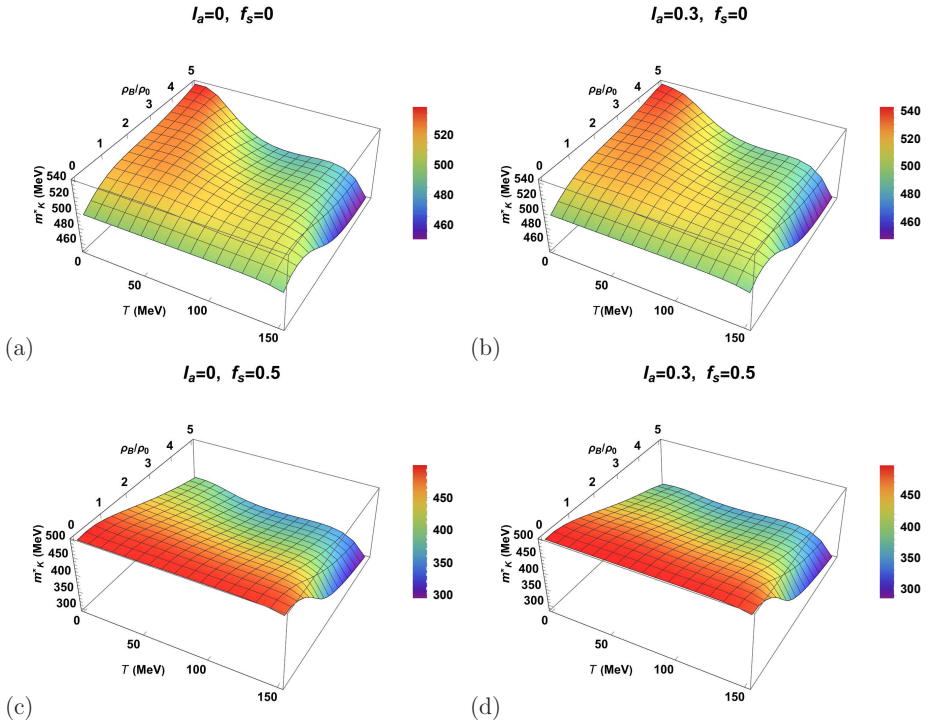
The pith
A machine-rendered reading of the paper's core claim, the machinery that carries it, and where it could break.
The reading
What carries the argument
The load-bearing machinery is a two-stage calculation. First, the chiral SU(3) hadronic mean-field model produces density- and temperature-dependent scalar fields and baryon scalar and vector densities, which enter the kaon and antikaon self-energies and give unequal in-medium masses $m^*_K$ and $m^*_{\bar K}$. Second, those masses are inserted into the one-loop $\phi K\bar K$ self-energy; a dipole form factor with cutoff $\Lambda_c$ in the range 2 to 4 GeV regularizes the real part, and the imaginary part yields the decay width. The split between the strongly falling antikaon mass and the weakly changing kaon mass is what opens the phi decay phase space and controls the broadening.
What would settle it
Measure the phi meson's dilepton invariant-mass spectrum at baryon densities near saturation in nuclear-target or heavy-ion collisions: the paper predicts a width growing from about 7 MeV at saturation density to tens of MeV at $T=100$ MeV and beyond 100 MeV at $4\rho_0$ in the hot, strangeness-rich medium, so a measured width that stays near the vacuum value of about 4 MeV would rule out the claimed density dependence.
Extended reading notes
Core claim
In an isospin-asymmetric resonance medium at saturation density and $T=100$ MeV, the average kaon mass falls by 3.6% and the average antikaon mass by 11.8%; through the $\phi K\bar K$ loop this lowers the phi mass by about 1.56%. The same phase-space opening that produces this modest shift drives the width: at zero temperature and saturation density the in-medium width is already about 7 MeV, and it rises steadily with baryon density and temperature, exceeding 100 MeV at $4\rho_0$ in the hot, strangeness-rich resonance medium. The precise mass numbers depend on the dipole cutoff $\Lambda_c$ between 2 and 4 GeV, but the qualitative result that the width is strongly enhanced while the mass shift stays small holds for all cutoffs studied. The paper presents this as the signature of resonance baryons in the medium, with decuplet states contributing at high densities and temperatures.
Load-bearing premise
The quantitative mass shift rests on a phenomenological dipole form factor with a cutoff $\Lambda_c$ between 2 and 4 GeV used to tame the kaon-antikaon loop integral, and the paper gives no independent measurement or calculation that fixes that cutoff.
Editorial extensions
If this is right
- At saturation density and $T=100$ MeV the phi mass falls by only about 1.56% even though the antikaon mass falls by 11.8%, so the in-medium phi is a broad state with a nearly stationary peak.
- The phi decay width rises monotonically with baryon density and temperature for every cutoff from 2 to 4 GeV, exceeding 100 MeV at $4\rho_0$ in the hot, strange resonance medium.
- Including spin-3/2 resonance baryons changes the results mainly at high density and temperature; at $T=0$ and zero strangeness the phi mass with and without delta baryons is almost identical.
- A larger cutoff $\Lambda_c$ produces a larger mass drop but a slightly smaller width, so a measurement of either quantity constrains the effective $\phi K\bar K$ vertex.
- These in-medium masses and widths are the input transport-model simulations use to predict phi yields and kaon-to-phi ratios in heavy-ion collisions.
Reading between the lines
- If the picture is right, the cutoff sensitivity means only the qualitative message is safe: precise phi mass shifts in dense matter cannot be quoted until the $\phi K\bar K$ vertex form factor is fixed by an independent probe, such as lattice QCD or near-threshold kaon photoproduction.
- Because the width at several times saturation density can reach or exceed 100 MeV, phi mesons produced inside a heavy-ion fireball would mostly decay while the medium is still dense, so the visible signature would be a suppressed phi yield and modified kaon momentum correlations rather than a clean peak shift.
- The same two-stage machinery could be applied to other hidden-strangeness channels or to charmed vector mesons, whose in-medium widths would inherit the same kaon and antikaon mass asymmetry if their self-energies respond similarly.
Signed reviews
Editorial analysis
A structured set of objections, weighed in public.
Referee Report
Summary. The paper computes the in-medium mass and decay width of the φ meson in isospin asymmetric hadronic matter containing both octet and decuplet baryon resonances at finite temperature. The kaon and antikaon masses are obtained from the chiral SU(3) mean-field model; these enter a one-loop φK\bar K self-energy whose real part is regularized with a phenomenological dipole form factor with cutoff Λ_c varied between 2 and 4 GeV, and whose width is computed from a phase-space formula with g_φ fitted to the vacuum width. The authors find that at T=100 MeV and saturation density the kaon and antikaon masses decrease by 3.6% and 11.8%, producing a 1.56% decrease in m_φ, while the decay width rises from about 7 MeV to tens of MeV and can exceed 100 MeV at 4ρ0.
Significance. The qualitative physics—φ meson broadening driven by reduced K and \bar K masses in a hot, dense resonance medium—is timely and relevant for J-PARC E16, CBM, and PANDA, and the explicit inclusion of the full decuplet baryon sector goes beyond earlier octet-only studies. The calculation is anchored to several external inputs, including nuclear saturation properties, kaon-nucleon scattering lengths, and the vacuum φ width, and the cutoff dependence is displayed in Tables II and III. However, the quantitative predictions are not yet robust because the regularization of the real part of the self-energy is incompletely specified and the dominant uncertainty, Λ_c, is not propagated into the quoted numbers.
major comments (4)
- [Sec. II.C, Eqs. (14)-(16)] The real part of the φ self-energy is not properly renormalized. m0_φ is called the bare mass but no prescription is given for fixing it. Since ReΠ*_φ as defined in Eq. (15)/(16) is nonzero at ρ_B=0, Eq. (14) cannot return m_φ=1020 MeV if m0_φ is taken to be the physical mass; a vacuum subtraction or counterterm is required. The manuscript should state how m0_φ is fixed and whether the quoted mass shifts are relative to the vacuum value after subtraction, and Tables II and III should include the vacuum row needed for this comparison.
- [Table II and Sec. III.B] The mass shift depends strongly on the unconstrained cutoff Λ_c. For example, at T=100 MeV, fs=0.5, Ia=0.3, and ρ_B=4ρ0, m*_φ changes from 983.0 MeV at Λ_c=2 GeV to 963.3 MeV at 3 GeV and 949.5 MeV at 4 GeV, so the shift from 1020 MeV roughly doubles from 37 to 70 MeV. The abstract's 1.56% number is therefore not representative of the model's uncertainty. I request a systematic Λ_c scan reported as an uncertainty on all central quantitative claims, or an external constraint on Λ_c.
- [Sec. II.C, Eq. (17)] The coupling g_φ is fixed by reproducing the vacuum width using the same formula that is then used to compute the in-medium width. As a result, the predicted broadening is essentially the kinematical consequence of the input kaon/antikaon masses and m*_φ, rather than an independent prediction of the loop calculation. The manuscript should state this explicitly and, ideally, provide a cross-check using the imaginary part of the regularized self-energy rather than only the tree-level phase-space formula.
- [Figs. 2-3 and Tables II-III] At the higher densities and temperatures considered, the antikaon masses fall below 200 MeV, approaching values where the chiral mean-field and one-loop perturbative approximations become questionable. Since the central claims include results at 4ρ0 and above, the model's domain of validity should be stated, and results outside that domain should be flagged as extrapolations.
minor comments (5)
- [Throughout] There are several typos and inconsistent citation formats, e.g., "caculated" in Sec. III.B, "revi." in Refs. [86] and [91], and missing spaces before reference numbers in several places; a careful proofreading pass is needed.
- [Sec. II.C] The definition of the average antikaon mass should use parentheses: m*_{\bar K} = (m*_{K^-}+m*_{\bar K^0})/2; the current typesetting is ambiguous.
- [Before Eq. (16)] The phrase "after renormalization" is misleading because no subtraction scheme or counterterm is introduced; the text should say "after regularization with a form factor" or describe the renormalization procedure explicitly.
- [Table IV] Table IV does not state the strangeness fraction fs used in the comparison; from the surrounding text it appears that fs=0, but the caption should say so explicitly.
- [Sec. II.C, Eq. (14)] Equation (14) is an implicit equation for m*_φ, since ReΠ*_φ depends on m*_φ through the loop energy denominators; the solution procedure (e.g., iterative) should be described.
Circularity Check
No significant circularity: the phi-mass shift and broadening are computed from externally anchored kaon self-energies and a scanned cutoff, not from re-fit phi observables.
full rationale
The paper's derivation is self-contained and non-circular. The in-medium kaon and antikaon masses, which are the main inputs to the phi self-energy, are obtained from the chiral SU(3) mean-field model whose parameters are anchored to nuclear saturation properties, baryon potentials, and kaon-nucleon scattering lengths, not to the phi mass or width. The phi-K-Kbar coupling g_phi = 4.539 is fixed from the empirical vacuum phi width using the same tree-level width formula, Eq. (17); this is standard calibration, and the in-medium width is not forced because it is evaluated at the independently computed shifted kaon masses and is sensitive to the model's density and temperature dependence. The real part of the phi self-energy is regularized by a dipole form factor with a cutoff Lambda_c scanned over 2-4 GeV, with the sensitivity shown in Tables II and III; a free regulator is a fitting and uncertainty issue, not a circular reduction. The paper's self-citations supply a published model and a previous computation of resonance-medium kaon masses, but those inputs are externally falsifiable and are not invoked as uniqueness constraints. One reproducibility concern remains: the paper never states explicitly how the bare mass m0_phi in Eq. (14) is fixed or whether a vacuum subtraction is applied to RePi*, but this is a correctness and regularization-uncertainty issue, not a circularity, because it does not make the predicted phi mass shift equal to any fitted input by construction.
Assumptions & free parameters
free parameters (4)
- Dipole form-factor cutoff Lambda_c =
Varied at 2, 3, 4 GeV
- phi-K-Kbar coupling g_phi =
4.539
- Range parameters d1 and d2 =
2.56/m_K and 0.73/m_K
- Baryon-meson couplings and mi3 =
Table I values
assumptions (4)
- domain assumption Chiral SU(3) mean-field model with baryons and mesons is a valid description of dense hadronic matter up to 5 rho0.
- domain assumption The dominant in-medium modification of the phi meson is captured by the one-loop phi-K-Kbar diagram; other channels are negligible.
- domain assumption Average on-shell kaon and antikaon masses capture the medium effect in the loop integral and decay width.
- ad hoc to paper A dipole form factor with cutoff Lambda_c between 2 and 4 GeV is the correct regularization for the phi-K-Kbar loop.
Cite this review
Pith. "Pith review of $\phi$ meson properties in dense resonance matter at finite temperature." pith.science (2026). https://pith.science/paper/NEYOHKST
@misc{pith2026250507065,
  author       = {Pith},
  title        = {Pith review of: $\phi$ meson properties in dense resonance matter at finite temperature},
  year         = {2026},
  howpublished = {\url{https://pith.science/paper/NEYOHKST}},
  note         = {Machine review of arXiv:2505.07065}
}
abstract
The effective mass and decay width of the $\phi$ meson in the isospin asymmetric hot and dense resonance matter are studied using the effective Lagrangian framework considering the $\phi K \bar K $ interactions at one-loop level. In addition to spin$-1/2$ octet baryons, we consider the effect of resonances $\Delta^{++,+,0,-}, \Sigma^{*\pm,0},\Xi^{*0,-}, \Omega^{-}$, on the properties of $\phi$ meson. The in-medium effects on the $\phi$ meson properties are simulated through the effective masses of kaons and antikaons computed using the chiral SU(3) hadronic mean field model in the presence of resonance baryons. The loop integral appearing in the computation of $\phi$ meson self energies is regularized using the dipole form factor with a cutoff parameter. The presence of resonance baryons within the medium at finite temperature is observed to significantly modify the effective mass and decay width of $\phi$ mesons. Examining the $\phi$ meson masses and decay width within a dense medium is anticipated to be essential for understanding experimental results from heavy-ion collision experiments.
Figures


Figures from the paper (10 more)


Forward citations
Cited by 2 Pith papers
-
Polarization-dependent mass modifications of $\phi$ meson with finite momentum in nuclear matter
In nuclear matter, the phi meson's longitudinal polarization mass decreases quadratically with momentum; the transverse polarization mass stays constant.
-
Towards compressed baryonic matter densities: D meson diffusion
Using relaxation-time kinetic theory with a chiral hadronic model, the authors estimate that D meson spatial diffusion in dense nuclear matter decreases rapidly in a dilute-gas regime and mildly in a degenerate-gas regime.
Reference graph
Works this paper leans on
-
[1]
Leupold et al
S. Leupold et al. , Int. J. Mod. Phys. E 19, 147 (2010)
2010
-
[2]
is subtracted to ensure that 7 the vacuum energy is zero. The Eq. ( 2) is subjected to minimization with respect to the mesonic fields through the following relations ∂Ω ∂σ = ∂Ω ∂ζ = ∂Ω ∂δ = ∂Ω ∂χ = ∂Ω ∂ω = ∂Ω ∂ρ = ∂Ω ∂φ = 0. (4) At finite values of baryon density,ρB, temperature,T , isospin asymmetry,Ia, and strangeness fraction, fs of the medium, the non-...
-
[3]
Maruyama et al
T. Maruyama et al. , Phys. Lett. B 659, 192 (2008)
2008
-
[4]
for finite T , Ia, and fs within the medium. The effective mass of the φ meson is calculated from the real part of Π ∗ φ(p) through relation [ 88] m∗2 φ = ( m0 φ ) 2 + ReΠ∗ φ(m∗2 φ ), (14) where m0 φ is the bare mass of the φ meson. The real part of self-energy is given as [ 48, 88] ReΠ∗ φ = −4 3g2 φ P ∫ d3q (2π)3⃗ q2 (E∗ K +E∗ ¯K) E∗ KE∗ ¯K((E∗ K +E∗ ¯K)2 ...
-
[5]
At fs = 0.5, these mass shift values for K ( ¯K) change to −11.5 ( −16.7) and −17.7 ( −58) MeV inducing shift of −6.3 MeV and −15.7 MeV in m∗ φ
At T = 0 and 100 MeV, in the non-strange ( fs = 0) isospin asymmetric (Ia = 0.3) resonance medium, at nuclear saturation density, ρ0, average kaons (antikaons) mass shift of 22 ( −44.5) and 15 ( −78.3) MeV leads to only −5 MeV and −13 MeV mass shift ofm∗ φ, respectively. At fs = 0.5, these mass shift values for K ( ¯K) change to −11.5 ( −16.7) and −17.7 (...
-
[6]
Pushkina et al
I. Pushkina et al. , Phys. Lett. B 609, 265 (2005)
2005
-
[7]
R. S. Hayano and T. Hatsuda, Rev. Mod. Phys. 82, 2949 (2010)
2010
-
[8]
A. G. Knospe, EPJ Web Conf. 171, 09001 (2018)
2018
Show all 147 references
-
[9]
with mK and m ¯K denote the vacuum masses of kaons and antikaons, respectively. C. In-medium mass and decay width of φ meson Figure 1: φK ¯K interaction at one loop level. The in-medium masses ofK and ¯K mesons calculated in the isospin asymmetric resonance 11 medium are used ...
-
[10]
Wang et al
P. Wang et al. , Phys. Rev. C 75, 045202 (2007)
2007
-
[11]
Tolos and L
L. Tolos and L. Fabbietti, Prog. Part. Nucl. Phys. 112, 103770 (2020)
2020
-
[12]
Rafelski and J
J. Rafelski and J. Letessier, Phys. Rev. Lett. 85, 4695 (2000)
2000
-
[13]
Evans, New J
L. Evans, New J. Phys. 9, 335 (2007)
2007
-
[14]
Harrison, T
M. Harrison, T. Ludlam, and S. Ozaki, Nucl. Instrum. Meth . A 499, 235 (2003)
2003
-
[15]
Friman et al
B. Friman et al. , Lect. Notes Phys. 814 (2011)
2011
-
[16]
Kumar et al
L. Kumar et al. , Nucl. Phys. A 904, 256c (2013)
2013
-
[17]
Odyniec, J
G. Odyniec, J. Phys. G: Nucl. Part. Phys. 37, 094028 (2010)
2010
-
[18]
Herlert, EPJ Web Conf
A. Herlert, EPJ Web Conf. 71, 00064 (2014)
2014
-
[19]
Di Nezza et al
P. Di Nezza et al. , PoS SPIN2023, 036 (2024)
2024
-
[20]
Agarwal, Phys
K. Agarwal, Phys. Scripta 98, 034006 (2023)
2023
-
[21]
Senger, Cent
P. Senger, Cent. Eur. J. Phys. 10, 1289 (2012)
2012
-
[22]
Nilsson, Phys
T. Nilsson, Phys. Scripta T 166, 014070 (2015)
2015
-
[23]
V. D. Kekelidze and et al. , Nucl. Phys. A 967, 8847 (2017)
2017
-
[24]
Rapp et al
R. Rapp et al. , Prog. Part. Nucl. Phys. 65, 209 (2010). 28
2010
-
[25]
Sawada, Nucl
S. Sawada, Nucl. Phys. A 782, 434 (2007)
2007
-
[26]
Hotchi et al
H. Hotchi et al. , Phys. Rev. Accel. Beams 20, 060402 (2017)
2017
-
[27]
V. D. Kekelidze and et al. , Phys. Part. Nucl. 48, 727 (2017)
2017
-
[28]
Fukushima and Y
K. Fukushima and Y. Hidaka, Phys. Rev. D 75, 036002 (2007)
2007
-
[29]
Milov, Eur
A. Milov, Eur. Phys. J. C 61, 721 (2009)
2009
-
[30]
K. G. Wilson, Phys. Rev. D 10, 2445 (1974)
1974
-
[31]
Alexandru et al
A. Alexandru et al. , Rev.Mod. Phys. 94, 015006 (2022)
2022
-
[32]
Bloch and T
J. Bloch and T. Wettig, JHEP 03, 100 (2009)
2009
-
[33]
Tsushima et al
K. Tsushima et al. , Nucl. Phys. A 630, 691 (1998)
1998
-
[34]
Muroya et al
S. Muroya et al. , Prog. Theor. Phys. 110, 615 (2003)
2003
-
[35]
Takaishi, Prog
T. Takaishi, Prog. Theor. Phys. Suppl. 153, 277 (2004)
2004
-
[36]
Tsushima et al
K. Tsushima et al. , Phys. Rev. C 59, 2824 (1999)
1999
-
[37]
Saito and A
K. Saito and A. W. Thomas, Phys. Lett. B 327, 9 (1994)
1994
-
[38]
Pich, Rep
A. Pich, Rep. Prog. Phys. 58, 563 (1995)
1995
-
[39]
Cao, Eur
G. Cao, Eur. Phys. J. A 57, 264 (2021)
2021
-
[40]
Bochkarev and J
A. Bochkarev and J. I. Kapusta, Phys. Rev. D 54, 4066 (1996)
1996
-
[41]
Huovinen and P
P. Huovinen and P. Petreczky, Nucl. Phys. A 837, 26 (2010)
2010
-
[42]
S. R. Wadia, Phys. Rev. D 24, 970 (1981)
1981
-
[43]
Z. Y. Zhang et al. , Nucl. Phys. A 625, 59 (1997)
1997
-
[44]
Scherer, Adv
S. Scherer, Adv. Nucl. Phys. 27, 277 (2003)
2003
-
[45]
T. Waas, M. Rho, and W. Weise, Nucl. Phys. A 617, 449 (1997)
1997
-
[46]
Hatsuda et al
T. Hatsuda et al. , Phys. Rev. C 46, R34 (1992)
1992
-
[47]
Kumar and A
A. Kumar and A. Mishra, Eur. Phys. J. A 47, 164 (2011)
2011
-
[48]
Kumar and A
R. Kumar and A. Kumar, Phys. Rev. C 102, 045206 (2020)
2020
-
[49]
Wang et al
P. Wang et al. , Nucl. Phys. A 744, 273 (2004)
2004
-
[50]
Papazoglou et al
P. Papazoglou et al. , Phys. Rev. C 59, 411 (1999)
1999
-
[51]
Mishra et al
A. Mishra et al. , Eur. Phys. J. A 45, 169 (2010)
2010
-
[52]
Dexheimer and S
V. Dexheimer and S. Schramm, AstroPhys. J. 683, 943 (2008)
2008
-
[53]
Schaefer, J
B.-J. Schaefer, J. M. Pawlowski, and J. Wambach, Phys. R ev. D 76, 074023 (2007)
2007
-
[54]
Chahal et al
N. Chahal et al. , Eur. Phys. J. C 94, 1028 (2024)
2024
-
[55]
Zschiesche et al
D. Zschiesche et al. , Phys. Rev. C 70, 045202 (2004). 29
2004
- [56]
-
[57]
Kaur and A
M. Kaur and A. Kumar, Phys. Rev. D 110, 114054 (2024)
2024
-
[59]
T. K. Herbst, J. M. Pawlowski, and B.-J. Schaefer, Phys. Lett. B 696, 58 (2011)
2011
-
[60]
Stiele, E
R. Stiele, E. S. Fraga, and J. Schaffner-Bielich, Phys. Le tt. B 729, 72 (2014)
2014
-
[61]
Ramos and E
A. Ramos and E. Oset, Nucl. Phys. A 671, 481 (2000)
2000
-
[62]
Schaffner-Bielich, V
J. Schaffner-Bielich, V. Koch, and M. Effenberger, Nucl. Ph ys. A 669, 153 (2000)
2000
- [63]
-
[64]
Tolos et al
L. Tolos et al. , Phys. Rev. C 70, 025203 (2004)
2004
-
[65]
Tolos et al
L. Tolos et al. , Phys. Lett. B 635, 85 (2006)
2006
-
[66]
Tolos et al
L. Tolos et al. , Phys. Rev. C 77, 015207 (2008)
2008
-
[67]
Wang, EPJ Web Conf
Y.-F. Wang, EPJ Web Conf. 291, 02004 (2024)
2024
-
[68]
G. S. Bali et al. , PoS ConfinementX, 197 (2012)
2012
-
[69]
D. J. Wilson et al. , Phys. Rev. Lett. 132, 241901 (2024)
2024
-
[70]
Rozynek and G
J. Rozynek and G. Wilk, J. Phys. G 36, 125108 (2009)
2009
-
[71]
Adel and T
A. Adel and T. Alharbi, Eur. Phys. J. A 53, 1 (2017)
2017
-
[72]
G. S. Bali et al. , JHEP 02, 044 (2012)
2012
-
[73]
Ruggieri and G
M. Ruggieri and G. X. Peng, Phys. Rev. D 93, 094021 (2016)
2016
-
[74]
Peterson et al
J. Peterson et al. , Phys. Rev. D 108, 063011 (2023)
2023
-
[75]
Bhattacharyya et al
A. Bhattacharyya et al. , Phys. Rev. C 91, 041901 (2015)
2015
-
[76]
Magdy, M
N. Magdy, M. Csan´ ad, and R. A. Lacey, J. Phys. G 44, 025101 (2017)
2017
-
[77]
Braun, B
J. Braun, B. Klein, and B.-J. Schaefer, Phys. Lett. B 713, 216 (2012)
2012
-
[78]
Okubo, Phys
S. Okubo, Phys. Lett. 5, 165 (1963)
1963
-
[79]
Ruggieri, Z
M. Ruggieri, Z. Y. Lu, and G. X. Peng, Phys. Rev. D 94, 116003 (2016)
2016
-
[80]
Senger, Nucl
P. Senger, Nucl. Phys. A 835, 102 (2010)
2010
-
[81]
Yong, Phys
G.-C. Yong, Phys. Rev. D 108, L091507 (2023)
2023
-
[82]
T. Song, J. Aichelin, and E. Bratkovskaya, Phys. Rev. C 601, 024903 (2022)
2022
-
[83]
Blaizot and R
J.-P. Blaizot and R. M. Galain, Phys. Lett. B 271, 32 (1991)
1991
-
[84]
Iizuka, Prog
J. Iizuka, Prog. Theor. Phys. Suppl. 37, 21 (1966)
1966
-
[85]
H. J. Lipkin, Nucl. Phys. B 244, 147 (1984)
1984
-
[86]
Asakawa and C
M. Asakawa and C. Ko, Nucl. Phys. A 572, 732 (1994). 30
1994
-
[87]
Hatsuda et al
T. Hatsuda et al. , Prog. Theor. Phys. 95, 1009 (1996)
1996
-
[88]
J. J. Cobos-Mart ´ ınezet al. , Phys. Lett. B 771, 113 (2017)
2017
-
[89]
Kuwabara and T
H. Kuwabara and T. Hatsuda, Prog. Theor. Phys. 94, 1163 (1995)
1995
-
[90]
was an earlier experiment that investigated the in-medium modificat ion of φ meson by measuring its decay into e+e− and K ¯K pairs in p +A collisions, observing no modification of invariant mass spectra of K ¯K at nuclear saturation density. In Ref. [ 93], SPring8 collab- oratio...
-
[91]
Oset et al
E. Oset et al. , Phys. Lett. B 508, 237 (2001)
2001
-
[92]
Bhattacharyya et al
A. Bhattacharyya et al. , Phys. Revi. C 55, 1463 (1997)
1997
-
[93]
Klingl, N
F. Klingl, N. Kaiser, and W. Weise, Nucl. Phys. A 624, 527 (1997)
1997
-
[94]
J. J. Cobos-Mart ´ ınezet al. , Phys. Rev. C 96, 035201 (2017)
2017
-
[95]
Muto et al
R. Muto et al. , Phys. revi. lett. 98, 042501 (2007)
2007
-
[96]
Mibe et al
T. Mibe et al. , Phys. Revi. C 76, 052202 (2007)
2007
-
[97]
X. Qian, W. Chen, et al. , Phys. Lett. B 680, 417 (2009)
2009
-
[98]
Ishikawa et al
T. Ishikawa et al. , Phys. Lett. B 608, 215 (2005)
2005
-
[99]
Sako et al
H. Sako et al. , J. Subatomic Part. Cosmol. 1-2, 100012 (2024)
2024
-
[100]
Aoki et al
K. Aoki et al. , J. Subatomic Part. Cosmol. 3, 100019 (2025)
2025
-
[101]
W. T. Chiang et al. , Phys. Revi. C 69, 065208 (2004)
2004
-
[102]
Lutz, Phys
M. Lutz, Phys. Lett. B 426, 12 (1998)
1998
-
[103]
Klingl, T
F. Klingl, T. Waas, and W. Weise, Phys. Lett. B 431, 254 (1998)
1998
-
[104]
Gubler and K
P. Gubler and K. Ohtani, Phys. Rev. D 90, 094002 (2014)
2014
-
[105]
W. S. Chung, G.-Q. Li, and C. M. Ko, Nucl. Phys. A 625, 347 (1997)
1997
-
[106]
S. Pal, C. M. Ko, and Z.-w. Lin, Nucl. Phys. A 707, 525 (2002)
2002
-
[107]
E. Y. Paryev, Nucl. Phys. A 1032, 122624 (2023)
2023
- [108]
- [109]
-
[110]
Tu and S.-G
Z.-H. Tu and S.-G. Zhou, AstroPhys. J. 925, 16 (2022)
2022
-
[111]
Wu and W
C. Wu and W. Guo, arXiv:2308.00007 [nucl-th]
-
[112]
J. Song, J. Phys. Conf. Ser. 1602, 012008 (2020)
2020
-
[113]
L¨ omker, PoS EPS-HEP2023, 216 (2024)
J. L¨ omker, PoS EPS-HEP2023, 216 (2024)
2024
-
[114]
Rosano, PoS ICHEP2022, 1066 (2022)
A. Rosano, PoS ICHEP2022, 1066 (2022)
2022
-
[115]
Kiselev, Phys
S. Kiselev, Phys. Atom. Nucl. 85, 965 (2022)
2022
-
[116]
P. F. Bedaque, Phys. Lett. B 387, 1 (1996)
1996
-
[117]
J. M. Torres-Rincon, B. Sintes, and J. Aichelin, Phys. Rev. C 91, 065206 (2015). 31
2015
-
[118]
Xu, Y.-L
Y.-J. Xu, Y.-L. Liu, and M.-Q. Huang, Commun. Theor. Ph ys. 63, 209 (2015)
2015
-
[119]
Azizi and G
K. Azizi and G. Bozkır, Eur. Phys. J. C 76, 521 (2016)
2016
-
[120]
Azizi, N
K. Azizi, N. Er, and H. Sundu, Phys. Rev. D 94, 114002 (2016)
2016
-
[121]
S. M. Ouellette and R. Seki, Phys. Lett. B 404, 108 (1997)
1997
-
[122]
Kumar et al
A. Kumar et al. , Eur. Phys. J. A 60, 4 (2024)
2024
-
[123]
C. Y. Ryu et al. , Phys. Lett. B 674, 122 (2009)
2009
-
[124]
Singh, A
H. Singh, A. Kumar, and H. Dahiya, Eur. Phys. J. Plus 134, 128 (2019)
2019
-
[125]
Singh, A
H. Singh, A. Kumar, and H. Dahiya, Eur. Phys. J. Plus 135, 422 (2020)
2020
-
[126]
Zschiesche et al
D. Zschiesche et al. , Phys. Rev. C 63, 025211 (2001)
2001
-
[127]
Lenske and M
H. Lenske and M. Dhar, Lect. Notes Phys. 948, 161 (2018)
2018
-
[128]
N. K. Glendenning, Phys. Lett. B 70, 392 (1982)
1982
-
[129]
J. C. T. Oliveira et al. , J. Phys. Conf. Ser. 1291, 012038 (2019)
2019
-
[130]
A. R. Raduta et al. , Mon. Not. Roy. Astron. Soc. 499, 914 (2020)
2020
-
[131]
Dexheimer et al
V. Dexheimer et al. , Eur. Phys. J. A 57, 216 (2021)
2021
-
[132]
Weinberg, Phys
S. Weinberg, Phys. Rev. 166, 1568 (1968)
1968
-
[133]
Bardeen and B
W. Bardeen and B. Lee, Phys. Rev. C 177, 2389 (1969)
1969
-
[134]
Mishra et al
A. Mishra et al. , Eur. Phys. J. A 41, 205 (2009)
2009
-
[135]
Mishra et al
A. Mishra et al. , Phys. Rev. C 78, 024901 (2008)
2008
-
[136]
Barnes and E
T. Barnes and E. S. Swanson, Phys. Rev. C 49, 1166 (1994)
1994
-
[137]
C. M. Ko et al. , Phys. Rev. C 45, 1400 (1992)
1992
-
[138]
Klingl, N
F. Klingl, N. Kaiser, and W. Weise, Z. Phys. A 356, 193 (1996)
1996
-
[139]
Krein, A
G. Krein, A. W. Thomas, and K. Tsushima, Phys. Lett. B 697, 136 (2011)
2011
-
[140]
F. E. Close and E. S. Swanson, Phys. Rev. D 72, 094004 (2005)
2005
-
[141]
Godfrey and N
S. Godfrey and N. Isgur, Phys. Rev. D 32, 189 (1985)
1985
-
[142]
Li and C
G.-Q. Li and C. M. Ko, Nucl. Phys. A 582, 731 (1995)
1995
-
[143]
Gubler and W
P. Gubler and W. Weise, Nucl. Phys. A 954, 125 (2016)
2016
-
[144]
Cabrera and M
D. Cabrera and M. J. Vicente Vacas, Phys. Rev. C 67, 045203 (2003)
2003
-
[145]
Weil et al
J. Weil et al. , PoS BORMIO2011, 053 (2011)
2011
-
[146]
H. W. Barz et al. , Open Nucl. Part. Phys. J. 3, 1 (2010)
2010
-
[147]
Aoki et al
K. Aoki et al. , Few Body Syst. 64 (2023)
2023
-
[148]
Destefanis et al
M. Destefanis et al. , Nucl. Phys. B 245, 199 (2013). 32
2013
Reviewed August 15, 2026 · model on record in the stance chip above.
Discussion (0). Continue with ORCID to comment.