Fast-spinning massive black holes from slowly rotating low-metallicity stars: implications for GW231123
Pith reviewed 2026-06-28 04:42 UTC · model grok-4.3
The pith
Slowly rotating massive Pop III stars can collapse directly into 80-85 solar mass black holes with spins up to 0.7.
A machine-rendered reading of the paper's core claim, the machinery that carries it, and where it could break.
Core claim
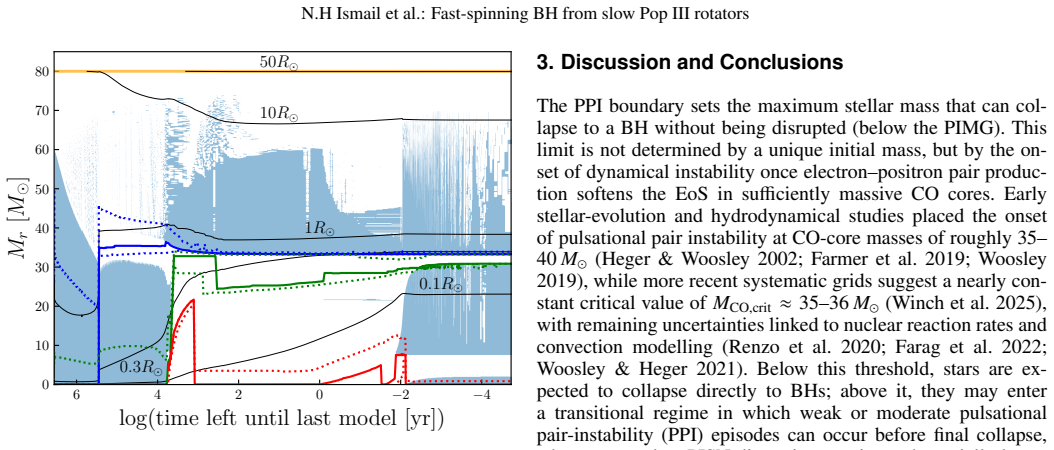
Our non-rotating and slowly rotating 80 and 85 M⊙ models develop carbon-oxygen core masses between 31 and 36 M⊙ and have an adiabatic index that remains above 4/3. Our models thus predict that Pop III stars can keep most of their mass and collapse directly to form black holes of 80 to 85 M⊙ with dimensionless spins up to a_BH ≲ 0.7. Initially slowly rotating, massive Pop III stars can form very massive, rapidly spinning black holes just below the pair-instability regime.
What carries the argument
Direct-collapse assumption applied to the final angular-momentum profiles of GENEC models that include magnetic-torque transport, used to convert core mass and specific angular momentum into black-hole mass and dimensionless spin.
If this is right
- Black holes of 80-85 solar masses with spins up to 0.7 form from single, slowly rotating Pop III stars.
- The lower edge of the pair-instability mass gap acts as a smooth, structure-dependent transition rather than an abrupt cutoff.
- Single-star Pop III evolution supplies one channel for the massive, fast-spinning black holes detected by gravitational-wave observatories.
- The 90 solar mass models are more likely to encounter pair-instability effects, narrowing the viable mass window for this channel.
Where Pith is reading between the lines
- If the channel operates, the observed spin distribution of high-mass black holes should show a tail toward moderate spins even in low-metallicity environments without binary spin-up.
- Rates of such events at high redshift could be estimated from the initial mass function of Pop III stars once the uncertain mass-loss and torque efficiencies are bracketed by observations.
- The same modeling framework could be reapplied to slightly higher metallicities to test how quickly the channel shuts off as metallicity rises.
Load-bearing premise
The stars lose negligible mass and the magnetic torques transport angular momentum at exactly the efficiency assumed in the GENEC code.
What would settle it
A direct measurement or simulation showing that an 80-85 solar mass Pop III star loses more than a few solar masses before core collapse or that its CO core adiabatic index drops below 4/3.
Figures
read the original abstract
The origin of massive black holes in the early universe remains uncertain and still unexplored. Pop III stars are among the first stellar sources capable of producing such remnants, but their evolution is very sensitive to rotation. We explore how slow initial rotation influences the evolution and black hole formation of very massive Pop III stars, and assess their potential to become massive, fast-spinning black holes consistent with GW events such as GW231123. We compute a grid of non-rotating and slowly rotating Pop III stellar models with initial masses of 80, 85, and 90 $M_\odot$ using the GENEC code. Our models include rotationally induced mixing and angular-momentum transport by magnetic torques. We analyse the CO core masses and their volume-averaged adiabatic index to assess stability against electron-positron pair creation. From the angular-momentum profiles at the end of He burning, we estimate the resulting black hole masses and dimensionless spins under the assumption of direct collapse. Our non-rotating and slowly rotating 80 and 85 $M_\odot$ models develop carbon-oxygen core masses between 31 and 36 $M_\odot$ and have an adiabatic index that remains above 4/3. Our models thus predict that Pop III stars can keep most of their mass and collapse directly to form black holes of 80 to 85 $M_\odot$ with dimensionless spins up to $a_{\rm BH} \lesssim 0.7$. Initially slowly rotating, massive Pop III stars can form very massive, rapidly spinning black holes just below the pair-instability regime. This supports interpreting the lower boundary of the PISN mass gap as a smooth, structure-dependent transition and identifies single-star Pop III evolution as a possible channel for massive fast-spinning black holes observed by gravitational-wave detectors, subject to the uncertain efficiency of internal angular-momentum transport and mass-loss prescriptions.
Editorial analysis
A structured set of objections, weighed in public.
Referee Report
Summary. The manuscript computes a grid of non-rotating and slowly rotating Pop III stellar models (initial masses 80, 85, 90 M⊙) with the GENEC code, including rotationally induced mixing and magnetic-torque angular-momentum transport. It reports that the 80 and 85 M⊙ models develop CO cores of 31–36 M⊙ with volume-averaged adiabatic index >4/3, avoid pair instability, and, under the assumption of direct collapse with no mass loss, produce black holes of 80–85 M⊙ with dimensionless spins a_BH ≲ 0.7. The work argues that this single-star channel can explain massive, rapidly spinning black holes such as those inferred for GW231123 and implies a smooth lower edge to the pair-instability mass gap.
Significance. If the numerical results are robust, the paper supplies a concrete, single-star pathway for high-mass, moderate-spin black holes from the first stellar generation, directly relevant to LIGO/Virgo events and to the interpretation of the pair-instability gap. The explicit use of GENEC models with magnetic torques and the adiabatic-index stability check are positive technical features; the conclusions remain conditional on the adopted transport efficiency and collapse assumption.
major comments (2)
- [Abstract] Abstract and § on angular-momentum transport: the reported upper bound a_BH ≲ 0.7 is obtained from the CO-core angular-momentum profile at the end of core helium burning under the default GENEC magnetic-torque prescription. The abstract itself states that this efficiency is uncertain, yet no additional models with stronger or weaker torques are presented; altering the torque strength would change the retained core angular momentum and therefore the derived spin, making the quoted limit dependent on an unvaried parameter.
- [Black-hole formation] Section on black-hole formation and direct collapse: the mapping from final stellar mass to black-hole mass assumes negligible mass loss and direct collapse for the 80–85 M⊙ models. While the reported CO-core masses (31–36 M⊙) lie below the nominal pair-instability regime, the paper does not quantify the sensitivity of the final black-hole mass or spin to even modest wind or eruptive mass loss near the pair-instability boundary.
minor comments (2)
- [Methods] The manuscript states that spins are estimated from angular-momentum profiles but does not provide the explicit formula or the assumed moment-of-inertia factor used to convert specific angular momentum to dimensionless spin a_BH.
- [Results] No error bars or ranges are attached to the quoted CO-core masses, adiabatic indices, or spin values, even though the models are described as a grid.
Simulated Author's Rebuttal
We thank the referee for the constructive feedback on our manuscript. We address each major comment below, indicating planned revisions where appropriate. Our responses focus on clarifying the scope of the presented models while acknowledging the limitations noted.
read point-by-point responses
-
Referee: [Abstract] Abstract and § on angular-momentum transport: the reported upper bound a_BH ≲ 0.7 is obtained from the CO-core angular-momentum profile at the end of core helium burning under the default GENEC magnetic-torque prescription. The abstract itself states that this efficiency is uncertain, yet no additional models with stronger or weaker torques are presented; altering the torque strength would change the retained core angular momentum and therefore the derived spin, making the quoted limit dependent on an unvaried parameter.
Authors: We agree that the quoted a_BH ≲ 0.7 bound is specific to the default GENEC magnetic-torque implementation and that varying the torque efficiency would alter the retained angular momentum. The abstract already flags this uncertainty, but we accept that the dependence should be made more explicit. Running a full grid with modified torque strengths is beyond the computational scope of the current study. In revision we will expand the angular-momentum transport section with a brief analytic estimate, drawing on published scalings for magnetic braking efficiency, to illustrate how stronger or weaker torques would shift the final core angular momentum and thus a_BH. This will clarify the parameter dependence without new simulations. revision: partial
-
Referee: [Black-hole formation] Section on black-hole formation and direct collapse: the mapping from final stellar mass to black-hole mass assumes negligible mass loss and direct collapse for the 80–85 M⊙ models. While the reported CO-core masses (31–36 M⊙) lie below the nominal pair-instability regime, the paper does not quantify the sensitivity of the final black-hole mass or spin to even modest wind or eruptive mass loss near the pair-instability boundary.
Authors: The direct-collapse assumption with negligible mass loss follows from the CO-core masses lying below the pair-instability threshold and the volume-averaged adiabatic index remaining above 4/3 throughout the models. We nevertheless recognize that even modest mass loss near the boundary could reduce the final black-hole mass. In the revised manuscript we will add a short quantitative discussion in the black-hole formation section, considering illustrative cases of 5–10 % mass loss (consistent with the upper limits from our stability analysis) and noting the consequent shift in black-hole mass while preserving the spin estimate under the assumption that any lost material carries negligible specific angular momentum. This will address the requested sensitivity analysis for the fiducial models. revision: yes
Circularity Check
No significant circularity; forward stellar models under stated assumptions
full rationale
The paper computes a grid of Pop III stellar models in GENEC with explicit initial masses, slow rotation, and magnetic-torque angular-momentum transport, then extracts CO-core properties and angular-momentum profiles at the end of He burning to estimate BH mass and spin under the direct-collapse assumption. These outputs are produced by numerical integration of the stellar-structure equations; they are not obtained by fitting parameters to GW231123 data, nor do any equations reduce the final a_BH ≲ 0.7 result to a tautological re-expression of the inputs. The abstract itself flags the torque efficiency as uncertain, confirming the result is conditional on model physics rather than self-defined. No self-citation chains, ansatzes smuggled via prior work, or renaming of known results appear as load-bearing steps.
Axiom & Free-Parameter Ledger
free parameters (2)
- initial rotation velocity
- mass-loss efficiency
axioms (2)
- domain assumption Direct collapse to black hole with no significant mass ejection after helium burning
- domain assumption Angular-momentum transport dominated by magnetic torques
Reference graph
Works this paper leans on
-
[1]
How Massive Single Stars End their Life
How Massive Single Stars End Their Life. , keywords =. doi:10.1086/375341 , archivePrefix =. astro-ph/0212469 , primaryClass =
work page internal anchor Pith review Pith/arXiv arXiv doi:10.1086/375341
-
[2]
Heger, A. and Woosley, S. E. , title =. 2002 , month =. doi:10.1086/338487 , url =
-
[3]
The Evolution of Massive Helium Stars Including Mass Loss
The Evolution of Massive Helium Stars, Including Mass Loss. , keywords =. doi:10.3847/1538-4357/ab1b41 , archivePrefix =. 1901.00215 , primaryClass =
work page internal anchor Pith review Pith/arXiv arXiv doi:10.3847/1538-4357/ab1b41 1901
-
[4]
Merging black hole binaries: the effects of progenitor's metallicity, mass-loss rate and Eddington factor. , keywords =. doi:10.1093/mnras/stx2933 , archivePrefix =. 1711.03556 , primaryClass =
work page internal anchor Pith review Pith/arXiv arXiv doi:10.1093/mnras/stx2933
-
[5]
GW231123: a Binary Black Hole Merger with Total Mass 190-265 $M_{\odot}$
GW231123: A Binary Black Hole Merger with Total Mass 190─265 M _. , keywords =. doi:10.3847/2041-8213/ae0c9c , archivePrefix =. 2507.08219 , primaryClass =
work page internal anchor Pith review Pith/arXiv arXiv doi:10.3847/2041-8213/ae0c9c 2041
-
[6]
GW231123 mass gap event and the primordial black hole scenario. , keywords =. doi:10.1103/2vfn-48kh , archivePrefix =. 2507.15701 , primaryClass =
-
[7]
Dynamical Black Hole in the accelerating Universe approaching the future singularity Possible origin of (super-)massive black holes. Phys. Dark Univ. , keywords =. doi:10.1016/j.dark.2025.102104 , archivePrefix =. 2508.07524 , primaryClass =
-
[8]
Can Premature Collapse Form Black Holes in the Upper and Lower Mass Gaps?. , keywords =. doi:10.1103/26yd-1mhd , archivePrefix =. 2509.04574 , primaryClass =
-
[9]
2025, A&A, 702, A208, doi: 10.1051/0004-6361/202556434
Black hole mass function shift in proto-stellar clusters driven by gas accretion. , keywords =. doi:10.1051/0004-6361/202556434 , archivePrefix =. 2509.08448 , primaryClass =
-
[10]
doi:10.1093/mnrasl/slaa196 , url =
Is GW190521 the merger of black holes from the first stellar generations?. , keywords =. doi:10.1093/mnrasl/slaa196 , archivePrefix =. 2009.06585 , primaryClass =
-
[11]
Spinning into the Gap: Direct-horizon Collapse as the Origin of GW231123 from End-to-end General-relativistic Magnetohydrodynamic Simulations. , keywords =. doi:10.3847/2041-8213/ae0d81 , archivePrefix =. 2508.15887 , primaryClass =
-
[12]
Beyond Hierarchical Mergers: Accretion-driven Origins of Massive, Highly Spinning Black Holes in Dense Star Clusters. , keywords =. doi:10.3847/2041-8213/ae1eeb , archivePrefix =. 2509.05415 , primaryClass =
-
[13]
On the Formation of GW231123 in Population III Star Clusters. , keywords =. doi:10.3847/2041-8213/ae1024 , archivePrefix =. 2510.05634 , primaryClass =
-
[14]
Resolving Black Hole Family Issues among the Massive Ancestors of Very High-spin Gravitational-wave Events like GW231123. , keywords =. doi:10.3847/2041-8213/ae0e5f , archivePrefix =. 2507.15967 , primaryClass =
-
[15]
, year = 1970, month = apr, volume =
Kerr Metric Black Holes. , year = 1970, month = apr, volume =
1970
-
[16]
Accretion Feedback from newly-formed black holes and its implications for LIGO Sources
Accretion Feedback from newly-formed black holes and its implications for LIGO Sources. arXiv e-prints , keywords =. doi:10.48550/arXiv.1904.04835 , archivePrefix =. 1904.04835 , primaryClass =
work page internal anchor Pith review Pith/arXiv arXiv doi:10.48550/arxiv.1904.04835 1904
-
[17]
General relativistic magnetohydrodynamic simulations of magnetically choked accretion flows around black holes. , keywords =. doi:10.1111/j.1365-2966.2012.21074.x , archivePrefix =. 1201.4163 , primaryClass =
-
[18]
Disk-Accretion onto a Black Hole. II. Evolution of the Hole. , year = 1974, month = jul, volume =
1974
-
[19]
GW231123: a Binary Black Hole Merger with Total Mass 190-265 M_
The LIGO Scientific Collaboration and the Virgo Collaboration and the KAGRA Collaboration , year=. GW231123: a Binary Black Hole Merger with Total Mass 190-265 M_. 2507.08219 , archivePrefix=
-
[20]
Models from 0.8 to 120 M⊙ at solar metallicity (Z= 0.014) , author=
Grids of stellar models with rotation-I. Models from 0.8 to 120 M⊙ at solar metallicity (Z= 0.014) , author=. , volume=. 2012 , publisher=
2012
-
[21]
, volume=
Grids of stellar models with rotation VII: Models from 0.8 to 300 M⊙ at supersolar metallicity (Z= 0.020) , author=. , volume=. 2022 , publisher=
2022
-
[22]
, volume=
Evolving massive stars to core collapse with GENEC: Extension of equation of state, opacities and effective nuclear network , author=. , volume=. 2025 , publisher=
2025
-
[23]
The fate of rotating massive stars across cosmic times. , keywords =. doi:10.1093/mnras/staf1470 , archivePrefix =. 2508.21233 , primaryClass =
-
[25]
Sibony, Yves and Shepherd, Kendall G. and Yusof, Norhasliza and Hirschi, Raphael and Chambers, Caitlan and Tsiatsiou, Sophie and Nandal, Devesh and Sciarini, Luca and Moyano, Facundo D. and Bétrisey, Jérôme and Buldgen, Gaël and Georgy, Cyril and Ekström, Sylvia and Eggenberger, Patrick and Meynet, Georges , year=. Grids of stellar models with rotation: V...
-
[26]
Rotation in stellar interiors: General formulation and an asteroseismic-calibrated transport by the Tayler instability , volume=. , author=. 2022 , month=aug, pages=. doi:10.1051/0004-6361/202243781 , abstractNote=
-
[27]
The magneto-rotational instability in massive stars , volume=. , author=. 2022 , month=sept, pages=. doi:10.1051/0004-6361/202243599 , abstractNote=
-
[28]
Murphy, Laura J. and Groh, Jose H. and Ekström, Sylvia and Meynet, Georges and Pezzotti, Camila and Georgy, Cyril and Choplin, Arthur and Eggenberger, Patrick and Farrell, Eoin and Haemmerlé, Lionel and Hirschi, Raphael and Maeder, André and Martinet, Sébastien , year=. Grids of stellar models with rotation - V. Models from 1.7 to 120 M⊙ at zero metallici...
-
[29]
Very Massive and Supermassive Stars: Evolution and Fate , ISBN=
Hirschi, Raphael , year=. Very Massive and Supermassive Stars: Evolution and Fate , ISBN=. doi:10.1007/978-3-319-21846-5_120 , booktitle=
-
[30]
Woosley, S. E. , year=. Pulsational Pair-instability Supernovae , volume=. , publisher=. doi:10.3847/1538-4357/836/2/244 , abstractNote=
-
[31]
Renzo, M. and Farmer, R. and Justham, S. and Götberg, Y. and de Mink, S. E. and Zapartas, E. and Marchant, P. and Smith, N. , year=. Predictions for the hydrogen-free ejecta of pulsational pair-instability supernovae , volume=. , publisher=. doi:10.1051/0004-6361/202037710 , abstractNote=
-
[32]
1999, MNRAS, 309, 447, doi: 10.1046/j.1365-8711.1999.02853.x
Criterion for the dynamical stability of a non-adiabatic spherical self-gravitating body , volume=. , author=. 1999 , month=may, pages=. doi:10.1046/j.1365-8711.1999.02444.x , abstractNote=
-
[33]
Ledoux, P. , year=. On the Radial Pulsation of Gaseous Stars. , volume=. doi:10.1086/144747 , journal=
-
[34]
Farmer, R. and Renzo, M. and de Mink, S. E. and Marchant, P. and Justham, S. , title =. , volume =. 2019 , type =. doi:10.3847/1538-4357/ab518b , url =
-
[35]
Leung, Shing-Chi and Nomoto, Ken’ichi and Blinnikov, Sergei , title =. , volume =. 2019 , type =. doi:10.3847/1538-4357/ab4fe5 , url =
-
[36]
Rahman, N and Janka, H-T and Stockinger, G and Woosley, S E , title =. , volume =. 2022 , type =. doi:10.1093/mnras/stac758 , url =
-
[37]
Farag, Ebraheem and Renzo, Mathieu and Farmer, Robert and Chidester, Morgan T. and Timmes, F. X. , title =. , volume =. 2022 , type =. doi:10.3847/1538-4357/ac8b83 , url =
-
[38]
, title =
Marchant, Pablo and Moriya, Takashi J. , title =. , volume =. 2020 , type =
2020
-
[39]
Woosley, S. E. and Heger, Alexander , title =. , volume =. 2021 , type =. doi:10.3847/2041-8213/abf2c4 , url =
-
[40]
, archivePrefix = "arXiv", eprint =
Fishbach, Maya and Holz, Daniel E. , title =. , volume =. 2017 , type =. doi:10.3847/2041-8213/aa9bf6 , url =
-
[41]
and Fishbach, Maya and Ye, Jiani and Holz, Daniel E
Farr, Will M. and Fishbach, Maya and Ye, Jiani and Holz, Daniel E. , title =. , volume =. 2019 , type =. doi:10.3847/2041-8213/ab4284 , url =
-
[42]
Ray, Anarya and Kalogera, Vicky , title =. , volume =. 2026 , type =. doi:10.3847/2041-8213/ae374d , url =
-
[43]
Winch, Ethan R J and Sabhahit, Gautham N and Vink, Jorick S and Higgins, Erin R , title =. , volume =. 2025 , month =. doi:10.1093/mnras/staf676 , url =
-
[44]
2026, ApJ, 996, 57, doi: 10.3847/1538-4357/ae22d4 12
Collapse of Rotating Very Massive Stellar Cores Leading to a Black Hole and a Massive Disk as a Source of Gravitational Waves. , keywords =. doi:10.3847/1538-4357/ae22d4 , archivePrefix =. 2509.15619 , primaryClass =
-
[45]
Eggenberger, P. and Meynet, G. and Maeder, A. and Hirschi, R. and Charbonnel, C. and Talon, S. and Ekström, S. , year=. The Geneva stellar evolution code , volume=. Astrophysics and Space Science , publisher=. doi:10.1007/s10509-007-9511-y , abstractNote=
discussion (0)
Sign in with ORCID, Apple, or X to comment. Anyone can read and Pith papers without signing in.