REVIEW 2 major objections 4 minor 25 references
ViPro-2: Unsupervised State Estimation via Integrated Dynamics for Guiding Video Prediction
T0 review · 2 major / 4 minor · reviewed 2026-08-05 · deepseek-v4-flash
Pith's one-line read ViPro-2 shows that a video-prediction model can estimate the symbolic state of objects from observed frames alone, without ground-truth initial states, by fusing predicted and observed states through a learned gain.
desk verdict A solid fix for ViPro's shortcut, but the noise-robustness claim is untested and 'unsupervised' reaches further than the experiments. read the letter →
The pith
A machine-rendered reading of the paper's core claim, the machinery that carries it, and where it could break.
The reading
What carries the argument
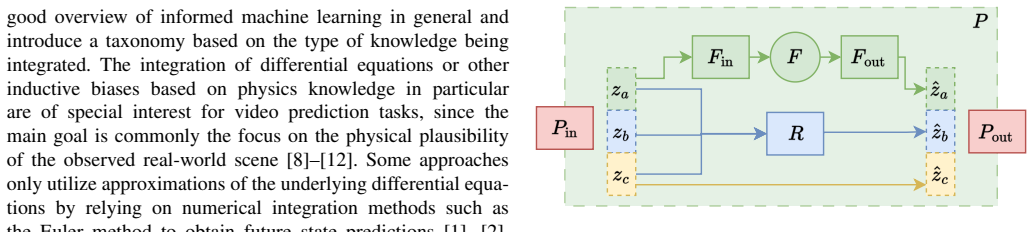
The procedural knowledge module integrates known dynamics equations $F$ into the object-centric prediction loop built on Slot Attention and SlotFormer-style burn-in/rollout. The load-bearing components are: (1) the observation-alignment loss $L_{\text{obs}}=(s_{\text{pred}}-s_{\text{obs}})^2$, which prevents the shortcut by forcing the predicted state to agree with the state read from the current frame; (2) a recurrent gain predictor $G$, an MLP-plus-GRU-plus-sigmoid module, that computes a per-frame gain $K=\sigma(G(z_a^{\text{obs}}, z_a^{\text{pred}}))$ to fuse observed and predicted states as in a Kalman filter. Supporting changes include per-variable MLPs in $F_{\text{in}}$ and $F_{\text
What would settle it
Run ViPro-2 on Orbits-2D with the dynamics equations deliberately perturbed (for example, the gravity constant changed by 10%) or with the first-frame screen coordinates shifted by several pixels. If image and position errors stay at the reported levels, the model is still ignoring the integrated knowledge; if they degrade sharply, the unsupervised-state-estimation claim depends on the privileged initialization. A more direct test is removing the screen-coordinate initialization entirely and seeing whether object states emerge from raw video alone.
Extended reading notes
Core claim
The paper's central discovery is that ViPro had learned a shortcut: given a perfect initial symbolic state and a perfect dynamics equation, it propagated that state forward and decoded it, ignoring the video frames. Evidence is that switching initialization from world positions to screen coordinates made position MAE jump from 0.18 to 9.54. ViPro-2 changes the training target: the latent used for decoding is built from the observed state $s_{\text{obs}}$, while the dynamics-predicted state $s_{\text{pred}}$ is used as a regularizing target through $L_{\text{obs}}=(s_{\text{pred}}-s_{\text{obs}})^2$, and a recurrent gain predictor $G$ produces a Kalman-style gain $K$ so that the final state i
Load-bearing premise
Everything rests on being given the exact dynamics equations $F$ and a starting state derived from screen coordinates (plus a depth map for 3D); if those external inputs are wrong or missing, the paper's unsupervised-state-estimation claim does not apply.
Editorial extensions
If this is right
- Video prediction with physics knowledge no longer requires ground-truth object states for every scene; first-frame screen coordinates (plus a depth map for 3D) suffice.
- State estimation becomes a byproduct of prediction, so the same model outputs object positions while generating future frames, with position MAE below 0.05 in the 2D benchmark.
- Because the observation must be used, the model can correct imperfect initial states during burn-in rather than carrying them forward blindly, making it tolerant of noisy conditioning.
- The 3D variant demonstrates that depth-aware dynamics can be handled with an RGB-D first frame, extending the approach toward real-world scenes where full 3D state labels are not available.
Reading between the lines
- The learned gain $G$ can be read as an empirical Kalman gain; a natural testable extension is to check whether $G$ converges to the optimal Kalman gain when process and observation noise levels are known, linking the architecture to classical recursive state estimation.
- Because the Z-coordinate error accounts for about 90% of the position error in Orbits-3D, improving depth initialization—for example, aggregating depth samples across an object's mask instead of a single pixel—should yield large unsupervised gains.
- The diagnosis of ViPro's shortcut suggests a general failure mode: whenever a perfect forward model is provided, a network can satisfy the training loss by copying the given state instead of perceiving it. The observation-alignment loss is a template for preventing this in other model-based prediction settings.
- If the approach transfers to real video, an object-centric predictor with integrated dynamics could double as a self-supervised tracker, since consistent state estimates are required to reconstruct and predict frames.
Editorial analysis
A structured set of objections, weighed in public.
Referee Report
Summary. The paper proposes ViPro-2, an extension of the ViPro video-prediction model that aims to estimate latent object states from observations without being given the full ground-truth initial state. The main architectural changes are restructuring the procedural knowledge module, adding an observation-alignment loss Lobs, separating the latent state per variable, and introducing a recurrent gain predictor G that fuses observed and predicted states. On the Orbits-2D benchmark, ViPro-2 initialized from screen coordinates achieves LPIPS 1.72 and position MAE 0.042, outperforming ViPro initialized from full ground-truth state (LPIPS 3.4, MAE 0.18). The paper also introduces Orbits-3D, where a depth sample from the first frame is used to initialize world positions; here the unsupervised ViPro-2 reaches LPIPS 6.9 and MAE 15.7, substantially worse than its supervised counterpart (LPIPS 2.5, MAE 0.08 for the Groundtruth Z baseline). The authors acknowledge in Section VI that the model is not fully unconditioned and depends on known dynamics equations.
Significance. The 2D result is a meaningful step: it demonstrates that an object-centric video predictor can be trained to recover a useful symbolic state from observations without direct state supervision, and the ablation in Table II clearly attributes the gains to specific design choices (observation alignment, latent separation, gain predictor). The release of code and data is a strength, and the Orbits-3D extension is a useful benchmark addition. However, the central motivation---robustness to noisy or inaccurate states---is never tested, and the 3D unsupervised results are far from the supervised upper bound. The 'unsupervised' label is also used in a narrow sense that depends on privileged conditioning (screen coordinates, known dynamics, and, in 3D, a depth map). If the missing experiments are added and claims are scoped accordingly, the contribution would be solid.
major comments (2)
- [Section I and IV-D, Tables I-II] The paper's stated motivation is that ViPro fails when 'previous states are noisy' and that ViPro-2 'correctly infer[s] states from observations' despite noisy inputs. However, every experiment initializes from exact screen coordinates (and, in 3D, a depth sample), which are clean ground-truth-derived quantities, and no noise is injected into the initialization or into the burn-in observations. The gain predictor (Eq. 4-5) is explicitly motivated by Kalman-filter-style weighting between prediction and observation, but its behavior is never evaluated under the noise regime that motivates it. The improvement from ViPro (LPIPS 31.8, MAE 9.54) to ViPro-2 (LPIPS 1.72, MAE 0.042) could therefore be due to the model learning a better mapping from clean observations rather than to genuine correction of noisy state estimates. Please add experiments with corrupted initialization (e.g., Gaussian pe
- [Section V, Tables V-VII] The abstract states that state inference is possible 'in an unsupervised manner,' but the 3D experiments do not support this at the same standard as the 2D experiments. The unsupervised ViPro-2 reaches LPIPS 6.9 and position MAE 15.7, while the supervised variant reaches LPIPS 2.5 and the Groundtruth Z baseline reaches MAE 0.08 (Table VI); the authors note that Z contributes about 90% of the error. Moreover, the method uses a depth map provided with the first frame and known screen coordinates (Section V), and Section VI explicitly acknowledges that the model is not 'fully unconditioned' and that the availability of dynamics equations is a foundational assumption. These are not fatal flaws, but the title and abstract overstate the general claim. Please either add a 3D experiment that treats depth as an estimated variable rather than provided input, or clearly scope the claim to 'unsuperv
minor comments (4)
- [Table II] The column header 'MAEP os' appears to be a typo for 'Position MAE' or 'MAE Pos'.
- [Section II] The name 'V on Rueden' should be 'von Rueden'; please check the spelling in the text and in reference [7].
- [Section IV-C] The grouping of architectural changes into a single ablation stage is currently justified only by 'we have found' statements. Since this grouping is the main empirical evidence, please document the individual failed combinations in an appendix or supplementary material.
- [Figure 3] The diagram uses symbols such as zapred, zaobs, and the '∼' node that are not all defined in the caption. Please define them in the caption or in the text near the figure.
Circularity Check
No significant circularity: the derivation is self-contained and independently evaluated.
full rationale
The paper's central chain—initialize from screen coordinates, propagate with known dynamics F, align predicted and observed states via Lobs=(spred−sobs)^2, and fuse with a learned gain K—does not reduce to its own inputs. F is an external, pre-specified dynamics model, not fitted to the target state MAE. The observation loss is a consistency regularizer, not a definition of the target: the final symbolic state is not defined as the minimizer of the ground-truth MAE, and MAE is computed on held-out ground-truth positions independent of the training losses. The supervised ViPro-2 variant provides a control: supplying ground-truth states during burn-in does not improve 2D performance (Table IV), so the unsupervised result is not forced by the loss construction. Comparisons against SlotFormer, PhyDNet, PredRNN-V2, Slot Diffusion, and Dona et al. are external benchmarks. Self-citations to ViPro [2] are empirical starting points and are re-tested here (Table I reproduces ViPro's failure with screen coordinates); no load-bearing uniqueness theorem or ansatz is imported solely from the authors' prior work. Section VI candidly concedes the model is not fully unconditioned and assumes known dynamics; this is a stated limitation/privileged input, not a circular step. The skeptic's observation that no noise-perturbation experiment tests the robustness motivation is a genuine evidence gap, but it concerns correctness and empirical support, not circularity, and under the review rules it does not raise the circularity score.
Assumptions & free parameters
assumptions (6)
- domain assumption The dynamics equations F exactly describe the scene dynamics (e.g., gravitational N-body motion in Orbits).
- domain assumption The initial screen coordinates of each object are provided to the model at frame 0.
- domain assumption For Orbits-3D, a depth map of the first frame is available and used to sample initial depth per object.
- domain assumption Slot Attention discovers the correct object-centric decomposition of the scene (number of slots and object-background split).
- domain assumption The scene rendering is deterministic and known (camera projection, object appearance), with no occlusions or lighting changes.
- standard math Euler numerical integration of the dynamics is accurate enough for the prediction horizon.
Cite this review
Pith. "Pith review of ViPro-2: Unsupervised State Estimation via Integrated Dynamics for Guiding Video Prediction." pith.science (2026). https://pith.science/paper/NFGZ3QW3
@misc{pith2026250806335,
  author       = {Pith},
  title        = {Pith review of: ViPro-2: Unsupervised State Estimation via Integrated Dynamics for Guiding Video Prediction},
  year         = {2026},
  howpublished = {\url{https://pith.science/paper/NFGZ3QW3}},
  note         = {Machine review of arXiv:2508.06335}
}
read the original abstract
Predicting future video frames is a challenging task with many downstream applications. Previous work has shown that procedural knowledge enables deep models for complex dynamical settings, however their model ViPro assumed a given ground truth initial symbolic state. We show that this approach led to the model learning a shortcut that does not actually connect the observed environment with the predicted symbolic state, resulting in the inability to estimate states given an observation if previous states are noisy. In this work, we add several improvements to ViPro that enables the model to correctly infer states from observations without providing a full ground truth state in the beginning. We show that this is possible in an unsupervised manner, and extend the original Orbits dataset with a 3D variant to close the gap to real world scenarios.
Figures


Figures from the paper (2 more)


Reference graph
Works this paper leans on
-
[1]
Guiding Video Prediction with Explicit Procedural Knowledge,
P. Takenaka, J. Maucher, and M. F. Huber, “Guiding Video Prediction with Explicit Procedural Knowledge,” in Proceedings of the IEEE/CVF International Conference on Computer Vision (ICCV) Workshops , Oct. 2023, pp. 1084–1092
work page 2023
-
[2]
——, “ViPro: Enabling and Controlling Video Prediction for Complex Dynamical Scenarios Using Procedural Knowledge,” inNeural-Symbolic Learning and Reasoning , T. R. Besold, A. d’Avila Garcez, E. Jimenez- Ruiz, R. Confalonieri, P. Madhyastha, and B. Wagner, Eds. Cham: Springer Nature Switzerland, 2024, pp. 62–83
work page 2024
-
[3]
Improving Language Understanding by Generative Pre-Training
A. Radford, K. Narasimhan, T. Salimans, and I. Sutskever, “Improving Language Understanding by Generative Pre-Training.”
-
[4]
G. Marcus and E. Davis, Rebooting AI: Building Artificial Intelligence We Can Trust. USA: Pantheon Books, 2019
work page 2019
-
[5]
GSM-Symbolic: Understanding the Limitations of Math- ematical Reasoning in Large Language Models,
I. Mirzadeh, K. Alizadeh, H. Shahrokhi, O. Tuzel, S. Bengio, and M. Farajtabar, “GSM-Symbolic: Understanding the Limitations of Math- ematical Reasoning in Large Language Models,” Oct. 2024
work page 2024
-
[6]
GTBench: Uncovering the Strategic Reasoning Limitations of LLMs via Game-Theoretic Evalu- ations,
J. Duan, R. Zhang, J. Diffenderfer, B. Kailkhura, L. Sun, E. Stengel- Eskin, M. Bansal, T. Chen, and K. Xu, “GTBench: Uncovering the Strategic Reasoning Limitations of LLMs via Game-Theoretic Evalu- ations,” Jun. 2024
work page 2024
-
[7]
L. von Rueden, S. Mayer, K. Beckh, B. Georgiev, S. Giesselbach, R. Heese, B. Kirsch, J. Pfrommer, A. Pick, R. Ramamurthy, M. Walczak, J. Garcke, C. Bauckhage, and J. Schuecker, “Informed Machine Learning – A Taxonomy and Survey of Integrating Prior Knowledge into Learning Systems,” IEEE Transactions on Knowledge and Data Engineering , vol. 35, no. 1, pp. ...
work page 2023
-
[8]
Unsupervised Learning for Physical Interaction through Video Prediction,
C. Finn, I. Goodfellow, and S. Levine, “Unsupervised Learning for Physical Interaction through Video Prediction,” in Advances in Neural Information Processing Systems, vol. 29. Curran Associates, Inc., 2016
work page 2016
Show all 25 references
-
[9]
Learning Visual Predictive Models of Physics for Playing Billiards,
K. Fragkiadaki, P. Agrawal, S. Levine, and J. Malik, “Learning Visual Predictive Models of Physics for Playing Billiards,” Jan. 2016
2016
-
[10]
A Disentangled Recognition and Nonlinear Dynamics Model for Unsupervised Learn- ing,
M. Fraccaro, S. Kamronn, U. Paquet, and O. Winther, “A Disentangled Recognition and Nonlinear Dynamics Model for Unsupervised Learn- ing,” in Advances in Neural Information Processing Systems , vol. 30. Curran Associates, Inc., 2017
2017
-
[11]
Reasoning About Physical Interactions with Object-Oriented Prediction and Planning,
M. Janner, S. Levine, W. T. Freeman, J. B. Tenenbaum, C. Finn, and J. Wu, “Reasoning About Physical Interactions with Object-Oriented Prediction and Planning,” in International Conference on Learning Representations, Sep. 2018
2018
-
[12]
Physical Representation Learning and Parameter Identification from Video Using Differentiable Physics,
R. K. Kandukuri, J. Achterhold, M. Moeller, and J. Stueckler, “Physical Representation Learning and Parameter Identification from Video Using Differentiable Physics,” International Journal of Computer Vision , vol. 130, no. 1, pp. 3–16, Jan. 2022
2022
-
[13]
Physics-as-Inverse-Graphics: Unsupervised Physical Parameter Estimation from Video,
M. Jaques, M. Burke, and T. Hospedales, “Physics-as-Inverse-Graphics: Unsupervised Physical Parameter Estimation from Video,” in Interna- tional Conference on Learning Representations , Sep. 2019
2019
-
[14]
gradSim: Differentiable simulation for system identification and visuomotor control,
J. K. Murthy, M. Macklin, F. Golemo, V . V oleti, L. Petrini, M. Weiss, B. Considine, J. Parent-L ´evesque, K. Xie, K. Erleben, L. Paull, F. Shkurti, D. Nowrouzezahrai, and S. Fidler, “gradSim: Differentiable simulation for system identification and visuomotor control,” in Int...
2020
-
[15]
ENVIDR: Implicit Differentiable Renderer with Neural Environment Lighting,
R. Liang, H. Chen, C. Li, F. Chen, S. Panneer, and N. Vijaykumar, “ENVIDR: Implicit Differentiable Renderer with Neural Environment Lighting,” in Proceedings of the IEEE/CVF International Conference on Computer Vision , 2023, pp. 79–89
2023
-
[16]
Object-Centric Learning with Slot Attention,
F. Locatello, D. Weissenborn, T. Unterthiner, A. Mahendran, G. Heigold, J. Uszkoreit, A. Dosovitskiy, and T. Kipf, “Object-Centric Learning with Slot Attention,” in Advances in Neural Information Processing Systems , vol. 33. Curran Associates, Inc., 2020, pp. 11 525–11 538
2020
-
[17]
Conditional Object- Centric Learning from Video,
T. Kipf, G. F. Elsayed, A. Mahendran, A. Stone, S. Sabour, G. Heigold, R. Jonschkowski, A. Dosovitskiy, and K. Greff, “Conditional Object- Centric Learning from Video,” in International Conference on Learning Representations, Jan. 2022
2022
-
[18]
SA Vi++: Towards End-to-End Object-Centric Learning from Real-World Videos,
G. F. Elsayed, A. Mahendran, S. van Steenkiste, K. Greff, M. C. Mozer, and T. Kipf, “SA Vi++: Towards End-to-End Object-Centric Learning from Real-World Videos,” inAdvances in Neural Information Processing Systems, Oct. 2022
2022
-
[19]
SlotFormer: Un- supervised Visual Dynamics Simulation with Object-Centric Models,
Z. Wu, N. Dvornik, K. Greff, T. Kipf, and A. Garg, “SlotFormer: Un- supervised Visual Dynamics Simulation with Object-Centric Models,” in The Eleventh International Conference on Learning Representations , Feb. 2023
2023
-
[20]
The Unreasonable Effectiveness of Deep Features as a Perceptual Metric,
R. Zhang, P. Isola, A. A. Efros, E. Shechtman, and O. Wang, “The Unreasonable Effectiveness of Deep Features as a Perceptual Metric,” in 2018 IEEE/CVF Conference on Computer Vision and Pattern Recog- nition. Salt Lake City, UT: IEEE, Jun. 2018, pp. 586–595
2018
-
[21]
Learning Phrase Representations using RNN Encoder–Decoder for Statistical Machine Translation,
K. Cho, B. van Merri ¨enboer, C. Gulcehre, D. Bahdanau, F. Bougares, H. Schwenk, and Y . Bengio, “Learning Phrase Representations using RNN Encoder–Decoder for Statistical Machine Translation,” inProceed- ings of the 2014 Conference on Empirical Methods in Natural Language Pro...
2014
-
[22]
Disentangling Physical Dynamics From Un- known Factors for Unsupervised Video Prediction,
V . Le Guen and N. Thome, “Disentangling Physical Dynamics From Un- known Factors for Unsupervised Video Prediction,” in 2020 IEEE/CVF Conference on Computer Vision and Pattern Recognition (CVPR). Seat- tle, W A, USA: IEEE, Jun. 2020, pp. 11 471–11 481
2020
-
[23]
PredRNN: A Recurrent Neural Network for Spatiotemporal Predictive Learning,
Y . Wang, H. Wu, J. Zhang, Z. Gao, J. Wang, P. S. Yu, and M. Long, “PredRNN: A Recurrent Neural Network for Spatiotemporal Predictive Learning,” IEEE Transactions on Pattern Analysis and Machine Intelli- gence, vol. 45, no. 2, pp. 2208–2225, Feb. 2023
2023
-
[24]
PDE- Driven Spatiotemporal Disentanglement,
J. Don `a, J.-Y . Franceschi, S. Lamprier, and P. Gallinari, “PDE- Driven Spatiotemporal Disentanglement,” in International Conference on Learning Representations , Jan. 2021
2021
-
[25]
SlotDiffusion: Object-Centric Generative Modeling with Diffusion Models,
Z. Wu, J. Hu, W. Lu, I. Gilitschenski, and A. Garg, “SlotDiffusion: Object-Centric Generative Modeling with Diffusion Models,” in Thirty- Seventh Conference on Neural Information Processing Systems , Nov. 2023
2023
Reviewed August 5, 2026 · model on record in the stance chip above.
Discussion (0). Continue with ORCID to comment.