REVIEW 4 major objections 5 minor 27 references
Hierarchical Question-Answering for Driving Scene Understanding Using Vision-Language Models
T0 review · 4 major / 5 minor · reviewed 2026-08-07 · deepseek-v4-flash
Pith's one-line read A compact vision-language model can describe driving scenes in real time by answering a fixed tree of 41 questions instead of generating free-form text.
desk verdict A useful lightweight driving-scene description system with a solid latency result, but the claimed competitiveness with GPT-4o rests on incompatible scoring protocols and does not survive close reading. read the letter →
The pith
A machine-rendered reading of the paper's core claim, the machinery that carries it, and where it could break.
The reading
What carries the argument
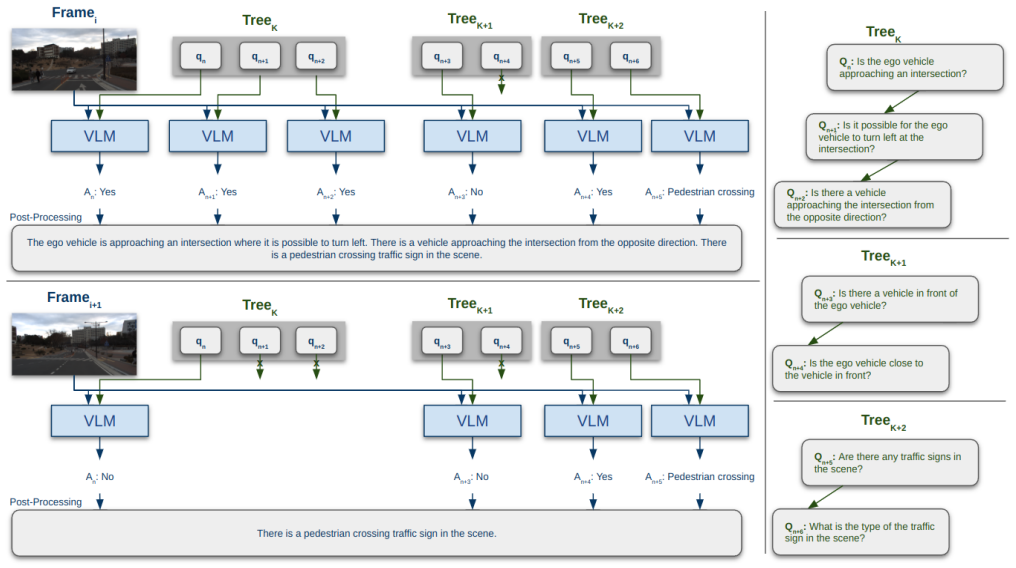
The central object is the handcrafted hierarchical question tree: a fixed set of 41 questions about road geometry, intersections, vehicles, pedestrians, traffic signs, speed bumps, and crosswalks, arranged so that answering a high-level question (for example, whether a left turn is possible) opens up or prunes detailed sub-questions. The tree converts scene description from a generation problem into a sequence of constrained classification problems, and the pruning rule—skip any question whose parent was answered "no"—is what keeps inference time low. Handcrafted templates then assemble the surviving positive answers into a final scene description. The fine-tuned VLM (BLIP, 384.7 million trainable parameters) supplies the per-question answers.
What would settle it
Collect a set of driving frames from the same campus that contain objects or conditions outside the 41-question vocabulary—for example, a fallen tree, a pedestrian pushing a bicycle, or newly installed construction barriers—and run the system. If the generated descriptions systematically omit these clearly visible elements while a full-image description captures them, the claim that the approach provides detailed scene understanding is falsified for exactly the cases the question set does not anticipate.
Extended reading notes
Core claim
On the paper's own terms, the central claim is that detailed scene understanding for driving does not require a large general-purpose model generating long free-form text; it can be produced by a small VLM answering a carefully ordered set of binary and multiple-choice questions. The 41-question hierarchy is organized so that high-level questions gate detailed ones: if "is the ego vehicle on a straight road?" is answered affirmatively, the question about curve direction is skipped, and a "no" at a parent prunes an entire subtree. Only positive answers are converted into template sentences, giving a coherent, deterministic description. Evaluated with Lingo-Judge, the fine-tuned model reaches 94.81% overall accuracy, and the measured mean inference time of 423 ms (standard deviation 171 ms) is presented as evidence that the approach supports real-time autonomous driving applications. The authors also report GPT-4o scores of 79 with ground truth and 65 without, positioning the approach as competitive with GPT-4o's 77 on reference-free scoring while far cheaper.
Load-bearing premise
The whole approach presupposes that the handcrafted 41-question tree covers every visual element that matters in the operating area; anything not represented in the question set is structurally invisible to the system, no matter how well the VLM answers.
Editorial extensions
If this is right
- Scene understanding can run at 423 ms mean inference on an RTX 4090, making onboard, real-time description plausible without a cloud connection.
- Large latency variance from API-based models (GPT-4o mean 5 s, maximum 125 s) is avoided entirely, which matters for time-sensitive driving decisions.
- Fine-tuning a compact VLM on the operating region improves Lingo-Judge accuracy from 72.10% to 94.81%, suggesting area-specific adaptation is a large part of the gain.
- Because descriptions are assembled from a fixed question set and templates, the output is deterministic and interpretable, which suits downstream decision or logging systems.
- The method scales to new regions by collecting and annotating more frames and questions, so the same architecture transfers if the question set is expanded.
Reading between the lines
- The fixed 41-question set is the real bottleneck: any visible element that is not asked about is invisible to the system, so the claimed "detailed scene understanding" is strictly bounded by the question designer's coverage.
- A testable extension would be to measure coverage loss on an open-vocabulary task: present frames with rare obstacles or construction changes and count how often the system omits them despite their being visible.
- The GPT score comparison mixes evaluation protocols (with versus without ground truth), so the headline competitiveness with GPT-4o should be read cautiously until a single protocol is applied to both.
- The same hierarchical QA pattern could be applied to other closed-set perception domains, such as warehouse robotics or assistive navigation, where a fixed list of relevant questions is acceptable.
Editorial analysis
A structured set of objections, weighed in public.
Referee Report
Summary. The paper proposes a hierarchical question-answering approach for driving scene understanding, in which a compact VLM (BLIP) is fine-tuned on a custom campus-specific dataset of 465 frames and 41 predefined questions. At inference, the model navigates a hand-built question tree, skips irrelevant sub-questions, and synthesizes answers into template-based scene descriptions. The authors report a mean inference time of 423 ms, Lingo-Judge accuracy of 94.81% for the fine-tuned VLM, and GPT-based scores of 79 (with ground truth) and 65 (without ground truth), which they contrast with GPT-4o's 57 and 77. The central claim is that the approach is competitive with GPT-4o at capturing key scene details while being much faster.
Significance. The latency measurements are concrete and reproducible in form (mean, standard deviation, min, max), and the dynamic question-skipping idea is practical for edge deployment. If the quality claims held, the paper would provide a useful data point for low-cost scene description in constrained autonomous-driving domains. However, the quality evaluation is not yet convincing: the headline comparison to GPT-4o mixes incompatible scoring protocols, the judge is also a competitor, and no human or second-model validation is provided. The contribution is therefore currently a latency optimization with a promising but inadequately supported accuracy story.
major comments (4)
- [Section IV-C, Table IV] The central claim of competitiveness with GPT-4o is not supported by the same-protocol comparison. Under the only protocol that does not use ground-truth annotations to score the descriptions ('GPT Score w/o GT'), the proposed system scores 65 while GPT-4o scores 77, a 12-point gap. The other protocol ('GPT Score with GT') compares the proposed system's 79 against GPT-4o's 57, but this protocol is structurally biased toward the proposed system: its outputs are generated from the same constrained 41-question vocabulary used to define the ground-truth annotations, whereas GPT-4o produces free-form descriptions that are penalized for not using that vocabulary. The abstract and introduction should not present the system as competitive with GPT-4o based on scores taken from different protocols; the paper must either rely on the single fair protocol (where the proposed system trails) or provide a new evaluation that is unbiased and appropriately controlled.
- [Section IV-C] The evaluation has a circularity problem: GPT-4o is used both as the scorer and as the subject for the 'without GT' comparison. In the 'w/o GT' condition, GPT-4o assigns itself a score of 77, and in the 'with GT' condition it assigns itself a lower score of 57, which is unsurprising if self-evaluation is lenient. A learned metric such as Lingo-Judge may also favor the fine-tuned model, which was trained on the same annotation style. The paper should provide an independent evaluation, ideally with human raters scoring a sample of descriptions from both the proposed system and GPT-4o under identical instructions, and report inter-rater agreement or confidence intervals. Without this, the quality comparison is not reliable.
- [Table I] The validation split is incomplete: the 'Vehicle Blocking the Road' and 'Merging Traffic' scenarios have 0% of frames in the validation set, so the reported Lingo-Judge accuracy in Table II and the GPT-based scores in Table IV do not cover these two scenarios. Any claim about the approach's performance on vehicle blockages or merging traffic is therefore unsupported. The authors should either provide per-scenario validation results, use a split that includes all scenarios, or explicitly state that those scenarios are excluded from the quantitative evaluation.
- [Section III-A] The paper's claim that the approach supports 'real-time autonomous driving applications' (Abstract and Conclusion) is an overstatement given the closed-world design. Section III-A states that the dataset omits questions about traffic lights because they are absent from the campus operating area, and the 41 handcrafted questions define the full set of detectable scene elements. Any element outside this set, such as new construction, unusual obstacles, or unmodeled traffic controls, cannot be reported regardless of model accuracy. This limitation should be acknowledged explicitly in the abstract and conclusion, and the claim should be narrowed to 'operating areas covered by the predefined question set'.
minor comments (5)
- [Section III-A] The dataset description reports 15,006 training question-answer pairs and 4,059 validation pairs, but the table shows 80%/20% train/validation only for some scenarios; the numbers should be reconciled, because 250 frames at 75% for one scenario and 20 frames at 100% for another make the 80/20 overall split confusing.
- [Section IV-A] Please specify the exact VLM architecture and the number of trainable parameters. The text says 'BLIP with 384.7 million trainable parameters' but the paper does not state which BLIP variant (e.g., BLIP-base or BLIP-large) was used, nor the input resolution and decoder settings.
- [Table III] The GPT-4o API inference time column reports a very large standard deviation (12,253 ms) and a maximum of 125,970 ms; it would be helpful to state how many API calls were measured and whether the 5 s mean is affected by network variability or by retries.
- [Section IV-D] The qualitative results are presented with red/green highlighting, but the figure caption does not explain the color scheme; please add a sentence to the caption or text describing what red and green sentences mean.
- [References] Reference [27] is cited as 'LingoQA: Visual question answering for autonomous driving' and used to introduce Lingo-Judge, but the paper does not explain how Lingo-Judge works or why a threshold of 85% similarity is appropriate; a brief description would improve reproducibility.
Circularity Check
No significant circularity; the Table IV protocol-mixing is an evaluation-validity concern, not a constructional circularity.
full rationale
I walked the claimed derivation chain. The method is empirical: a compact VLM is fine-tuned on a custom VQA dataset, then inference uses hierarchical question selection and handcrafted templates to assemble scene descriptions. The reported quantities are measurements on held-out validation frames: Lingo-Judge accuracy (94.81% vs 72.10% baseline), mean inference time (423 ms), and GPT-4o scores (65 without GT and 79 with GT for the proposed system; 77 without GT and 57 with GT for GPT-4o). No parameter is fitted to a subset and then relabeled as a prediction; the training/validation split is proper (80/20), with some scenarios appearing only in training. Lingo-Judge [27] and GPT-4o are external evaluators, not author-supplied metrics, and no load-bearing self-citation appears. The one notable issue is that the "competitive with GPT-4o" narrative in Table IV can be read as comparing the proposed system's with-GT score (79) against GPT-4o's without-GT score (77), which are different protocols; under the single reference-free protocol the proposed system trails 65 to 77. That is an evaluation-validity limitation, not a circular derivation, because no equation, fitted parameter, or self-citation chain reduces the claim to its own input. Therefore no significant circularity is present.
Assumptions & free parameters
assumptions (4)
- domain assumption The 41 predefined questions and answer categories cover all scene information needed for safe driving in the target area.
- domain assumption The handcrafted templates produce coherent, contextually accurate descriptions from discrete answers.
- domain assumption GPT-4o's reference-free score is a valid measure of scene description quality.
- domain assumption BLIP can be fine-tuned to answer the hierarchical questions reliably with 15,006 training samples.
Cite this review
Pith. "Pith review of Hierarchical Question-Answering for Driving Scene Understanding Using Vision-Language Models." pith.science (2026). https://pith.science/paper/NFQGSUZH
@misc{pith2026250602615,
  author       = {Pith},
  title        = {Pith review of: Hierarchical Question-Answering for Driving Scene Understanding Using Vision-Language Models},
  year         = {2026},
  howpublished = {\url{https://pith.science/paper/NFQGSUZH}},
  note         = {Machine review of arXiv:2506.02615}
}
read the original abstract
In this paper, we present a hierarchical question-answering (QA) approach for scene understanding in autonomous vehicles, balancing cost-efficiency with detailed visual interpretation. The method fine-tunes a compact vision-language model (VLM) on a custom dataset specific to the geographical area in which the vehicle operates to capture key driving-related visual elements. At the inference stage, the hierarchical QA strategy decomposes the scene understanding task into high-level and detailed sub-questions. Instead of generating lengthy descriptions, the VLM navigates a structured question tree, where answering high-level questions (e.g., "Is it possible for the ego vehicle to turn left at the intersection?") triggers more detailed sub-questions (e.g., "Is there a vehicle approaching the intersection from the opposite direction?"). To optimize inference time, questions are dynamically skipped based on previous answers, minimizing computational overhead. The extracted answers are then synthesized using handcrafted templates to ensure coherent, contextually accurate scene descriptions. We evaluate the proposed approach on the custom dataset using GPT reference-free scoring, demonstrating its competitiveness with state-of-the-art methods like GPT-4o in capturing key scene details while achieving significantly lower inference time. Moreover, qualitative results from real-time deployment highlight the proposed approach's capacity to capture key driving elements with minimal latency.
Figures

Reference graph
Works this paper leans on
-
[1]
Spherical transformer for lidar-based 3d recognition,
X. Lai, Y . Chen, F. Lu, J. Liu, and J. Jia, “Spherical transformer for lidar-based 3d recognition,” inProceedings of the IEEE/CVF Conference on Computer Vision and Pattern Recognition (CVPR), June 2023, pp. 17 545–17 555
work page 2023
-
[2]
Rea- son2drive: Towards interpretable and chain-based reasoning for au- tonomous driving,
M. Nie, R. Peng, C. Wang, X. Cai, J. Han, H. Xu, and L. Zhang, “Rea- son2drive: Towards interpretable and chain-based reasoning for au- tonomous driving,” inComputer Vision – ECCV 2024, A. Leonardis, E. Ricci, S. Roth, O. Russakovsky, T. Sattler, and G. Varol, Eds. Cham: Springer Nature Switzerland, 2025, pp. 292–308
work page 2024
-
[3]
Gpt-4v as traffic assistant: an in-depth look at vision language model on complex traffic events,
X. Zhou and A. C. Knoll, “Gpt-4v as traffic assistant: an in-depth look at vision language model on complex traffic events,”arXiv preprint arXiv:2402.02205, 2024
arXiv 2024
-
[4]
DriveVLM: The convergence of autonomous driving and large vision-language models,
X. Tian, J. Gu, B. Li, Y . Liu, Y . Wang, Z. Zhao, K. Zhan, P. Jia, X. Lang, and H. Zhao, “DriveVLM: The convergence of autonomous driving and large vision-language models,” in8th Annual Conference on Robot Learning, 2024. [Online]. Available: https://openreview.net/forum?id=928V4Umlys
work page 2024
-
[5]
J. Li, D. Li, C. Xiong, and S. Hoi, “BLIP: Bootstrapping language- image pre-training for unified vision-language understanding and generation,” inProceedings of the 39th International Conference on Machine Learning, ser. Proceedings of Machine Learning Research, K. Chaudhuri, S. Jegelka, L. Song, C. Szepesvari, G. Niu, and S. Sabato, Eds., vol. 162. PMLR...
work page 2022
-
[6]
Clip2scene: Towards label-efficient 3d scene understanding by clip,
R. Chen, Y . Liu, L. Kong, X. Zhu, Y . Ma, Y . Li, Y . Hou, Y . Qiao, and W. Wang, “Clip2scene: Towards label-efficient 3d scene understanding by clip,” inProceedings of the IEEE/CVF Conference on Computer Vision and Pattern Recognition (CVPR), June 2023, pp. 7020–7030
work page 2023
-
[7]
S. Peng, K. Genova, C. “. Jiang, A. Tagliasacchi, M. Pollefeys, and T. Funkhouser, “Openscene: 3d scene understanding with open vocab- ularies,” inProceedings of the IEEE/CVF Conference on Computer Vision and Pattern Recognition (CVPR), June 2023, pp. 815–824
work page 2023
-
[8]
Pla: Language-driven open-vocabulary 3d scene understanding,
R. Ding, J. Yang, C. Xue, W. Zhang, S. Bai, and X. Qi, “Pla: Language-driven open-vocabulary 3d scene understanding,” inPro- ceedings of the IEEE/CVF Conference on Computer Vision and Pattern Recognition (CVPR), June 2023, pp. 7010–7019
work page 2023
Show all 27 references
-
[9]
Learning transferable visual models from natural language supervision,
A. Radford, J. W. Kim, C. Hallacy, A. Ramesh, G. Goh, S. Agarwal, G. Sastry, A. Askell, P. Mishkin, J. Clarket al., “Learning transferable visual models from natural language supervision,” inInternational conference on machine learning. PmLR, 2021, pp. 8748–8763
2021
-
[10]
The traffic scene un- derstanding and prediction based on image captioning,
W. Li, Z. Qu, H. Song, P. Wang, and B. Xue, “The traffic scene un- derstanding and prediction based on image captioning,”IEEE Access, vol. 9, pp. 1420–1427, 2021
2021
-
[11]
Delving into clip latent space for video anomaly recognition,
L. Zanella, B. Liberatori, W. Menapace, F. Poiesi, Y . Wang, and E. Ricci, “Delving into clip latent space for video anomaly recognition,”Computer Vision and Image Understanding, vol. 249, p. 104163, 2024. [Online]. Available: https://www.sciencedirect.com/ science/article/pii...
2024
-
[12]
Learning to prompt for vision-language models,
K. Zhou, J. Yang, C. C. Loy, and Z. Liu, “Learning to prompt for vision-language models,”International Journal of Computer Vision, vol. 130, no. 9, p. 2337–2348, Jul. 2022. [Online]. Available: http://dx.doi.org/10.1007/s11263-022-01653-1
2022 doi
-
[13]
Lidar-llm: Exploring the potential of large language models for 3d lidar understanding,
S. Yang, J. Liu, R. Zhang, M. Pan, Z. Guo, X. Li, Z. Chen, P. Gao, Y . Guo, and S. Zhang, “Lidar-llm: Exploring the potential of large language models for 3d lidar understanding,”arXiv preprint arXiv:2312.14074, 2023
2023 arXiv
-
[14]
Vectornet: Encoding hd maps and agent dynamics from vectorized representation,
J. Gao, C. Sun, H. Zhao, Y . Shen, D. Anguelov, C. Li, and C. Schmid, “Vectornet: Encoding hd maps and agent dynamics from vectorized representation,” inProceedings of the IEEE/CVF Conference on Com- puter Vision and Pattern Recognition (CVPR), June 2020
2020
-
[15]
Reimagining an autonomous vehicle,
J. Hawke, V . Badrinarayanan, A. Kendallet al., “Reimagining an autonomous vehicle,”arXiv preprint arXiv:2108.05805, 2021
2021 arXiv
-
[16]
Explainable artificial intelligence (xai): Concepts, taxonomies, opportunities and challenges toward responsible ai,
A. Barredo Arrieta, N. D ´ıaz-Rodr´ıguez, J. Del Ser, A. Bennetot, S. Tabik, A. Barbado, S. Garcia, S. Gil-Lopez, D. Molina, R. Benjamins, R. Chatila, and F. Herrera, “Explainable artificial intelligence (xai): Concepts, taxonomies, opportunities and challenges toward responsi...
2020
-
[17]
From automation to autonomy and autonomous vehicles: Challenges and opportunities for human-computer interaction,
W. Xu, “From automation to autonomy and autonomous vehicles: Challenges and opportunities for human-computer interaction,”inter- actions, vol. 28, 01 2021
2021
-
[18]
Languagempc: Large language models as decision makers for autonomous driving,
H. Sha, Y . Mu, Y . Jiang, L. Chen, C. Xu, P. Luo, S. E. Li, M. Tomizuka, W. Zhan, and M. Ding, “Languagempc: Large language models as decision makers for autonomous driving,”arXiv preprint arXiv:2310.03026, 2023
2023 arXiv
-
[19]
Lm-nav: Robotic navigation with large pre-trained models of language, vision, and action,
D. Shah, B. Osi ´nski, b. ichter, and S. Levine, “Lm-nav: Robotic navigation with large pre-trained models of language, vision, and action,” inProceedings of The 6th Conference on Robot Learning, ser. Proceedings of Machine Learning Research, K. Liu, D. Kulic, and J. Ichnowski...
2023
-
[20]
Dilu: A knowledge-driven approach to autonomous driving with large language models,
L. Wen, D. Fu, X. Li, X. Cai, T. Ma, P. Cai, M. Dou, B. Shi, L. He, and Y . Qiao, “Dilu: A knowledge-driven approach to autonomous driving with large language models,” 2024. [Online]. Available: https://arxiv.org/abs/2309.16292
2024 arXiv
-
[21]
Driving with llms: Fusing object- level vector modality for explainable autonomous driving,
L. Chen, O. Sinavski, J. H ¨unermann, A. Karnsund, A. J. Willmott, D. Birch, D. Maund, and J. Shotton, “Driving with llms: Fusing object- level vector modality for explainable autonomous driving,” in2024 IEEE International Conference on Robotics and Automation (ICRA), 2024, pp...
2024
-
[22]
Gpt- driver: Learning to drive with gpt,
J. Mao, Y . Qian, J. Ye, H. Zhao, and Y . Wang, “Gpt- driver: Learning to drive with gpt,” 2023. [Online]. Available: https://arxiv.org/abs/2310.01415
2023 arXiv
-
[23]
Drivegpt4: Interpretable end-to-end autonomous driving via large language model,
Z. Xu, Y . Zhang, E. Xie, Z. Zhao, Y . Guo, K.-Y . K. Wong, Z. Li, and H. Zhao, “Drivegpt4: Interpretable end-to-end autonomous driving via large language model,”IEEE Robotics and Automation Letters, vol. 9, no. 10, pp. 8186–8193, 2024
2024
-
[24]
RAG-Driver: Generalisable Driving Explanations with Retrieval-Augmented In-Context Learning in Multi-Modal Large Lan- guage Model,
J. Yuan, S. Sun, D. Omeiza, B. Zhao, P. Newman, L. Kunze, and M. Gadd, “RAG-Driver: Generalisable Driving Explanations with Retrieval-Augmented In-Context Learning in Multi-Modal Large Lan- guage Model,”arXiv e-prints, p. arXiv:2402.10828, Feb. 2024
2024
-
[25]
DriveMLM: Aligning Multi-Modal Large Language Models with Behavioral Planning States for Autonomous Driving,
W. Wang, J. Xie, C. Hu, H. Zou, J. Fan, W. Tong, Y . Wen, S. Wu, H. Deng, Z. Li, H. Tian, L. Lu, X. Zhu, X. Wang, Y . Qiao, and J. Dai, “DriveMLM: Aligning Multi-Modal Large Language Models with Behavioral Planning States for Autonomous Driving,”arXiv e- prints, p. arXiv:2312....
2023
-
[26]
Lmdrive: Closed-loop end-to-end driving with large language models,
H. Shao, Y . Hu, L. Wang, G. Song, S. L. Waslander, Y . Liu, and H. Li, “Lmdrive: Closed-loop end-to-end driving with large language models,” inProceedings of the IEEE/CVF Conference on Computer Vision and Pattern Recognition (CVPR), June 2024, pp. 15 120–15 130
2024
-
[27]
Lingoqa: Visual question answering for au- tonomous driving,
A.-M. Marcu, L. Chen, J. H ¨unermann, A. Karnsund, B. Hanotte, P. Chidananda, S. Nair, V . Badrinarayanan, A. Kendall, J. Shotton, E. Arani, and O. Sinavski, “Lingoqa: Visual question answering for au- tonomous driving,” inComputer Vision – ECCV 2024, A. Leonardis, E. Ricci, S...
2024
Reviewed August 7, 2026 · model on record in the stance chip above.
Discussion (0). Sign in to comment.