REVIEW 4 major objections 6 minor 36 references
Weightless Fine-Tuning: Personalizing LLMs via Logit-Space Transport
T0 review · 4 major / 6 minor · reviewed 2026-08-15 · deepseek-v4-flash
Pith's one-line read The distributional effect of supervised fine-tuning can be reproduced at decoding time without updating any model weights.
desk verdict A clever training-free personalization idea whose central transport mechanism never actually gets tested in the experiments. read the letter →
The pith
A machine-rendered reading of the paper's core claim, the machinery that carries it, and where it could break.
The reading
What carries the argument
The load-bearing object is the cross-prefix transport operator $M_{t\leftarrow s}$, a $V\times V$ map that converts a supervised residual computed at training position $s$ into a logit correction at prompt position $t$. It is estimated from the empirical cross-covariance $\Sigma_{t,s}$ and self-covariance $\Sigma_{s,s}$ of dropout-perturbed logits as $\widehat M_{t\leftarrow s}=\Sigma_{t,s}(\Sigma_{s,s}+\lambda I)^{-1}$, which Proposition 1 identifies as a ridge-regularized approximation to the cross-prefix NTK action $\Theta_{t,s}\Theta_{s,s}^{-1}$. The theoretical mechanism that makes this possible is that a KL-proximal natural-gradient step is multiplicative in probability and additive in logits ($q\propto p\,e^{\eta g}$), so a weight update can be replaced by adding a logit shift; the operator supplies that shift directly, and the multi-step version iterates residual recomputation on the training side while keeping the operator fixed.
What would settle it
On a small model where the full Jacobian can be computed, compare the dropout-estimated $\widehat M_{t\leftarrow s}$ against the true cross-prefix NTK action $\Theta_{t,s}\Theta_{s,s}^{-1}$ as $K$ grows; if the two do not converge for residuals in the column span of $\Theta_{s,s}$, then the isotropic dropout assumption is false and WFT's transport estimate is not an NTK approximation.
Extended reading notes
Core claim
The paper's central claim is that the distributional effect of a supervised natural-gradient update can be moved from the training context to a different prompt context in logit space, without ever updating the weights. Concretely, the logit shift at prompt prefix $x_{1:t}$ induced by one supervised step is written as $\Delta z_t = \eta \sum_{s=1}^S M_{t\leftarrow s} r_s$, where $r_s = e_{\tilde{x}_{s+1}} - p(\cdot|\tilde{x}_{1:s})$ is the supervised residual at training position $s$, and $M_{t\leftarrow s}$ is a cross-prefix transport operator. WFT estimates this operator as $\widehat M_{t\leftarrow s} = \Sigma_{t,s}(\Sigma_{s,s}+\lambda I)^{-1}$ from paired dropout-perturbed forward passes, and shows it converges to a ridge-regularized cross-prefix neural tangent kernel action $\Theta_{t,s}(\Theta_{s,s}+\lambda' I)^{-1}$. The paper argues this transported residual approximates the logit shift one-step SFT would produce, and supports the claim with benchmark results and logit-level similarity between WFT and SFT shifts.
Load-bearing premise
The whole construction stands on the assumption that dropout-perturbed forward passes reveal the same cross-prefix propagation that a real supervised weight update would cause, which requires the model's logits to be locally linear in the weights and the dropout perturbations to be isotropic; if that fails, the estimated transport operator no longer tracks SFT.
Editorial extensions
If this is right
- Per-author personalization becomes an inference-time operation: no per-author weight copies are stored, and incorporating new author data only requires recomputing residuals and covariance estimates rather than retraining.
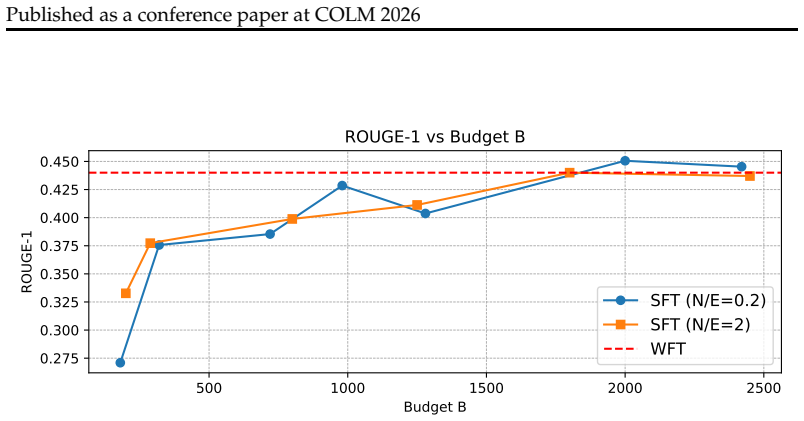
- At the reported budget, WFT reaches SFT-comparable quality with less than 7% of the effective computation, so serving thousands of authors becomes feasible on fixed hardware.
- Because the base model weights are never modified, WFT avoids catastrophic forgetting and leaves the model's general capabilities intact for non-personalized tasks.
- WFT operates through stochastic forward passes and output logits, so it can personalize models accessed through inference-only APIs where gradients and weight access are unavailable.
- The high cosine similarity between WFT and SFT logit shifts suggests WFT captures the same distributional direction as supervised adaptation over the tokens that dominate next-token probability.
Reading between the lines
- Inference: the method's theoretical guarantees require local linearity of logits in weights and isotropic dropout noise; on very large models where these fail, WFT's alignment with SFT should degrade, so the 0.875 similarity is likely an upper bound for harder reasoning-heavy tasks.
- Inference: the implementation replaces the full $V\times V$ operator with a vocabulary-coordinate-wise approximation that the paper does not derive from Section 3.1's operator; if the approximation rather than the full operator drives the empirical gains, the NTK interpretation may be stronger than necessary.
- Inference: WFT's transport operator is estimated per author from that author's own text, so its quality should depend on how much author history is available; with very little history the covariance estimate will be rank-deficient and the ridge regularization will dominate, which should predict a sharp performance floor.
- Inference: the same residual-transport idea could be tested for cross-task or cross-author transfer, where residuals from one author or task are transported to another prompt; the paper does not evaluate this, but the operator formalism does not restrict it to same-author data.
Signed reviews
Editorial analysis
A structured set of objections, weighed in public.
Referee Report
Summary. The paper proposes Weightless Fine-Tuning (WFT), a decoding-time method that aims to approximate the effect of per-author supervised fine-tuning (SFT) on next-token distributions without updating the model weights. The method computes supervised residuals on an author's training sequence and transports them to the current prompt prefix through a cross-prefix transport operator estimated from dropout-augmented forward passes, motivated by an NTK-style local-linearization argument. Experiments on three LaMP benchmarks with Qwen3-8B and Llama-3.1-8B-Instruct report that WFT achieves the best average ROUGE scores, matches or exceeds SFT on individual tasks, and does so at a fraction of the effective compute. Additional results include a budget-controlled SFT comparison, ablations, a human evaluation, and a logit-space similarity analysis against one-step SFT.
Significance. If the transport mechanism were established, WFT would be a practically valuable method for per-author personalization, since it avoids per-author weight storage and training while operating through forward passes only. The paper contains several constructive elements: a clearly motivated problem, a budget-controlled comparison, an ablation study, and a human evaluation. However, the current manuscript does not substantiate the central mechanistic claim. The theory in Proposition 1 requires assumptions that are not met by real dropout, and, more importantly, the algorithm actually implemented in Appendix B is not the transport operator defined in Section 3.1. The reported experiments therefore support a diagonal logit-rescaling heuristic rather than the cross-prefix logit-space transport that the paper claims. These gaps are load-bearing and need to be resolved before the paper's central claim can be accepted.
major comments (4)
- [Appendix B vs. Section 3.1] The implemented update is not the Section 3.1 transport operator. Section 3.1 defines the correction as Delta z_t = eta * sum_s M_{t<-s} r_s, with M_{t<-s} = Sigma_{t,s} (Sigma_{s,s} + lambda I)^{-1}; in coordinates the full operator acts as (M_{t<-s} r_s)_v = (1/(K-1)) * sum_k t_k(v) * sum_{v'} U_s(k,v') w_s(v'). Appendix B instead computes Delta z_t(v) = eta * sum_j (1/(K-1)) * sum_k t_k(v) * B^{(j)}_k(v), where B^{(j)}_k(v) = (1/S) * sum_s U_s(k,v) w^{(j)}_s(v). This retains only the v'=v term and averages over source positions inside the coefficient matrix. No derivation is provided to show that off-diagonal vocabulary transport is negligible; the paper only calls this a 'vocabulary-coordinate-wise dropout-factored approximation.' Consequently, Tables 1-3, the ablation that removes M, and the cosine-similarity analysis in Section 6.2 exercise a diagonal rescaling of logits, not the cross-prefix transport operator invoked by the central claim.
- [Appendix A, Proposition 1] Proposition 1's Condition 2, Sigma_theta = sigma^2 I, is not merely unverified but inconsistent with the dropout mechanism actually used in the experiments. Dropout masks set individual neurons to zero and rescale the remaining entries, producing sparse, low-rank, anisotropic parameter covariance; they do not yield isotropic perturbations. Therefore the convergence result in part (b), M_hat_{t<-s} -> Theta_{t,s} (Theta_{s,s} + lambda' I)^{-1}, does not follow for the dropout-perturbed forward passes used to estimate the covariances. To make the theory applicable, the paper needs either to model the actual dropout-induced covariance and re-derive the estimator, or to provide a direct empirical test that the dropout-estimated operator matches the NTK action on a setting where the Jacobian can be computed exactly.
- [Section 5.3, Table 3] The ablation that sets M to the identity does not test the cross-prefix transport operator, because the implemented method already replaces the operator with a coordinate-wise approximation. Setting M=I in the implemented algorithm only removes the dropout-factored reweighting w_s and leaves the diagonal, per-token action intact. The observed degradation therefore cannot be attributed to 'structured transport' or to the cross-prefix coupling that the paper's central claim relies on; it is equally consistent with the hypothesis that ridge-regularized, dropout-normalized token rescaling is what helps.
- [Section 6.2] The cosine-similarity analysis of 0.875 is computed on the top-10 tokens ranked by Delta z_WFT, which is a post-hoc selected subset. Such selection can produce high similarity even when the two updates are only weakly aligned in general, because the subset is chosen to maximize the apparent agreement. The analysis is also based on a single randomly sampled author, so it provides no measure of variability across authors or contexts. The claim that 'WFT captures the distributional effect of supervised adaptation' would require either reporting similarity over the full vocabulary or with a proper baseline, and averaging over multiple authors.
minor comments (6)
- [Title/Abstract] The title and abstract contain a typo: 'Fine-T uning' should be 'Fine-Tuning'.
- [Tables 1-2] The main results are reported as point estimates without confidence intervals or significance tests, and the number of test authors is only 50; it would be helpful to report per-author variance and pairwise significance for the WFT-versus-SFT comparisons.
- [Section 5.4] The human evaluation uses two annotators on 50 examples and reports only the aggregate preference count; inter-annotator agreement (e.g., Cohen's kappa) should be reported to gauge reliability.
- [Section 6.1] The complexity comparison assumes that K and E are of the same order and sets c >= 2 in T_b = c T_f; these choices are stated but not justified, and the 'effective budget B of WFT is approximately 100' is not derived rigorously from the algorithm's cost expression.
- [Section 3.2] The time-homogeneous approximation M^{(j)}_{t<-s} = M_{t<-s} is introduced without a bound on the approximation error or a discussion of when update sizes remain small enough for the first-order argument to hold.
- [Table 3 header] The column header 'Full WFT Component Steps Data' is confusing; it should be split into separate headers for 'Full WFT', 'w/o M', '1/2 steps', '1/4 steps', '1/2 data', and '1/4 data'.
Circularity Check
No significant circularity: WFT's transport operator is estimated from dropout covariance of the frozen model, SFT is trained independently, and the self-citations only motivate baselines.
full rationale
The central derivation is self-contained and not circular. WFT defines the supervised residual r_s from the frozen model's own next-token probabilities and the author's training text, then forms the transport operator M = Sigma_{t,s}(Sigma_{s,s}+lambda I)^{-1} from dropout-perturbed forward passes of the same frozen model (Section 3.1, Eq. for M). Neither the residual nor the operator is fitted to SFT outputs, SFT logit shifts, or test labels, so the benchmark comparison against SFT is independent of the construction. Proposition 1 is a conditional mathematical statement: under explicit local-linearity and isotropic-perturbation assumptions, the dropout covariance converges to a ridge-regularized cross-prefix NTK. Even if the isotropic-dropout assumption is unrealistic for real LLMs, that is a validity/correctness concern, not circularity, because the conclusion is not assumed in the premise. The implemented Appendix B coordinate-wise approximation drops off-diagonal vocabulary transport relative to the Section 3.1 operator; this is a theory-implementation gap and a potential correctness issue, but it is not a reduction of the claim to its own inputs. The logit-level comparison in Section 6.2 is computed post hoc on a randomly sampled author and is not used to fit eta, lambda, or M. The self-citations (Chakrabarty et al. 2025; Chakrabarty and Dhillon 2026) only motivate SFT as a strong baseline and in-context prompt formatting; they do not justify the transport operator or the NTK connection, and they are externally grounded empirical studies. No fitted parameter is renamed as a prediction, no uniqueness theorem is imported from the authors' prior work, and no ansatz is smuggled in via self-citation. Overall, the derivation chain does not exhibit circularity.
Assumptions & free parameters
free parameters (4)
- η (step size) =
5e-3
- λ (ridge regularization) =
1e-4
- R (number of WFT steps) =
400
- K (dropout forward passes) =
10
assumptions (5)
- domain assumption Logits are locally linear in parameters around θ0 (NTK regime).
- domain assumption Dropout-induced parameter perturbations are isotropic with Σθ = σ²I.
- domain assumption The KL-proximal NGD update in logit space describes SFT's effect.
- domain assumption Time-homogeneous transport operator M is a valid first-order approximation across iterations.
- ad hoc to paper Vocabulary-coordinate-wise approximation preserves the transport operator's effect.
Cite this review
Pith. "Pith review of Weightless Fine-Tuning: Personalizing LLMs via Logit-Space Transport." pith.science (2026). https://pith.science/paper/NG2Y4XHF
@misc{pith2026260811342,
  author       = {Pith},
  title        = {Pith review of: Weightless Fine-Tuning: Personalizing LLMs via Logit-Space Transport},
  year         = {2026},
  howpublished = {\url{https://pith.science/paper/NG2Y4XHF}},
  note         = {Machine review of arXiv:2608.11342}
}
read the original abstract
Supervised fine-tuning (SFT) is a standard approach for adapting LLMs to a target distribution, but in settings such as personalization, where each author requires separate weight access, optimization, storage, and retraining, its costs become prohibitive. We propose Weightless Fine-Tuning (WFT), a training-free decoding-time method that approximates the distributional effect of SFT without weight updates. WFT computes supervised residuals on an author's training sequence and transports them to the current prompt through a cross-prefix transport operator estimated from dropout-induced cross-covariance. The operator captures how a perturbation at one context propagates to predictions at another, replacing gradient-based parameter updates with logit-space corrections. On three LaMP personalization benchmarks, WFT achieves the best average performance across datasets, matches or exceeds SFT on individual tasks, and outperforms other lightweight baselines on average. In a budget-controlled comparison, WFT approaches SFT performance using less than 7% of the effective computation. Logit-level analysis shows a cosine similarity of 0.875 between the logit shifts induced by WFT and SFT over 95% of the next-token probability mass, suggesting that WFT captures the distributional effect of supervised adaptation without modifying model weights.
Figures

Reference graph
Works this paper leans on
-
[1]
Attention is All you Need , url =
Vaswani, Ashish and Shazeer, Noam and Parmar, Niki and Uszkoreit, Jakob and Jones, Llion and Gomez, Aidan N and Kaiser, ukasz and Polosukhin, Illia , booktitle =. Attention is All you Need , url =
-
[2]
L a MP : When Large Language Models Meet Personalization
Salemi, Alireza and Mysore, Sheshera and Bendersky, Michael and Zamani, Hamed. L a MP : When Large Language Models Meet Personalization. Proceedings of the 62nd Annual Meeting of the Association for Computational Linguistics (Volume 1: Long Papers). 2024. doi:10.18653/v1/2024.acl-long.399
-
[3]
Readers Prefer Outputs of AI Trained on Copyrighted Books over Expert Human Writers , author=. 2025 , eprint=
work page 2025
-
[4]
2025 , eprint=
Qwen3 Technical Report , author=. 2025 , eprint=
2025
-
[5]
Liu, Shuai and Cho, Hyundong and Freedman, Marjorie and Ma, Xuezhe and May, Jonathan. RECAP : Retrieval-Enhanced Context-Aware Prefix Encoder for Personalized Dialogue Response Generation. Proceedings of the 61st Annual Meeting of the Association for Computational Linguistics (Volume 1: Long Papers). 2023. doi:10.18653/v1/2023.acl-long.468
-
[6]
2025 , eprint=
Embedding-to-Prefix: Parameter-Efficient Personalization for Pre-Trained Large Language Models , author=. 2025 , eprint=
2025
-
[7]
P ersona PKT : Building Personalized Dialogue Agents via Parameter-efficient Knowledge Transfer
Han, Xu and Guo, Bin and Jung, Yoon and Yao, Benjamin and Zhang, Yu and Liu, Xiaohu and Guo, Chenlei. P ersona PKT : Building Personalized Dialogue Agents via Parameter-efficient Knowledge Transfer. Proceedings of the Fourth Workshop on Simple and Efficient Natural Language Processing (SustaiNLP). 2023. doi:10.18653/v1/2023.sustainlp-1.21
-
[8]
Prefix-Tuning: Optimizing Continuous Prompts for Generation
Li, Xiang Lisa and Liang, Percy. Prefix-Tuning: Optimizing Continuous Prompts for Generation. Proceedings of the 59th Annual Meeting of the Association for Computational Linguistics and the 11th International Joint Conference on Natural Language Processing (Volume 1: Long Papers). 2021. doi:10.18653/v1/2021.acl-long.353
Show all 36 references
-
[9]
2021 , eprint=
Understanding Catastrophic Forgetting and Remembering in Continual Learning with Optimal Relevance Mapping , author=. 2021 , eprint=
2021
-
[10]
arXiv preprint arXiv:2410.16208 , year=
Compute-Constrained Data Selection , author=. arXiv preprint arXiv:2410.16208 , year=
-
[11]
2026 , eprint=
Data Repetition Beats Data Scaling in Long-CoT Supervised Fine-Tuning , author=. 2026 , eprint=
2026
-
[12]
Advances in Neural Information Processing Systems , volume=
Scaling data-constrained language models , author=. Advances in Neural Information Processing Systems , volume=
-
[13]
2025 , eprint=
A Scaling Law for Token Efficiency in LLM Fine-Tuning Under Fixed Compute Budgets , author=. 2025 , eprint=
2025
-
[14]
and Sifre, Laurent , title =
Hoffmann, Jordan and Borgeaud, Sebastian and Mensch, Arthur and Buchatskaya, Elena and Cai, Trevor and Rutherford, Eliza and de Las Casas, Diego and Hendricks, Lisa Anne and Welbl, Johannes and Clark, Aidan and Hennigan, Tom and Noland, Eric and Millican, Katie and van den Dri...
2022
-
[15]
Proceedings of the IEEE/CVF Conference on Computer Vision and Pattern Recognition Workshops , pages=
Dithered backprop: A sparse and quantized backpropagation algorithm for more efficient deep neural network training , author=. Proceedings of the IEEE/CVF Conference on Computer Vision and Pattern Recognition Workshops , pages=
-
[16]
Drift: Decoding-time Personalized Alignments with Implicit User Preferences
Kim, Minbeom and Lee, Kang-il and Joo, Seongho and Lee, Hwaran and Thonet, Thibaut and Jung, Kyomin. Drift: Decoding-time Personalized Alignments with Implicit User Preferences. Findings of the Association for Computational Linguistics: EMNLP 2025. 2025. doi:10.18653/v1/2025.f...
2025 doi
-
[17]
Amulet: ReAlignment During Test Time for Personalized Preference Adaptation of
Zhaowei Zhang and Fengshuo Bai and Qizhi Chen and Chengdong Ma and Mingzhi Wang and Haoran Sun and Zilong Zheng and Yaodong Yang , booktitle=. Amulet: ReAlignment During Test Time for Personalized Preference Adaptation of. 2025 , url=
2025
-
[18]
arXiv preprint arXiv:2507.04756 , year=
CoSteer: Collaborative Decoding-Time Personalization via Local Delta Steering , author=. arXiv preprint arXiv:2507.04756 , year=
-
[19]
arXiv preprint arXiv:2505.20633 , year=
Test-time learning for large language models , author=. arXiv preprint arXiv:2505.20633 , year=
-
[20]
Learning to (
Sun, Yu and Li, Xinhao and Dalal, Karan and Xu, Jiarui and Vikram, Arjun and Zhang, Genghan and Dubois, Yann and Chen, Xinlei and Wang, Xiaolong and Koyejo, Sanmi and Hashimoto, Tatsunori and Guestrin, Carlos , booktitle =. Learning to (. 2025 , editor =
2025
-
[21]
2026 , eprint=
Can Good Writing Be Generative? Expert-Level AI Writing Emerges through Fine-Tuning on High-Quality Books , author=. 2026 , eprint=
2026
-
[22]
Transactions on Machine Learning Research , issn=
Personalization of Large Language Models: A Survey , author=. Transactions on Machine Learning Research , issn=. 2025 , url=
2025
-
[23]
World wide web , volume=
When large language models meet personalization: Perspectives of challenges and opportunities , author=. World wide web , volume=. 2024 , publisher=
2024
-
[24]
arXiv preprint arXiv:2502.11528 , year=
A survey of personalized large language models: Progress and future directions , author=. arXiv preprint arXiv:2502.11528 , year=
-
[25]
International Conference on Machine Learning , pages=
Transformers learn in-context by gradient descent , author=. International Conference on Machine Learning , pages=. 2023 , organization=
2023
-
[26]
Findings of the Association for Computational Linguistics: ACL 2023 , pages=
Why can GPT learn in-context? language models secretly perform gradient descent as meta-optimizers , author=. Findings of the Association for Computational Linguistics: ACL 2023 , pages=
2023
-
[27]
Proceedings of the 41st International Conference on Machine Learning , pages =
Position: Do pretrained Transformers Learn In-Context by Gradient Descent? , author =. Proceedings of the 41st International Conference on Machine Learning , pages =. 2024 , editor =
2024
-
[28]
Proceedings of the 2024 Conference of the North American Chapter of the Association for Computational Linguistics: Human Language Technologies (Volume 1: Long Papers) , pages=
In-context learning and gradient descent revisited , author=. Proceedings of the 2024 Conference of the North American Chapter of the Association for Computational Linguistics: Human Language Technologies (Volume 1: Long Papers) , pages=
2024
-
[29]
Personalize Your LLM : Fake it then Align it
Zhang, Yijing and Adila, Dyah and Shin, Changho and Sala, Frederic. Personalize Your LLM : Fake it then Align it. Findings of the Association for Computational Linguistics: NAACL 2025. 2025. doi:10.18653/v1/2025.findings-naacl.407
2025 doi
-
[30]
1950 , publisher=
Inverting modified matrices , author=. 1950 , publisher=
1950
-
[31]
, author=
Lora: Low-rank adaptation of large language models. , author=. Iclr , volume=
-
[32]
arXiv preprint arXiv:1907.11692 , year=
Roberta: A robustly optimized bert pretraining approach , author=. arXiv preprint arXiv:1907.11692 , year=
1907 arXiv
-
[33]
arXiv preprint arXiv:1606.08415 , year=
Gaussian error linear units (gelus) , author=. arXiv preprint arXiv:1606.08415 , year=
-
[34]
Advances in neural information processing systems , volume=
Supervised contrastive learning , author=. Advances in neural information processing systems , volume=
-
[35]
Proceedings of the 41st International Conference on Machine Learning , articleno =
Liu, Sheng and Ye, Haotian and Xing, Lei and Zou, James , title =. Proceedings of the 41st International Conference on Machine Learning , articleno =. 2024 , publisher =
2024
-
[36]
arXiv preprint arXiv:2407.21783 , year=
The Llama 3 Herd of Models , author=. arXiv preprint arXiv:2407.21783 , year=
Reviewed August 15, 2026 · model on record in the stance chip above.
Discussion (0). Continue with ORCID to comment.