REVIEW 4 major objections 4 minor 32 references
Strategic Analysis of Just-In-Time Liquidity Provision in Concentrated Liquidity Market Makers
T0 review · 4 major / 4 minor · reviewed 2026-08-15 · deepseek-v4-flash
Pith's one-line read A transaction-level model of just-in-time liquidity provision in concentrated-liquidity AMMs proves an optimal single-swap strategy exists, and fitting it to real Uniswap V3 data shows JIT LPs could earn up to 69% more by accounting for…
desk verdict Solid first model of JIT LP optimization in CLMMs, with an existence theorem worth taking seriously, but the empirical headline numbers are upper bounds that ignore inclusion auctions and the paper has one genuinely sloppy lemma. read the letter →
The pith
A machine-rendered reading of the paper's core claim, the machinery that carries it, and where it could break.
The reading
What carries the argument
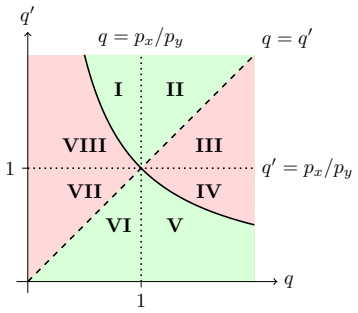
The load-bearing object is the tick-decomposed utility identity $U=\sum_m (F_m-C_m)$, where $F_m=\delta_m L/(L+P_m)$ is the JIT LP's pro-rata share of the fee accrued in tick $m$, and $C_m$ is the corresponding price-impact term derived as a function of the JIT liquidity $L$, the passive liquidity $P_m$, the swap size, and the market and tick prices. The key structural fact is the price-impact threshold of Theorem 3.1: for a move $q\to q'$, with $\hat q$ the projection of the current price onto the chosen range, $C\le 0$ holds exactly when $\hat q' \le (p_x/p_y)^2/\hat q$ for a price decrease, and the reverse inequality for a price increase. This turns the JIT decision into a finite search over tick ranges that are actually touched as the price travels from $q$ to the no-JIT post-swap price $q^*$, plus a one-dimensional optimization in $L$; Algorithm 1 performs that search, and Theorem 4.1 guarantees the search has a finite global winner.
What would settle it
Obtain the complete set of bids from the block-builder auctions for the same six months of USDC/WETH JIT bundles, and recompute the profit gap as $U=F-C-v(\text{bid})$ with each JIT LP charged its actual inclusion cost; if the gap between observed and optimized profit shrinks toward zero as $v$ rises with position profitability, the 69% estimate is an artefact of the constant-$v$ assumption rather than a real inefficiency.
Extended reading notes
Core claim
On the paper's model, a JIT LP's per-swap utility is $U(s;\theta)=F(s;\theta)-C(s;\theta)$, where $F$ is the trading fee it captures from the swap and $C$ is price impact (the change in dollar value of its position between mint and burn, defined as positive when the position loses value). Theorem 4.1 states that this utility always attains a global maximum over the strategy space of single positions $(L,a,b)$ subject to the budget; the argument is that tick ranges are finite, and on each range $F$ is continuous and bounded while $C$ is continuous in $L$, so the feasible interval for $L$ is compact. Algorithm 1 finds the optimum by enumerating ranges in $\mathcal{R}(q,q^*)$ and solving a one-dimensional non-concave problem for $L^*$. The paper classifies the resulting optima into three strategic archetypes: overpriced trades (pool price moves away from market price, price impact helps the LP), arbitrageur trades (price moves toward market, price impact hurts), and overshoot trades (price crosses the market price, so the LP should concentrate liquidity only in the segment where $C<0$). Fitting the algorithm to 6,829 real JIT swaps in a USDC/WETH Uniswap V3 pool, the authors find that observed JIT behavior underperforms the optimum by up to 69%, that price impact accounts for roughly 75% of total returns on average, and that optimized JIT participation could cut passive-LP fee income by up to 44% per trade while lowering trader slippage.
Load-bearing premise
The central empirical claim assumes the JIT LP's cost of winning the right to include its sandwich bundle is the same no matter which liquidity position it chooses; if that cost is actually a competitive bid that rises with the profit the position can extract, the measured 69% gain would be eaten by the auction.
Editorial extensions
If this is right
- Overpriced trades, which push the pool price away from the market price, are unambiguously favorable: price impact is non-positive and the optimal strategy can deploy the full JIT budget.
- Arbitrageur trades, which push the pool price toward the market price, are usually loss-making unless fees cover the price impact, so the optimal strategy is often to skip the trade.
- If JIT LPs optimized their positions, passive LPs' fee income would fall by up to 44% per trade, while traders would enjoy lower slippage.
- JIT liquidity acts as a preemptive arbitrage force: it dampens price dislocations and reduces the profit available to arbitrageurs who would correct the same mispricing later.
- The three-way classification of trades (overpriced, arbitrageur, overshoot) gives a practical participation rule derived from the price-impact threshold, not just a numerical recipe.
Reading between the lines
- The 69% figure likely overstates what JIT LPs could retain if inclusion is a competitive auction: the paper fixes the winning-bid cost $v$ independent of the position, so part of the measured gap may be a transfer to block builders rather than profit.
- The threshold condition in Theorem 3.1 could be turned into a real-time classifier: label a pending swap by whether $q'$ crosses the boundary, and only dispatch capital when the label is 'overpriced' or the post-crossing segment of an overshoot trade.
- Because the strategy space is restricted to single positions, a natural extension is to allow two or more simultaneous positions; the proof that $U$ attains a maximum would need revisiting, but the tick-decomposed utility carries over.
- The empirical study uses one pool, and the authors say volatile pools show wider gaps, so the same counterfactual should be re-run on a high-volatility pool to see whether the 69% gap widens.
Signed reviews
Editorial analysis
A structured set of objections, weighed in public.
Referee Report
Summary. This paper studies just-in-time (JIT) liquidity provision in concentrated liquidity market makers (CLMMs). It develops a transaction-level model in which a JIT LP chooses a position (L,a,b) immediately before a swap and earns fees minus price impact, subject to a budget constraint. The paper characterizes when price impact is favorable, analyzes how post-swap price depends on injected liquidity, proves existence of an optimal strategy (Theorem 4.1), and proposes Algorithm 1 to compute it. The empirical evaluation on Uniswap V3 USDC/WETH data (January-June 2024) claims that real JIT LPs are suboptimal, could earn up to 69% more with the optimized strategy, that JIT returns are driven mostly by price impact, and that optimized JIT activity reduces passive LP fees and trader slippage.
Significance. If the results hold, this would be a valuable first formal, transaction-level treatment of JIT LP optimization in CLMMs. The theoretical core is largely self-contained: the price-impact characterization and the existence theorem do not rely on fitted parameters, and the empirical study uses real on-chain data. The paper also articulates falsifiable predictions through the three strategic archetypes and the fee-sufficiency condition. However, the headline empirical claims are currently overstated because inclusion-auction costs are assumed away and the numerical optimizer lacks a global-optimality certificate; these issues do not invalidate the existence theorem but do affect the practical contribution.
major comments (4)
- [Section 3.2 / Appendix D (Lemma 3.2)] Lemma 3.2 states that q' is 'continuous, strictly decreasing in L' with lim_{L→∞} q'=q, but with q'(L)<q for finite L, convergence to q from below requires q' to be increasing in L. The proof sketch in Section 3.2 even says 'As L increases, the same ∆x has less price impact, so q'↑,' and the appendix proof does not establish the claimed direction. This is not a cosmetic typo: the sign of the monotonicity is used implicitly in Lemma 3.1 and in the continuity/boundedness argument of Theorem 4.1. Please correct the statement and make the proof consistent.
- [Section 4.2.2 and Section 6 (Data Collection)] The model assumes the auction/bid cost v is 'a constant that does not relate to the choice of liquidity position' (Section 4.2.2), while Section 4.1 describes inclusion as a sealed-bid auction in which the winning JIT bundle pays a tip bounded below by the second-highest bid. Section 6 explicitly does not simulate bidding auctions among JIT LPs. Consequently, the reported 'up to 69% more than current profit' and 'never loses money' (Section 6.1.1) are gross-of-auction upper bounds, not achievable net profits; under competitive bidding the surplus could be consumed by tips. The existence theorem is unaffected, but the practical headline should be either re-derived with an auction model or explicitly labeled as an upper bound.
- [Section 5 (Algorithm 1)] Algorithm 1's optimality guarantee is conditional on solving a non-concave, non-linear univariate problem (Eq. 19) to global optimality. The implementation uses Particle Swarm Optimization and binary search, neither of which provides a global optimality certificate. The empirical 'optimized' profits, including the 69% figure and the 'never loses money' statement in Section 6.1.1, are therefore only as strong as the heuristic solver. Please either provide a certified global method (e.g., branch-and-bound over the single variable) or report bounds on the suboptimality gap.
- [Appendix E (Proposition 5.1)] The proof of Proposition 5.1 contains sign errors: it states 'F_m < C_m for all m ⇒ U>0' when U=F−C would give U<0, and it concludes that the derived inequality is 'a sufficient condition for U>0' although the proposition asserts U<0. The proposition itself appears correct after rearrangement, but the appendix proof needs to be fixed to match the statement.
minor comments (4)
- [Appendix B, proof of Theorem 3.1] The proof divides by sqrt(q)−sqrt(q') and calls it positive, but for q<q' it is negative; the final inequality is correct only after a sign flip. Please correct the sign discussion.
- [Section 6] The data-collection paragraph reports 6,829 JIT swaps, while Section 6.1.1 states 6,884 JIT transactions; please reconcile these numbers.
- [Section 4.2.2 and Table 1] The bid/inclusion cost is denoted v in Section 4.2.2, v* in Appendix D's proof of Theorem 4.1, and 'v*_j' in Table 1; please unify the notation.
- [Figure 3(a)] The axis labels appear garbled ('102 101 100 0 100 101 102 103'); please format the log-scale axis clearly.
Circularity Check
No significant circularity: the optimization theorem and empirical counterfactual are self-contained and do not reduce to their inputs.
full rationale
The paper's central derivation chain is analytical. Theorem 4.1 takes U(s;θ)=F(s;θ)-C(s;θ) from the CLMM fee formula (Eq. 14) and the tick-wise price-impact decomposition (Eq. 17), then proves existence of a maximizer by finiteness of tick intervals and continuity/compactness; no parameter is fitted to obtain the theorem. The empirical 69% claim (Section 6.1.1) is a counterfactual evaluation: real JIT transactions are replayed under Algorithm 1 using the same realized transaction set and the same budget, and the paper explicitly states it does not simulate auction outcomes (Section 6, Data Collection), so the figure is a stated upper-bound comparison rather than a fitted prediction. The single-position restriction cites the authors' own [24], but it is a conservative modeling assumption (also attributed to [27]) and does not imply the measured profit gap; it is not load-bearing for Theorem 4.1. The 'never loses money' sentence is an analytic consequence of including non-participation in the strategy space rather than a separate empirical discovery, but this is a presentation nuance, not a circular derivation. The unmodeled inclusion-auction cost is an explicitly acknowledged limitation rather than a circular step. No equation in the paper is defined in terms of its own output, and no fitted constant is renamed as a prediction.
Assumptions & free parameters
assumptions (5)
- domain assumption External market prices p_x and p_y are constant throughout the trade (Section 3, Assumptions).
- domain assumption A JIT LP can atomically mint before and burn after the target swap and is guaranteed inclusion (Section 4.1, modeling implications).
- domain assumption The JIT LP commits to a single position (L,a,b) rather than multiple positions (Section 4.2.1).
- ad hoc to paper The auction or bid cost v is a constant independent of the chosen liquidity position (Section 4.2.2).
- domain assumption Passive LP positions s are fixed a priori and do not respond to the JIT LP's intervention (Section 4.2).
Cite this review
Pith. "Pith review of Strategic Analysis of Just-In-Time Liquidity Provision in Concentrated Liquidity Market Makers." pith.science (2026). https://pith.science/paper/NGMFLC34
@misc{pith2026250916157,
  author       = {Pith},
  title        = {Pith review of: Strategic Analysis of Just-In-Time Liquidity Provision in Concentrated Liquidity Market Makers},
  year         = {2026},
  howpublished = {\url{https://pith.science/paper/NGMFLC34}},
  note         = {Machine review of arXiv:2509.16157}
}
read the original abstract
Liquidity providers (LPs) are essential figures in the operation of automated market makers (AMMs); in exchange for transaction fees, LPs lend the liquidity that allows AMMs to operate. While many prior works have studied the incentive structures of LPs in general, we currently lack a principled understanding of a special class of LPs known as Just-In-Time (JIT) LPs. These are strategic agents who momentarily supply liquidity for a single swap, in an attempt to extract disproportionately high fees relative to the remaining passive LPs. This paper provides the first formal, transaction-level model of JIT liquidity provision for a widespread class of AMMs known as Concentrated Liquidity Market Makers (CLMMs), as seen in Uniswap V3, for instance. We characterize the landscape of price impact and fee allocation in these systems, formulate and analyze a non-linear optimization problem faced by JIT LPs, and prove the existence of an optimal strategy. By fitting our optimal solution for JIT LPs to real-world CLMMs, we observe that in liquidity pools (particularly those with risky assets), there is a significant gap between observed and optimal JIT behavior. Existing JIT LPs often fail to account for price impact; doing so, we estimate they could increase earnings by up to 69% on average over small time windows. We also show that JIT liquidity, when deployed strategically, can improve market efficiency by reducing slippage for traders, albeit at the cost of eroding average passive LP profits by up to 44% per trade.
Figures


Figures from the paper (5 more)


Reference graph
Works this paper leans on
-
[11]
Agostino Capponi, Ruizhe Jia, and Brian Zhu. The Paradox Of Just-in- Time Liquidity in Decentralized Exchanges: More Providers Can Some- times Mean Less Liquidity.arXiv preprint arXiv:2311.18164, 2023. URL: https://arxiv.org/abs/2311.18164
arXiv 2023
-
[24]
Weizhao Tang, Rachid El-Azouzi, Cheng Han Lee, Ethan Chan, and Giulia Fanti. Game Theoretic Liquidity Provisioning in Concentrated Liquidity Market Makers.Proceedings of the ACM on Measurement and Analysis of Computing Systems, 9(1):1–45, 2025
work page 2025
-
[25]
Just-in-Time Liquidity on the Uniswap Pro- tocol.SSRN 4382303 Electron
Xin Wan and Austin Adams. Just-in-Time Liquidity on the Uniswap Pro- tocol.SSRN 4382303 Electron. J., 2023
work page 2023
-
[1]
Uniswap v3 core.https://uniswap.org/whitepaper-v3.pdf,
Hayden Adams, Noah Zinsmeister, Moody Salem, River Keefer, and Dan Robinson. Uniswap v3 core.https://uniswap.org/whitepaper-v3.pdf,
-
[2]
Uniswap v4 core.https://uniswap.org/whitepaper-v4.pdf,
Hayden Adams, Noah Zinsmeister, Moody Salem, River Keefer, and Dan Robinson. Uniswap v4 core.https://uniswap.org/whitepaper-v4.pdf,
-
[3]
Impermanent loss and loss-vs-rebalancing I: some statistical properties
Abe Alexander and Lars Fritz. Impermanent loss and loss-vs-rebalancing I: some statistical properties, 2024. URL:https://arxiv.org/abs/2410. 00854,arXiv:2410.00854
work page Pith review arXiv 2024
-
[4]
Impermanent loss and Loss-vs-Rebalancing II, 2025
Abe Alexander, Guillaume Lambert, and Lars Fritz. Impermanent loss and Loss-vs-Rebalancing II, 2025. URL:https://arxiv.org/abs/2502. 04097,arXiv:2502.04097
arXiv 2025
-
[5]
Allium - enterprise blockchain data platform.https://www
Allium. Allium - enterprise blockchain data platform.https://www. allium.so/. (Accessed on 10/04/2024)
work page 2024
Show all 32 references
-
[6]
Improved price oracles: Constant function market makers
Guillermo Angeris and Tarun Chitra. Improved price oracles: Constant function market makers. InProceedings of the 2nd ACM Conference on Advances in Financial Technologies, AFT ’20, page 80–91, New York, NY, USA, 2020. Association for Computing Machinery.doi:10.1145/3419614. 3423251
2020 doi
-
[7]
An analysis of Uniswap markets, 2021
Guillermo Angeris, Hsien-Tang Kao, Rei Chiang, Charlie Noyes, and Tarun Chitra. An analysis of Uniswap markets, 2021. URL:https://arxiv.org/ abs/1911.03380,arXiv:1911.03380
2021 arXiv
-
[8]
Equi- librium reward for liquidity providers in automated market makers, 2025
Alif Aqsha, Philippe Bergault, and Leandro S´ anchez-Betancourt. Equi- librium reward for liquidity providers in automated market makers, 2025. URL:https://arxiv.org/abs/2503.22502,arXiv:2503.22502
2025 arXiv
-
[9]
An Empirical Study of Market Inefficiencies in Uniswap and Sushiswap
Jan Arvid Berg, Robin Fritsch, Lioba Heimbach, and Roger Wattenhofer. An Empirical Study of Market Inefficiencies in Uniswap and Sushiswap. InInternational Conference on Financial Cryptography and Data Security, pages 238–249. Springer, 2022
2022
-
[10]
Arbitrageurs’ profits, lvr, and sandwich attacks: batch trading as an amm design response, 2025
Andrea Canidio and Robin Fritsch. Arbitrageurs’ profits, lvr, and sandwich attacks: batch trading as an amm design response, 2025. URL:https: //arxiv.org/abs/2307.02074,arXiv:2307.02074. 26
2025 arXiv
-
[12]
Decentralized finance and automated market making: Predictable loss and optimal liquidity pro- vision.SIAM Journal on Financial Mathematics, 15(3):931–959, 2024
´Alvaro Cartea, Fay¸ cal Drissi, and Marcello Monga. Decentralized finance and automated market making: Predictable loss and optimal liquidity pro- vision.SIAM Journal on Financial Mathematics, 15(3):931–959, 2024
2024
-
[13]
Flash Boys 2.0: Frontrunning, Trans- action Reordering, and Consensus Instability in Decentralized Exchanges
Philip Daian, Steven Goldfeder, et al. Flash Boys 2.0: Frontrunning, Trans- action Reordering, and Consensus Instability in Decentralized Exchanges. InIEEE S&P, 2020
2020
-
[14]
Concentrated liquidity in automated market makers
Robin Fritsch. Concentrated liquidity in automated market makers. In Proceedings of the 2021 ACM CCS Workshop on Decentralized Finance and Security, DeFi ’21, page 15–20, New York, NY, USA, 2021. Association for Computing Machinery.doi:10.1145/3464967.3488590
2021
-
[15]
Risks and returns of Uniswap V3 liquidity providers
Lioba Heimbach, Eric Schertenleib, and Roger Wattenhofer. Risks and returns of Uniswap V3 liquidity providers. InProceedings of the 4th ACM Conference on Advances in Financial Technologies (AFT), pages 89–101, 2022
2022
-
[16]
Fragmentation and optimal liquidity supply on decentralized exchanges, 2024
Alfred Lehar, Christine Parlour, and Marius Zoican. Fragmentation and optimal liquidity supply on decentralized exchanges, 2024. URL:https: //arxiv.org/abs/2307.13772,arXiv:2307.13772
2024 arXiv
-
[17]
Demystifying defi mev activities in flashbots bundle
Zihao Li, Jianfeng Li, Zheyuan He, Xiapu Luo, Ting Wang, Xiaoze Ni, Wenwu Yang, Xi Chen, and Ting Chen. Demystifying defi mev activities in flashbots bundle. InProceedings of the 2023 ACM SIGSAC Conference on Computer and Communications Security, CCS ’23, page 165–179, New Yor...
2023
-
[18]
Pancakeswap hits record$310b trading volume in 2024.Nasdaq, 2024
Annika Masrani. Pancakeswap hits record$310b trading volume in 2024.Nasdaq, 2024. URL:https://www.nasdaq.com/articles/ pancakeswap-hits-record-310b-trading-volume-2024
2024
-
[19]
Moallemi, Tim Roughgarden, and Anthony Lee Zhang
Jason Milionis, Ciamac C. Moallemi, Tim Roughgarden, and Anthony Lee Zhang. Automated market making and loss-versus-rebalancing, 2024. URL: https://arxiv.org/abs/2208.06046,arXiv:2208.06046
2024 arXiv
-
[20]
DeFi: Modeling and Forecast- ing Trading Volume on Uniswap v3 Liquidity Pools.SSRN Electronic Journal, May 2023
Deborah Miori and Mihai Cucuringu. DeFi: Modeling and Forecast- ing Trading Volume on Uniswap v3 Liquidity Pools.SSRN Electronic Journal, May 2023. Available at SSRN:https://ssrn.com/abstract= 4445351orhttp://dx.doi.org/10.2139/ssrn.4445351.doi:10.2139/ ssrn.4445351
2023 doi
-
[21]
PancakeSwap: AMM on Binance Smart Chain.https: //docs.pancakeswap.finance/, 2021
PancakeSwap. PancakeSwap: AMM on Binance Smart Chain.https: //docs.pancakeswap.finance/, 2021. Accessed: 2025-05-25. 27
2021
-
[22]
Quantifying blockchain ex- tractable value: How dark is the forest? In2022 IEEE Symposium on Security and Privacy (SP), pages 198–214
Kaihua Qin, Liyi Zhou, and Arthur Gervais. Quantifying blockchain ex- tractable value: How dark is the forest? In2022 IEEE Symposium on Security and Privacy (SP), pages 198–214. IEEE, 2022
2022
-
[23]
SushiSwap System.https://docs.sushi.com/, 2020
SushiSwap. SushiSwap System.https://docs.sushi.com/, 2020. Ac- cessed: 2025-05-25
2020
-
[26]
Private order flows and builder bidding dynamics: The road to monopoly in ethereum’s block building market, 2024
Shuzheng Wang, Yue Huang, Wenqin Zhang, Yuming Huang, Xuechao Wang, and Jing Tang. Private order flows and builder bidding dynamics: The road to monopoly in ethereum’s block building market, 2024. URL: https://arxiv.org/abs/2410.12352,arXiv:2410.12352
2024 arXiv
-
[27]
De- mystifying just-in-time (JIT) liquidity attacks on uniswap v3
Xihan Xiong, Zhipeng Wang, William Knottenbelt, and Michael Huth. De- mystifying just-in-time (JIT) liquidity attacks on uniswap v3. Cryptology ePrint Archive, Paper 2023/973, 2023. URL:https://eprint.iacr.org/ 2023/973
2023
-
[28]
A Retrospective Analysis of Public and Private Order Flow on the Ethereum Blockchain
Deniz Y¨ uksel. A Retrospective Analysis of Public and Private Order Flow on the Ethereum Blockchain. Master’s thesis in informatics, Technische Universit¨ at M¨ unchen, 2024
2024
-
[29]
Yuksel et al
M. Yuksel et al. Automated market makers and decentral- ized exchanges: a defi primer.Financial Innovation, 7(1):1–27,
-
[32]
1186/s40854-021-00314-5
URL:https://jfin-swufe.springeropen.com/articles/10. 1186/s40854-021-00314-5. A Notation Table 1 summarizes the notation used throughout this work. B Proof of Theorem 3.1 Theorem(Threshold condition for price impact 3.1).Let ˆq≜max{a,min{b,q}}, and similarly for ˆq′. The chang...
-
[33]
Therefore, asLincreases,q ′ must not increase by 2 and 4.q ′ must not stay constant, either, by 1 and 3, which implies the strict monotonicity ofq ′ inL
Pm k=1ϕk(L)ψk(q′) = ∆xis constant. Therefore, asLincreases,q ′ must not increase by 2 and 4.q ′ must not stay constant, either, by 1 and 3, which implies the strict monotonicity ofq ′ inL. The continuity ofq ′ inLoriginates from the continuity of eachϕ k andψ k. Finally, asL→∞...
-
[2024]
Accessed: 2025-08-07
2025
Reviewed August 15, 2026 · model on record in the stance chip above.
Discussion (0). Continue with ORCID to comment.