CFT Constraints on the Weak Gravity Conjecture
Pith reviewed 2026-06-30 05:28 UTC · model grok-4.3
The pith
The Weak Gravity Conjecture follows from boundary Green's function poles for black holes in dRGT massive gravity and Einstein-ModMax electrodynamics.
A machine-rendered reading of the paper's core claim, the machinery that carries it, and where it could break.
Core claim
We show that the WGC follows from this boundary calculation in two settings that fall outside the Reissner-Nordstrom idealisation: static spherically symmetric black holes in dRGT massive gravity, and dyonic black holes in Einstein-ModMax non-linear electrodynamics. The chain runs from the metric and gauge field, through the charged Klein-Gordon equation, into a near-horizon scaling limit whose radial equation reduces to Whittaker form; the conformal weight nu zero then enters a damping-time inequality. For the dRGT black hole every massive-gravity parameter cancels out, leaving the universal saturation q over m r plus greater than or equal to one over square root of two. For the Einstein-Mo
What carries the argument
The near-horizon scaling limit of the charged Klein-Gordon equation that reduces its radial part to Whittaker form, from which the conformal weight is extracted and inserted into a damping-time inequality.
If this is right
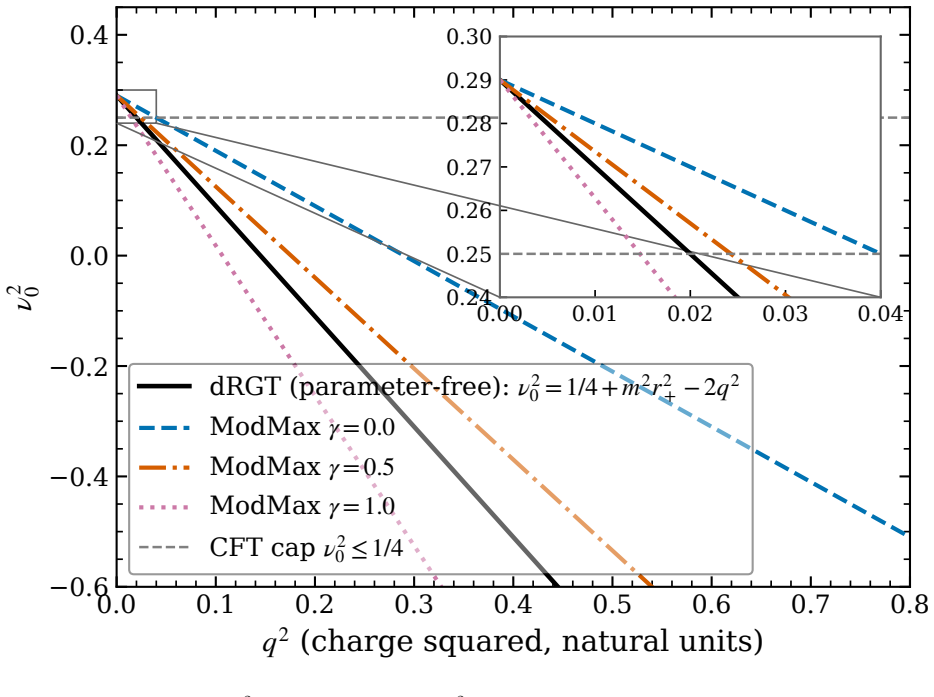
- In dRGT massive gravity the bound is independent of the parameters alpha, beta, m sub g and h.
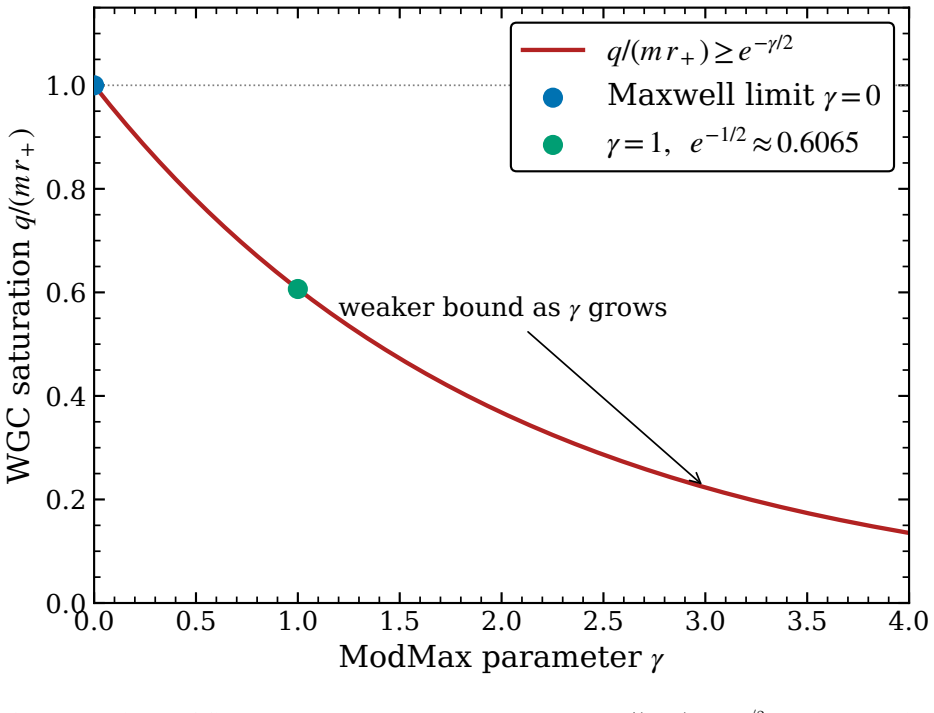
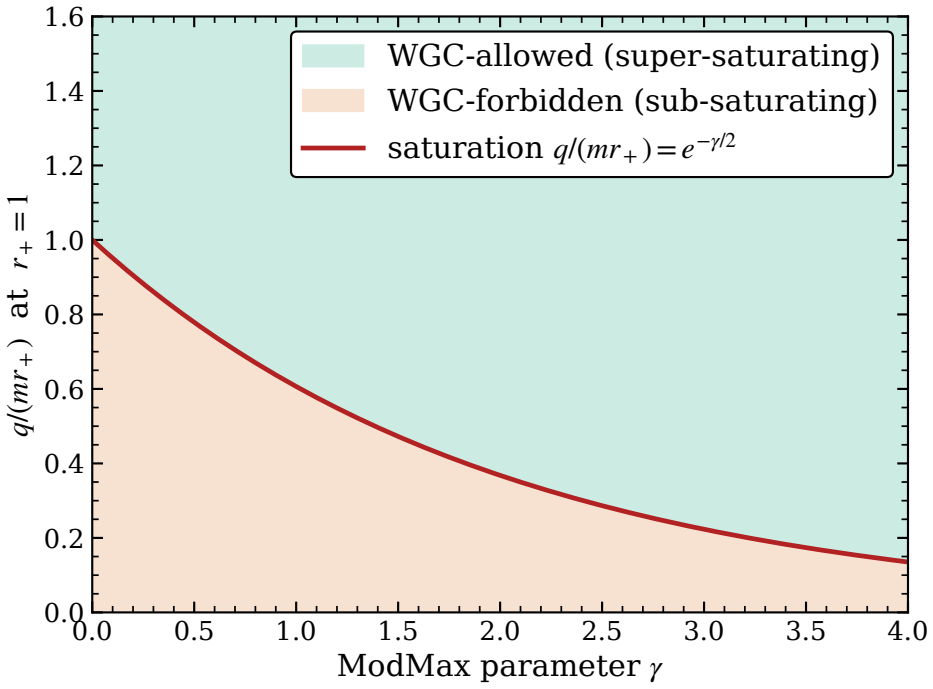
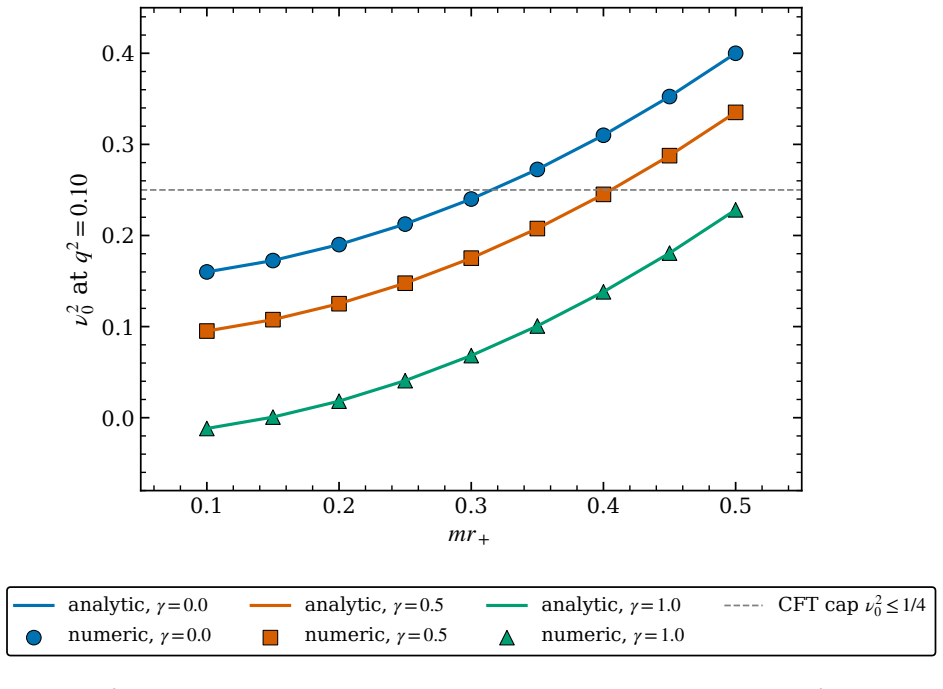
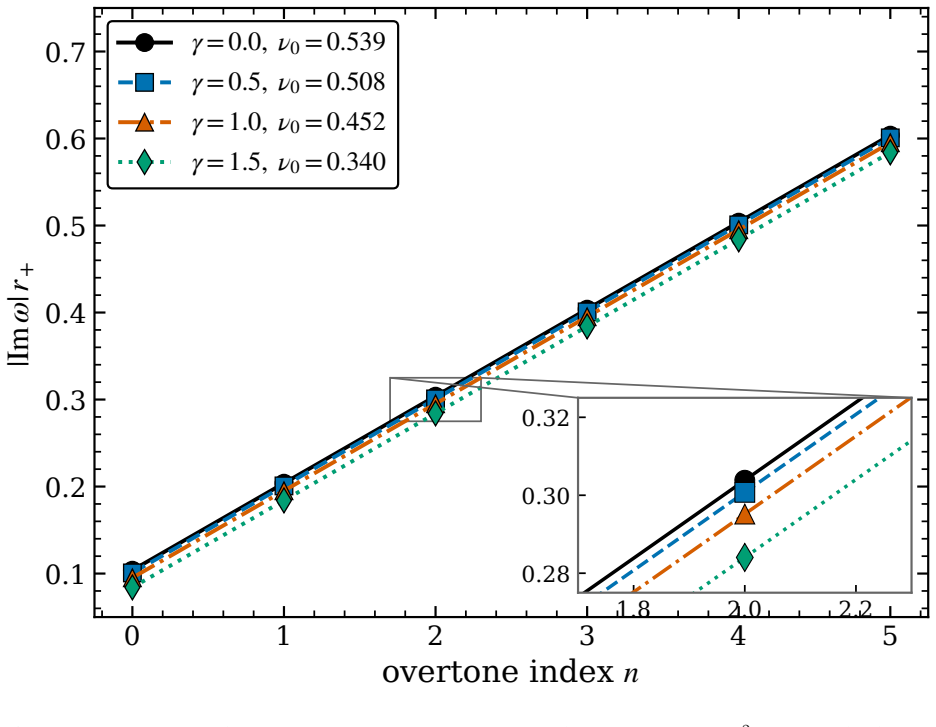
- In Einstein-ModMax theory the bound depends on gamma and weakens monotonically as the nonlinearity increases.
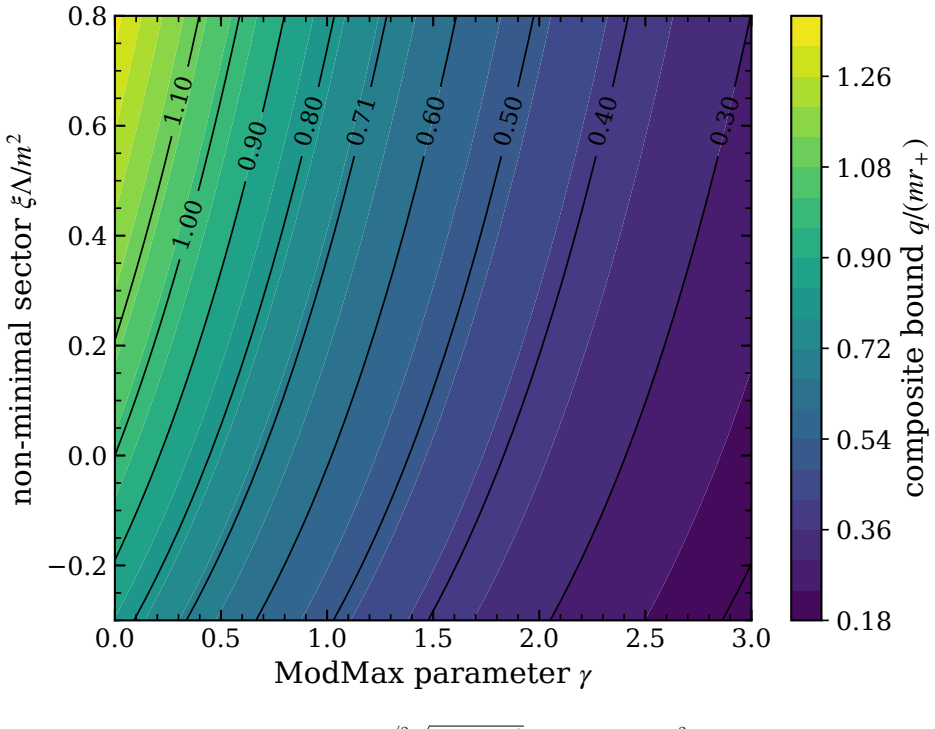
- Relaxing exact extremality, minimal coupling or the absence of higher-curvature terms reintroduces dependence on the massive-gravity parameters through controlled functional forms.
- The resulting bounds remain of order unity across the cases examined.
Where Pith is reading between the lines
- The cancellation in the dRGT case suggests the bound may hold more generally when the near-horizon limit still yields Whittaker form.
- Numerical checks of quasinormal modes in the relaxed dRGT models with higher-curvature corrections could confirm or adjust the tabulated parameter dependence.
- The same boundary extraction might be applied to other nonlinear electrodynamics models whose equations admit an analogous near-horizon reduction.
- If the bounds persist under further extensions they could serve as a practical constraint when fitting massive-gravity parameters to cosmological data.
Load-bearing premise
The near-horizon scaling limit reduces the radial equation of the charged Klein-Gordon field to Whittaker form so that the conformal weight enters the damping-time inequality.
What would settle it
A direct numerical computation of quasinormal frequencies for a dRGT black hole whose charge-to-mass ratio lies below one over square root of two, showing that the imaginary part violates the derived damping-time inequality, would falsify the claim.
Figures
read the original abstract
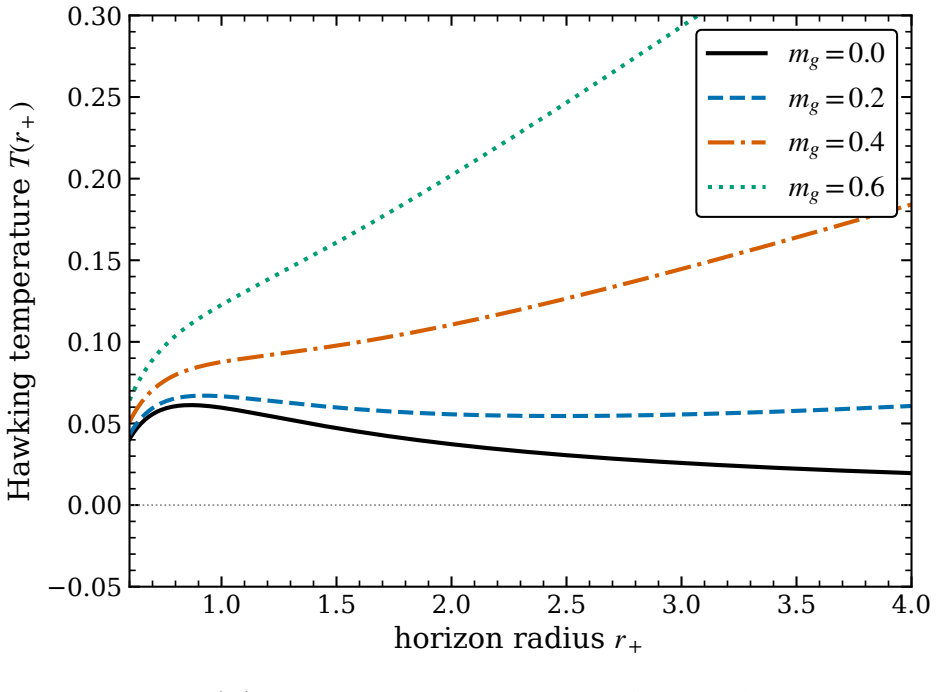
The Weak Gravity Conjecture (WGC) is a swampland criterion of long standing: any consistent theory of quantum gravity must contain a charged particle whose charge-to-mass ratio exceeds that of an extremal black hole, so that gravity remains the weakest force. The AdS/CFT correspondence offers a calculable boundary handle on bulk gravity, and the imaginary parts of bulk quasinormal modes are read off the boundary as poles of a retarded Green's function. We show that the WGC follows from this boundary calculation in two settings that fall outside the Reissner--Nordstr\"om idealisation: static spherically symmetric black holes in dRGT massive gravity, and dyonic black holes in Einstein--ModMax non-linear electrodynamics. The chain runs from the metric and gauge field, through the charged Klein--Gordon equation, into a near-horizon scaling limit whose radial equation reduces to Whittaker form; the conformal weight $\nu_0$ then enters a damping-time inequality. For the dRGT black hole every massive-gravity parameter ($\alpha,\beta,m_g,h$) cancels out, leaving the universal saturation $q/(m r_+) \geq 1/\sqrt{2} \approx 0.707$. For the Einstein--ModMax black hole the duality-symmetric non-linearity parameter $\gamma$ survives, and yields $q/(m r_+) \geq e^{-\gamma/2}$, which reduces to the Reissner--Nordstr\"om bound $q/(m r_+) \geq 1$ in the Maxwell limit $\gamma \to 0$. Either result is of order unity, and the second weakens monotonically as the non-linearity grows. We then relax three of the simplifying assumptions of the dRGT derivation, namely exact extremality, minimal coupling, and the absence of higher-curvature terms. The cancellation breaks. Each correction reintroduces $m_g,\alpha,\beta$ into the bound through a controlled functional dependence, and we tabulate and plot the relaxed forms across parameter space.
Editorial analysis
A structured set of objections, weighed in public.
Referee Report
Summary. The paper claims that the Weak Gravity Conjecture follows from a boundary CFT calculation of retarded Green's function poles (corresponding to bulk quasinormal modes) for two classes of black holes outside the Reissner-Nordström case: static spherically symmetric solutions in dRGT massive gravity and dyonic solutions in Einstein-ModMax nonlinear electrodynamics. The derivation chain starts from the metric and gauge field, proceeds through the charged Klein-Gordon equation, applies a near-horizon scaling limit that reduces the radial equation to Whittaker form, extracts a conformal weight ν₀, and inserts it into a damping-time inequality. This produces the bound q/(m r₊) ≥ 1/√2 (with all dRGT parameters α, β, m_g, h canceling) and q/(m r₊) ≥ e^{-γ/2} (with γ dependence retained, reducing to the RN bound as γ → 0). The paper also relaxes three assumptions (exact extremality, minimal coupling, absence of higher-curvature terms) and tabulates the resulting parameter-dependent corrections.
Significance. If the central technical steps hold, the work offers a CFT-derived route to the WGC in non-standard gravity and electrodynamics theories, with the exact parameter cancellation in the dRGT case and the controlled γ-dependence in ModMax constituting potentially useful results. The explicit treatment of relaxed assumptions, including tabulated and plotted forms, provides a concrete illustration of how the bound responds to corrections. These features would strengthen the case for viewing the WGC as emerging from boundary consistency conditions beyond the Einstein-Maxwell idealization.
major comments (2)
- [Abstract (derivation chain) and the section presenting the charged Klein-Gordon equation and near-horizon limit] The near-horizon scaling limit and reduction to Whittaker form (described in the abstract's derivation-chain paragraph) is load-bearing for extracting ν₀ and the subsequent bound. The manuscript must supply the explicit scaled radial ODE, the precise matching to the Whittaker equation, and the resulting expression for ν₀ in both the dRGT and ModMax backgrounds so that the claimed exact cancellation of (α, β, m_g, h) and the retention of γ can be verified at the algebraic level rather than numerically.
- [Abstract (damping-time inequality) and the section deriving the bound from ν₀] The damping-time inequality that converts ν₀ into the stated q/(m r₊) bound is not accompanied by an explicit statement of its form or the assumptions on the quasinormal-mode spectrum and Green's-function poles. This step is required for both the universal dRGT saturation 1/√2 and the ModMax result e^{-γ/2}; without it the chain from the Whittaker reduction to the WGC claim remains incomplete.
minor comments (2)
- [Abstract] The abstract is information-dense; numbering the steps of the derivation chain (metric → KG equation → scaling limit → Whittaker → ν₀ → inequality) would improve readability.
- Notation for the conformal weight (ν₀) and the damping time should be introduced with a brief reminder of their relation to the retarded Green's function poles when first used.
Simulated Author's Rebuttal
We thank the referee for the careful and constructive report. The two major comments correctly identify places where the technical steps require more explicit presentation to allow algebraic verification. We will revise the manuscript to supply these details.
read point-by-point responses
-
Referee: [Abstract (derivation chain) and the section presenting the charged Klein-Gordon equation and near-horizon limit] The near-horizon scaling limit and reduction to Whittaker form (described in the abstract's derivation-chain paragraph) is load-bearing for extracting ν₀ and the subsequent bound. The manuscript must supply the explicit scaled radial ODE, the precise matching to the Whittaker equation, and the resulting expression for ν₀ in both the dRGT and ModMax backgrounds so that the claimed exact cancellation of (α, β, m_g, h) and the retention of γ can be verified at the algebraic level rather than numerically.
Authors: We agree that the explicit scaled radial ODE, the matching procedure to the Whittaker equation, and the resulting ν₀ must be displayed for both backgrounds. In the revised manuscript we will insert these derivations in the relevant sections, making the parameter cancellation in the dRGT case and the γ dependence in the ModMax case verifiable algebraically. revision: yes
-
Referee: [Abstract (damping-time inequality) and the section deriving the bound from ν₀] The damping-time inequality that converts ν₀ into the stated q/(m r₊) bound is not accompanied by an explicit statement of its form or the assumptions on the quasinormal-mode spectrum and Green's-function poles. This step is required for both the universal dRGT saturation 1/√2 and the ModMax result e^{-γ/2}; without it the chain from the Whittaker reduction to the WGC claim remains incomplete.
Authors: We accept that the damping-time inequality, together with the precise assumptions on the quasinormal-mode spectrum and the identification of Green's-function poles, should be stated explicitly. The revised version will contain a dedicated paragraph (or short subsection) giving the inequality, listing the assumptions, and showing how it produces the quoted bounds in each theory. revision: yes
Circularity Check
No significant circularity; derivation chain is self-contained
full rationale
The paper derives the WGC bound via an explicit chain (metric/gauge field → charged Klein-Gordon equation → near-horizon Whittaker limit → conformal weight ν0 → damping-time inequality) whose steps are presented as identities or direct consequences of the background solutions. In the dRGT case the cancellation of (α,β,mg,h) is an algebraic identity inside the derived inequality, not a fit; in the ModMax case γ enters as a fixed theory parameter. No load-bearing self-citation, no parameter fitted to the target bound and then relabeled as prediction, and no ansatz smuggled via prior work. The result is therefore not equivalent to its inputs by construction.
Axiom & Free-Parameter Ledger
axioms (2)
- domain assumption AdS/CFT correspondence maps bulk quasinormal modes to poles of the boundary retarded Green's function
- domain assumption Near-horizon radial equation reduces to Whittaker form allowing extraction of conformal weight ν0
Reference graph
Works this paper leans on
-
[1]
The Large N limit of superconformal field theories and super- gravity.Adv
Juan Martin Maldacena. The Large N limit of superconformal field theories and supergravity.Adv. Theor. Math. Phys., 2: 231–252, 1998. doi: 10.1023/A:1026654312961. URLhttps://doi.org/10.1023/A:1026654312961
-
[2]
S. S. Gubser, Igor R. Klebanov, and Alexander M. Polyakov. Gauge theory correlators from noncritical string theory.Phys. Lett. B, 428:105–114, 1998. doi: 10.1016/S0370-2693(98)00377-3. URLhttps://doi.org/10.1016/S0370-2693(98)00377-3
-
[3]
Anti-de Sitter space and holography.Adv
Edward Witten. Anti-de Sitter space and holography.Adv. Theor. Math. Phys., 2:253–291, 1998. doi: 10.4310/ATMP.1998. v2.n2.a2. URLhttps://doi.org/10.4310/ATMP.1998.v2.n2.a2
-
[4]
Igor R. Klebanov and Edward Witten. AdS/CFT correspondence and symmetry breaking.Nucl. Phys. B, 556:89–114, 1999. doi: 10.1016/S0550-3213(99)00387-9. URLhttps://doi.org/10.1016/S0550-3213(99)00387-9
-
[5]
M. Kioumarsipour and J. Sadeghi. Effects of the hyperscaling violation and dynamical exponents on the imaginary potential and entropic force of heavy quarkonium via holography.Eur. Phys. J. C, 81(8):735, 2021. doi: 10.1140/epjc/s10052-021-09524-8. URLhttps://doi.org/10.1140/epjc/s10052-021-09524-8
-
[6]
Yanyan Bu and Biao Zhang. Schwinger-Keldysh effective action for a relativistic Brownian particle in the AdS/CFT correspondence.Phys. Rev. D, 104(8):086002, 2021. doi: 10.1103/PhysRevD.104.086002. URL https://doi.org/10.1103/ PhysRevD.104.086002
-
[7]
Shota Fujiwara, Yosuke Imamura, and Tatsuya Mori. Flavor symmetries of six-dimensional N = (1, 0) theories from AdS/CFT correspondence.JHEP, 05:221, 2021. doi: 10.1007/JHEP05(2021)221. URLhttps://doi.org/10.1007/JHEP05(2021)221
-
[8]
Nick Evans and Jack Mitchell. Domain wall AdS/QCD.Phys. Rev. D, 104(9):094018, 2021. doi: 10.1103/PhysRevD.104.094018. URLhttps://doi.org/10.1103/PhysRevD.104.094018. 24 Abbreviation Expansion AdS Anti-de Sitter spacetime AdS/CFT Anti-de Sitter / Conformal Field Theory correspondence BH Black hole CFT Conformal Field Theory dRGT de Rham–Gabadadze–Tolley (...
-
[9]
Heavy quarkonia spectroscopy at zero and finite temperature in bottom-up AdS/QCD.Phys
Miguel Angel Martin Contreras, Saulo Diles, and Alfredo Vega. Heavy quarkonia spectroscopy at zero and finite temperature in bottom-up AdS/QCD.Phys. Rev. D, 103(8):086008, 2021. doi: 10.1103/PhysRevD.103.086008. URL https://doi.org/ 10.1103/PhysRevD.103.086008
-
[10]
Tony Gherghetta, Joseph I. Kapusta, and Thomas M. Kelley. Chiral symmetry breaking in the soft-wall AdS/QCD model. Phys. Rev. D, 79:076003, 2009. doi: 10.1103/PhysRevD.79.076003. URLhttps://doi.org/10.1103/PhysRevD.79.076003
-
[11]
Stanley J. Brodsky and Guy F. de Teramond. Light-Front Dynamics and AdS/QCD Correspondence: The Pion Form Factor in the Space- and Time-Like Regions.Phys. Rev. D, 77:056007, 2008. doi: 10.1103/PhysRevD.77.056007. URL https://doi.org/10.1103/PhysRevD.77.056007
-
[12]
Drag force, jet quenching, and AdS/QCD.Phys
Eiji Nakano, Shunsuke Teraguchi, and Wen-Yu Wen. Drag force, jet quenching, and AdS/QCD.Phys. Rev. D, 75:085016,
-
[13]
URLhttps://doi.org/10.1103/PhysRevD.75.085016
doi: 10.1103/PhysRevD.75.085016. URLhttps://doi.org/10.1103/PhysRevD.75.085016
-
[14]
Emanuel Katz, Adam Lewandowski, and Matthew D. Schwartz. Tensor mesons in AdS/QCD.Phys. Rev. D, 74:086004, 2006. doi: 10.1103/PhysRevD.74.086004. URLhttps://doi.org/10.1103/PhysRevD.74.086004
-
[15]
Unitarity Methods in AdS/CFT.JHEP, 03:061, 2020
David Meltzer, Eric Perlmutter, and Allic Sivaramakrishnan. Unitarity Methods in AdS/CFT.JHEP, 03:061, 2020. doi: 10.1007/JHEP03(2020)061. URLhttps://doi.org/10.1007/JHEP03(2020)061
-
[16]
Andreas Karch, Emanuel Katz, Dam T. Son, and Mikhail A. Stephanov. Linear confinement and AdS/QCD.Phys. Rev. D, 74:015005, 2006. doi: 10.1103/PhysRevD.74.015005. URLhttps://doi.org/10.1103/PhysRevD.74.015005
-
[17]
Oleg Andreev and Valentin I. Zakharov. Heavy-quark potentials and AdS/QCD.Phys. Rev. D, 74:025023, 2006. doi: 10.1103/PhysRevD.74.025023. URLhttps://doi.org/10.1103/PhysRevD.74.025023. 25
-
[18]
Separation of variables in AdS/CFT: functional approach for the fishnet CFT.JHEP, 06:131, 2021
Andrea Cavaglià, Nikolay Gromov, and Fedor Levkovich-Maslyuk. Separation of variables in AdS/CFT: functional approach for the fishnet CFT.JHEP, 06:131, 2021. doi: 10.1007/JHEP06(2021)131. URLhttps://doi.org/10.1007/JHEP06(2021)131
-
[19]
Troels Harmark, Jelle Hartong, Niels A. Obers, and Gerben Oling. Spin Matrix Theory String Backgrounds and Penrose Limits of AdS/CFT.JHEP, 03:129, 2021. doi: 10.1007/JHEP03(2021)129. URLhttps://doi.org/10.1007/JHEP03(2021)129
-
[20]
A Weyl semimetal from AdS/CFT with flavour.JHEP, 04:162, 2021
Kazem Bitaghsir Fadafan, Andy O’Bannon, Ronnie Rodgers, and Matthew Russell. A Weyl semimetal from AdS/CFT with flavour.JHEP, 04:162, 2021. doi: 10.1007/JHEP04(2021)162. URLhttps://doi.org/10.1007/JHEP04(2021)162
-
[21]
Retore, and Alessandro Torrielli
Marius De Leeuw, Chiara Paletta, Anton Pribytok, Ana L. Retore, and Alessandro Torrielli. Free Fermions, vertex Hamiltonians, and lower-dimensional AdS/CFT.JHEP, 02:191, 2021. doi: 10.1007/JHEP02(2021)191. URL https: //doi.org/10.1007/JHEP02(2021)191
-
[22]
Generalized symmetries and 2-groups via electromagnetic duality in AdS/CFT
Oliver DeWolfe and Kenneth Higginbotham. Generalized symmetries and 2-groups via electromagnetic duality in AdS/CFT. Phys. Rev. D, 103(2):026011, 2021. doi: 10.1103/PhysRevD.103.026011. URL https://doi.org/10.1103/PhysRevD.103. 026011
-
[23]
Nambu-Goldstone modes in non-equilibrium systems from AdS/CFT correspondence
Shuta Ishigaki and Masataka Matsumoto. Nambu-Goldstone modes in non-equilibrium systems from AdS/CFT correspondence. JHEP, 04:040, 2021. doi: 10.1007/JHEP04(2021)040. URLhttps://doi.org/10.1007/JHEP04(2021)040
-
[24]
Kabat, Gilad Lifschytz, and David A
Seiji Terashima. Bulk locality in the AdS/CFT correspondence.Phys. Rev. D, 104(8):086014, 2021. doi: 10.1103/PhysRevD. 104.086014. URLhttps://doi.org/10.1103/PhysRevD.104.086014
-
[25]
Chiral magnetic effect and three-point function from AdS/CFT correspondence.JHEP, 09:117, 2021
Lin Yin, Defu Hou, and Hai-cang Ren. Chiral magnetic effect and three-point function from AdS/CFT correspondence.JHEP, 09:117, 2021. doi: 10.1007/JHEP09(2021)117. URLhttps://doi.org/10.1007/JHEP09(2021)117
-
[26]
Aaron K. Mes, R. W. Moerman, Jonathan P. Shock, and W. A. Horowitz. Strongly coupled heavy and light quark thermal motion from AdS/CFT.Annals Phys., 436:168675, 2022. doi: 10.1016/j.aop.2021.168675. URLhttps://doi.org/10.1016/ j.aop.2021.168675
-
[27]
The Tortoise and the Hare: A Causality Puzzle in AdS/CFT.Class
David Berenstein and David Grabovsky. The Tortoise and the Hare: A Causality Puzzle in AdS/CFT.Class. Quant. Grav., 38(10):105008, 2021. doi: 10.1088/1361-6382/abf1c7. URLhttps://doi.org/10.1088/1361-6382/abf1c7
-
[28]
Robert J. Berman, Tristan C. Collins, and Daniel Persson. Emergent Sasaki-Einstein geometry and AdS/CFT.Nature Commun., 13(1):365, 2022. doi: 10.1038/s41467-021-27951-9. URLhttps://doi.org/10.1038/s41467-021-27951-9
-
[29]
Gubser, Juan Martin Maldacena, Hirosi Ooguri, and Yaron Oz
Ofer Aharony, Steven S. Gubser, Juan Martin Maldacena, Hirosi Ooguri, and Yaron Oz. Large N field theories, string theory and gravity.Phys. Rept., 323:183–386, 2000. doi: 10.1016/S0370-1573(99)00083-6. URLhttps://doi.org/10.1016/ S0370-1573(99)00083-6
-
[30]
Freedman
Eric D’Hoker and Daniel Z. Freedman. Supersymmetric gauge theories and the AdS/CFT correspondence. pages 3–158, 2002
2002
-
[31]
Sean A. Hartnoll. Lectures on holographic methods for condensed matter physics.Class. Quant. Grav., 26:224002, 2009. doi: 10.1088/0264-9381/26/22/224002. URLhttps://doi.org/10.1088/0264-9381/26/22/224002
-
[32]
Holographic duality with a view toward many-body physics.Adv
John McGreevy. Holographic duality with a view toward many-body physics.Adv. High Energy Phys., 2010:723105, 2010. doi: 10.1155/2010/723105. URLhttps://doi.org/10.1155/2010/723105
-
[33]
Holographic QCD: Past, Present, and Future.Prog
Youngman Kim, Ik Jae Shin, and Takuya Tsukioka. Holographic QCD: Past, Present, and Future.Prog. Part. Nucl. Phys., 68:55–112, 2013. doi: 10.1016/j.ppnp.2012.09.002. URLhttps://doi.org/10.1016/j.ppnp.2012.09.002
-
[34]
Carr, Thomas Schäfer, Peter Steinberg, and John E
Allan Adams, Lincoln D. Carr, Thomas Schäfer, Peter Steinberg, and John E. Thomas. Strongly Correlated Quantum Fluids: Ultracold Quantum Gases, Quantum Chromodynamic Plasmas, and Holographic Duality.New J. Phys., 14:115009, 2012. doi: 10.1088/1367-2630/14/11/115009. URLhttps://doi.org/10.1088/1367-2630/14/11/115009
-
[35]
The String Landscape and the Swampland
Cumrun Vafa. The String landscape and the swampland. 2005. URLhttps://arxiv.org/abs/hep-th/0509212
work page internal anchor Pith review Pith/arXiv arXiv 2005
-
[36]
On the Geometry of the String Landscape and the Swampland.Nucl
Hirosi Ooguri and Cumrun Vafa. On the Geometry of the String Landscape and the Swampland.Nucl. Phys. B, 766:21–33,
-
[37]
URLhttps://doi.org/10.1016/j.nuclphysb.2006.10.033
doi: 10.1016/j.nuclphysb.2006.10.033. URLhttps://doi.org/10.1016/j.nuclphysb.2006.10.033
-
[38]
The String landscape, black holes and gravity as the weakest force.JHEP, 06:060, 2007
Nima Arkani-Hamed, Lubos Motl, Alberto Nicolis, and Cumrun Vafa. The String landscape, black holes and gravity as the weakest force.JHEP, 06:060, 2007. doi: 10.1088/1126-6708/2007/06/060. URL https://doi.org/10.1088/1126-6708/ 2007/06/060. 26
-
[39]
J. Sadeghi, B. Pourhassan, S. Noori Gashti, and S. Upadhyay. Swampland conjecture and inflation model from brane perspective. Phys. Scripta, 96(12):125317, 2021. doi: 10.1088/1402-4896/ac3a90. URLhttps://doi.org/10.1088/1402-4896/ac3a90
-
[40]
Generalized Symmetry Breaking Scales and Weak Gravity Conjectures
Clay Cordova, Kantaro Ohmori, and Tom Rudelius. Generalized Symmetry Breaking Scales and Weak Gravity Conjectures
- [41]
-
[42]
Bounding Violations of the Weak Gravity Conjecture
Johan Henriksson, Brian McPeak, Francesco Russo, and Alessandro Vichi. Bounding Violations of the Weak Gravity Conjecture
- [43]
-
[44]
Higher-Group Symmetries and Weak Gravity Conjecture Mixing
Saliha Kaya and Tom Rudelius. Higher-Group Symmetries and Weak Gravity Conjecture Mixing. 2022. URLhttps: //arxiv.org/abs/2202.04655
-
[45]
E9 symmetry in the Heterotic String onS1 and the Weak Gravity Conjecture
Veronica Collazuol, Mariana Graña, and Álvaro Herráez. E9 symmetry in the Heterotic String onS1 and the Weak Gravity Conjecture. 2022. URLhttps://arxiv.org/abs/2203.13354
-
[46]
Salvatore Capozziello, Mariafelicia De Laurentis, Sergei D. Odintsov, and Arturo Stabile. Hydrostatic equilibrium and stellar structure in f(R)-gravity.Phys. Rev. D, 83:064004, 2011. doi: 10.1103/PhysRevD.83.064004. URL https://doi.org/10. 1103/PhysRevD.83.064004
-
[47]
Planar Black Holes as a Route to Understanding the Weak Gravity Conjecture
Brett McInnes. Planar Black Holes as a Route to Understanding the Weak Gravity Conjecture. 2022. URL https: //arxiv.org/abs/2201.05257
-
[48]
Clifford Cheung and Grant N. Remmen. Naturalness and the Weak Gravity Conjecture.Phys. Rev. Lett., 113:051601, 2014. doi: 10.1103/PhysRevLett.113.051601. URLhttps://doi.org/10.1103/PhysRevLett.113.051601
-
[49]
Constraints on Early Dark Energy from the Axion Weak Gravity Conjecture
Tom Rudelius. Constraints on Early Dark Energy from the Axion Weak Gravity Conjecture. 2022. URLhttps://arxiv. org/abs/2203.05581
-
[50]
Weak gravity versus scale separation
Niccolò Cribiori and Gianguido Dall’Agata. Weak gravity versus scale separation. 2022. URLhttps://arxiv.org/abs/2203. 05559
2022
-
[51]
Daniel Klaewer, Seung-Joo Lee, Timo Weigand, and Max Wiesner. Quantum corrections in 4d N = 1 infinite distance limits and the weak gravity conjecture.JHEP, 03:252, 2021. doi: 10.1007/JHEP03(2021)252. URLhttps://doi.org/10.1007/ JHEP03(2021)252
-
[52]
Sharpening the Weak Gravity Conjecture with Dimensional Reduction
Ben Heidenreich, Matthew Reece, and Tom Rudelius. Sharpening the Weak Gravity Conjecture with Dimensional Reduction. JHEP, 02:140, 2016. doi: 10.1007/JHEP02(2016)140. URLhttps://doi.org/10.1007/JHEP02(2016)140
-
[53]
Evidence for a sublattice weak gravity conjecture.JHEP, 08:025, 2017
Ben Heidenreich, Matthew Reece, and Tom Rudelius. Evidence for a sublattice weak gravity conjecture.JHEP, 08:025, 2017. doi: 10.1007/JHEP08(2017)025. URLhttps://doi.org/10.1007/JHEP08(2017)025
-
[54]
A Tower Weak Gravity Conjecture from Infrared Consistency.Fortsch
Stefano Andriolo, Daniel Junghans, Toshifumi Noumi, and Gary Shiu. A Tower Weak Gravity Conjecture from Infrared Consistency.Fortsch. Phys., 66(5):1800020, 2018. doi: 10.1002/prop.201800020. URL https://doi.org/10.1002/prop. 201800020
-
[55]
Monopoles, duality, and string theory.Int
Joseph Polchinski. Monopoles, duality, and string theory.Int. J. Mod. Phys. A, 19S1:145–156, 2004. doi: 10.1142/ S0217751X0401866X. URLhttps://doi.org/10.1142/S0217751X0401866X
-
[56]
Non-supersymmetric AdS and the Swampland.Adv
Hirosi Ooguri and Cumrun Vafa. Non-supersymmetric AdS and the Swampland.Adv. Theor. Math. Phys., 21:1787–1801,
-
[57]
URLhttps://doi.org/10.4310/ATMP.2017.v21.n7.a8
doi: 10.4310/ATMP.2017.v21.n7.a8. URLhttps://doi.org/10.4310/ATMP.2017.v21.n7.a8
-
[58]
Ibanez, Victor Martin-Lozano, and Irene Valenzuela
Luis E. Ibanez, Victor Martin-Lozano, and Irene Valenzuela. Constraining Neutrino Masses, the Cosmological Constant and BSM Physics from the Weak Gravity Conjecture.JHEP, 11:066, 2017. doi: 10.1007/JHEP11(2017)066. URLhttps: //doi.org/10.1007/JHEP11(2017)066
-
[59]
Weak Gravity Conjecture and extremal black holes.Sci
Gary Shiu, Pablo Soler, and William Cottrell. Weak Gravity Conjecture and extremal black holes.Sci. China Phys. Mech. Astron., 62(11):110412, 2019. doi: 10.1007/s11433-019-9406-2. URLhttps://doi.org/10.1007/s11433-019-9406-2
-
[60]
Zachary Fisher and Cynthia J. Mogni. A Semiclassical, Entropic Proof of a Weak Gravity Conjecture. 2017. URL https://arxiv.org/abs/1706.07957
work page internal anchor Pith review Pith/arXiv arXiv 2017
-
[61]
Clifford Cheung, Junyu Liu, and Grant N. Remmen. Proof of the Weak Gravity Conjecture from Black Hole Entropy.JHEP, 10:004, 2018. doi: 10.1007/JHEP10(2018)004. URLhttps://doi.org/10.1007/JHEP10(2018)004. 27
-
[62]
Toby Crisford, Gary T. Horowitz, and Jorge E. Santos. Testing the Weak Gravity - Cosmic Censorship Connection.Phys. Rev. D, 97(6):066005, 2018. doi: 10.1103/PhysRevD.97.066005. URLhttps://doi.org/10.1103/PhysRevD.97.066005
-
[63]
Wormholes, Emergent Gauge Fields, and the Weak Gravity Conjecture.JHEP, 01:122, 2016
Daniel Harlow. Wormholes, Emergent Gauge Fields, and the Weak Gravity Conjecture.JHEP, 01:122, 2016. doi: 10.1007/ JHEP01(2016)122. URLhttps://doi.org/10.1007/JHEP01(2016)122
-
[64]
Weak Gravity Conjecture from Unitarity and Causality.Phys
Yuta Hamada, Toshifumi Noumi, and Gary Shiu. Weak Gravity Conjecture from Unitarity and Causality.Phys. Rev. Lett., 123(5):051601, 2019. doi: 10.1103/PhysRevLett.123.051601. URLhttps://doi.org/10.1103/PhysRevLett.123.051601
-
[65]
Kinney, Sunny Vagnozzi, and Luca Visinelli
William H. Kinney, Sunny Vagnozzi, and Luca Visinelli. The zoo plot meets the swampland: mutual (in)consistency of single-field inflation, string conjectures, and cosmological data.Class. Quant. Grav., 36(11):117001, 2019. doi: 10.1088/ 1361-6382/ab1d87. URLhttps://doi.org/10.1088/1361-6382/ab1d87
-
[66]
The Weak Gravity Conjecture: A Review
Daniel Harlow, Ben Heidenreich, Matthew Reece, and Tom Rudelius. The Weak Gravity Conjecture: A Review. 2022. URL https://arxiv.org/abs/2201.08387
-
[67]
Weak gravity conjecture and effective field theory.Phys
Prashant Saraswat. Weak gravity conjecture and effective field theory.Phys. Rev. D, 95(2):025013, 2017. doi: 10.1103/ PhysRevD.95.025013. URLhttps://doi.org/10.1103/PhysRevD.95.025013
-
[68]
Weak gravity conjecture in the AdS/CFT correspondence.Phys
Yu Nakayama and Yasunori Nomura. Weak gravity conjecture in the AdS/CFT correspondence.Phys. Rev. D, 92(12):126006,
-
[69]
URLhttps://doi.org/10.1103/PhysRevD.92.126006
doi: 10.1103/PhysRevD.92.126006. URLhttps://doi.org/10.1103/PhysRevD.92.126006
-
[70]
Bachlechner, Cody Long, and Liam McAllister
Thomas C. Bachlechner, Cody Long, and Liam McAllister. Planckian Axions and the Weak Gravity Conjecture.JHEP, 01: 091, 2016. doi: 10.1007/JHEP01(2016)091. URLhttps://doi.org/10.1007/JHEP01(2016)091
-
[71]
Positivity of Amplitudes, Weak Gravity Conjecture, and Modified Gravity.Phys
Brando Bellazzini, Matthew Lewandowski, and Javi Serra. Positivity of Amplitudes, Weak Gravity Conjecture, and Modified Gravity.Phys. Rev. Lett., 123(25):251103, 2019. doi: 10.1103/PhysRevLett.123.251103. URL https://doi.org/10.1103/ PhysRevLett.123.251103
-
[72]
Convexity of charged operators in CFTs and the weak gravity conjecture.Phys
Ofer Aharony and Eran Palti. Convexity of charged operators in CFTs and the weak gravity conjecture.Phys. Rev. D, 104 (12):126005, 2021. doi: 10.1103/PhysRevD.104.126005. URLhttps://doi.org/10.1103/PhysRevD.104.126005
-
[73]
Repulsive Forces and the Weak Gravity Conjecture.JHEP, 10:055,
Ben Heidenreich, Matthew Reece, and Tom Rudelius. Repulsive Forces and the Weak Gravity Conjecture.JHEP, 10:055,
-
[74]
URLhttps://doi.org/10.1007/JHEP10(2019)055
doi: 10.1007/JHEP10(2019)055. URLhttps://doi.org/10.1007/JHEP10(2019)055
-
[75]
U(1) mixing and the Weak Gravity Conjecture.Eur
Karim Benakli, Carlo Branchina, and Gaetan Lafforgue-Marmet. U(1) mixing and the Weak Gravity Conjecture.Eur. Phys. J. C, 80(12):1118, 2020. doi: 10.1140/epjc/s10052-020-08691-4. URLhttps://doi.org/10.1140/epjc/s10052-020-08691-4
-
[76]
A Stringy Test of the Scalar Weak Gravity Conjecture.Nucl
Seung-Joo Lee, Wolfgang Lerche, and Timo Weigand. A Stringy Test of the Scalar Weak Gravity Conjecture.Nucl. Phys. B, 938:321–350, 2019. doi: 10.1016/j.nuclphysb.2018.11.001. URLhttps://doi.org/10.1016/j.nuclphysb.2018.11.001
-
[77]
S. de Alwis, A. Eichhorn, A. Held, J. M. Pawlowski, M. Schiffer, and F. Versteegen. Asymptotic safety, string theory and the weak gravity conjecture.Phys. Lett. B, 798:134991, 2019. doi: 10.1016/j.physletb.2019.134991. URL https: //doi.org/10.1016/j.physletb.2019.134991
-
[78]
Duality and axionic weak gravity.Phys
Stefano Andriolo, Tzu-Chen Huang, Toshifumi Noumi, Hirosi Ooguri, and Gary Shiu. Duality and axionic weak gravity.Phys. Rev. D, 102(4):046008, 2020. doi: 10.1103/PhysRevD.102.046008. URLhttps://doi.org/10.1103/PhysRevD.102.046008
-
[79]
Sera Cremonini, Callum R. T. Jones, James T. Liu, Brian McPeak, and Yuan Tang. NUT charge weak gravity conjecture from dimensional reduction.Phys. Rev. D, 103(10):106011, 2021. doi: 10.1103/PhysRevD.103.106011. URL https: //doi.org/10.1103/PhysRevD.103.106011
-
[80]
Ibanez, Miguel Montero, Angel Uranga, and Irene Valenzuela
Luis E. Ibanez, Miguel Montero, Angel Uranga, and Irene Valenzuela. Relaxion Monodromy and the Weak Gravity Conjecture. JHEP, 04:020, 2016. doi: 10.1007/JHEP04(2016)020. URLhttps://doi.org/10.1007/JHEP04(2016)020
discussion (0)
Sign in with ORCID, Apple, or X to comment. Anyone can read and Pith papers without signing in.