REVIEW 3 major objections 2 minor 34 references
Reviewed by Pith at T0; open to challenge.
T0 means a machine referee read the full paper against a public rubric. The mark states how deep the mechanical check went, never who wrote it. the ladder, T0–T4 →
T0 review · glm-5.2
Four-Stage Agent Pipeline Beats Zero-Shot LLMs on Sentiment Extraction
2026-07-10 00:24 UTC pith:NHADPKVN
load-bearing objection MASTE decomposes zero-shot ASTE into a four-agent pipeline; the idea is reasonable but the paper is abstract-only and the central claim is unquantified. the 3 major comments →
MASTE: A Multi-Agent Pipeline for Zero-Shot Aspect Sentiment Triplet Extraction
The pith
A machine-rendered reading of the paper's core claim, the machinery that carries it, and where it could break.
Core claim
The central mechanism is the decomposition of a joint structured-extraction task into a sequence of explicitly conditioned subtasks, each handled by a specialized agent. Rather than asking a single model to emit (aspect, opinion, sentiment) triples in one pass, MASTE assigns each compositional step to a dedicated agent whose input includes the structured output of all preceding stages. This sequential conditioning is what the authors identify as the source of improvement over both single-pass generation and chain-of-thought prompting, which they characterize as forcing too much joint reasoning into a single decoding step.
What carries the argument
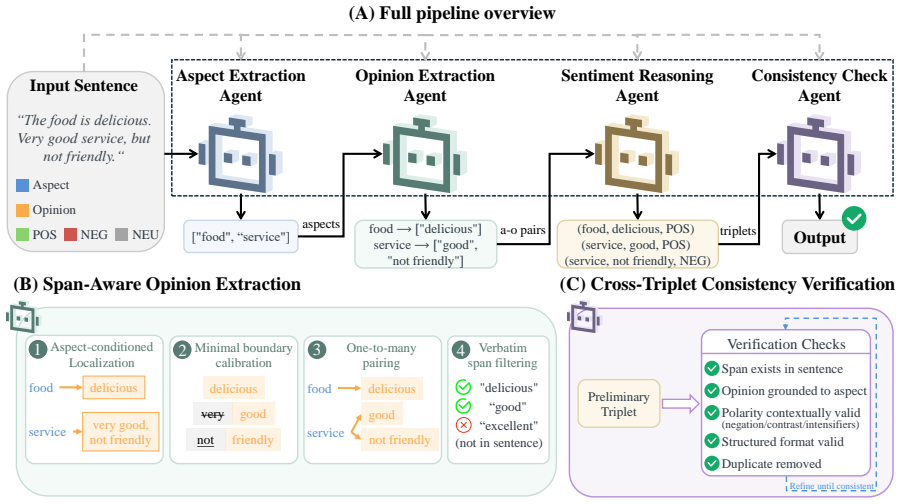
MASTE (Multi-Agent pipeline for zero-shot ASTE): four sequential agent stages, each handling a compositional subtask of aspect-sentiment-opinion triplet extraction, with explicit conditioning on prior outputs; training-free and backbone-agnostic.
Load-bearing premise
The paper attributes its gains to the four-stage decomposition with explicit conditioning, but the claim depends on the baselines being controlled for prompt engineering, backbone choice, and decoding parameters. If the improvements are driven by better prompts or cherry-picked benchmarks rather than the decomposition itself, the central claim weakens.
What would settle it
If a single-pass or chain-of-thought baseline, given equally engineered prompts and the same backbone with identical decoding parameters, matches or exceeds MASTE on the same four benchmarks, the decomposition strategy is not the source of the gains.
Editorial analysis
A structured set of objections, weighed in public.
Referee Report
Summary. The manuscript proposes MASTE, a multi-agent pipeline for zero-shot Aspect Sentiment Triplet Extraction (ASTE). The core idea is to decompose ASTE into four sequential stages, each handled by a specialized agent that conditions on prior outputs, thereby avoiding the difficulty of jointly predicting aspect spans, opinion spans, and sentiment polarity in a single decoding pass. The authors claim extensive experiments on four ASTE benchmarks showing substantial improvement over zero-shot and chain-of-thought LLM baselines under the same backbone, narrowing the gap to fully supervised methods without labeled triplets. Code is reportedly released. This review is based on the abstract and the reader's report, as the full text was not available for assessment.
Significance. Zero-shot ASTE is a practically relevant problem, and the decomposition of joint extraction into sequential agent stages is a reasonable architectural idea. The claim of being fully training-free and generalizing across backbones and datasets is appealing. However, the significance of the contribution cannot be fully assessed without the full text, which is needed to verify the experimental claims, the strength of baselines, and the presence of ablations isolating the decomposition from confounding factors such as prompt-engineering effort.
major comments (3)
- The central claim that the four-stage sequential decomposition drives the performance gains cannot be verified from the abstract alone. The reader's report correctly identifies the key confound: in multi-agent pipelines, each specialized agent typically receives its own task-specific system prompt, so the collective prompt content across four agents may encode substantially more domain instruction than a single baseline prompt. If the zero-shot and CoT baselines do not receive an equivalent amount of task-specific guidance (e.g., the concatenated text of all four agent prompts as a single prompt), the observed gains may reflect richer instruction rather than the decomposition architecture itself. The manuscript must include an ablation that isolates decomposition from instruction quantity. Without the full text, it is impossible to confirm whether such a control exists. This is load-bear
- The abstract does not quantify 'substantially outperforms' or 'narrowing the gap to fully supervised methods.' No numerical results, error bars, or statistical significance tests are visible. For a claim of this nature, the full text must report exact F1 scores (or equivalent metrics) on all four benchmarks, with standard deviations across multiple runs and significance tests against at least the strongest baseline. The absence of any quantification in the abstract makes it impossible to assess the magnitude of the contribution from the abstract alone.
- The claim of generalization 'across different backbones and datasets' requires explicit specification of which backbones were tested and whether the same prompts and decoding parameters were used across all backbones and baselines. Prompt parity across baselines is essential for the causal attribution to decomposition. The full text must be reviewed to confirm these controls.
minor comments (2)
- The abstract could benefit from including at least one representative numerical result (e.g., average F1 improvement over the best zero-shot baseline) to give readers an immediate sense of the magnitude of gains.
- The phrase 'inspired by the classical agent paradigm' is vague; a brief clarification of which specific prior work or paradigm is referenced would improve positioning.
Circularity Check
No circularity detected — empirical pipeline architecture evaluated on external benchmarks
full rationale
MASTE is a multi-agent pipeline architecture evaluated against external ASTE benchmarks. The abstract contains no derivation chain, no fitted parameters renamed as predictions, no uniqueness theorem invoked, and no self-citation chain. The central claim — that four-stage decomposition outperforms single-pass and CoT baselines — is an empirical hypothesis tested on external data, not a result forced by definition or by circular self-citation. The skeptic's concerns about prompt parity (whether gains come from decomposition vs. richer collective instruction) are validity/correctness risks, not circularity: they question whether the experiment isolates the right causal variable, not whether the conclusion is tautological with the inputs. With only the abstract available, no equation-level or definition-level circularity can be exhibited, and none is suggested. This is a normal, honest non-finding.
Axiom & Free-Parameter Ledger
free parameters (2)
- Stage-specific prompts =
unknown
- Backbone LLM =
unknown
axioms (3)
- domain assumption Decomposing ASTE into sequential subtasks with explicit conditioning improves zero-shot LLM performance
- ad hoc to paper Four stages are sufficient to cover the compositional structure of ASTE
- domain assumption Zero-shot LLM baselines (single-pass, chain-of-thought) are the appropriate comparison points
invented entities (1)
-
None
independent evidence
read the original abstract
Aspect Sentiment Triplet Extraction (ASTE) requires jointly identifying (aspect, opinion, sentiment) triples from a given review sentence. While large language models (LLMs) achieve strong zero-shot performance on many NLP benchmarks, their effectiveness on ASTE remains limited, as single-pass generation forces the model to determine span boundaries, opinion grouping, and sentiment polarity in a single decoding step. Common remedies, such as few-shot in-context learning and chain-of-thought prompting, offer only marginal improvements and rely heavily on either in-domain demonstrations sampled from labeled training data or carefully engineered reasoning prompts, neither of which is broadly available in zero-shot deployment. Inspired by the classical agent paradigm, we propose MASTE, a multi-agent pipeline for zero-shot Aspect Sentiment Triplet Extraction. MASTE decomposes ASTE into four sequential stages, where specialized agents handle different compositional subtasks with explicit conditioning on prior outputs. This design enables entirely training-free zero-shot ASTE and generalizes across different backbones and datasets. Extensive experiments on four ASTE benchmarks show that MASTE substantially outperforms zero-shot and chain-of-thought LLM baselines under the same backbone, narrowing the gap to fully supervised methods without using any labeled triplets. Code is available at https://github.com/Hankerlove/MASTE.
Figures

Reference graph
Works this paper leans on
-
[1]
Proceedings of the AAAI Conference on Artificial Intelligence , volume=
Knowing What, How and Why: A Near Complete Solution for Aspect-based Sentiment Analysis , author=. Proceedings of the AAAI Conference on Artificial Intelligence , volume=
-
[2]
Position-Aware Tagging for Aspect Sentiment Triplet Extraction , author=. Proceedings of EMNLP , pages=
-
[3]
Pontiki, Maria and Galanis, Dimitris and Pavlopoulos, John and Papageorgiou, Harris and Androutsopoulos, Ion and Manandhar, Suresh , booktitle=
-
[4]
Grid Tagging Scheme for Aspect-Oriented Fine-Grained Opinion Extraction , author=. Findings of EMNLP , pages=
-
[5]
Enhanced Multi-Channel Graph Convolutional Network for Aspect Sentiment Triplet Extraction , author=. Proceedings of ACL , pages=
-
[6]
Towards Generative Aspect-Based Sentiment Analysis , author=. Proceedings of ACL , pages=
-
[7]
A Unified Generative Framework for Aspect-Based Sentiment Analysis , author=. Proceedings of ACL , pages=
-
[8]
Sun, Qiao and Wei, Zhao and Long, Yunfei and Lu, Qin and Chen, Ruifeng , booktitle=
-
[9]
Bodke, Mandar and others , booktitle=
-
[10]
Improving Factuality and Reasoning in Language Models through Multiagent Debate , author=. Proceedings of ICML , year=
-
[11]
Lu, Meng and Xie, Yuzhang and Bi, Zhenyu and Cao, Shuxiang and Wang, Xuan , booktitle=
-
[12]
Shi, Yuchen and Jiang, Guochao and Qiu, Tian and Yang, Deqing , booktitle=
-
[13]
arXiv preprint arXiv:2511.13118 , year=
Extracting Events Like Code: A Multi-Agent Programming Framework for Zero-Shot Event Extraction , author=. arXiv preprint arXiv:2511.13118 , year=
-
[14]
Wang, Zheng and others , booktitle=
-
[15]
Zhang, Fang and others , booktitle=
-
[16]
Debating Truth: Debate-Driven Claim Verification with Multiple
Wu, Anonymous and others , booktitle=. Debating Truth: Debate-Driven Claim Verification with Multiple
-
[17]
Anonymous , booktitle=
-
[18]
Debate Only When Necessary: Adaptive Multiagent Collaboration for Efficient
Anonymous , journal=. Debate Only When Necessary: Adaptive Multiagent Collaboration for Efficient
- [19]
-
[20]
Proceedings of NeurIPS , year=
Chain-of-Thought Prompting Elicits Reasoning in Large Language Models , author=. Proceedings of NeurIPS , year=
-
[21]
Least-to-Most Prompting Enables Complex Reasoning in Large Language Models , author=. Proceedings of ICLR , year=
-
[22]
Training Verifiers to Solve Math Word Problems
Training Verifiers to Solve Math Word Problems , author=. arXiv preprint arXiv:2110.14168 , year=
work page internal anchor Pith review Pith/arXiv arXiv
-
[23]
Train Once for All: A Transitional Approach for Efficient Aspect Sentiment Triplet Extraction
Train Once for All: A Transitional Approach for Efficient Aspect Sentiment Triplet Extraction , author=. arXiv preprint arXiv:2412.00208 , year=
work page internal anchor Pith review Pith/arXiv arXiv
-
[24]
arXiv preprint arXiv:2412.19437 , year=
work page internal anchor Pith review Pith/arXiv arXiv
-
[25]
Naglik, Iwo and Lango, Mateusz , booktitle=
-
[26]
Scaria, Kevin and Gupta, Himanshu and Goyal, Siddharth and Sawant, Saurabh Arjun and Mishra, Swaroop and Baral, Chitta , booktitle=
-
[27]
Findings of the Association for Computational Linguistics: NAACL 2024 , pages=
Sentiment analysis in the era of large language models: A reality check , author=. Findings of the Association for Computational Linguistics: NAACL 2024 , pages=
work page 2024
-
[28]
Proceedings of the 31st international conference on computational linguistics , pages=
Aspect-based sentiment analysis with syntax-opinion-sentiment reasoning chain , author=. Proceedings of the 31st international conference on computational linguistics , pages=
-
[29]
Faima: Feature-aware in-context learning for multi-domain aspect-based sentiment analysis , author=. Proceedings of the 2024 Joint International Conference on Computational Linguistics, Language Resources and Evaluation (LREC-COLING 2024) , pages=
work page 2024
-
[30]
Advances in Neural Information Processing Systems (NeurIPS) , year=
Language Models are Few-Shot Learners , author=. Advances in Neural Information Processing Systems (NeurIPS) , year=
-
[31]
Pontiki, Maria and Galanis, Dimitris and Papageorgiou, Haris and Manandhar, Suresh and Androutsopoulos, Ion , booktitle=
-
[32]
Proceedings of the 10th International Workshop on Semantic Evaluation , pages=
Pontiki, Maria and Galanis, Dimitris and Papageorgiou, Haris and Androutsopoulos, Ion and Manandhar, Suresh and AL-Smadi, Mohammad and Al-Ayyoub, Mahmoud and Zhao, Yanyan and Qin, Bing and De Clercq, Orph. Proceedings of the 10th International Workshop on Semantic Evaluation , pages=
-
[33]
Proceedings of the 57th annual meeting of the association for computational linguistics , pages=
Neural aspect and opinion term extraction with mined rules as weak supervision , author=. Proceedings of the 57th annual meeting of the association for computational linguistics , pages=
-
[34]
Proceedings of the AAAI conference on artificial intelligence , volume=
Coupled multi-layer attentions for co-extraction of aspect and opinion terms , author=. Proceedings of the AAAI conference on artificial intelligence , volume=
discussion (0)
Sign in with ORCID, Apple, or X to comment. Anyone can read and Pith papers without signing in.