REVIEW 4 major objections 5 minor 2 cited by
This paper claims that ultra-long user histories can be compressed into about two hundred personalized interest centers, and that this compressed representation beats full-sequence attention while lifting click-through rate by 1.65% in prod
Reviewed by Pith at T0; open to challenge. T0 means a machine referee read the full paper against a public rubric. the ladder, T0–T4 →
T0 review · deepseek-v4-flash
2026-08-02 21:10 UTC pith:NHPKZ2KY
load-bearing objection A competent industrial compression paper whose own ablation undercuts the hierarchical-voting novelty, but the soft-routing mechanism and deployment results are worth peer review if the A/B methodology is disclosed. the 4 major comments →
HiSAC: Hierarchical Sparse Activation Compression for Ultra-long Sequence Modeling in Recommenders
The pith
A machine-rendered reading of the paper's core claim, the machinery that carries it, and where it could break.
Core claim
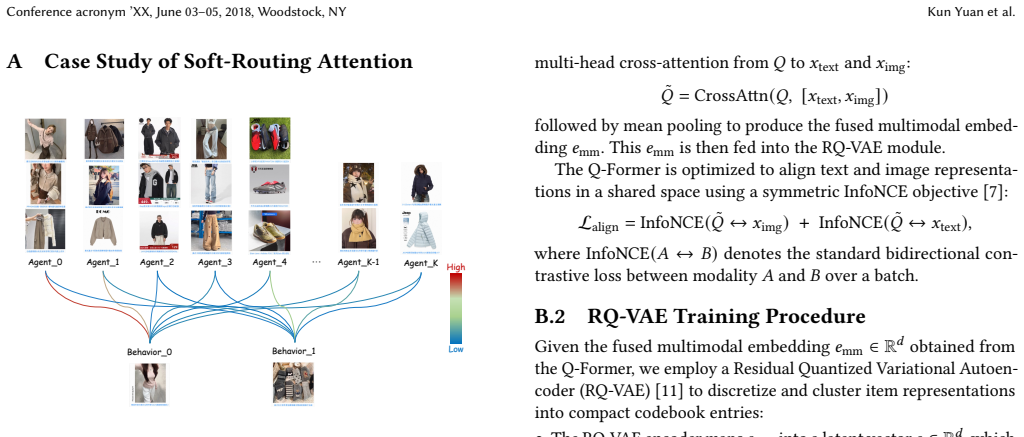
On the paper's own terms, the discovery is that sequence compression can be personalized and soft rather than fixed and hard. HiSAC first converts every item into a multi-level semantic identifier using a multimodal encoder plus residual quantization, and organizes all identifiers into a global semantic tree. For each user, hierarchical voting prunes the tree to around 200 interest-agents—prototypes that represent that user's dominant coarse and fine interests. Then Soft-Routing Attention computes, for each agent, a weighted average of trainable ranking embeddings, with weights given by a temperature-scaled softmax over negative L2 distances between the frozen semantic embeddings of historic
What carries the argument
The load-bearing objects are 'interest-agents' and 'Soft-Routing Attention.' Interest-agents are user-specific preference centers obtained by voting on a global hierarchical semantic tree: each user's tokenized history votes at the leaves, votes are summed upward, and a top-k pruning at each level retains the most salient branches, giving each user about K=200 agents. Soft-Routing Attention is Eq. (4): for each agent prototype z_a, every historical item e_i receives weight proportional to exp(-||e_i - z_a||^2 / tau), and the agent's output is the weighted sum of the corresponding trainable ranking embeddings e'_i. The mechanism's work is to replace exact hard assignment with similarity-weigh
Load-bearing premise
The load-bearing premise is that L2 distance in the frozen multimodal semantic space is a faithful proxy for how much a past item should contribute to a user's interest; if visual and textual similarity does not track purchase preference, the soft-routing weights become smoothed noise and the claimed gains would not transfer.
What would settle it
A reader could run a held-out routing test: for users with long histories, compute the soft-routing weights, hold out the most recent click, and check whether items with high predicted weight to an activated agent are clicked more often than matched items with low weight. If routing weights are no better than random assignment at predicting held-out behavior, the mechanism is not doing the work. A cheaper control is to replace the L2 distances in Eq. (4) with random weights of the same distribution; if the offline AUC gap to HiSAC largely persists, the paper's attribution to semantic similarit
If this is right
- At sequence lengths of 10,000, a roughly 200-agent compression can replace exact full-sequence attention in serving without an AUC penalty—and with a gain—so the practical ceiling on history length is lifted.
- Soft routing means rare, long-tail interactions are not discarded when they fail to match an interest center exactly; they still contribute through nearest semantic agents, so diversity does not have to be traded for compression.
- Decoupling frozen semantic routing from trainable ranking aggregation preserves a wider set of activated interest centers (about 13% more agents than an aligned-embedding variant), which should mainly help users with heterogeneous tastes.
- Keeping broad coarse-level branches rather than spending the agent budget on fine-grained leaves yields most of the benefit, so the method's serving cost stays controllable through the voting budget.
- The reported production deployment caches the compressed sequence per request and per user, cutting end-to-end latency by about 40% with no measurable loss in recommendation performance.
Where Pith is reading between the lines
- Editorial inference: the paper restricts routing to a frozen semantic space; a natural extension is to test a lightly adapted routing space that is not fully aligned to the ranking objective, since the paper's decoupling result predicts heavy alignment collapses interest coverage.
- Editorial inference: the hierarchical budget finding—broad coarse categories matter more than many fine leaves—suggests other compressed-memory designs could allocate capacity by semantic breadth first, though the paper does not test that transfer.
- Editorial inference: because the A/B control definition and significance details are not disclosed, the exact 1.65% lift should not be expected to transfer to other platforms; the portable claim is the mechanism, not the number.
Editorial analysis
A structured set of objections, weighed in public.
Referee Report
Summary. HiSAC proposes a three-stage pipeline for compressing ultra-long user behavior sequences: (1) tokenizing items into multi-level semantic IDs using a frozen CLIP encoder and RQ-VAE; (2) building a global hierarchical semantic tree and using bottom-up voting/top-down pruning to select per-user interest agents; (3) computing a small set of agent representations by soft-routing attention over all historical items in the semantic space, with aggregation content taken from learned ranking embeddings. The compressed sequence is then fed to MHA-based ranking. Experiments on a 200M-user industrial dataset and Taobao-MM claim state-of-the-art offline AUC/GAUC, ablations attribute gains to multimodal tokenization and soft-routing, and a two-week online A/B test on Taobao reports a 1.65% CTR improvement. Deployment optimizations (offline tree construction, request-level compression, cache-enhanced MHA) are claimed to reduce latency by ~40% with no measurable loss.
Significance. If the claims hold, the practical significance is high: a production-deployable method that reduces a 10k behavior sequence to ~200 semantic agents while improving CTR over the strongest prior compression method would be a meaningful contribution to industrial sequence modeling. The paper is strongest on specification: the routing equations (Eq. 4, Appendix C) are explicit, the comparison set is broad (K-Means, LSH, Patching, Aggregator, ELASTIC, Longer, SIM, TWIN, PatchRec), and the ablation structure isolates tokenization, routing, long-tail handling, and embedding decoupling. However, the empirical support is currently too thin in three places: no uncertainty quantification, an A/B test without methodology, and an ablation that undermines the stated role of the paper's headline mechanism.
major comments (4)
- [Table 3 / §3.4] As written, the paper's central novelty—hierarchical voting for identifying user-specific interest centers—is not supported by its own ablation. Table 3 reports w/o Hierarchical Voting with AUC 0.6445/GAUC 0.5525 vs. full HiSAC 0.6444/0.5525. The text states this variant 'yields only a 0.01pt AUC gain,' but that gain belongs to the variant without voting, not to voting. Since the abstract, §1 and §3.4 present voting as the mechanism that accurately identifies user-specific interest centers and is central to the accuracy story, the evidence instead supports voting as a pure computational prune (3× fewer agents at essentially equal AUC). The paper should be repositioned: either explicitly frame voting as an efficiency component and remove accuracy-based claims associated with it in the abstract and contributions, or provide new experiments where voting improves accuracy.
- [§4.5, Table 5] The headline online result is a 1.65% CTR uplift, but Table 5 provides only relative lifts. No control definition, baseline method, experiment duration (a two-week window is mentioned), user allocation, significance tests, confidence intervals, or guardrail metrics are reported. The abstract says the improvement is 'over the strongest prior compression method,' but this comparison is not documented. For a load-bearing industrial result, this is not a style issue; please add standard A/B test reporting, including the exact control arm, metric definitions, allocation, duration, significance, and guardrails.
- [§4.2, Table 1] Offline margins between HiSAC and the best baselines are 0.0002–0.0006 AUC (e.g., 0.6444 vs. 0.6438 Aggregator at 10k; 0.6449 vs. 0.6442 ELASTIC at 10k). No error bars, number of seeds, or statistical tests are reported. With ~200M users, even tiny differences could be nominally significant, but without within-dataset variance (e.g., bootstrap over users or multiple runs), the paper's claim that HiSAC 'achieves the best overall performance' at every sequence length is not established. Please report confidence intervals or pairwise significance tests for the main comparisons.
- [§3.5, Eq. (4), Appendix C] The routing weights are defined by negative L2 distance in a frozen CLIP-derived semantic space. This is load-bearing: all of soft-routing's benefit depends on semantic distance being a useful proxy for user preference similarity. Appendix C asserts L2 is 'more stable' than cosine without giving the comparison. The only indirect evidence is the ablation in Table 4 and the 0.2pt drop from w/o Multimodal Encoder. Please provide a direct validation—for example, a head-to-head L2 vs. cosine routing comparison, or an analysis showing that held-out clicks are more likely among L2-nearest agents than among random agents.
minor comments (5)
- [§3.6] The claim of 'no measurable loss' for deployment optimizations is asserted. Since the cache-enhanced MHA is said to preserve identical outputs, the more relevant risk is daily refresh of interest trees; please report offline accuracy before/after the optimized serving path and characterize staleness effects.
- [Eq. (4)] The notation z_{a,k} is introduced without defining the double index; z_a is defined in §3.5. Use consistent subscripting throughout.
- [Figures 4 and 5] The curves appear to be single runs. Add error bars or replicated values, and state the exact values of log(τ) for the curves in Figure 5(b).
- [§4.3] In the w/o Long-Tail Interests ablation, clarify what 'cannot be matched' means precisely: exact SID match? a similarity threshold? This affects interpretation of the 0.06pt gain.
- [Tables 1–3] The AUC values differ at the fourth decimal place. Consider reporting differences in 1e-4 units or with explicit standard deviations to avoid presenting false precision.
Circularity Check
No significant circularity: HiSAC is an empirical systems paper whose equations define the mechanism and whose main claims are tested against external baselines and online A/B metrics.
full rationale
HiSAC does not claim to derive any target quantity from a fitted input. The routing weights in Eq. (4) are defined directly as a softmax over negative L2 distances between frozen semantic item embeddings and agent prototypes; the prototypes are selected by explicit vote counts in Section 3.4; the ranking embeddings are trained end-to-end. No component's value is set by the metric it is later said to predict. Offline comparisons are against external baselines (K-Means, LSH, Patching, Aggregator, ELASTIC, Longer, PatchRec, SIM, TWIN) with a fixed compression budget of 200 groups, and the online A/B result is an external business measurement rather than a derived prediction. The citation list includes work by Alibaba-affiliated groups, but no load-bearing citation is authored by the present authors, and no uniqueness theorem is imported from prior same-author work. The closest concern—Table 3 shows 'w/o Hierarchical Voting' AUC 0.6445 versus HiSAC 0.6444—undermines the paper's novelty framing but is an internal-consistency or interpretation issue, not circularity: the ablation is an empirical comparison, not a reduction of the output to the input by construction. The deployment claims (e.g., cache-enhanced MHA preserving identical outputs) are justified by stated algebraic equivalences, not by renaming fitted quantities. Accordingly, no circular step is exhibited.
Axiom & Free-Parameter Ledger
free parameters (5)
- τ (soft-routing temperature) =
log(τ) ≈ −0.18 (τ ≈ 0.835) at K=200, L=2
- Interest-agent budget K =
≈200 (industrial); 200 groups for all compared methods
- Top-k allocation (k(1), k(2)) across hierarchy levels =
(100, 2) preferred among [(50,4),(100,2),(200,1)]
- RQ-VAE depth L and codebook sizes =
L=2; 512 entries/level (industrial), 200 entries/level × 2 (Taobao-MM)
- Commitment coefficient β in RQ-VAE loss =
0.25
axioms (5)
- domain assumption Frozen CLIP-based semantic space (multimodal encoder + RQ-VAE) yields L2 distances that rank user preference similarity.
- domain assumption User interests are stable within a day, so daily offline interest-tree construction does not degrade online accuracy.
- domain assumption A fixed global semantic tree plus per-user top-k voting preserves ranking-relevant information at K≈200.
- domain assumption RQ-VAE codebooks form semantically coherent clusters in the item space.
- standard math Attention/softmax algebra and matrix formulation are valid.
invented entities (1)
-
Interest-agents A_u with weights W_u
no independent evidence
read the original abstract
Modern recommender systems leverage ultra-long user behavior sequences to capture dynamic preferences, but end-to-end modeling is infeasible in production due to latency and memory constraints. While summarizing history via interest centers offers a practical alternative, existing methods struggle to (1) identify user-specific centers at appropriate granularity and (2) accurately assign behaviors, leading to quantization errors and loss of long-tail preferences. To alleviate these issues, we propose Hierarchical Sparse Activation Compression (HiSAC), an efficient framework for personalized sequence modeling. HiSAC encodes interactions into multi-level semantic IDs and constructs a global hierarchical codebook. A hierarchical voting mechanism sparsely activates personalized interest-agents as fine-grained preference centers. Guided by these agents, Soft-Routing Attention aggregates historical signals in semantic space, weighting by similarity to minimize quantization error and retain long-tail behaviors. Deployed on Taobao's "Guess What You Like" homepage, HiSAC achieves significant compression and cost reduction, with online A/B tests showing a consistent 1.65% CTR uplift -- demonstrating its scalability and real-world effectiveness.
Figures


Forward citations
Cited by 2 Pith papers
-
IAT: Instance-As-Token Compression for Historical User Sequence Modeling in Industrial Recommender Systems
IAT compresses each historical interaction instance into a unified embedding token via temporal-order or user-order schemes, allowing standard sequence models to learn long-range preferences with better performance an...
-
SinkRec: Mitigating Semantic State Sink in Long Sequence Recommendation with Memory-Conditioned Gated Delta Networks
SinkRec proposes a memory-conditioned architecture with TDGD to mitigate semantic state sink in linear attention for long-sequence recommendation.
Reference graph
Works this paper leans on
-
[1]
Zheng Chai, Qin Ren, Xijun Xiao, Huizhi Yang, Bo Han, Sijun Zhang, Di Chen, Hui Lu, Wenlin Zhao, Lele Yu, et al . 2025. Longer: Scaling up long sequence modeling in industrial recommenders. InProceedings of the Nineteenth ACM Conference on Recommender Systems. 247–256
2025
-
[2]
Jianxin Chang, Chenbin Zhang, Zhiyi Fu, Xiaoxue Zang, Lin Guan, Jing Lu, Yiqun Hui, Dewei Leng, Yanan Niu, Yang Song, et al. 2023. TWIN: TWo-stage interest network for lifelong user behavior modeling in CTR prediction at kuaishou. In Proceedings of the 29th ACM SIGKDD Conference on Knowledge Discovery and Data Mining. 3785–3794
2023
-
[3]
Bao Chong et al. 2021. K-means clustering algorithm: a brief review.Academic Journal of Computing & Information Science4, 5 (2021), 37–40
2021
-
[4]
Mayur Datar, Nicole Immorlica, Piotr Indyk, and Vahab S Mirrokni. 2004. Locality- sensitive hashing scheme based on p-stable distributions. InProceedings of the twentieth annual symposium on Computational geometry. 253–262
2004
-
[5]
Jiaxin Deng, Shiyao Wang, Song Lu, Yinfeng Li, Xinchen Luo, Yuanjun Liu, Peixing Xu, and Guorui Zhou. 2024. ELASTIC: Efficient Linear Attention for Sequential Interest Compression.arXiv preprint arXiv:2408.09380(2024)
Pith/arXiv arXiv 2024
-
[6]
Duy-Tai Dinh, Tsutomu Fujinami, and Van-Nam Huynh. 2019. Estimating the optimal number of clusters in categorical data clustering by silhouette coefficient. InInternational Symposium on Knowledge and Systems Sciences. Springer, 1–17
2019
-
[7]
Kaiming He, Haoqi Fan, Yuxin Wu, Saining Xie, and Ross Girshick. 2020. Mo- mentum contrast for unsupervised visual representation learning. InProceedings of the IEEE/CVF conference on computer vision and pattern recognition. 9729–9738
2020
-
[8]
Ruining He, Lukasz Heldt, Lichan Hong, Raghunandan Keshavan, Shifan Mao, Nikhil Mehta, Zhengyang Su, Alicia Tsai, Yueqi Wang, Shao-Chuan Wang, et al
-
[9]
Samuel Humeau, Kurt Shuster, Marie-Anne Lachaux, and Jason Weston. 2019. Poly-encoders: Transformer architectures and pre-training strategies for fast and accurate multi-sentence scoring.arXiv preprint arXiv:1905.01969(2019)
Pith/arXiv arXiv 2019
-
[10]
Nikita Kitaev, Łukasz Kaiser, and Anselm Levskaya. 2020. Reformer: The efficient transformer.arXiv preprint arXiv:2001.04451(2020)
Pith/arXiv arXiv 2020
-
[11]
Doyup Lee, Chiheon Kim, Saehoon Kim, Minsu Cho, and Wook-Shin Han. 2022. Autoregressive image generation using residual quantization. InProceedings of the IEEE/CVF conference on computer vision and pattern recognition. 11523–11532
2022
-
[12]
Junnan Li, Dongxu Li, Silvio Savarese, and Steven Hoi. 2023. Blip-2: Bootstrapping language-image pre-training with frozen image encoders and large language models. InInternational conference on machine learning. PMLR, 19730–19742
2023
-
[13]
Jiayi Liao, Ruobing Xie, Sihang Li, Xiang Wang, Xingwu Sun, Zhanhui Kang, and Xiangnan He. 2025. Multi-Grained Patch Training for Efficient LLM-based Recommendation. InProceedings of the 48th International ACM SIGIR Conference on Research and Development in Information Retrieval. 1572–1581
2025
-
[14]
Chengkai Liu, Jianghao Lin, Jianling Wang, Hanzhou Liu, and James Caverlee
-
[15]
Qi Pi, Guorui Zhou, Yujing Zhang, Zhe Wang, Lejian Ren, Ying Fan, Xiaoqiang Zhu, and Kun Gai. 2020. Search-based user interest modeling with lifelong sequential behavior data for click-through rate prediction. InProceedings of the 29th ACM International Conference on Information & Knowledge Management. 2685–2692
2020
-
[16]
Alec Radford, Jong Wook Kim, Chris Hallacy, Aditya Ramesh, Gabriel Goh, Sandhini Agarwal, Girish Sastry, Amanda Askell, Pamela Mishkin, Jack Clark, et al. 2021. Learning transferable visual models from natural language supervision. InInternational conference on machine learning. PmLR, 8748–8763
2021
-
[17]
Ali Razavi, Aaron Van den Oord, and Oriol Vinyals. 2019. Generating diverse high-fidelity images with vq-vae-2.Advances in neural information processing systems32 (2019)
2019
-
[18]
Aurko Roy, Mohammad Saffar, Ashish Vaswani, and David Grangier. 2021. Effi- cient content-based sparse attention with routing transformers.Transactions of the Association for Computational Linguistics9 (2021), 53–68
2021
-
[19]
Zhuoran Shen, Mingyuan Zhang, Haiyu Zhao, Shuai Yi, and Hongsheng Li
-
[20]
Xiang-Rong Sheng, Feifan Yang, Litong Gong, Biao Wang, Zhangming Chan, Yujing Zhang, Yueyao Cheng, Yong-Nan Zhu, Tiezheng Ge, Han Zhu, et al
-
[21]
Zihua Si, Lin Guan, ZhongXiang Sun, Xiaoxue Zang, Jing Lu, Yiqun Hui, Xingchao Cao, Zeyu Yang, Yichen Zheng, Dewei Leng, et al. 2024. Twin v2: Scaling ultra- long user behavior sequence modeling for enhanced ctr prediction at kuaishou. InProceedings of the 33rd ACM International Conference on Information and Knowledge Management. 4890–4897
2024
-
[22]
Fei Sun, Jun Liu, Jian Wu, Changhua Pei, Xiao Lin, Wenwu Ou, and Peng Jiang
-
[23]
Aaron Van Den Oord, Oriol Vinyals, et al. 2017. Neural discrete representation learning.Advances in neural information processing systems30 (2017)
2017
-
[24]
InProceedings of the 33rd ACM International Conference on Information and Knowledge Management
Enhancing Taobao Display Advertising with Multimodal Representations: Challenges, Approaches and Insights. InProceedings of the 33rd ACM International Conference on Information and Knowledge Management. 4858–4865
-
[25]
Bin Wu, Feifan Yang, Zhangming Chan, Yu-Ran Gu, Jiawei Feng, Chao Yi, Xiang- Rong Sheng, Han Zhu, Jian Xu, Mang Ye, and Bo Zheng. 2025. MUSE: A Simple Yet Effective Multimodal Search-Based Framework for Lifelong User Interest Modeling. arXiv:2512.07216 [cs.IR] https://arxiv.org/abs/2512.07216
arXiv 2025
-
[26]
Xu Xie, Fei Sun, Zhaoyang Liu, Shiwen Wu, Jinyang Gao, Jiandong Zhang, Bolin Ding, and Bin Cui. 2022. Contrastive learning for sequential recommendation. In 2022 IEEE 38th international conference on data engineering (ICDE). IEEE, 1259– 1273
2022
-
[27]
Ailing Zeng, Muxi Chen, Lei Zhang, and Qiang Xu. 2023. Are transformers effective for time series forecasting?. InProceedings of the AAAI conference on artificial intelligence, Vol. 37. 11121–11128
2023
-
[28]
Shuai Zhang, Lina Yao, Aixin Sun, and Yi Tay. 2019. Deep learning based recom- mender system: A survey and new perspectives.ACM computing surveys (CSUR) 52, 1 (2019), 1–38
2019
-
[29]
Ashish Vaswani, Noam Shazeer, Niki Parmar, Jakob Uszkoreit, Llion Jones, Aidan N Gomez, Łukasz Kaiser, and Illia Polosukhin. 2017. Attention is all you need.Advances in neural information processing systems30 (2017)
2017
-
[30]
top- wear
Guorui Zhou, Xiaoqiang Zhu, Chenru Song, Ying Fan, Han Zhu, Xiao Ma, Yanghui Yan, Junqi Jin, Han Li, and Kun Gai. 2018. Deep interest network for click-through rate prediction. InProceedings of the 24th ACM SIGKDD international conference on knowledge discovery & data mining. 1059–1068. Conference acronym ’XX, June 03–05, 2018, Woodstock, NY Kun Yuan et a...
2018
-
[34]
Guorui Zhou, Na Mou, Ying Fan, Qi Pi, Weijie Bian, Chang Zhou, Xiaoqiang Zhu, and Kun Gai. 2019. Deep interest evolution network for click-through rate prediction. InProceedings of the AAAI conference on artificial intelligence, Vol. 33. 5941–5948
2019
-
[2019]
InProceedings of the 28th ACM international conference on information and knowledge management
BERT4Rec: Sequential recommendation with bidirectional encoder rep- resentations from transformer. InProceedings of the 28th ACM international conference on information and knowledge management. 1441–1450
-
[2021]
InProceedings of the IEEE/CVF winter conference on applications of computer vision
Efficient attention: Attention with linear complexities. InProceedings of the IEEE/CVF winter conference on applications of computer vision. 3531–3539
-
[2024]
Mamba4rec: Towards efficient sequential recommendation with selective state space models.arXiv preprint arXiv:2403.03900(2024)
Pith/arXiv arXiv 2024
-
[2025]
Plum: Adapting pre-trained language models for industrial-scale generative recommendations.arXiv preprint arXiv:2510.07784(2025)
arXiv 2025
discussion (0)
Sign in with ORCID, Apple, or X to comment. Anyone can read and Pith papers without signing in.