An Unsupervised Framework for Dynamic Health Indicator Construction and Its Application in Rolling Bearing Prognostics
Pith reviewed 2026-05-25 08:03 UTC · model grok-4.3
The pith
An unsupervised autoencoder framework constructs dynamic health indicators for rolling bearings by modeling temporal dependence in degradation without expert features.
A machine-rendered reading of the paper's core claim, the machinery that carries it, and where it could break.
Core claim
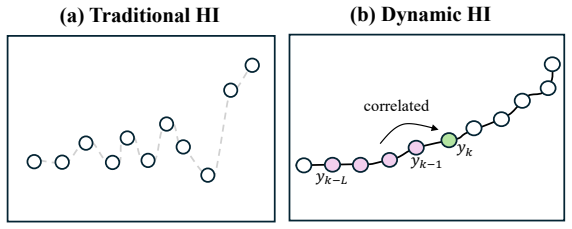
By first mapping raw signals into a degradation feature space via a skip-connection autoencoder and then generating the health indicator inside a module that contains an explicit inner prediction block, the framework produces a dynamic HI whose value at each step depends on its own prior states, thereby capturing the inherent temporal dynamics of the degradation process and improving both trend representation and future prognostics.
What carries the argument
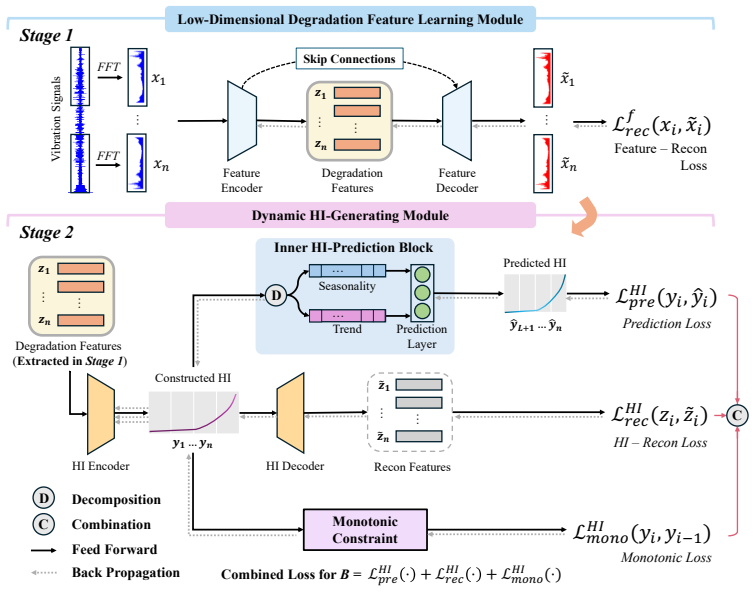
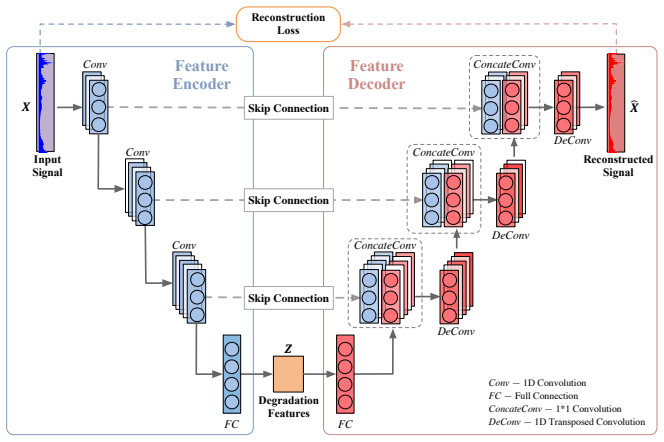
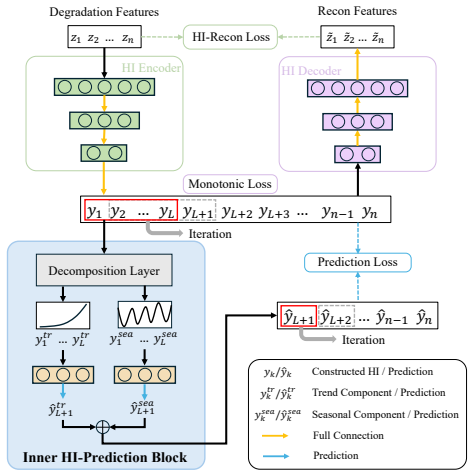
Skip-connection-based autoencoder that learns a degradation feature space, combined with an HI-generating module containing an inner HI-prediction block that enforces temporal dependence between successive HI values.
If this is right
- The dynamic HI supplies a more faithful representation of degradation trends than indicators that ignore temporal dependence.
- Future degradation prognostics become more accurate because the indicator already encodes the relationship between past and present states.
- The entire construction runs without expert-selected features, removing a common source of human bias in bearing monitoring.
- The same architecture can be applied to any sequential degradation signal once raw measurements are available.
Where Pith is reading between the lines
- The same unsupervised feature-plus-prediction structure might transfer to other rotating equipment such as gearboxes or turbines where vibration data are plentiful but labeled failure times are scarce.
- If the inner prediction block is the key to capturing dynamics, replacing it with other sequence models could further improve long-horizon forecasts.
- The approach implies that health indicators for predictive maintenance can be learned end-to-end from raw sensors rather than engineered in stages.
Load-bearing premise
Raw vibration signals contain degradation information that an autoencoder can isolate without human guidance, and explicitly predicting the next HI value from earlier ones correctly encodes the true time evolution of bearing wear.
What would settle it
On the same two bearing lifecycle datasets, if the dynamic HI shows equal or worse accuracy in remaining-useful-life prediction or trend correlation compared with methods that rely on manually chosen statistical features, the claim that the unsupervised dynamic construction is superior would be falsified.
Figures


read the original abstract
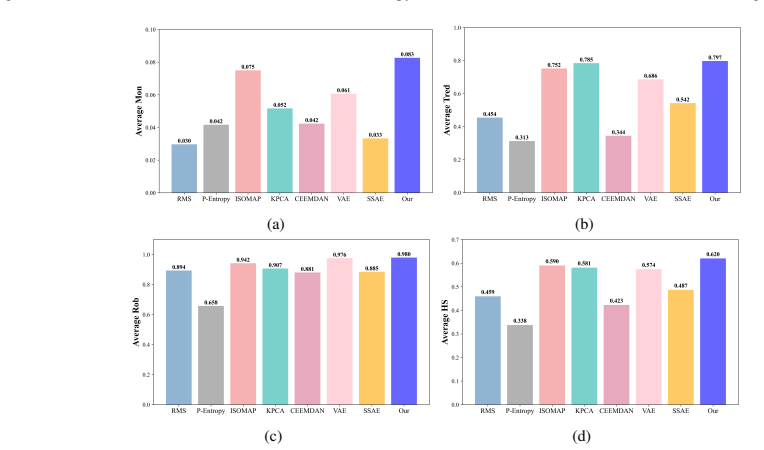
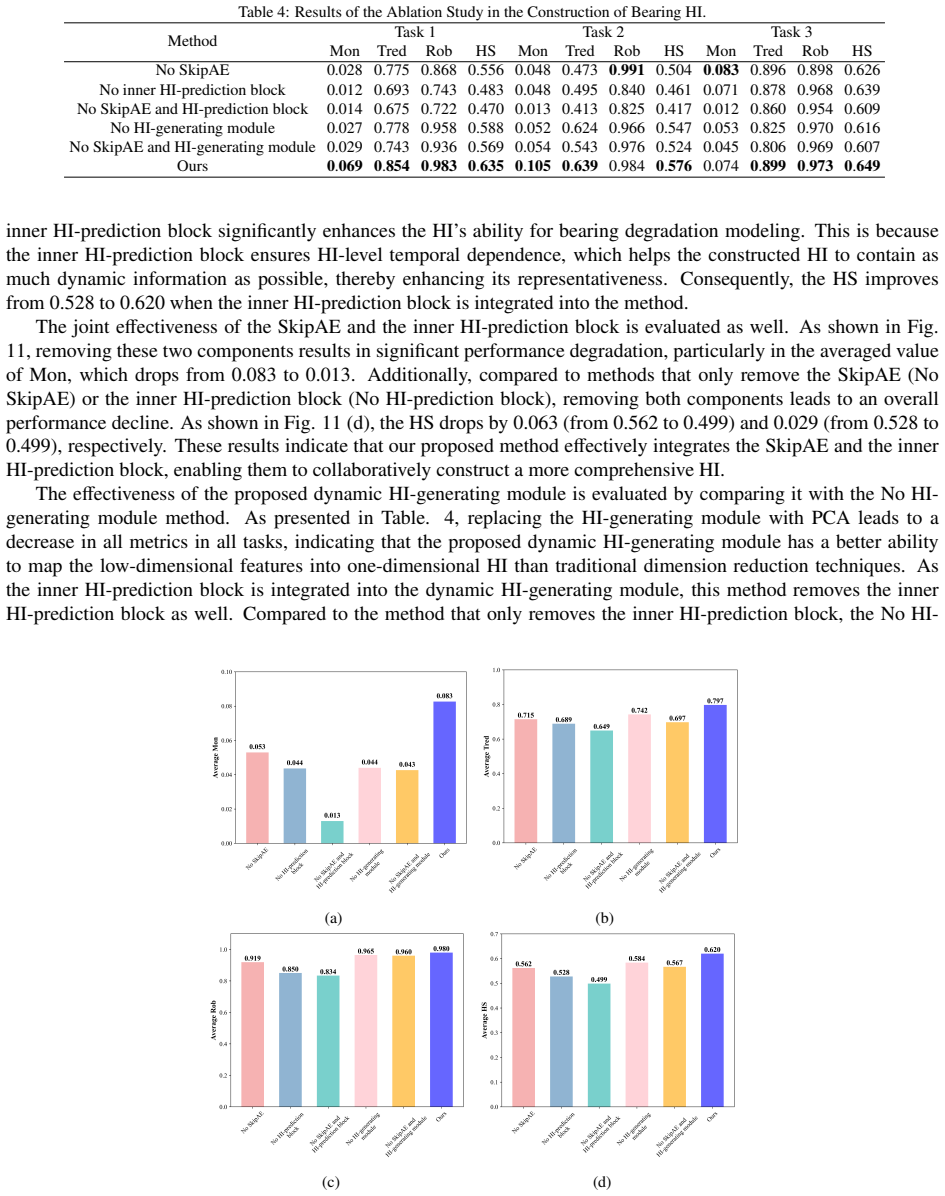
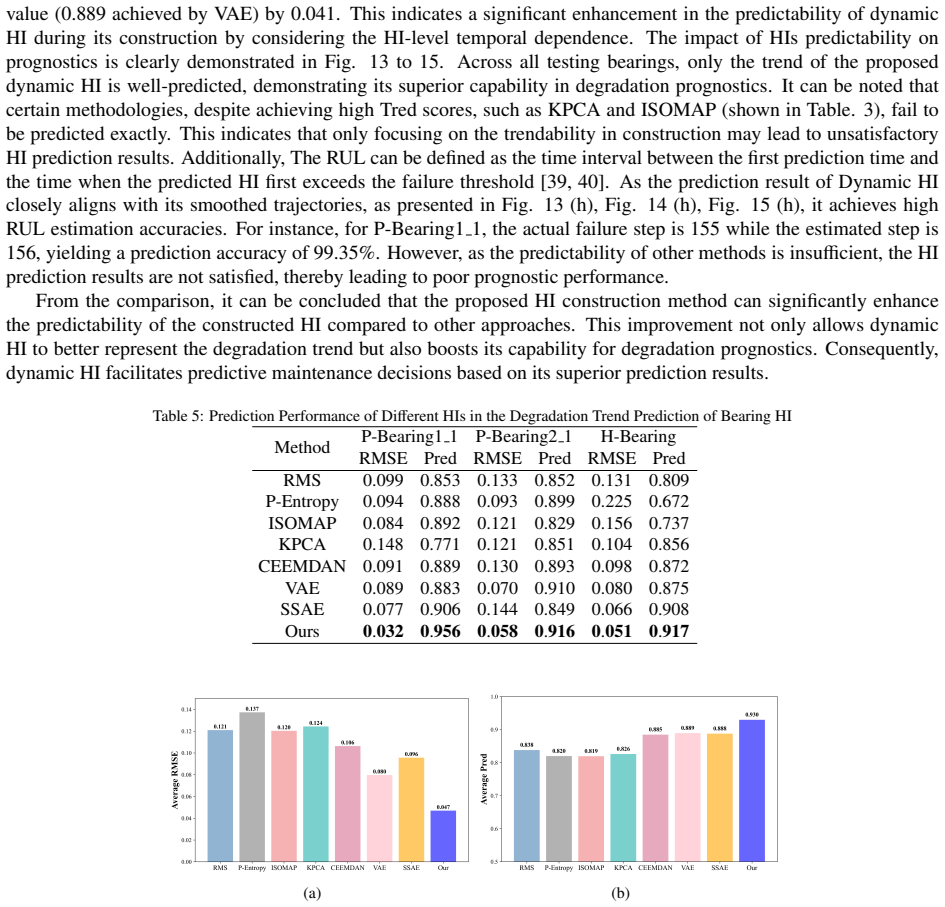
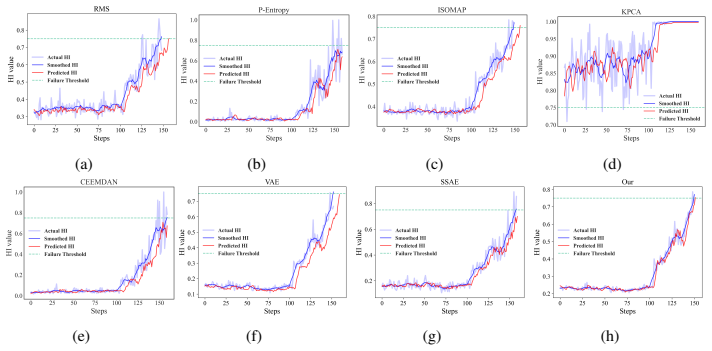
Health indicator (HI) plays a key role in degradation assessment and prognostics of rolling bearings. Although various HI construction methods have been investigated, most of them rely on expert knowledge for feature extraction and overlook capturing dynamic information hidden in sequential degradation processes, which limits the ability of the constructed HI for degradation trend representation and prognostics. To address these concerns, a novel dynamic HI that considers HI-level temporal dependence is constructed through an unsupervised framework. Specifically, a degradation feature learning module composed of a skip-connection-based autoencoder first maps raw signals to a representative degradation feature space (DFS) to automatically extract essential degradation features without the need for expert knowledge. Subsequently, in this DFS, a new HI-generating module embedded with an inner HI-prediction block is proposed for dynamic HI construction, where the temporal dependence between past and current HI states is guaranteed and modeled explicitly. On this basis, the dynamic HI captures the inherent dynamic contents of the degradation process, ensuring its effectiveness for degradation tendency modeling and future degradation prognostics. The experiment results on two bearing lifecycle datasets demonstrate that the proposed HI construction method outperforms comparison methods, and the constructed dynamic HI is superior for prognostic tasks.
Editorial analysis
A structured set of objections, weighed in public.
Referee Report
Summary. The paper proposes an unsupervised framework for constructing a dynamic health indicator (HI) for rolling bearing prognostics. A skip-connection-based autoencoder first maps raw vibration signals to a degradation feature space (DFS) to extract essential features automatically. An HI-generating module then embeds an inner HI-prediction block to explicitly model temporal dependence between past and current HI states. The authors claim this yields a dynamic HI that captures inherent degradation dynamics and outperforms comparison methods on two bearing lifecycle datasets for both HI construction and prognostic tasks.
Significance. If the explicit temporal modeling via the inner prediction block is verified through the training objective and the experimental superiority is supported by detailed, reproducible comparisons, the work could advance unsupervised HI construction by incorporating dynamic temporal content without expert feature engineering, potentially improving degradation trend modeling in rotating machinery applications.
major comments (2)
- [Abstract / HI-generating module] Abstract and method description of the HI-generating module: The load-bearing claim that the embedded inner HI-prediction block 'guarantees and models explicitly' the temporal dependence between past and current HI states requires the specific unsupervised loss function (reconstruction, consistency, or forward-prediction term) to be stated. Without an explicit past-to-current HI prediction term in the objective, the dynamic property may reduce to an implicit side-effect of the autoencoder rather than a guaranteed modeling step.
- [Abstract / Experiments] Abstract and experimental claims: The assertion that the proposed method 'outperforms comparison methods' and that the dynamic HI 'is superior for prognostic tasks' on two datasets is central but unsupported by any named baselines, metrics (e.g., RMSE, RUL error), statistical significance tests, or run counts. This prevents evaluation of the prognostic superiority that is said to follow from the dynamic property.
minor comments (1)
- [Abstract] The acronym DFS is introduced in the abstract without expansion; define 'degradation feature space (DFS)' on first use.
Simulated Author's Rebuttal
We thank the referee for the constructive comments, which help improve the clarity of our claims regarding the temporal modeling and experimental validation. We address each major comment below and will make revisions to the manuscript.
read point-by-point responses
-
Referee: [Abstract / HI-generating module] Abstract and method description of the HI-generating module: The load-bearing claim that the embedded inner HI-prediction block 'guarantees and models explicitly' the temporal dependence between past and current HI states requires the specific unsupervised loss function (reconstruction, consistency, or forward-prediction term) to be stated. Without an explicit past-to-current HI prediction term in the objective, the dynamic property may reduce to an implicit side-effect of the autoencoder rather than a guaranteed modeling step.
Authors: We agree that the abstract and method description should explicitly reference the loss terms to substantiate the claim of explicit temporal modeling. The HI-generating module incorporates a forward-prediction loss term (alongside reconstruction and consistency losses) that directly penalizes the difference between predicted and actual current HI states given past states, ensuring the temporal dependence is not merely implicit. We will revise the abstract to briefly note this loss component and expand the method section with the full unsupervised objective function. revision: yes
-
Referee: [Abstract / Experiments] Abstract and experimental claims: The assertion that the proposed method 'outperforms comparison methods' and that the dynamic HI 'is superior for prognostic tasks' on two datasets is central but unsupported by any named baselines, metrics (e.g., RMSE, RUL error), statistical significance tests, or run counts. This prevents evaluation of the prognostic superiority that is said to follow from the dynamic property.
Authors: The full manuscript reports comparisons against multiple baselines (including traditional statistical HIs and other autoencoder-based methods) on two public bearing datasets, using metrics such as monotonicity and trendability for HI quality and RMSE/MAE for RUL prediction, with results averaged over multiple runs. However, the abstract is overly concise and does not name the baselines or metrics. We will revise the abstract to include key baseline names and primary metrics while retaining brevity, and ensure the experiments section already provides the requested statistical details and run counts. revision: yes
Circularity Check
Dynamic HI temporal dependence is guaranteed by embedding the prediction block, reducing the central claim to an architectural definition
specific steps
-
self definitional
[Abstract]
"a new HI-generating module embedded with an inner HI-prediction block is proposed for dynamic HI construction, where the temporal dependence between past and current HI states is guaranteed and modeled explicitly. On this basis, the dynamic HI captures the inherent dynamic contents of the degradation process"
The paper defines the dynamic HI via a module whose defining feature is the embedded prediction block that 'guarantees' temporal dependence; the claim that this HI therefore captures inherent dynamic contents follows by construction from the architectural choice rather than from data-driven evidence independent of the module's own fitted predictions.
full rationale
The paper asserts that embedding an inner HI-prediction block in the HI-generating module 'guarantees and models explicitly' the temporal dependence, allowing the dynamic HI to capture inherent degradation dynamics. This is load-bearing for the prognostic superiority claim. Because the framework is unsupervised, the block is trained via reconstruction/consistency losses; the 'guarantee' and 'explicit modeling' therefore reduce to the presence of the block itself rather than an independent derivation or external validation of the dynamic content. The abstract directly ties the construction method to this embedded structure, making the dynamic property self-referential.
Axiom & Free-Parameter Ledger
free parameters (2)
- Autoencoder architecture choices
- HI-prediction block loss weights
axioms (1)
- domain assumption Raw vibration signals contain all information needed to extract essential degradation features without expert-defined inputs.
invented entities (2)
-
Degradation Feature Space (DFS)
no independent evidence
-
Inner HI-prediction block
no independent evidence
Lean theorems connected to this paper
-
IndisputableMonolith/Cost/FunctionalEquationwashburn_uniqueness_aczel unclear?
unclearRelation between the paper passage and the cited Recognition theorem.
inner HI-prediction block ... explicitly models and guarantees the HI-level temporal dependence
-
IndisputableMonolith/Foundation/RealityFromDistinctionreality_from_one_distinction unclear?
unclearRelation between the paper passage and the cited Recognition theorem.
SkipAE ... maps raw signals to a representative degradation feature space
What do these tags mean?
- matches
- The paper's claim is directly supported by a theorem in the formal canon.
- supports
- The theorem supports part of the paper's argument, but the paper may add assumptions or extra steps.
- extends
- The paper goes beyond the formal theorem; the theorem is a base layer rather than the whole result.
- uses
- The paper appears to rely on the theorem as machinery.
- contradicts
- The paper's claim conflicts with a theorem or certificate in the canon.
- unclear
- Pith found a possible connection, but the passage is too broad, indirect, or ambiguous to say the theorem truly supports the claim.
Reference graph
Works this paper leans on
-
[1]
H. Zhou, X. Huang, G. Wen, Z. Lei, S. Dong, P. Zhang, X. Chen, Construction of health indicators for condition monitoring of rotating machinery: A review of the research, Expert Systems with Applications 203 (2022) 117297
work page 2022
-
[2]
E. Zio, Prognostics and health management (phm): Where are we and where do we (need to) go in theory and practice, Reliability Engineering & System Safety 218 (2022) 108119
work page 2022
-
[3]
C. Yin, Y . Li, Y . Wang, Y . Dong, Physics-guided degradation trajectory modeling for remaining useful life prediction of rolling bearings, Mechanical Systems and Signal Processing 224 (2025) 112192
work page 2025
-
[4]
Q. Ni, J. Ji, K. Feng, Data-driven prognostic scheme for bearings based on a novel health indicator and gated recurrent unit network, IEEE Transactions on Industrial Informatics 19 (2) (2022) 1301–1311
work page 2022
-
[5]
D. Wang, K.-L. Tsui, Q. Miao, Prognostics and health management: A review of vibration based bearing and gear health indicators, Ieee Access 6 (2017) 665–676
work page 2017
-
[6]
Y . Lei, N. Li, L. Guo, N. Li, T. Yan, J. Lin, Machinery health prognostics: A systematic review from data acquisition to rul prediction, Mechanical systems and signal processing 104 (2018) 799–834
work page 2018
-
[7]
J. Meng, C. Yan, G. Chen, Y . Liu, L. Wu, Health indicator of bearing constructed by rms-cumsum and grrmd-cumsum with multifeatures of envelope spectrum, IEEE Transactions on Instrumentation and Measurement 70 (2021) 1–16
work page 2021
-
[8]
N. Li, Y . Lei, J. Lin, S. X. Ding, An improved exponential model for predicting remaining useful life of rolling element bearings, IEEE Transactions on Industrial Electronics 62 (12) (2015) 7762–7773
work page 2015
-
[9]
B. Hou, D. Wang, T. Xia, Y . Wang, Y . Zhao, K.-L. Tsui, Investigations on quasi-arithmetic means for machine condition monitoring, Me- chanical Systems and Signal Processing 151 (2021) 107451. 18
work page 2021
- [10]
-
[11]
O. O. Aremu, D. Hyland-Wood, P. R. McAree, A relative entropy weibull-sax framework for health indices construction and health stage division in degradation modeling of multivariate time series asset data, Advanced Engineering Informatics 40 (2019) 121–134
work page 2019
-
[12]
S. Buchaiah, P. Shakya, Bearing fault diagnosis and prognosis using data fusion based feature extraction and feature selection, Measurement 188 (2022) 110506
work page 2022
-
[13]
C. Yang, J. Ma, X. Wang, X. Li, Z. Li, T. Luo, A novel based-performance degradation indicator rul prediction model and its application in rolling bearing, ISA transactions 121 (2022) 349–364
work page 2022
-
[14]
J. Wu, C. Wu, S. Cao, S. W. Or, C. Deng, X. Shao, Degradation data-driven time-to-failure prognostics approach for rolling element bearings in electrical machines, IEEE Transactions on Industrial Electronics 66 (1) (2018) 529–539
work page 2018
-
[15]
Q. Li, C. Yan, G. Chen, H. Wang, H. Li, L. Wu, Remaining useful life prediction of rolling bearings based on risk assessment and degradation state coefficient, ISA transactions 129 (2022) 413–428
work page 2022
-
[16]
X. Li, W. Teng, D. Peng, T. Ma, X. Wu, Y . Liu, Feature fusion model based health indicator construction and self-constraint state-space estimator for remaining useful life prediction of bearings in wind turbines, Reliability Engineering & System Safety 233 (2023) 109124
work page 2023
-
[17]
F. Xu, L. Wang, Constructing a health indicator for bearing degradation assessment via an unsupervised and enhanced stacked autoencoder, Advanced Engineering Informatics 53 (2022) 101708
work page 2022
-
[18]
Y . Qin, J. Yang, J. Zhou, H. Pu, Y . Mao, A new supervised multi-head self-attention autoencoder for health indicator construction and similarity-based machinery rul prediction, Advanced Engineering Informatics 56 (2023) 101973
work page 2023
-
[19]
H. Wang, X. Li, Z. Zhang, X. Deng, W. Jiang, A deep learning based health index construction method with contrastive learning, Reliability Engineering & System Safety 242 (2024) 109799
work page 2024
-
[20]
W. Mao, Y . Wang, K. Feng, L. Kou, Y . Zhang, Swdae: A new degradation state evaluation method for metro wheels with interpretable health indicator construction based on unsupervised deep learning, IEEE Transactions on Instrumentation and Measurement (2024)
work page 2024
-
[21]
W. Ma, L. Guo, H. Gao, Y . Yu, M. Qian, A health indicator construction method based on self-attention convolutional autoencoder for rotating machine performance assessment, Measurement 204 (2022) 112108
work page 2022
-
[22]
L. Guo, Y . Yu, A. Duan, H. Gao, J. Zhang, An unsupervised feature learning based health indicator construction method for performance assessment of machines, Mechanical Systems and Signal Processing 167 (2022) 108573
work page 2022
-
[23]
A. Gonz ´alez-Mu˜niz, I. Diaz, A. A. Cuadrado, D. Garc´ıa-P´erez, Health indicator for machine condition monitoring built in the latent space of a deep autoencoder, Reliability Engineering & System Safety 224 (2022) 108482
work page 2022
-
[24]
Z. Xu, M. Bashir, Q. Liu, Z. Miao, X. Wang, J. Wang, N. Ekere, A novel health indicator for intelligent prediction of rolling bearing remaining useful life based on unsupervised learning model, Computers & Industrial Engineering 176 (2023) 108999
work page 2023
-
[25]
D. Chen, Y . Qin, Y . Wang, J. Zhou, Health indicator construction by quadratic function-based deep convolutional auto-encoder and its application into bearing rul prediction, ISA transactions 114 (2021) 44–56
work page 2021
-
[26]
Y . Qin, J. Zhou, D. Chen, Unsupervised health indicator construction by a novel degradation-trend-constrained variational autoencoder and its applications, IEEE/ASME Transactions on Mechatronics 27 (3) (2021) 1447–1456
work page 2021
-
[27]
X. Li, Y . Wang, B. Tang, Y . Qin, G. Zhang, Canonical correlation analysis of dimension reduced degradation feature space for machinery condition monitoring, Mechanical Systems and Signal Processing 182 (2023) 109603
work page 2023
- [28]
-
[29]
Z. Chen, H. Zhu, J. Wu, L. Fan, Health indicator construction for degradation assessment by embedded lstm–cnn autoencoder and growing self-organized map, Knowledge-Based Systems 252 (2022) 109399
work page 2022
-
[30]
H. Li, Z. Xu, G. Taylor, C. Studer, T. Goldstein, Visualizing the loss landscape of neural nets, Advances in neural information processing systems 31 (2018)
work page 2018
-
[31]
P. Nectoux, R. Gouriveau, K. Medjaher, E. Ramasso, B. Chebel-Morello, N. Zerhouni, C. Varnier, Pronostia: An experimental platform for bearings accelerated degradation tests., in: IEEE International Conference on Prognostics and Health Management, PHM’12., IEEE Catalog Number: CPF12PHM-CDR, 2012, pp. 1–8
work page 2012
-
[32]
Batch Normalization: Accelerating Deep Network Training by Reducing Internal Covariate Shift
S. Io ffe, C. Szegedy, Normalization: accelerating deep network training by reducing internal covariate shift, arXiv preprint arXiv:1502.03167
work page internal anchor Pith review Pith/arXiv arXiv
-
[33]
G. E. Dahl, T. N. Sainath, G. E. Hinton, Improving deep neural networks for lvcsr using rectified linear units and dropout, in: 2013 IEEE international conference on acoustics, speech and signal processing, IEEE, 2013, pp. 8609–8613
work page 2013
-
[34]
R. Yao, C. Liu, L. Zhang, P. Peng, Unsupervised anomaly detection using variational auto-encoder based feature extraction, in: 2019 IEEE International Conference on Prognostics and Health Management (ICPHM), IEEE, 2019, pp. 1–7
work page 2019
-
[35]
C. Sun, M. Ma, Z. Zhao, S. Tian, R. Yan, X. Chen, Deep transfer learning based on sparse autoencoder for remaining useful life prediction of tool in manufacturing, IEEE transactions on industrial informatics 15 (4) (2018) 2416–2425
work page 2018
-
[36]
A. Zeng, M. Chen, L. Zhang, Q. Xu, Are transformers e ffective for time series forecasting?, in: Proceedings of the AAAI conference on artificial intelligence, V ol. 37, 2023, pp. 11121–11128
work page 2023
- [37]
-
[38]
M. L. Baptista, K. Goebel, E. M. Henriques, Relation between prognostics predictor evaluation metrics and local interpretability shap values, Artificial Intelligence 306 (2022) 103667
work page 2022
-
[39]
W. Guo, X. Li, X. Wan, A novel approach to bearing prognostics based on impulse-driven measures, improved morphological filter and practical health indicator construction, Reliability Engineering & System Safety (2023) 109451
work page 2023
-
[40]
J. Guo, Z. Wang, H. Li, Y . Yang, C.-G. Huang, M. Yazdi, H. S. Kang, A hybrid prognosis scheme for rolling bearings based on a novel health indicator and nonlinear wiener process, Reliability Engineering & System Safety (2024) 110014. 19
work page 2024
discussion (0)
Sign in with ORCID, Apple, or X to comment. Anyone can read and Pith papers without signing in.