REVIEW 4 major objections 6 minor 17 references
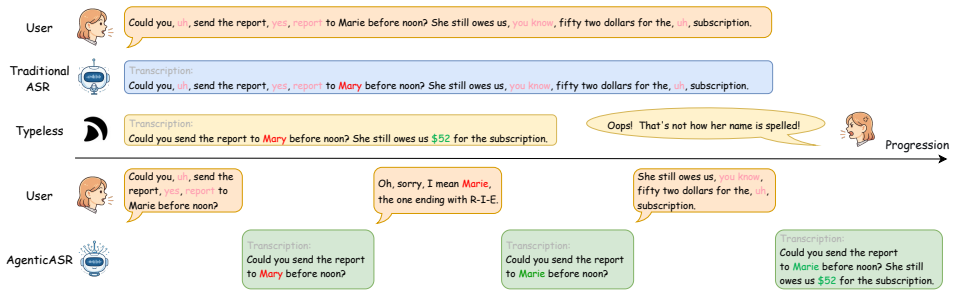
Speech recognition can emit clean, intent-preserving text online and revise earlier words when later speech changes their meaning.
Reviewed by Pith at T0; open to challenge. T0 means a machine referee read the full paper against a public rubric. the ladder, T0–T4 →
T0 review · grok-4.5
2026-07-31 15:36 UTC pith:NHZ5L3ZX
load-bearing objection Solid systems paper: bounded-window refine-and-replace is the real idea; leaderboard wins are real but sit on a mostly synthetic, LLM-mediated bench. the 4 major comments →
AgenticASR: Refining Speech Recognition in Real-World Scenarios via an Agentic Approach
The pith
A machine-rendered reading of the paper's core claim, the machinery that carries it, and where it could break.
Core claim
AgenticASR shows that online intent-preserving clean transcription is practical: by refining a bounded concatenated active context (default three chunks) and replacing the corresponding local output span as audio arrives, a shared ASR–Refiner system can emit readable text continually, revise earlier content when later speech supplies new evidence, and achieve the highest AASR-Bench scores among the systems tested across multiple ASR front ends.
What carries the argument
The ASR–Refiner with bounded active-window replacement: at each update the system concatenates up to K recent source chunks into one ordinary text string, runs one Oral-to-Written Refiner pass, and swaps that string for the previously emitted span tied to the same window, so new right context can rewrite local history without reprocessing the whole stream.
Load-bearing premise
The main results rest on a mostly synthetic bilingual benchmark and LLM-written rubrics scored by another model, with only a small human agreement check, standing in for real spontaneous speech and human notions of final intent.
What would settle it
Run the same online K=3 AgenticASR setup on a large held-out set of real, multi-speaker spontaneous bilingual conversations with human gold clean transcripts and human rubric scores; if Overall no longer beats strong offline post-transform baselines, or human judges systematically disagree with the automated rubrics on Filter and Rephrase, the central claim fails.
If this is right
- Voice assistants and live dictation can show readable text before an utterance ends and still fix names, numbers, and destinations when the speaker corrects them.
- Meeting and streaming transcription need not freeze early partial text; local span replacement can absorb later spellings and self-repairs.
- A compact task-trained Refiner can be swapped across ASR front ends without retraining the recognizer for clean-text output.
- A three-chunk active window is enough, on this benchmark, to recover nearly offline Rephrase and Explanation quality with only modest added latency.
- Direct speech-to-clean ASR training can over-edit already clean speech; pass-through controls become a necessary check for faithfulness.
Where Pith is reading between the lines
- Downstream agents that currently parse verbatim ASR may reduce intent-detection errors if they consume AgenticSR output instead of raw hypotheses.
- The Content drop under weak Whisper front ends suggests the Refiner is not a general repair model; pairing it with stronger streaming ASR may matter more than scaling the Refiner alone.
- If atomic rubric judging stays stable under broader human audits, similar Content/Format/Filter/Rephrase splits could become a standard way to score other spoken-to-written systems beyond this benchmark.
- Long-form dialogue with repairs spanning far more than three chunks would stress the fixed window and may need adaptive context or explicit repair markers.
Editorial analysis
A structured set of objections, weighed in public.
Referee Report
Summary. The paper defines Agentic Speech Recognition (AgenticSR) as audio-to-clean-text recognition that removes disfluencies, resolves self-corrections, applies ITN/formatting, and preserves final speaker intent. It proposes AgenticASR, an ASR–Refiner system that, online, concatenates a bounded K-chunk active source window, refines it once, and replaces the corresponding emitted span—enabling continual emission and revision without reprocessing the full stream. The authors introduce bilingual AASR-Bench (917 utterances, 6,637 atomic rubrics over Content/Format/Filter/Rephrase), train a compact Refiner on LLM-generated pairs, and report highest Overall scores across Qwen3-ASR and Whisper front ends versus API post-transformation and FormalASR, plus Refiner-capacity, window-size, and human–judge agreement ablations.
Significance. If the results transfer beyond the constructed benchmark, this is a practically useful contribution: online spoken-to-written conversion with local revision is a real gap relative to offline post-editors and end-to-end formal ASR, and the bounded span-replacement design is a clean systems idea for streaming interfaces (dictation, meetings, agents). Strengths include multi-backbone tables, scene-level breakdowns, window-size and Refiner-size ablations, a double-blind human agreement check (Table 4), pass-through controls, and promised code/benchmark release. The work is incremental relative to cascaded spoken-to-written and interactive ASR lines, but the online revision framing and atomic-rubric bench are concrete additions rather than pure rebranding.
major comments (4)
- [§3.1 Benchmark Construction; §4 Main Results] §3.1 and §4: The central claim that AgenticASR is a practical framework for real-world ongoing speech rests almost entirely on AASR-Bench. Oral text is manually constructed from Clean seeds; 83.64% of audio is Doubao TTS 2 and only 16.36% human-recorded; rubrics are Qwen3.7-Plus-generated and judged by Gemma-4-31B-IT. Table 3/6 gains therefore primarily measure recovery of constructed Oral→Clean mappings under an LLM judge. A load-bearing revision is needed: either a held-out organic spontaneous-speech subset with human Clean references and human rubric answers, or an explicit external validation (e.g., real meeting/dictation audio) showing that Overall/Rephrase advantages survive outside the synthetic distribution. Without that, transfer claims in the abstract and §5 overreach the evidence.
- [§3.1 Rubric-Based Evaluation; §3.2 Data Generation; Table 4] §3.2 Stages 1–5 and §3.1 rubric judging: Training pairs, quality control, and the primary judge all use Gemma-4-31B-IT (rubric generation uses Qwen3.7-Plus). Table 4’s human agreement on 100 utterances (ρ≈0.81–0.82) is helpful but narrow—it covers only AgenticASR outputs on two Qwen front ends, not baseline outputs or failure modes. Please (i) report agreement on FormalASR/API outputs and on pass-through/over-edit cases, (ii) add at least one independent judge model or full human scoring on a stratified subset for the main leaderboard, and (iii) discuss how much leaderboard separation could be judge-family artifact versus true transformation quality.
- [Table 3; §3.1 Task Formulation; Appendix A.2] Table 3 Whisper rows and appendix Tables 9–11: With weaker ASR evidence, AgenticASR raises Filter/Rephrase but lowers Content (e.g., Whisper Base Content 38.69 vs 47.04 API; pass-through also drops). This is acknowledged briefly but undercuts the “preserves final intent / evidence-supported edits only” task definition in §3.1. The paper should quantify over-editing (unsupported deletions/substitutions) more directly—e.g., Content negative-option rates, entity error analysis, or a constrained decoding/abstention policy—and state deployment conditions under which the Refiner should not be applied. Otherwise the highest-Overall claim can mask harmful edits when the front end is imperfect.
- [§4.1; Table 6; §3.2 Online inference] Table 6 online ablation: K=3 nearly matches offline Rephrase/Explanation, which supports the mechanism, but end-to-end latency is reported as mean wall time on CPU with CUDA disabled (§4.1), and online latency is higher than offline (12.15s vs 9.59s) despite the streaming motivation. For a systems paper claiming online practicality, please report streaming metrics that match the use case: time-to-first-clean-token, revision frequency/extent, per-update Refiner latency on GPU, and whether partial clean text is shown before window closure. As written, “online” is demonstrated algorithmically more than as a latency win.
minor comments (6)
- [Abstract; Figure 1] Figure 1 and the abstract use “AgenticASR” while the task is “AgenticSR”; keep terminology consistent early to avoid equating the task with one system.
- [§3.1 Eq. (1)] Eq. (1): clarify how clip[0,1] interacts with negative rubric scores in practice (floor at 0 can compress differences among weak systems).
- [Table 3] Table 3 latency column: FormalASR ~3.4s vs AgenticASR ~9.6s vs API ~60s is important; state hardware parity and whether API latency includes network.
- [§2] Related work cites several 2026 arXiv/preprint systems (Typeless, FormalASR, Interactive ASR); ensure stable citations and fair capability descriptions at camera-ready.
- [Appendix Table 14] Appendix examples (Table 14) show residual issues (e.g., Mary/Marie-type entity errors, “Palm 2”, “markus@email.com”); a short error analysis would strengthen §4.2.
- [Global] Minor prose/spacing artifacts appear throughout (e.g., missing spaces after periods in the abstract PDF text). A copy-edit pass is needed.
Circularity Check
No derivation-chain circularity: empirical system vs. held-out benchmark and external baselines, not a self-forced prediction.
full rationale
AgenticASR is an engineering/empirical paper, not a first-principles derivation. The load-bearing claim is that an ASR–Refiner with bounded active-window replacement scores highest on AASR-Bench versus FormalASR, API post-transformers, and matched front ends (Tables 3–12, Fig. 3). That claim is measured, not obtained by defining the metric as the method. Training pairs (§3.2 pipeline) are LLM-constructed and held out from the benchmark; AASR-Bench Oral–Clean pairs are separately hand-built from collected Clean text with controlled Oral phenomena, mostly TTS audio, plus pass-through controls (§3.1). Rubric scores use a fixed question set and an external judge protocol with a double-blind human agreement check (Table 4)—they do not algebraically equal the Refiner’s training objective. Online K-window ablations (Table 6, Fig. 4) are empirical quality–latency trade-offs, not tautologies. Related-work self-citations (Jiang et al. 2026; Wang et al. 2026) are background, not uniqueness theorems that force the result. Concerns that synthetic Oral speech and LLM rubrics may overstate transfer to organic speech are external-validity issues, not circular reduction of outputs to inputs by construction. No fitted parameter is relabeled a prediction; no equation collapses to its defining data.
Axiom & Free-Parameter Ledger
free parameters (5)
- online window size K =
3
- chunk character limit L =
80 characters
- Refiner training hyperparameters =
AdamW 2e-5, 5 epochs, etc.
- scene allocation and corruption rates in data pipeline =
8% pass-through; 20% ASR simulation
- near-duplicate Jaccard threshold =
0.75
axioms (5)
- domain assumption Final intended message is a well-defined written target recoverable from spoken artifacts plus later local context.
- domain assumption Bounded recent ASR text (not full history or audio) suffices for online Oral-to-Written revision.
- ad hoc to paper LLM-generated Oral/Clean/ASR-simulation pairs and atomic rubrics are valid supervision and evaluation for real AgenticSR.
- ad hoc to paper Gemma-4-31B-IT majority-vote rubric judgments align with expert notions of content/format/filter/rephrase quality.
- domain assumption Standard supervised fine-tuning of a compact LM on text pairs yields a transferable Refiner across ASR front ends.
invented entities (3)
-
Agentic Speech Recognition (AgenticSR) task
no independent evidence
-
AASR-Bench
no independent evidence
-
AgenticASR ASR–Refiner with active-window span replacement
no independent evidence
read the original abstract
Automatic speech recognition (ASR) has achieved substantial gains in transcription accuracy, yet verbatim transcription does not necessarily produce readily usable text. It retains fillers, repetitions, false starts, and self-corrections that increase reading effort, obscure the speaker's final intent, and propagate unresolved or abandoned content to downstream tasks. Existing spoken-to-written methods process completed audio or transcripts but cannot revise emitted text when later speech changes how preceding content should be interpreted. We therefore formulate Agentic Speech Recognition (AgenticSR), an audio-to-clean-text task that removes disfluencies, resolves self-corrections, and normalizes written form while preserving the speaker's final intent. AgenticASR implements this task through an ASR--Refiner architecture that repeatedly transforms a bounded active context and replaces its corresponding output span as audio arrives. This enables continual emission and revision over streams of arbitrary duration. We also introduce AASR-Bench, a bilingual benchmark with fine-grained atomic rubrics. Across multiple ASR front ends, AgenticASR attains the highest AASR-Bench scores among evaluated systems. A human--AI agreement study shows that rubric-based judgments align with independent expert assessments. Ablations characterize Refiner capacity, context length, and the quality--latency trade-off between online and offline inference. Together, these results establish AgenticASR as a practical framework for intent-preserving clean transcription during ongoing speech. Code, AASR-Bench, and a demo will be released at https://github.com/AnXMuy/AgenticASR.
Figures


Reference graph
Works this paper leans on
-
[4]
InProceedings of the Seventh Workshop on Noisy User-generated Text (W-NUT 2021), 168–174
Improving punctuation restoration for speech transcripts via external data. InProceedings of the Seventh Workshop on Noisy User-generated Text (W-NUT 2021), 168–174. GemmaTeam;etal.2026. Gemma4TechnicalReport.arXiv preprint arXiv:2607.02770. Graves, A
Pith/arXiv arXiv 2021
-
[7]
Large- Context Pointer-Generator Networks for Spoken-to-Written StyleConversion. InICASSP2020-2020IEEEInternational Conference on Acoustics, Speech and Signal Processing (ICASSP), 8189–8193. Jiang, Z.; Zhu, Y.; Wang, P.; Chen, Q.; Zhao, X.; Qiu, X.; Wang,W.;Gao,Z.;Li,X.;Yu,K.;andChen,X.2026.Towards Human-Like Interactive Speech Recognition With Agentic Co...
Pith/arXiv arXiv 2026
-
[10]
InFindings of the Association for Compu- tational Linguistics: ACL 2023, 11479–11488
Disfluency Generation for More Robust Dialogue Systems. InFindings of the Association for Compu- tational Linguistics: ACL 2023, 11479–11488. Association for Computational Linguistics. MiniCPM Team
2023
-
[11]
Ning, W.; Guo, Y.; Qian, H.; Cheng, J.; Feng, W.; and Zhang, Y.2026
MiniCPM4: Ultra-Efficient LLMs on End Devices.arXiv preprint arXiv:2506.07900. Ning, W.; Guo, Y.; Qian, H.; Cheng, J.; Feng, W.; and Zhang, Y.2026. FormalASR:End-to-EndSpokenChinesetoFormal Text.arXiv preprint arXiv:2605.19266. Prabhavalkar, R.; Hori, T.; Sainath, T. N.; Schluter, R.; and Watanabe, S
Pith/arXiv arXiv 2026
-
[12]
An approach to measuring the performance of Automatic Speech Recognition (ASR) models in the context of Large LanguageModel(LLM)poweredapplications.arXivpreprint arXiv:2507.16456. Radford, A.; Kim, J. W.; Xu, T.; Brockman, G.; McLeavey, C.; and Sutskever, I
-
[13]
Qwen3-ASR Technical Report.arXiv preprint arXiv:2601.21337. Spearman, C
-
[14]
https://github.com/ tover0314-w/opentypeless
OpenTypeless: Open-Source AI Voice Typing for macOS, Windows, and Linux. https://github.com/ tover0314-w/opentypeless. Version 1.1.48, commit 39df000, accessed 2026-07-11. Typeless
2026
-
[15]
https: //www.typeless.com/
Typeless: AI Voice Dictation. https: //www.typeless.com/. CommercialAIvoice-dictationsystem; accessed 2026-07-11. Volcengine
2026
-
[16]
Interactive ASR: Towards Human-Like Interaction and Se- manticCoherenceEvaluationforAgenticSpeechRecognition. arXiv:2604.09121. Wang,W.;Tur,G.;Zheng,J.;andAyan,N.F.2010. Automatic Disfluency Removal for Improving Spoken Language Trans- lation. In2010 IEEE International Conference on Acoustics, Speech and Signal Processing, 5214–5217. Zhang, H.; Cheng, Y.-...
Pith/arXiv arXiv 2010
-
[17]
InICASSP 2022-2022 IEEE International Conference on Acoustics, Speech and Signal Processing (ICASSP), 6097–6101
Capitalization normalization for languagemodelingwithanaccurateandefficienthierarchical RNN model. InICASSP 2022-2022 IEEE International Conference on Acoustics, Speech and Signal Processing (ICASSP), 6097–6101. IEEE. Zheng, L.; Chiang, W.-L.; Sheng, Y.; Zhuang, S.; Wu, Z.; Zhuang,Y.;Lin,Z.;Li,Z.;Li,D.;Xing,E.;etal.2023.Judging llm-as-a-judge with mt-benc...
2022
-
[2012]
Graves, A.; Fernández, S.; Gomez, F.; and Schmidhuber, J
Sequence Transduction with Recurrent Neural Networks.arXiv preprint arXiv:1211.3711. Graves, A.; Fernández, S.; Gomez, F.; and Schmidhuber, J
-
[2020]
InProceedings of the Sixth Workshop on Noisy User-generated Text (W-NUT 2020), 132–142
Punctuation restora- tion using transformer models for high-and low-resource languages. InProceedings of the Sixth Workshop on Noisy User-generated Text (W-NUT 2020), 132–142. Biber,D.2019.Text-linguisticapproachestoregistervariation. Register Studies, 1(1): 42–75. Bortfeld, H.; Leon, S. D.; Bloom, J. E.; Schober, M. F.; and Brennan, S. E
2020
-
[2021]
InInterspeech 2021, 3670–3674
GigaSpeech: An Evolving, Multi-DomainASRCorpuswith10,000HoursofTranscribed Audio. InInterspeech 2021, 3670–3674. Cohen, J
2021
-
[2022]
In Interspeech 2022, 1106–1110
From Disfluency Detection to Intent Detection and Slot Filling. In Interspeech 2022, 1106–1110. Fleiss,J.L.;andCohen,J.1973.TheEquivalenceofWeighted Kappa and the Intraclass Correlation Coefficient as Measures of Reliability.Educational and Psychological Measurement, 33(3): 613–619. Fu, X.-Y.; Chen, C.; Laskar, M. T. R.; Bhushan, S.; and Corston-Oliver, S
2022
-
[2023]
InProceedings of the 2023 Conference on Empirical Methods in Natural Language Pro- cessing, 3962–3979
CS2W: A Chinese Spoken-to-Written Style Conversion Dataset with Multiple Conversion Types. InProceedings of the 2023 Conference on Empirical Methods in Natural Language Pro- cessing, 3962–3979. Honnibal, M.; and Johnson, M
2023
-
[2025]
InProceedings of the AAAI Conference on Artificial Intelligence, volume 39, 24623–24631
Recording for eyes, not echoing to ears: Contextualized spoken-to-written conversion of ASR transcripts. InProceedings of the AAAI Conference on Artificial Intelligence, volume 39, 24623–24631. Liu,Y.;Iter,D.;Xu,Y.;Wang,S.;Xu,R.;andZhu,C.2023. G- eval:NLGevaluationusinggpt-4withbetterhumanalignment. InProceedings of the 2023 conference on empirical method...
2023
-
[2026]
MMAE: A Massive Multitask Audio Editing Benchmark.arXiv preprint arXiv:2606.07229. Marie, B
discussion (0)
Sign in with ORCID, Apple, or X to comment. Anyone can read and Pith papers without signing in.