REVIEW 2 major objections 59 references
Perceptual information lives across the entire DiT denoising path; fusing it with spatial weights unlocks multi-modal generation from a frozen backbone.
Reviewed by Pith at T0; open to challenge. T0 means a machine referee read the full paper against a public rubric. the ladder, T0–T4 →
T0 review · grok-4.5
2026-07-12 13:44 UTC pith:NIVW6KI4
load-bearing objection Solid engineering result: multi-timestep adaptive fusion on frozen DiTs is the real gain, and the evaluations back it. the 2 major comments →
MMDiff: Extending Diffusion Transformers for Multi-Modal Generation
The pith
A machine-rendered reading of the paper's core claim, the machinery that carries it, and where it could break.
Core claim
Perceptual information inside a diffusion transformer is temporally distributed along the denoising trajectory; multi-timestep feature fusion with spatially varying aggregation weights is essential and improves semantic segmentation by up to 28.7% mIoU over any single-timestep extraction. Frozen DiT features are competitive with, and complementary to, state-of-the-art discriminative encoders, so lightweight heads alone turn a generative model into a multi-modal labeler.
What carries the argument
Multi-timestep token aggregation: features drawn from four single-stream layers and four denoising timesteps are projected, then combined by a small temporal transformer that predicts per-pixel mixing weights, refined by CBAM and a gated skip from the cleanest timestep. Concept-driven one-way attention supplies task-specific spatial maps without altering generation.
Load-bearing premise
The four hand-picked timesteps and four layers chosen from entropy and correlation plots on one backbone are assumed to capture the bulk of the useful information; if the peaks lie elsewhere, the fusion advantage shrinks.
What would settle it
Re-run the single-versus-multi-timestep ablation on the same frozen backbone but with a denser or differently spaced set of timesteps; if the mIoU gap collapses below a few points, the claim that information is broadly distributed and that the reported fusion is essential is weakened.
If this is right
- A single frozen DiT can emit an image plus segmentation, depth, and saliency in one forward pass, removing the need for separate task networks at generation time.
- Synthetic datasets with pixel-level labels become far cheaper: generate once, decode many modalities, and train downstream models that beat prior U-Net extraction pipelines.
- Generative and discriminative features can be concatenated for free performance gains without fine-tuning either backbone.
- The same aggregation pattern transfers to video DiTs for geometry-aware 3D reconstruction from latents.
- As stronger DiT generators appear, the same frozen heads improve automatically because richer internal features yield better dense predictions.
Where Pith is reading between the lines
- If the same multi-timestep aggregation works for any dense label that can be supervised with a lightweight head, future multi-modal generators may ship with a standard ‘perception port’ rather than task-specific fine-tunes.
- The complementarity result suggests generative pre-training and contrastive pre-training are encoding orthogonal axes of visual structure; joint feature banks could become the default for dense prediction.
- Because the backbone stays frozen, the method is a drop-in annotation engine for any already-deployed DiT, lowering the barrier to large-scale synthetic data for domains where labels are scarce.
Editorial analysis
A structured set of objections, weighed in public.
Referee Report
Summary. MMDiff freezes a diffusion transformer (primarily FLUX.1-dev) and trains only lightweight decoder heads to jointly emit images plus dense modalities (semantic segmentation, saliency, depth). The central technical claim is that perceptual information is temporally distributed along the DiT denoising trajectory, so multi-timestep feature fusion with spatially varying aggregation weights is essential; Table 5 shows single-stream t=0 at 50.20 mIoU rising to 78.90 with multi-timestep + concept attention (+28.7 points). Features are taken from single-stream layers L={4,15,26,37} and timesteps T={0.78,0.52,0.26,0.001}, projected and fused by a temporal transformer that predicts per-pixel alphas, refined by CBAM and a gated skip from t=0 (Eq. 2). Concept-driven one-directional attention supplies task-specific spatial maps, and optional DINOv3 features are shown to be complementary. Evaluation uses three protocols: multi-modal consistency on generated images (Table 1), synthetic-data transfer to EoMT/IS-Net/DepthFormer (Tables 2–3), and real-image feature quality under identical decoder training (Table 4), plus ablations, limited-data regimes, SD 3.5 transfer, and a video-to-3DGS probe.
Significance. If the multi-timestep result holds, the paper supplies a practical, frozen-backbone route to multi-modal generation and large-scale synthetic annotation that substantially outperforms prior U-Net extractors (DatasetDM, DiffuMask, Dataset Diffusion) while remaining competitive with fine-tuned discriminative encoders. The controlled re-training of baselines under identical decoders and schedules, the explicit isolation of the +28.7 mIoU jump in Table 5, the complementarity result with DINOv3, and the transfer experiments (SD 3.5, limited data, video→3DGS) are concrete strengths that make the work useful beyond a single backbone. The framework is immediately actionable for synthetic dataset creation without task-specific fine-tuning of the generator.
major comments (2)
- Section 3.1 / 3.4 and Table 5: the headline +28.7 mIoU gain is measured from single-stream t=0 (50.20) to multi-timestep + concept attention (78.90). The four timesteps and four layers are hand-chosen from FLUX entropy/correlation plots (Fig. 3). While Appendix G shows the same recipe transfers to SD 3.5 without retuning (70.14 mIoU diffusion-only) and the adaptive-alpha ablation (full model w/o aggregation 78.21 vs 84.95) supports learned fusion, a short sensitivity check—e.g., random or uniform timestep subsets of the same cardinality, or a denser schedule—would make the “temporally distributed / multi-timestep is essential” claim less dependent on this particular schedule. This is a load-bearing engineering choice for the central claim and should be tightened before final acceptance.
- Section 4.2 / Table 1: multi-modal consistency relies on pseudo-GT from EoMT, Depth Anything v2 and S3OD plus manual correction on each method’s own generated images. The protocol is carefully described and the ranking is consistent with the other two evaluation axes, but residual method-specific bias cannot be fully ruled out. A brief quantification of the manual-correction rate or an inter-annotator check on a subset would strengthen the claim that DiT features “more accurately capture the visual content” than U-Net extractors.
Circularity Check
No significant circularity; multi-timestep gains and feature claims rest on controlled ablations and external benchmarks, not definitional or self-referential reductions.
full rationale
The paper's load-bearing claim (perceptual information temporally distributed in DiT; multi-timestep fusion with spatially varying weights essential, +28.7 mIoU) is an empirical ablation result (Table 5: single-stream t=0 at 50.20 mIoU vs. multi-timestep + concept attention at 78.90). Aggregation weights α are learned parameters of a lightweight transformer head trained on real labeled data, then applied to frozen FLUX (or SD 3.5) features; this is ordinary supervised learning, not a fit-then-predict of a quantity forced by construction. Downstream evaluation uses held-out real benchmarks (PASCAL VOC, DUTS, NYU) and transfer to synthetic data generation, with independent baselines (DINO-v3, VPD, DatasetDM, etc.) retrained under identical protocols. Concept attention is adopted from external work [16]; layer/timestep choices are motivated by entropy/correlation analysis (Fig. 3) but not definitional. Pseudo-GT consistency (Table 1) is secondary and manually verified. No equation reduces a claimed prediction to its own input; no uniqueness theorem or ansatz is imported via self-citation as load-bearing; no known result is merely renamed. The derivation chain is self-contained against external data.
Axiom & Free-Parameter Ledger
free parameters (5)
- Timestep set T =
{0.78, 0.52, 0.26, 0.001}
- Layer set L =
{4, 15, 26, 37}
- Temporal transformer hidden dim / heads / layers =
768 / 8 / 3
- LayerScale init and skip-gate init =
1e-4 (or 1e-6 in appendix) / 0.1
- Decoder learning-rate schedule =
1e-4 base, half for decoders, EMA 0.999
axioms (4)
- standard math Standard forward diffusion noising formula for real-image feature extraction
- domain assumption Frozen FLUX.1-dev dual-stream DiT produces usable dense features without fine-tuning
- domain assumption Concept tokens updated by one-directional attention do not alter image generation
- ad hoc to paper Pseudo-GT from SOTA models (EoMT, Depth Anything v2, S3OD) plus manual correction is a valid consistency benchmark
invented entities (2)
-
Token Aggregation Module (temporal transformer + spatially varying alpha + CBAM + gated skip)
no independent evidence
-
Concept-driven one-directional attention stream for DiT
no independent evidence
read the original abstract
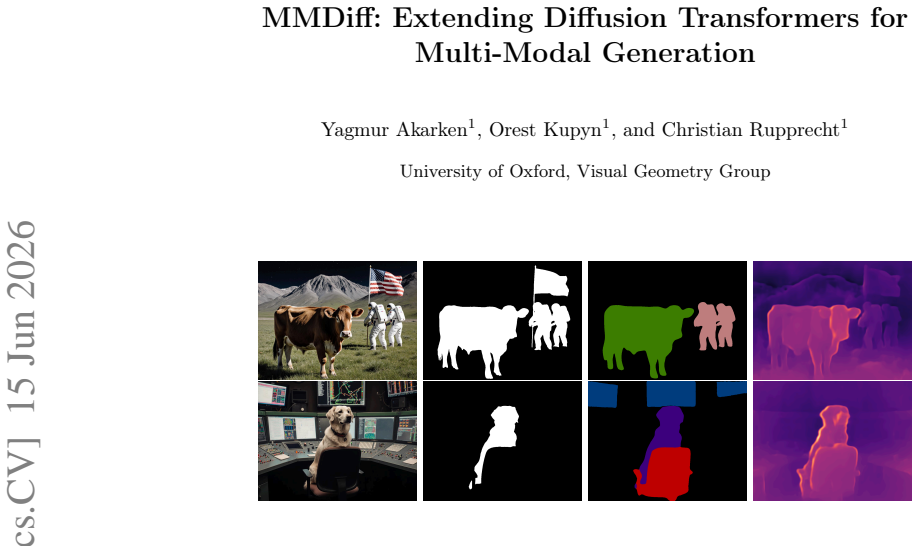
Diffusion transformers have demonstrated remarkable generative capabilities, yet the rich perceptual representations computed across their denoising trajectory are discarded once the content is rendered. We present MMDiff, a framework that transforms a frozen diffusion transformer into a multi-modal generative system that jointly produces images alongside any combination of dense perceptual modalities using lightweight decoder heads. Our central finding is that perceptual information is temporally distributed along the denoising trajectory, and that multi-timestep feature fusion with spatially varying aggregation weights is essential, improving semantic segmentation results by up to 28.7% mIoU over single-timestep extraction. We further adopt concept-driven attention extraction for interpretable spatial guidance, and show that frozen diffusion features are competitive with and complementary to state-of-the-art encoders such as DINOv3. By training only lightweight decoder heads on a frozen backbone, we achieve strong performance in semantic segmentation, salient object detection, and depth estimation, and demonstrate that this framework enables effective synthetic data generation at scale.
Figures


Reference graph
Works this paper leans on
-
[1]
In: 2009 IEEE conference on computer vision and pattern recogni- tion
Achanta, R., Hemami, S., Estrada, F., Susstrunk, S.: Frequency-tuned salient re- gion detection. In: 2009 IEEE conference on computer vision and pattern recogni- tion. pp. 1597–1604. IEEE (2009)
2009
-
[2]
arXiv preprint arXiv:2603.26599 (2026)
An, Z., Kupyn, O., Uscidda, T., Colaco, A., Ahuja, K., Belongie, S., Gonzalez- Franco, M., Gazulla, M.T.: Vggrpo: Towards world-consistent video generation with 4d latent reward. arXiv preprint arXiv:2603.26599 (2026)
arXiv 2026
-
[3]
In: International Conference on Learning Representations (ICLR) (2026)
Bahmani, S., Shen, T., Ren, J., Huang, J., Jiang, Y., Turki, H., Tagliasacchi, A., Lindell, D.B., Gojcic, Z., Fidler, S., Ling, H., Gao, J., Ren, X.: Lyra: Generative 3d scene reconstruction via video diffusion model self-distillation. In: International Conference on Learning Representations (ICLR) (2026)
2026
-
[4]
In: The Twelfth International Conference on Learning Representations (2024)
Chen, J., YU, J., GE, C., Yao, L., Xie, E., Wang, Z., Kwok, J., Luo, P., Lu, H., Li, Z.: Pixart-$\alpha$: Fast training of diffusion transformer for photorealis- tic text-to-image synthesis. In: The Twelfth International Conference on Learning Representations (2024)
2024
-
[5]
arXiv preprint arXiv:1706.05587 (2017)
Chen, L.C., Papandreou, G., Schroff, F., Adam, H.: Rethinking atrous convolution for semantic image segmentation. arXiv preprint arXiv:1706.05587 (2017)
Pith/arXiv arXiv 2017
-
[6]
In: Proceedings of the European conference on computer vision (ECCV)
Chen, L.C., Zhu, Y., Papandreou, G., Schroff, F., Adam, H.: Encoder-decoder with atrous separable convolution for semantic image segmentation. In: Proceedings of the European conference on computer vision (ECCV). pp. 801–818 (2018)
2018
-
[7]
arXiv preprint (2025)
Dai, Y., Jiang, F., Wang, C., Xu, M., Qi, Y.: Fantasyworld: Geometry-consistent world modeling via unified video and 3d prediction. arXiv preprint (2025)
2025
-
[8]
Advances in neural information processing systems34, 8780–8794 (2021)
Dhariwal, P., Nichol, A.: Diffusion models beat gans on image synthesis. Advances in neural information processing systems34, 8780–8794 (2021)
2021
-
[9]
In: International Conference on Learning Representations (2021)
Dosovitskiy, A., Beyer, L., Kolesnikov, A., Weissenborn, D., Zhai, X., Unterthiner, T., Dehghani, M., Minderer, M., Heigold, G., Gelly, S., Uszkoreit, J., Houlsby, N.: An image is worth 16x16 words: Transformers for image recognition at scale. In: International Conference on Learning Representations (2021)
2021
-
[10]
arXiv preprint arXiv:2601.23286 (2026)
Du, H., Ye, J., Cong, X., Li, R., Ni, J., Agarwal, A., Zhou, Z., Li, Z., Balestriero, R., Wang, Y.: Videogpa: Distilling geometry priors for 3d-consistent video generation. arXiv preprint arXiv:2601.23286 (2026)
Pith/arXiv arXiv 2026
-
[11]
arXiv preprint arXiv:2507.17657 (2025)
Erel, Y., Dünkel, O., Dabral, R., Golyanik, V., Theobalt, C., Bermano, A.H.: At- tention (as discrete-time markov) chains. arXiv preprint arXiv:2507.17657 (2025)
arXiv 2025
-
[12]
Esser, P., Kulal, S., Blattmann, A., Entezari, R., Müller, J., Saini, H., Levi, Y., Lorenz, D., Sauer, A., Boesel, F., Podell, D., Dockhorn, T., English, Z., Rombach, R.:Scalingrectifiedflowtransformersforhigh-resolutionimagesynthesis.In:Forty- first International Conference on Machine Learning (2024)
2024
-
[13]
In: Proceedings of the IEEE international conference on computer vision
Fan, D.P., Cheng, M.M., Liu, Y., Li, T., Borji, A.: Structure-measure: A new way to evaluate foreground maps. In: Proceedings of the IEEE international conference on computer vision. pp. 4548–4557 (2017)
2017
-
[14]
arXiv preprint arXiv:2505.18584 (2025) 16 Y
Gan, C., Tu, Y., Chen, X., Chen, T., Li, Y., Harandi, M., Lin, W.: Unleashing diffusiontransformersforvisualcorrespondencebymodulatingmassiveactivations. arXiv preprint arXiv:2505.18584 (2025) 16 Y. Akarken et al
arXiv 2025
-
[15]
Gemma Team: Gemma 3 (2025),https://goo.gle/Gemma3Report
2025
-
[16]
Helbling, A., Meral, T.H.S., Hoover, B., Yanardag, P., Chau, D.H.: Conceptatten- tion: Diffusion transformers learn highly interpretable features (2025)
2025
-
[17]
arXiv preprint arXiv:1606.08415 (2016)
Hendrycks, D.: Gaussian error linear units (gelus). arXiv preprint arXiv:1606.08415 (2016)
Pith/arXiv arXiv 2016
-
[18]
Advances in neural information processing systems33, 6840–6851 (2020)
Ho, J., Jain, A., Abbeel, P.: Denoising diffusion probabilistic models. Advances in neural information processing systems33, 6840–6851 (2020)
2020
-
[19]
arXiv preprint (2025)
Huang, C.H.P., Mitra, N., Jeong, H., Yoon, J.S., Ceylan, D.: Jog3r: Towards 3d- consistent video generators. arXiv preprint (2025)
2025
-
[20]
ACM Transactions on Graphics42(4) (July 2023)
Kerbl, B., Kopanas, G., Leimkühler, T., Drettakis, G.: 3d gaussian splatting for real-time radiance field rendering. ACM Transactions on Graphics42(4) (July 2023)
2023
-
[21]
In: Proceedings of the Computer Vision and Pattern Recognition Conference
Kerssies, T., Cavagnero, N., Hermans, A., Norouzi, N., Averta, G., Leibe, B., Dubbelman, G., de Geus, D.: Your vit is secretly an image segmentation model. In: Proceedings of the Computer Vision and Pattern Recognition Conference. pp. 25303–25313 (2025)
2025
-
[22]
arXiv preprint arXiv:2509.18096 (2025)
Kim, C., Shin, H., Hong, E., Yoon, H., Arnab, A., Seo, P.H., Hong, S., Kim, S.: Seg4diff: Unveiling open-vocabulary segmentation in text-to-image diffusion transformers. arXiv preprint arXiv:2509.18096 (2025)
arXiv 2025
-
[23]
In: Proceedings of the IEEE/CVF In- ternational Conference on Computer Vision
Krishnan, A., Yan, X., Casser, V., Kundu, A.: Orchid: Image latent diffusion for joint appearance and geometry generation. In: Proceedings of the IEEE/CVF In- ternational Conference on Computer Vision. pp. 28217–28227 (2025)
2025
-
[24]
arXiv preprint arXiv:2509.22650 (2025)
Kukleva, A., Simsar, E., Tonioni, A., Naeem, M.F., Tombari, F., Lenssen, J.E., Schiele, B.: Refam: Attention magnets for zero-shot referral segmentation. arXiv preprint arXiv:2509.22650 (2025)
arXiv 2025
-
[25]
In: International Conference on Learning Represen- tations (ICLR) (2026)
Kupyn, O., Kataoka, H., Rupprecht, C.: S3od: Towards generalizable salient object detection with synthetic data. In: International Conference on Learning Represen- tations (ICLR) (2026)
2026
-
[26]
arXiv preprint arXiv:2510.21615 (2025)
Kupyn,O.,Manhardt,F.,Tombari,F.,Rupprecht,C.:Epipolargeometryimproves video generation models. arXiv preprint arXiv:2510.21615 (2025)
Pith/arXiv arXiv 2025
-
[27]
Labs, B.F.: Flux.https://github.com/black-forest-labs/flux(2023)
2023
-
[28]
Machine Intelli- gence Research20(6), 837–854 (2023)
Li, Z., Chen, Z., Liu, X., Jiang, J.: Depthformer: Exploiting long-range correlation and local information for accurate monocular depth estimation. Machine Intelli- gence Research20(6), 837–854 (2023)
2023
-
[29]
In: Proceedings of the Computer Vision and Pattern Recognition Conference
Liang, H., Cao, J., Goel, V., Qian, G., Korolev, S., Terzopoulos, D., Plataniotis, K.N., Tulyakov, S., Ren, J.: Wonderland: Navigating 3d scenes from a single image. In: Proceedings of the Computer Vision and Pattern Recognition Conference. pp. 798–810 (2025)
2025
-
[30]
arXiv preprint arXiv:1711.05101 (2017)
Loshchilov, I., Hutter, F.: Decoupled weight decay regularization. arXiv preprint arXiv:1711.05101 (2017)
Pith/arXiv arXiv 2017
-
[31]
Advances in Neural Information Processing Systems36, 47500–47510 (2023)
Luo, G., Dunlap, L., Park, D.H., Holynski, A., Darrell, T.: Diffusion hyperfeatures: Searching through time and space for semantic correspondence. Advances in Neural Information Processing Systems36, 47500–47510 (2023)
2023
-
[32]
Advances in Neural Information Processing Systems36, 76872–76892 (2023)
Nguyen, Q., Vu, T., Tran, A., Nguyen, K.: Dataset diffusion: Diffusion-based syn- thetic data generation for pixel-level semantic segmentation. Advances in Neural Information Processing Systems36, 76872–76892 (2023)
2023
-
[33]
Peebles,W.,Xie,S.:Scalablediffusionmodelswithtransformers.In:Proceedingsof the IEEE/CVF international conference on computer vision. pp. 4195–4205 (2023)
2023
-
[34]
In: 2012 IEEE conference on computer vision and pattern recognition
Perazzi, F., Krähenbühl, P., Pritch, Y., Hornung, A.: Saliency filters: Contrast based filtering for salient region detection. In: 2012 IEEE conference on computer vision and pattern recognition. pp. 733–740. IEEE (2012) MMDiff: Extending Diffusion Transformers for Multi-Modal Generation 17
2012
-
[35]
SIAM journal on control and optimization30(4), 838–855 (1992)
Polyak, B.T., Juditsky, A.B.: Acceleration of stochastic approximation by averag- ing. SIAM journal on control and optimization30(4), 838–855 (1992)
1992
-
[36]
In: European Conference on Computer Vision
Qin, X., Dai, H., Hu, X., Fan, D.P., Shao, L., Van Gool, L.: Highly accurate di- chotomous image segmentation. In: European Conference on Computer Vision. pp. 38–56. Springer (2022)
2022
-
[37]
In: Proceedings of the IEEE/CVF international conference on computer vision
Ranftl, R., Bochkovskiy, A., Koltun, V.: Vision transformers for dense prediction. In: Proceedings of the IEEE/CVF international conference on computer vision. pp. 12179–12188 (2021)
2021
-
[38]
In: Proceedings of the IEEE/CVF conference on computer vision and pattern recognition
Rombach, R., Blattmann, A., Lorenz, D., Esser, P., Ommer, B.: High-resolution image synthesis with latent diffusion models. In: Proceedings of the IEEE/CVF conference on computer vision and pattern recognition. pp. 10684–10695 (2022)
2022
-
[39]
In: International Conference on Medical image computing and computer-assisted intervention
Ronneberger, O., Fischer, P., Brox, T.: U-net: Convolutional networks for biomedi- cal image segmentation. In: International Conference on Medical image computing and computer-assisted intervention. pp. 234–241. Springer (2015)
2015
-
[40]
arXiv preprint arXiv:2508.10104 (2025)
Siméoni, O., Vo, H.V., Seitzer, M., Baldassarre, F., Oquab, M., Jose, C., Khali- dov, V., Szafraniec, M., Yi, S., Ramamonjisoa, M., et al.: Dinov3. arXiv preprint arXiv:2508.10104 (2025)
Pith/arXiv arXiv 2025
-
[41]
In: Interna- tional Conference on Learning Representations (2021)
Song, Y., Sohl-Dickstein, J., Kingma, D.P., Kumar, A., Ermon, S., Poole, B.: Score- based generative modeling through stochastic differential equations. In: Interna- tional Conference on Learning Representations (2021)
2021
-
[42]
The journal of machine learning research15(1), 1929–1958 (2014)
Srivastava, N., Hinton, G., Krizhevsky, A., Sutskever, I., Salakhutdinov, R.: Dropout: a simple way to prevent neural networks from overfitting. The journal of machine learning research15(1), 1929–1958 (2014)
1929
-
[43]
Advances in Neural Information Processing Systems 36, 1363–1389 (2023)
Tang, L., Jia, M., Wang, Q., Phoo, C.P., Hariharan, B.: Emergent correspon- dence from image diffusion. Advances in Neural Information Processing Systems 36, 1363–1389 (2023)
2023
-
[44]
In: Proceedings of the IEEE/CVF international confer- ence on computer vision
Touvron, H., Cord, M., Sablayrolles, A., Synnaeve, G., Jégou, H.: Going deeper with image transformers. In: Proceedings of the IEEE/CVF international confer- ence on computer vision. pp. 32–42 (2021)
2021
-
[45]
arXiv preprint arXiv:2503.20314 (2025)
Wan, T., Wang, A., Ai, B., Wen, B., Mao, C., Xie, C.W., Chen, D., Yu, F., Zhao, H., Yang, J., Zeng, J., Wang, J., Zhang, J., Zhou, J., Wang, J., Chen, J., Zhu, K., Zhao, K., Yan, K., Huang, L., Feng, M., Zhang, N., Li, P., Wu, P., Chu, R., Feng, R., Zhang, S., Sun, S., Fang, T., Wang, T., Gui, T., Weng, T., Shen, T., Lin, W., Wang, W., Wang, W., Zhou, W.,...
Pith/arXiv arXiv 2025
-
[46]
In: Proceedings of the IEEE/CVF conference on computer vision and pattern recognition
Wang, S., Leroy, V., Cabon, Y., Chidlovskii, B., Revaud, J.: Dust3r: Geometric 3d vision made easy. In: Proceedings of the IEEE/CVF conference on computer vision and pattern recognition. pp. 20697–20709 (2024)
2024
-
[47]
In: Proceedings of the European conference on computer vision (ECCV)
Woo, S., Park, J., Lee, J.Y., Kweon, I.S.: Cbam: Convolutional block attention module. In: Proceedings of the European conference on computer vision (ECCV). pp. 3–19 (2018)
2018
-
[48]
Advances in Neural Information Processing Systems36, 54683–54695 (2023)
Wu, W., Zhao, Y., Chen, H., Gu, Y., Zhao, R., He, Y., Zhou, H., Shou, M.Z., Shen, C.: Datasetdm: Synthesizing data with perception annotations using diffu- sion models. Advances in Neural Information Processing Systems36, 54683–54695 (2023)
2023
-
[49]
In: 18 Y
Wu, W., Zhao, Y., Shou, M.Z., Zhou, H., Shen, C.: Diffumask: Synthesizing images with pixel-level annotations for semantic segmentation using diffusion models. In: 18 Y. Akarken et al. Proceedings of the IEEE/CVF International Conference on Computer Vision. pp. 1206–1217 (2023)
2023
-
[50]
Xu, G., Ge, Y., Liu, M., Fan, C., Xie, K., Zhao, Z., Chen, H., Shen, C.: What matters when repurposing diffusion models for general dense perception tasks? In: The Thirteenth International Conference on Learning Representations (2025)
2025
-
[51]
Advances in Neural Information Processing Systems37, 21875–21911 (2024)
Yang, L., Kang, B., Huang, Z., Zhao, Z., Xu, X., Feng, J., Zhao, H.: Depth anything v2. Advances in Neural Information Processing Systems37, 21875–21911 (2024)
2024
-
[52]
arXiv preprint arXiv:2401.11430 (2024)
Yue, Z., Wang, J., Sun, Q., Ji, L., Chang, E.I., Zhang, H., et al.: Explor- ing diffusion time-steps for unsupervised representation learning. arXiv preprint arXiv:2401.11430 (2024)
Pith/arXiv arXiv 2024
-
[53]
In: Proceedings of the Computer Vision and Pattern Recognition Conference
Zhang, Q., Zhai, S., Martin, M.A.B., Miao, K., Toshev, A., Susskind, J., Gu, J.: World-consistent video diffusion with explicit 3d modeling. In: Proceedings of the Computer Vision and Pattern Recognition Conference. pp. 21685–21695 (2025)
2025
-
[54]
In: CVPR
Zhang, Q., Zhai, S., Martin, M.A.B., Miao, K., Toshev, A., Susskind, J., Gu, J.: World-consistent video diffusion with explicit 3d modeling. In: CVPR. pp. 21685– 21695 (2025)
2025
-
[55]
arXiv preprint arXiv:2512.05044 (2025)
Zhang, Y., Wang, Z., Zheng, W., Zhu, Z., Zhou, J., Lu, J.: Joint 3d geometry reconstruction and motion generation for 4d synthesis from a single image. arXiv preprint arXiv:2512.05044 (2025)
Pith/arXiv arXiv 2025
-
[56]
In: Proceedings of the IEEE/CVF International Conference on Computer Vision
Zhao, W., Rao, Y., Liu, Z., Liu, B., Zhou, J., Lu, J.: Unleashing text-to-image diffu- sion models for visual perception. In: Proceedings of the IEEE/CVF International Conference on Computer Vision. pp. 5729–5739 (2023)
2023
-
[57]
In: The Thirteenth International Conference on Learning Representations (2025)
Zheng, S., Bao, Z., Zhao, R., Hebert, M., Wang, Y.X.: Diff-2-in-1: Bridging genera- tion and dense perception with diffusion models. In: The Thirteenth International Conference on Learning Representations (2025)
2025
-
[58]
In: SIGGRAPH (2018) MMDiff: Extending Diffusion Transformers for Multi-Modal Generation 19 A Learning from Limited Data MMDiff is particularly valuable when labeled data is limited
Zhou, T., Tucker, R., Flynn, J., Fyffe, G., Snavely, N.: Stereo magnification: Learn- ing view synthesis using multiplane images. In: SIGGRAPH (2018) MMDiff: Extending Diffusion Transformers for Multi-Modal Generation 19 A Learning from Limited Data MMDiff is particularly valuable when labeled data is limited. By combining complementary features from mult...
2018
-
[59]
object, background, detail, edges
Synthetic data generated from limited real supervision (1k, 5k, 10.5k) provides substantial improvements, with the best performance achieved by combining synthetic pre-training and real fine-tuning. Syn. Real ♂planeὫ2/d⌢ve/carὁ5/user Ὠ6 /tvmIoU Decoder trained with 1k real images ✗ ✓ 94.3 45.9 94.7 87.1 58.493.890.8 81.8 79.3 MMDiff✗ 91.746.192.4 83.4 71....
1938
discussion (0)
Sign in with ORCID, Apple, or X to comment. Anyone can read and Pith papers without signing in.